Skip to content


You know the feeling. The website looked polished when it launched, the photos were crisp, the homepage designer probably deserved a biscuit, and yet the phone is oddly quiet. Meanwhile, the scruffier competitor down the road is getting the calls because their site loads quickly, shows the number instantly, and doesn't make a homeowner hunt through three menus to ask for a quote.
That's the core job of local business web design in the UK now. It's not about being pretty for the sake of it. It's about making sure a busy person in Leeds, Bristol, Manchester, or Coventry can find, trust, and contact you without friction, because a local site now has to act like a decision-support interface, not a digital brochure. The winners treat every page element as a practical tool, not a decoration that got carried away with itself.
Table of Contents
- What Local Business Web Design Really Means in 2026
- The Five Features Every Local Business Website Needs
- Technical and On-Page Requirements That Decide Rankings
- Real UK Sites That Win and Why They Work
- Hiring a Designer or Agency and What to Realistically Pay
- Quick Wins You Can Ship This Week
What Local Business Web Design Really Means in 2026
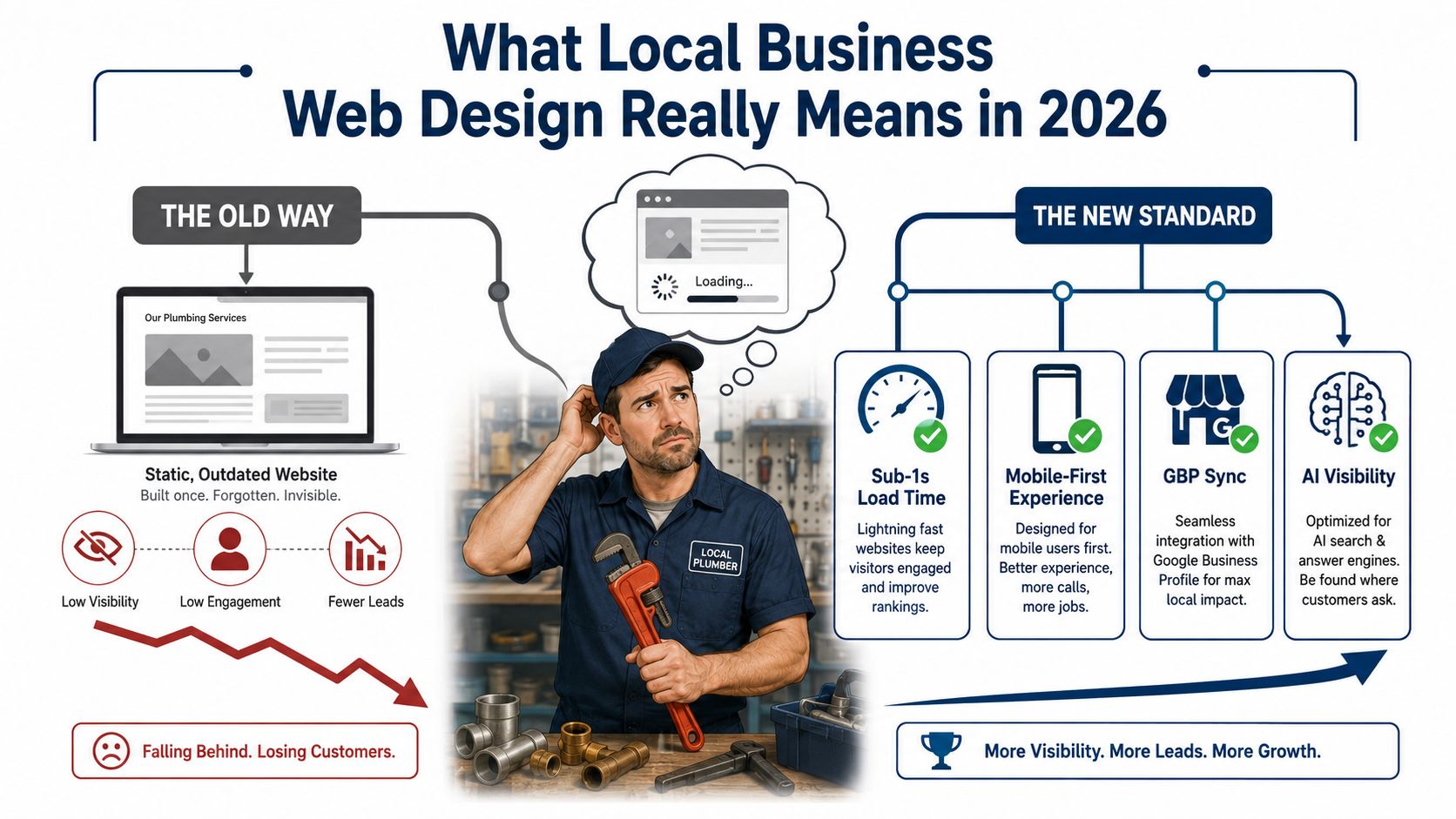
A Leeds plumber opens his site on a phone, waits, and waits some more. The hero image is a tasteful shot of a boiler, the menu sprawls like a bad house extension, and the quote button sits below the fold where enthusiasm goes to die. By the time the page finishes loading, the homeowner has already tapped a competitor who made the phone number visible and the next step obvious.
The old brochure site is finished
A generic small business site tries to impress people. A local business website tries to convert people who already have intent. That difference matters because UK SMEs dominate the market, with around 5.5 million private-sector businesses in 2024, and 99.9% of them being SMEs, while about 5.45 million were small businesses with 0 to 49 employees, according to the UK government's Business Population Estimates as cited in Clutch's summary of local web design stats (Clutch's UK business population summary).
So the brief has changed. A local site is no longer a digital leaflet that sits there looking noble. It has to answer three questions fast. Can I trust you, can I reach you, and can I understand whether you serve my area? That's why a solicitor, roofer, accountant, or electrician needs a very different structure from a corporate brand site with investor pages and glossy culture fluff.
Practical rule: if the site doesn't help a call, form fill, or map pin tap, it's padding.
The new standard is judged by action, not applause
In 2026, local business web design means building around the searcher's next move. Google's mobile-first indexing makes the mobile version the primary basis for crawling and ranking, and local-search best practice puts weight on compressed images, simple navigation, and visible contact actions so users don't have to faff about on a small screen (mobile-first and responsive local design guidance). That means a page that looks smart on a desktop monitor but behaves like treacle on a phone is a liability, not a brand asset.
For a solicitor in Nottingham, the site should help a nervous client see service relevance, office location, and a contact route in seconds. For a gardener in Glasgow, it should show the service area, the phone number, and proof that they work nearby. That's the practical difference between a passive site and a local one. One entertains. The other earns enquiries.
The Five Features Every Local Business Website Needs
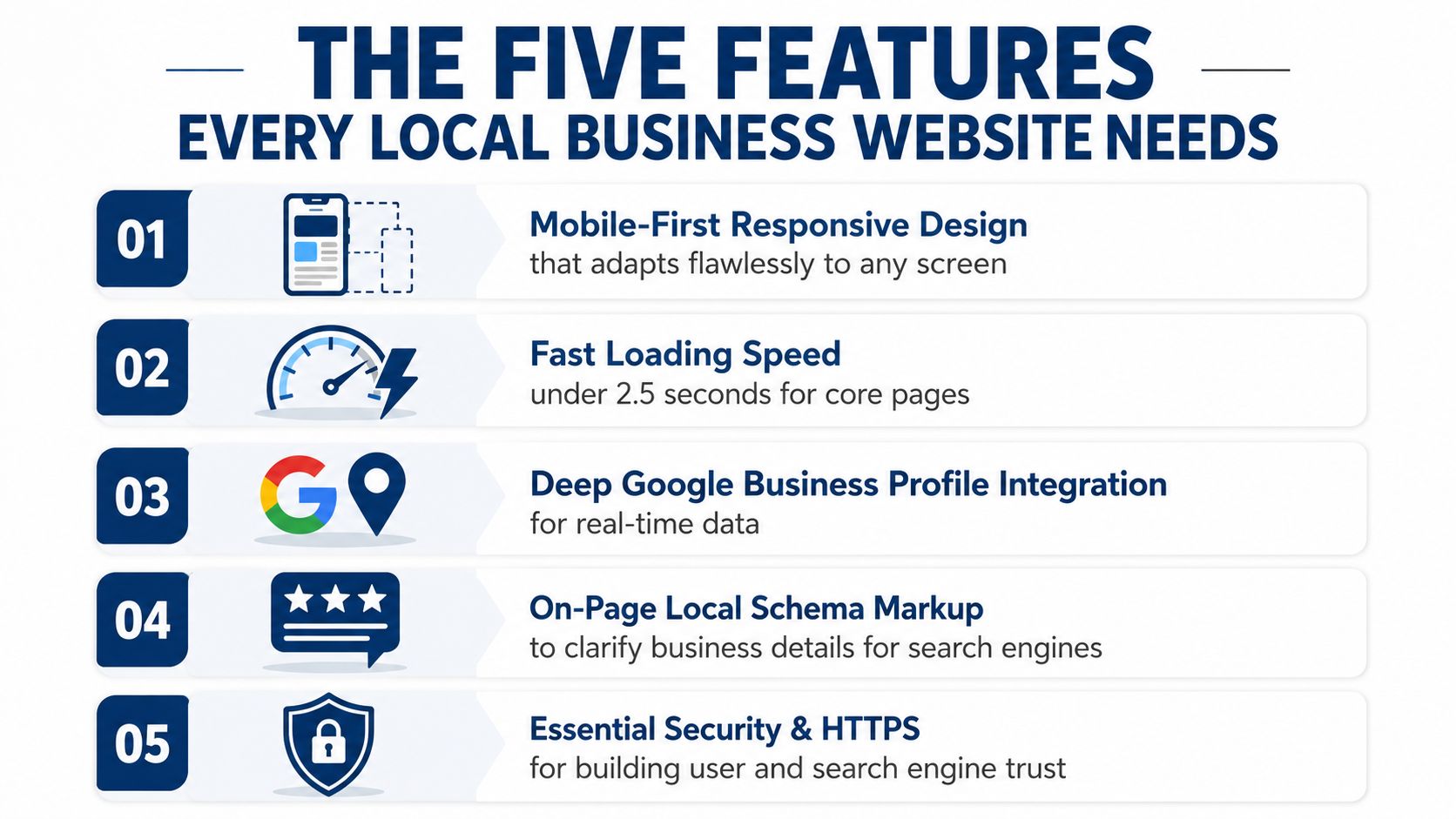
A Bristol accountancy firm doesn't need a digital circus. It needs a site that opens cleanly on a phone, loads fast enough to hold attention, syncs with its Google Business Profile, signals local relevance to search engines, and turns visitors into calls or form submissions without making them think too hard. A Manchester roofing company needs exactly the same discipline, just with more urgency and fewer corporate adjectives.
Start with the mobile screen
Mobile-first responsive design isn't a nice-to-have. It's the baseline. If the phone number breaks onto two lines, the buttons are tiny, or the menu needs a magnifying glass and a prayer, the site is failing before the user reaches the good bit. For service businesses, that usually means one tidy hero section, one clear next step, and no comedy scrolling effects.
Make speed obvious, not theoretical
Fast loading speed matters because impatient visitors don't wait around for your brand story. Local search guidance points to compressed responsive images and simple navigation, and that's exactly right. If the core page is sluggish on mobile, the call button may as well be in another postcode. A roofing lead in Manchester does not care that your homepage has cinematic video. They care that it opens before the kettle boils.
Sync the site with your local presence
Your website and Google Business Profile need to say the same thing. The address, phone number, and service area should line up, because inconsistency is how trust leaks out of the funnel. If your site says one thing and your profile says another, search engines get confused and users get suspicious. That's a poor combination, like putting a “licensed” sticker on a van with no tyres.
Use local signals the right way
Local pages need proper structure, not fluffy copy written for everyone and nobody. The best layouts make the service area obvious, keep the contact details visible, and link the home page, service pages, and area pages together logically. If you want a practical example of content that supports local intent on entry-level portal style pages, these portal web pages for 2025 are a useful point of comparison for how structured page intent can be handled cleanly.
Put conversion above decoration
A conversion-focused layout puts the main action where it belongs. For one business that means “Call now”. For another it means “Book a survey” or “Request a quote”. Decorative extras, such as animated counters and chatbots that ask three questions before saying anything helpful, often get in the way. They're the digital equivalent of a clipboard-wielding salesperson who won't let you leave the showroom.
Technical and On-Page Requirements That Decide Rankings
A Nottingham conveyancing solicitor can have a lovely-looking homepage and still lose visibility if the underlying signals are messy. Search engines and AI systems need to understand who the business is, where it operates, what services it offers, and which page should answer which query. That is where the technical layer earns its keep.
NAPW has to be boringly consistent
NAP consistency means the Name, Address, Phone number stay aligned across the site, Google Business Profile, and any relevant directories. Where hours and service details are included, you'll sometimes see that extended to NAPW. BrightLocal's local business website guidance is clear that the structured data and visible content should match, and that the most specific LocalBusiness subtype should be used only where it fits the page content (BrightLocal on local business websites). If a branch page says one thing in the content and another in the schema, you've created a contradiction. Search engines hate contradictions. Users do too.
Schema and page structure do the heavy lifting
LocalBusiness schema helps disambiguate branch, area, and service relevance when it's aligned with the visible page content. That's useful for a conveyancer with one office and disastrous if slapped everywhere like wallpaper. The page should support the schema with plain English, internal links to relevant services, and location pages that describe that branch or service area. Semantic HTML still matters because AI Overviews and other AI-driven summaries need clean signals, not a jumble of divs masquerading as strategy.
Separate white hat from the bad habits
White hat work is the sensible stuff. Semantic HTML. Structured data. Accessibility. Clear internal linking. Consistent location details. Grey hat tactics live in the awkward middle, things like bought citations and doorway pages that try to game relevance without earning it. Black hat is the usual nonsense, hidden text, cloaking, link farms, and other tricks that would embarrass a sixth-form IT club. If you care about long-term local visibility, don't build on sand and then complain when the tide arrives.
Bottom line: local rankings are not won by cleverness alone, they're won by clarity, consistency, and pages that genuinely answer the local searcher's question.
For a practical local SEO implementation guide, the internal resource at local SEO for small businesses is worth a look because it ties the site structure to the search visibility work that sits underneath it.
Google's mobile-first approach and the rise of AI-mediated results make that consistency even more important. If a page can't be parsed cleanly, it won't be the page that gets surfaced when a searcher wants a fast answer. And if the location signals are vague, search engines will pick the competitor who made life easier.
Real UK Sites That Win and Why They Work
A family-run Coventry roofing firm with a cluttered homepage usually has the same problem. Too many promises, too few priorities. The phone number hides in the footer, the service pages read like they were written for a national franchise that's never seen Coventry rain, and the trust signals are scattered like spare tiles after a storm. That kind of site loses because the user has to work for every answer.
One-site clarity versus one-page friction
A Sheffield locksmith with a lean, mobile-friendly page often wins because the entire experience is built around speed and intent. The number is visible, the contact action is obvious, the service area is plain, and the page doesn't waste time with vanity sections about “our journey”. A user on a phone doesn't need a memoir. They need a locksmith.
A Surrey plumbing group with several branches can stumble in a different way. More location pages are not automatically better, because poorly differentiated pages create duplication, confuse users, and dilute relevance. Independent local business guidance on multi-location governance makes the point that location-specific pages, consistent details, and clear service-area structure matter, but expansion without differentiation becomes noise rather than coverage (multi-location local website guidance). In plain English, slapping the same page across four towns and changing the place name is not strategy. It's recycling with extra steps.
What to copy and what to bin
The winning local sites tend to share three habits. They make the phone number unavoidable, they use local proof rather than generic stock phrases, and they keep the page focused on the next action. The weak ones try to look impressive and end up looking evasive.
A site that answers “Can I contact you, and do you work here?” usually does better than one that asks visitors to admire the typography.
For a roofer, that may mean a simple service page with local reviews and a quote button. For a solicitor, it may mean office details, a clear service description, and a form that doesn't feel like a mortgage application. For a locksmith, it often means nothing more elaborate than a fast mobile page with one strong call path. Fancy design can help, but only after it stops getting in the way.
Hiring a Designer or Agency and What to Realistically Pay
A decent brief saves money. A vague one buys you a generic template, a few cheerful meetings, and a site that looks fine right up until nobody enquires. If you're hiring someone, stop talking about “modern”. Say what the site must do. Calls, bookings, quote requests, store visits, or map clicks. That gives the designer something measurable instead of a decorative shrug.
What to put in the brief
Use this checklist and be specific.
- Business goal: say whether the site must generate calls, forms, bookings, or in-person visits.
- Service areas: list the towns, cities, or neighbourhoods you want to win.
- Core services: name the money pages, not just the homepage.
- Google Business Profile status: note whether it's active, verified, and aligned with the site.
- Competitors: include the local sites you think are winning and why.
- Measurement: decide how you'll judge success, such as calls, form fills, or direction requests.
Read the proposal like a sceptic
A good proposal will mention mobile-first design, page structure, local search basics, schema, and content ownership. A bad one leans on “custom look”, “premium feel”, and other phrases that sound expensive while saying nothing. If the provider cannot explain how the phone number, service area, and enquiry route will appear on the page, you're not buying local business web design. You're buying a branded mood board with billing attached.
For organisations that also want content planning folded in, DigiVisi Ltd offers website copywriting and local SEO work that aligns pages, service structure, and Google Business Profile signals. That sort of support matters when the brief is less about art direction and more about getting qualified leads through the door.
Typical UK local business web design package tiers
| Tier | Typical Scope | Best For | Realistic UK Range (2026) |
|---|---|---|---|
| Budget template build | Pre-made layout, basic branding, a few core pages, simple contact form | New starters and very small firms | Lower-cost entry level, usually a few hundred pounds |
| Mid-range custom design | Tailored layout, mobile-first build, local page structure, on-page SEO basics | Established local SMEs that need proper lead generation | Mid four figures is a common market expectation |
| Fully integrated SEO-ready build | Custom design, local SEO foundation, schema, content planning, internal linking, tracking, and conversion setup | Competitive service businesses and multi-location firms | Higher four figures to low five figures, depending on scope |
The sensible question is not “what's the cheapest option?” It's “which tier gives me a site that can earn its keep?” Cheap builds often end up costing more because they need fixing after launch. That's the web equivalent of buying a van with a brilliant paint job and no engine.
Quick Wins You Can Ship This Week
You don't need a full rebuild to get moving. Start with the parts that remove friction and sharpen trust, because small changes in local business web design often pay back faster than a shiny redesign with a six-month planning phase and a mood board the size of Wales.
Do these four things first
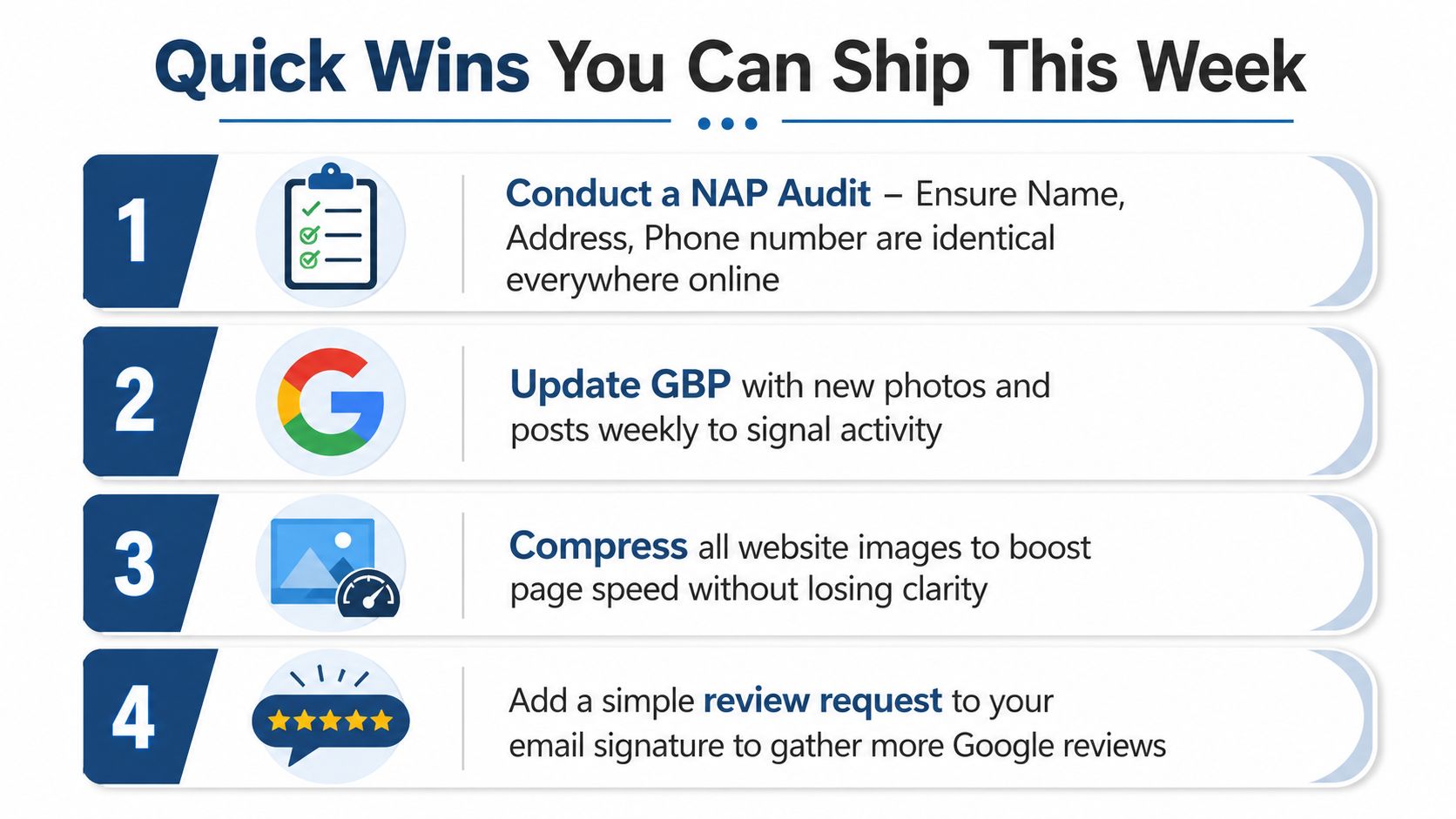
- Run a NAP audit. Check that your business name, address, and phone number match everywhere they appear online, then fix any odd variants.
- Refresh your Google Business Profile. Add new photos, update posts, and make the listing look alive rather than abandoned.
- Compress images on your site. Heavy files make pages crawl on mobile, and nobody wants to wait for a hero image of your van to arrive like a Victorian parcel.
- Ask for reviews properly. Put a simple review request into your email signature so happy customers can act without hunting for the link.
A single location page written for humans is also worth sorting. Keep the phone number visible, write the page in plain English, and mention the local area naturally instead of stuffing it like a Christmas turkey. If you're a trades business, make the service radius clear. If you're a solicitor or accountant, make the office location and contact route unavoidable.
The whole point is to make the next step obvious. Not fancy. Not noisy. Obvious. That's what wins the phone call, the form fill, and the map pin tap.
If your current site looks decent but isn't producing enough enquiries, DigiVisi Ltd builds and optimises local websites around keyword architecture, local search signals, and conversion paths that matter to UK service businesses. Visit DigiVisi Ltd if you want a site that's judged by calls, quotes, and booked work, not by how pleased it makes the designer's mood board.