Skip to content
If you're an accountant in the UK, there's a fair chance your marketing still leans heavily on referrals, repeat clients, and the occasional recommendation from a solicitor, mortgage broker, or mate from the golf club. That's all fine until the pipeline goes a bit quiet and you realise waiting for introductions is a rotten way to plan growth.
Most firms I speak to aren't short on expertise. They're short on visibility. Their website exists, technically. Their Google Business Profile may or may not have been claimed by someone who left three years ago. And when a business owner nearby searches for help with year-end accounts, contractor tax, payroll, or startup advice, another firm gets the call.
That's where SEO for accountants stops being a marketing buzzword and starts becoming a business asset. Done properly, it isn't a gimmick. It's a system for showing up when local people are actively looking for exactly what you do.
Table of Contents
- Why Your Next Client Is Googling You Right Now
- Your SEO Blueprint The Three Pillars of Success
- Keywords and Service Pages Speaking Your Clients Language
- Become the Go-To Firm Mastering Local SEO
- Content That Builds Trust and Brings in Leads
- Earning Your Stripes Authority Links and PR
- The Bottom Line Measurement and Your Action Plan
Why Your Next Client Is Googling You Right Now
Relying only on referrals feels comforting because it's familiar. It also leaves too much to chance. When a café owner in Leeds needs help with VAT, or a contractor in Bristol wants a tax adviser before the deadline panic kicks in, they don't usually wait for a recommendation to drift in. They search.
That matters because approximately 20,000 users search for "accountant" on Google each month in the UK, which means firms that don't rank are missing access to nearly 240,000 potential client inquiries annually according to Vivid Creative's accountant SEO analysis. That's not abstract traffic. That's commercial intent. Those are people looking for help now.

The search starts before the phone call
A potential client rarely lands on your site by accident. They have a problem. They need payroll sorted, tax advice clarified, company accounts filed, or support switching from an accountant who's gone missing until invoice time.
They'll typically do one of three things:
- Search by service like "tax return accountant Nottingham"
- Search by situation like "accountant for startups Manchester"
- Search by trust check by Googling your firm name after someone mentions you
If your firm doesn't appear, or appears with a scruffy profile and thin website, you don't just lose a click. You lose confidence before the conversation even begins.
Practical rule: SEO for accountants works best when you treat Google as the place people confirm trust, not just discover firms.
The clever bit is that search traffic often catches people at a better moment than social media does. They're not casually scrolling while pretending to watch the telly. They're actively trying to solve a problem. That's why local accounting SEO can bring in proper enquiries rather than random tyre-kickers.
Good SEO behaves like a well-placed signboard
Think of your online presence like signage on the busiest road in town. If your sign is clear, local, and relevant, the right people find you. If it's hidden behind a hedge of vague wording and old web pages, they drive past.
A strong website also helps with conversion once they arrive. If you're helping small firms tighten their finances, useful resources such as ways to lower your accountant fees can answer cost-related questions before they become objections. That's the broader point. Helpful content turns nerves into enquiries.
SEO isn't magic, and it isn't some dark technical art done by candlelight in a basement. For UK accountants, it's the practical work of showing Google and local prospects that you're relevant, trustworthy, and easy to contact. Done well, it compounds. Done badly, it's just a brochure in a drawer.
Your SEO Blueprint The Three Pillars of Success
Most firms overcomplicate SEO. They hear about keywords, backlinks, technical fixes, reviews, content calendars, and schema, then their eyes glaze over somewhere around paragraph two. Fair enough.
A simpler way to think about SEO for accountants is this. You're building a house. If the foundation is poor, the walls crack. If the rooms are confusing, nobody wants to stay. If the address looks dodgy, nobody knocks.
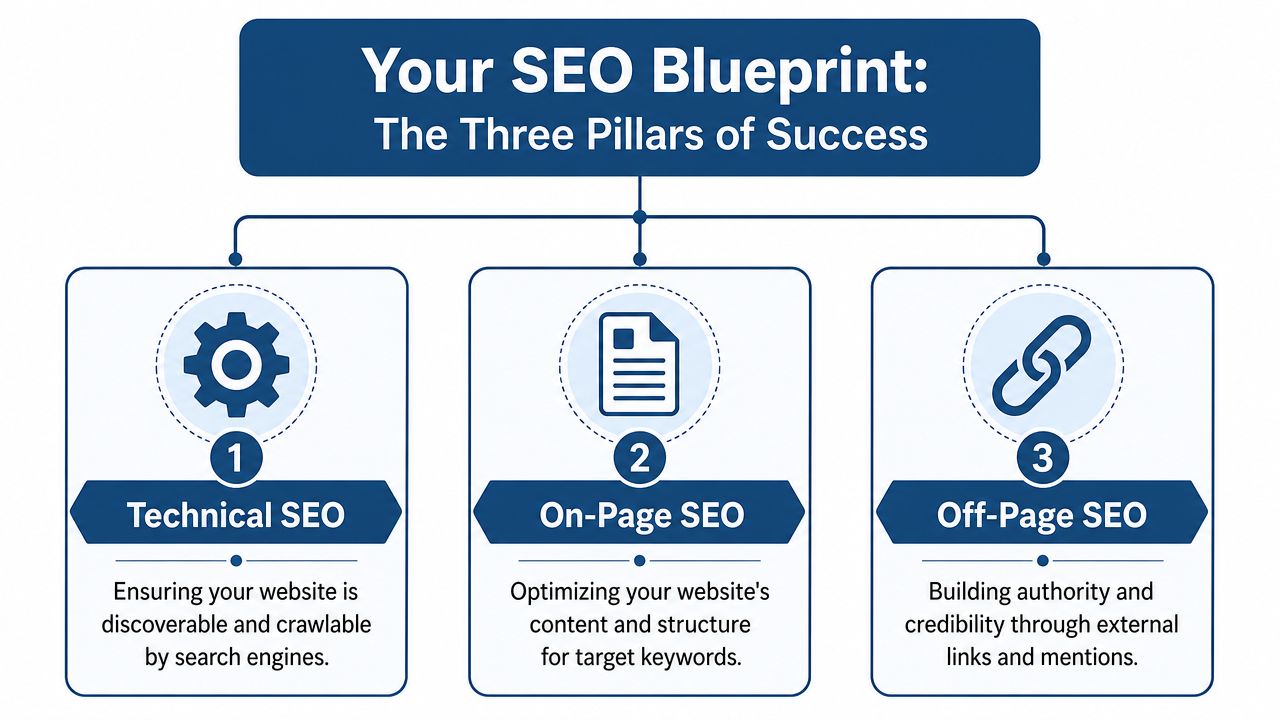
Technical SEO is the foundation
This is the invisible stuff that makes your site usable for search engines and human beings. If pages load badly, internal links are broken, or Google can't properly crawl your site, your content won't perform as it should.
For an accountant's website, the foundation usually includes:
- Clean site structure so services, locations, and contact pages make sense
- Mobile-friendly layouts because people do search on phones, especially when they're between meetings
- Indexable pages so Google can find the pages you want to rank
- Clear page titles and headings so both visitors and search engines know what each page is about
This isn't glamorous work. Neither is bookkeeping, but you'd still rather have it done correctly.
A common mistake is building a stylish site that looks lovely in a pitch meeting but hides key services behind awkward menus and vague labels like "Solutions" or "Advisory Excellence". Call the page "Tax Returns", not "Financial Confidence".
A short visual helps make the framework stick:
On-page SEO is the rooms people walk into
This is what your visitors read. Service pages, location pages, FAQs, titles, headings, copy, and calls to action all sit here.
A good on-page setup answers three questions fast:
- What do you do?
- Who do you help?
- Where do you offer it?
If you're an accountant in Sheffield helping limited companies, your page should say that plainly. Not with puffed-up nonsense. Just clearly. Search engines reward relevance, and clients reward clarity.
A page that says "Accountants for small businesses in Sheffield" will usually do more useful work than one that says "Trusted financial excellence for growth-minded enterprises".
Off-page SEO is your reputation outside the building
Trust is confirmed. Reviews, local mentions, business directory listings, and links from relevant sites all help confirm that your firm is real and respected.
Think of off-page SEO as the bit where the rest of town vouches for you. It's not enough to say you're brilliant on your own website. Other places need to support that story.
Here's the practical version of the three-pillar model:
| Pillar | What it does | What it looks like for an accountant |
|---|---|---|
| Technical | Makes the site usable and crawlable | Clear structure, no broken pages, mobile-friendly layout |
| On-page | Matches search intent | Service pages, local pages, FAQs, useful copy |
| Off-page | Builds authority and trust | Reviews, citations, directory mentions, local links |
Get these three pillars working together and SEO starts behaving less like guesswork and more like a proper growth channel.
Keywords and Service Pages Speaking Your Clients Language
The best accountant websites don't sound clever. They sound useful.
That's the whole game with keywords. You're not trying to impress Google with jargon. You're trying to match the exact language a business owner, landlord, contractor, or startup founder uses when they've got a question and want someone local who knows their stuff.
Start with the search, not the service list
A lot of firms build websites from the inside out. They begin with what they want to say. "Accounts." "Tax." "Advisory." "Compliance." That's tidy from an internal point of view, but it often misses how people search.
For UK firms, keyword research works best when you combine service + location + client need. That's the white hat route because it follows genuine user intent. Kora Marketing Agency's guide to SEO for accounting firms in the UK highlights examples such as "small business accountant London" and "tax advisor for contractors UK", and it also notes that firms serving multiple areas should create distinct landing pages for each location to rank for near me searches.
Let's make that real.
Say you're based in Bristol and want more work from local trades and small limited companies. A better keyword set would include phrases around:
- Small business accountant Bristol
- Contractor accountant Bristol
- Bookkeeping services Bristol
- Tax return accountant Bristol
- Ltd company accountant Bristol
Those phrases tell you exactly what pages to build.
If you want a useful consumer-facing reference for how people think about accounting fees when comparing providers, something like average CPA tax return costs can help you understand the kinds of pricing questions searchers often have before they enquire.
What a strong service page looks like
Take a page targeting "small business accountant in Bristol". A proper page doesn't just wedge that phrase into every heading like a maniac. It should read naturally and cover the reasons someone searched in the first place.
A solid page usually includes:
- A clear headline such as "Small Business Accountants in Bristol"
- A short intro that names the local area and the client type you help
- Specific services like bookkeeping, VAT, payroll, annual accounts, and tax planning
- A local trust signal such as your office area, service coverage, or contact details
- Questions people ask like whether you work with sole traders or limited companies
- A straightforward next step such as booking a call or sending an enquiry
Here's a simple example.
A generic page says:
We provide a full range of accounting services for businesses of all sizes.
A useful page says:
We help Bristol small businesses with bookkeeping, VAT, payroll, annual accounts, and tax advice. If you're running a café in Clifton, a design studio in Stokes Croft, or a plumbing firm covering the wider area, you need accounts that stay organised and advice you can use.
That second version gives Google context and gives people confidence.
The trap to avoid
The mistake I see often is creating one "Areas We Serve" page with a list of twenty towns dumped on it. That's lazy SEO. It rarely ranks well, and even when it does, it converts poorly because the page feels generic.
A stronger white hat approach is to create separate pages for genuine target locations, each with unique copy and proper local references. If you serve Bath, Bristol, and Weston-super-Mare, give each place its own page. Mention the services most relevant to that area. Keep the structure similar if needed, but don't copy and paste the same text with the town name swapped out like a dodgy mail merge.
If the location page would look absurd printed out and handed to a local business owner, it probably shouldn't be published.
Grey hat SEO tends to cut corners here. Black hat SEO goes further and pumps out spun location pages by the dozen. White hat SEO takes longer, but it builds pages that rank, convert, and don't leave you sweating every time Google updates something.
Become the Go-To Firm Mastering Local SEO
You don't need to be famous across Britain. You need to be visible where your clients live and work. For most accountants, that means local SEO is the engine room.
When somebody searches for an accountant nearby, the map results often do the heavy lifting. That's why local SEO isn't a side quest. It's the front door.
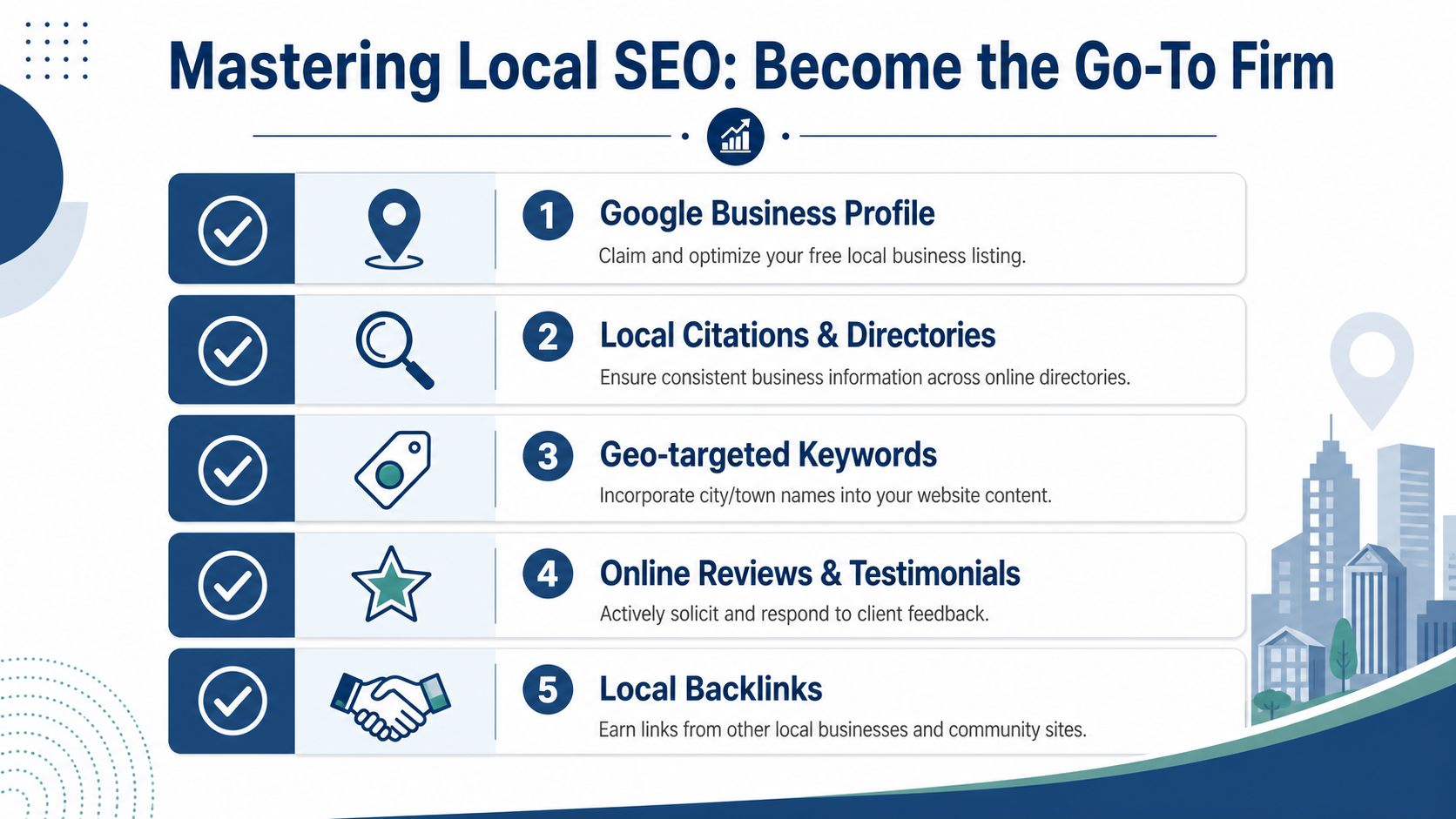
Your Google Business Profile is your digital shopfront
A high-quality Google Business Profile is not optional for accountants targeting local searches. According to Wow Infotech's local SEO guidance for accountants, 76% of local searchers in the UK use map results to find service providers, and firms without a verified profile can lose up to 50% of potential local leads. The same source notes that inconsistencies in NAPW details can reduce local ranking visibility by 30 to 40% in UK cities.
If that doesn't create urgency, nothing will.
The profile needs the basics nailed down:
- Exact business name used consistently
- Full address with postcode
- Primary phone number with area code
- Correct business category, such as Accountant or Tax Consultant
- Verification completed
Then come the details that separate a proper profile from a neglected one:
- Service descriptions that reflect what you offer
- Photos of the office, team, signage, or anything that proves you're a real local business
- Opening hours kept current
- Services listed clearly, not buried
If your profile still says "temporarily closed" from a bank holiday mix-up in 2022, fix that before you touch anything else.
NAPW consistency is boring and wildly important
NAPW means Name, Address, Phone, Website. Search engines cross-check these details across the web to confirm your business is legitimate.
That means your Google Business Profile, website footer, contact page, LinkedIn page, Facebook page, and directory listings should all match. Not roughly. Properly.
A mismatch as small as:
- "Suite 2" on one listing and no suite on another
- a different phone number
- an old website URL
- "Road" in one place and "Rd" in another, if mixed with other inconsistencies
can muddy the waters.
Here's a practical cleanup list:
- Check your website first because this is your source of truth
- Match your Google Business Profile to the website wording
- Update main directories such as Yelp and Yellow Pages if you use them
- Review social profiles including LinkedIn and Facebook
- Keep one preferred format and stick to it everywhere
Worth remembering: local SEO often improves through tidy admin, not clever tricks.
Reviews and local relevance
Reviews do two jobs. They persuade humans, and they support local visibility. For accountants, both matter because trust is the product as much as compliance work is.
Ask every happy client for a review. Not once a year when you remember. Build it into your process after onboarding, after a successful filing, or after you've solved a problem quickly.
Keep the request simple. Send the direct review link. Ask them to mention the service and area naturally if they're comfortable doing so. Something like "great help with payroll for our small business in Reading" is far more useful than "nice people".
Local relevance also comes from your site itself. Use place names naturally in page titles, headings, homepage copy, and service pages. If you serve several areas, give each one a dedicated page with unique content and the right local contact details. That's a clean white hat play. It helps Google understand where you work and helps clients feel they've found someone nearby, not a faceless national outfit pretending to be local.
Content That Builds Trust and Brings in Leads
Service pages catch people ready to hire. Content catches people who are circling the problem, asking questions, comparing options, and trying not to get stitched up.
That's where many accountants miss a trick. They publish blog posts that are technically fine and commercially useless. The classic example is "5 Top Tax Tips for Businesses". Nobody remembers it, nobody searches for it specifically, and it sounds like it was written by a committee trapped in a beige meeting room.
Two firms, two very different outcomes
Firm one writes broad, generic posts because they feel safe. Every article is bland enough to apply to anyone, anywhere. The blog looks active, but it doesn't answer the precise questions local businesses ask before they become clients.
Firm two writes about actual problems clients bring up on calls. Things like:
- whether a startup director should register for VAT
- what expenses a contractor can usually discuss with their accountant
- what local business owners need to prepare before year end
- whether a landlord should separate property income records properly from the start
That second firm sounds more useful because it is more useful.
Successful SEO for accountants in the UK should prioritise tax-related subjects that local businesses actively search for, such as "UK business tax" or "your city accountant for startups", and it should also focus on earning over 90 genuine Google reviews to strengthen local search authority, according to this discussion on accountant SEO challenges and review signals.

What accountants should actually publish
A useful content plan usually starts with the questions you hear every month.
Try building topics around:
- Business stage such as startup, growth, hiring, or year-end prep
- Client type such as contractors, landlords, sole traders, and limited companies
- Service confusion such as bookkeeping versus management accounts
- Tax pressure points where clients worry about deadlines, records, or structure
For example, a firm in Manchester could publish:
- Accountant for startups in Manchester
- What small businesses in Manchester should bring to their first accountant meeting
- UK business tax basics for new limited company directors
- Payroll mistakes local employers can avoid
That sort of content attracts the right readers and pre-qualifies them. By the time they contact you, they already trust your thinking.
To keep topics fresh, it also helps to explore platform updates and broader software or workflow changes that affect how small businesses operate. Not because you need to become a tech blogger, but because clients often search when new processes create confusion.
Write the article you'd send to a client after they ask the same question for the fifth time. That's usually the one worth ranking.
Reviews are content too, in Google's eyes
People think of reviews as reputation management. Fair enough. But for local SEO, they're also a content asset. They add fresh text, service terms, and local relevance around your business.
There is a real trade-off here. Chasing only reviews without improving your pages gives you an impressive star rating attached to a weak website. Writing loads of content without building reviews leaves trust signals on the table. The strongest firms do both steadily.
One other thing. Don't manufacture reviews, don't offer weird incentives, and don't ask staff or cousins to bulk them up on a rainy Sunday. That's not white hat. That's asking for trouble in a tie.
Earning Your Stripes Authority Links and PR
Link building has a terrible reputation because plenty of people made it sleazy. Buy a bundle of mystery backlinks, stuff your site into rubbish directories, and wait for rankings to wobble about like a shopping trolley with a bad wheel. That's the old nonsense.
For accountants, good links are better thought of as professional references online. They're signs that credible organisations, publications, and local bodies know you exist and consider you worth mentioning.
What white hat link building looks like
White hat link building is slow, sensible, and surprisingly normal. It often comes from things a solid firm should be doing anyway.
Examples include:
- Local business features where you comment on tax changes affecting nearby firms
- Professional directory listings that are relevant and properly maintained
- Community sponsorships where your firm supports an event, charity, or local initiative
- Useful resources such as a plain-English guide to HMRC-related topics that local publications may reference
- Industry commentary where journalists or business writers quote you on deadlines, compliance issues, or common mistakes
This isn't gaming the algorithm. It's digital PR with an SEO benefit attached.
If you want a broader view of how this fits into sector-specific search strategy, this guide to financial services SEO is a useful reference point.
A good link usually has three qualities. It's relevant, believable, and earned. If a local chamber site, regional business publication, or trusted directory links to your firm, that's the sort of signal search engines can take seriously.
What to avoid if you like sleeping at night
Let's separate the hats.
| Approach | What it looks like | Risk level |
|---|---|---|
| White hat | Local PR, useful content, genuine directories, earned mentions | Sustainable |
| Grey hat | Over-optimised anchor text, thin guest posts, borderline-relevant placements | Risky over time |
| Black hat | Bought links, private blog networks, spam comments, automated link blasts | High risk |
Grey hat tactics sometimes tempt firms because they can produce movement faster. The trouble is they build on sand. Black hat tactics are worse. They create a short-lived illusion of authority and can leave a site harder to recover than it was to rank in the first place.
If you'd be embarrassed explaining how you got a link to a client over a pint, don't build it.
The best link building for accountants starts offline. Speak at a local event. Sponsor something real. Publish a useful guide. Answer journalists promptly. Maintain proper profiles where businesses look. That's slower than buying junk links, but that's rather the point. Sustainable SEO should feel like building a reputation, not staging a burglary.
The Bottom Line Measurement and Your Action Plan
Accountants are usually good at one thing many marketers avoid. Looking at the numbers without getting emotionally attached to them.
That's handy, because SEO can produce a blizzard of reports full of graphs, impressions, visibility scores, and assorted dashboard confetti. Most of it isn't useless, but a lot of it isn't what you need to run the channel properly.
What to track without getting lost in dashboards
For accountant SEO, I prefer a short list.
Track:
- Rankings for your main money terms such as your key service and location phrases
- Organic traffic to service and location pages rather than traffic to everything under the sun
- Phone calls and contact form enquiries that come from organic search
- Google Business Profile actions such as calls, direction requests, and website clicks
Those numbers tell a sensible story. Are you getting found more often for the right searches? Are more people landing on the pages that matter? Are those visits turning into conversations?
Don't obsess over vanity metrics. A blog post can get plenty of visits and still produce no business. Equally, a location page can get modest traffic and still bring in excellent enquiries. An accountant in York doesn't need internet fame. They need a steady stream of relevant local leads.
A practical review rhythm works well:
- Monthly check rankings, page traffic, and enquiries
- Quarterly review page quality, internal links, and local coverage
- Ongoing update key service pages when services, messaging, or regulations change
Accountant SEO Implementation Checklist
Below is a realistic action plan with effort estimates. Nothing heroic. Just the work that moves the needle.
| Phase | Task | Effort (Initial) | Effort (Ongoing) |
|---|---|---|---|
| Foundation | Audit website structure, page titles, headings, and indexability | Medium | Low |
| Foundation | Set up and verify Google Business Profile | Low | Low |
| Foundation | Standardise NAPW across website, directories, and social profiles | Medium | Low |
| Foundation | Define core services and target locations | Low | Low |
| Build | Create one page per core service | Medium | Low |
| Build | Create distinct location pages for genuine target areas | High | Medium |
| Build | Improve internal linking between homepage, service pages, location pages, and contact page | Medium | Low |
| Build | Add clear calls to action on key pages | Low | Low |
| Trust | Ask happy clients for Google reviews as a routine process | Low | Medium |
| Trust | Refresh Google Business Profile with current details and photos | Low | Low |
| Content | Publish useful articles around tax questions, startup issues, and common client concerns | Medium | Medium |
| Authority | Earn local mentions through directories, PR, sponsorships, and business publications | Medium | Medium |
| Measurement | Track rankings, organic visits, calls, and enquiry forms each month | Low | Low |
| Maintenance | Update ageing pages and improve underperforming content | Medium | Medium |
If you want one final rule, it's this. Don't treat SEO for accountants like a campaign. Treat it like an asset. Campaigns stop. Assets keep working.
A clean site, strong local signals, useful content, proper reviews, and earned authority won't produce fireworks overnight. They produce something better. Predictability.
If you'd like expert help turning all of this into a practical SEO system, DigiVisi Ltd works with UK service-led businesses to improve rankings, Google Business Profile visibility, and the enquiries that matter. If your website isn't pulling its weight, it's worth having a proper look.