Skip to content
Most advice about Google Ads Quality Score starts in the wrong place. It tells UK advertisers to chase a higher number, celebrate a score of 10, and treat the dashboard like a school report where anything below “excellent” deserves a stern meeting with the head teacher. That approach misses the point.
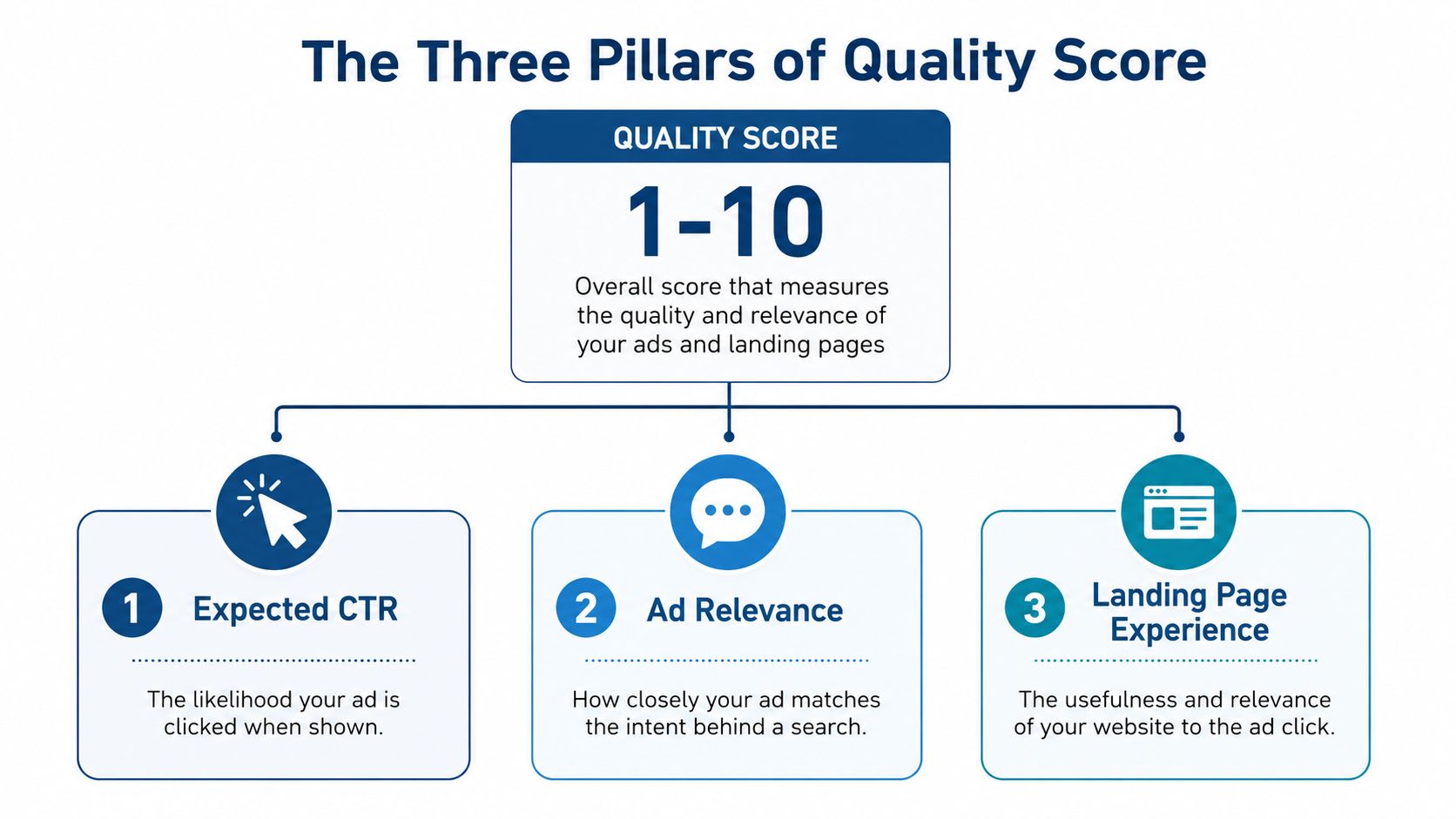
Google defines Quality Score as a keyword-level diagnostic on a 1–10 scale, built from expected click-through rate, ad relevance and landing page experience. It's also a comparison with other advertisers targeting the same search term, not an absolute verdict on your business or your account. Google's UK Quality Score guidance makes that distinction clear.
For a local electrician, solicitor or plumber, the useful question isn't “How do I get every keyword to 10?” It's “What does this score reveal about the relationship between my keyword, advert and landing page?” That shift saves time, protects budgets and stops teams polishing a vanity metric while expensive structural problems carry on merrily underneath.
Table of Contents
- Why Quality Score Is Not the KPI You Think It Is
- The Three Components That Shape Your Score
- How Quality Score Affects Your Cost Per Click and Ad Rank
- Diagnosing Your Quality Score in the Google Ads Dashboard
- Proven Optimisation Strategies for Local Service Businesses
- Tools and Reporting Templates for Ongoing Monitoring
- Your Quality Score Action Plan for Better Local Results
Why Quality Score Is Not the KPI You Think It Is
Many advertisers treat Quality Score as a performance KPI. A score rises, so the campaign must be healthier. A score falls, so someone reaches for a new advert, changes the bids and perhaps blames the weather. Google itself positions Quality Score as a diagnostic tool, not a key performance indicator. Google's explanation of Quality Score's purpose says it helps advertisers identify where search ad quality can improve.
Consider a Leeds electrician targeting the search “emergency electrician Leeds”. An account-wide average tells you very little. It might combine branded searches, boiler-related terms, rewiring enquiries and broad research phrases. The electrician needs to inspect the exact keyword, its advert and the page reached after the click. If the advert talks about emergency callouts but sends people to a general electrical services page, the score is useful because it points towards a relevance problem.
Practical rule: Treat Quality Score as a smoke alarm, not the temperature of the whole house.
The distinction matters because Google reports the score at keyword level, not campaign or account level. A low score on a high-intent keyword spending heavily deserves attention. A low score on a barely active term may lack enough useful evidence or represent a deliberate strategic trade-off. Pausing every low-scoring keyword would be as sensible as sacking every employee who once made a typo.
What the number can and cannot tell you
Quality Score can show where the keyword-ad-page relationship looks weaker than competing combinations. It can't tell you whether the campaign produces profitable leads, whether your phone is answered, whether a solicitor's consultation turns into a client, or whether a plumber has availability in the searcher's area.
Those business outcomes belong beside the diagnostic, not beneath it. Review cost per lead, qualified enquiries, booked work and revenue alongside Quality Score. A keyword with a modest score that produces excellent enquiries may be more valuable than a high-scoring keyword attracting curious clickers.
The score is relative, too. Google compares your combination with other advertisers targeting the same search terms. A score that looks respectable in one niche may reflect a tougher competitive environment than the same number elsewhere.
For a broader practitioner perspective on interpreting the number without worshipping it, Come Together Media's Quality Score advice is a useful additional read. The sensible conclusion is simple: investigate the clue, fix the cause and judge success by commercial results.
The Three Components That Shape Your Score
Google builds Quality Score from three diagnostic components: expected click-through rate, ad relevance and landing page experience. Think of a local service business as a shop. Expected CTR is the shop window, ad relevance is the sign above the door, and landing page experience is what happens once somebody walks in.
Expected click-through rate
Expected CTR reflects how likely Google expects people to click your advert when it appears for the keyword, compared with competing adverts. A Manchester plumber advertising “24-hour emergency callouts” has a stronger starting point when the advert clearly addresses an urgent search than when it says “Reliable Plumbing Services”.
The controllable levers are practical:
- Match the intent: Use language that reflects what the searcher wants now, not a list of every service you've ever offered.
- Lead with the service: Put emergency repairs, blocked drains or boiler plumbing prominently where that's the actual search intent.
- Give a reason to choose you: Availability, locality, clear process or a relevant reassurance can make the advert more compelling, provided it's accurate.
Raising bids won't make an advert more appealing. Nor will squeezing an impressive collection of unrelated phrases into one responsive search advert. The searcher has a problem, and your copy needs to sound as though you understand that problem.
Ad relevance
Ad relevance asks whether the advert fits the intent behind the keyword. A Bristol solicitor targeting “divorce solicitor Bristol” shouldn't rely on a generic advert for “Legal Services”. The business may offer excellent family law advice, but the message doesn't demonstrate that match.
Tighter ad group themes help because they let the copy speak to a narrower intent. Separate divorce, conveyancing and employment law themes make it easier to create adverts that answer the relevant search rather than producing a legal equivalent of alphabet soup.
Landing page experience
The landing page must deliver what the advert promises. If the Manchester plumber advertises round-the-clock emergency callouts but the page only discusses weekday bookings, the user experiences friction before making contact. If the Bristol solicitor sends divorce searches to a general legal homepage, the visitor has to hunt for the service they already named.
Useful pages should make the service, location and next step clear. They should support the advert's promise, work sensibly on mobile and avoid distracting the visitor with irrelevant content. Quality Score remains relative, so even a well-built page is being assessed against other advertisers competing for the same search. It's a comparison, not a certificate of sainthood.
How Quality Score Affects Your Cost Per Click and Ad Rank
Quality Score matters financially, but not in the simplistic way many guides suggest. Google doesn't present it as a guaranteed discount coupon, and a particular score doesn't promise a fixed cost per click. The score is a diagnostic representation of ad quality, while auction performance depends on the wider competitive context and the quality of the individual keyword-ad-page combination.
Two local businesses can enter an auction with similar bids and receive different results because one advert aligns closely with the search and the other sends the user towards a generic page. The stronger combination can be more efficient in the auction. That's why relevance work often deserves attention before increasing bids.
A Leeds electrician with a tightly matched “emergency electrician Leeds” theme may compete more effectively than one using the same budget for an advert covering every electrical service and several locations. The first approach gives Google and the searcher a clearer signal. The second may buy visibility, but it risks paying for clicks from people who don't find an obvious route to enquire.
Read the diagnostic, not a promised discount
| Quality Score Band | Estimated CPC Impact | Ad Rank Competitiveness | Typical Outcome for Local Campaigns |
|---|---|---|---|
| 1–3 | Don't assume an automatic saving. Investigate weak relevance signals first. | Often less competitive when the keyword-ad-page relationship is poor. | Click costs and lead costs can become harder to control. |
| 4–6 | Usually a workable middle ground, but context matters. | Depends on competitors, bids, relevance and auction conditions. | Campaigns can perform, provided enquiries are commercially worthwhile. |
| 7–10 | Not a guaranteed low CPC. Competitor quality and auction conditions still matter. | A stronger diagnostic profile can support more efficient participation. | Often a useful sign that the keyword, advert and page are aligned. |
The table deliberately avoids fake precision. Google's own guidance supports using Quality Score for diagnosis rather than treating it as a guaranteed direct reduction in CPC. Google's documentation on Quality Score and ad quality is the safer foundation than broad claims promising a fixed percentage saving.
A score of 7 doesn't guarantee cheap clicks. It tells you the combination appears comparatively relevant.
For UK service businesses, the practical money question is whether poor relevance is inflating waste. Tightening keyword themes, improving advert specificity, adding sensible negative keywords and matching the landing page can improve auction efficiency without blindly raising bids. The commercial test remains qualified lead cost and lead quality, not a prettier dashboard.
Diagnosing Your Quality Score in the Google Ads Dashboard
The Google Ads interface gives you enough information to investigate Quality Score without building an enormous reporting machine. The key is to work at keyword level and expose the component columns, rather than staring at an account average that combines unrelated services and locations.
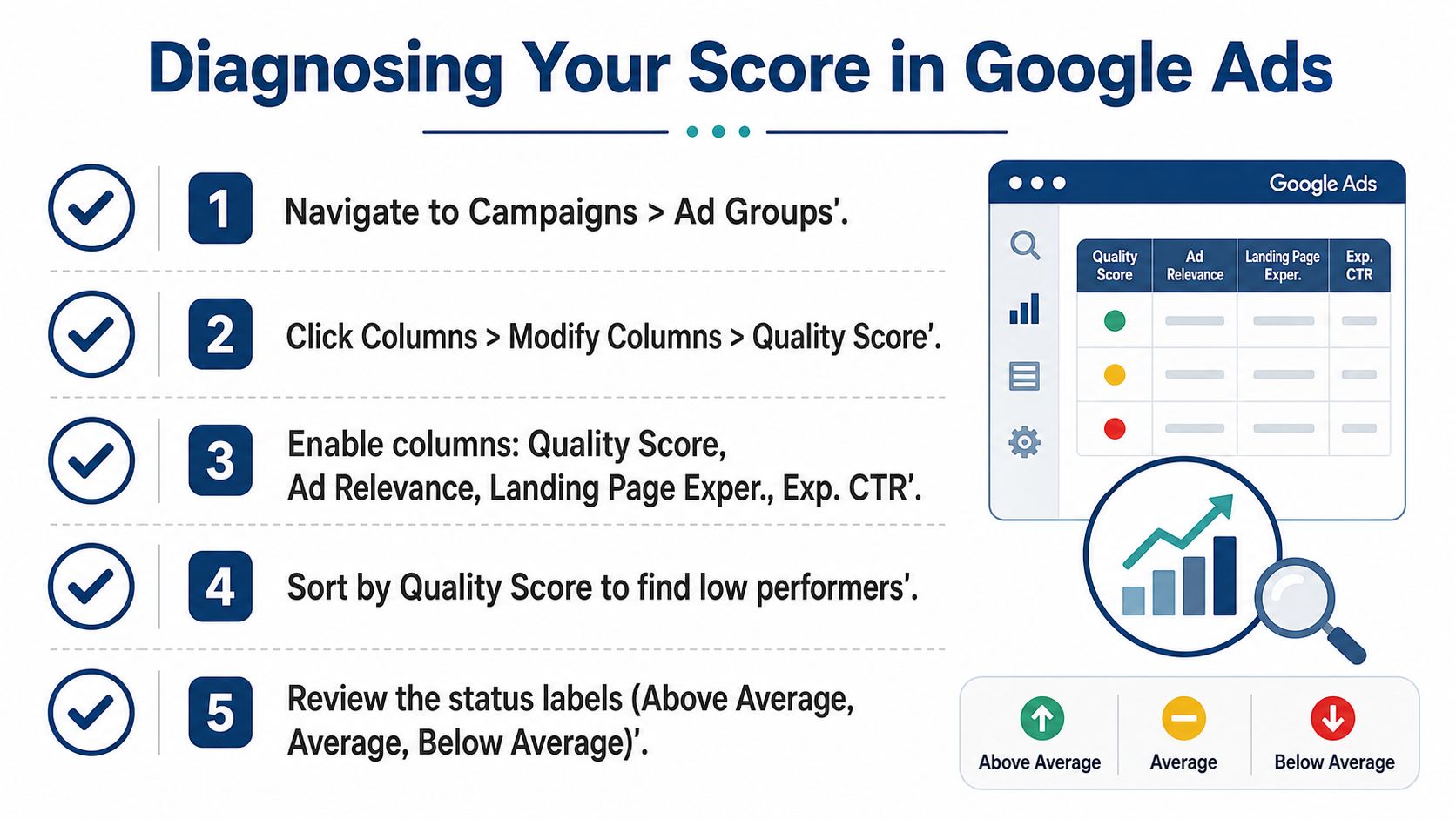
A practical dashboard routine
- Open the keyword view: In Google Ads, go to the relevant campaign and ad group, then open the keyword table.
- Modify the columns: Select Columns, choose Modify columns, and locate the Quality Score options.
- Add the diagnostic fields: Include Quality Score, historical Quality Score, expected CTR, ad relevance and landing page experience.
- Filter deliberately: Review one campaign, location or service theme at a time. Don't let branded terms flatter a struggling emergency service group.
- Sort for investigation: Put the weakest commercially important keywords at the top, then inspect their component ratings and search terms.
Google's UK documentation confirms that advertisers can report both current and historical Quality Score data in the keyword table. Historical information helps you connect a change with a later movement, although you still need to consider other changes made during the same period.
Translate the status labels into action
Google commonly presents component assessments as Above Average, Average or Below Average. These labels aren't instructions to make random edits. They tell you which part of the relationship deserves closer inspection.
- Below-average expected CTR: Review the advert against the actual search intent. A generic “Get a Quote” message may need a more specific service and location promise.
- Below-average ad relevance: Check whether the ad group mixes different services, audiences or motivations. A solicitor shouldn't expect one advert to speak equally well to divorce, probate and commercial property searches.
- Below-average landing page experience: Compare the advert promise with the page headline, service explanation and enquiry route. A plumber's emergency advert should land on an emergency plumbing page, not a homepage treasure hunt.
A dash doesn't automatically mean failure. It may indicate that Google hasn't gathered enough information to show a diagnostic assessment. Avoid making dramatic changes to a keyword before it has meaningful activity, particularly when it isn't spending materially.
The most useful workflow is keyword, component, cause, test. Find the term, identify the weak component, form a specific explanation, make one controlled improvement and monitor the commercial response.
Proven Optimisation Strategies for Local Service Businesses
The best Quality Score work looks remarkably unglamorous. It involves clearer ad groups, honest copy, better pages and fewer irrelevant searches. That's good news for local businesses because these changes improve the visitor's experience as well as the dashboard.

A Cardiff electrician might begin with one crowded ad group containing searches for rewiring, fuse box repairs, inspections and emergency work. The adverts then become vague because they're trying to cover everything. Separating those themes allows each advert to address one service clearly, while negative keywords reduce traffic from searches that don't represent a viable job.
A Birmingham solicitor faces a different issue. The campaign may have relevant keywords, but every click lands on a broad legal services page. Creating dedicated pages for family law, conveyancing or employment matters gives each advert somewhere sensible to send the visitor. The page should repeat the service promise in natural language, explain what happens next and make contacting the firm straightforward.
For wider work on the relationship between landing-page structure, search intent and organic visibility, Quarter Digital's Webflow SEO service provides useful context. Paid search pages still need to satisfy humans first. Google is rather good at noticing when they don't.
What to change first
- Tighten the theme: Group closely related keywords around one service intent. Don't create a single ad group that requires one advert to be a tradesperson, a law firm and a small call centre.
- Rewrite the promise: A Leeds plumber should reflect high-intent wording such as emergency repairs or blocked drains when that matches the search. Avoid claims the business can't fulfil.
- Build the destination: Give valuable service-area combinations a relevant page where the content supports the advert and the enquiry action is obvious.
- Manage negatives: Review search terms and exclude irrelevant research, employment, training or do-it-yourself traffic where it doesn't suit the business.
- Respect policy: Keep claims accurate, avoid cloaking and don't use misleading copy to provoke clicks.
These are white-hat improvements because they make the account more useful and transparent. Grey-hat shortcuts, such as keyword stuffing or misleading location claims, can make an advert look busy without making it relevant. Black-hat behaviour goes further by attempting to deceive users or bypass platform controls. None of it is a sound operating model for a business that wants repeatable enquiries.
A useful test is to read the advert and landing page aloud as a customer. If the promise sounds like it belongs to one service but the page opens with six unrelated offers, the account has an alignment problem. Fix that before tweaking bids for the fifteenth time.
The following video offers another practical perspective on the subject. It should support your audit, not replace examination of your own keywords and enquiry data.
Tools and Reporting Templates for Ongoing Monitoring
Small UK service businesses don't need a dashboard that resembles the control room at Heathrow. They need a repeatable way to spot meaningful changes, understand what caused them and connect them with leads.
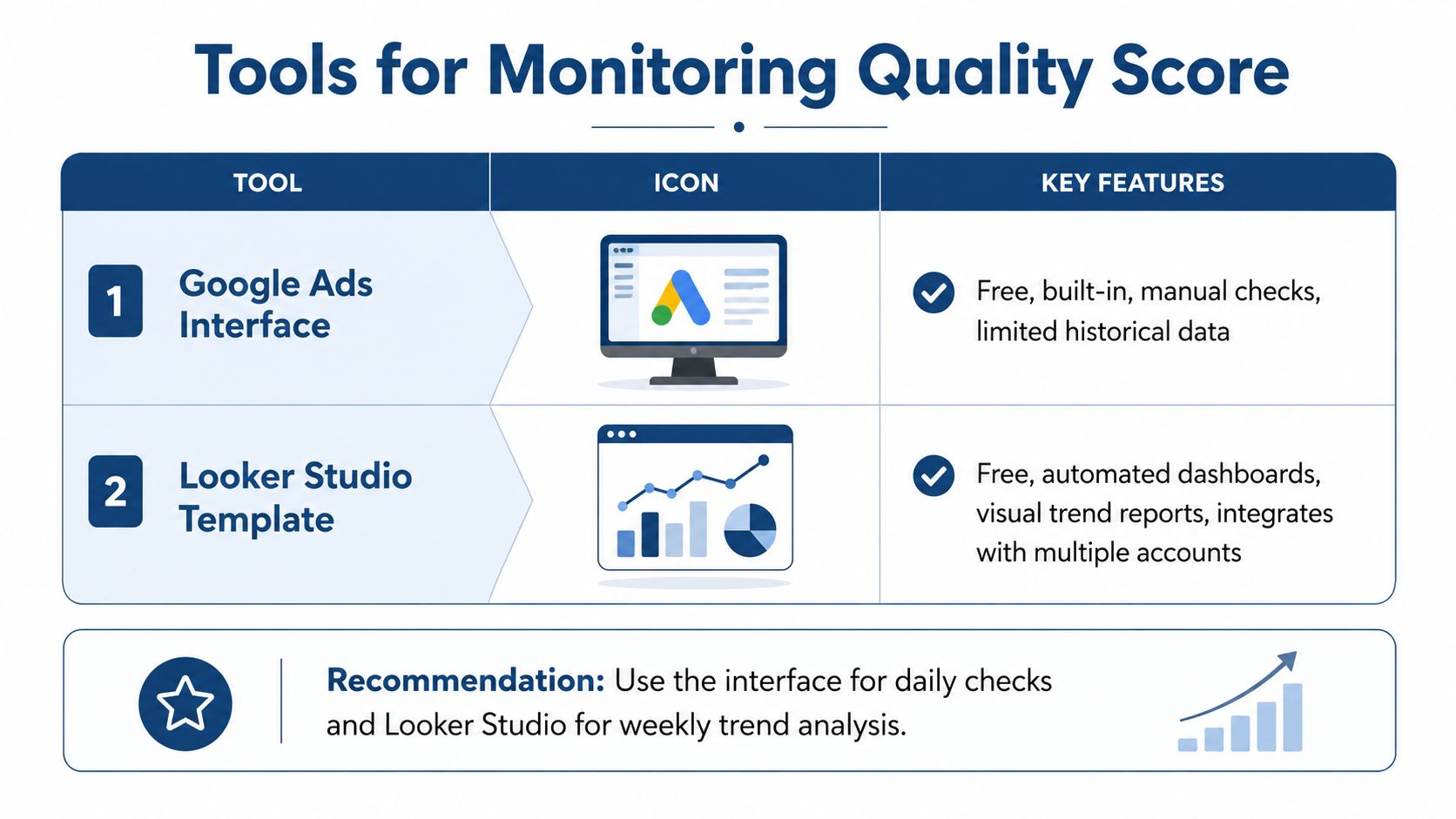
The Google Ads interface is the starting point. It provides current and historical Quality Score fields, component ratings and keyword-level filtering. It's ideal for daily checks when a campaign has changed recently or when a key service suddenly stops producing enquiries.
A lightweight Looker Studio report can make weekly review easier, especially where a business manages several campaigns or locations. The report should keep Quality Score beside practical business measures, including spend, clicks, conversions, cost per lead and lead status. Quality Score without those measures is just a well-dressed number.
A sensible reporting rhythm
Use the interface for quick checks after meaningful changes. Use a weekly report to review the most commercially important keywords, component movements, search-term quality and landing-page changes. A monthly review can examine whether location or service themes are behaving differently and whether budget is drifting towards weak intent.
Automated rules and scripts can alert you to sudden changes, but alerts need context. A notification that a score moved isn't a reason to rewrite the account at midnight. Check whether impressions changed, whether an advert was edited, whether a page was updated or whether the term has limited evidence.
A useful template includes:
- Keyword and theme: Record the exact keyword, service and location.
- Current and historical score: Use both fields where available.
- Weak component: Note expected CTR, ad relevance or landing page experience.
- Commercial context: Add spend, conversions, lead quality and cost per lead.
- Action and date: Write what changed and when, so later movement has a plausible explanation.
The aim is not constant fiddling. It's controlled observation, sensible prioritisation and fewer “what on earth happened here?” moments at the end of the month.
Your Quality Score Action Plan for Better Local Results
Start with the mindset, then work through the account in order. Quality Score is a diagnostic clue, not a vanity KPI, so every change should improve relevance or remove friction for a real searcher.
Quick fixes with limited effort
- Inspect important low-scoring keywords: Look at the component ratings and search terms rather than reacting to the headline number.
- Rewrite mismatched adverts: Make the service and location clear where they reflect genuine intent.
- Add negative keywords: Remove searches that cannot become suitable enquiries.
- Repair landing-page friction: Fix broken forms, unclear contact options and promises the page doesn't support.
Structural improvements
- Separate service themes: Stop asking one advert to cover unrelated jobs.
- Create relevant destinations: Build pages for valuable services and distinct areas where the content differs meaningfully.
- Test deliberately: Change meaningful copy or page elements, then record what changed and review the results alongside lead quality.
Keep the measurement honest
Review the keyword diagnostics regularly, but judge the account using qualified enquiries, booked work and commercial return. A strong score that produces poor leads isn't a win, and a middling score on a profitable, tightly controlled term isn't automatically a problem.
For businesses that want structured support across paid search activity and related visibility work, DigiVisi's PPC services packages explain how campaign management can sit alongside broader search optimisation. The principle remains the same whether you work in-house or bring in support: improve the relationship between search, advert and destination, then measure what the business receives.
Consistency beats grand gestures. Local campaigns improve when someone keeps reviewing search intent, tightening themes, strengthening pages and removing waste. The businesses that win aren't necessarily those with the biggest budgets. They're the ones that keep making their message more relevant, week after week.
DigiVisi Ltd helps UK service businesses manage conversion-focused Google Ads, refine search queries and improve the landing-page alignment that Quality Score diagnostics expose. Visit DigiVisi Ltd to discuss a practical campaign review focused on more relevant clicks, stronger enquiries and clearer reporting.