Skip to content
On-page SEO is the work of making individual pages clear, crawlable and answer-ready so they can earn rankings and citations, and the practical UK starting point is Google Search, used by 82% of UK adults, with roughly 3 billion UK searches each month and 91.56% UK search engine market share held by Google (Google Search Central). In plain English, it helps the right customer understand what you do before they wander off to a competitor with a slightly less alarming website.
You may be a Leeds plumber checking your phone at 9pm, wondering why your emergency boiler page gets impressions but few calls. Or perhaps you run a Bristol solicitors' practice and your “Services” page says almost nothing about conveyancing. The problem usually isn't a lack of enthusiasm. It's that the page hasn't made its subject, location, usefulness and next step obvious to users or search systems.
Table of Contents
- A Quick Plain-English Definition
- The Core Elements That Actually Move Rankings
- The Technical Foundations No One Likes Talking About
- White Hat, Grey Hat and Black Hat On-Page Tactics
- How a UK Service Business Puts It Together
- On-Page SEO in an AI and Zero-Click World
- Your Prioritised On-Page SEO Checklist
A Quick Plain-English Definition
A Leeds plumber may have a page that mentions boilers repeatedly, yet still leave a visitor unsure whether help is available nearby or how to book it. On-page SEO fixes that communication gap. The page should make what service is available, where it's offered, when help is available and how to make contact clear within moments.
The work has three connected parts:
- Clear content: Answer the customer's actual question, using natural wording for the service and location.
- Crawlable structure: Make it possible for search engines to find, render, understand and index the page.
- Answer-ready formatting: Use headings, short answers, lists, FAQs and structured data so Google and AI-generated results can identify useful information.
A trades firm serving Leeds, Bradford, Wakefield, Harrogate and York may operate one website, but each location can represent a different search intent. A Leeds boiler repair page should explain Leeds availability and common boiler problems. A Bradford bathroom installation page should focus on that service and its Bradford context. Copying one page five times and changing the town name creates thin, repetitive content. It's a content sausage machine, and nobody ordered one.
Google's guidance recommends unique, descriptive titles, with important query terms placed prominently, including in the title and main heading (Google's guidance on title links). Clear titles help visitors and search systems understand the page before they work through every paragraph.
Practical rule: Optimise each important page for one clear service, audience and geographic intent. Don't make one page do the work of an entire website.
On-page SEO cannot promise overnight rankings. It supplies reliable signals, useful customer information and a page that can compete for traditional listings, local features, zero-click answers and AI citations. Results still depend on execution, testing and the wider site. A plugin's traffic light is a prompt for checks, not a strategy.
The Core Elements That Actually Move Rankings
A service page earns visibility by sending several consistent signals at once. The aim is not to scatter keywords across a template. It is to make the page useful for a customer, understandable to search systems and quotable in an AI Overview or zero-click result.
| Element | What it does | UK service page example |
|---|---|---|
| Title tag | Describes the page in search results and attracts a relevant click | “Boiler Repair Sheffield | Same-Day Callouts” |
| Meta description | Provides a potential sales message beneath the result title | “Need boiler repair in Sheffield? See available callouts, common faults and how to book help.” |
| H1 and heading hierarchy | Organises the page for scanning and interpretation | H1 “Emergency Boiler Repair in Sheffield”, followed by fault and booking sections |
| Body content | Answers the visitor's intent with specific, useful information | Explains symptoms, service coverage, likely next steps and limits |
| Internal links | Connects related pages and clarifies their relationship | Boiler repair links to central-heating installation and the contact page |
| Image alt text | Describes meaningful images for accessibility and image understanding | “Engineer checking a residential boiler in Sheffield” |
| Schema markup | Adds machine-readable context about the business, service or content | Service, LocalBusiness or suitable FAQ structured data |
Titles and descriptions earn attention
The title tag is the search-result headline you can influence. Use a unique, descriptive title that puts the main query near the beginning and accurately reflects the page. Public-sector metadata guidance recommends titles of fewer than 60 characters, while other guidance commonly allows 50 to 70 characters including spaces (ONS metadata guidance). Treat those figures as working limits, not a reason to produce a truncated or awkward title.
A title such as “Boiler Repair Sheffield | Same-Day Callouts” gives the searcher a service, location and useful differentiator. It also sets a clear expectation for the page. Search engines can rewrite titles, particularly where the supplied wording is vague, repetitive or poorly matched to the visible content.
The meta description is not guaranteed to appear unchanged, but it gives you space to explain the offer and qualify the click. “Residential Conveyancing Solicitors in Bristol” is clear. “Welcome to Our Practice” tells a searcher almost nothing, unless welcoming people is the service.
Structure beats word-count obsession
Use one clear H1, then H2 and H3 headings that match the questions customers ask. A Sheffield boiler page might cover “Common Boiler Problems”, “Emergency Callouts in Sheffield” and “How to Book a Repair”. Answer each heading promptly, then add the detail needed to support a decision.
Write for intent rather than a mythical word target. Someone searching for emergency plumbing wants reassurance, availability and a route to contact, not a long history of pipework. Teams commissioning service pages can also review writer-focused optimization techniques to keep readability and customer usefulness in view.
Links, images and schema complete the picture
Internal links should describe their destination, such as “central-heating installation in Sheffield”, rather than “click here”. Google's SEO Starter Guide covers relevant anchor text, canonicalisation for duplicate URLs and Search Console monitoring. Link a service page to a related guide where that helps the customer, and link the guide back when the service is the logical next step.
Alt text should describe the image naturally. “Sheffield boiler repair boiler engineer boiler service Sheffield” is keyword stuffing, not accessibility. It gives a screen reader user a linguistic wheelbarrow and adds little useful context.
Schema can clarify a business, service or eligible content type, but it cannot rescue unsupported claims. A solicitor may use appropriate LegalService or Review structured data where accurate. A trades firm may use LocalBusiness and Service information. Validate the implementation, keep the details honest and ensure the visible page supports what the markup says.
For businesses that need help turning these principles into usable service pages, a SEO copywriting service can bring search intent, page structure and conversion copy into one working brief. That matters when the page must satisfy a customer, a crawler and an AI summary without sounding like it was assembled by a keyword sausage machine.
The Technical Foundations No One Likes Talking About
A beautifully written page can't help if search engines can't reach it or are told not to index it. Google describes SEO as making content easier to crawl, index and understand, so technical access comes before polishing the prose (Google Search documentation).
Take a plumber serving Leeds, Bradford and Wakefield. Start with crawlability. Check that robots.txt isn't blocking important folders, that service pages sit within a sensible internal-link hierarchy and that the XML sitemap includes the URLs you want discovered.
Indexing and location architecture
Next, check indexability. An accidental noindex directive, an incorrect canonical tag or a duplicate location page can remove a useful URL from the competition. Each location page should have a distinct purpose, genuine local relevance and a clear relationship to the main service page.
Use readable paths such as /boiler-repair/leeds/ and /boiler-repair/bradford/, provided each page contains different information. A page that only swaps “Leeds” for “Bradford” may create confusion rather than geographic clarity.
Performance is part of usability
Core Web Vitals provide measurable performance thresholds. The relevant targets are Largest Contentful Paint under 2.5 seconds, Interaction to Next Paint under 200 milliseconds and Cumulative Layout Shift under 0.1 (UK on-page SEO guidance). Test mobile templates, compress large images, reduce render-blocking code and check that embedded booking forms don't make the page lurch about like a startled pigeon.
Structured data also belongs in this technical pass. Use valid markup, test it and ensure it reflects the visible page. Technical SEO isn't glamorous, but neither is discovering that your best service page has been wearing a noindex tag for six months.
White Hat, Grey Hat and Black Hat On-Page Tactics
The difference between ethical optimisation and manipulation is usually intent. White hat work makes a page clearer and more useful whether or not Google notices. Grey hat tactics chase visibility through shortcuts that may work temporarily but create quality and trust problems. Black hat tactics attempt to deceive search systems.
| Tactic Type | Common UK Example | Likely Outcome |
|---|---|---|
| White hat | Genuine title tags, useful internal links and accurate LocalBusiness schema | Sustainable relevance and a clearer customer journey |
| Grey hat | Keyword-stuffed alt text, doorway pages for every nearby town, AI-spun location copy | Weak user experience, duplication and possible quality demotion |
| Black hat | Cloaking, hidden text and bought links used to manipulate page signals | Spam action, loss of visibility and reputational damage |
White hat is the scalable choice
A white hat page might title itself “Emergency Plumber in Leeds”, explain the service clearly, link to related advice and identify the business consistently. It can include structured data, customer proof and clear contact details. The work compounds because the page remains useful after an algorithm update.
Grey hat tactics often begin with a reasonable idea and push it too far. Natural alt text becomes a list of locations. A location strategy becomes a doorway-page network. AI assistance becomes a set of pages saying the same thing with “Leeds”, “Bradford” and “Wakefield” swapped in. Google's guidance warns against doorway pages and low-value content, and the site owner still has to answer the phone when a customer asks why the page claims local knowledge it plainly doesn't have.
Black hat is a business risk
Cloaking shows different content to search engines and users. Hidden text conceals keyword blocks. Buying links to manipulate page-level signals moves beyond optimisation into deliberate interference. Google's spam systems and manual review processes can result in loss of visibility, while a Helpful Content demotion can leave a solicitor or plumber difficult to find when customers need them.
Use one test before publishing a questionable tactic:
Would you still do this if Google ignored it completely?
If the answer is no, it probably isn't improving the customer's experience. It's merely trying to impress a robot, and robots are notoriously poor at awarding loyalty points.
How a UK Service Business Puts It Together
A Bristol solicitor's original conveyancing page has an H1 reading “Welcome to Our Practice” and a title tag reading “Smith & Co Solicitors”. The firm may be excellent, but those labels don't communicate residential conveyancing, Bristol or the searcher's need.
The revised page is more direct:
- Title tag: “Residential Conveyancing Solicitors in Bristol | Smith & Co”
- H1: “Residential Conveyancing Solicitors in Bristol”
- Useful content: Clear explanations of buying, selling, leasehold matters and the next step.
- FAQs: Questions about stamp duty and leasehold conveyancing.
- Structured data: Appropriate Review and LegalService markup, used only where accurate and eligible.
- Internal links: A link down to a Bristol property guide and a link up to the homepage.
The improvement isn't that the page has sprinkled “Bristol” everywhere like parsley. It now matches the visitor's purpose and gives search systems a coherent description of the service.
The plumber's page
A Leeds plumber's old page uses a 38-character title and has no Leeds modifier in the H1. The revised version uses “Emergency Plumber in Leeds | 24/7 Callouts” as its title, with an H1 that makes the service and location clear.
The page then answers practical questions rather than padding itself with generic plumbing copy. It includes a HowTo section for bleeding a radiator where that guidance is appropriate, receives an internal link from a blog post about frozen pipes and adds a unique testimonial block with proper name, address and phone consistency.
The pattern is simple:
- Name the service and place: Put the main intent in the title and H1 naturally.
- Answer the customer's concern: Explain what happens, what the service covers and how to proceed.
- Connect the site: Link from relevant guides and to related services using descriptive anchors.
- Add proof carefully: Use genuine testimonials, business details and suitable structured data.
- Remove generic filler: If a paragraph could appear on any trades website in Britain, it probably needs rewriting.
Don't copy either example mechanically. A page about leasehold conveyancing needs different evidence from one about frozen pipes. The structure is reusable, but the substance must belong to the business and the customer.
On-Page SEO in an AI and Zero-Click World
Traditional blue links are no longer the whole search experience. Around 69.5% of UK Google searches ended without a click in early 2026, according to UK search behaviour data. Another UK study reported AI Overviews on roughly 42% of searches, while research reported 98.7% of UK searches showing at least one enhanced SERP feature (UK AI Overview research).
That changes the job. A page must still earn clicks, but it should also supply concise information that search features can understand and potentially cite.
Extractability and citation-worthiness
Extractability means a parser can identify a clean answer, list, table or definition without wrestling through a swamp of vague introductions. Citation-worthiness means the page offers clear authorship, relevant evidence, business expertise and information worth using as a source.
For a service or location page, make the answer easy to lift:
- Direct opening: Give a concise answer in the first 40 to 60 words.
- Question heading: Use a descriptive H2 phrased around a real customer question.
- Scannable middle: Add a useful bulleted or numbered list.
- FAQ block: Address four to six genuine questions without manufacturing fluff.
- Trust signals: Show author bylines, credentials, organisation details and relevant outbound references.
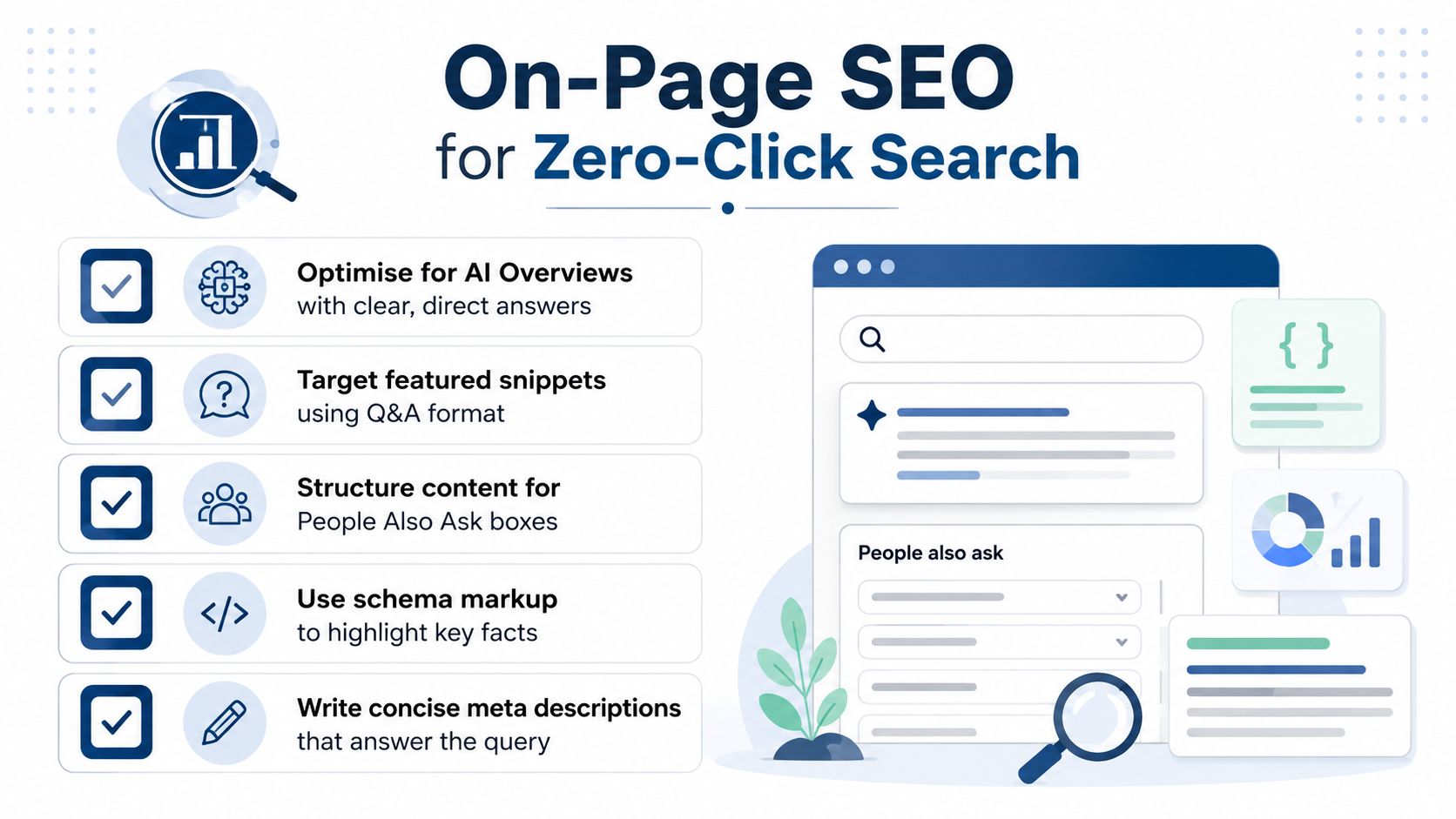
A page optimised only for ranking may miss the wider result page. A page written to be understood can appear in a traditional result, an FAQ feature, a local result, a People Also Ask answer or an AI summary. That doesn't mean writing for machines instead of people. It means writing clearly enough for both.
This short video provides another visual explanation of the modern on-page approach:
The strongest pages aim to become the source, not merely another result competing for a glance.
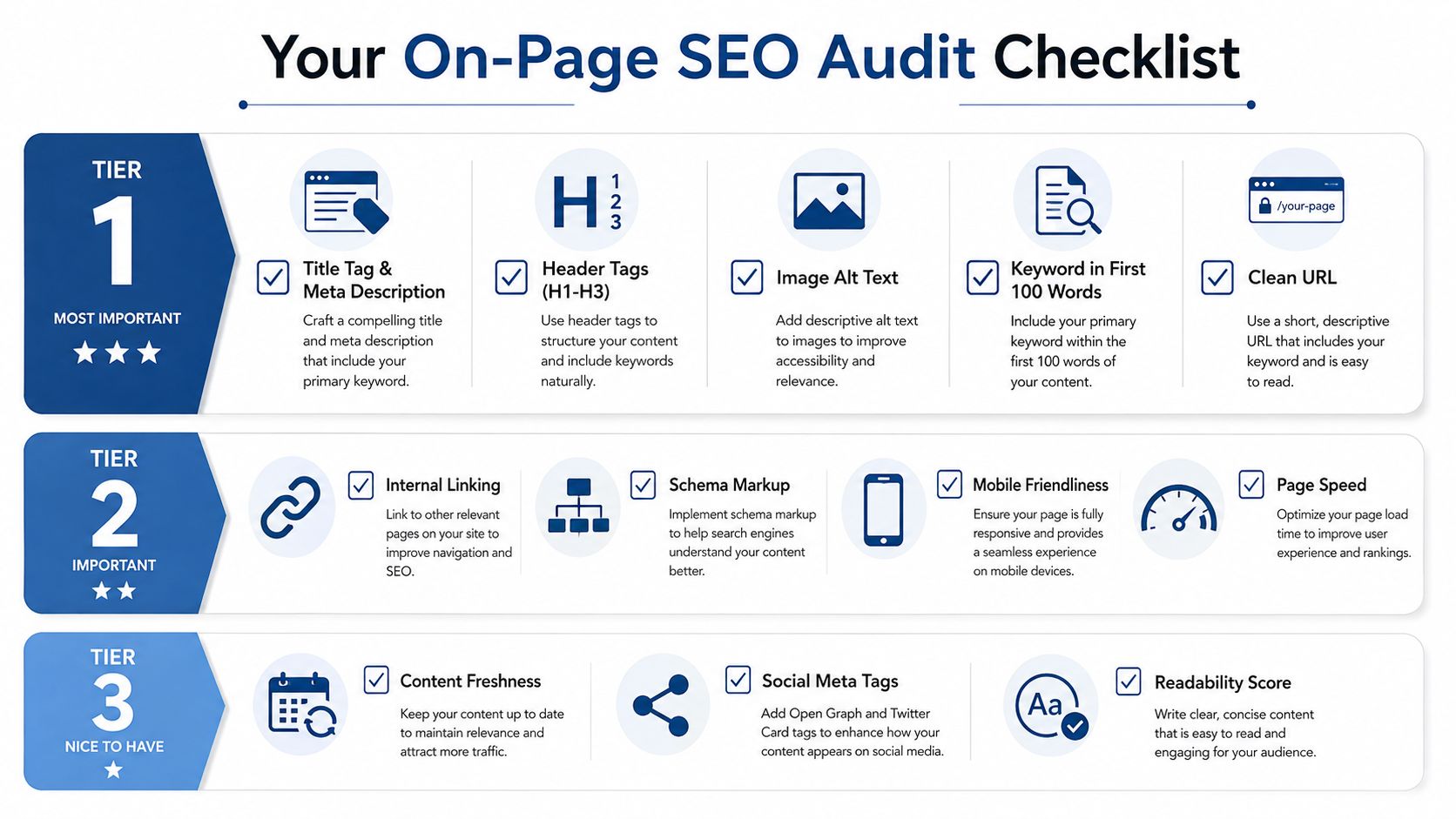
Your Prioritised On-Page SEO Checklist
Run the audit in tiers. Fixing a missing H1 is more useful than debating whether a paragraph needs one more related phrase.
Tier 1 covers page essentials
- Primary H1: Use one clear H1 that reflects the main query and page purpose.
- Unique title tag: Keep it under 60 characters in line with ONS metadata guidance, and place the main topic near the start.
- Useful meta description: Write for a human deciding whether to click, not for a keyword counter.
- Clean URL: Use a short, readable path that describes the service or topic.
- Internal discovery: Make sure at least one other indexable page links to the page with descriptive anchor text.
Tier 2 checks the foundations
- Indexability: Confirm the page isn't blocked by noindex, robots.txt or a conflicting canonical.
- Natural image text: Describe useful images accurately and avoid stuffing locations or services into alt attributes.
- Mobile experience: Test forms, menus, tables, images and embedded media on a phone.
- Performance: Review Core Web Vitals, particularly LCP, INP and CLS, then address the largest causes of delay or layout movement.
- Structured data: Add only relevant schema and validate it against the visible content.
Tier 3 prepares the page for AI visibility
- Answer block: Place a concise, direct response within the first 100 words.
- FAQ markup: Use genuine questions and answers where the content qualifies.
- Identity signals: Include suitable author and organisation schema, with credentials and business details that can be checked.
- Update signals: Keep dates accurate and refresh information when services, regulations or availability change.
On-page SEO is the foundation of the house, not the entire building. Competitive queries still depend on off-page authority, backlinks, local prominence and brand demand. A clean, honest page beats a clever one every time, particularly when a real customer is deciding whether to trust you with their boiler, property purchase or burst pipe.
DigiVisi Ltd helps UK service businesses improve profitable pages through technical fixes, service and location page optimisation, internal linking, schema and reporting aligned with AI visibility. Visit DigiVisi Ltd to review how a practical on-page SEO plan could turn clearer pages into more calls and enquiries.