Skip to content
Lead generation in marketing is the process of attracting strangers, capturing their interest, and nurturing them until they become qualified enquiries ready to buy. In the UK, lead generation is a funnel, not a single event, and the numbers make that painfully clear, with 91% of marketers ranking it as their top goal, 53% spending more than half their marketing budget on it, and 96% of website visitors not ready to buy on the first visit industry lead generation statistics.
If you've ever looked at a tidy website, a decent bit of traffic, and a worryingly quiet phone, you already know the problem. The work isn't done when someone lands on the site, it's done when they enquire, book, or call, and that usually takes a proper system rather than a hopeful “Contact us” button tucked in the corner like a biscuit in the back of the cupboard.
Table of Contents
- What Lead Generation Means for UK Service Businesses
- How the Marketing Funnel Turns Strangers into Paying Clients
- Lead Generation Channels That Work for Local UK SMEs
- Building Your Lead Generation System Step by Step
- Common Lead Generation Mistakes and How to Avoid Them
- Measuring Success and Planning Your Next Steps
What Lead Generation Means for UK Service Businesses
A plumber in Leeds can have a smart site, a polished logo, and enough testimonials to wallpaper a bathroom, then still sit there waiting for enquiries that never arrive. A solicitor in Bristol can do the same, except with more muted colours and fewer pipe jokes. The problem is usually not the business, it is the lack of a repeatable lead generation system that keeps moving people from casual interest to actual contact.
The Core Job Is Moving People Forward
Lead generation means getting the right people to notice you, trust you, and give you a reason to speak with them. For service businesses, that can be a phone call, a form fill, a booked consultation, or a quote request. It is not just traffic, which helps but stops short, and it is not the sale itself, because the sale comes later.
That is why the funnel matters for UK service SMEs. Prospects do not wake up ready to buy a boiler replacement, legal advice, or a new driveway from a stranger they spotted on Google five minutes earlier. They move through awareness, enquiry, and qualification in stages, usually with a few pauses for tea and a quick check of reviews.
Practical rule: if your marketing only celebrates visits, you are counting footsteps outside the shop, not customers at the till.
Why UK Service SMEs Need a Funnel, Not a Lucky Break
A lot of small firms still rely on referrals, which is lovely until the referrals dry up or turn up at exactly the wrong time. Lead generation fills that gap by giving you a system that can work alongside word of mouth, not instead of it. That matters in local trades, professional services, and home services where demand can be patchy, seasonal, or fiercely competitive.
The job is to make sure the right enquiry reaches the right person fast enough to matter. That means the website has to do more than look tidy. It has to guide people towards action, and it has to do so without the grey-hat nonsense that burns budget and attracts rubbish leads. White-hat nurturing, clear offers, useful follow-up, and decent local visibility tend to hold up far better than shortcuts.
A good local example is a bathroom fitter who gets lots of visits from people researching “best bathroom ideas” but few calls. That business does not need more admiration from the internet, it needs a clearer route from curiosity to quote request. Lead generation is the engine room that makes that happen, and funnel tips from Machine Marketing fit neatly into that way of thinking.
How the Marketing Funnel Turns Strangers into Paying Clients
A Manchester dental practice has a much easier time selling teeth whitening to someone already looking for it than to someone who clicked a random ad during lunch. That difference is the funnel in action. People don't leap from “noticed you” to “booked appointment” without a bit of guidance, and sometimes a gentle nudge is doing more work than a flashy headline ever will.
Awareness, interest, consideration, conversion
At the awareness stage, the person is searching. They might type “teeth whitening near me” into Google because they've got a wedding, a reunion, or a sudden dislike of their own coffee habit. At this point, the job is visibility, not hard selling.
Interest comes next, when they read something useful, like a guide to whitening options or a page explaining what happens at the appointment. Consideration is where the comparison starts, and that's when a pricing guide, service page, or FAQ helps them decide whether to carry on. Conversion is the final step, a consultation booked, a phone call made, or a form submitted.
If the message jumps too quickly, people drop out. A landing page that screams “buy now” at someone still comparing options is like proposing on the first date, which is bold, but rarely efficient.
Different stages need different content
The useful bit is that each stage asks for a different type of page and a different call to action. Early-stage visitors need clarity and reassurance. Mid-stage visitors need proof, detail, and an easy next step. Late-stage visitors need a simple path to contact.
A short guide from Machine Marketing on funnel tips is useful if you want a straightforward reminder that the funnel is about sequence, not shouting louder. That's the bit many businesses miss. They put one page in front of every visitor and expect it to do every job, which is a bit like asking one spoon to stir tea, pour the milk, and wash the car.
People don't need to be pushed at every stage. They need the next logical step.
The point is smooth movement. When the funnel works, the visitor feels guided rather than chased, which is exactly what a decent local service business should feel like.
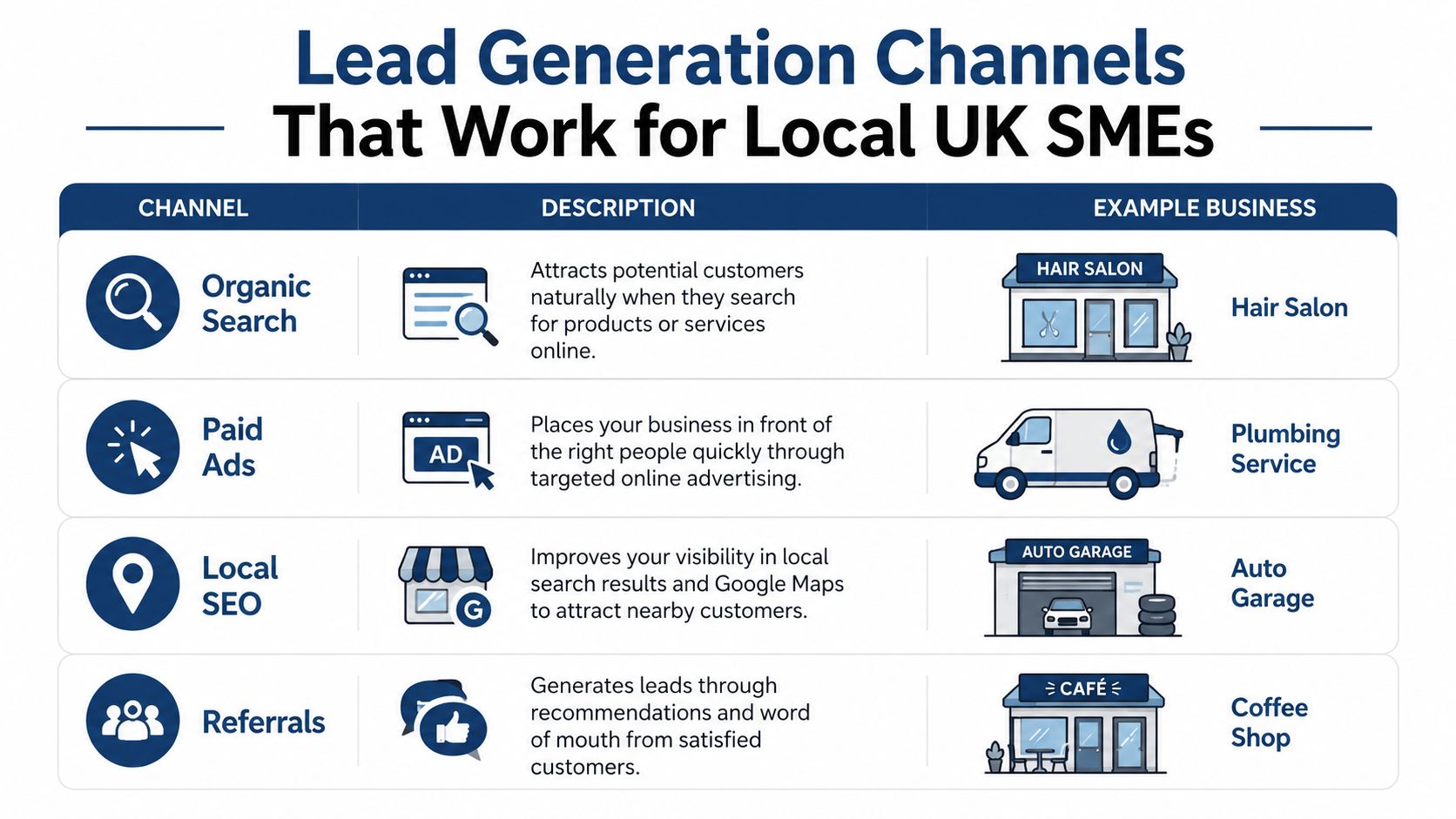
Lead Generation Channels That Work for Local UK SMEs
A local electrician in Portsmouth and a B2B consultant in Birmingham should not be buying leads or chasing the same channels in the same way. One wants urgent local intent, the other wants trust and authority over time. The channel choice depends on how quickly people buy, how much explanation they need, and how much budget you can afford to waste before the kettle's boiled.
Organic search and local SEO
Organic search works well when people are actively looking for help. That's often the case for trades, solicitors, clinics, and other services where the problem is already felt and the search starts with a need. Local SEO matters even more for businesses serving a defined area, because visibility in Maps and the local pack can feed the phone without constant ad spend.
A boiler repair firm benefits from service pages and location signals. A solicitor benefits from clear practice-area pages and trust content. A salon benefits from search-friendly pages that answer practical questions before the customer even has to ask.
Paid ads and referrals
Paid search is useful when you need speed or want to test demand quickly. It can drive enquiries into a landing page, but only if the page is built for conversion and the leads are properly qualified. A bad ad campaign can bring in plenty of traffic and very little business, which is a lovely way to fund someone else's holidays.
Referrals are still gold, especially for local firms with a strong reputation. They tend to convert well because trust is already partly built. But they're not a full strategy on their own, because you can't turn a referral tap on with a spreadsheet and hope for the best.
What to avoid and what to prioritise
Grey-hat shortcuts are tempting when cash is tight. Buying email lists, fake reviews, stuffing pages with keywords, or chasing cheap leads often creates the wrong kind of pipeline, the sort that fills your CRM with people who were never going to buy. Black-hat tactics can burn the brand name too, which is a nasty trick to pull on yourself.
For a local trades business, that usually means prioritising Google Business Profile, local search visibility, and a fast contact path. For a B2B consultant, that often means content, organic search, and a stronger lead magnet. The right channel is the one that matches how your buyers behave, not the one that sounds clever in a sales deck.
If you're looking for a practical SEO-led route into lead capture pages, the approach described in this lead generation SEO guide is relevant because it connects search intent to enquiry paths rather than treating them as separate jobs.
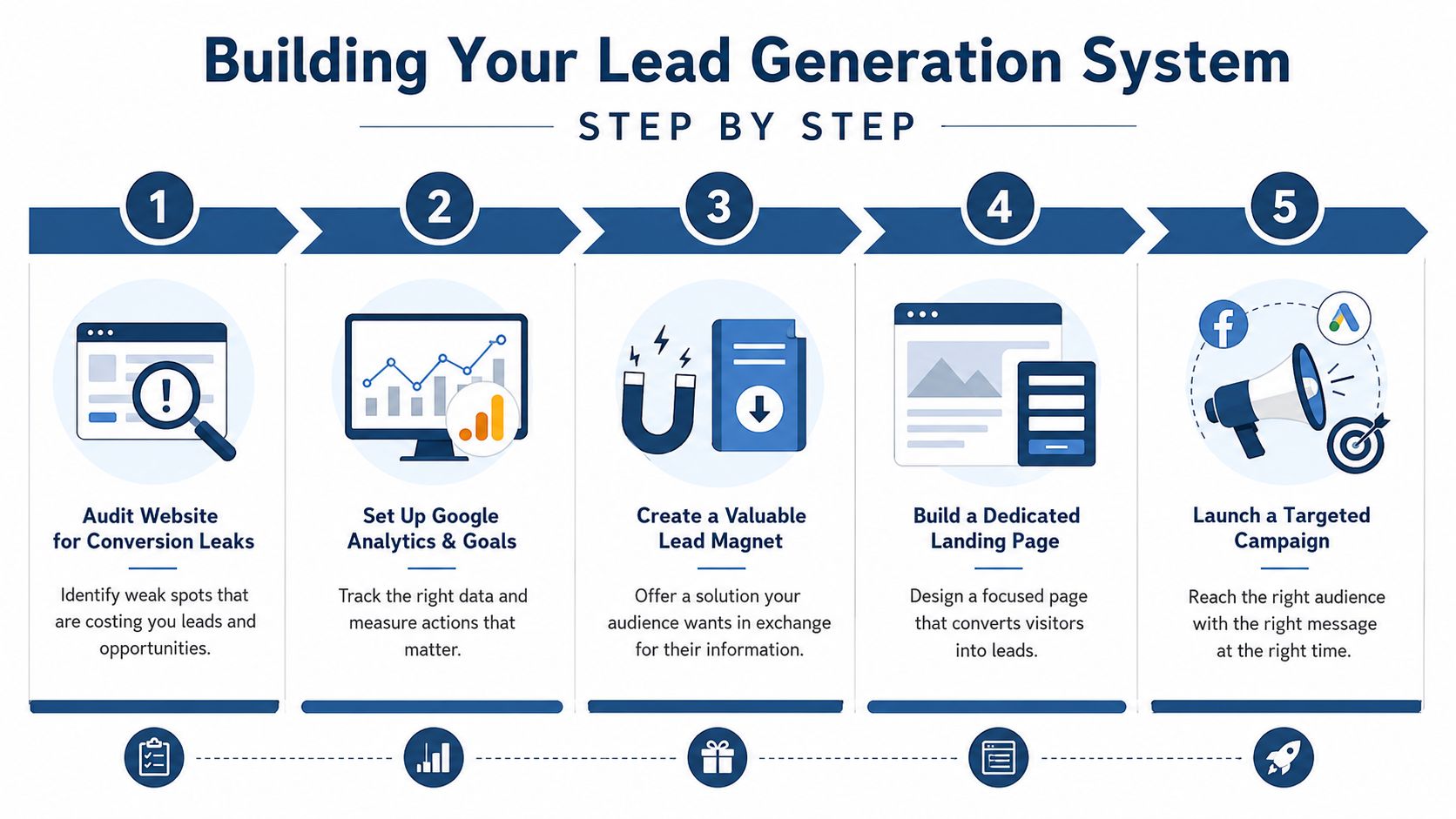
Building Your Lead Generation System Step by Step
A Bristol electrician doesn't need a marketing circus. They need a homepage that says what they do, a service page that explains the job properly, and a contact route that doesn't make the customer work harder than the sparky. The same logic applies to most UK service SMEs, whether the work is pipes, probate, plastering, or patching up a leaky roof.
Start with conversion leaks
First, check where people fall out of the process. If the site loads slowly, the phone number is hidden, or the form asks for a novella when a name and number would do, you've got conversion leaks. For mobile users, that's even more painful, because a Google study cited in UK marketing industry material found that 53% of mobile site visits are abandoned if pages take longer than 3 seconds to load mobile page speed statistic.
A good homepage should say the service plainly, show a clear call to action, and give a reason to trust you fast. The service page should answer the awkward questions before the visitor has to ring and ask them. The contact page should make it easy to call or submit a short form without feeling like they've applied for a mortgage.
Build the basics properly
Set up tracking so you know what's happening. A business can't improve lead generation if it only knows that “traffic went up”, because traffic alone doesn't pay the council tax. A basic CRM, Google Analytics, and Google Business Profile insights give you enough to see which pages and channels are producing enquiries.
Then improve the content around real search intent. A Bristol electrician's page shouldn't waffle about “electric solutions”, it should say which problems are fixed, where they work, and how the job starts. If the visitor can't tell in a few seconds that they're in the right place, they'll hit the back button and go elsewhere.
Keep follow-up simple and fast
New enquiries need a follow-up sequence, even if it's a straightforward one. Confirm the enquiry, set expectations, and move the conversation forward while the lead is still warm. A quiet inbox is rarely a sign of low demand, more often it means the business let the lead cool off before anyone picked up the thread.
If you want marketing automation support on social channels, Andy's Instagram-focused automation article is a useful reference point for thinking about repeatable follow-up rather than ad hoc replies.

A simple rule helps here. If a form field doesn't improve qualification right now, leave it out and ask later. Greedy forms make people vanish, and no one has ever thanked a plumbing quote form for being nosy.
Common Lead Generation Mistakes and How to Avoid Them
The easiest way to waste a marketing budget is to celebrate the wrong number. Traffic can rise while enquiries stay flat, and then everyone pretends the dashboard is “encouraging”. It isn't, it's just busy.
Vanity metrics and greedy forms
The first mistake is obsessing over visits instead of enquiries. A site can attract plenty of curious people who were never a fit, especially if the content is too broad or the call to action is vague. The white-hat fix is to track the journey properly and make the next step obvious.
The second mistake is asking for too much on the form. Many people will happily offer a name, phone number, and a short note, but start asking for their life history and they disappear. Salesforce's guide says teams should track conversion rates, CPL, lead quality, and ROI, and use CRM lead scoring plus concise forms and A/B testing to improve performance Salesforce lead generation guide.
Weak follow-up and shortcut tactics
The third mistake is letting leads go cold. A contact form is not the finish line, it's the starting whistle. If nobody responds quickly, the lead rings someone else, and that someone else is usually just good at answering the phone.
The fourth mistake is chasing grey-hat shortcuts. Buying leads, faking reviews, stuffing pages with keywords, or spraying a generic message at everyone may create movement, but it's the wrong kind. Those tactics tend to attract rubbish leads, irritate real prospects, and eventually make the brand look a bit dodgey, which is rarely the business model anyone wrote down in the company planner.
White-hat wins because it respects the buyer
A better route is slower, cleaner, and less dramatic. Short forms, clear service pages, honest local proof, and sensible follow-up usually outperform the shiny nonsense because they match how people choose a solicitor, electrician, or roofer. They want clarity, trust, and a quick path to a human being.
Grey-hat tactics can make the spreadsheet look lively for a week. White-hat systems make the diary healthier for months.
Measuring Success and Planning Your Next Steps
Lead generation KPIs should track activity, engagement, lead quality, and pipeline or revenue impact, including lead-to-MQL conversion, MQL-to-SQL conversion, cost per lead, lead velocity rate, and revenue contribution lead generation KPI guide. That gives you a clean view of whether the funnel is producing real business, not just pageviews with good intentions.
Start simple. Use Google Analytics to see where visitors come from, Google Business Profile insights to understand local discovery, and a CRM to track enquiries through to booked work. If the site gets traffic but the pipeline stays thin, the issue is usually the landing page, the qualification flow, or the speed of response.
The next sensible moves are straightforward. Fresh photos and posts on Google Business Profile help keep the local presence alive, one locally targeted article a month builds search visibility over time, and a small paid search test can validate which search terms deserve more attention. If you want the full funnel working, don't treat these as separate jobs, because the phone doesn't care which department got the credit.
If you'd rather have the SEO, local search, and conversion pieces handled by someone who spends their time turning service-site visitors into enquiries, visit DigiVisi Ltd. It's a sensible place to start if you want a lead generation system that's measured properly, built around search intent, and focused on ringing phones rather than pretty graphs.