Skip to content
Monday morning in a UK agency has a particular smell to it, usually coffee, urgency, and one outstanding approval that should've been sorted on Friday. A solicitor wants “something more authoritative”, a plumber wants the phones ringing, and a multi-location SME wants every branch to look locally relevant without sounding like it's been cloned in a basement. Meanwhile, the writers are waiting on SME input, the client is asking where the leads are, and someone in the corner is muttering about “just a quick blog”, which is how operations problems begin.
Table of Contents
- Why Agency Content Writing Is an Operations Problem
- Setting Up the Client Intake and Onboarding
- Keyword and Competitor Research That Drives Briefs
- Building a Content Brief Writers Can Use
- The Editorial Workflow From Brief to Publish
- Pricing and Packaging Content Writing for UK Clients
- Quality Assurance and Staying Squarely in White-Hat Territory
Why Agency Content Writing Is an Operations Problem
Monday starts the same way in too many agencies. There are five briefs in the queue, two of them are missing a target audience, one has no conversion goal, and another has the sort of “SEO notes” that amount to “make it rank, please”. The writer can't move because the SME hasn't replied, the client wants a draft by Thursday, and the account manager is already promising results as if Google were a local council with a form to fill in.
That's why content writing for agencies is an operations problem first and a creative problem second. Forbes Advisor reports that 48% of content marketing is outsourced to agencies or third-party companies, and writing is the top freelance marketing work area at 69%. That tells you the industry has already moved into a delivery model where content is assembled across people, systems, and approvals, not handed to one heroic writer and left to vibes. The old “give it to the writer and see what comes back” approach is a lovely way to generate rework.
Practical rule: if the brief is vague, the edit cycle becomes the real production line.
The profitable desk is the one that treats intake, research, briefing, workflow, QA, pricing, and reporting as a single machine. The chaotic desk treats each article as a bespoke rescue mission, which is fine until your best writer spends half the week chasing context and the other half rewriting the same introduction in three different ways. Service-led UK clients don't buy literary perfection. They buy clear process, visible competence, and content that supports enquiries without making the whole thing feel like a school project.
For a plumbing firm, that might mean service pages, location pages, and a few sharp articles that map directly to commercial search. For a solicitor, it might mean service-led explainers that answer real buyer questions without turning into beige safety brochures. Either way, the profit sits in the system, not in the sentence-level heroics.
Setting Up the Client Intake and Onboarding
The first half hour of a new content engagement usually decides whether the next month is smooth or full of “just one more thing” emails. A proper intake call should do three jobs, establish what the client needs, identify what access and approvals exist, and make the hidden constraints visible before anyone starts writing.
Ask before you accept the brief
Start with the basics, but ask them properly. Who is the decision-maker, who signs off content, what counts as success, and what kind of lead is valuable? A Birmingham accountant chasing year-end tax planning enquiries needs very different content from a trades business trying to fill call slots on Monday mornings.
Collect the assets that stop guesswork later:
- Brand voice guidance, so the writing doesn't swing between stiff corporate waffle and “cheeky mate down the pub”.
- Audience notes, especially if the client has more than one customer type.
- Existing content audit, so you're not rewriting pages that already do the job.
- Google Business Profile access, where local visibility matters.
- Approval matrix, so everyone knows who can comment, who can approve, and who can't veto content three days after sign-off.
For a three-branch plumbing firm, the intake call should quickly move away from vanity topics and towards the pages that sell. A “how to bleed a radiator” article might have its place, but a boiler repair service page, a local emergency plumbing page, and branch-specific location content are what normally support bottom-of-funnel intent.
Make access and approvals boring
The goal is to remove friction before it appears. If the client insists every draft must pass through three people, build that into the timeline and price it accordingly. If one SME is the only person with the technical knowledge, plan around their diary, not around optimism.
A clean onboarding pack saves more margin than a clever headline ever will.
The best practice, especially for UK service businesses, is to make the process repeatable. One master onboarding doc, one contact map, one approval route, and one place where all research, notes, and source material live. That keeps the work moving and stops the classic “I thought Claire had sent that over” routine, which is the agency equivalent of a kettle with no water in it.
Keyword and Competitor Research That Drives Briefs
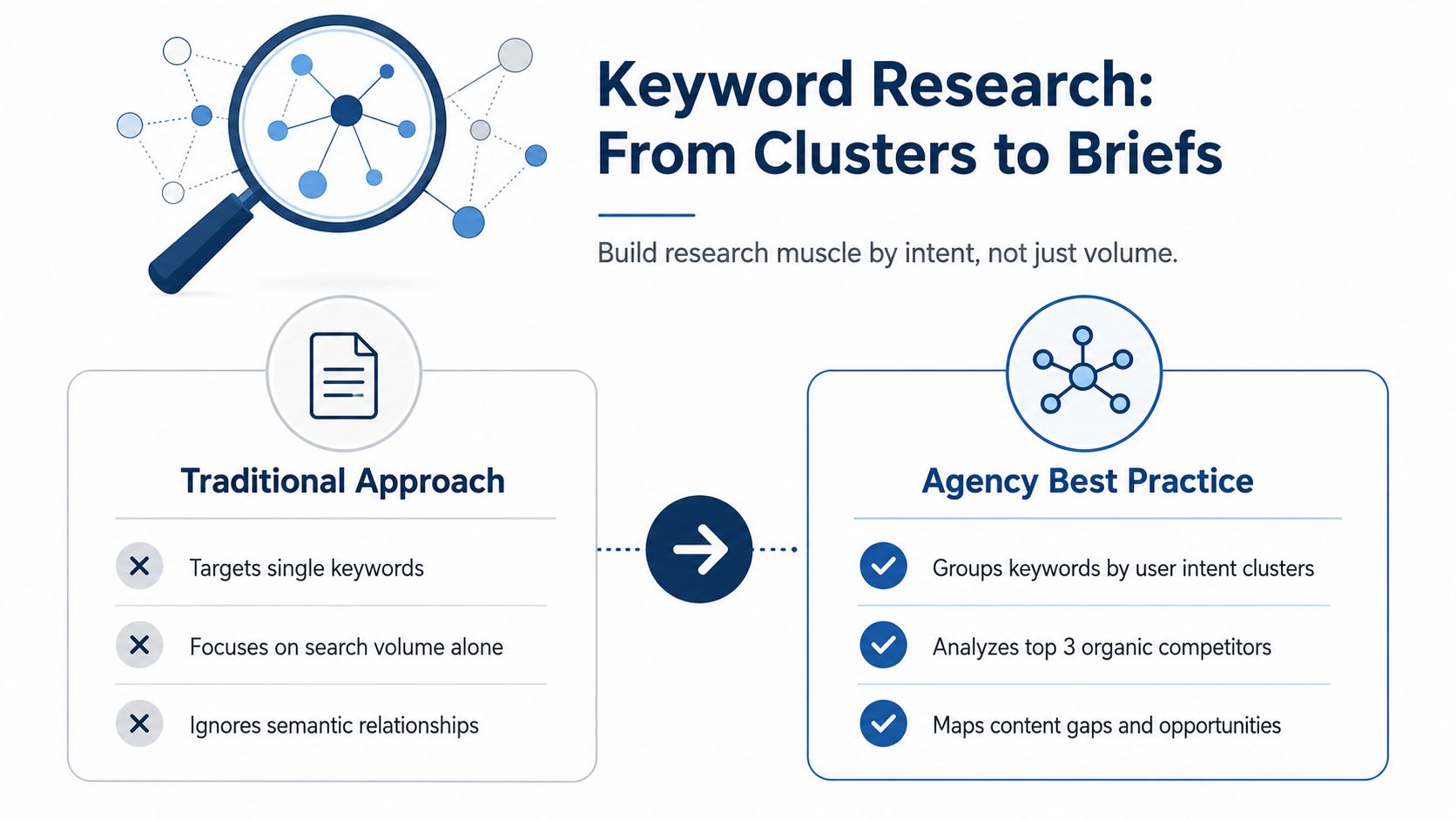
Good research starts with intent, not with a pile of phrases scraped from a tool and left in a spreadsheet like it's evidence in a fraud case. For local service clients, the target keyword only matters if the page can answer the searcher's real job to be done, whether that means booking a callout, checking trust signals, or comparing options before they pick up the phone.
Build around the top three organic competitors
The top three organic results show what Google already thinks deserves to win. Strip them back for intent, depth, and trust signals, then decide whether your brief should match them, beat them, or take a slightly different angle. For a Leeds conveyancing solicitor, that might mean checking how the winning pages frame the service, what supporting questions they answer, and how much evidence they use to calm a nervous buyer.
Here's a simple competitor signal snapshot you can use in your own process.
| Competitor | Primary intent | Content depth | Trust signals | Gap to exploit |
|---|---|---|---|---|
| Result 1 | Service comparison | Broad | Clear credentials | Better local proof |
| Result 2 | Immediate enquiry | Moderate | Strong contact prompts | More buyer education |
| Result 3 | Advice-led | Deep | Helpful but generic | Stronger commercial CTA |
The point is not to copy. It is to understand the shape of the result page and write a brief that gives your writer a fair shot. If the top pages are all advice-heavy, a page that never reaches the commercial point will drift. If the winners are thin and salesy, you can usually beat them by adding substance and proof.
Use a proper search-led writing process, not guesswork. The Lumi Humanizer SEO writing guide is a decent reference point for keeping the writing readable while still structured for search, and the same discipline sits behind a well-run content writing service for agencies when the job has to scale across several clients without turning into chaos.
Choose the metrics that actually matter
Search volume has its place, but it does not pay the bills on its own. For UK service clients, the useful filters are business fit, intent fit, SERP features, and whether the content can credibly support local trust. If the page is meant to generate calls or form fills, the keyword has to align with that commercial shape.
A content desk that does this well is not chasing every term. It is narrowing the field to the phrases that can support real enquiries, then shaping pages that answer the question properly and convert without sounding like a used car advert in a suit.
Building a Content Brief Writers Can Use
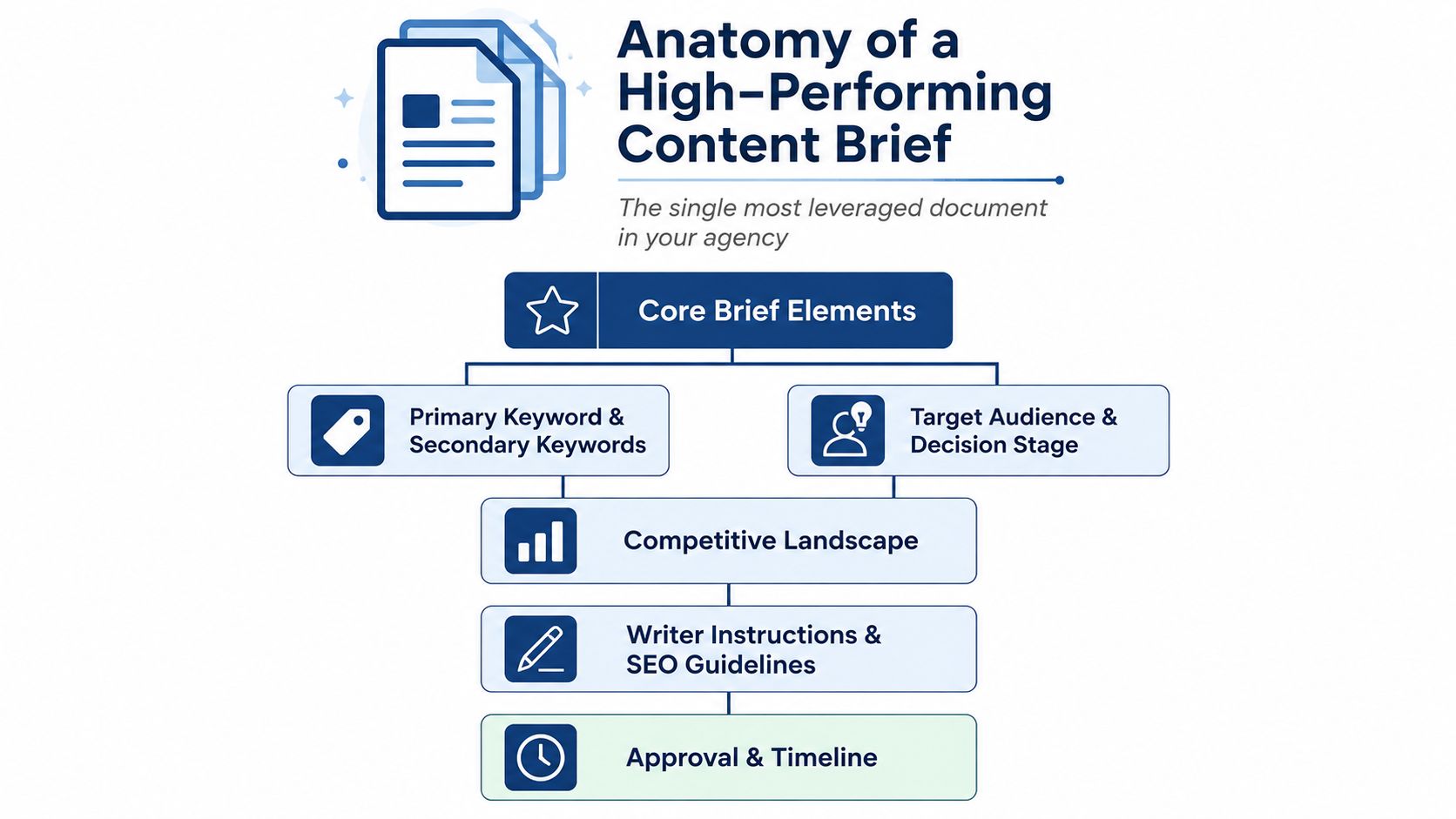
A brief is the most useful document in the content operation. If it is strong, writers move quickly, edits stay focused, and SME input lands in the right place. If it is flimsy, the draft becomes a guessing game, and the person on the receiving end has to sort out search intent, tone, structure, and compliance at the same time.
What a useful brief contains
Every decent agency brief should include primary and secondary keywords, the audience and decision stage, the conversion objective, internal link targets, SME talking points, brand voice notes, format, and expected length. Those fields do more than organise the page. They force the team to agree on what the article is for before anyone spends time writing prose.
A realistic brief for a Birmingham accountant writing about year-end tax planning might look like this:
- Primary keyword: year-end tax planning for small businesses
- Secondary keywords: tax reliefs, allowable expenses, year-end accounting checklist
- Audience: owner-managed SMEs, decision stage, comparing advisers
- Conversion objective: consultation booking
- Internal links: bookkeeping service page, corporation tax page, contact page
- SME notes: common deadline issues, typical mistakes, what clients forget
- Voice: clear, calm, competent, no jargon dump
That gives a writer enough to work from. It also gives the editor a way to spot drift early. If the article starts wandering into general business advice and never reaches the point where a client would book a call, the brief was wrong or the writer ignored it. Either way, the desk pays for it later.
Make SME input easy, not heroic
SMEs rarely vanish because they are difficult. They vanish because the request is a nuisance. Send a pre-filled template, ask focused questions, and give them the context for why the content matters. Removing friction at the start saves a lot of silence later.
The other useful move is to track which SME contributions improve the draft. Some experts are brilliant at practical examples and terrible at writing coherent sentences. That is fine. You want usable input, not a polished essay written in a hurry. As a DigiVisi website copywriting service style workflow would suggest in practice, the structure matters just as much as the words, because service pages need search intent, trust signals, and a clear call to action to do their job.
The Editorial Workflow From Brief to Publish

A sane workflow keeps the desk moving without turning every draft into a committee exercise. Monday planning should assign briefs and set priorities, mid-week should be for drafting and research, SME review should validate facts, and SEO optimisation should happen before the page becomes emotionally attached to its own wording.
Where the handovers should happen
The biggest failure mode is letting SEO review arrive after the writing is already polished. By then, the writer has committed to structure, examples, and assumptions that might not fit the target query. Fixing that late means you're not optimising a page. You're negotiating with it.
The smoother route is simple. Strategy defines the job, the brief defines the target, the draft uses that target, SME review checks the facts, editorial QA checks the quality, and then the page gets approved and scheduled. That order is not glamorous, but it stops you paying for two versions of the same article.
A local trade client landing page makes this obvious. The strategist sets the intent, the writer drafts the service page, the SME confirms the service details, the editor tightens the flow, and the final version gets uploaded with proper internal links and a clear call to action. No drama, no mystery, no midnight redesigns because someone suddenly decided the headline “didn't feel right”.
Keep the research in one place
Independent content-process guidance recommends putting all research in a single master notes document, labelling sources by subtopic, and tracking performance so each publish cycle becomes a learning loop rather than a one-off draft. That is basic discipline, but it's the sort of basic discipline that separates a content desk from a pile of drafts.
The practical benefit is simple. When the next page on the same topic comes in, nobody has to start from scratch. They can see what worked, what didn't, and what the client approved. That makes the operation faster without turning it careless, which is the sweet spot every agency claims to want and then ignores the minute a deadline appears.
Useful habit: the fewer places the truth lives, the easier it is to keep the copy straight.
Pricing and Packaging Content Writing for UK Clients
Pricing content by the word or by the hour is a quick route to heartbreak. One under-scoped service page can eat half a day, one sprawling “simple blog” can become a research rabbit hole, and suddenly the margin is doing a disappearing act worthy of a seaside magician. Packaging works better because it ties the writing to research, optimisation, publishing, and reporting.
What tends to work in practice
Monthly retainers suit ongoing service-led clients who need a steady stream of pages and posts. Fixed fees work for specific briefs with a clear start and end. SEO-aligned content bundles suit businesses that want the writing tied to search intent, internal linking, and reporting rather than treated as a standalone deliverable.
A sensible package might include:
- Research and brief building, so the writer isn't improvising.
- Drafting and optimisation, not just words on a page.
- Publishing support, where agreed.
- Reporting, so the client can see what the content did.
- Scope boundaries, so nobody sneaks in six extra rewrites because “it seemed small”.
For a UK service business, the point is alignment. Four optimised service pages plus two monthly blogs makes sense as a retainer because the work supports visibility, trust, and conversion together. It also makes renewals easier, because the client is buying an operating rhythm rather than a random pile of articles.
Content marketing can cost 62% less than traditional marketing methods while generating leads that are 6 times more likely to convert, according to Content Marketing Institute data compiled by Omnius. That's one reason the packaging matters so much, because the client isn't paying for literary flair. They're paying for a repeatable system that can earn its keep. The wider content market is large, but the agencies that keep their margins are the ones that tie delivery to measurable business value rather than volume for its own sake.
Quality Assurance and Staying Squarely in White-Hat Territory
Quality assurance is where agencies either protect the client or sabotage themselves. A sensible QA checklist should cover factual accuracy, source tracing, intent match, on-page SEO, brand voice, originality, and any compliance notes that matter for the sector. That's true whether the client is a solicitor, a roofer, or a multi-location healthcare practice with a reputation to defend.
Where the line sits
White-hat work is transparent, attributable, and written for people first. Grey-hat work gets sloppy with signals, leans on duplication, and hopes nobody notices. Black-hat work is the point where the content stops being useful and starts trying to trick systems, usually with doorway pages, fake authority, or claims that would fall apart under a phone call. UK service businesses don't need any of that nonsense. They need content that stands up to scrutiny from a buyer and a search engine.
Guidance on using statistics in content recommends naming the source in the text and explaining what the figure means rather than dropping it in bare, which keeps the writing transparently in white-hat territory. That's the right instinct for agencies too. If a number matters, explain it in context. If a source is weak, don't use it. And if the source is stale, treat it with caution. Old figures from a fast-moving market are how perfectly decent pages start looking dated before they've even settled into the index.
Source rule: if you can't trace it cleanly back to something reputable, don't put it in the draft.
For compliance-sensitive content, a broader governance framework helps. The scalable content governance for brands approach is worth studying if you're managing multiple writers, approvals, and publication standards across several service lines. It's the sort of structure that keeps everyone honest without turning the desk into a bureaucracy with a login.
What to report and how to spot trouble early
The metrics that matter for UK service clients are qualified enquiries, calls, form fills, ranking movement on commercial terms, and AI Overview presence where relevant. Vanity metrics like raw pageviews and “we published six posts this month” make a nice team screenshot and very little else.
A practical 30, 60, 90-day rollout looks like this. In the first 30 days, lock down onboarding, briefs, templates, and source tracing. By 60 days, the team should have enough live work to compare performance and tighten the QA checklist. By 90 days, you should know which topics, formats, and approval patterns are worth scaling.
Watch for the warning signs that the engine is wobbling. Writer churn usually means the process is too messy. Brief drift means the team never agreed on the target. Creeping scope means nobody is policing deliverables. Silent approvals mean someone has stopped reading properly, which is rarely a confidence-boosting sign.
A content operation becomes profitable when the same standards produce better output month after month. That only happens when reporting feeds back into briefing, QA stays strict, and the team stops pretending every article deserves a fresh invention of the wheel. If you want content that supports leads for a UK service business, DigiVisi Ltd works on that exact model, with content, SEO, and local visibility joined up rather than treated as separate chores. Visit DigiVisi Ltd if you want the production side sorted properly, without the usual agency theatre.