Skip to content

You're staring at the same ugly truth a lot of UK service businesses face. Your phones aren't quiet because demand disappeared, they're quiet because three rivals keep showing up above you, winning the local pack, and making your business look like the backup option.
That's why how to analyze competitors for local SEO can't be a vague marketing exercise. It needs to be a proper reverse-engineering job, focused on the businesses that take calls away from you, plus the shadow competitors that never show up in a tidy rankings report but still nick the sale.
Table of Contents
- The Moment Your Local Rivals Start Stealing Your Calls
- Naming the Rivals That Truly Matter
- Gathering the Right Data Without Drowning in Tools
- Reading the Data to Find Real Gaps
- Picking Quick Wins and Avoiding Grey-Hat Traps
- Your Repeatable Audit, Reporting and Action Plan
The Moment Your Local Rivals Start Stealing Your Calls
A Bristol plumber looks at Google, sees three local-pack rivals ahead of him, and has that familiar sinking feeling. Same postcode. Same service. Different phone rings. The frustrating bit is that all three don't need to be better at everything, they only need to be clearer, more trusted, or easier to pick at the exact moment a homeowner is comparing options.
That's why a scattergun competitor review wastes time. If you try to benchmark every firm in your town, every national brand, every directory, and every freelancer with a half-decent website, you end up with a spreadsheet full of noise and no decision. The UK Competition and Markets Authority says competitive analysis should identify rivals, assess strengths and weaknesses, estimate market share, and define the window of opportunity, while GOV.UK market-research guidance stresses mapping direct and indirect competitors by service line and segment. In practical terms, that means a targeted competitive set, not a “who else ranks?” pub quiz CMA and GOV.UK competition guidance.
Why top-three reverse-engineering works
For local SEO, the top three local-pack results usually give you enough signal to act. You can see who is winning on Google Business Profile quality, review themes, citations, service-page depth, and the overall trust story. You do not need to benchmark the whole county to learn that the winner is replying to reviews, the second place result has stronger service-area pages, and the third is propped up by a cleaner citation trail.
A Leeds accountant faces the same logic. One rival wins on fixed-fee messaging, another on reviews that mention speed and clarity, and a third on a stronger service page for limited company accounts. None of that requires guesswork, and none of it needs a week of soul-destroying tab hopping.
Practical rule: if a rival keeps appearing in the local pack for the same service and area, treat them as a live commercial threat, not just a SEO curiosity.
Who this approach is for
This method suits solo marketers, owners, and small in-house teams who need answers quickly. It also suits service-led firms where the competition includes firms with the same offer, firms with a different delivery model, and firms that solve the problem without looking like competitors at all.
You are not trying to produce a museum exhibit. You are trying to work out why the phone goes to someone else, what they're doing that you're not, and which moves are worth fixing first without buying an agency-sized headache.
Naming the Rivals That Truly Matter
The first mistake is to define competitors by instinct alone. The better approach is to split them into direct rivals, indirect rivals, and shadow competitors, then cap the field at five to seven businesses so the analysis stays sane. That range lines up with established practitioner guidance to keep the set manageable, usually around the top five to seven competitors for a usable comparison competitor-analysis structure, and it fits the practical advice to focus on a small, validated sample rather than the whole market framework for scoping rivals.
Direct, indirect and shadow competitors
A Bristol electrician might have direct rivals who offer the same domestic call-out service in the same city. Those are the firms you can compare on price, service pages, reviews, and local-pack visibility. Then come the indirect rivals, such as a general building company that bundles electrical work into a larger home-refurbishment offer.
Shadow competitors are the awkward ones. They include the homeowner who decides to DIY, the landlord who calls a freelancer, the office manager who asks an internal handyperson to sort it, and the buyer who delays the job. UK small-business guidance often skips this layer, but it matters because the customer is not always choosing between two firms with the same logo on a van. Sometimes they are choosing between a specialist, a generalist, and doing nothing shadow-competitor gap.
For a Leeds accountant, the same structure applies. A direct rival offers similar bookkeeping or tax services in the same city. An indirect rival might be a broader business advisor or an online subscription model. Shadow competitors include the founder who keeps using spreadsheets, the bookkeeper already on payroll, or the owner who plans to sort it “after this quarter”, which in business terms means never.
How to keep the field tight
Use your target query, then pick the businesses that show up on the page. Add one or two shadow alternatives that customers choose instead. That gives you a field big enough to spot patterns and small enough to finish in a working week.
For local service businesses, this is the difference between useful intelligence and an organised nap. The point is not to admire the market. The point is to work out which rivals deserve a response.
If you want a second lens on the process, keywordme's competitor analysis guide is useful because it keeps the comparison grounded in concrete commercial signals, not fluffy brand theatre.

A useful habit is to sort those rivals into tiers before you start saving screenshots. Top-tier local threats come first, then regional players, then broader benchmarks that matter for positioning but not for day-to-day local-pack battles.
Gathering the Right Data Without Drowning in Tools
Competitor analysis gets messy when people collect everything. The UK's Information Commissioner's Office warns that data-driven analysis needs careful governance because personal and business data can be combined to identify patterns, while UK government statistics guidance says competition decisions should rest on measurable indicators rather than anecdote. The lesson is simple, a small set of high-value signals beats a junk drawer full of screenshots and feelings data governance and measurable indicators.
What to record for each rival
Start with the stuff that changes local visibility and enquiries. That means target keywords, ranking positions, estimated traffic, on-page signals, technical health, backlinks, GBP quality, review themes, and NAPW citations. You don't need every bell and whistle. You need enough evidence to see why one site is ahead and whether that lead is structural or sloppy.
A practical audit can be built from:
- Search intent terms: the main local service queries each rival appears for.
- Ranking pattern: where they show up, especially in the local pack.
- Content depth: service-page headings, FAQs, trust copy, and proof.
- Technical basics: page speed, indexation, schema, and crawl cleanliness.
- Authority signals: backlinks, citations, and branded mentions.
- GBP behaviour: categories, services, photos, posts, review replies, and completeness.
- Review themes: what customers praise or complain about, not just star counts.
Practical rule: if a data point doesn't change a ranking decision, a lead decision, or a content decision, leave it out.
A simple spreadsheet structure
One useful way to stay organised is to treat each competitor like a folder. Save their homepage copy, pricing page if they have one, a few customer reviews, one or two case studies, and a sample of blog or advice content. That structure mirrors practitioner guidance to collect hard assets rather than loose impressions competitor research folders.
Use a straightforward sheet with columns for the signal, the observation, and the implication. If a rival has stronger review language around speed or friendliness, write that down. If another rival has a cleaner service page with better headings, note that too. The goal is not to win a data beauty contest, it's to build a reliable comparison set.
| Competitor data collection checklist | What to record | Why it matters |
|---|---|---|
| Target keywords | Primary and secondary local service terms | Shows what search demand each rival is chasing |
| Rank positions | Local pack and organic placement for key queries | Reveals who is actually visible where leads are won |
| On-page signals | Titles, headings, FAQs, schema, content depth | Shows how well the page answers buyer intent |
| Technical health | Speed, indexation, mobile usability, structured data | Helps explain why similar content ranks differently |
| Backlinks | Referring sites, link themes, anchor patterns | Indicates authority and trust signals |
| GBP quality | Categories, services, photos, posts, replies | Affects local trust and map visibility |
| Reviews | Themes, recency, response patterns | Shows customer experience gaps you can exploit |
| NAPW citations | Name, address, phone, website consistency | Reduces local confusion and trust friction |
For a salon owner, the same logic can be used to set referral KPIs for your salon, then compare those signals with local rivals. The benefit is not the spreadsheet itself. It's the fact that you stop arguing with guesswork.
Reading the Data to Find Real Gaps
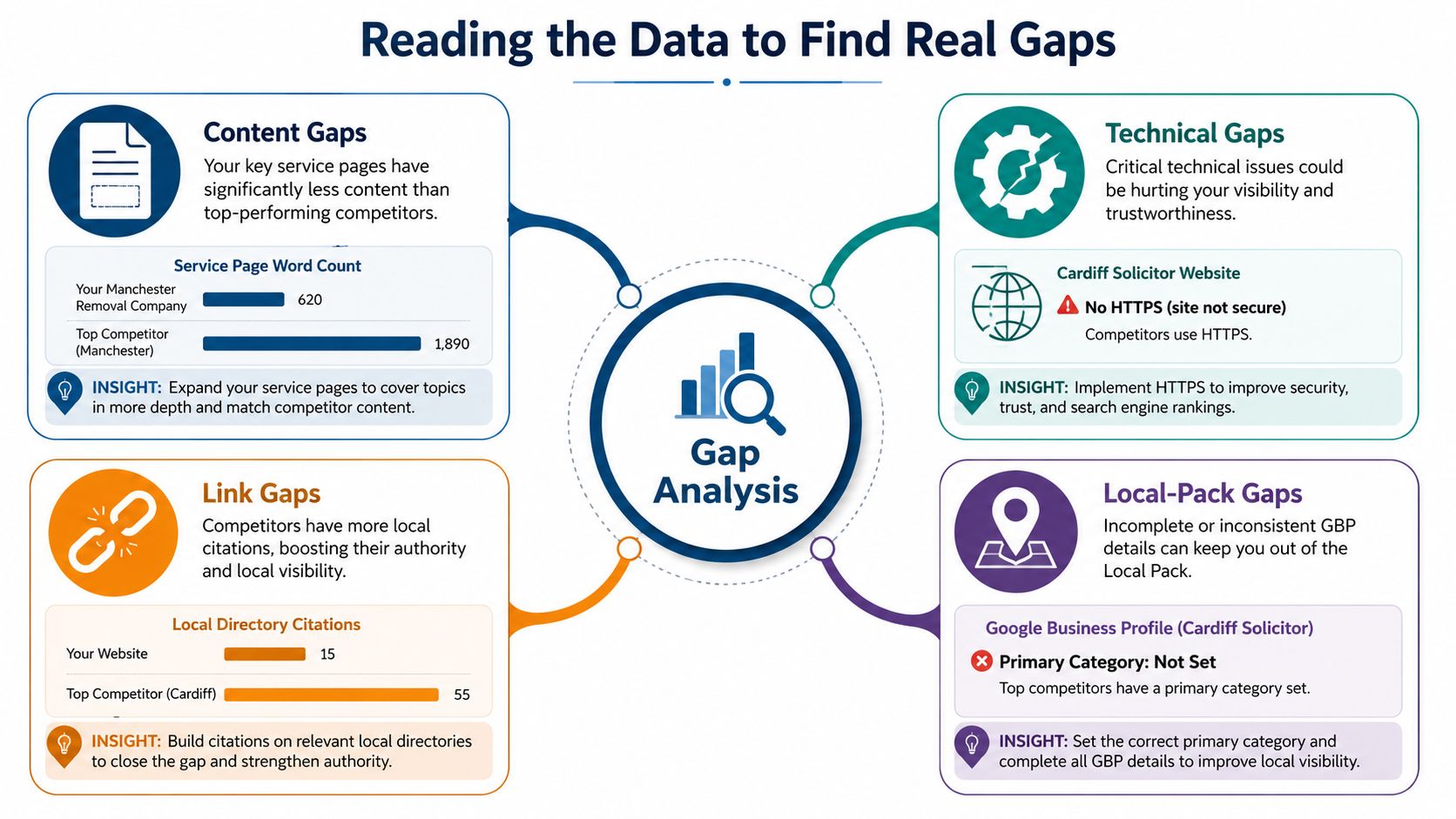
The raw numbers only start to matter once you sort content gaps, technical gaps, link gaps, and local-pack gaps into separate buckets. A Manchester removal company might have decent content but weak location pages, while a Cardiff solicitor could have solid service pages and still lose trust because the review themes do not match buyer concerns. Review counts matter, but review themes usually explain why one rival converts better than another.
The gap types that drive real outcomes
Content gaps appear when a rival answers more buyer questions, covers more service variants, or uses clearer language around price, process, and reassurance. Technical gaps are the less visible issues that still shape performance, such as crawlability, page speed, or schema that helps search engines understand the page. Link gaps show up when a rival has stronger citations, local mentions, or other authority signals that are hard to fake and expensive to ignore.
Local-pack gaps usually stand out once you know where to look. One rival may have a fuller Google Business Profile, another may have stronger categories, and a third may look more active through photos, posts, and review replies. That is why local SEO so often works as a trust exercise disguised as a rankings exercise.
How to prioritise what matters
A simple effort versus impact view helps sort the findings. Put the easiest, highest-value fixes in one corner, the big rebuilds in another, and the low-value distractions in the bin where they belong. If a rival wins because their GBP is complete and yours is half-baked, that is a quicker fix than rewriting twelve service pages from scratch.
For a Manchester removal firm, the meaningful gap might be that one competitor has stronger location-specific pages for the surrounding suburbs. For a Cardiff solicitor, the key gap may be that competitors are building trust through clearer service pages and stronger review narratives while the weaker site is still hiding behind legal boilerplate. For a salon owner, the same logic can be used to set referral KPIs for your salon, then compare those signals with local rivals.
If you feel pulled toward every gap at once, resist that instinct. Pick the few that sit closest to revenue and local visibility, then leave the rest for a later cycle. That keeps the work commercially sharp rather than academically impressive.
Picking Quick Wins and Avoiding Grey-Hat Traps
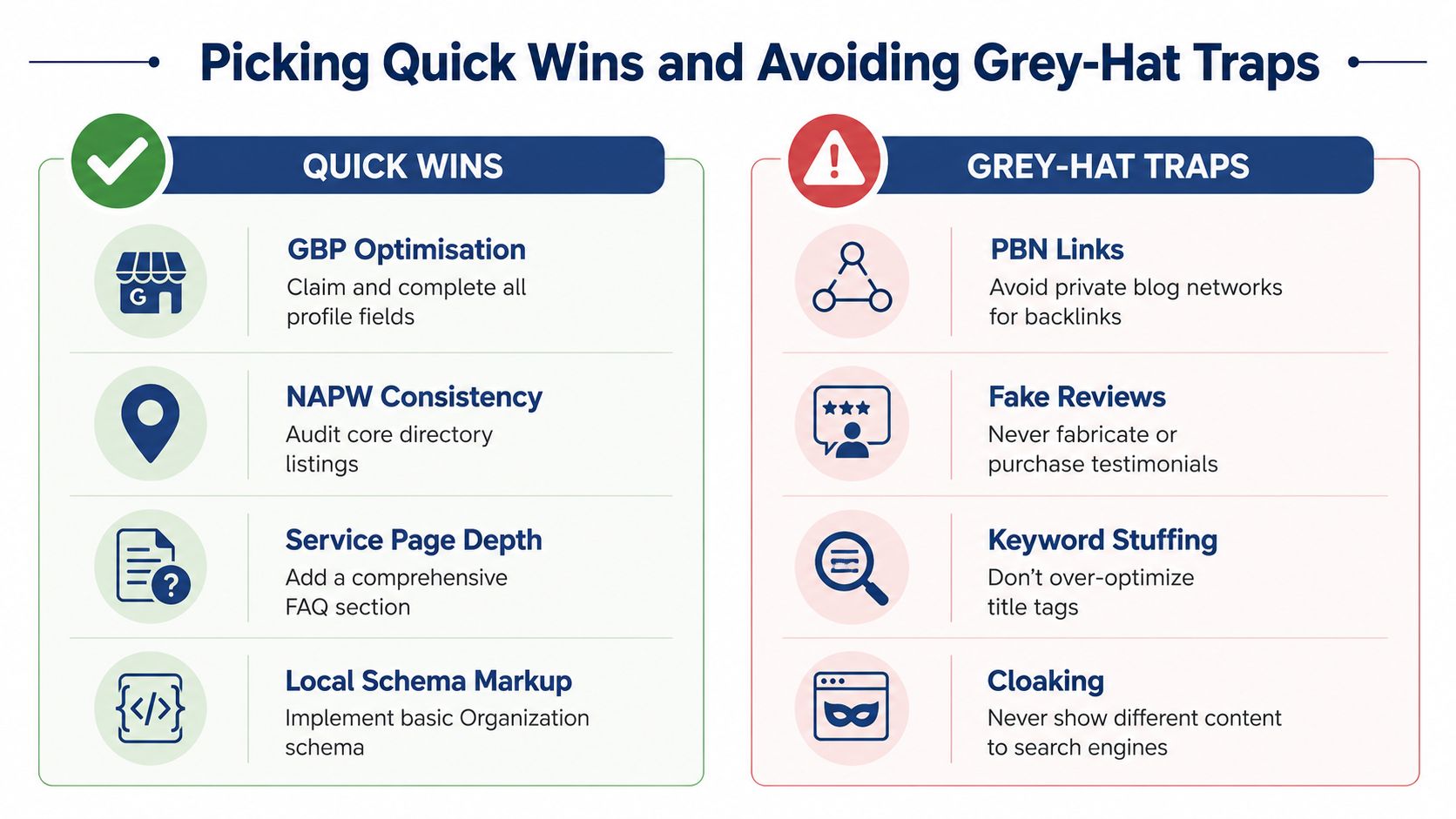
Most UK local-service businesses should fix the obvious wins first. That means GBP optimisation, NAPW consistency, review velocity, internal linking, and service-page upgrades before they rebuild the whole site or start doing anything daft with link schemes. The small stuff often wins because it removes friction, and local search is full of friction.
What to do first
A Surrey plumber staring at twelve opportunities can usually triage them into a 90-day backlog without drama. Four items might go straight into the “do this week” pile, such as completing the Google Business Profile, tightening directory consistency, refreshing the main service page, and improving internal links to the money pages. Another four might need structured content work, and the rest can wait until the first round has proven itself.
Practical rule: if a task improves trust, clarity, or local relevance without risking the account, it probably belongs near the top of the list.
The white-hat path is straightforward. It means real outreach, useful content, earned links, proper review collection, and technical fixes that make the site cleaner and easier to understand. Grey-hat tactics are the slippery middle ground, things like PBNs, paid link networks, manipulative review gating, and other schemes that look clever until they don't. Black-hat tactics, such as cloaking, spam, and hacked links, can torch a small business overnight and leave everyone pretending it was “just a temporary issue”.
A simple sorting habit
Use this quick lens when you're deciding whether a move belongs in the plan:
- White-hat: real content, real citations, real relationships, real improvements.
- Grey-hat: shortcuts that might work for a bit, but leave a mess behind.
- Black-hat: anything that's designed to deceive search engines or users.
One of the cleanest wins is often the most boring. A more complete service page with FAQs, better internal links, and a tidier GBP often beats a flashy but brittle tactic. That's not glamorous, but it is how a lot of local calls get won.
Your Repeatable Audit, Reporting and Action Plan
The best competitor analysis is the one you can run again next quarter without hating your life. A quarterly cycle keeps the work fresh, picks up new rivals, and stops your decisions going stale. It also suits the way local search behaves, because the top three pack results shift as Google tests new businesses, new review patterns, and new signals from the area.
A repeatable process works best if you focus on the rivals that keep taking the calls, not every business that appears on page one. In local markets, that usually means the current top three map pack listings, plus shadow competitors such as DIY providers, freelancers, and no-SEO operators who win on proximity, reviews, or a stronger Google Business Profile. A structured competitor workflow helps keep that focus tight without turning the audit into a spreadsheet exercise for its own sake.
The 30-day refresh sprint
Use the first month to confirm the competitive set, update your sources, and reset the benchmark metrics. If a rival disappears from the local pack, replace them. If a new one appears, add them. If your own rankings have shifted, document it before you touch the site so you can tell whether the next round of changes helped.
A simple reporting structure works well:
- Refresh the set: keep only the rivals that matter now.
- Audit the signals: content, technical, links, and local.
- Score the opportunities: note what's quick, what's hard, and what's pointless.
- Assign ownership: decide who does what and by when.
The audit and dashboard shape
A usable audit template should score each competitor across the same pillars, then list the top three opportunities in each. That gives you a clean comparison without pretending every site deserves equal attention. A monthly dashboard can then track local visibility changes, GBP shifts, review themes, citation consistency, and the status of the quick wins you already launched.
If you want a practical starting point, a practical local SEO audit guide is the sort of reference that helps you turn the findings into an actual site check rather than a pile of notes. Keep the dashboard simple enough that a busy owner can read it in two minutes.
When the process gets stuck
No time usually means the audit is too big. Cut the field. No access to tools usually means you're trying to measure too much. Cut the metrics. No clear owner usually means the work belongs to everyone and therefore no one. Name a person, then make the cadence visible.
The point is to build a habit, not a heroic one-off. Competitors keep changing their pages, reviews, and local signals, so your review process needs to keep pace. Keep an eye on the GBP behaviour, the citation profile, and the review themes that come up again and again. That is usually where the local gap shows up, not in clever tricks or noisy tactics.