Skip to content

You've got a website. It looks decent. Your mate said it was “proper smart”. You've claimed your Google Business Profile, added a few photos, and maybe even posted on it once before getting distracted by, well, running an actual business.
And yet the enquiries are wrong, patchy, or oddly far away.
A builder in Bristol gets form fills from Birmingham. A family solicitor in Leeds ranks for vague advice searches but not for “conveyancing solicitor Leeds”. A florist in York shows up if you search the business name, but not when someone nearby wants wedding flowers. It's maddening, because the problem usually isn't that local search “doesn't work”. It's that nobody has done a proper local SEO audit to find out what's broken, what's missing, and what competitors are doing better.
That's where most owners go astray. They guess. They tweak a page title, upload a logo, ask a cousin to “do some keywords”, then hope Google has a nice day and sends business over. Hope is lovely. It's also useless.
A good local SEO audit is a diagnostic. It tells you why you're not pulling in the right local work, where your visibility is leaking, and which fixes are worth your time. Better still, it stops you copying random tactics from Facebook groups full of confident nonsense. White hat work builds durable visibility. Grey hat shortcuts can look tempting but often age badly. Black hat tricks are the digital equivalent of buying a dodgy van from a bloke in a pub car park.
The smart move is simpler. Reverse-engineer what already works in your patch, benchmark your business properly, and build an action plan from evidence rather than hunches. That's the DigiVisi way. Less crystal ball, more clipboard.
Table of Contents
- Why Is Your Website Not Bringing In Local Work
- Pre-Audit Prep and Your Local SEO Toolkit
- Your Website's Digital Health Check
- Mastering Your Google Business Profile
- Analysing Your Local Reputation and Web Footprint
- The DigiVisi Method for Competitor Benchmarking
- From Audit Findings to Your Action Plan
Why Is Your Website Not Bringing In Local Work
A lot of local websites fail at one simple job. They don't make it obvious what the business does, where it works, and why someone nearby should trust it.
Take a plumber in Poole. The site says “professional plumbing solutions” and “high-quality services for residential and commercial clients”. Lovely. It also says absolutely nothing useful. There's no proper page for emergency call-outs in Poole, no mention of nearby service areas, no visible trust signals, and no clues that the business is active locally. Google has to guess. Customers do too. Neither likes guessing.
That's why a local SEO audit matters. It strips away the vanity bits and checks the things that affect local visibility and local conversions. Is your website easy to crawl? Does your Google Business Profile line up with the site? Are your contact details consistent across the web? Are your competitors winning because they've got better reviews, clearer service pages, and stronger local mentions? Or are they just keyword-stuffing themselves into a short-lived mess?
Practical rule: If your site could belong to any business in any town, it won't rank or convert well for your actual town.
The biggest shift comes when you stop asking, “Why am I not ranking?” and start asking, “What signals are the top local results sending that I'm not?” That's a much better question.
A family-run cleaning company in Nottingham, for example, might discover the issue isn't the homepage at all. It could be that rivals have proper pages for end-of-tenancy cleaning, office cleaning, and carpet cleaning, each tied to local areas they serve. The company's site, meanwhile, bundles everything onto one vague services page and wonders why enquiries are all over the shop.
A local SEO audit gives you a clean answer. Not magic. Not guru fluff. Just the evidence, the gaps, and the next moves.
Pre-Audit Prep and Your Local SEO Toolkit
A sloppy audit produces sloppy conclusions. Before touching a page title or fiddling with categories, get your evidence together.
Start with access, not assumptions
For a start, make sure you can see the platforms that matter. You want access to Google Analytics, Google Search Console, and your Google Business Profile. Without them, you're peering through the letterbox and pretending you know what's in the house.
If you're a Leeds solicitor trying to win more conveyancing work, you need to know which pages already attract impressions, which searches trigger your site, whether branded searches dominate everything, and whether your business profile is complete and active. If all you have is “I think traffic's down” from someone in the office, that's not audit data. That's office folklore.
Build a practical audit pack
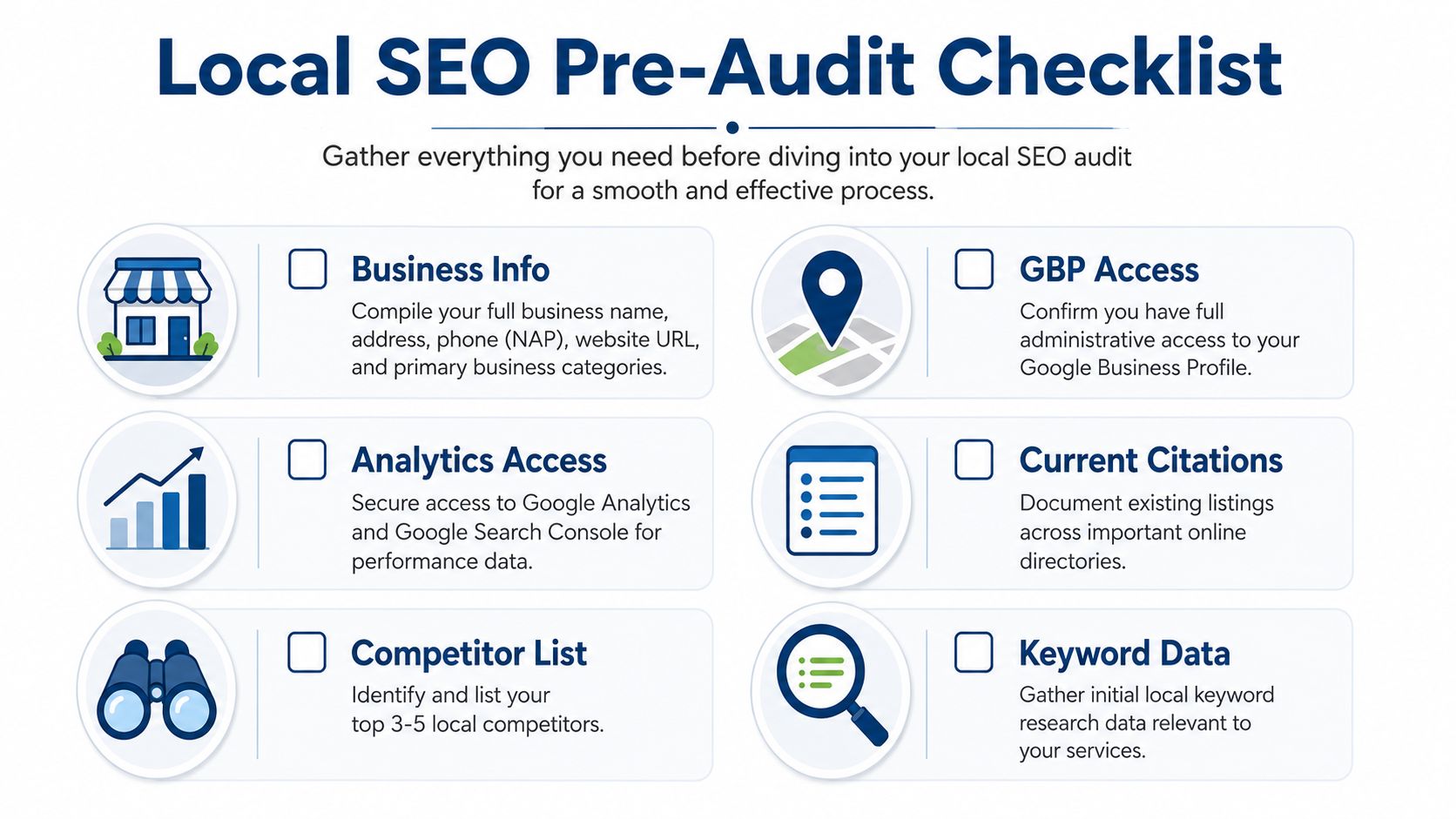
Gather these before you begin:
- Business details: Your exact business name, address, phone number, website URL, opening hours, and core service categories.
- Service area notes: The towns, boroughs, or postcodes you want work from. Not the fantasy map. The true one.
- Key landing pages: Homepage, service pages, location pages, contact page, and any high-intent blog content.
- Current listings: Your Google Business Profile, major directories, trade directories, local chambers, and any industry profiles.
- Competitor shortlist: The businesses that keep appearing when you search your main services locally.
- Review snapshot: A quick look at your latest reviews and your competitors' latest reviews.
The best audits start with boring admin done properly. Skip that, and the rest goes wonky.
Choose tools that answer real questions
Use free tools first. They're often enough for a small business audit done properly.
Google Search Console helps you spot which queries and pages already have local traction. Google Analytics shows where users land and whether they do anything useful after arriving. Google Business Profile Manager lets you inspect categories, photos, posts, services, and questions. Google Maps is essential for competitor checking, because local search looks different there than it does in plain organic results.
A browser extension that shows page titles, headings, canonicals, and indexability saves a lot of faffing. A crawler can help identify thin pages, broken internal links, and duplicate titles. A spreadsheet is still your best mate for comparing businesses side by side.
If you do want a paid platform, use it for speed and pattern-spotting, not as a substitute for judgement. A useful primer on tool selection is Monro Cloud's analysis of SERanking, which is handy if you're weighing up whether broader rank tracking and competitor views will effectively help your audit process.
What matters is this. Every tool should answer a specific local question. If it doesn't, it's just another shiny dashboard.
Your Website's Digital Health Check
Your website is your digital shopfront. If it creaks, confuses, or sends mixed signals, local search visibility suffers before a customer even gets the chance to mistrust your stock photo smile.
Check the basics on mobile first
Start on your phone, not your laptop. Most local customers won't sit at a desk to search “boiler repair Sheffield” or “emergency locksmith near me”. They'll search while standing in a hallway, on a pavement, or halfway through a mild panic.
Check whether your site loads cleanly, whether the phone number is tappable, and whether the key service information appears quickly. If the first screen is swallowed by a giant banner and a vague slogan like “trusted solutions for modern living”, that's not helping anyone.
Run through these essentials:
- Mobile layout: Menus should work, text should be readable, and forms shouldn't require finger acrobatics.
- Core contact paths: Phone, contact form, and directions should be easy to find.
- Indexability: Important service and location pages must be crawlable and not accidentally blocked or tagged out of search.
- Page basics: Titles, headings, and meta descriptions should reflect actual local services.
A decorator in Sheffield doesn't need a homepage that says “transforming spaces with passion”. They need pages that clearly target interior decorating in Sheffield, wallpaper hanging in Sheffield, and perhaps nearby areas they serve.
Audit pages for local intent, not waffle
Most weak local pages fail because they're generic. They read like they were written for every town in Britain and therefore help nobody in particular.
Check each service page against a simple test. Does it say what the service is, who it's for, where it's offered, and what happens next? If not, rewrite it. Keep the language natural. “Emergency electrician in York” can appear in a heading and body copy without sounding like a robot wrote it after a head injury.
Use location pages carefully. A good location page contains real local detail, service specifics, proof, and useful contact information. A bad one swaps “Leicester” for “Loughborough” across twenty near-identical pages and hopes for the best. That's edging into grey hat territory, and it usually looks grim.
A location page should answer a local customer's questions. If it exists only to stuff place names in, bin it and start again.
Here's a quick content MOT:
| Check | Good sign | Bad sign |
|---|---|---|
| Service page focus | One main service, clear town relevance | Everything jammed onto one page |
| Local wording | Natural mentions of service area | Place names repeated awkwardly |
| Calls to action | Clear next step | “Learn more” everywhere |
| Trust elements | Reviews, accreditations, FAQs, real photos | Empty claims and filler |
Tidy up trust signals and structure
Now inspect your NAPW, meaning name, address, phone, and website details. These should be consistent and easy to find. Put them in the footer, on the contact page, and anywhere else it makes sense without overdoing it.
Then look at internal linking. If your homepage mentions “roof repairs” and “gutter cleaning”, those phrases should point to the relevant pages. Don't make users hunt. Don't make Google infer structure from breadcrumbs and good manners.
Finally, check whether local business schema is present and sensible, whether duplicate pages are competing with each other, and whether old pages are still hanging around with no purpose. A site can look polished and still be a structural muddle underneath.
Clean architecture wins. Fancy jargon doesn't.
Mastering Your Google Business Profile
For local businesses, your Google Business Profile often does more heavy lifting than the website. It's the thing people see in Maps, in branded searches, and in those moments when they're choosing between you and the shop two streets over with the blurrier logo.
Audit the core profile fields properly
Start with the obvious fields, but don't stop at “it's filled in”.
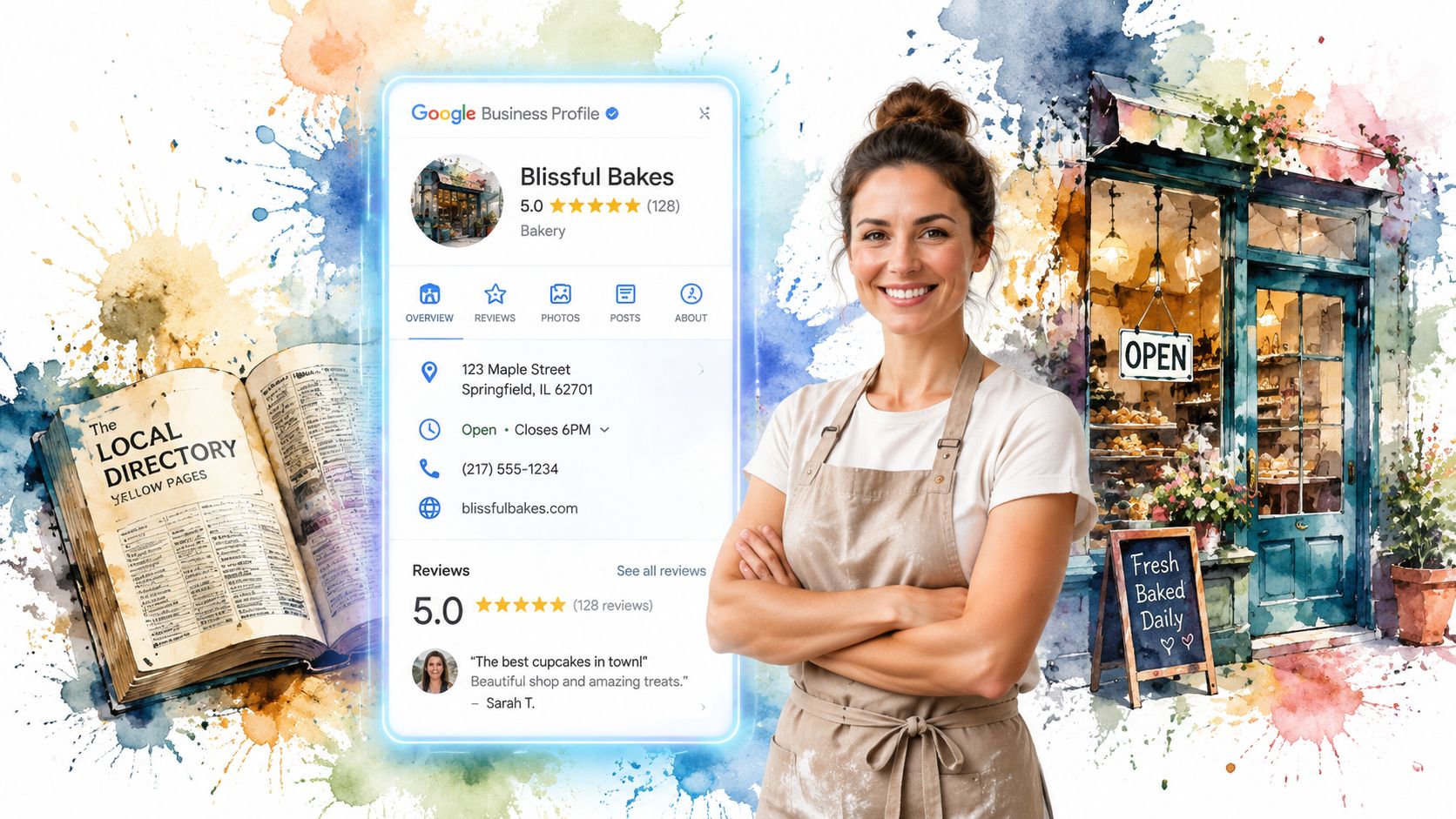
Check your business name, address, phone number, website link, opening hours, services, description, and categories. The primary category matters enormously because it frames what Google thinks you are. Secondary categories add breadth, but they shouldn't be a random grab-bag.
A bakery in Bath, for instance, might choose a primary category that reflects its actual main revenue driver. If celebration cakes are the focus, that should shape the setup more than a side line in coffee. Too many businesses pick categories based on ego rather than commercial intent.
Audit these profile elements one by one:
- Business name: Keep it accurate. Stuffing keywords into the name is a classic grey hat move. You'll see it about. It can produce short-term gains, but it's risky and often looks desperate.
- Description: Explain what you do, where you do it, and what makes you useful. No waffle.
- Services and products: Add real services customers search for. Don't leave this blank.
- Attributes: Fill in relevant options where available.
- Opening hours: Make them current, especially for bank holidays and seasonal changes.
Look for weak spots competitors exploit
A proper audit compares your profile against the top local pack listings. Not big national brands. Not firms outside your true service area. The businesses appearing when customers search.
Look at their categories, service naming, review recency, images, offers, and whether their profile feels alive. If they've got fresh reviews, regular updates, detailed services, and a fuller visual presence, Google and users both get stronger trust signals.
One thing you'll notice in many markets is competitors bending the rules. Keyword-stuffed names. Fake service area sprawl. Thin profiles propped up by dodgy tactics elsewhere. That's where it helps to know the line between white, grey, and black hat work.
White hat means accurate data, useful updates, genuine reviews, and profile completeness. Grey hat starts when businesses nudge naming conventions, overplay categories, or push thin local signals harder than they should. Black hat is fake reviews, fake listings, manipulated locations, and other nonsense that can unravel badly.
Don't copy a competitor just because they're visible. Some rankings are sturdy. Others are held together with digital chewing gum.
A quick explainer often helps if you want to sanity-check the moving parts of local profiles and visibility:
Use posts, photos and Q and A like a grown-up
Photos matter, but not because they're magical. They help users trust that your business is real, active, and local. Upload fresh images of your premises, team, work, vans, products, or completed jobs. Avoid a gallery full of generic graphics that look like they were pinched from a free template pack.
Keep an eye on the Q and A section too. If customers ask whether you cover a nearby village, offer emergency appointments, or stock a specific product, answer clearly. Better yet, add useful questions before confusion builds.
Google Posts can support visibility and conversion when they're tied to real services or seasonal demand. A garden centre can post about spring planting advice. A dentist can post about new patient appointments. A solicitor can highlight a practical FAQ on wills or conveyancing. Keep them specific, tidy, and relevant.
A neglected profile sends a message. So does a sharp one.
Analysing Your Local Reputation and Web Footprint
Your local presence doesn't stop at your site and your Google Business Profile. Search engines and customers both look wider. They notice whether your business is cited consistently, reviewed credibly, and mentioned in the right corners of the local web.
Citations need consistency, not chaos
A citation is any online mention of your business details. That might be a directory listing, a chamber profile, a local trade association page, or an industry-specific directory. The point isn't to spray your business into every dusty listing known to mankind. The point is consistency.
If your company is “Smith & Sons Heating Ltd” on one site, “Smith and Sons Plumbing” on another, with an old phone number lurking on a third, you're muddying trust signals. Local search thrives on clear identity.
Audit your citations with a spreadsheet. List the business name, address, phone, website, and category shown on each site. Flag anything inconsistent, incomplete, or outdated. Prioritise the listings that customers use and that regularly appear for local businesses in your sector.
A Manchester accountant might care about local directories, chamber pages, and sector directories. A restaurant in Brighton might have more reason to check consumer-facing review platforms and food directories. Different trades, different footprints.
Reviews tell you more than a star average
Most owners glance at reviews, see the stars, and move on. That's too shallow for a useful audit.
Read them. Look at what customers praise, what they complain about, and how recently the business has been reviewed. A competitor with fewer reviews but a steady flow of fresh, detailed feedback may look healthier than one with an old pile of generic praise and no recent activity.
Use this simple review lens:
- Recency: Are reviews still coming in, or has the profile gone quiet?
- Relevance: Do reviews mention the services you want to rank and convert for?
- Response quality: Are replies helpful, calm, and human?
- Pattern spotting: Do complaints reveal operational issues that damage trust?
Reviews are market research in disguise. They tell you what customers notice, what rivals deliver, and what language real people use.
That last point matters. If customers constantly mention “same-day boiler repair” in reviews, that phrase may deserve a more visible place in your service messaging.
Local links separate real authority from rubbish
Then there are links. Not all links are equal, and local SEO is full of dreadful advice from people who think quantity fixes everything.
A link from a local business association, a nearby supplier, a community event page, or a respected local publication can reinforce relevance and trust. A swarm of spammy directory links from irrelevant sites usually does the opposite. That's the black hat trap. It looks like momentum until it starts to smell.
Use a short comparison when reviewing links:
| Link type | Usually useful | Usually poor |
|---|---|---|
| Local relevance | Chamber, sponsor page, local press, suppliers | Unrelated foreign directories |
| Editorial value | Earned mention or sensible listing | Paid spam with no context |
| Brand alignment | Fits your area and service | Looks manufactured |
| User value | Someone might actually click it | Exists only for link manipulation |
A roofer in Newcastle doesn't need a bizarre pile of links from nonsense directories. They need a credible footprint that says, “This business exists here, works here, and is known here.”
The DigiVisi Method for Competitor Benchmarking
Most local businesses audit themselves in isolation. That's like revising for an exam without ever checking the mark scheme. The DigiVisi method fixes that. It starts with one blunt question: what are the top local competitors doing right now that search engines already reward?
Pick real local competitors
Your real competitors in local search aren't always the firms you worry about offline. They're the businesses repeatedly showing up for the services and locations you want.
Search your core terms in Google Search and Google Maps. Use location-specific phrases, service variants, and intent-led searches. A probate solicitor in Birmingham might check “probate solicitor Birmingham”, “will dispute solicitor Birmingham”, and related searches with nearby modifiers. Ignore giant national directories and focus on the recurring local businesses.
If you need a more technical route for gathering result data at scale, especially across different locations or keyword sets, this guide to choosing a SERP API is useful for understanding how people automate search result collection without relying on guesswork.
Once you've got your shortlist, keep it tight. You want the businesses that appear often enough to reveal patterns, not every company with a website and a logo.
Build a comparison sheet you can actually use
Run the same mini-audit on each competitor that you ran on yourself. That means website health, Google Business Profile detail, reviews, citations, local links, and page targeting. Put it all into one sheet so weaknesses jump out.
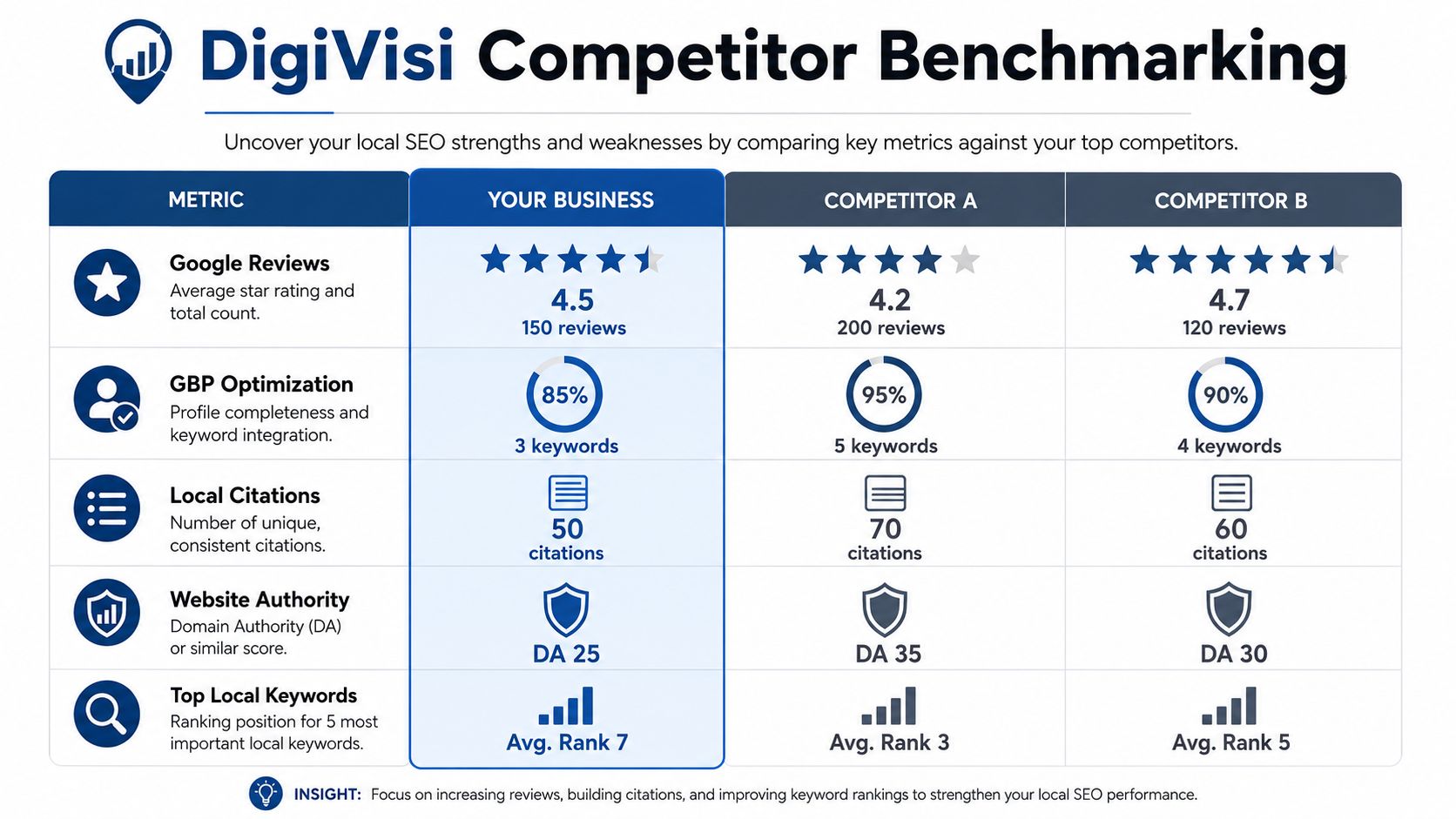
Here's the sort of comparison worth making:
- GBP quality: Which services do they highlight? How polished is the profile? Are they using posts and fresh images?
- Page targeting: Do they have separate pages for each service and town, or one woolly services page?
- Review themes: What do customers repeatedly praise or criticise?
- Citation spread: Where are they listed that you aren't?
- Link sources: Which local sites mention them?
- Conversion cues: Is their phone number obvious? Do their pages answer local questions better than yours?
For professional firms, there's often a useful overlap between local SEO and service-line structure. This is especially relevant if you're comparing specialist practices. A good example of that wider approach sits in this guide on SEO for professional services, where service clarity and authority signals matter just as much as local targeting.
Turn competitor signals into opportunities
Now, the method becomes useful rather than merely interesting. You're not copying competitors. You're extracting patterns and spotting gaps.
Maybe every top-ranking electrician in your area has a dedicated emergency page, while your site buries emergency call-outs halfway down the homepage. Maybe rivals have loads of local supplier links but weak service copy. Maybe their GBP profiles are tidy, but their review replies are robotic and their Q and A sections are neglected. Those are opportunities.
Use a simple benchmark frame:
| Area | Competitor strength | Your response |
|---|---|---|
| Service pages | Better local targeting | Build clearer pages by service and area |
| Reviews | More detailed service mentions | Request reviews around priority services |
| Citations | Present on key local directories | Clean up and expand quality listings |
| Links | Better local mentions | Pursue relevant partnerships and coverage |
Good benchmarking doesn't ask, “How do we copy them?” It asks, “Which signals matter here, and where can we beat them cleanly?”
That last word matters. Cleanly. You can borrow the logic of what works without borrowing the dodgy bits. If a rival ranks with a stuffed business name and a junky link trail, the lesson isn't “do that too”. The lesson is “they're visible despite weak fundamentals, which means solid fundamentals may be enough to overtake them.”
That's the lovely bit. Competitor research often shows that local markets are far less advanced than they look.
From Audit Findings to Your Action Plan
An audit becomes valuable the moment it turns into decisions. Before that, it's just a pile of observations and a spreadsheet that slowly starts to haunt you.
Score each area before you start fixing things
Give each audit area a simple status such as strong, adequate, or weak. You don't need a theatrical scoring model with seventeen coloured tabs and a dashboard that looks like mission control. You need a clear view of what's hurting visibility and what's already in decent nick.
Assess your website, Google Business Profile, citations, reviews, links, and competitor gap side by side. If your service pages are weak, your profile is decent, and your citations are messy, that tells you where to focus first. If competitors are outperforming you mainly through stronger page targeting and better review quality, that's useful. If they only look stronger because they're pushing grey hat naming tricks, that's useful too.
Use effort versus impact to stop busywork
Now prioritise each fix by impact and effort. This stops businesses wasting weeks polishing bits that won't move the needle.
Here's a straightforward matrix:
| Prioritisation Matrix | Low Effort | High Effort |
|---|---|---|
| High Impact | Update GBP categories and services, fix NAPW inconsistencies, improve titles and headings on core service pages | Rebuild thin service pages, create proper location pages, earn stronger local links |
| Low Impact | Refresh photo gallery, tidy old directory descriptions, improve minor metadata | Redesign non-priority pages, rewrite low-value blog posts, chase irrelevant listings |
If you only have a few hours a month, start in the top-left box. If you've got more resource, plan the bigger projects without letting them block the quick wins.
Report it simply so it gets done
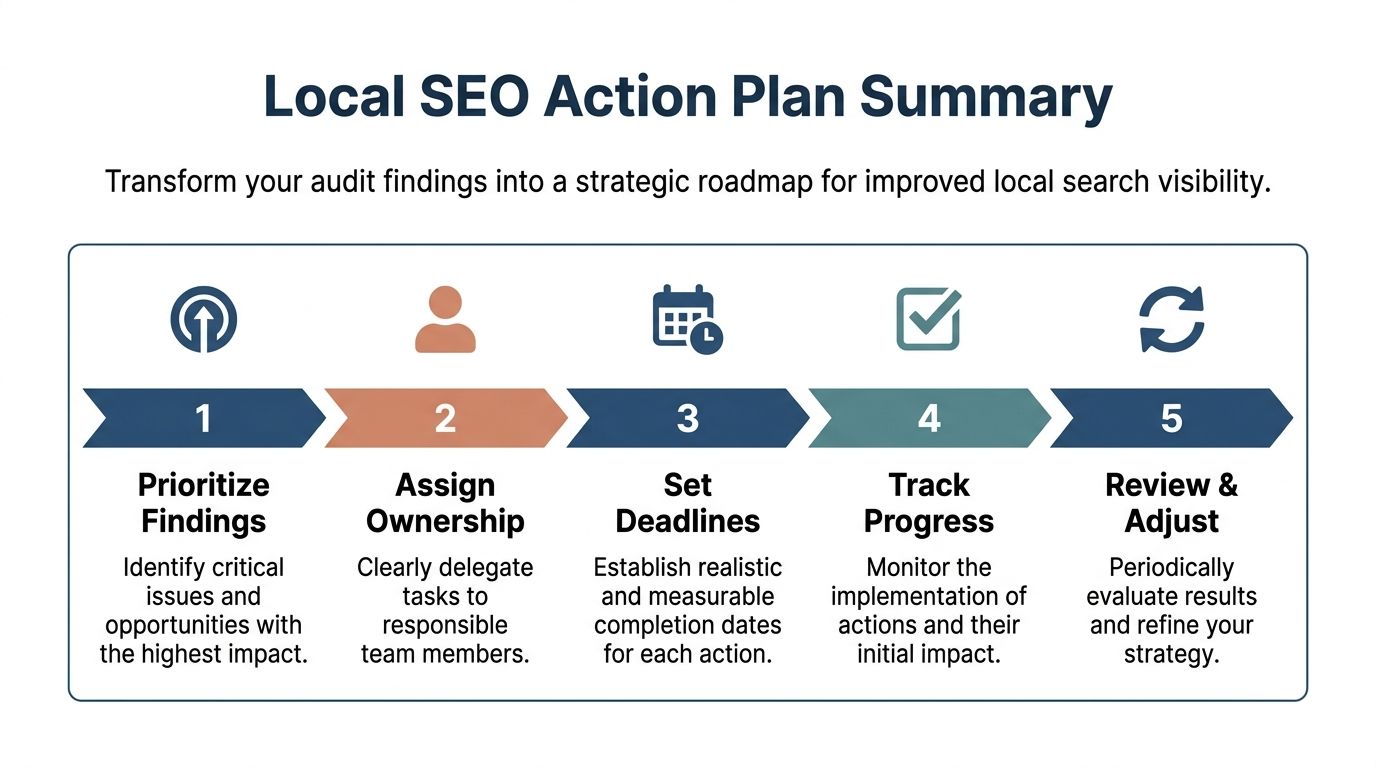
Keep the final action plan short enough that someone will use it. A practical format looks like this:
- Issue: What's wrong.
- Why it matters: What visibility or conversion problem it causes.
- Fix: The action required.
- Owner: Who's responsible.
- Priority: High, medium, or low.
- Deadline: A real date, not “ASAP”.
The best local SEO audit ends with a to-do list clear enough to hand to a colleague without a half-hour explanation.
For example, a Bristol removals company might list “create dedicated office removals page” as a high-impact job, “correct old phone number on local directories” as a quick win, and “gain links from local business groups” as a longer-term authority task. That's tangible. That gets done.
A proper action plan also forces honesty. Some fixes are cosmetic. Some are structural. Some should wait. The discipline is knowing the difference.
If you'd rather have an expert pair of eyes do the heavy lifting, DigiVisi Ltd helps UK service businesses turn local SEO audits into practical growth plans built on competitor analysis, clear reporting, and fixes that lead to more calls, enquiries, and sales.