Skip to content
Google’s AI Overviews now appear in nearly half of all search queries, and AI chatbots like ChatGPT, Perplexity, and Gemini are becoming primary research tools for millions of users.
If your website isn’t showing up in these AI-generated answers, you’re losing visibility you might not even realise is slipping away.
The old SEO playbook still matters, but it’s no longer enough on its own. Running an audit of your site for AI search readiness is now a practical necessity, not a future concern.
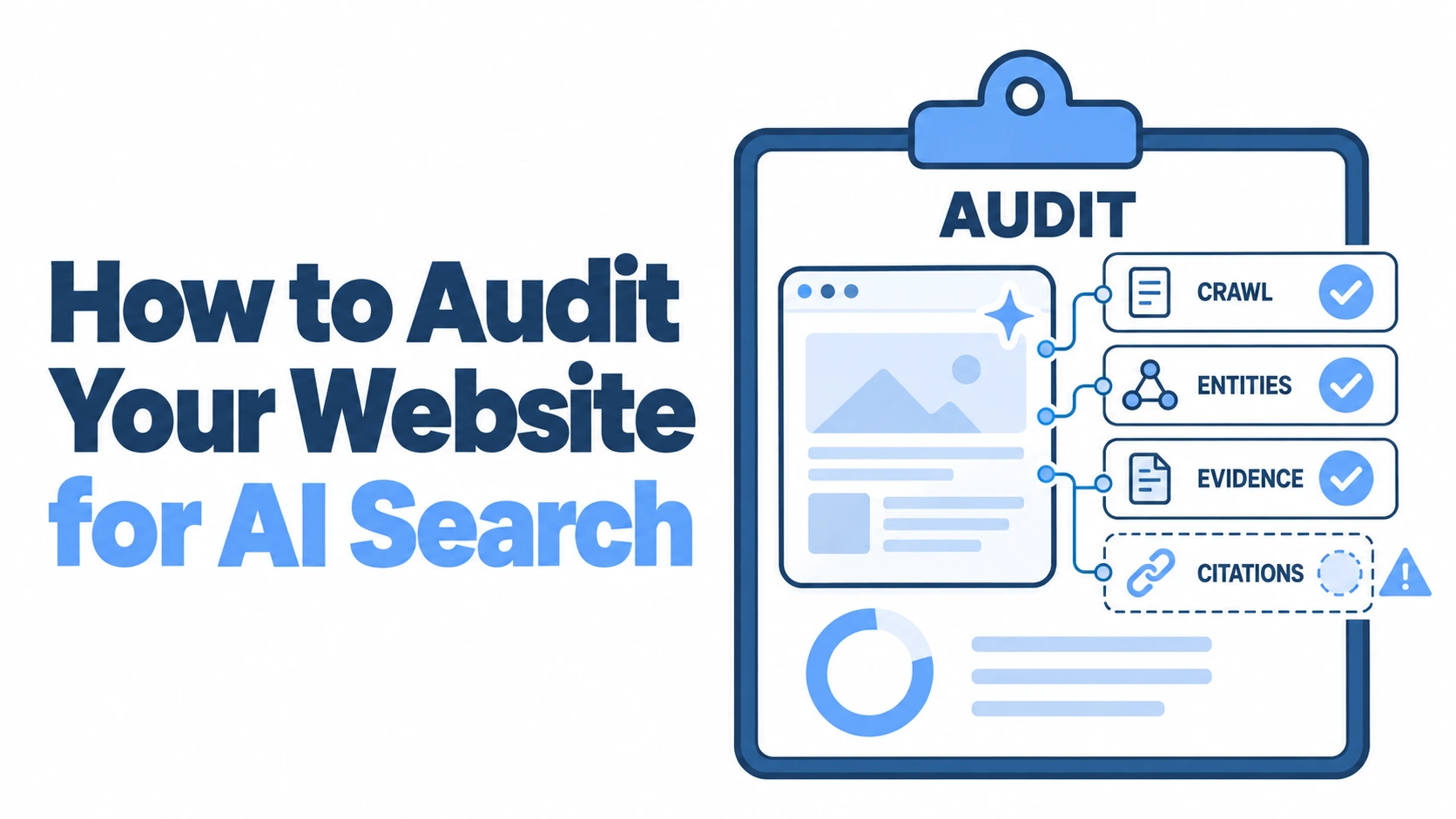
This guide walks you through a structured process: from understanding how AI engines actually work to evaluating your content, technical setup, authority signals, and performance tracking.
Whether you’re an SEO professional or a business owner managing your own site, these steps will help you identify gaps and fix them before your competitors do.
Understanding AI Search Engines and LLM Optimisation
AI search engines don’t work the way traditional search does. Instead of matching keywords to indexed pages and ranking them by backlinks, large language models (LLMs) synthesise information from multiple sources to generate a single, conversational answer. Your content might be used as a source, quoted directly, or ignored entirely, and the factors that determine which outcome you get are different from classic ranking signals.
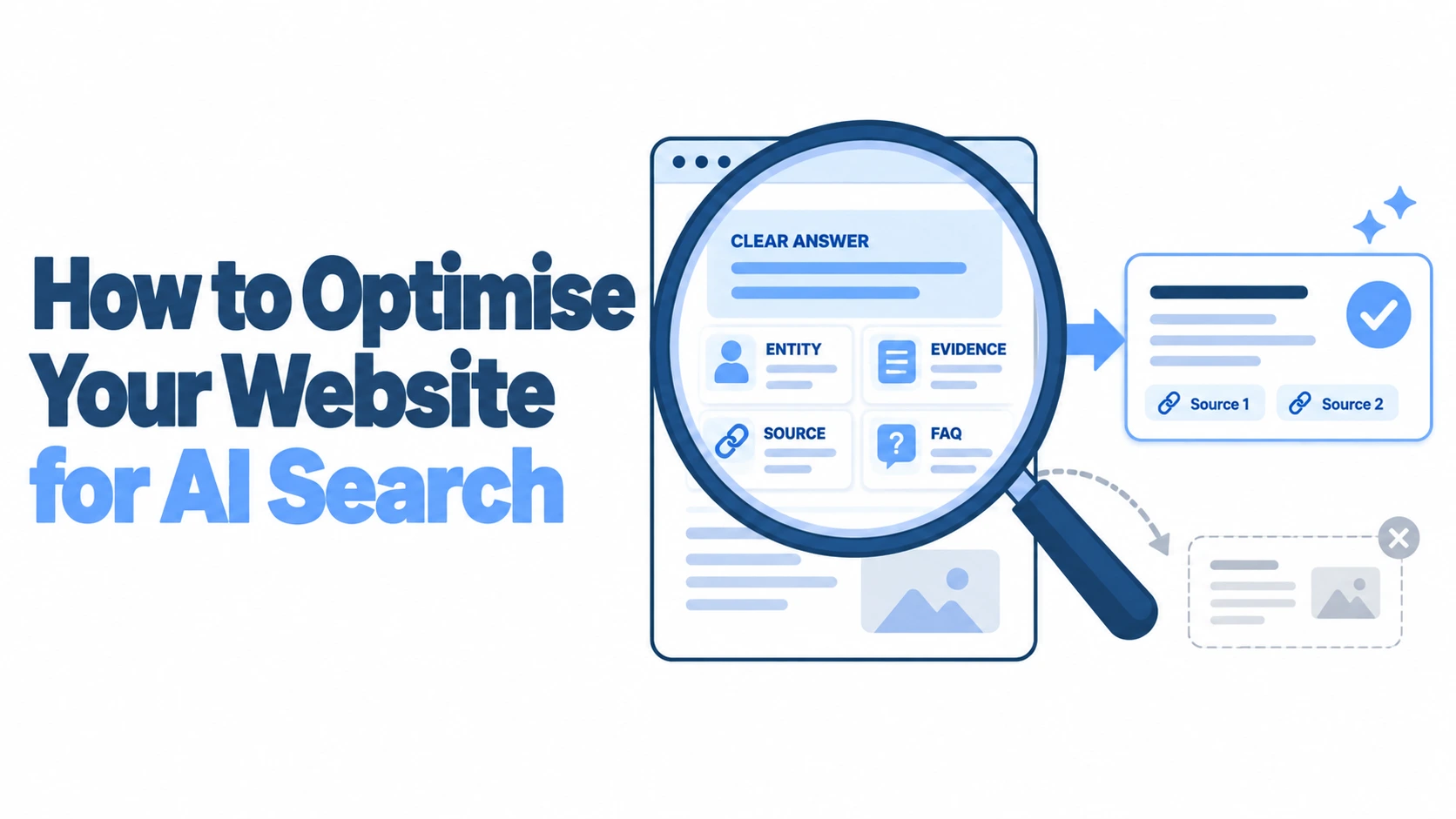
The first step in auditing your website for AI search is understanding what these systems actually value: clear, well-structured information that directly answers questions, strong entity associations, and demonstrated expertise.
The Shift from Keywords to Natural Language Entities
Traditional SEO trained us to think in keywords. AI search thinks in entities and relationships. An entity is a distinct concept: a person, product, place, or idea that an LLM can identify and connect to other concepts. When Google’s AI Overview answers a question about “best running shoes for flat feet,” it’s not just matching those words. It’s identifying the entity “running shoes,” the attribute “flat feet,” and pulling from sources that demonstrate clear understanding of the relationship between them.
Your audit should examine whether your content defines entities clearly. Do your product pages explain what something is, not just what it does? Do your articles establish relationships between concepts? If your content reads like a list of keywords strung together, LLMs will likely skip it in favour of sources that present information more naturally.
How AI Overviews and Chatbots Process Web Data
AI Overviews and chatbot responses are generated through a combination of retrieval and generation. The system first retrieves relevant content from its index or training data, then generates a response that synthesises that information. This means your content needs to be both retrievable (properly indexed, crawlable, and structured) and useful for synthesis (clear, specific, and authoritative).
Chatbots like Perplexity actively crawl the web in real time, while others rely more heavily on pre-trained data. Your audit needs to account for both scenarios. Can AI crawlers access your content? And is your content structured in a way that makes it easy for a model to extract and cite specific claims?
Analysing Content Depth and Semantic Relevance
Thin content has always been a liability, but AI search raises the bar considerably. LLMs favour sources that provide comprehensive, nuanced coverage of a topic because those sources are more useful for generating accurate answers. A 300-word blog post that skims the surface won’t compete with a detailed guide that covers edge cases, provides examples, and offers original analysis.
Auditing for Information Gain and Unique Perspectives
Google’s information gain patent, which measures how much new information a page adds beyond what’s already available, is particularly relevant here. AI systems are trained to identify and prioritise novel information. If your content simply restates what ten other sites have already published, it offers zero information gain.
During your audit, ask these questions about each key page:
- Does this page contain original data, research, or firsthand experience?
- Does it offer a perspective or framework not found elsewhere?
- Are there specific examples, case studies, or numbers that are unique to your site?
- Could an LLM learn something new from this page that it couldn’t get from competitors?
Pages that fail these tests should be flagged for rewriting or consolidation.
Mapping Content to User Intent and Direct Answers
AI search is fundamentally answer-driven. Users ask questions, and the system provides direct responses. Your content audit should map each page to the specific questions it answers, then evaluate whether those answers are clear and easy to extract.
Look at your highest-traffic pages and identify the implicit questions behind them. Then check: does the page actually answer those questions within the first few paragraphs, or does it bury the answer under filler? LLMs tend to pull from content that provides concise, direct answers early, then supports them with detail. Restructuring your content to lead with answers and follow with evidence can significantly improve your chances of being cited.
Evaluating Technical Readiness for AI Crawlers
Content quality means nothing if AI systems can’t access your pages. The technical side of an AI search audit overlaps with traditional technical SEO but includes several additional considerations specific to how LLMs and their associated crawlers interact with your site.
Optimising Schema Markup for Entity Recognition
Schema markup (structured data) helps AI systems understand what your content is about at a machine-readable level. While schema has been important for traditional rich snippets, it’s even more critical for AI search because it explicitly defines entities and their attributes.
Your audit should check for:
- Organisation and Person schema on relevant pages
- Article and FAQ schema on content pages
- Product schema with complete attributes (price, availability, reviews)
- HowTo schema for instructional content
- Proper nesting and validation (use Google’s Rich Results Test)
Pay special attention to the “about” and “mentions” properties in your Article schema. These help AI systems understand which entities your content covers, making it easier for them to match your pages to relevant queries.
Managing Robots.txt and Permissions for AI Agents
This is one of the most overlooked aspects of AI search readiness. Several AI crawlers use distinct user agents: GPTBot (OpenAI), ClaudeBot (Anthropic), PerplexityBot, and Google-Extended (Google’s AI training crawler). If your robots.txt file blocks these agents, your content won’t appear in their responses.
Check your robots.txt file for any blanket disallow rules that might unintentionally block AI crawlers. Some sites block all unknown bots by default, which can prevent AI indexing entirely. You’ll need to make a deliberate decision about which AI agents you want to allow, but blocking them all means opting out of AI search visibility completely. Review your server logs to see which AI bots are already crawling your site and how frequently.
Assessing E-E-A-T and Digital Authority
Experience, Expertise, Authoritativeness, and Trustworthiness (E-E-A-T) have been central to Google’s quality guidelines for years. For AI search, these signals matter even more because LLMs need to determine which sources are credible enough to cite in their generated answers. A page with no clear author, no citations, and no demonstrated expertise is unlikely to be selected as a source.
Verifying Author Credentials and Citations
Start by auditing your author pages. Every piece of content on your site should have a clearly attributed author with a bio that establishes relevant credentials. If your blog posts are attributed to “Admin” or your company name with no individual byline, fix that immediately.
Check whether your content cites reputable sources. LLMs are trained to recognise citation patterns, and content that references peer-reviewed studies, official statistics, or recognised industry sources carries more weight. Your audit should also verify that outbound links point to live, authoritative pages rather than broken URLs or low-quality sources.
Author schema markup should connect each author to their other published work, social profiles, and professional credentials. This creates a web of entity associations that helps AI systems verify expertise.
Monitoring Brand Mentions Across LLM Training Sets
Your brand’s presence in AI training data affects how often LLMs mention or recommend you. While you can’t directly control what’s in a model’s training set, you can monitor how AI systems currently represent your brand. Ask ChatGPT, Gemini, and Perplexity about your company, products, or key topics in your space. Note whether they mention you, whether the information is accurate, and how you compare to competitors in their responses.
If AI systems have outdated or incorrect information about your brand, increasing your presence on high-authority sites that are likely included in training data (Wikipedia, major publications, industry directories) can help correct this over time. Consistent NAP (Name, Address, Phone) information across the web also strengthens entity recognition.
Measuring Performance in an AI-First Search Landscape
An audit is only useful if you can track improvements over time. Traditional metrics like organic traffic and keyword rankings still matter, but they don’t capture the full picture of AI search performance. You need new measurement approaches.
Tracking Visibility in AI Overviews and Answer Boxes
Several tools now track whether your site appears in AI Overviews and chatbot responses. Platforms like Profound, Peec AI, and Otterly.ai monitor your brand’s visibility across AI search engines. Google Search Console has also expanded its reporting to include AI Overview impressions in 2026.
Set up tracking for your most important queries and monitor:
- How often your site is cited in AI Overviews
- Which specific pages are being referenced
- How your visibility compares to competitors for the same queries
- Whether AI chatbots recommend your brand when asked relevant questions
This data will tell you which parts of your audit are working and where you need to focus next.
Developing a Long-Term AI Search Maintenance Plan
Auditing your site for AI search isn’t a one-time project. AI algorithms, crawler behaviours, and user patterns are shifting constantly. Build a recurring audit schedule: quarterly is a reasonable cadence for most sites, with monthly checks on key metrics.
Your maintenance plan should include regular content freshness reviews (AI systems favour up-to-date information), ongoing schema validation, periodic checks of robots.txt permissions as new AI crawlers emerge, and monthly monitoring of how AI platforms represent your brand. Document your baseline metrics now so you can measure progress accurately.
Assign ownership of AI search performance to a specific person or team. Without clear accountability, these tasks tend to fall through the cracks as traditional SEO demands take priority.
Building Your AI Search Audit Into a Repeatable Process
The sites winning in AI search right now share a few common traits: they provide genuinely useful, original content; they make that content technically accessible to AI crawlers; and they’ve built clear authority signals that LLMs can verify. Your audit should evaluate all three dimensions and produce a prioritised list of fixes.
Start with the highest-impact items: unblocking AI crawlers in robots.txt, adding author attribution to key content, and restructuring your most important pages to lead with direct answers. Then work through schema improvements, content depth enhancements, and authority building over time. The sites that treat AI search readiness as an ongoing discipline rather than a one-off checklist will be the ones that maintain visibility as this space continues to evolve.