Skip to content

You've paid for clicks, watched the traffic arrive, and still can't answer the question that matters: which enquiries became real work? A plumber in Manchester might see a healthy-looking campaign while genuine calls disappear into a mobile phone, and a Bristol solicitor might count form submissions without knowing whether anyone booked a consultation. Google Ads conversion tracking is what turns that fog into useful evidence.
Done properly, it records meaningful actions after an ad interaction, including form fills, phone calls, bookings and purchases. Done carelessly, it can count button clicks, duplicate submissions and low-quality enquiries as if they were revenue. The difference is not a clever dashboard. It's whether the tracking reflects how the business wins work.
Table of Contents
- Why Conversion Tracking Matters for Local Service Businesses
- Choosing the Right Conversions to Track and How to Count Them
- How to Set Up Google Ads Conversion Tracking Without the Headache
- Staying Compliant in the UK While Keeping Your Data Accurate
- Verifying Tracking and Turning Conversions Into Real Business Results
- Your Next Steps to Smarter Bidding and Steady Enquiries
Why Conversion Tracking Matters for Local Service Businesses

A Manchester plumber can spend money on searches for emergency repairs, boiler servicing and bathroom installation, then open Google Ads to see clicks and impressions. Without conversion tracking, those figures say very little about whether the phone rang, whether somebody completed a quote form, or whether the job was worth pursuing. The account may look busy while the diary remains suspiciously quiet.
Google defines Conversions as the total number of conversions within the chosen conversion window after an ad click or another ad interaction. Cost per conversion is calculated by dividing total cost by total conversions, as set out in Google's UK conversion tracking documentation. In plain English, the platform can help answer, “How many meaningful actions did advertising generate, and what did each one cost?”
That's the useful starting point, not the finish line. A form submission is an enquiry, not automatically a booked job. A phone call can be a serious prospect, a supplier, or someone asking whether you buy old radiators. Measurement must follow the customer journey far enough to support a commercial decision.
Clean data beats impressive data
White-hat tracking records genuine actions, respects consent and gives bidding systems signals that resemble reality. Grey-hat shortcuts often inflate performance by counting weak interactions, while black-hat tactics manipulate reporting or create artificial activity. Those approaches might make a monthly report look cheerful, but they leave the owner making budget decisions on fiction. A shiny lie is still a lie, even if it has a pie chart.
Reliable conversion data lets you compare campaigns, search terms, locations and services with more confidence. It also gives Google Ads a better basis for automated bidding, provided the conversion actions are defined properly and the account receives useful quality feedback.
Practical rule: Track the action that matters to the business, then keep asking whether that action led to a sale.
For a local firm, the objective isn't maximum click volume. It's more of the right calls, better enquiries and jobs that fit the service area and capacity. Tracking is the foundation that makes those decisions possible.
Choosing the Right Conversions to Track and How to Count Them
Start with a conversion plan before anyone touches Google Tag Manager. Write down the actions a customer can take, then separate actions that indicate genuine intent from actions that merely show curiosity.
A tree surgeon might track a completed quote form, a call from an advert, a call from the website and an appointment confirmed by staff. A Leeds café could track a completed booking rather than counting every visit to its reservations page. The useful event is the completed action, not the hopeful wobble of a cursor near a button.
Select meaningful actions
Use separate conversion actions where the business decisions differ:
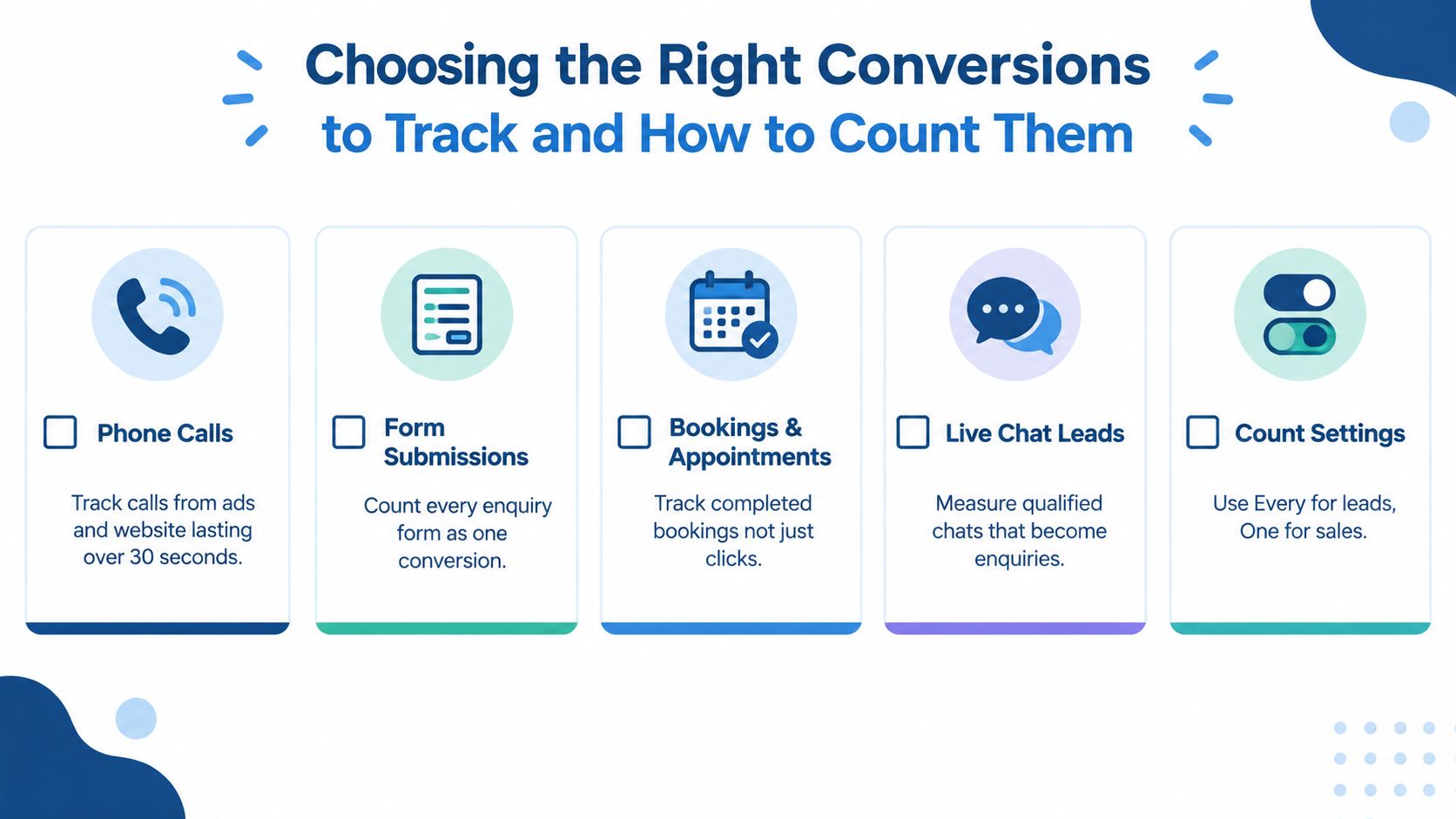
- Form submissions: Count a valid quote, contact or appointment form after successful submission. A confirmation page or reliable data-layer event is stronger than tracking a submit-button click.
- Phone calls: Separate calls from ads and calls generated after a visitor reaches the website. A solicitor may value a consultation call differently from a general enquiry.
- Bookings: Track completed bookings, not merely clicks on a calendar widget. A Leeds café booking page should report the reservation confirmation, not every person who inspected the menu.
- Live chat leads: Treat a chat as a conversion only when it produces a meaningful enquiry. Counting every automated greeting will make the account feel busier than it is.
- Offline outcomes: Import qualified leads, booked jobs or closed sales from the CRM. Google Ads conversion tracking then starts to reflect business value rather than just digital activity.
Choose the right counting rule
For lead-generation actions, set counting to One. That prevents several visits or repeated submissions from turning one potential customer into a small crowd of phantom customers. The verified UK guidance for service-business setups recommends treating forms, calls and offline lead quality as separate actions, with lead actions counted as “One” to avoid inflated repeats, as described in this UK lead-tracking guidance.
Every" has a place, particularly where each transaction matters. An online retailer may count each purchase, while a service firm usually wants one meaningful lead per ad interaction. Don't choose “Every” because a larger number looks encouraging.
Assign values without pretending
A lead can have a value, but the value needs a defensible basis. You might assign different values to a boiler replacement enquiry, a routine service request and a commercial installation lead, provided those distinctions reflect how the business earns money.
Keep enquiry types separate rather than blending everything into “lead”. If a Bristol solicitor receives family-law and conveyancing enquiries, the CRM should preserve that service information. Later, you can compare which campaigns produce booked consultations, not just which ones generate forms.
How to Set Up Google Ads Conversion Tracking Without the Headache
The smoothest implementations begin with a decision, not a tag. Decide what must be measured, where the successful action occurs, and whether the business needs only online events or also closed-job information from a CRM.
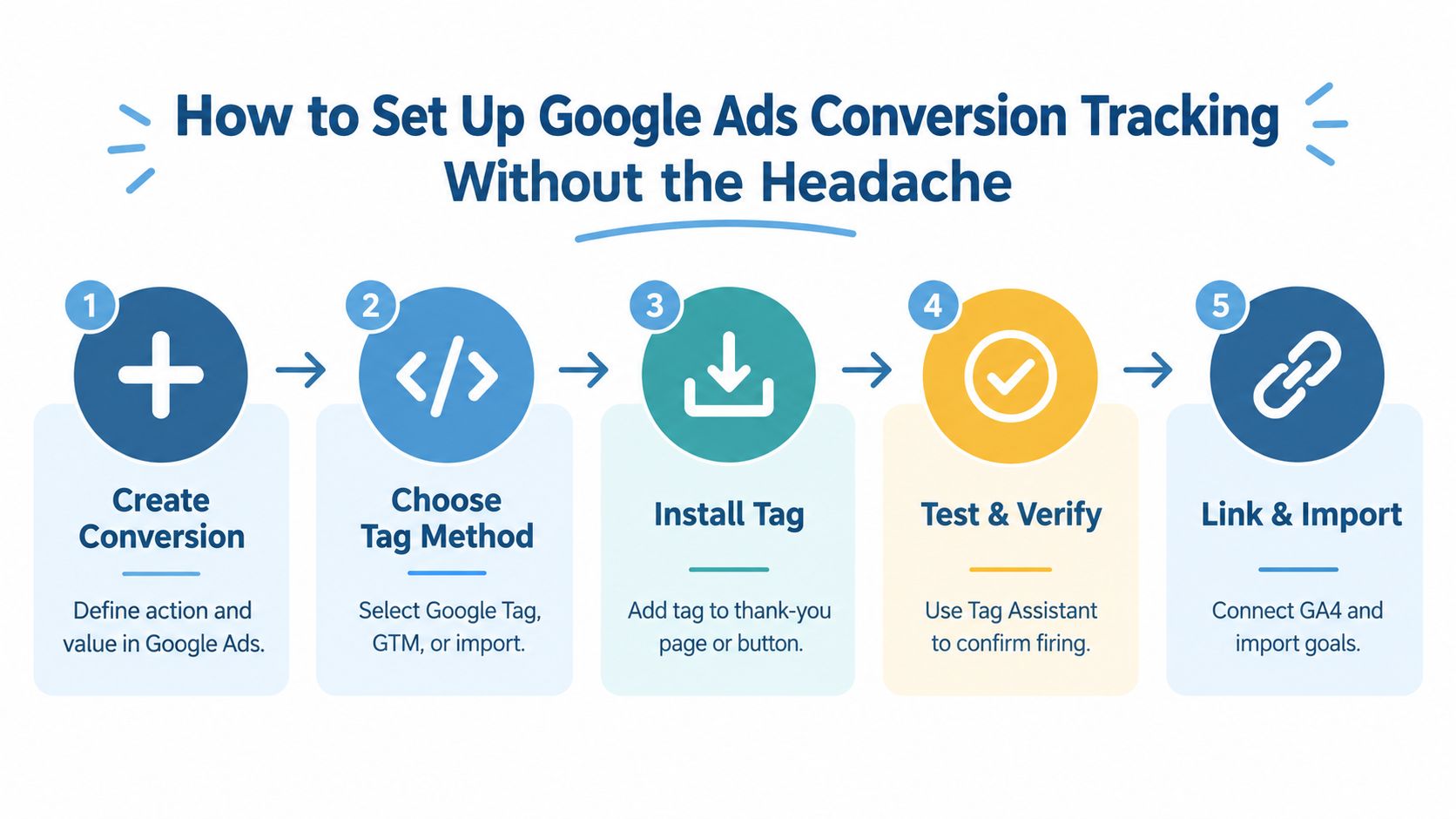
Google's UK documentation says the Google tag should be installed on every page, with an event snippet or phone snippet added according to the conversion type. Website conversions can use the Google Ads conversion tag or imported Google Analytics key events, so the best route depends on the site, the analytics setup and how much control the team needs.
Build the online foundation
Create the conversion action in Google Ads first. Define the category, name, counting method and value, then record the conversion ID and label if you're using Google Tag Manager. Naming matters. “Manchester Boiler Quote Form” tells a future account manager far more than “Lead 1”.
You'll generally choose from these routes:
- Google tag and event snippets: Install the Google tag across the site, then use the relevant event or phone snippet for the action. This suits a straightforward website where a developer can place code accurately.
- Google Tag Manager: Use GTM when several tags, triggers and consent rules need central management. Create clear triggers for successful form events, confirmation pages or telephone interactions, and test them before publishing.
- Google Analytics import: Import relevant GA4 key events where the analytics implementation is already dependable and the event definitions match the Google Ads goal. Don't import every interesting interaction and call it a business conversion.
- Enhanced conversions for web: Use consented first-party details such as an email address or phone number where appropriate. Google says enhanced conversions hash consented first-party data and match it with signed-in Google accounts, improving attribution in a privacy-focused environment. That can strengthen measurement, but it still doesn't prove that a lead became revenue.
The following table keeps the choice practical:
| Business situation | Recommended method | Why it fits |
|---|---|---|
| Simple brochure site with a reliable thank-you page | Google tag with an event snippet | A direct implementation can be easy to maintain |
| Several forms, call actions and marketing tags | Google Tag Manager | Central triggers and testing make changes more manageable |
| Mature GA4 event setup | Import Google Analytics key events | Useful when existing events already match business goals |
| Lead forms collect consented customer details | Enhanced conversions for web | Adds privacy-aware matching signals |
| Calls and enquiries become jobs after staff follow-up | Offline conversion imports | Connects advertising data with CRM outcomes |
A medspa with multiple treatment forms, consultation requests and phone enquiries may need a more structured setup. Guidance on services for medspa owners can be useful when the website has several customer journeys that need to remain distinct.
Add offline outcomes
Online tracking records the form submission. Offline imports record what happened next. Store the relevant Google click information and connect it to the CRM record, then upload the outcome when staff qualify the enquiry, book the job or close the sale. The exact fields depend on the CRM and import method, but the principle is simple: pass back a trustworthy business result.
For a Bristol tree surgeon, the useful chain might be ad click, quote form, qualified enquiry, site visit and booked work. Google Ads can't infer every commercial outcome from a thank-you page. Your team has to reconcile the records.
Watch the implementation
This short walkthrough is useful before you publish a container:
Test the success event in production conditions, not just in a comfortable preview environment. Check that the event fires once, the correct conversion action receives it, consent rules behave as intended, and phone tracking uses the appropriate snippet or call setup.
Avoid black-hat tricks such as firing a conversion when someone lands on a contact page or using fake success messages to boost totals. Those tactics damage optimisation and make the eventual CRM comparison painful.
Staying Compliant in the UK While Keeping Your Data Accurate
UK measurement now has to handle consent choices rather than assuming every visitor can be tracked in the same way. Google's Consent Mode adjusts tag behaviour according to cookie-consent choices and uses conversion modelling to help fill measurement gaps, as explained in Google's UK and EEA Consent Mode guidance.
That means a denied consent choice doesn't produce ordinary cookie-based measurement. Google's guidance says relevant tags change behaviour so they don't use associated cookies, while conversions can still be measured at a more aggregate level. The system may contribute modelled conversions rather than pretending that an unobserved visit behaved exactly like an observed one.
Consent affects the signal
Consider a Leeds café promoting online bookings. A visitor may reject advertising cookies, complete a booking and leave with fewer directly observed signals than a consenting visitor. Consent-aware modelling can help estimate the missing measurement at an aggregate level, rather than making the account shrug its shoulders and stare into the middle distance.
Google's UK-facing explanation describes a flow in which the customer visits the site, makes a consent choice, Google tag behaviour changes, and denied consent can lead to conversion recovery through modelling. That approach is relevant to local firms because a lost signal can matter when campaigns generate a modest stream of enquiries.
The technical consent names matter too. Google states that ad_user_data is required for measurement uses such as enhanced conversions and tag-based conversion tracking, according to its UK consent signal documentation. A local solicitor's form tracking therefore depends not only on a tag being installed, but also on the consent configuration allowing the relevant measurement use.
Use first-party data carefully
Enhanced conversions can improve match quality by hashing consented first-party information before it is used for attribution. That's useful in a privacy-centric setup, but it isn't a magic wand. Google can match what its systems can match. It cannot determine whether the solicitor accepted the case, whether the tree surgeon completed the work, or whether the café booking became a repeat customer.
A compliant setup needs:
- A clear consent banner: Explain the relevant choices in plain English and make refusal as clear as acceptance.
- Correct tag behaviour: Ensure tags respond to the consent state rather than firing as if permission were automatic.
ad_user_dataconfiguration: Confirm that measurement features relying on user-provided data have the required signal.- A sensible privacy policy: Describe what data is collected, why it is used and how customer information is handled.
- A fallback measurement plan: Accept that some conversions will be modelled or aggregated, then use CRM reconciliation for commercial truth.
Compliance isn't decorative paperwork added after the campaign goes live. It is part of measurement quality. A tracking system that ignores user choices may collect more apparent data, but it creates legal and analytical problems at the same time.
Verifying Tracking and Turning Conversions Into Real Business Results
A conversion can be technically active and commercially useless. Verification should therefore cover two questions: did the tag fire correctly, and did the recorded action produce the sort of customer the business wants?
Start in Google Tag Manager and Tag Assistant. Complete a real test form, trigger a phone interaction where possible, inspect the event and confirm that the correct conversion action fires once. Then test the published production version, because preview mode can hide problems caused by caching, consent banners, redirects or a different mobile template.
Compare the signals
| Signal | What it tells you | What it doesn't prove |
|---|---|---|
| Clicks | People interacted with the advert | They wanted the service |
| Form submissions | A form was completed | The enquiry was genuine or suitable |
| Call conversions | A call met the configured condition | The caller became a customer |
| CRM-qualified leads | Staff judged the enquiry commercially relevant | The job was won |
| Booked jobs or sales | The business received a meaningful outcome | The result came from one channel alone without attribution context |
Google says conversion data can be surfaced across device and browser contexts in the All conversions column, as noted in its UK conversion tracking guidance. Use that view carefully, alongside the account's primary conversion reporting, and investigate differences rather than assuming one number is the universal truth.
A common failure is duplicate counting. A user submits a form, reaches a thank-you page and then refreshes it. If both the event and page view fire the same conversion, the report becomes inflated. Another is missing phone measurement, where the website generates the most valuable action but the account only records forms.
The account should optimise towards booked work, not applause for producing clicks.
Reconcile with the CRM
Give each enquiry a consistent record containing the campaign identifiers available to the business, service type, location, lead status and eventual outcome. Then compare Google Ads conversions with CRM stages. A Manchester plumbing campaign may produce many quote requests but few accepted jobs, while a smaller campaign for boiler replacements produces fewer enquiries with stronger commercial value.
Segment the comparison by location and service type. A multi-location firm might discover that one postcode area generates useful work while another creates long-distance enquiries that staff cannot serve efficiently. A solicitor may find that a campaign produces plenty of forms but very few suitable matters. Those are optimisation findings that a form count alone cannot provide.
Google's own guidance encourages checking tagging accuracy, using enhanced conversions and uploading conversions frequently, ideally daily, through its conversion best-practices guidance. Frequent imports keep bidding signals fresher, but only if the CRM statuses are accurate. Uploading unreliable outcomes every day makes bad information arrive with admirable punctuality.
Your Next Steps to Smarter Bidding and Steady Enquiries
Treat tracking as an operating habit, not a one-off installation. A sensible routine looks like this:
- This week: List every meaningful action, separate forms, calls, bookings and offline outcomes, and choose One for lead actions where repeat submissions shouldn't inflate the count.
- Next: Test each production journey with Tag Assistant, inspect consent behaviour and check that the right conversion fires once.
- After that: Match Google Ads records to CRM stages, then segment by service and location.
- Ongoing: Upload qualified and closed outcomes frequently, ideally daily, as recommended in the Google guidance cited earlier.
- Monthly: Review whether primary conversions still represent valuable actions and whether bidding is being fed useful signals.
- When changing campaigns: Keep white-hat measurement intact. Don't replace weak lead quality with inflated conversion totals, no matter how tempting the dashboard's little green arrows look.
Consent reviews belong in the routine as well. Check that banners, tag behaviour, enhanced conversions and the ad_user_data signal still align after website or analytics changes. A new form plugin can break tracking while everyone remains delighted by the website redesign.
Once the data is trustworthy, assess how bidding should use it. For a practical overview of how to choose a winning bidding strategy, compare the strategy with the conversion actions you trust, not with every interaction available in the account.
Businesses that need hands-on support can also review Google PPC management services alongside their measurement needs. The strongest setup joins ad clicks, consent-aware tracking, qualified enquiries and booked work into one feedback loop. That's how you reduce wasted spend without asking Google Ads to perform divination with a spreadsheet.
DigiVisi Ltd helps UK service businesses build conversion-focused Google Ads campaigns, audit tracking, reconcile leads with real outcomes and improve bidding around calls, enquiries and booked jobs. Visit DigiVisi Ltd to discuss a practical measurement and PPC plan for your business.