Skip to content

You're probably in a familiar spot. The van's booked, the phone rings often enough, and “SEO” sounds like the sort of thing dreamt up by someone who's never had to crawl through a loft in February. Fair enough.
But being busy and being visible aren't the same thing. Plenty of electricians are flat out doing low-margin fault-finding, awkward little call-outs, and price-shopping quote requests, while another firm down the road keeps landing the tidy board changes, EICRs for landlords, and EV charger installs. The difference often isn't that they're better on the tools. It's that they're easier to find when the right customer searches.
Good SEO for electricians isn't about gaming Google or stuffing “electrician Bristol” into every sentence like a faulty socket crammed with too many plugs. It's about making sure the people already looking for your services in your area see you first, trust what they see, and pick up the phone.
Table of Contents
- Why Bother with SEO When You're Already Flat Out
- The Blueprint Finding Your Golden Keywords
- Your Digital Shop Window Mastering Google Business Profile
- Build a Website That Google and Customers Love
- Become the Go-To Sparky Building Local Authority
- Is It Working? Tracking Results and Deciding What's Next
Why Bother with SEO When You're Already Flat Out
The biggest mistake I see is this. A busy electrician assumes marketing can wait because there's already work coming in. That sounds sensible until the work mix goes wrong.
If your enquiries are mostly small reactive jobs, tyre-kickers, or customers who ring six firms and pick the cheapest, you haven't really got control of your pipeline. You've just got momentum. And momentum can disappear the minute a competitor gets more visible than you.
The local battleground is brutally small. The top three map-pack results capture nearly 44% of all local search clicks, according to Four Arrows Marketing's electrician SEO write-up. For a local electrician, that means moving up a couple of positions can change who gets the call before the customer ever reaches your website.
Practical rule: If you're not near the top in local search, you're often not “in the running”. You're just technically present.
That's why SEO matters even when you're already busy. It lets you shape demand instead of just reacting to it. You can tilt your visibility towards consumer unit upgrades, inspection work, EV charging, smart-home installs, or whatever gives you the best margins and the least grief.
A simple example. Say two electricians cover the same patch in Leeds. One has a thin website with a home page, a contact page, and not much else. The other has a polished Google Business Profile, clear service pages for EICRs, fuse box replacements, emergency faults, and EV charger installation, plus proper location coverage. The second business looks like the specialist. Google notices. Customers do too.
If you want a quick sense of what clients tend to value when judging SEO support, it's worth skimming Aryan Singh reviews on Testimonial. Not because you need a guru or a magic wand, but because patterns in client feedback often reveal what moves the needle. Clear communication, local visibility, and lead quality matter more than flashy jargon every time.
SEO for electricians is not optional if you want better jobs, steadier demand, and fewer feast-or-famine months. It's the difference between waiting for the phone to ring and stacking the odds in your favour.
The Blueprint Finding Your Golden Keywords
Most electrician websites go wrong before a single page is written. They target broad phrases, chase vanity terms, and ignore the specialised jobs customers are actively searching for. That's how you end up ranking for vague traffic that doesn't convert, which is about as useful as a chocolate spirit level.
Start with what you actually want to sell
Begin with a plain-English list of services you want more of. Not every service you can do. The services you want.
A decent starting list might include:
- Core essentials: emergency electrician, EICR, rewires, fuse box upgrades, fault finding
- Higher-value specialist work: EV charger installation, smart-home wiring, solar and battery-related electrical work, aluminium wiring replacement
- Commercial or landlord work: PAT testing, maintenance contracts, inspections, lighting upgrades
There's a strong reason to include specialist services. A Housecall Pro guide on electrician SEO highlights an undercovered opportunity in specialised service pages, especially EV charging. It also notes that the UK Government's ZEV mandate requires 28% of new cars sold in 2025 to be zero-emission vehicles, which keeps pressure on home charging demand. For electricians, that makes EV charger installation a durable local search opportunity, not a fad.
If your website only talks about “electrical services”, you blur all that commercial intent into one mushy page. Customers don't search in mushy terms. They search for the problem they need solved.
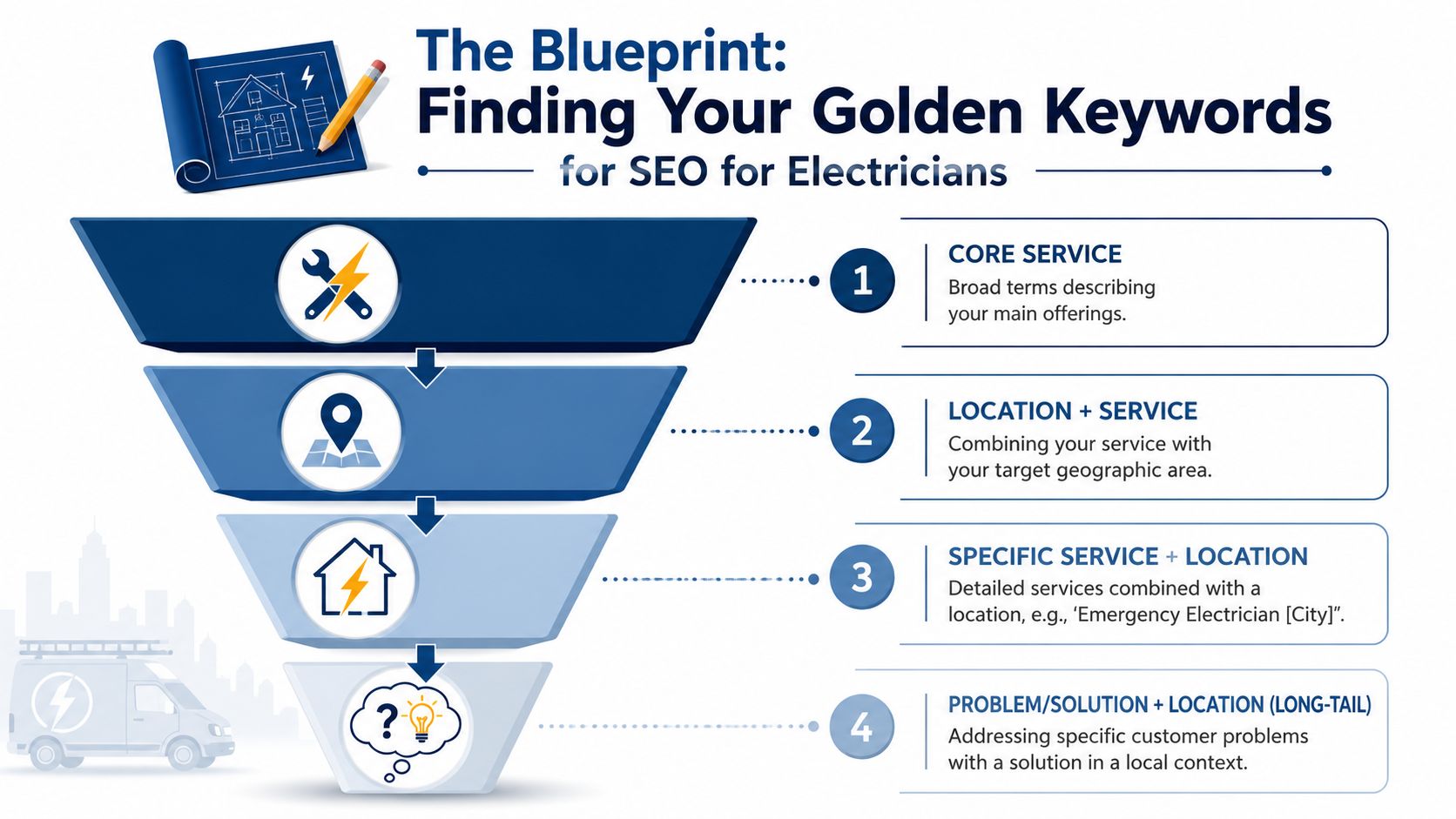
Use a simple keyword ladder
A busy tradesperson doesn't need a fifty-tab spreadsheet. Use a ladder.
Core service terms
“Electrician”, “emergency electrician”, “EICR”, “fuse box replacement”.Service plus location
“EICR in Nottingham”, “electrician in Bath”, “fuse box upgrade in Watford”.Specific service plus location
“EV charger installer in York”, “smart home wiring in Reading”, “outdoor lighting electrician in Chelmsford”.Problem-led local searches
“tripping electrics electrician in Croydon”, “burning smell from consumer unit in Derby”, “landlord electrical certificate in Luton”.
That last layer is often where the money is. Long-tail searches may sound less glamorous, but they usually come from people who know what they need and want it sorted.
For firms outside the trades, the same principle applies. This SEO for professional services guide is a useful parallel because it shows how service-led businesses structure pages around intent rather than vague homepage copy. Electricians benefit from the same logic.
Spy on competitors without being weird about it
Search your main services in your town and nearby towns. Open the top-ranking local competitors and look for patterns.
Check things like:
- Page structure: Do they have separate pages for each service?
- Specialist coverage: Are they targeting EV chargers, solar-linked work, or smart-home installs?
- Location targeting: Have they built pages for every town they cover?
- Trust signals: Reviews, accreditation mentions, photos, FAQs, recent jobs
If three top competitors all have dedicated EV charger pages and you don't, that's not a coincidence. That's a gap.
Don't copy them line for line. That's lazy, and it usually produces bland pages that sound like they were written by a photocopier. Pinch the structure, understand the intent, and produce something more useful for your own patch.
Your Digital Shop Window Mastering Google Business Profile
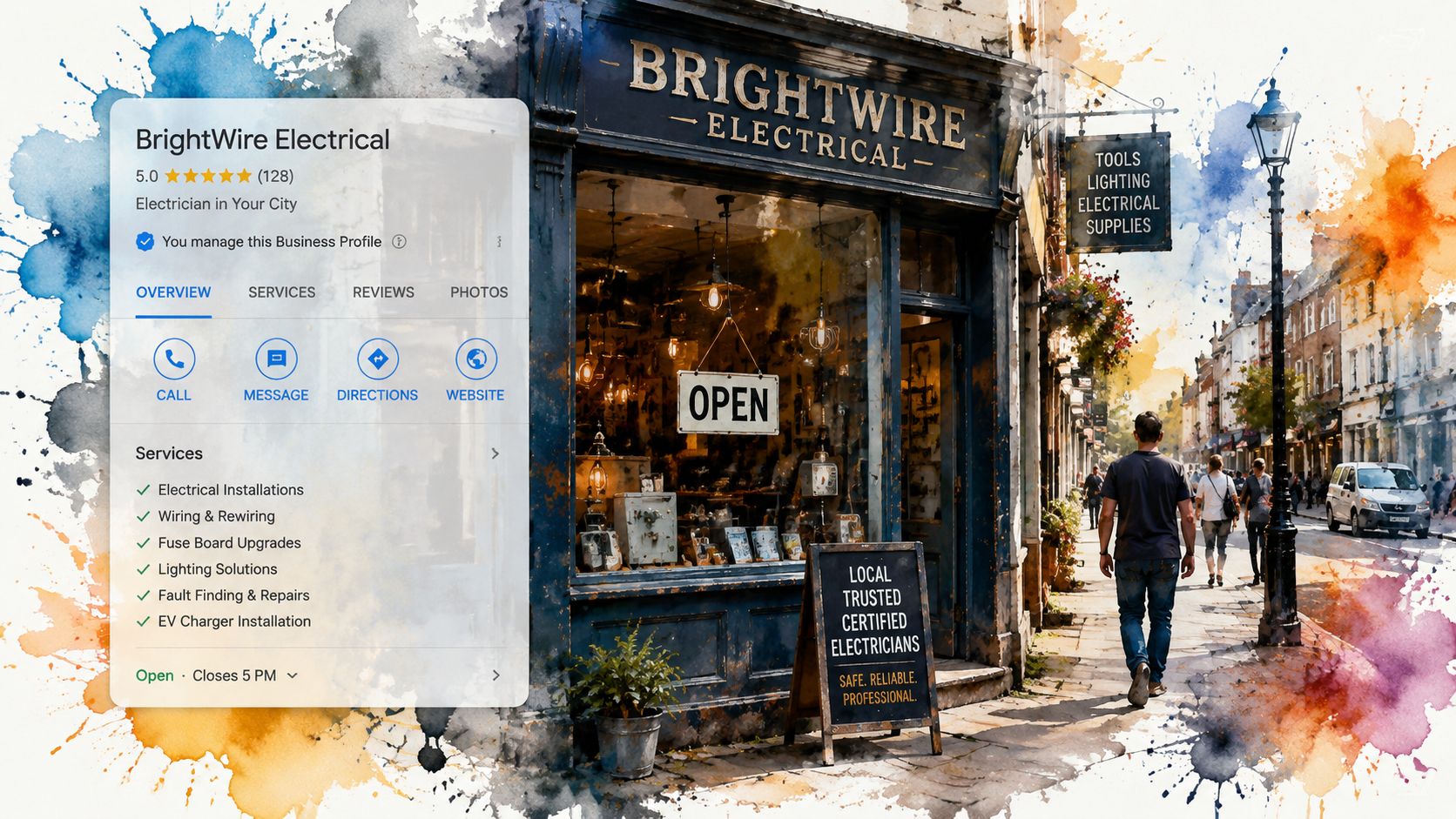
For local SEO, your Google Business Profile does an enormous amount of the heavy lifting. It's often the first thing a customer sees before they ever click through to your site. If that profile looks half-finished, stale, or vague, you're leaving work on the table.
Get the basics absolutely right
Start with the foundations. Your business name, address, phone number, opening hours, website link, services, categories, and service areas all need to be accurate and complete.
Pick the main category that best matches your core trade, then add relevant secondary categories where they properly fit. Don't get silly with it. Google likes relevance, not a profile that looks like it's trying to enter every raffle at the village fête.
If you need a quick plain-English refresher on the terminology, this page to browse social media definitions for GBP is handy. It's useful when you're dealing with labels like posts, categories, attributes, and service areas and just want the straightforward version.
A strong profile also needs a clear business description. Skip generic guff like “we provide quality solutions”. Say what you do, where you work, and what sort of jobs you're known for. “Domestic and landlord electrical work across Stockport, including EICRs, consumer unit upgrades, fault finding, and EV charger installations” is a lot more helpful.
Photos reviews and service detail do the heavy lifting
Most electricians underuse photos badly. That's a shame, because Google Business Profile photo data cited here says businesses with photos receive 42% more requests for directions and 35% more click-throughs to websites than businesses without photos. For electricians, those map-pack interactions directly influence leads and calls.
That doesn't mean hiring a fashion photographer to take moody pictures of a consumer unit at sunset. It means uploading useful, real images:
- Van branding: A clean van outside a recognisable local property type
- Completed jobs: New board installs, neat cabling, EV chargers, lighting upgrades
- Team presence: You or your staff on-site, in uniform, looking like actual humans
- Before and after context: Especially for upgrades and visible improvement work
Customers don't expect glossy. They expect proof that you're real, active, local, and competent.
Reviews matter too, but the trick isn't begging everyone for “a review”. Ask at the right moment. After a clean install, after a landlord gets their certificate sorted without hassle, after you've fixed an emergency fault quickly. Then gently guide the customer to mention the service and area in their own words if they're comfortable doing so.
A short explainer can help if you want to see how profile optimisation fits together in practice:
Treat your profile like a live sales asset
A neglected profile goes stale fast. The best-performing local businesses tend to keep theirs active with new photos, service updates, review responses, and accurate info.
Use this simple maintenance rhythm:
- Weekly: add a few fresh job photos
- After every good job: request a review
- Monthly: check service areas, categories, and any missed questions
- Whenever details change: update hours, phone number, or website link immediately
If you serve multiple towns, make sure your service area reflects reality. Don't claim the whole county if you only sensibly cover a tighter patch. You want local relevance, not a profile that looks like it's had one too many pints and become overconfident.
Build a Website That Google and Customers Love
A lot of electrician websites look fine at first glance. Nice logo. Stock photo of a smiling bloke holding a screwdriver he clearly doesn't use for a living. A sentence about “trusted solutions”. Then nothing useful underneath.
That sort of site can exist online for years without pulling its weight. Good SEO for electricians needs a website structure that matches how people search and how Google understands services.
Build service pages like separate circuits
The cleanest structure is a service hub. A Four Winds Marketing article on local SEO for electricians describes a proven workflow: build one core page for each major service, support it with location pages for the towns you cover, and reinforce it with LocalBusiness schema plus consistent NAP data.
That means separate pages for things like:
- Consumer unit upgrades
- EICR reports
- Emergency fault finding
- EV charger installation
- Outdoor lighting
- Full and partial rewires
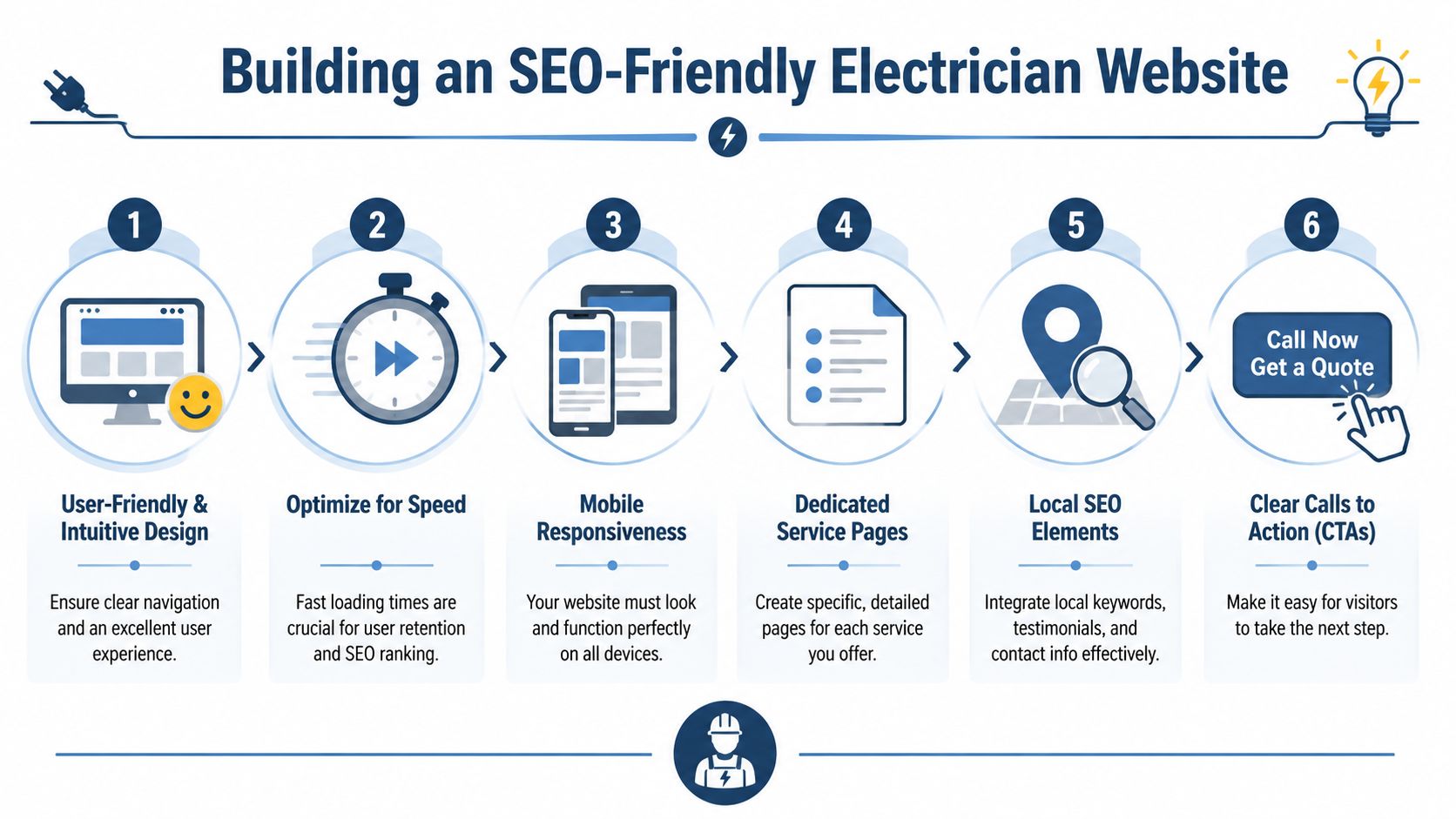
Wiring a house properly illustrates the point: you wouldn't run the cooker, shower, lights, and sockets off one vague circuit and hope for the best. Each important service deserves its own page because each one answers a different customer need.
Each service page should include:
- A plain title: “EV Charger Installation in Norwich”
- A short intro: who it's for and what problem it solves
- Specific details: brands, property types, process, safety considerations
- Local context: the towns or service area you cover
- A clear CTA: call, request a quote, or book an assessment
Location pages need local detail not copy and paste
If you cover several areas, create location pages. But don't clone the same page twenty times and swap “Bristol” for “Keynsham”. That's thin content, and it usually performs like a damp extension lead.
A useful location page includes genuine local relevance:
- Typical jobs in that area: landlord certificates, older housing rewires, EV charging in new-build estates
- Travel and coverage notes: where you attend and how quickly
- Service combinations: emergency call-outs plus inspections, or domestic and small commercial work
- Nearby proof: photos, testimonials, or references to common local property types
Where nearby pages overlap heavily, canonical tags help search engines understand which page is primary. If you built your site with Elementor and need technical pointers, this guide on how to optimize Elementor website SEO covers practical housekeeping without descending into developer waffle.
Schema and NAP are labels not wizardry
Schema markup sounds more mysterious than it is. In plain English, it's just structured labelling that helps search engines understand your business details and services properly.
Field note: Schema doesn't rescue a poor website. It helps a good website become easier for Google to interpret.
Keep your Name, Address, and Phone number consistent across the site, especially in the footer and contact page. If your business name appears one way on the contact page, another way on your Google profile, and a third way in directory listings, you create confusion where you want certainty.
Customers benefit too. A tidy, fast, mobile-friendly site with clear service pages and obvious calls to action doesn't just rank better. It converts better.
Become the Go-To Sparky Building Local Authority
This is the bit that makes some electricians roll their eyes. “Link building” sounds suspicious, and to be fair, parts of the SEO world have treated it like a back-alley cash deal in a raincoat.
That's the black-hat version. Avoid it.
White hat beats cowboy tactics
White hat SEO is simple. You earn trust signals by being a real local business with consistent details, useful content, and legitimate mentions from relevant places. Grey hat lives in the murky middle. It might work for a while, but it can also leave you with a mess to untangle later. Black hat is the full cowboy routine, usually involving spammy links, junk directories, and tricks that look clever right up until they don't.
For electricians, white hat usually wins because local trust is visible.
A strong local authority setup includes:
- Consistent directory listings: your name, address, and phone number match everywhere they appear
- Local relevance: mentions from community organisations, local news, trade associations, or suppliers
- Real-world proof: reviews, job photos, service pages, and active local presence
If your NAP data is inconsistent, fix that before chasing anything fancier. There's no point polishing the chrome if the van won't start.
Local authority comes from real world signals
The easiest local links are often hiding in plain sight.
Consider things like:
- Sponsoring local activity: junior football kits, a school raffle, a village event, a charity night
- Supplier relationships: local wholesalers or partner trades listing trusted installers
- Community involvement: parish newsletters, chamber listings, business associations
- Property networks: estate agents, landlords, letting firms, local builders, kitchen fitters
A simple example. If you regularly install outdoor lighting and CCTV in a certain town, a local landscaping company or driveway installer might happily mention you on their site as a recommended electrical contact. That's relevant, local, and natural.
A good link is a by-product of being known, not a parlour trick.
This also applies to content. Publish pages or short articles that answer local customer questions. “Do I need an EICR for a rental in Manchester?” or “What's involved in fitting an EV charger at a terraced house in Sheffield?” are the kinds of useful pieces that support your specialist pages and reinforce your authority.
You don't need hundreds of links. You need the right signals from the right places, backed by a business that looks active and trustworthy everywhere a customer checks.
Is It Working? Tracking Results and Deciding What's Next
A decent SEO campaign should bring in better jobs, not just busier vanity charts. If the goal is more EV charger installs, consumer unit upgrades, or landlord EICRs, judge the work by the quality and type of enquiries coming through. Website traffic does not cover diesel, test gear, or a lost afternoon quoting for the wrong sort of job.
The useful checks are simple. Look at website traffic, conversion rate, Google Business Profile views and actions, and call volume. Then go one step further and sort leads by service type. That is where the full picture becomes clear.
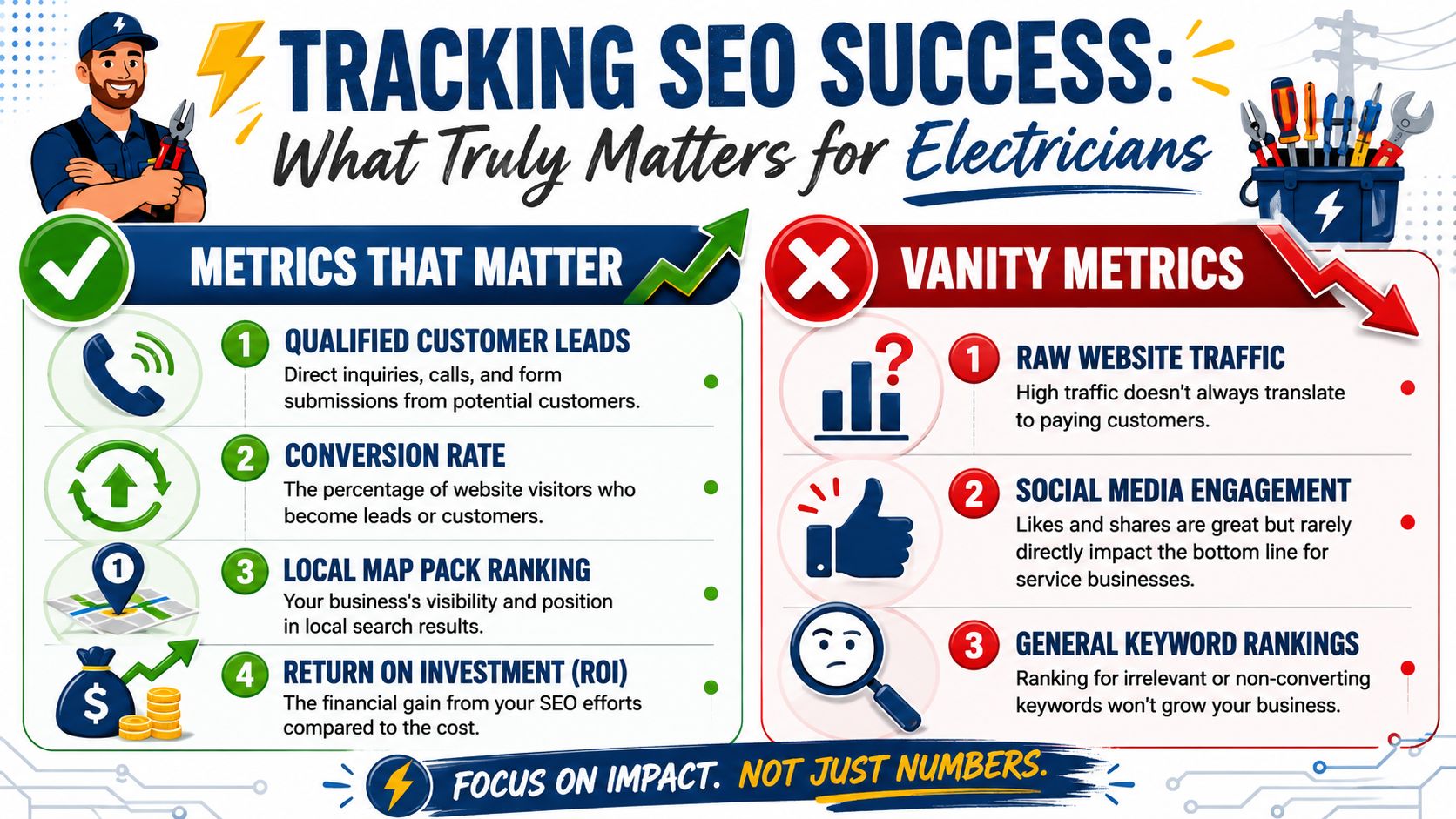
A broad term like "electrician near me" can send plenty of traffic, but specialist terms often send better work. A strong page for EV charger installation in the towns you want to cover will usually beat generic visibility for lead quality. Fewer tyre-kickers. More jobs worth pricing.
Use this as a monthly review for a busy spark who wants answers, not another spreadsheet:
| What to check | Why it matters |
|---|---|
| Calls from website and GBP | Shows whether visibility is turning into enquiries |
| Form submissions | Signals buying intent from site visitors |
| Visits to key service pages | Shows which services are attracting attention |
| GBP actions and visibility trends | Helps spot gains or drop-offs in local demand |
| Enquiry quality | Tells you whether SEO is attracting the jobs you want |
| NAP consistency | Prevents trust issues and local ranking friction |
One habit improves this whole process. Tag every lead by service, area, and whether it turned into quoted work. If ten enquiries came in, you want to know whether they were for fault finding in your patch or EV chargers in the better postcodes, not just that the phone made a noise.
DIY or hire help
Some firms should keep SEO in-house. Others are better off handing it over and getting back on the tools. The honest question is not whether you could do it yourself. It is whether you will keep doing it properly for six months while the diary is full and a wholesaler run has just eaten your morning.
| Factor | DIY SEO | Hiring an Agency |
|---|---|---|
| Time commitment | Needs regular attention each month | Frees up time for chargeable work |
| Learning curve | You need to learn content, GBP, site structure, and tracking | The agency handles the specialist work |
| Control | Full control over edits and priorities | You set priorities, delivery is shared |
| Speed of implementation | Often slower for technical fixes and page updates | Usually quicker if approvals are clear |
| Cost structure | Lower cash cost, higher time cost | Higher cash cost, lower time cost |
| Suitability | Best for owners who are consistent and hands-on | Best for firms that want steady execution |
If you bring in help, keep the brief grounded in jobs and geography. Ask for keyword research tied to service lines, page plans for specific towns, Google Business Profile work, NAP cleanup, call and form tracking, and reports written in plain English. DigiVisi Ltd is one UK option offering technical SEO, local optimisation, content work, and reporting for service-led businesses. The useful bit is whether the campaign is built around the work you want more of, especially higher-value services that generic electrician SEO plans often gloss over.
If an SEO report cannot connect visibility to calls, quote requests, and booked work, it is admin in a hi-vis.
Start small. Pick one specialist service, such as EV charger installs, choose one target area, improve the page and your Google profile, then track what comes in over the next month. If it produces the right leads, repeat the same workflow for the next service.
If you want a clearer plan for turning local searches into better enquiries, DigiVisi Ltd can help map the essentials. That includes keyword targeting, service-page structure, Google Business Profile optimisation, NAP cleanup, and reporting tied back to calls and quote requests.