Skip to content

You're probably in one of two moods right now. Either you're fed up because the phone's gone quiet, or you're getting leads, but not enough of the right ones. You know people need your service. There are boilers breaking, drains blocking, conveyancing dragging on, and office carpets needing a proper clean. Yet somehow the firm down the road keeps popping up first on Google and hoovering up the calls.
That's where small business local SEO stops being marketing fluff and starts becoming a practical sales system. Not a mystical art. Not a bag of tricks. Just a set of actions that help Google trust you, show you, and send local people your way when they're ready to buy.
Table of Contents
- Why Your Competitor's Phone Keeps Ringing and Yours Does Not
- Your Digital Front Door Mastering Google Business Profile
- Building a Five-Star Reputation That Google's AI Loves
- Getting Your Website Fighting Fit for Local Searches
- Creating Content That Screams Local Authority
- Tracking Success and Legally Spying on Your Rivals
- Frequently Asked Questions About Local SEO
Why Your Competitor's Phone Keeps Ringing and Yours Does Not
A lot of owners assume their quieter phone means demand has dropped. Usually, it hasn't. What's happened is much simpler. People are still searching, but they're finding somebody else first.
In the UK, 46% of all Google searches have local intent, and 76% of UK consumers who search for something nearby visit a business within a single day, while 80% of local searches lead to conversions according to the verified local search data provided for this guide. For a plumber in Leeds, a solicitor in Nottingham, or a café in York, that's not casual browsing. That's buying intent with its coat already on.
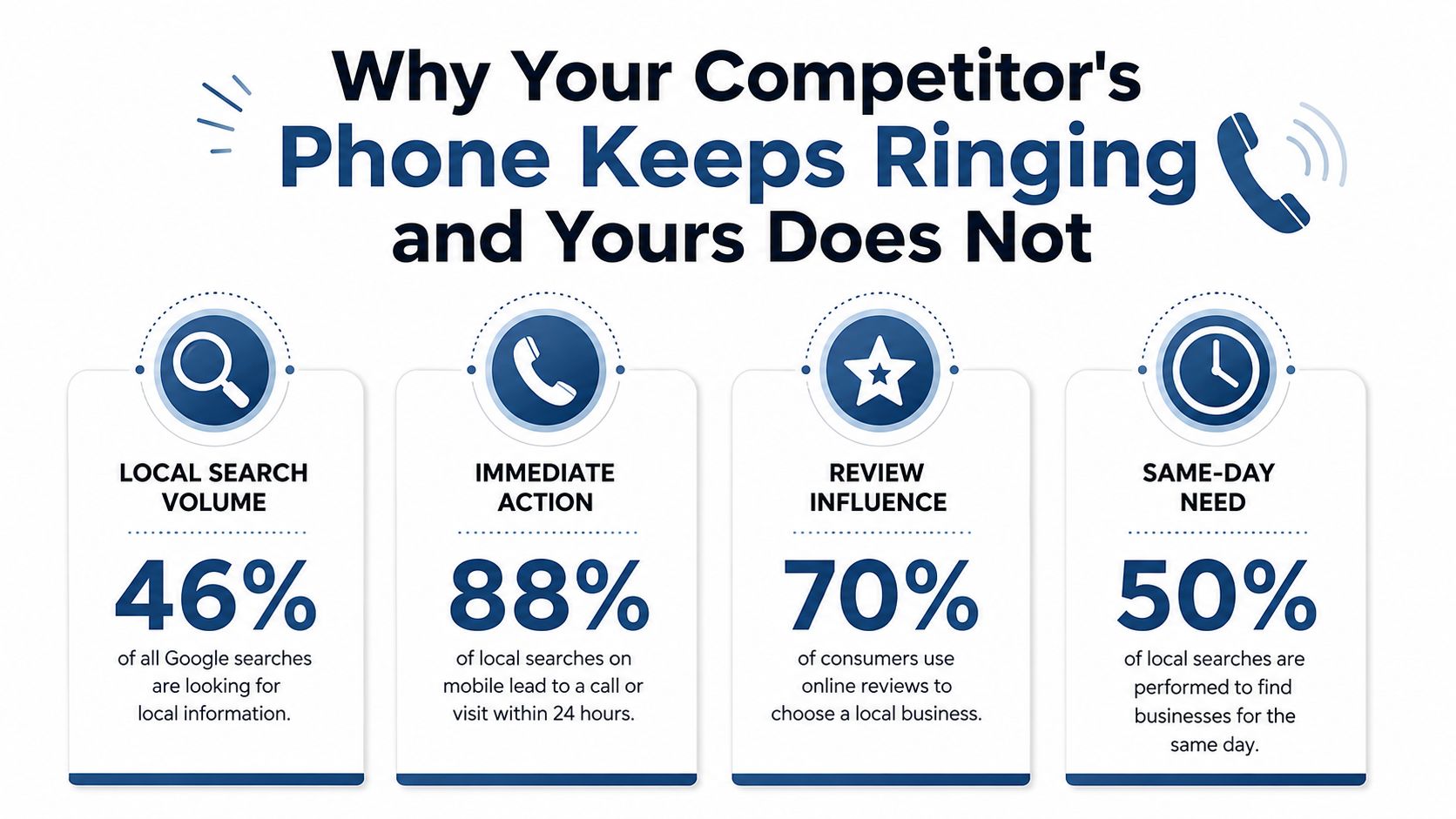
What's really going on
If your competitor appears in Google's local results with a tidy profile, strong reviews, correct details, and a decent website, they look safer. Google likes them more. Searchers trust them more. The result is obvious. Their phone rings while you sit there wondering whether everyone in town has suddenly learned DIY.
This is why local SEO matters so much for service businesses. A national brand can survive on broad awareness. A local electrician in Bristol can't. They need visibility where the decision happens, which is often on a phone, in a rush, with someone typing a practical search like “fuse board repair near me”.
Practical rule: Local SEO isn't about vanity rankings. It's about being visible at the exact moment somebody needs what you sell.
The opportunity is bigger than most owners realise
There's good news hidden in all this. Many firms still haven't sorted the basics. In the UK, 58% of small businesses do not optimise for local search and only 30% have a formal local SEO plan in place according to the verified UK local SEO data in this brief. That means your market often isn't won by the flashiest brand. It's won by the owner who gets organised.
A decent local SEO setup does three things at once:
- It improves visibility: You show up when nearby buyers search.
- It improves trust: Reviews, photos, and complete business details make you look legitimate.
- It improves conversion: The people clicking are already looking for a local provider, not just having a nose around.
A Manchester roofer doesn't need a million visitors. They need the right few. Same for a family solicitor in Exeter or a cleaning company in Croydon. Done properly, small business local SEO turns Google into a steady stream of high-intent enquiries instead of a lottery.
Your Digital Front Door Mastering Google Business Profile
Your Google Business Profile is your digital shop front. If it's half-finished, inaccurate, or stale, you're asking searchers to trust a business that can't even keep its opening details straight. That's a hard sell.
According to Digital Applied's local SEO statistics, prioritising Google Business Profile optimisation yields a 41% increase in customer actions, and GBP signals account for 32% of Local Pack rankings. That's why this is the first job, not the fifth.
Start with the bits Google actually uses
A proper profile isn't just your business name and a phone number. It needs accuracy and completeness.
Here's the no-nonsense checklist:
Business name
Use your real trading name. Don't cram in extra keywords like “Dave's Plumbing Best Emergency Boiler Repair London”. That's clumsy, and it wanders into grey hat or black hat territory fast.Primary category
This is huge. A solicitor should pick the closest core service category, not something vague. A café should choose café, not restaurant, if that's the better fit. Categories help Google decide when to show you.NAPW consistency
Your Name, Address, Phone, Website must match your site and your directory listings. If one place says “Unit 4” and another says “Suite 4”, it might look petty, but inconsistency muddies trust.Service list and description
Be specific. “Drain unblocking”, “boiler servicing”, “probate solicitor”, “end of tenancy cleaning”. Buyers search for jobs, not marketing slogans.Photos
Upload real ones. Vans, staff, completed jobs, your reception, your team in uniform, your coffee counter, your treatment room. Not cheesy stock photos with suspiciously American smiles.
What a strong profile looks like in real life
Take a London plumber. If the profile is complete, has the right categories, useful photos, current opening hours, and clear services, it stands a much better chance of landing in the local pack. Verified data in this brief notes that businesses in the local pack earn 126% more traffic than those ranked 4–10, and one example highlights that a London-based plumber in the top three gets that advantage in a brutally practical way. More visibility. More clicks. More quote requests.
A complete listing matters because buyers compare quickly. They'll ask themselves:
| What the searcher sees | What they assume |
|---|---|
| Full details and recent photos | This business is active and credible |
| Clear services and service area | They probably handle my job |
| Reviews with replies | They care about customers |
| Missing info and no updates | Bit ropey, maybe skip |
If you want a useful outside reference on presentation and conversion, this guide to maximizing store listing performance is worth a read. It's a helpful reminder that listings aren't just for being found. They need to persuade.
Use your profile like an active sales asset
Most owners set up a profile once and leave it to gather dust. Bad move. Google likes signs of activity, and customers do too.
Use posts for updates, seasonal offers, service reminders, or common questions. Add fresh photos. Check your Q&A. Make sure holiday hours are accurate before a bank holiday catches you out and earns you a grumpy review from someone standing outside your locked door.
A short walk-through helps if you want to see the basics in action:
A well-kept Google Business Profile often does more for a local firm than another generic page on the website.
If you're choosing between fiddling with minor website tweaks and fixing a neglected GBP, start with the profile. For most local firms, that's where the quickest gains live.
Building a Five-Star Reputation That Google's AI Loves
Most review advice is stuck in the past. It says “get more five-star reviews” and leaves it there. That's only half the job now.
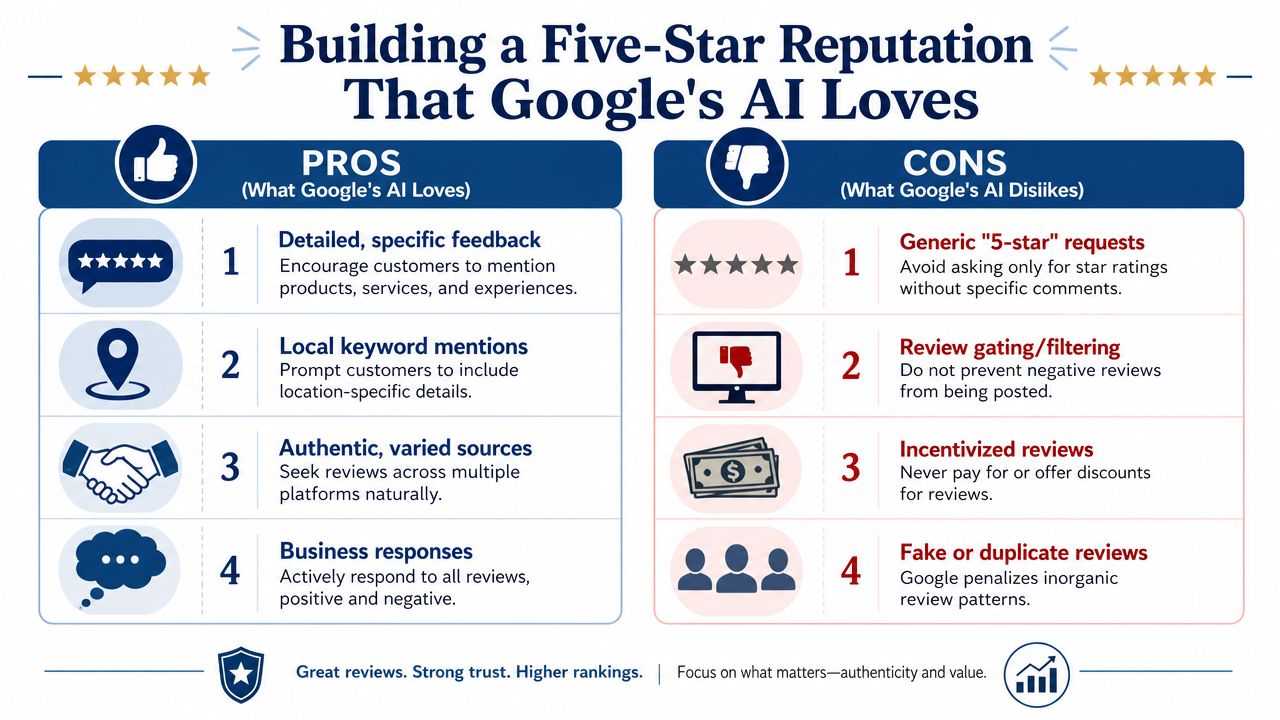
The sharper play is getting reviews with specific details. According to a 2025 UK study cited by Red Eagle, reviews mentioning specific services, outcomes, and staff names are weighted 3x higher by AI than generic “great service” comments. That matters because search is drifting toward AI summaries and interpretation, not just old-fashioned blue links.
Generic praise is nice but specific reviews win
“Brilliant service, thanks” is pleasant. It tells Google and potential customers almost nothing.
Compare that with:
- “Tom fixed our leaking Worcester boiler the same afternoon”
- “Sarah handled our house sale in Truro and kept us updated through every stage”
- “The team did an end of tenancy clean on our two-bed flat in Reading and the letting agent signed it off first time”
Those reviews mention the service, the result, and often a person or place. They sound real because they are real. They also give Google more context.
How to ask without sounding awkward
You don't need a script that sounds like it came from a call centre training manual. You need a simple nudge.
Try prompts like these after a successful job:
- For trades: “If you leave a review, it helps if you mention the job we did, like the boiler repair or leak fix.”
- For solicitors: “If you found the process smooth, mention the type of matter we helped with.”
- For cleaners: “If you were happy with the result, a line about the clean itself is brilliant.”
That's ethical, white hat, and sensible. You're not telling people what to say. You're helping them write something useful.
If you need practical ideas for building a review process, this guide on how to get more Google reviews gives a straightforward framework you can adapt.
Don't chase stars alone. Chase detail, authenticity, and consistency.
The boring trust work that still matters
Reviews need managing, not just collecting. Verified data in this brief notes that 89% of UK consumers expect businesses to respond to reviews. So reply to all of them. Thank the happy customers. Handle the awkward ones calmly. Never get into a public slanging match, even if the reviewer is being a complete plank.
Then sort your citations. Make sure your business details match across major UK directories such as Yell and Thomson Local. The same verified data set notes that failing to maintain NAP consistency across 50+ UK directories can undermine citation signals and reduce visibility in competitive markets.
What not to do:
- Don't buy reviews: That's black hat, obvious, and risky.
- Don't filter out unhappy customers: Review gating is a bad habit and often comes back to bite.
- Don't post fake reviews from staff or cousins: Google isn't daft.
Good reputation work is slow, honest, and durable. That's why it lasts.
Getting Your Website Fighting Fit for Local Searches
Your website doesn't need to be flashy. It needs to be clear, local, and easy to use. Plenty of small firms lose good leads because the site says too little, says it vaguely, or buries the important stuff under design fluff.
According to Humans With AI's guide to top local SEO strategies, successful local SEO includes hyperlocal content creation, local schema markup implementation, and voice search optimisation, and businesses executing all five core strategies achieve a 78% increase in local visibility within 3–6 months. That's a useful benchmark because it points to method, not magic.
Build pages for real services in real places
If you offer multiple services across multiple towns, don't squash everything onto one page and hope for the best.
A better setup looks like this:
- Emergency plumbing in Bristol
- Boiler installation in Bath
- Probate solicitor in Plymouth
- Office cleaning in Milton Keynes
Each page should explain that exact service in that exact area. Add local details where they're genuine. Mention the neighbourhoods you cover. Include practical FAQs. Use photos from real work if you have them.
This is what hyperlocal means in practice. Not stuffing town names everywhere like a faulty sat-nav. Just creating relevant pages for real buyer searches.
Tell Google what your site is about
Local schema markup sounds more technical than it is. Think of it as a neatly organised label attached to your page. It helps search engines understand your business details, services, location, and relevance.
If you're a family law solicitor in Chester, schema can reinforce who you are, where you are, and what services you provide. It won't rescue a weak site on its own, but it helps Google join the dots faster and with less guesswork.
A few on-page basics still matter too:
- Page titles: Make them service and location specific.
- Internal links: Link related service pages and location pages together naturally.
- Contact details: Keep them visible, especially on service pages.
Make the mobile visit painless
Verified data in this brief notes that 64% of local searches are mobile. So if your site is fiddly on a phone, you're making life harder for the very people most likely to contact you.
Use large tap targets. Put the phone number near the top. Keep forms short. Don't hide your service area. Don't make users pinch and zoom like it's 2011.
If someone needs an emergency electrician, they won't admire your animations. They'll look for a number and a reason to trust you.
That's the standard. Clear pages for clear services in clear locations, backed by clean structure and mobile usability.
Creating Content That Screams Local Authority
A lot of owners hear “content” and immediately picture soulless blog posts no one reads. Fair enough. There's plenty of that about. But useful local content is different. It helps you sound like the business that knows the area, the housing stock, the common problems, and the customer worries.
Write the stuff only a local expert would know
A generic page saying “We offer roofing services” does very little. A post on “Choosing the right slate for a Victorian terrace in Didsbury” does much more for a Manchester roofer. It shows experience. It answers a real local concern. It gives Google and the reader something concrete.
A few examples:
- Plumber in Norwich: Write about common causes of low water pressure in older terraces.
- Solicitor in Cornwall: Explain local conveyancing delays that crop up in coastal property transactions.
- Café in Brighton: Publish a page about your pre-theatre menu for nearby venues, if that's a genuine draw.
This kind of content supports E-E-A-T because it demonstrates lived knowledge, not recycled filler.
What this looks like for ordinary service firms
You don't need to publish endless articles. You need the right ones.
A cleaning company, for example, can produce useful pages around local tenancy cleaning expectations, office cleaning routines, or seasonal cleaning issues in particular property types. If you want a decent example of niche service content thinking, this guide on grow your cleaning business with SEO shows how service-focused SEO can be tied to real commercial intent.
Good local content usually falls into three buckets:
Problem-led content
“Why does this issue happen in homes like mine?”Area-led content
“Do you serve my part of town, and do you understand the local quirks?”Decision-led content
“Why should I choose this service or approach?”
Write fewer pieces, but make them sharper. That beats publishing generic waffle just to keep a blog alive.
Tracking Success and Legally Spying on Your Rivals
If you don't measure local SEO properly, you'll either panic too early or congratulate yourself for the wrong thing. Rankings matter, but they're not the end goal. Jobs are.
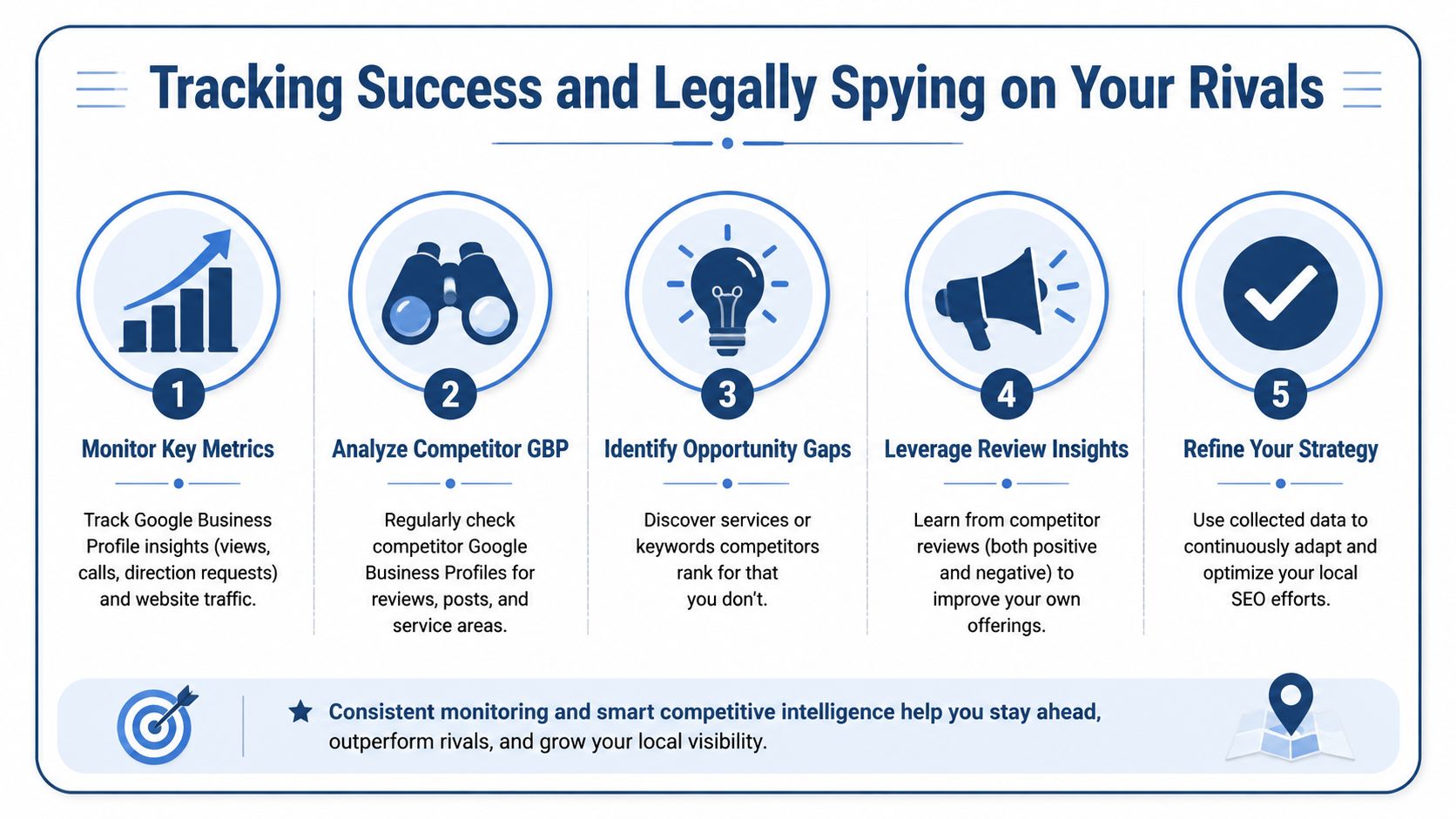
Verified data in this brief notes that in the UK the top three GBP profiles capture over 31% of all map clicks, while businesses in the local pack earn 126% more traffic than those ranked 4–10. That gap is why tracking local visibility properly matters. The difference between position three and position five isn't a vanity issue. It can be the difference between a busy diary and a very quiet Tuesday.
Track the numbers that lead to jobs
For local firms, focus on a small handful of indicators:
| Metric | Why it matters |
|---|---|
| GBP website clicks | Shows whether your profile attracts interest |
| Direction requests | Strong sign of local buying intent |
| Phone calls | Often the clearest lead signal |
| Service page enquiries | Tells you which services and locations convert |
If calls matter most to your business, proper attribution helps. A practical primer on call tracking for lead generation can help you understand how to connect phone enquiries to actual marketing activity rather than guessing.
Some firms also use structured monthly reporting tools or managed services. For example, DigiVisi Ltd offers local SEO reporting tied to position tracking, GBP work, content, and technical fixes. That sort of setup can be useful if you want clearer attribution without building the process yourself.
How to study competitors without copying badly
This part is simple. Search the terms you want to rank for and inspect the firms already there.
Look at:
- Their Google Business Profile: categories, photos, review quality, posting habits
- Their service pages: which towns they target, how specific the page copy is
- Their review themes: what customers repeatedly praise or complain about
- Their content gaps: services or areas they've ignored
A solicitor in Leicester might notice rival firms have strong family law pages but weak probate pages. A plumber in Sheffield might spot that competitors mention boiler servicing everywhere but say almost nothing about emergency call-outs in specific districts. Those gaps are opportunities.
Study what's working. Don't clone it badly. Improve it with better detail, cleaner structure, and more trust signals.
White hat grey hat and black hat in plain English
It is here that a lot of small business owners get sold nonsense.
- White hat SEO is clean work. Accurate listings, useful pages, proper reviews, good site structure, and honest citations.
- Grey hat SEO sits in the dodgy middle. Over-optimised business names, thin location pages, or tactics that might work briefly but feel slippery.
- Black hat SEO is the muck. Fake reviews, spammy links, copied content, keyword stuffing, and tricks designed to game Google rather than help customers.
If a tactic would embarrass you in front of a customer, treat it with suspicion. Local SEO should build an asset, not create a future headache.
Frequently Asked Questions About Local SEO
How long does small business local SEO take to work
Some improvements can show up fairly quickly, especially if your Google Business Profile is neglected and your local details are a mess. Website and content gains usually take longer because Google needs time to crawl, assess, and compare your pages against competing firms. The key is consistency. A few solid months of proper work beats one frantic weekend of random tweaks.
Is local SEO a one-off job
No. It's ongoing maintenance with occasional bigger pushes. Your reviews need managing, business details need checking, pages need updating, and competitors won't politely stop improving just because you've finally sorted your profile. It's comparable to keeping a van in good nick. Ignore it for too long and something expensive starts rattling.
What's the biggest mistake to avoid
Doing everything halfway. A half-filled profile, a thin website, and a scattergun review strategy don't combine into a strong local presence. They combine into confusion. Pick the fundamentals and do them properly.
Do I need a blog
Not always. A local café may get more value from a sharp Google Business Profile and solid reviews than from churning out articles. A solicitor, plumber, or cleaning firm usually benefits more from targeted service pages and selective local content that answers real buyer questions.
Should I worry about AI in search
Yes, but calmly. The practical response isn't panic. It's clearer service pages, more specific reviews, stronger business information, and content that reflects genuine local expertise. That gives your business more ways to be understood, whether someone finds you through classic local results or AI-generated summaries.
If you want a practical second pair of eyes on your local visibility, DigiVisi Ltd works with UK service businesses on Google Business Profile optimisation, local SEO, content, technical fixes, and reporting geared around calls and enquiries rather than fluffy metrics.