Skip to content

A one-star lift in your Google rating can increase revenue by 5 to 9% for UK businesses, and firms with more than nine recent reviews generate 52% more revenue than average, according to this review and revenue analysis. That's not a vanity metric. That's sales, visibility, trust, and the difference between getting the call or watching a rival nick it.
If you run a local service business, learning how to get more Google reviews isn't a side task for a quiet Friday afternoon. It's one of the sharpest growth levers you've got. But in the UK, there's a catch. The usual internet advice is full of half-baked tactics that ignore GDPR, ignore Google's fraud filters, and ignore the very British reality that customers often need a bit of breathing room before they'll leave thoughtful feedback.
A good review strategy is simple. Deliver a service worth talking about, ask at the right time, make it dead easy, and stay well away from anything dodgy.
Table of Contents
- Why Google Reviews Are Your Business Secret Weapon
- Laying the Groundwork for Five-Star Feedback
- The Art of the Ask When and How to Request Reviews
- Staying on the Right Side of the Law and Google
- Responding to Reviews The Good The Bad and The Baffling
- Your New Review-Centric Workflow
Why Google Reviews Are Your Business Secret Weapon
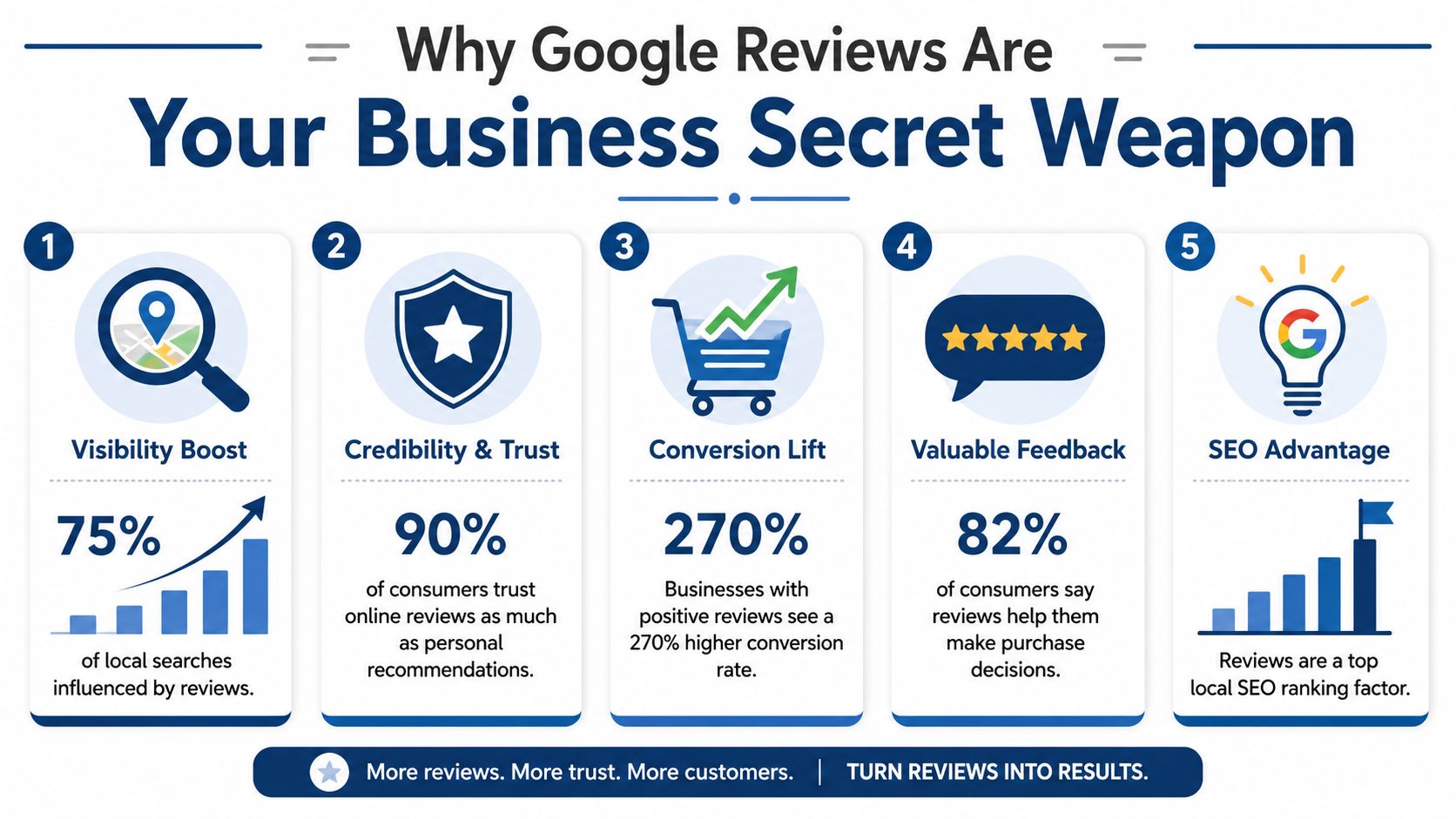
Google reviews pull far more weight than most owners realise. They influence whether people trust you before they've visited your site, and they shape whether Google shows you in the map results in the first place.
Online reviews now make up exactly 20% of Google's local pack ranking factors, up from 16% in 2023, making them the second most important signal for Local Pack and AI rankings, according to this local search ranking guide. That's a big shift. If you've been treating reviews as a nice bonus, that ship has sailed.
Reviews affect money and visibility
The commercial case is already strong. The visibility case makes it stronger.
When someone searches for a plumber, solicitor, salon, or electrician, they're making a snap judgement. They haven't met you. They don't know your process. They don't know your guarantees. They see your stars, your review count, and the tone of what people say.
That means reviews do three jobs at once:
- They help you appear in the local pack and on Google Maps.
- They help you win the click when you appear beside competitors.
- They help you convert because the customer arrives pre-sold on your credibility.
Practical rule: Reviews are not reputation garnish. They're part of local SEO and part of conversion.
A local example from Bristol
Take a hairdresser in Bristol. A searcher types in something like “balayage Bristol” or “hairdresser near me”. Several listings appear side by side. If one profile has recent, detailed feedback mentioning friendly service, a great cut, and an easy booking experience, that business looks safer. Less risky. More established.
That's the power here. Reviews remove doubt.
And unlike many marketing jobs, this one compounds. One strong review makes the next easier to earn. A profile with recent, specific feedback gives future customers confidence to book, and it gives future reviewers a nudge on what “helpful” looks like.
If you're deciding where to spend effort this month, sorting your review process belongs near the top. Not because it's flashy. Because it works.
Laying the Groundwork for Five-Star Feedback
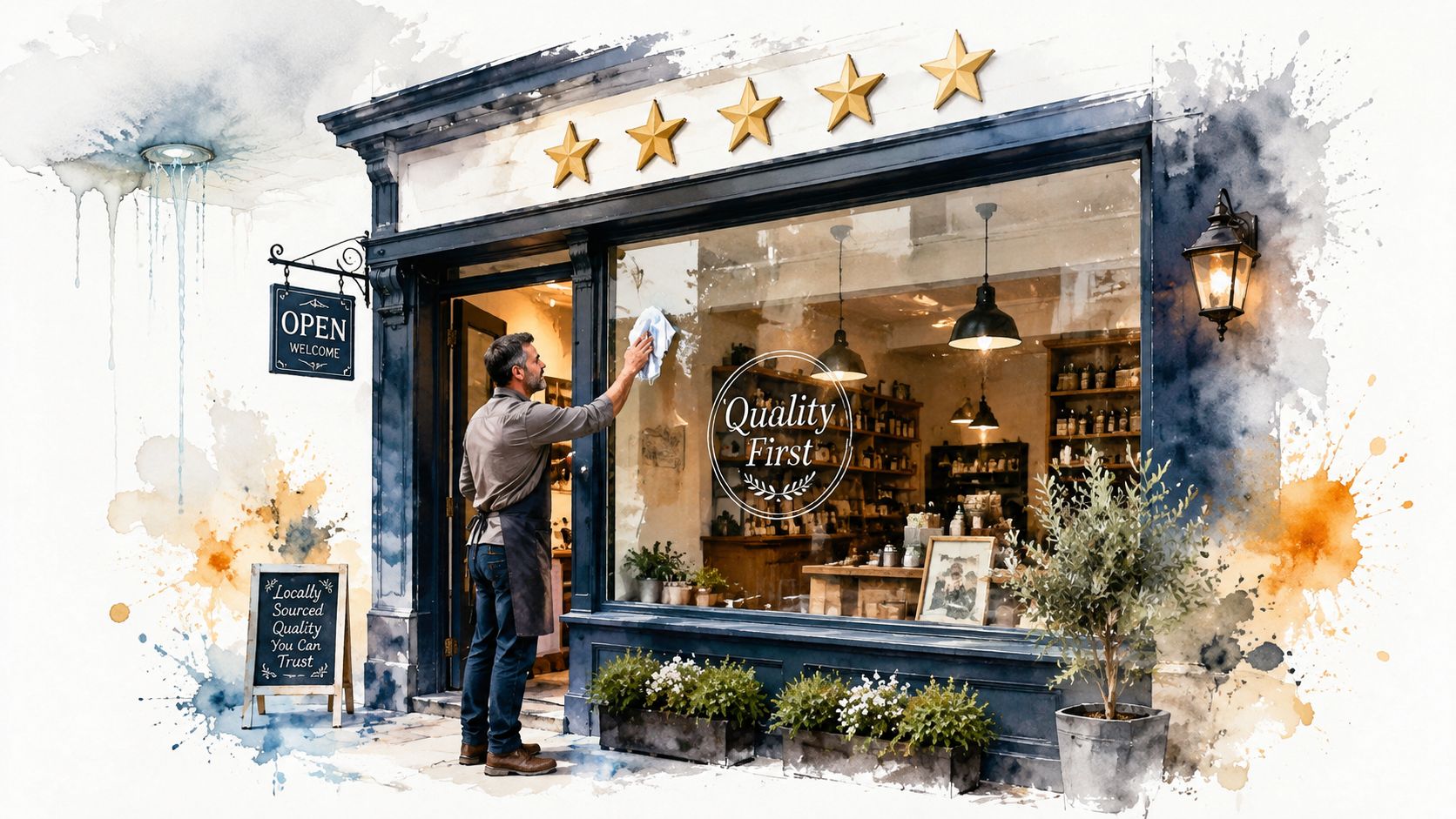
You can't build a review strategy on a scruffy Google Business Profile and a vague hope that customers will somehow figure it out. First tidy the shop window, then ask people to admire it.
Get your profile and process sorted
Start with the basics:
Complete your Google Business Profile
Make sure your business name, category, phone number, opening hours, service areas, and website are correct. If you're a trades business, list services clearly. If you're a solicitor, make your practice areas obvious.Create your direct review link
Use your Google Business Profile's “Ask for reviews” feature and save that link somewhere sensible. Your team should be able to grab it in seconds, not hunt for it like lost car keys.Check the customer journey
If your booking process is clunky, your communication is patchy, or your aftercare is poor, reviews will reflect that. Fair enough too.Decide who asks and when
Don't leave this floating about with no owner. Someone in the business needs responsibility for sending requests and checking responses.
A review strategy works best when it follows a service process that already feels organised. If you want a useful framework for spotting service weak points before they end up in public feedback, this practical guide to customer satisfaction metrics is worth a look.
What consistency looks like in practice
For a UK electrician in Manchester, 15 to 50 quality reviews is the competitive baseline to appear in local search results, and 1 to 3 new reviews per week tends to outperform sudden bursts that can trigger fraud detection, according to this local SEO analysis for small businesses. That tells you something useful. You do not need hundreds overnight. You need a believable pattern.
Here's what that looks like in a practical context:
| Business type | Good review habit | Bad review habit |
|---|---|---|
| Electrician | Asking after each completed job using the same simple process | Ignoring reviews for months, then begging everyone at once |
| Solicitor | Requesting feedback after a matter closes and the client has had time to reflect | Asking while the client is still stressed and paperwork is flying |
| Cleaner | Sending a short follow-up link after a regular visit | Posting “please review us” on social media and hoping for the best |
A profile that grows steadily looks trustworthy to customers and normal to Google. A profile that sits dormant, then suddenly sprouts a pile of near-identical reviews, looks a bit suspicious. Like a suntan in February.
If you're in a professional service where trust matters, tightening the basics around local search helps the whole system work better. A solid SEO approach for professional services supports the review work by making sure your service pages and local signals line up properly.
Clean profile, easy link, good service, steady rhythm. That's the groundwork.
The Art of the Ask When and How to Request Reviews
Most businesses ask for reviews at the wrong moment. Usually too soon, too awkwardly, or with all the warmth of a parking fine.
Timing beats enthusiasm
For UK service-led businesses, the most effective review trigger happens 7 to 10 days after delivery. A two-email sequence with the customer's first name, technician name, and service type can improve conversion by 22% and achieve a 28% median response rate versus 12% for generic, immediate asks, according to this review request timing guide.
That makes sense in plain English. On the day of service, people are busy. They're back to work, chasing the dog out of the hallway, or haven't had time to judge the result properly. Give them a few days, and they can say something more thoughtful.
A simple sequence works well:
Day 3
Send a quick check-in. Ask if everything arrived, settled in, or worked as expected.Day 10
Ask how the experience has been and include the review link.
This works for loads of local businesses. A boiler installer can ask once the heating's had a proper run. A window cleaner can ask after the customer's seen the result in daylight. A family solicitor can ask when the matter has closed and the client has had a breath.
Simple templates that don't sound robotic
The request should feel personal, not produced by a man in a headset reading from a clipboard.
Email template
Subject: Quick favour about your recent service
Hi Sarah,
Thanks again for choosing us for your boiler service with Tom. I just wanted to check everything's running as it should.
If you've got a minute, we'd really appreciate an honest Google review. It helps other local customers know what to expect.
[Review link]
Thanks again,
[Business name]
SMS template
Hi James, thanks again for using us for your gutter repair. If you've got a spare minute, we'd be grateful for an honest Google review: [review link]
A few rules make a big difference:
- Use real details like first name, service, or staff member.
- Keep it short so it doesn't feel like homework.
- Ask for an honest review, not a positive one.
- Send one follow-up if they don't respond, then leave it there.
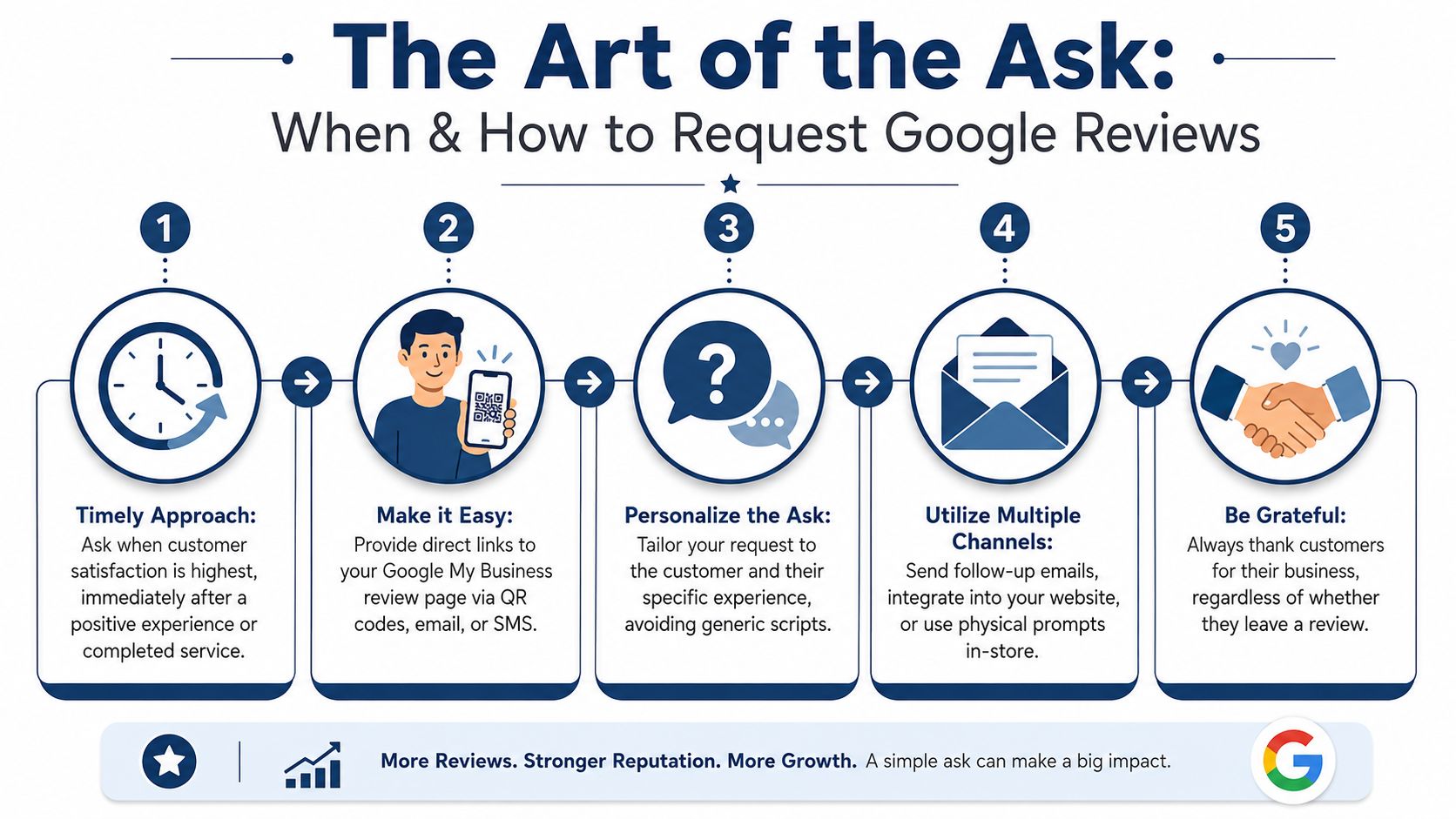
Here's a useful visual summary before you build your own routine:
Passive review collection for busy teams
Not every review has to come from email. In many businesses, the best system is a mix of active asks and passive prompts.
A few easy wins:
QR codes at the right touchpoints
Put them on receipts, job completion cards, or front-desk signage. A café can add one near the till. A locksmith can print one on a leave-behind card.Thank-you pages and follow-up pages
If customers land on a confirmation page after booking or paying, that page can invite feedback later.Team prompts
Train staff to say, “If you're happy with everything, I can text over our review link.” Natural. No hard sell.
Ask when the customer has had enough time to know whether the service was actually good. That's when the useful reviews appear.
Staying on the Right Side of the Law and Google
A lot of businesses frequently run into trouble. Not always because they're malicious. Often because they've copied advice from a US blog, a Facebook group, or that mate who “knows a bloke who does SEO”.
In the UK, fake reviews are no longer a slap-on-the-wrist issue. The Digital Markets, Competition and Consumers Act explicitly bans fake reviews, and from April 2025 the CMA can fine firms up to 10% of global turnover for violations, according to this summary of Google reviews and UK compliance. That's serious enough to stop the nonsense.
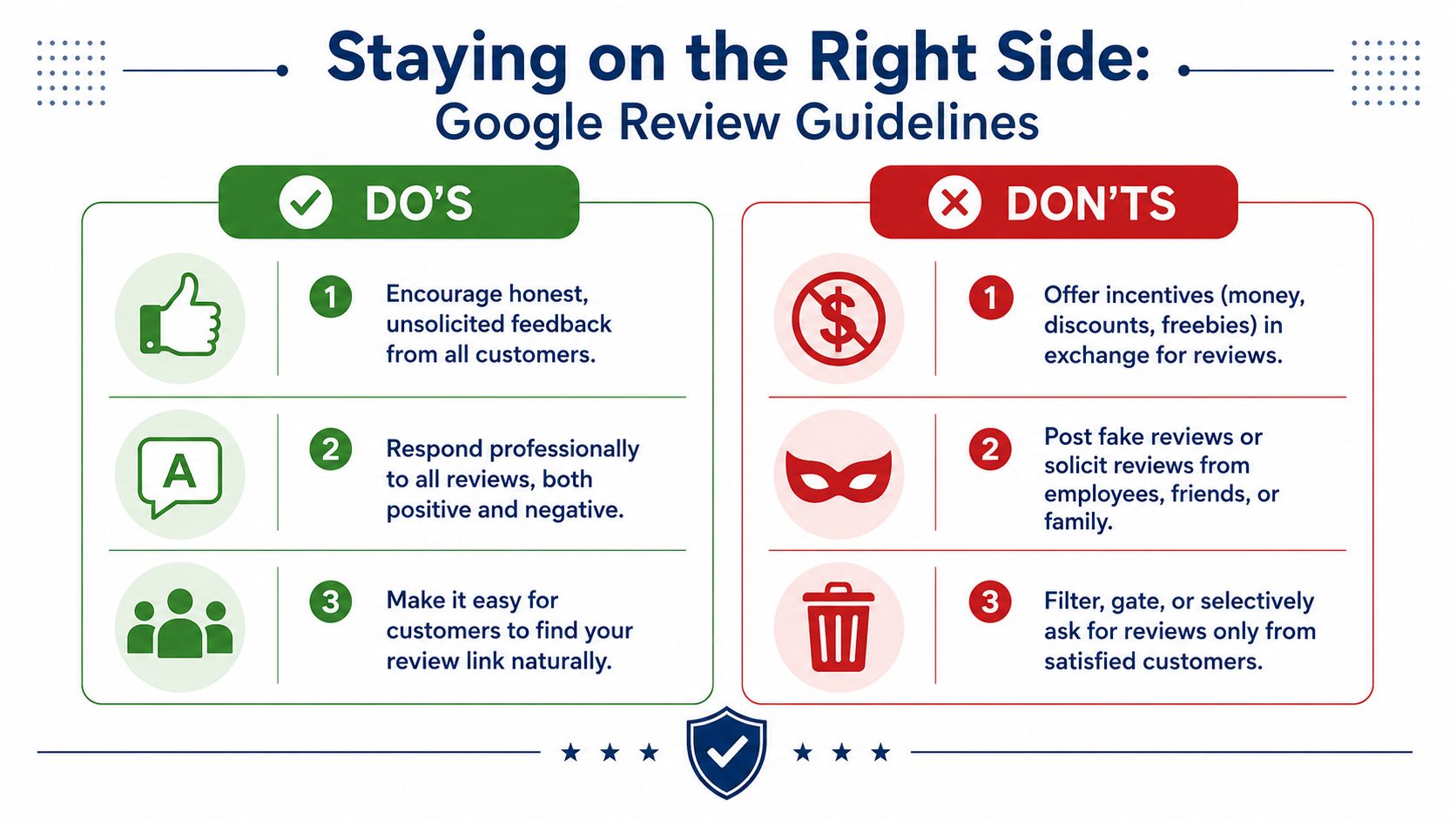
White hat grey hat and black hat
Here's the practical version.
| Approach | What it looks like | Verdict |
|---|---|---|
| White hat | Asking real customers for honest reviews, making it easy, responding professionally | Safe and sustainable |
| Grey hat | Nudging only your happiest customers, getting a bit selective, skating close to policy lines | Risky and short-sighted |
| Black hat | Buying reviews, using staff or friends, offering rewards for positive feedback, posting fake reviews | Don't touch it |
The biggest trap is incentives. If the reward is tied to the review itself, or worse, tied to positivity, you're asking for grief. Even if it “works” briefly, it leaves a nasty footprint. Google's filters aren't getting more forgiving, and the regulator certainly isn't in a generous mood.
The cooling-off period matters
One of the most overlooked UK-specific issues is timing after a tense or imperfect service experience.
Data included in the verified brief shows that a notable share of Google Business Profile suspensions involved service-led businesses that asked for reviews within minutes of completing work, especially when customers had expressed even mild dissatisfaction. The safer move is a 24-hour cooling-off period, particularly in trades, legal services, and home services where emotions can still be a bit fresh.
That's a smart operational rule even without the algorithm angle. If a customer is annoyed about dust, delay, cost, or confusion, don't shove a review request under their nose while they're still simmering. Resolve the issue first. Ask later, if appropriate.
Compliance reality: Fast isn't always clever. In review collection, a bit of patience can protect the profile you've spent years building.
GDPR opt-outs need a different route
This catches plenty of good businesses out.
If a customer has opted out of marketing communications, you need to be careful about using their personal data for review requests. The safe route is to use privacy-neutral channels that don't depend on marketing consent in the same way. Practical examples include:
- In-person QR codes at reception or in a vehicle folder
- Printed receipt inserts after a completed purchase
- Job completion cards handed over physically
- On-site signage that invites reviews without direct follow-up messaging
For example, a dentist's reception desk can display a review QR code. A plumber can leave a printed card after a job. A solicitor can include a neutral feedback prompt in a closing pack, without slipping into promotional messaging.
The principle is simple. If someone said no to marketing, respect it. You can still make reviewing easy through channels that don't rely on emailing or texting them out of the blue.
Responding to Reviews The Good The Bad and The Baffling
Getting a review isn't the finish line. Your response is public, searchable, and often more revealing than the original comment.
That matters because reviews now account for 20% of Google's local pack ranking factors, as noted earlier in the article. So review management isn't just customer service admin. It's part reputation, part SEO, part conversion support.
What a strong response looks like
For positive reviews, don't just write “Thanks”. That's better than silence, but not by much. Add a bit of texture.
A decent reply from a Manchester electrician might be:
Thanks, Rachel. Glad Tom could get the fault sorted quickly and explain everything clearly. We really appreciate you taking the time to leave a review.
Short. Specific. Human.
For a review without text, still respond. Thank them, reference the service if you can, and keep the tone warm. A blank five-star review still deserves an acknowledgement because future customers see that you pay attention.
Here's a simple way to think about response style:
Positive review
Thank them, mention the service, reinforce the good experience.Negative review
Stay calm, acknowledge the issue, invite an offline resolution.Baffling review
If it seems unrelated, fake, or clearly mistaken, respond politely and investigate before flagging it.
A bad reply versus a good one
Say a solicitor's firm receives this review:
“Slow replies, poor communication, felt ignored.”
Bad response:
“We completely disagree. You were updated throughout and your expectations were unrealistic.”
That tells future clients one thing. If something goes wrong, this firm gets defensive.
Better response:
“Thank you for your feedback. We're sorry you felt communication fell short. That's not the standard we aim for. Please contact our office directly so we can review the matter and try to resolve your concerns.”
That response won't magically erase the review, but it does show composure. It tells potential clients that the firm takes criticism seriously and behaves professionally under pressure.
A good response isn't written for the reviewer alone. It's written for every future customer reading the page.
If a review breaks the rules, such as obvious spam, impersonation, or irrelevant abuse, flag it through Google. But don't rely on removals as your strategy. The stronger your base of genuine reviews and sensible responses, the less damage one rogue comment can do.
Your New Review-Centric Workflow
Most businesses don't need a fancy reputation machine. They need a repeatable habit. Something the team can follow even on a busy Tuesday when the phone won't stop and someone's lost the van keys.
The four-part routine
This is the practical workflow:
Deliver great service
Reviews start before the ask. Turn up when you said you would, explain things clearly, tidy up, and follow through. The review request only amplifies what the customer already feels.Perfect the ask
Use your direct review link. Send it at a sensible time. Keep the message personal and brief. Don't badger people.Respond to everything
Thank happy customers. Deal with criticism calmly. Show future buyers that there are real humans behind the listing.Stay compliant
No fake reviews. No dodgy incentives. No lazy shortcuts with GDPR opt-outs. White hat always wins in the long run.
A Bristol salon, a Leeds tradesperson, and a small solicitor's office won't run this in exactly the same way. Fair enough. But the bones of the workflow stay the same.
What to track without turning into an accountant
Keep an eye on a handful of basics:
- Your average rating
- Your total review count
- How recent your latest reviews are
- Whether reviews mention specific services or staff
- How quickly your team responds
If progress is lumpy, don't panic. The goal isn't a sudden flood. It's a steady, believable stream of genuine feedback that reflects real customer experience.
That's how to get more Google reviews without making a mess of it. Better service. Better timing. Better systems. Less nonsense.
Start small if you need to. Get your review link sorted today. Write one email template. Train one staff member. Add one QR code. Then keep going.
If you'd like help turning reviews, local SEO, and Google Business Profile work into more calls and enquiries, DigiVisi Ltd helps UK service businesses build a proper search presence without the fluff, the lock-in, or the black-hat nonsense.