Skip to content
You're probably in one of two camps right now. Either you've dabbled with Google Ads, watched a few clicks roll in, then wondered why the phone didn't ring. Or you've been quoted for one of those neat little PPC services packages and you're trying to work out whether it's a sensible growth move or a polite mugging.
That's a fair question.
If you run a local service business in the UK, a plumbing firm in Manchester, a solicitor in Edinburgh, an electrician in Bristol, you don't need fluff. You need enquiries, booked jobs, and a clear answer on whether the money you're about to spend will bring business in or vanish into the digital equivalent of a fruit machine.
Table of Contents
- Are PPC Packages a Goldmine or a Money Pit
- So What Are PPC Services Packages Anyway
- What Is Actually Inside a Proper PPC Package
- Decoding PPC Package Pricing Models
- How to Choose the Right Package for Your Business
- Red Flags and Dodgy Deals to Avoid
- Your Next Move Making PPC Pay
Are PPC Packages a Goldmine or a Money Pit
You log into the bank. You look at overheads. Van insurance, wages, fuel, software, rent. Then someone suggests Google Ads and says it'll “scale your lead generation”. Lovely phrase. Means absolutely nothing if you're already watching every pound.

Here's the blunt truth. PPC can be brilliant. It can also be a cash bonfire if it's set up badly, aimed at the wrong searches, or left to run on autopilot while somebody sends you a cheerful PDF once a month.
The reason PPC gets so much attention is simple. Google Ads dominates paid search in the UK. In a 2023 survey, 97% of pay-per-click marketers in the UK used Google search advertising, and 65% of UK small-to-medium businesses now run active Google Ads campaigns, up from 58% in 2024 according to Statista's UK PPC platform data. That tells you two things. First, this channel isn't a fad. Second, your competitors are already there.
A Manchester plumber is a good example. If somebody's boiler packs in on a freezing Tuesday morning, they're not browsing politely. They're searching with intent. If your ad shows up for the right query, in the right area, with the right landing page, you've got a real shot at a lead. If your ad shows up for broad nonsense, or sends people to a generic homepage, you're paying for tyre-kickers, job seekers, and accidental clicks.
PPC isn't magic. It's a system. Good systems print opportunities. Bad systems print excuses.
Why packages exist in the first place
Most owners don't want to live in Google Ads all week, and they shouldn't. A proper package bundles the work that keeps campaigns healthy. Strategy, setup, testing, tracking, and ongoing optimisation all sit under one roof.
That's the goldmine side.
The money pit appears when the package is generic, lazy, or stuffed with vanity reporting. A shiny proposal means very little if nobody has thought about your postcode targets, your search intent, your call handling, or the cost of clicks in your trade.
So What Are PPC Services Packages Anyway
Think of PPC services packages like a meal deal.
You can buy the sandwich on its own. That's the DIY route. You open a Google Ads account, pick a few keywords, write some ads, and hope for the best. Sometimes that works for a week or two. Then the wheels wobble. Search terms drift, costs creep up, and you realise there's rather more to it than clicking “go”.
A package is the full meal deal. You're not just paying for ads to exist. You're paying for the thinking, the setup, the management, and the reporting that makes those ads worth running.
What you're actually buying
A proper package should cover four basic jobs:
- Strategy: Which services to push, which locations matter, and what counts as a good lead.
- Build: Campaign setup, ad groups, keywords, tracking, copy, and targeting.
- Management: Bid changes, search query checks, exclusions, testing, and budget control.
- Reporting: Clear updates on leads, costs, wasted spend, and what's being changed.
That's the difference between “we've got some ads running” and “we've got a managed lead generation channel”.
If you're still sorting out what different offers look like, it helps to spend a few minutes comparing pay per click packages so you can spot the difference between a proper managed service and a glorified setup fee wrapped in fancy wording.
Why DIY usually falls over
A local bakery in Chester might think, “How hard can it be? I'll just bid on cakes and wedding cakes.” Fair enough. But if the account starts matching for cake decorating classes, wholesale supplies, or people outside the delivery area, the budget starts leaking quickly.
That's where experience matters. Not mystical guru nonsense. Just solid management.
And the hat colours hold significance. White hat PPC is clean targeting, honest tracking, proper consent, relevant ads, and landing pages that say what they mean. Grey hat gets murkier. Think aggressive match types, fuzzy attribution, or reports that dress up weak leads as wins. Black hat is the proper swamp. Cloaking, misleading ads, bait-and-switch pages, or dodgy click manipulation. If anyone's playing in that end of the pool, get out fast.
What Is Actually Inside a Proper PPC Package
A lot of so-called packages are mostly packaging. Bit like buying a “luxury” hamper and discovering it's mainly shredded paper and a tiny jar of chutney.
A proper PPC package should contain work that improves results, not just activity that fills a report.
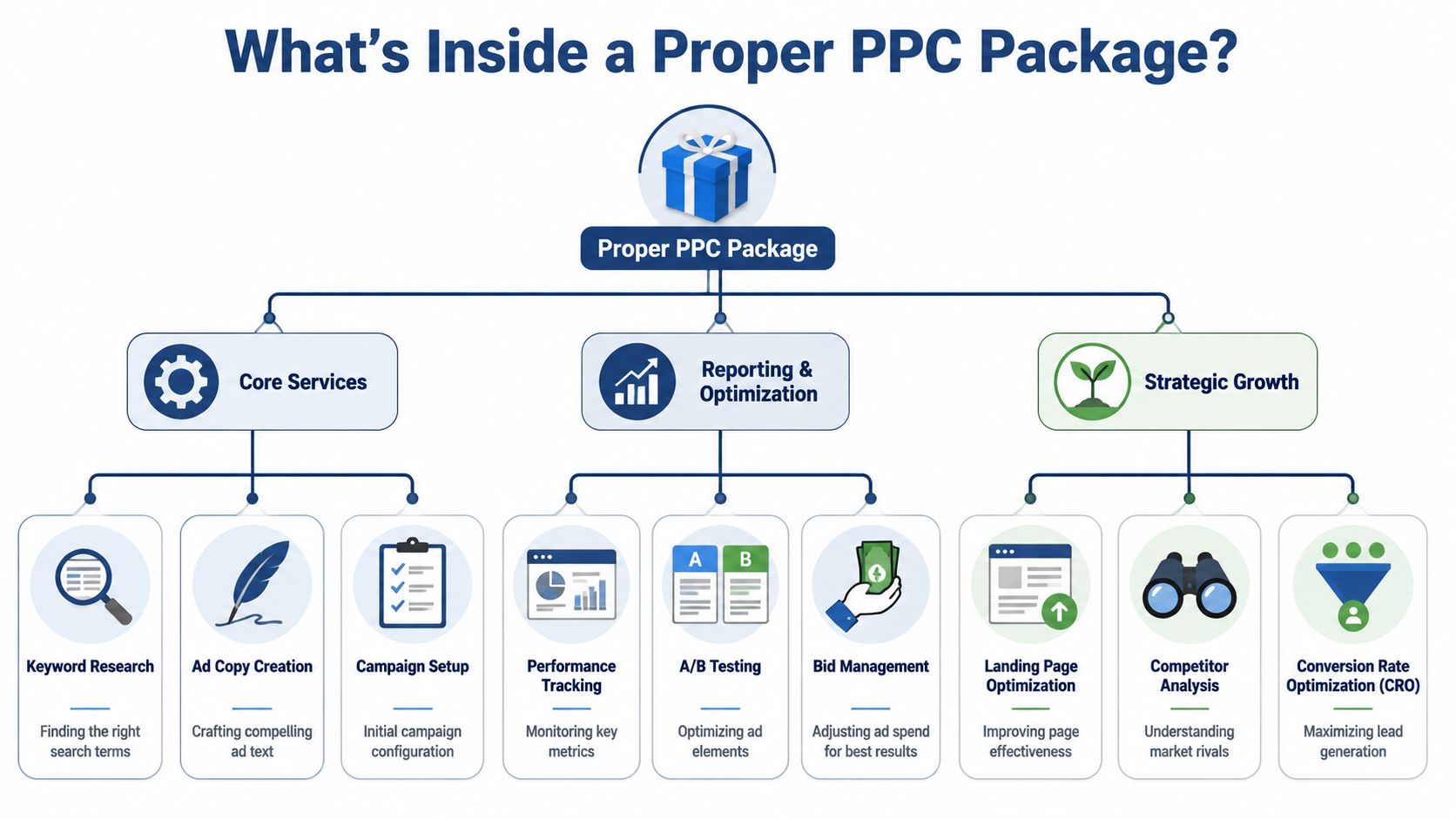
In the UK market, PPC services packages are usually priced either as a fixed monthly fee or as a percentage of ad spend, and the extensive ones include bid management, A/B testing, landing page optimisation, and competitor analysis according to this UK guide on PPC package structure.
The non-negotiables
For a Bristol electrician, each part has a job to do.
Keyword research
This finds what people type, not what you assume they type. “Emergency electrician Bristol” is one thing. “Electrical course Bristol” is another. Mix them up and you'll pay for rubbish traffic.Ad copy creation
Your ad needs to match intent. If somebody needs a same-day fuse box repair, they want speed, trust, and clarity. Not vague waffle about “premium electrical solutions”.Campaign setup
This includes structure, location targeting, ad scheduling, and conversion tracking. If the foundations are sloppy, every later decision is built on sand.
After that comes the ongoing graft.
- Bid management keeps you from overpaying for poor traffic.
- A/B testing stops ads going stale and helps you learn what language gets clicks and leads.
- Landing page optimisation makes sure the click has somewhere sensible to go.
- Competitor analysis shows who else is bidding hard in your patch, and where there may be openings.
Here's a useful explainer if you want a visual walkthrough before you sign anything:
Practical rule: If a package doesn't include search term checks, negative keywords, landing page input, and conversion tracking, it isn't management. It's babysitting.
What white hat looks like in PPC
A seasoned operator knows the difference between getting clever and getting stupid.
White hat PPC means the account is built to attract real buyers with transparent reporting. Calls are tracked properly. Form leads are recorded properly. Brand terms are separated from non-brand terms so you can see what's really happening.
Grey hat PPC often hides inside “good enough” package deals. You'll see broad targeting, weak exclusions, and reports that celebrate clicks while saying little about lead quality. It's not fraud, but it's not sharp work either.
Black hat PPC is where ads overpromise, landing pages mislead, and data gets massaged until it tells a fairy tale. That sort of campaign can generate short-term noise, but it poisons trust. For a local service business, trust is half the sale.
Decoding PPC Package Pricing Models
At this point, owners usually lean forward and ask the only question that really matters.
What's this going to cost me?
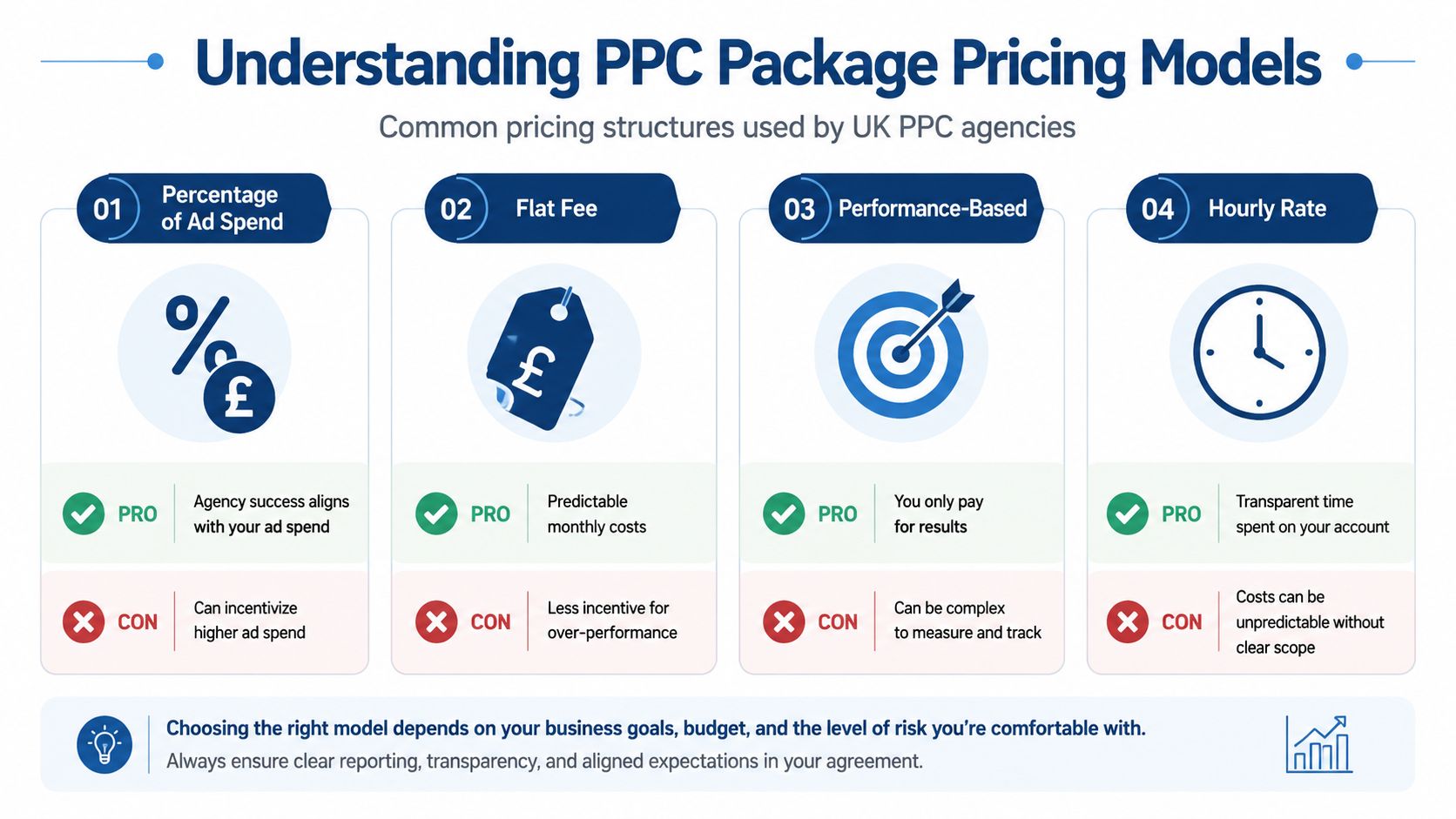
In the UK, PPC fees commonly sit at 10% to 20% of ad spend, though they can reach 25%. A business spending £5,000 a month on ads might pay between £500 and £1,250 in management fees according to IBISWorld's UK digital advertising industry data.
Fixed fee versus percentage of spend
Here's the straight comparison.
| Pricing model | How it works | Good bit | Catch |
|---|---|---|---|
| Fixed monthly fee | You pay a set amount each month | Predictable cash flow | Some providers do the minimum once the account is live |
| Percentage of ad spend | Fee rises or falls with budget | Can fit growing accounts | It can reward higher spend, not better efficiency |
| Hybrid model | Base fee plus spend-based element | Balanced for some firms | Can get fiddly if the scope isn't clear |
| Hourly or one-off work | You pay for set tasks or time | Fine for audits or fixes | Usually poor for ongoing lead generation |
What suits a small local business
A bakery in Chester with a modest budget usually values certainty. A fixed fee can work well if the package clearly says what management is included. If it doesn't, “fixed fee” can quickly become “fixed effort”, which is less charming.
A larger solicitor's firm with several service lines may prefer a percentage model if campaigns are expanding across locations and practice areas. That can make commercial sense. But only if reporting is crystal clear and the account is measured against lead quality, not just spend and traffic.
Cheap management often becomes expensive advertising.
The question isn't “which model is best?” It's “which model gives me enough active management for my budget and my level of competition?” If the answer is “not much”, the structure doesn't matter. You're still being short-changed.
How to Choose the Right Package for Your Business
The best PPC services packages are built around the business. The worst ones are built around a brochure.
A local plumber, a conveyancing solicitor, and a multi-branch home services company do not need the same thing. Yet plenty of packages pretend they do. That's where owners get stitched up.
Why generic packages fail local firms
The biggest problem is cost per click variance by industry. Generic package pages love broad budget ranges because they sound simple. Real life is messier.
According to this UK PPC pricing analysis for service businesses, many packages hide industry-specific click costs and cause small service firms to underbudget by 30–45%. Generic packages may cite £500–£5,000 per month, but UK trade and service clicks, including plumbers and solicitors, can average £2.50–£8.00, which means £500 in ad spend may only buy 60–100 clicks.
That matters.
If you're a new plumber in Manchester and your package assumes low-cost clicks, your budget can vanish before enough data comes in to make sensible decisions. If you're a solicitor bidding on urgent legal terms, the margin for error gets even tighter. Generic pricing can make a package look affordable while subtly setting you up to fail.
A smart owner should also compare providers carefully before signing. A tool like the NotFair agency comparison tool is useful because it forces you to look beyond the sales patter and compare real service depth, pricing style, and fit.
Sample PPC Packages for UK Service Businesses
| Business Profile | Best Fit Package | Typical Monthly Ad Spend | Key Focus Areas |
|---|---|---|---|
| New local tradesperson | Lean fixed-fee package with tight location targeting | Lower end of the available budget range | Emergency terms, call tracking, negative keywords, limited radius targeting |
| Established local solicitor | Higher-management package with careful search segmentation | Mid to higher budget depending on service line competition | Practice-area campaigns, branded versus non-branded split, lead quality checks |
| Multi-location service business | Broader management package with location-level control | Larger ad spend with structured reporting | Separate locations, tailored landing pages, local intent, budget allocation by branch |
The best fit depends on the shape of the business.
- Scrappy starter: Keep the service list narrow. One or two high-intent services. One core location. No faffing about.
- Established local hero: Protect your patch. Build separate campaigns by service and location. Don't blend everything together.
- Ambitious grower: Split campaigns properly by branch or service area. If all locations sit in one bucket, you won't know what's working.
Red Flags and Dodgy Deals to Avoid
The PPC world has plenty of solid practitioners. It also has some absolute artists, and not in a good way.
You need to know the difference before you sign anything.
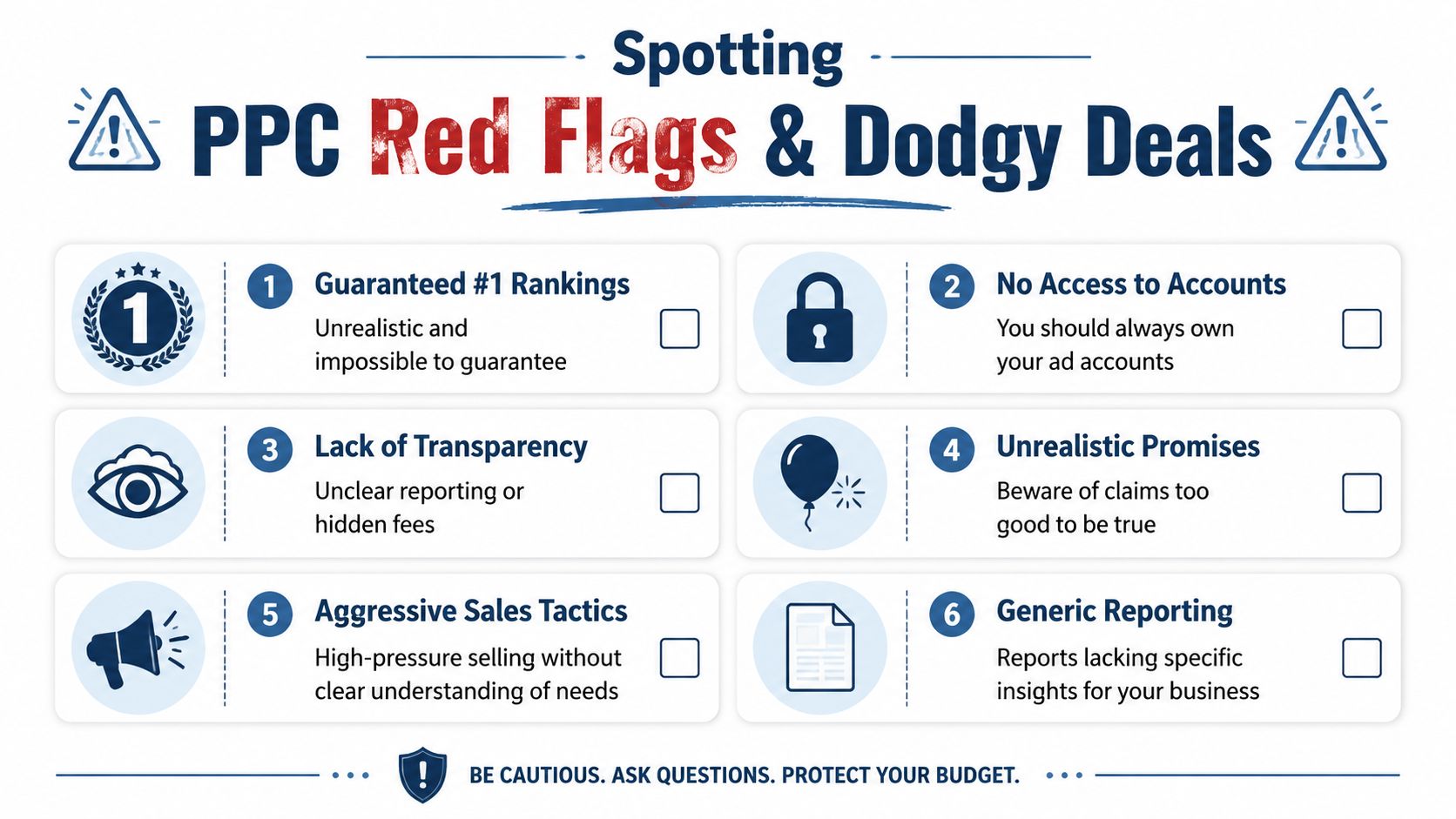
The obvious nonsense
Some warning signs are easy to spot.
Guaranteed rankings
Nobody can guarantee the top slot on demand. Anyone promising that is selling fairy dust.No account access
It's your data. Your ad history. Your conversion record. If you can't access the account, that's a problem.Murky reporting
If reports are all impressions, clicks, and pretty graphs with no proper discussion of leads, quality, and wasted spend, walk away.Long contracts with no breathing room
Confidence shows up as performance and transparency, not handcuffs.
The sneaky stuff that catches good businesses out
The more dangerous problem is the one that doesn't look dodgy on day one.
A major example is Performance Max cannibalisation. UK service firms have reported 15–25% of branded search traffic being taken by their own Performance Max campaigns, which can erode ROAS when reporting isn't transparent, as outlined in this discussion of PMax risks for service businesses. Most cheaper packages don't include the controls needed to stop that.
That means a business can think the campaign is performing beautifully, when in reality it's often harvesting branded demand that might have come in anyway.
If a report makes everything look brilliant but never separates brand traffic, non-brand traffic, and campaign types, assume you're not seeing the full story.
There's another trap. Generic reporting. You'll get a monthly sheet that says costs are “stable”, clicks are “up”, and the campaign is “optimising”. Fine. But for a local service firm, the essential questions are simpler.
- Are calls increasing from the right areas?
- Are irrelevant searches being blocked?
- Are branded clicks being kept under control?
- Is the landing page helping or hurting conversion?
That's white hat thinking. Clear, transparent, measurable. Grey hat operators dance around those questions. Black hat ones avoid them entirely and hope the invoice gets paid before anybody asks.
Your Next Move Making PPC Pay
PPC services packages aren't mysterious. They're just easy to dress up badly.
The right package fits your trade, your area, your click costs, and your sales process. The wrong one gives you generic management, broad targeting, and reports that tell a lovely story while your diary stays patchy. For local UK businesses, the difference often comes down to whether somebody has built the campaign around your actual market instead of dumping you into a pre-made template.
Keep your standards high. Demand account access. Demand clear reporting. Demand a proper explanation of how branded traffic, non-branded traffic, search terms, and landing pages are being handled. If you want a wider view of practical digital marketing strategies, that guide is a useful companion because PPC works best when it supports a broader lead generation setup.
And don't ignore the bit after the click. If your website turns visitors away, better ads won't save you. That's where conversion rate optimisation support becomes part of the conversation.
Pick the package that matches reality, not the one with the slickest sales deck. That's how PPC becomes a profit engine instead of a monthly headache.
If you want straight answers on whether your current PPC setup is pulling its weight, have a look at DigiVisi Ltd. DigiVisi works with UK service-led businesses that need more calls, better leads, and clearer reporting, without contracts and without the usual smoke and mirrors.