Skip to content

Your phone isn't dead because your service is poor. More often, it's because the right people can't find you when they're ready to book.
A lot of UK business owners sit in exactly that spot. The vans are branded, the workmanship is solid, the staff are decent with customers, and referrals still come in. But online, a competitor with a tidier Google Business Profile and a better set of location pages keeps popping up first, like that one chap at the pub quiz who somehow knows every answer.
That's where local SEO services earn their keep. Not as digital fluff, and not as a vanity project for rankings screenshots, but as a practical way to turn nearby searches into calls, enquiries, and booked jobs.
Table of Contents
- Why Your Competitors Are Everywhere Online
- What Are Local SEO Services Anyway
- A Look Inside a Local SEO Package
- Sorting the Good from the Dodgy
- How to Choose the Right Local SEO Partner
- Local SEO in Action UK Business Stories
- Frequently Asked Questions about Local SEO
Why Your Competitors Are Everywhere Online
You've seen it happen. A homeowner in Leeds searches for a boiler repair. A landlord in Manchester wants a solicitor. A driver in Bristol needs a garage. Your competitor appears in the map results, has tidy reviews, a clear phone button, proper service pages, and a website that doesn't look like it was built during the reign of dial-up.
Meanwhile, you're good at the actual work, but you're nearly invisible online.
That gap matters because over 46% of all Google searches in the UK have local intent, and businesses that optimise for local SEO can see up to 126% more search traffic per location, according to Birdeye's local SEO data for the UK. In plain English, nearly half the people searching are looking for something nearby, and proper local SEO helps more of them find your branch, office, or service area page.
This is modern word of mouth
Local SEO isn't some mysterious dark art. It's the digital version of being the business everybody in town recommends first.
If a customer types “emergency electrician near me”, Google has to decide who looks trustworthy, relevant, nearby, and easy to contact. Businesses that send clearer signals usually win that decision. That means a complete Google Business Profile, consistent contact details, useful location pages, strong reviews, and service pages that match what people search.
Good local SEO does the same job as a tidy van, a clear shop sign, and a strong local reputation. It helps strangers trust you quickly.
For hands-on businesses, this also blends with how leads are handled after the click. If you run a garage or workshop, resources like Eden's AI for auto repair businesses are worth a look because missed calls can undo the benefit of strong local visibility.
Why competitors seem to be everywhere
They usually aren't doing everything brilliantly. They're just doing the basics consistently.
A rival plumber may not have a bigger budget. They may have:
- A verified profile: Correct hours, service categories, photos, and contact details.
- Better local pages: Separate pages for each town or service area instead of one vague “Areas We Cover” page.
- Cleaner signals: The same business name, address, phone number, and website details wherever Google checks them.
That's often enough to look more reliable than a business with a stronger real-world reputation but a messy online presence.
What Are Local SEO Services Anyway
Local SEO services help your business show up where nearby customers are ready to ring, visit, or book. The goal is simple. Become the obvious, trustworthy option in your patch, rather than chasing clicks from people who will never buy.
If you're a roofer in Sheffield, the valuable search is not someone browsing from Aberdeen. It's the person a few streets over with water coming through the ceiling on a wet Tuesday evening.
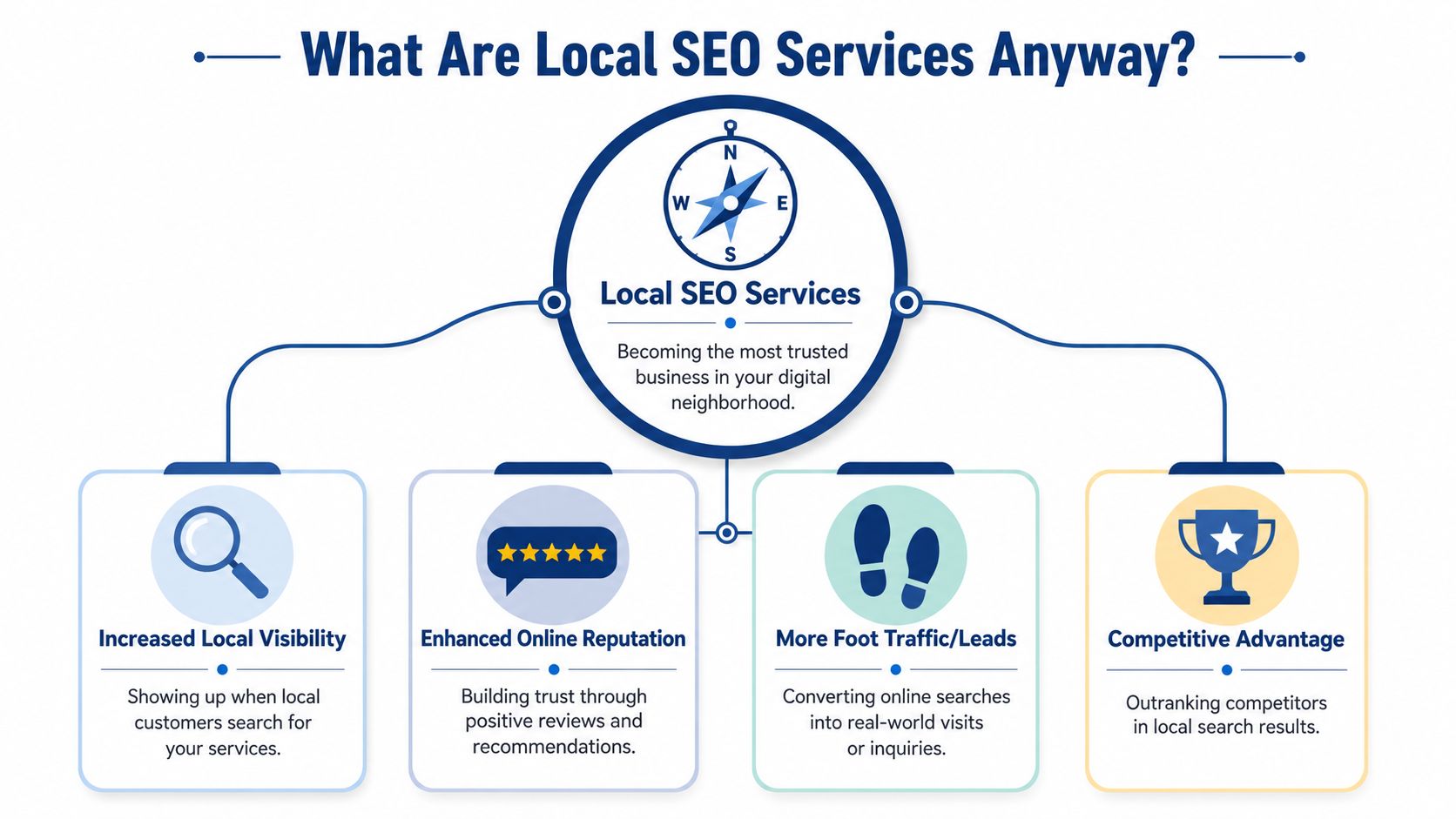
Local SEO is usually built on three parts. Your Google Business Profile, your reputation across the web, and your website's ability to turn intent into an enquiry. If one is weak, the whole setup underperforms. Like a car with good tyres, a healthy engine, and a dead battery, it still won't get you very far.
Your digital shopfront
The first pillar is your Google Business Profile. In plenty of local searches, this is the first thing a customer sees, and sometimes the only thing they look at before deciding who to call.
For a café, salon, solicitor, or drainage company, the profile does the job of a front window and a receptionist rolled into one. It shows your category, opening hours, service area, reviews, photos, and the buttons that prompt a call or directions request. If those details are wrong, missing, or neglected, you make choosing a competitor far too easy.
This gets more important for firms with more than one branch. A company serving London, Croydon, and Watford needs each location to stand on its own, with clear signals about which services belong to which area. Seoprofy's local SEO statistics note that businesses with multiple locations need to target hyperlocal searches tied to where customers live and work, especially because so many searches carry local intent and many mobile users act quickly.
Your reputation around town
The second pillar is citations, local mentions, and reviews.
A citation is your business information listed on other sites such as Yell, Bing Places, or an industry directory. Reviews sit in the same trust bucket. Together, they help search engines confirm that your business is real, active, and tied to a specific area.
This is one of the places where business owners can waste money. A decent provider will clean up bad listings, remove duplicates where possible, and focus on sites that people in your market might use. A dodgy one will sell “500 directory submissions” as if quantity alone wins the day. It doesn't. That sort of work is the SEO version of stuffing leaflets through random letterboxes and hoping one lands in the right kitchen.
Practical rule: If a directory wouldn't help a real customer choose or contact you, it probably isn't helping your local SEO much either.
If you want a practical companion piece, how to improve local SEO gives a useful broad view of the building blocks.
Your website that says what you do and where you do it
The third pillar is your website. It needs clear service pages, sensible location targeting, and contact paths that do not test a visitor's patience.
A family solicitor should not bury everything under one generic “Services” page. Separate pages for family law in Manchester, conveyancing in Manchester, and wills in Manchester give both Google and potential clients a clearer signal. The same applies to trades. “Emergency plumber in Stockport” and “boiler service in Stockport” are different jobs, with different urgency and different search behaviour.
Here's what local SEO services usually include on the website side:
- Location targeting: Pages built around real towns, boroughs, or service areas you serve.
- On-page optimisation: Titles, headings, copy, internal links, and contact details aligned with local intent.
- Conversion basics: Clear call buttons, working forms, and service information that helps people act without digging around.
Good local SEO is not about tricking Google. It is about reducing doubt. Your profile earns the click, your reputation backs up the promise, and your website gives people a straightforward reason to get in touch. That is also the lens worth using when you judge any provider. If the work does not improve visibility, trust, or enquiries in the places you serve, it is noise, not investment.
A Look Inside a Local SEO Package
When you pay for local SEO services, you should be buying real work, not vague promises and a monthly PDF full of charts nobody asked for.
A proper package starts with detective work. What do people search in your area? Which competitors appear for those terms? What are they doing better? Where is your Google Business Profile weak? Which service pages are missing? Which citations are wrong or duplicated?
The work that actually moves the needle
The useful parts of a local SEO package usually include a mix of technical fixes, content work, profile optimisation, and local authority building.
For a small electrician in Nottingham, that might mean tightening service pages for emergency call-outs, landlord certificates, and rewires. For a solicitor, it might mean separate pages by service and town, plus tighter internal linking so Google can understand which pages matter most.
A sensible package often includes:
- Local keyword research: Not broad vanity phrases, but service-and-location terms that match how customers search.
- Google Business Profile optimisation: Categories, services, descriptions, photos, FAQs, and routine updates.
- On-page edits: Title tags, headings, service copy, schema, and location relevance.
- Internal linking: Making sure the important pages are supported by the rest of the site.
- Review support: A process for collecting and responding to genuine reviews.
- Reporting tied to leads: Calls, form fills, direction requests, and profile interactions.
If someone can't explain what they'll improve on your site, your profile, and your citations, you're not looking at a plan. You're looking at a sales script.
What a proper citation cleanup looks like
A lot of money gets wasted here.
Some providers still push the idea that more directories always equals better rankings. That's how businesses end up listed on irrelevant sites with inconsistent details. According to Red Eagle's local SEO analysis for small businesses, 68% of UK local businesses are listed on irrelevant directories that dilute NAP consistency, while only 30% focus on high-impact ones like Yell, Bing Places, and industry-specific platforms such as Checkatrade.
That tells you something important. Citation work isn't about spraying your business details across the internet like a toddler with a hose. It's about accuracy and relevance.
A proper citation cleanup usually means:
| Task | Why it matters |
|---|---|
| Audit existing listings | Finds old numbers, duplicate listings, and address variations |
| Prioritise key directories | Focuses effort on platforms customers and search engines actually trust |
| Standardise NAPW | Keeps your name, address, phone, and website consistent |
| Remove or fix duplicates | Reduces confusion for both Google and real users |
| Add sector relevance | Strengthens trust with industry-specific platforms |
For firms in advisory sectors, local visibility also intersects with service credibility. That's why work like SEO for professional services tends to focus heavily on clean service pages, trust signals, and accurate local information rather than gimmicks.
The short version is simple. You're paying for clarity. Clear relevance, clear trust signals, and clear routes for customers to contact you.
Sorting the Good from the Dodgy
Not all SEO is created equal. Some of it is solid craftsmanship. Some of it is the marketing equivalent of covering a warning light with masking tape and hoping the MOT tester's had a long week.
If you're hiring local SEO services, you need to know the difference between white hat, grey hat, and black hat tactics. One builds a durable business asset. One plays with fire. One can leave you with a mess that costs more to clean up than to build properly in the first place.
How the three camps differ
Here's the plain-English version.
| Tactic Category | White Hat (Safe & Recommended) | Grey Hat (Risky) | Black Hat (Dangerous) |
|---|---|---|---|
| Google Business Profile work | Accurate categories, genuine updates, real photos, proper service areas | Aggressive keyword additions that push the limits | Fake locations, fake listings, misleading business details |
| Reviews | Ask real customers and respond properly | Over-managed review funnels that skew reality | Buying fake reviews or posting them yourself |
| Content | Useful location pages and service pages written for users | Thin location variants with minor wording changes | Keyword stuffing, spun pages, copied content |
| Links | Earn local and relevant mentions | Questionable placements from loosely related sites | Paid spam links, private link schemes, automated link blasts |
| Citations | Clean, consistent listings on relevant directories | Chasing volume over quality | Mass submissions to spam directories and fake business sites |
| Results profile | Slower but steadier gains | Unpredictable, can work until it doesn't | Short-lived spikes followed by drops, suspensions, or worse |
| Long-term risk | Low | Medium | High |
White hat work is boring in the best possible way. It's methodical, transparent, and rooted in what helps both users and search engines.
Grey hat work often sounds tempting because it promises speed. Sometimes it does move things faster. But it also creates fragility. That's fine if you enjoy rebuilding your foundations in the rain.
Black hat work is the danger zone. Fake locations, bought reviews, doorway pages, and nonsense backlinks can damage trust, visibility, or both.
Red flags that should make you twitchy
A few warning signs come up again and again:
- Guaranteed rankings: Nobody credible controls Google's results that neatly.
- Secret methods: If they can't explain the work in plain English, be wary.
- Obsessing over volume: More directories, more links, more pages. Quantity alone isn't strategy.
- No mention of leads: If calls and enquiries never come up, the job's already gone sideways.
- Template pages everywhere: Fifty near-identical town pages are not a masterstroke.
Cheap SEO often turns out to be the expensive option. You just pay the second bill later.
How to Choose the Right Local SEO Partner
A good local SEO partner should feel less like hiring a magician and more like hiring a solid tradesperson. You want someone who can show their workings, explain the likely return, and tell you where the job could go wrong.
Small business owners often ask the wrong first question. “Can you get me to number one?” sounds sensible, but it skips the part that pays the wages. The better test is whether their work is likely to bring in more profitable enquiries from the places you serve and for the services you most want to sell.
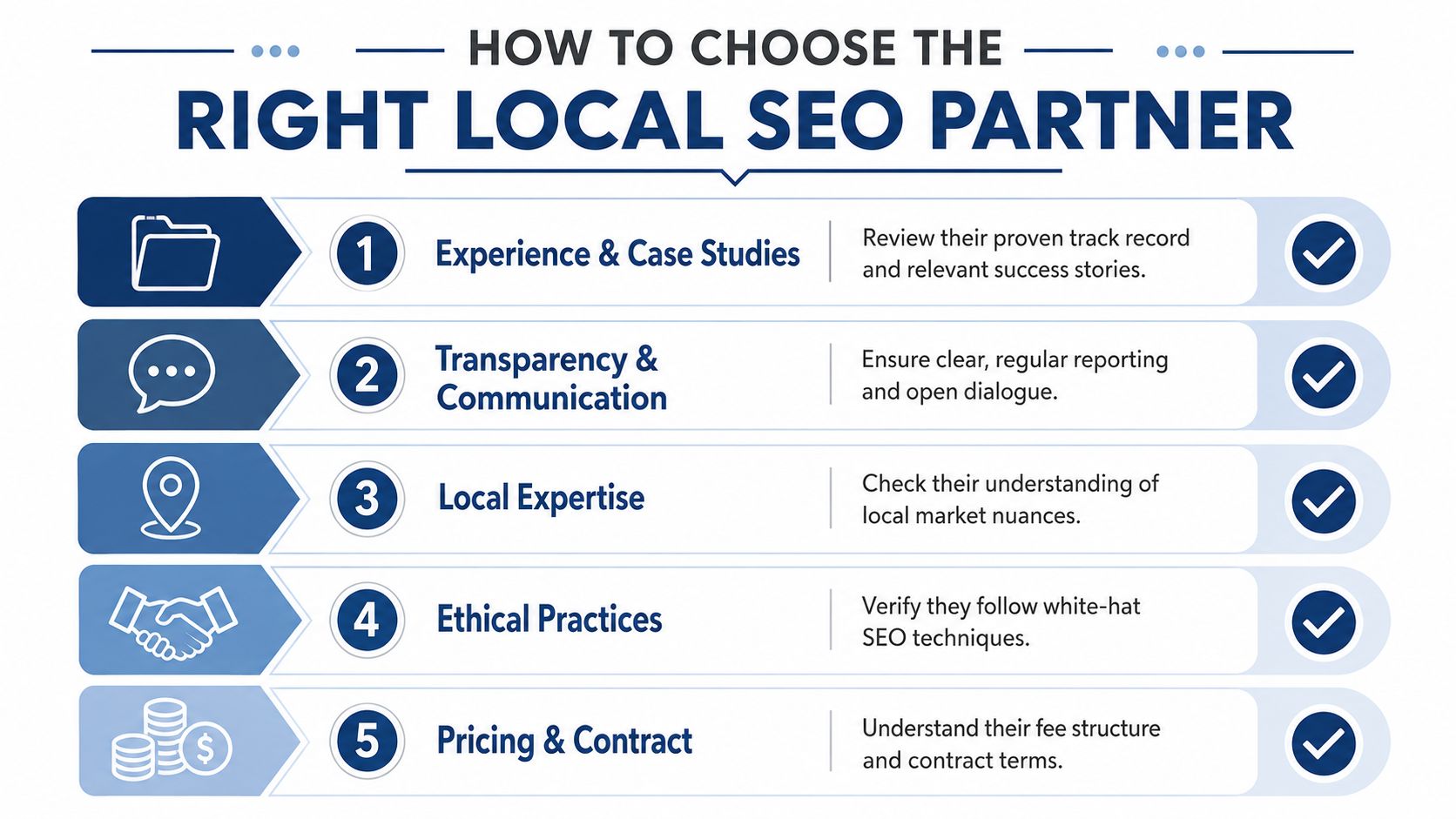
A decent agency will talk about trade-offs. If you target every nearby town at once, the budget gets spread thin. If you focus first on your highest-margin services and strongest service areas, results are usually easier to measure. That is how local SEO should be judged. As an investment, not a vanity project with prettier charts.
Questions worth asking before you sign anything
Ask direct questions. Then listen for direct answers.
- How do you measure success beyond rankings? A useful answer should cover calls, form enquiries, booked jobs, and which pages or profiles influenced them. This discussion on measuring SEO ROI for UK SMEs is a fair reminder that many businesses struggle to tie SEO activity back to leads, which is why rank reports on their own are weak evidence.
- What is your process for Google Business Profile optimisation? They should be able to explain how they handle categories, services, photos, reviews, posts, and conversion tracking.
- How do you choose which locations and services deserve dedicated pages? Good answers mention search demand, commercial value, and whether you are capable of serving that area well.
- How do you handle citations? Look for auditing, fixing inconsistencies, and pruning rubbish listings. Mass submissions are cheap because they are blunt.
- What do you need from us each month? Strong local SEO usually needs input from the business. New photos, updated services, review requests, opening hours, and changes to staff or premises all matter.
The tone matters too. If every answer sounds like a sales pitch, keep digging. A reliable partner should be able to tell you what they would prioritise first, what can wait, and what is unlikely to be worth your money.
What sensible reporting looks like
Reporting should help you decide whether to keep investing, change course, or stop. If it cannot do that, it is decoration.
Useful local SEO reporting usually includes:
- Profile actions: Calls, website clicks, direction requests, and other Google Business Profile activity.
- Lead paths: Which pages attract local visitors, and which ones help turn them into enquiries.
- Competitor movement: Which local rivals are gaining ground, and what changed.
- Work completed: The tasks done that month, why they were done, and what happened after.
One question I like on a first call is this: “If rankings improved but calls did not, what would you check first?”
A seasoned consultant will usually mention conversion issues before they start celebrating traffic. Maybe the wrong page is ranking. Maybe the page gets visits but does not persuade anyone. Maybe the profile is visible, but the reviews are thin and the photos look like they were taken during a power cut. Those are the answers that show someone is thinking about revenue, not just visibility.
Price needs a sober look as well. The cheapest quote can be fine if the business only needs a tidy-up and light ongoing support. It is poor value if you are paying for generic reports, recycled content, and no real strategy. On the other hand, an expensive retainer is not proof of quality. Ask what work is included, what is excluded, and what you should expect to see improve over the next few months.
If the conversation never gets past impressions, generic visibility, and “awareness”, keep your wallet in your pocket a bit longer.
Local SEO in Action UK Business Stories
Theory is useful. A diary full of decent local work is better.

Dave the plumber from Plymouth
Dave relied mostly on referrals. Nice when it worked, patchy when it didn't. His website had one generic services page, his Google Business Profile was half-finished, and his service areas were a bit of a shrug.
The first fix wasn't glamorous. It was practical. His profile was tightened up, service categories were clarified, photos were improved, and his website got clearer pages for the actual work he wanted more of.
That focus on the profile matters for trades. Axiom Flux's write-up on local SEO strategies notes that for a UK plumber in Leeds, optimising Google Business Profile is the single most critical local SEO factor, with 52% of businesses ranking it as their top priority service, and that a verified GBP generates approximately 200 clicks or interactions monthly.
Dave also benefited from a stronger enquiry-handling setup. For repair and service businesses, FixyFlow's local SEO insights are useful because they connect profile visibility with the practical realities of capturing leads once people are ready to call.
Sarah the solicitor from Manchester
Sarah had a different problem. She was visible enough for her firm name, but not for the services new clients searched for. Her site spoke in broad legal language when local prospects wanted clear answers about family law, conveyancing, and wills in Manchester.
The fix was sharper service targeting. Each key service got its own well-written local page, the internal links were cleaned up, and the messaging shifted from “about us” waffle to “here's how we help with this issue”. That made the site more useful for both searchers and Google.
A helpful video on local SEO basics and practical execution sits well here:
Neither story requires magic. Just sound local SEO services, done in the right order, with attention to what gets the phone ringing.
Frequently Asked Questions about Local SEO
How much should I expect to pay for local SEO services
It depends on the size of the job. A single-location trades business with a basic site usually needs less work than a multi-location solicitor or home services firm. The key question isn't the monthly fee on its own. It's what work is included, what gets improved, and how results are tracked.
How long does it honestly take to see results
Local SEO usually takes time to bed in. Some improvements, especially around Google Business Profile and on-page clarity, can help quite quickly. Stronger and steadier gains tend to come from consistent work over time, not overnight heroics.
Is this a one-off job or an ongoing thing
It's ongoing. It's like tending a garden rather than fitting a new sink. You can do a one-off cleanup, and that helps, but competitors keep updating their sites, earning reviews, and improving visibility. If you stop completely, things usually drift.
If you want local SEO services that focus on calls, enquiries, and sensible reporting rather than smoke and mirrors, DigiVisi Ltd is a practical UK option for service-led businesses. They work on a monthly basis with no contracts and a data-first approach, which suits owners who want clear work, clear reporting, and a straight answer about what's being done.