Skip to content

A surprising amount of SEO progress comes from tidying up what you already own. Internal linking is the classic example. A study of over 5,000 websites found that 95% fail to implement effective internal linking strategies, which means most firms are leaving easy wins on the table (InLinks internal linking guide).
For a local service business, that's excellent news. You don't need a giant brand, a newsroom, or a marketing department with more job titles than a London tech start-up. You need a site that makes sense, sends visitors to the right pages, and gives Google a clear map instead of a muddy footpath through a field.
Done well, internal linking helps your service pages get found, supports your blog content, and nudges people towards a call, booking, or enquiry. Done badly, it turns your website into the digital version of a shop with no signs and the till hidden in the cellar.
Table of Contents
- Your Competitors Are Getting This Wrong
- What Are Internal Links and Why Should You Care
- How to Quickly Audit Your Website's Links
- Building Your Site Structure for SEO Success
- The Art of Writing Powerful Anchor Text
- Advanced Linking for Conversions and AI Overviews
- Your Simple Internal Linking Action Plan
Your Competitors Are Getting This Wrong
A startling share of websites still mishandle internal linking, and for a UK local service business, that is good news.
Plenty of firms spend money on a new homepage banner, a shinier logo, or another batch of blog posts, then leave their best pages barely connected to the rest of the site. The result is simple. Google gets a muddled view of what matters, and potential customers land on a page with no clear route to the next useful step.
That gap is your opportunity.
For a roofer in Sheffield, a solicitor in Nottingham, or a plumber in Bristol, internal linking is not some fussy SEO hobby. It is one of the few jobs that can improve rankings and enquiries without needing a huge budget. A smaller firm with a tidy site structure can often beat a bigger rival whose website has been bolted together over five years by three agencies and a nephew who once built a Wix site.
Here is where local businesses usually trip themselves up:
| Common mistake | What it costs them |
|---|---|
| Blog posts sit on their own with no links to service pages | Visitors read, leave, and never reach an enquiry page |
| Every link uses the same keyword-heavy anchor text | The site looks forced and low quality |
| Key service pages are buried deep | Google gives them less weight and users miss them |
| Old pages are left orphaned | Good content stops helping the rest of the site |
The trade-off is worth being honest about. Internal linking will not rescue a poor service page or make bad content rank by magic. But when the page is decent, better links usually give it a clearer push. That is why I like this area for local SEO. It is practical, fast to fix, and ignored by an absurd number of competitors.
A good internal linking setup does two commercially useful things. It points Google towards the pages that make you money, and it gives real people a smoother path from question to service to contact.
If your competitors are still treating their website like a pile of disconnected leaflets, a well-linked site gives you an edge without spending like a national brand. That is exactly the sort of advantage a local firm should take.
What Are Internal Links and Why Should You Care
An internal link is just a link from one page on your website to another page on the same website. Nothing mystical. No incense. No secret handshake.
Think roads, not code
The easiest way to understand internal linking best practices is to think of your website like a town.
Your homepage is the town hall. Your main service pages are the important businesses on the high street. Your blog posts, FAQs, and area pages are the side streets. Internal links are the roads connecting all of them.
If the roads are obvious and well signposted, people get where they need to go. Google does too.
If the roads are poor, everything feels hidden. A visitor lands on one page, can't find the next useful page, and leaves. Google lands on one page, sees weak connections, and gets a fuzzy picture of what your site is really about.
That's why internal links do two jobs at once:
- They help users find related pages
- They help Google understand priority by showing which pages support which topics
A local example that makes this obvious
Take a plumber in Bristol. They might have these pages:
- Emergency plumbing
- Boiler repair
- Bathroom installation
- A blog post on fixing a leaking tap
- A blog post on low boiler pressure
- A contact page
If the article about a leaking tap mentions bigger problems and links naturally to the emergency plumbing page, that's useful for the reader and helpful for SEO. If the low boiler pressure article links to the boiler repair page, same story.
Now compare that with the usual small business site. The blog exists in one corner, service pages sit in another, and the only route between them is blind luck and a hamburger menu. That's not structure. That's a scavenger hunt.
Good internal links answer the next question a customer is likely to ask.
A few practical distinctions help here:
Navigation links
These sit in your menu, footer, or breadcrumbs. They help with overall structure.
Contextual links
These sit inside the main body copy. They're often the most useful because they connect closely related topics in plain English.
Conversion links
These point people towards contact, booking, quote, or consultation pages at the right moment.
For local service companies, the strongest internal linking usually combines all three. The menu gets people to the main sections. Contextual links explain topic relationships. Conversion links guide ready-to-buy visitors to the next step without making it feel like a hard sell from a bloke in a shiny suit.
How to Quickly Audit Your Website's Links
Most internal linking problems reveal themselves quickly if you know where to look. You don't need a ten-tab spreadsheet and a facial twitch from staring at crawl data all afternoon.

Start with your money pages
Begin with the pages that directly bring enquiries. For a local business, that usually means service pages, key location pages, and the contact page.
Write down the top pages you care about. Then ask three simple questions:
- Can I reach this page easily from the homepage?
- Do other relevant pages link to it?
- Does it lead visitors somewhere sensible next?
If a high-value page is hard to reach, lightly linked, or isolated, that's your first fix.
A proper crawl helps, of course. If you want a broader check on how your local search foundations are holding up, a local SEO audit checklist is a sensible companion to an internal linking review.
Three checks that catch most problems
The biggest wins usually come from fixing obvious structural issues, not from tinkering with microscopic details.
A useful benchmark is the three-click rule. Keeping important pages within three clicks of the homepage is critical, and audits show that fixing orphaned URLs and reducing click depth can increase organic visibility by 25 to 30% within three months (Siteimprove internal linking strategy).
Check one: orphaned pages
An orphaned page has no internal links pointing to it. It may exist in your sitemap or backend, but as far as the rest of your site is concerned, it's living alone in a shed at the end of a lane.
Common examples:
- Old service pages
- Blog posts no one links to
- Location pages created in a rush
- Seasonal offers that were never integrated properly
If a page matters, link to it from related pages and, where appropriate, from category or service hubs.
Check two: pages buried too deep
If someone has to click through homepage, services, sub-services, blog category, article archive, and then finally the page you care about, that page is too far down the chain.
Keep priority service pages close to the homepage, either through navigation, service hubs, or contextual links from strong pages.
Check three: broken and pointless links
Look for links that send users to dead pages, redirected URLs, or pages that no longer support a business goal. These clutter the site and waste attention.
Use this quick review:
- Broken links should be updated or removed
- Redirected internal links should point straight to the final live page
- Weak links from irrelevant pages should be replaced with stronger, topical ones
A short manual audit often reveals enough to get moving. Open your main pages, click through like a customer, and note where the path feels awkward. If you get annoyed, your visitors probably do too.
Building Your Site Structure for SEO Success
Good internal linking doesn't start with random links added after the fact. It starts with a structure that makes sense.
Use a hub and spoke model
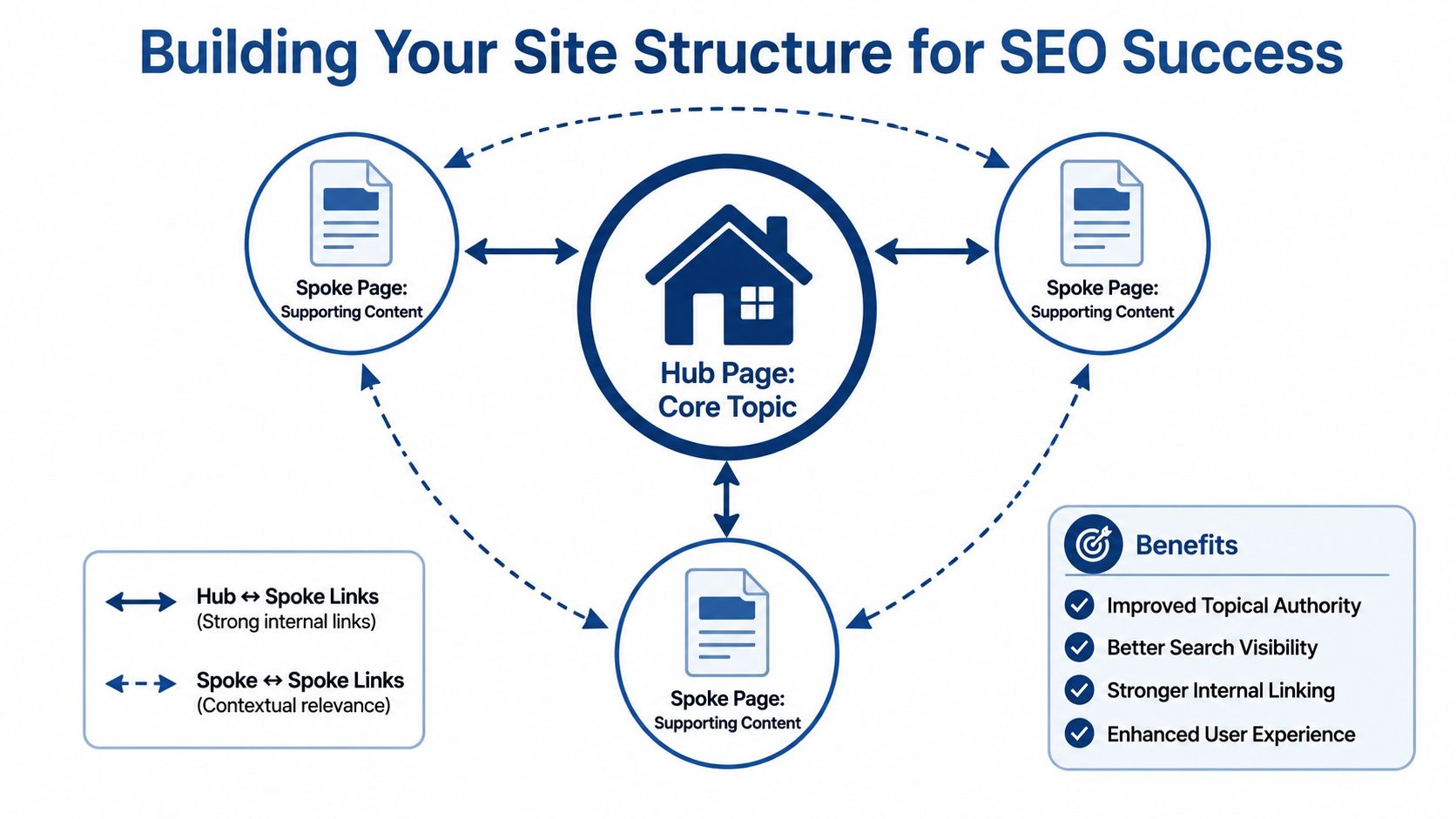
For local service firms, the cleanest approach is a hub and spoke setup, sometimes called a topic cluster.
You create one main page for a core service. That's the hub. Then you create supporting pages around related subtopics. Those are the spokes. Each spoke links back to the hub, and the hub links out to the spokes where relevant.
This works because it creates order. Google sees a clear relationship between pages, and visitors can move from broad information to specific answers without getting lost.
For a broader technical refresher on how structure, crawling, and on-page signals fit together, this technical on-page SEO guide is worth a read.
What this looks like for a local firm
Take a loft conversion company in Leeds.
Hub page
- Loft conversions
Spoke pages
- Dormer loft conversions
- Velux loft conversion ideas
- Loft conversion planning permission
- Loft conversion costs
- Loft conversions in Headingley
That structure gives you a tidy set of relationships:
| Page type | Links to |
|---|---|
| Hub page | Each relevant spoke page |
| Spoke page | The main hub page |
| Related spokes | Other closely connected spokes when useful |
Later in the section, this becomes even stronger when paired with sensible anchor text. The point is not to create endless pages for the sake of it. The point is to build a network around real services and real customer questions.
A strong benchmark comes from a UK-based analysis showing that pages with 40 to 44 internal links get four times more traffic than pages with fewer internal links, while 66.2% of websites have pages with only one internal link (Whitehat SEO internal links guide). That tells you two things. Well-linked pages can do far better, and many competitors are under-linking badly.
Here's a visual explanation before you map your own structure:
How many links is sensible
People often go a bit feral. They hear “more links” and start stuffing links into every sentence like they're hiding peas under mashed potato.
A better approach is controlled and useful. Link where the relationship is genuine. Make sure your main pages earn repeated support from relevant content. Build out hubs around services core to the business.
A page should feel well connected, not overstuffed.
For a local solicitor, builder, electrician, or accountant, the practical goal is simple. Each important service page should sit at the centre of a small, logical network. Not a lonely page. Not a link swamp. A network.
The Art of Writing Powerful Anchor Text
Anchor text is the clickable wording in a link. It tells readers what they'll get if they click, and it tells Google what the destination page is about. This is one of those areas where white-hat and grey-hat behaviour split very quickly.
Why exact match everywhere is a rotten idea
Some site owners still believe the clever move is to hammer the exact keyword into every link. So a law firm might link to the same page with “best solicitor London” over and over again.
That's not clever. That's clumsy.
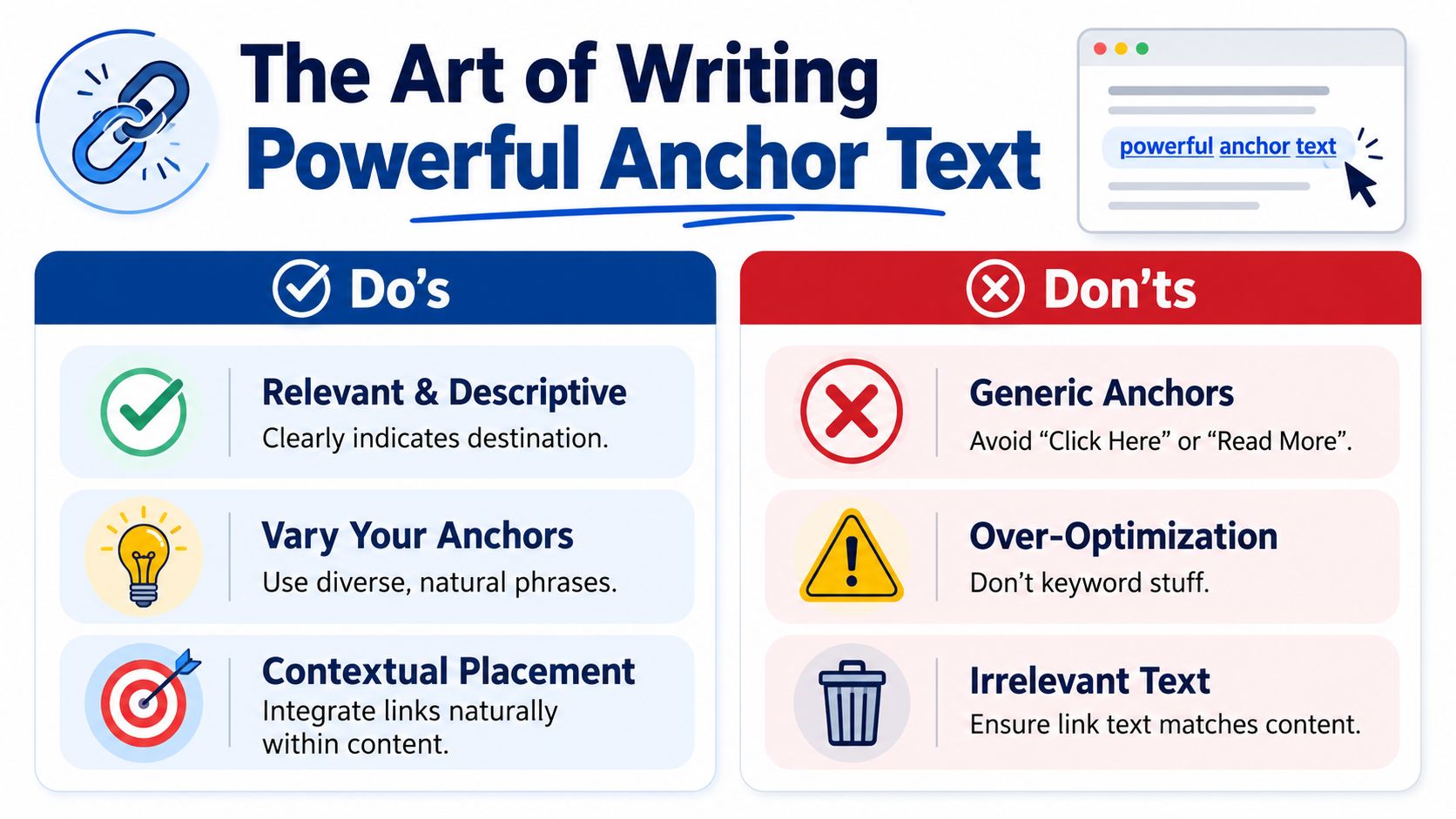
Moz advises using anchor text variations such as “our family law experts” or “help with divorce” rather than mechanically repeating the same exact phrase, because varied anchors help target a broader range of keywords and appear more natural (Moz internal link guidance).
That's the white-hat line. Useful, descriptive, and natural.
The grey-hat version is over-optimisation. It often looks like this:
- Every link uses the exact same keyword
- The anchor sounds robotic in the sentence
- The destination page doesn't quite match the wording
- The copy is written for a crawler, not a human being
Black-hat tactics go further still. Think hidden links, manipulative link blocks, or nonsense copy created only to jam in anchor text. For a local business site, that sort of thing is a marvellous way to look spammy and waste perfectly good pages.
Do this instead
Anchor text should match the page, fit the sentence, and vary naturally.
Here's a cleaner comparison for a plumbing business linking to an emergency plumbing page:
| Don't use | Better anchors |
|---|---|
| click here | emergency plumbing service |
| plumber Leeds | our emergency plumbing team |
| best plumber Leeds | urgent help for burst pipes |
| read more | same-day plumbing support |
A few practical rules keep you on the straight and narrow:
- Match intent: if the page is about boiler repair, the anchor should suggest boiler repair, not generic plumbing.
- Vary phrasing: use service-led, problem-led, and natural language variations.
- Keep it readable: if the sentence sounds daft out loud, rewrite it.
- Avoid filler anchors: “here”, “this page”, and “read more” waste context.
If you wouldn't say the phrase naturally to a customer on the phone, it probably shouldn't be your anchor text either.
For a solicitor, “speak to our employment law team” is better than “employment solicitor Manchester” jammed into a sentence that reads like it was assembled by a malfunctioning fridge.
Good anchor text doesn't shout. It guides.
Advanced Linking for Conversions and AI Overviews
Ranking is useful. Enquiries are better. Internal links should help with both.
Send traffic to pages that make the phone ring
A common mistake is treating blog traffic as a vanity metric. Nice to look at, but disconnected from revenue. A stronger approach is to use internal links to move readers from informational pages to commercial pages.
Say you run a heating business. A blog post about odd boiler noises may attract useful traffic. That article shouldn't just sit there being informative and hoping for the best. It should naturally link readers to the boiler repair service page, the emergency call-out page if relevant, and the contact page where they can take action.
The best places for conversion-focused internal links are usually:
- Mid-content links when the reader realises they may need help
- Short end-of-page prompts pointing to the most relevant service
- Supporting links from FAQs to contact or quote pages
If you're improving the page journey as well as the links, these conversion rate optimization tips are a handy companion read.
Internal linking for AI visibility
AI Overviews are changing how local visibility works, especially for service-led searches. Internal linking now helps with more than crawling and authority. It also helps search systems understand topic relationships and business relevance.
One especially useful finding is that UK sites using topic clusters with bidirectional linking, meaning pillar-to-cluster and back again, rank 18% higher in AI Overviews for “near me” queries (Yoast guide to internal linking for SEO and GEO).
That matters for local firms because “near me” intent often sits close to a buying decision. If your Manchester electrician page links to a fuse board guide, and that guide links back to the core service page, you're reinforcing both relevance and hierarchy.
Two trade-offs matter here:
Link for context, not volume
More links aren't always better if they muddy the page. The cluster should feel deliberate.
Link for intent, not just keywords
A phrase like “help with a tripping fuse board” often serves users better than a stuffed exact-match anchor.
Many sites fall short in this area. They build pages. They even build clusters. Then they fail to connect those pages in both directions, so the structure never fully works. A proper internal network helps users convert and helps search systems understand what your business specialises in.
Your Simple Internal Linking Action Plan
A tidy plan beats a grand strategy that never leaves the notebook.
A four week plan you can actually finish
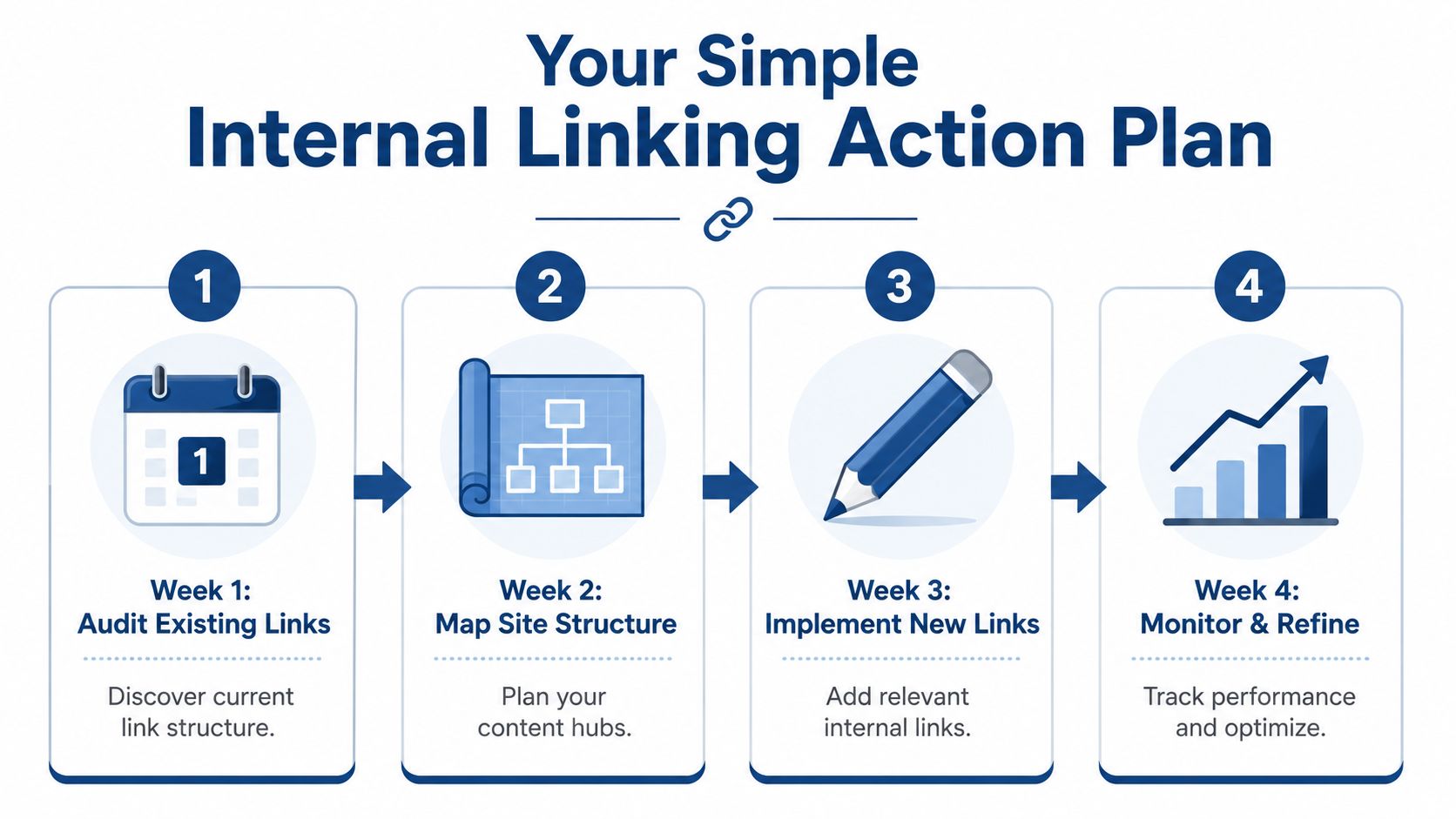
Here's a practical month-long routine for a busy local business owner.
Week 1
Audit your top pages. Check service pages, location pages, and blog posts that already get attention. Fix broken links, redirect old internal links properly, and note any orphaned pages.
Week 2
Map one hub. Pick a core service, such as bathroom fitting, wills and probate, or commercial cleaning. Then list three supporting pages or articles that relate to it.
Week 3
Add the links. Link from the hub to the spokes, from the spokes back to the hub, and from older relevant content into that cluster where it makes sense.
Week 4
Review anchor text on your five most important pages. Replace vague or repetitive anchors with natural descriptive wording. Then click through the site like a customer and make sure the journey feels obvious.
A simple checklist helps:
- Prioritise revenue pages: don't start with pages no one cares about.
- Use relevance first: only add links where the topic match is clear.
- Keep navigation human: if users can't follow the structure, Google won't love it either.
- Review monthly: internal linking is upkeep, not a one-off tidy-up.
Small improvements compound when the structure is consistent.
A well-linked website usually feels better to use. That's the hidden test. If the site becomes easier for a customer to find their way, you're usually moving in the right SEO direction too.
If you'd like an expert pair of eyes on your site structure, DigiVisi Ltd helps UK service businesses turn messy websites into organised lead-generating assets. The team focuses on practical SEO that improves visibility, enquiries, and sales, without the waffle or the long contracts.