Skip to content

Most UK small service businesses should expect to invest between £500 and £1,500 per month for meaningful local SEO, with competitive campaigns usually needing £1,500 to £3,000 monthly. If somebody tells you proper search visibility can be bought for the price of a round of sandwiches, they're selling hope, not rankings.
The popular advice is usually too neat. It treats search engine optimization services cost like a menu price when it's really a labour question, a competition question, and a quality question rolled into one. A decent SEO engagement for a solicitor in Birmingham or a plumber in Manchester isn't about sprinkling keywords around and waiting for the telephone to ring. It's about technical fixes, service-page optimisation, local trust signals, content that answers real queries, and enough ongoing work to keep pace with rivals who'd quite like your leads.
That's why cheap SEO often ends up being the dearest mistake on the spreadsheet. A £99 package can be perfectly lovely in theory, but if it doesn't include the work that moves the needle, you've bought a very expensive sense of activity. The bill is small, the outcome is smaller, and the only thing that improves is the provider's monthly recurring revenue. Charming, in a thoroughly uncharming way.
Table of Contents
- Why Cheap SEO Is the Most Expensive Mistake You Will Make
- Common SEO Pricing Models Explained
- What Actually Drives the Cost of SEO Services
- Realistic UK Price Ranges for Small Service Businesses
- The False Economy of Budget SEO Packages
- How to Vet an SEO Provider Without Getting Burned
- Budgeting for SEO and Planning Your Next Steps
Why Cheap SEO Is the Most Expensive Mistake You Will Make
A cheap SEO package usually looks attractive because it promises movement without discomfort. The problem is that white-hat SEO is work, proper work, the sort that includes technical repair, content improvement, internal linking, local citation cleanup, and competitor analysis. A bargain-basement package often trims exactly those parts, then wonders why the site sits there like a wet Sunday roast.
The Manchester plumber problem
Take a Manchester plumber who signs up for a £99-a-month deal. They get a monthly report, a few meta tag tweaks, maybe a blog post that reads like it was assembled by a toaster, and not much else. The business owner then asks why the map pack is still full of rivals, and the answer is simple, if inconvenient, the work never touched the ranking signals that matter.
Practical rule: if the package doesn't change site quality, local relevance, or trust, it's not SEO, it's decorative admin.
The distinction between white-hat, grey-hat, and black-hat matters here. White-hat work earns visibility through better structure, better content, and better relevance. Grey-hat shortcuts try to game the system a bit, usually with shaky links or thin content. Black-hat tactics go further and can leave you with penalties, lost visibility, and an SEO bill that now includes an apology tour.
What you're actually paying for
The price of SEO is mostly the price of specialist labour. That's why the better UK pricing guidance puts small-business SEO around £500–£1,500 per month and freelancer work around £300–£1,000+ for lighter local service engagement, while larger retainers move higher as scope expands and competition tightens, as set out in GoodFirms' 2025 SEO pricing benchmark. More scope means more hours, more checking, more fixing, and more thinking, which is a nuisance if you wanted magic, but excellent if you want leads.
A solicitor in Leeds, a roofer in Bristol, and a dog groomer in Cornwall don't need the same level of effort. The first may need authority content, the second may need service-page and local visibility work, and the third may need tidy local basics and careful review management. Cheap SEO ignores that reality. Real SEO respects it.
Common SEO Pricing Models Explained
SEO gets sold in four main ways, and each one has a place if it's used appropriately. The trouble starts when the model is chosen for convenience rather than fit. A one-off audit can be brilliant, but it won't keep a service business visible for long if rivals are moving every month.
Hourly, monthly, project and performance models
Hourly consulting suits focused work. In the UK, a one-off technical audit or strategy session often makes sense at £75 to £200 per hour, especially if you already know what needs fixing and just want expert eyes on the problem. It falls apart for ongoing content, links, and local SEO because those jobs don't politely finish when the clock does.
Monthly retainers dominate serious campaigns because they match the nature of SEO work. Search doesn't stand still, competitors keep publishing, and local ranking signals need maintenance, not a ceremonial once-a-quarter glance. That's why market guidance clusters much of the serious monthly spend in the middle, not at the bottom.
Project-based fees work for bounded jobs like a site migration, a local SEO clean-up, or a new set of service pages. You pay for a defined outcome, which is tidy, assuming the brief is tight enough. If the brief is vague, the project becomes a philosophical experiment with invoices.
Performance-based pricing sounds attractive until you ask what “performance” means. Rankings? Leads? Revenue? A provider can define success in a way that flatters the contract and annoys the client. I'd treat this model with suspicion unless the metrics are absolutely clear and the reporting is transparent.
| SEO Pricing Models at a Glance | Typical UK Range | Best For | Key Trade-Off |
|---|---|---|---|
| Hourly consulting | £75 to £200 per hour | Audits, advice, troubleshooting | Good for short jobs, poor for sustained growth |
| Monthly retainer | Varies by scope, commonly mid-market | Ongoing SEO for local service businesses | Best alignment, but needs commitment |
| Project-based fee | Fixed per deliverable | Migrations, audits, site rebuilds | Clear budget, limited flexibility |
| Performance-based | Usually negotiated case by case | Narrow, measurable outcomes | Easy to distort definitions |
One UK pricing guide also shows that serious agencies commonly sit in the £1,500–£3,000 local SEO band and the broader £2,500–£5,000 sweet spot for established campaigns, which is why retainers remain the sensible default for real-world campaigns as described in 2025 pricing research. If you're running a local firm, that structure usually makes more sense than trying to buy growth by the hour and hoping the market stays still.
What Actually Drives the Cost of SEO Services
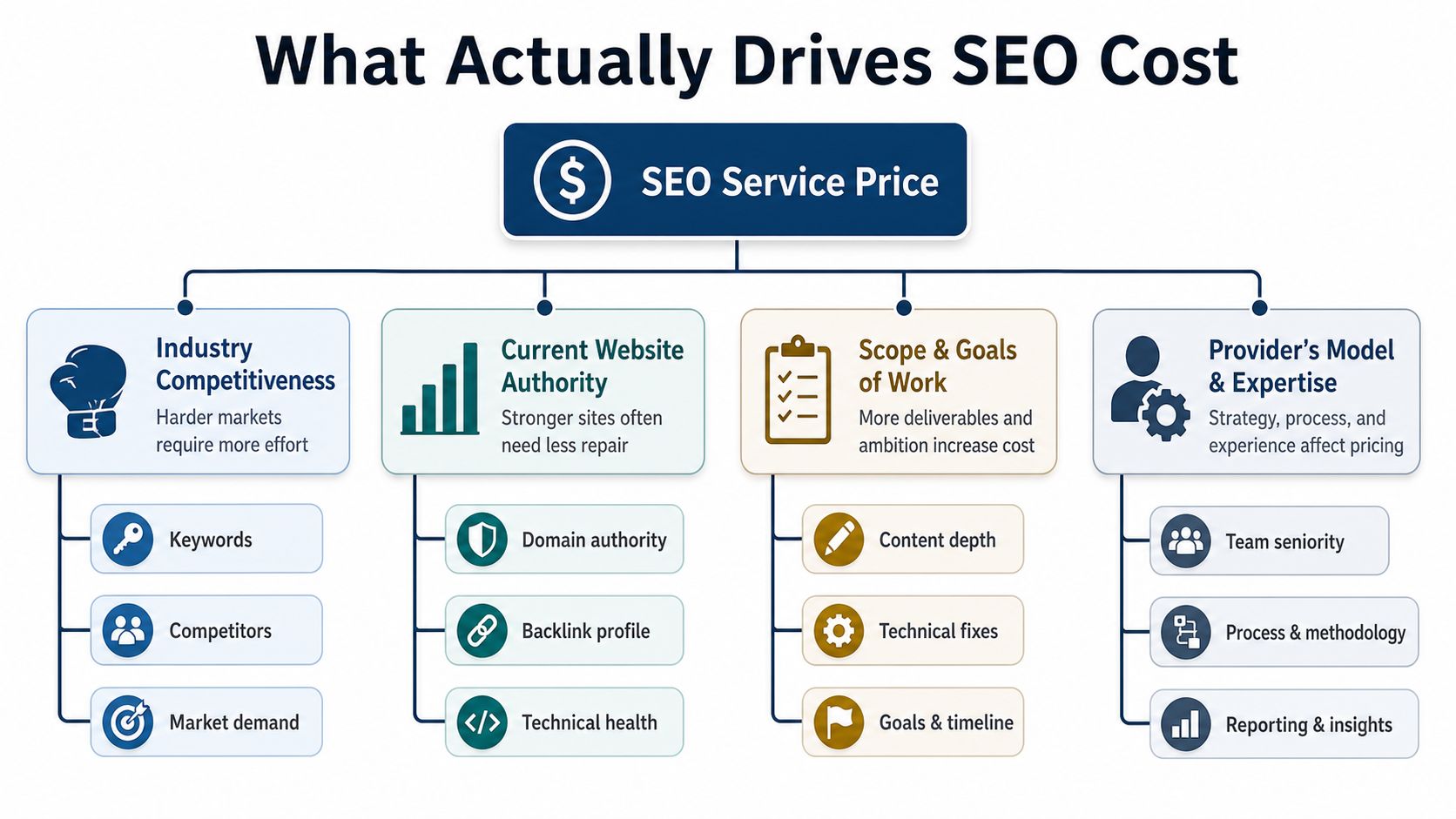
SEO quotes vary because the work varies. A solicitor in central London faces a far nastier fight than a dog groomer in Cornwall, and anyone pretending otherwise is probably also happy to sell you “premium” keyword stuffing. The bill reflects the number of moving parts, the level of competition, and how much damage already exists on the site.
Competition, authority and site condition
Industry competitiveness is the first obvious driver. A local services market with many similar firms pushes the price up because the work has to be sharper and more persistent. If your rivals already rank, already have reviews, and already have stronger pages, you're not buying a quick tidy-up, you're buying a catch-up campaign.
Current website authority matters just as much. A site with technical problems, thin pages, broken internal links, duplicate location pages, or years of neglected content consumes budget early because the first job is often fixing the mess before growth even begins. There's no glamour in cleaning up indexation errors, but there is value in not wasting six months producing content that lands on a shaky foundation.
Local SEO has its own cost structure
Local SEO adds its own delivery stack. Google Business Profile, NAPW consistency, schema markup, citation cleanup, and internal linking are not decorative extras, they're the plumbing of local visibility. One pricing guide for local businesses notes that local campaigns often start with this operational work because it reduces duplicate entity signals and strengthens local trust Higher Visibility's pricing guide.
Plain truth: local SEO usually costs more than a vanity audit because it has to fix the entity, not just the homepage.
Content volume also changes the price. Some firms need four good service pages and a sensible local landing-page structure. Others need dozens of pages, ongoing blog content, and careful E-E-A-T-friendly coverage to stay useful in both organic search and AI-driven summaries. If you need more pages, more research, and more editing, the cost rises. That isn't a scam, that's arithmetic.
Realistic UK Price Ranges for Small Service Businesses
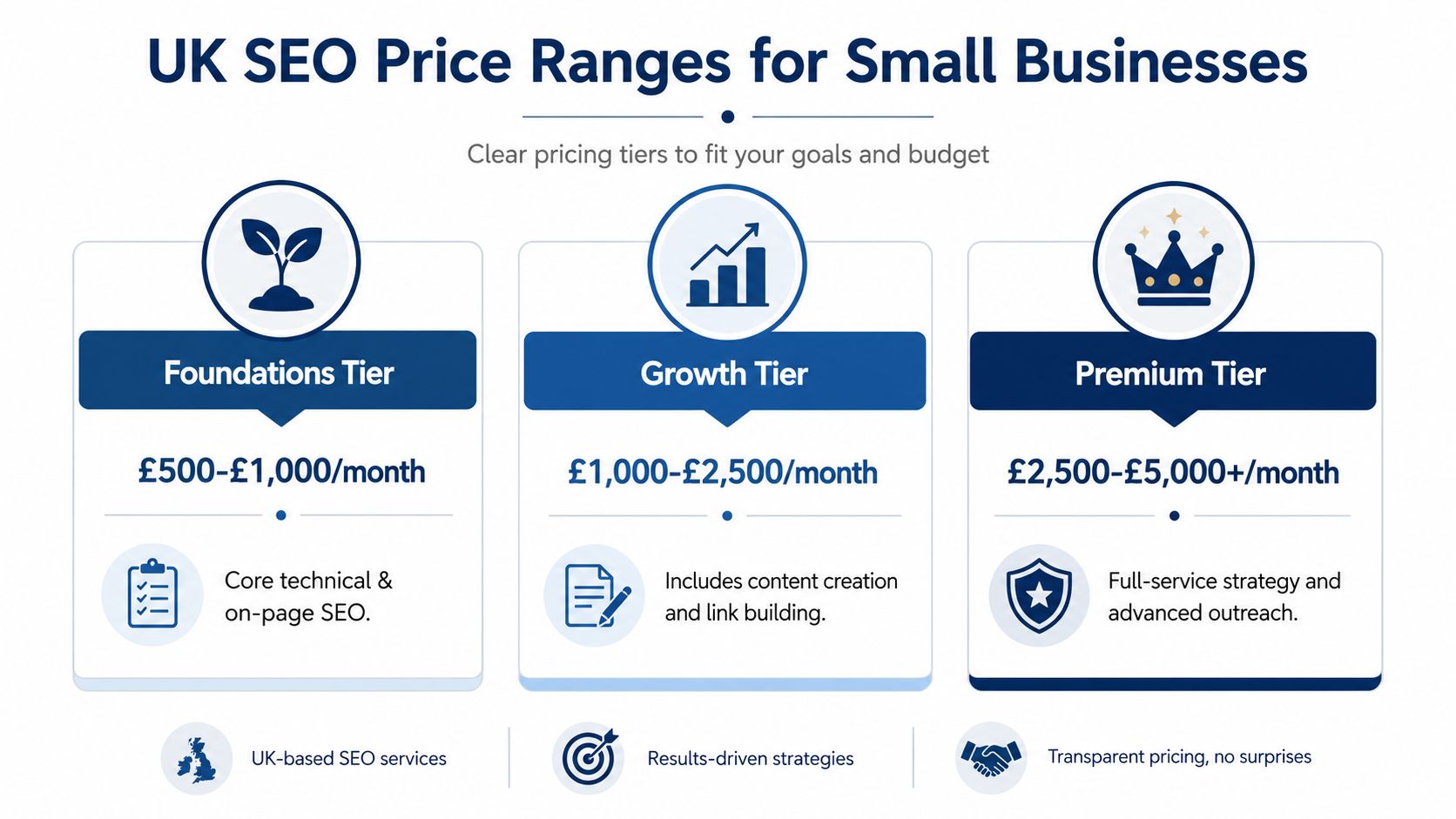
A sensible SEO budget for a UK local business should match the scope of the job, not the fantasy of the buyer. For small service firms, the market has three workable bands. They're not sacred, but they are realistic, and they're far more useful than vague talk about “affordable SEO”.
Three pricing tiers that actually make sense
Foundations Tier, £500 to £1,000 per month. This covers core on-page work, technical basics, limited reporting, and a modest local SEO push. It suits a single-location trades firm, a small practice, or a home-service business that needs to stop losing easy opportunities. A Bristol electrician with a decent site but weak location optimisation can use this tier to sort the basics without pretending to dominate the region by Tuesday.
Growth Tier, £1,000 to £2,500 per month. Content creation, local citation work, better internal linking, and broader optimisation start to happen properly. It fits a solicitor office, a multi-service trades business, or a growing local company that needs more than a tidy-up. This is also the zone where most serious local campaigns begin to feel properly managed rather than merely observed.
Premium Tier, £2,500 to £5,000+ per month. This is for competitive markets, multi-location firms, and businesses that need full technical SEO, competitor gap analysis, and ongoing content built for both search and AI surfaces. It's not overkill for the right business. It's just what happens when several nearby rivals are all fighting over the same leads and the same map-pack real estate.
A second useful marker comes from broader industry pricing. A 2026 pricing analysis based on survey and agency-aggregated data places average monthly SEO costs around $2,917 to $3,200, with small businesses commonly landing around $1,500 to $5,000 per month Digital Applied's pricing breakdown. That lines up with what most UK owners end up buying when they stop shopping for fantasy and start shopping for outcomes.
For businesses weighing a lighter setup, a package page such as DigiVisi Ltd's SEO package overview gives a useful picture of how local SEO deliverables are often bundled in practice. The point isn't to buy the cheapest bracket. It's to buy the bracket that meets the work your market demands.
Video:
The False Economy of Budget SEO Packages
Budget SEO usually saves money in the same way a leaky bucket saves water. It doesn't. The low monthly fee feels efficient until you realise the provider has stripped out the work that creates visibility in the first place. What remains is often little more than light housekeeping and a report with better confidence than evidence.
What gets cut first
The first casualty is usually competitor research. Without that, nobody knows what the local market is rewarding, so the campaign ends up guessing instead of reverse-engineering ranking signals. Next goes content production, because proper writing costs time and that's awkward if the package has been priced like a takeaway.
Then comes technical SEO, which is inconvenient because it's often where the core problems live. If a site has crawl issues, weak schema, messy internal links, or duplicate location signals, ignoring them saves money only in the sense that not fixing a tyre saves money on a mechanic. Finally, low-cost packages often trim ongoing tracking, which is a fine way to discover six months later that nothing improved.
A roofer in Leeds paying for a rock-bottom package may get a bit of on-page tinkering and a cheery dashboard. They won't get the map-pack work, the trust signals, or the follow-through that competing firms need. That's not a strategy. That's administrative theatre with an invoice attached.
Cheap links and grey-hat nonsense
This is also where grey-hat and black-hat tactics try to sneak in wearing a false moustache. Spammy links and thin network-driven tactics can look cheap because they offload effort onto shortcuts. They also create risk, and risk has a nasty habit of arriving later, when the site is already dependent on the very tricks that could sink it.
Do not confuse low price with low risk. In SEO, the cheap option often just delays the expensive part.
The market middle has moved up because the work has become broader. Local search now rewards ongoing optimisation, not a one-off polish. If your package doesn't include enough labour to stay useful month after month, it's not a bargain, it's a slowly depreciating mistake.
How to Vet an SEO Provider Without Getting Burned
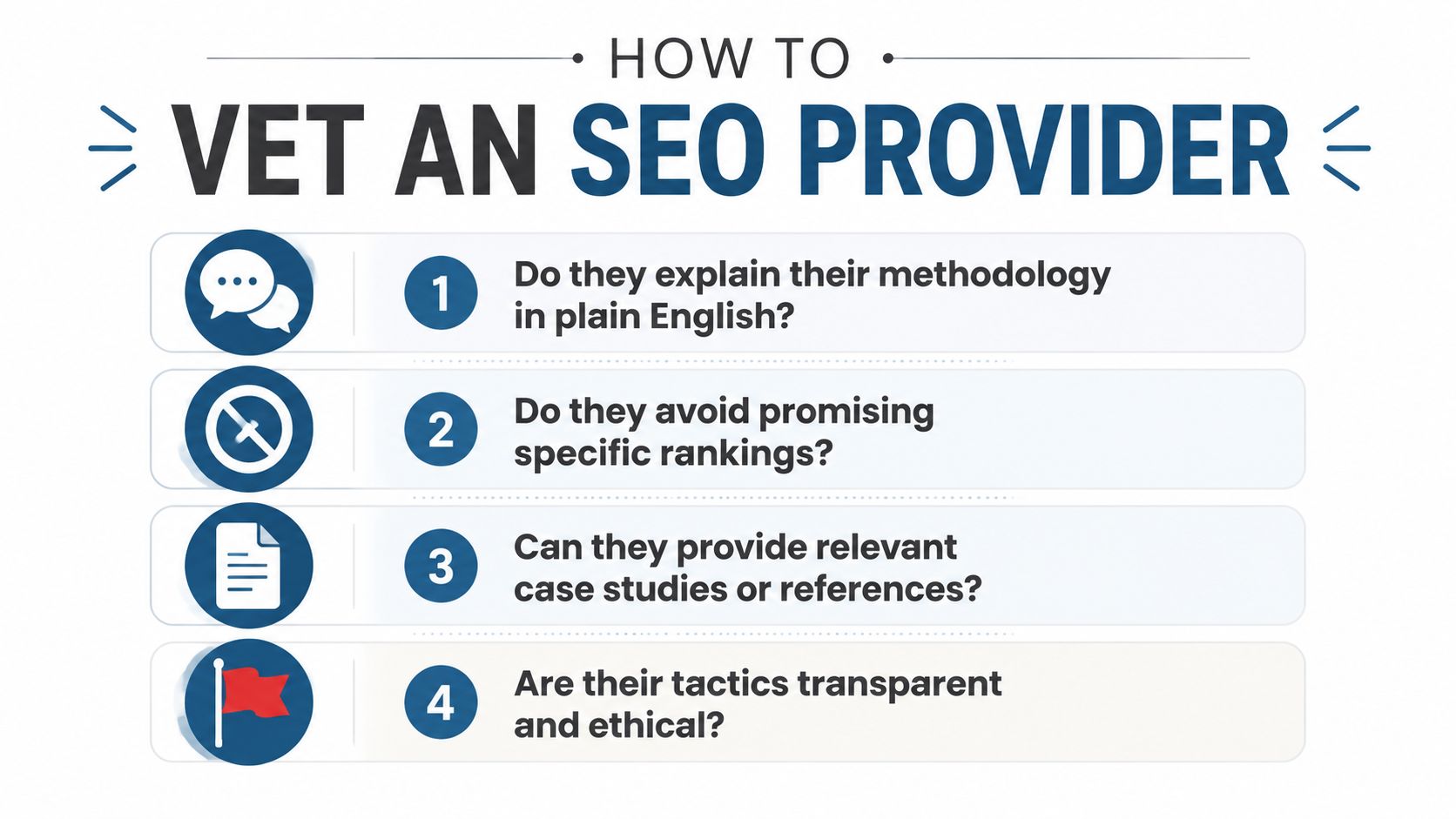
A good SEO provider talks plainly. A bad one talks like a magician trying to protect the rabbit. If someone can't explain their process without hiding behind jargon, move on. The first sign of quality is usually clarity, not mystery.
Questions worth asking
Ask how they work. A genuine specialist should be able to tell you how they approach competitor analysis, page optimisation, local citations, schema, and internal linking in plain English. If they can't explain the method, they probably haven't got one that survives contact with a real local market.
Ask what they'll show you every month. Transparent reporting should include position tracking, traffic data, and a clear explanation of what changed. If the report reads like it was generated by a bored robot at 4.55 pm on a Friday, you're not being informed, you're being occupied.
Ask what they won't do. A serious provider will be comfortable saying no to spammy links, keyword stuffing, and other nonsense that belongs in a 2012 forum thread. For a useful overview of technical mistakes that often derail WordPress sites, avoid these common WordPress SEO issues is a handy reference.
Red flags you should not ignore
Guaranteed number-one rankings are nonsense. So are vague promises about accessing hidden algorithmic potential, which sounds impressive until you realise nobody can prove it. Long lock-in contracts are another warning sign, especially if the provider won't commit to transparent work plans.
If you want a practical benchmark for local campaigns, the work should include the right mix of technical repair, local relevance, and content support. That's where providers that reverse-engineer competitor signals tend to outperform those who merely change meta descriptions and call it strategy. One such example in the UK market is DigiVisi Ltd, which focuses on competitor-led local SEO delivery rather than vanity metrics.
Budgeting for SEO and Planning Your Next Steps
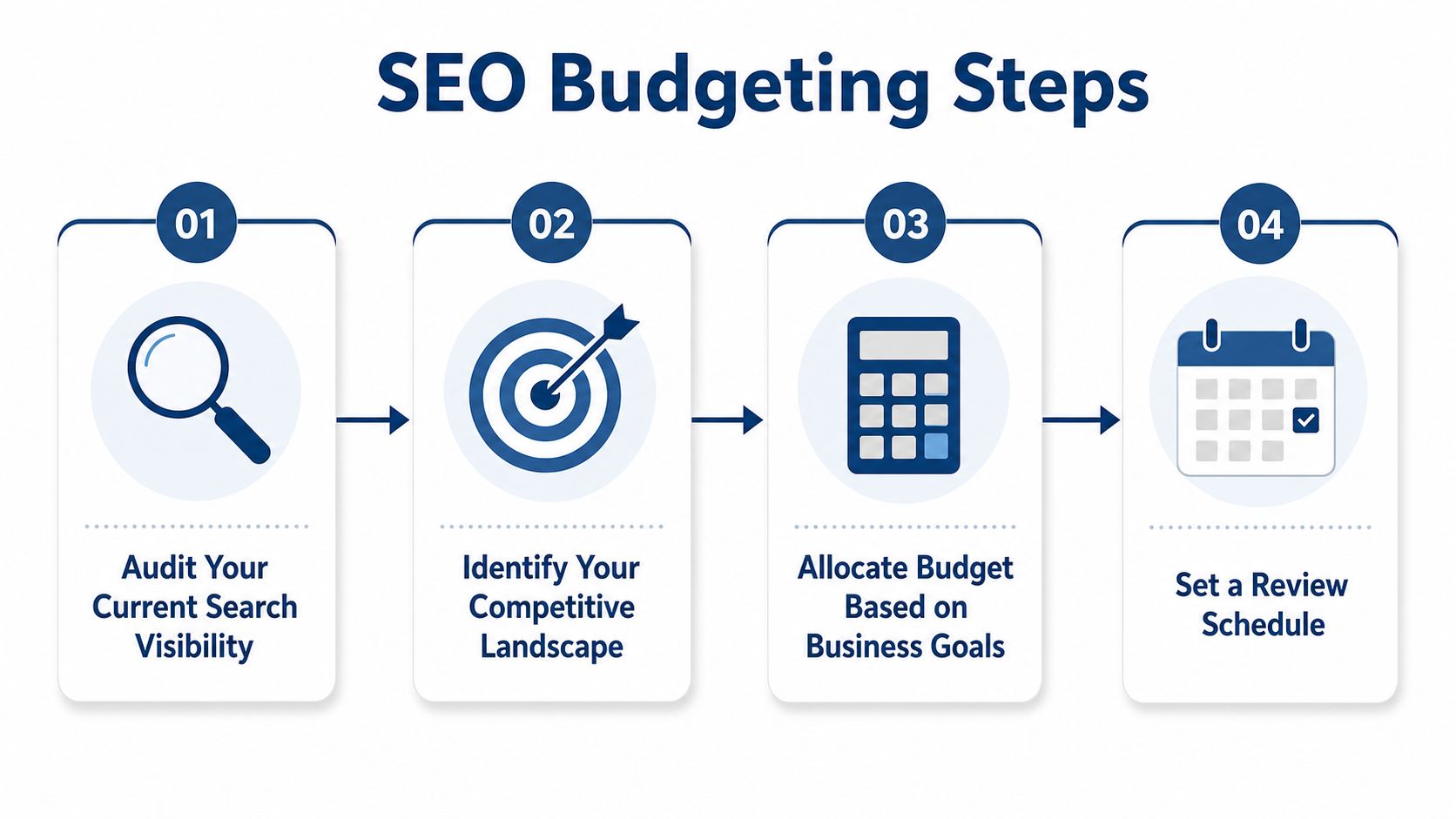
Start with your current visibility, not your wishlist. Look at which service pages already rank, which local terms bring enquiries, and which competitors keep appearing ahead of you. Then decide whether your market needs a modest cleanup, a growth campaign, or a serious push into a more competitive band.
How to allocate the money
Put the first slice of budget into technical fixes if the site is messy. Put the next slice into the pages that should win enquiries. Then support those pages with local relevance, authority building, and enough ongoing review to keep the campaign from drifting into irrelevance.
A practical budgeting habit is to separate repair, growth, and maintenance. Repair fixes the site. Growth builds the pages and local signals that can win. Maintenance keeps the thing from falling apart again six months later, which is an underrated part of life and a very underrated part of SEO.
Budget for the market you're in, not the market you wish you had. A single-location café and a multi-location accounting firm should not spend like identical twins.
UK service businesses should also keep the timescale honest. Meaningful movement usually takes time, and there's no sensible reason to expect a local campaign to transform overnight. Track enquiries, not vanity noise, and review the work against the actual lead quality coming in from organic search.
If you want straight-talking SEO pricing, local-search strategy, and deliverables that match how UK service businesses compete, visit DigiVisi Ltd. They build SEO around competitor analysis, local visibility, and transparent reporting, which is a refreshing change from paying for smoke and hoping it turns into leads.