Skip to content
You can buy the clicks, pay for the rankings, and still hear nothing but the kettle boiling. That's the bit many UK owners know too well, the site looks busy enough in analytics, but the phone stays oddly polite. A Bristol plumber, a Manchester solicitor, a roofer in Leeds, the pattern's the same, traffic is arriving, yet the journey from curious visitor to proper enquiry is leaking somewhere in plain sight.
The fix isn't usually a flashy redesign. It's usually a sharper conversion rate process, built around friction reduction, better measurement, and tests that prove what works. The UK Government's service guidance pushes teams towards completing tasks in one sitting where possible, and user research before launch, which is a useful reminder that fewer obstacles usually beat more traffic, especially for short local journeys where trust and speed matter most (UK service usability guidance). For a gym owner looking at retention rather than first clicks, there's a useful parallel in this practical guide for gym owners, the principle is the same, reduce friction where people drop off.
Table of Contents
- Why Most Local Service Businesses Are Leaking Money on the Table
- Auditing Your Current Funnel the Right Way
- High-Impact Fixes Worth Doing First
- Forming Hypotheses and Running Real A/B Tests
- Where Local Intent Trust and Lead Quality Actually Live
- White Hat Grey Hat and Black Hat in Plain English
- Your 30 60 and 90 Day Conversion Improvement Plan
Why Most Local Service Businesses Are Leaking Money on the Table
A plumber in Bristol can have decent rankings, steady Google Ads spend, and a website that looks perfectly respectable, yet the phone barely rings. That's not because the market is dead. It's usually because the site is asking for too much effort at exactly the moment the visitor should be making a fast decision.
The right question isn't “How many people filled in the form?” It's “How many qualified enquiries came through from the right postcode, for the right service, with enough intent to quote properly?” That's the bit generic CRO advice often misses. A dozen low-quality form fills from the wrong end of town are not a win, they're just admin with better branding.
Practical rule: if a change increases form fills but lowers lead quality, it's not an improvement, it's a shinier mistake.
The bigger point is that conversion rate optimisation for UK local services should be measured against the value of the enquiry, not vanity metrics. A solicitor who gets three decent calls from business owners is in a better place than one who gets a pile of “just wondering” submissions from bargain hunters. The CRO logic is simple, reduce friction, then validate the change with data, not vibes or a designer's morning coffee.
You can see the same discipline in adjacent commercial settings too. A service business doesn't need a full rebuild just because the page feels old. It needs a cleaner path to contact, clearer local relevance, and proof that the next step is safe. That's white-hat work, transparent, measurable, and boring in the best possible way. Grey-hat shortcuts, hidden numbers, fake urgency, review tricks, and manipulative forms, might produce a sugar rush, but they usually leave the business with reputational indigestion.
A decent benchmark is to think in terms of one simple local journey, visitor lands, visitor trusts, visitor enquires. If any one of those steps is muddy, the whole thing leaks. That's why the best practitioners start by cutting friction rather than repainting the whole house.
Auditing Your Current Funnel the Right Way
A proper audit starts before you touch copy, colours, or button labels. First, make sure analytics, call tracking, and form tracking are all firing cleanly, then map the full path from the first click to the booked job. If you can't see the handoff points, you can't fix them.
For a Leeds boiler repair firm, the useful sequence might be Google Business Profile click, landing page view, phone click, form open, form submit, callback, booked survey. If the form-to-call handoff is weak, that's where the leak is, not in the logo, not in the hero image, and not in the mate's cousin's opinion about blue buttons. The point of the audit is to isolate the step with the worst drop-off, then segment it by device, traffic source, and landing page.
Start with the measurement chain
A clean audit needs three layers. Analytics shows where people land and leave. Call recording and form analytics show what they do when they hesitate. Session replays show the bits you'd never guess from aggregate numbers alone.
If you need help thinking about call capture in a structured way, this guide to ProdShort helps with sales recording is a sensible reference point for the operational side of recording and reviewing inbound conversations. For service firms, that's often where the story lives, not in the click, but in the first awkward few seconds on the phone.
The UK service manual's “one sitting” logic is useful here, if a lead journey takes several mental hops, you've probably built too much resistance into it.
Use a one-page audit template
Keep the audit brutally simple. One page is enough. Write down the landing page, the source, the device split, the key action, the observed abandonment point, and the likely reason. Then mark each step as working, unclear, or broken.
A basic template might look like this.
- Traffic source: Google Business Profile, paid search, local organic, or referral.
- Entry page: the exact page people land on.
- Primary action: call, form, quote request, or booking.
- Drop-off point: where people stop moving.
- Likely friction: confusing copy, weak trust signal, too many fields, or poor mobile layout.
Once that's in place, patterns usually jump out quickly. A mobile-heavy audience that scrolls but doesn't call is a different problem from desktop visitors who reach the quote form and then vanish. The audit gives you the map before you start moving furniture.
High-Impact Fixes Worth Doing First
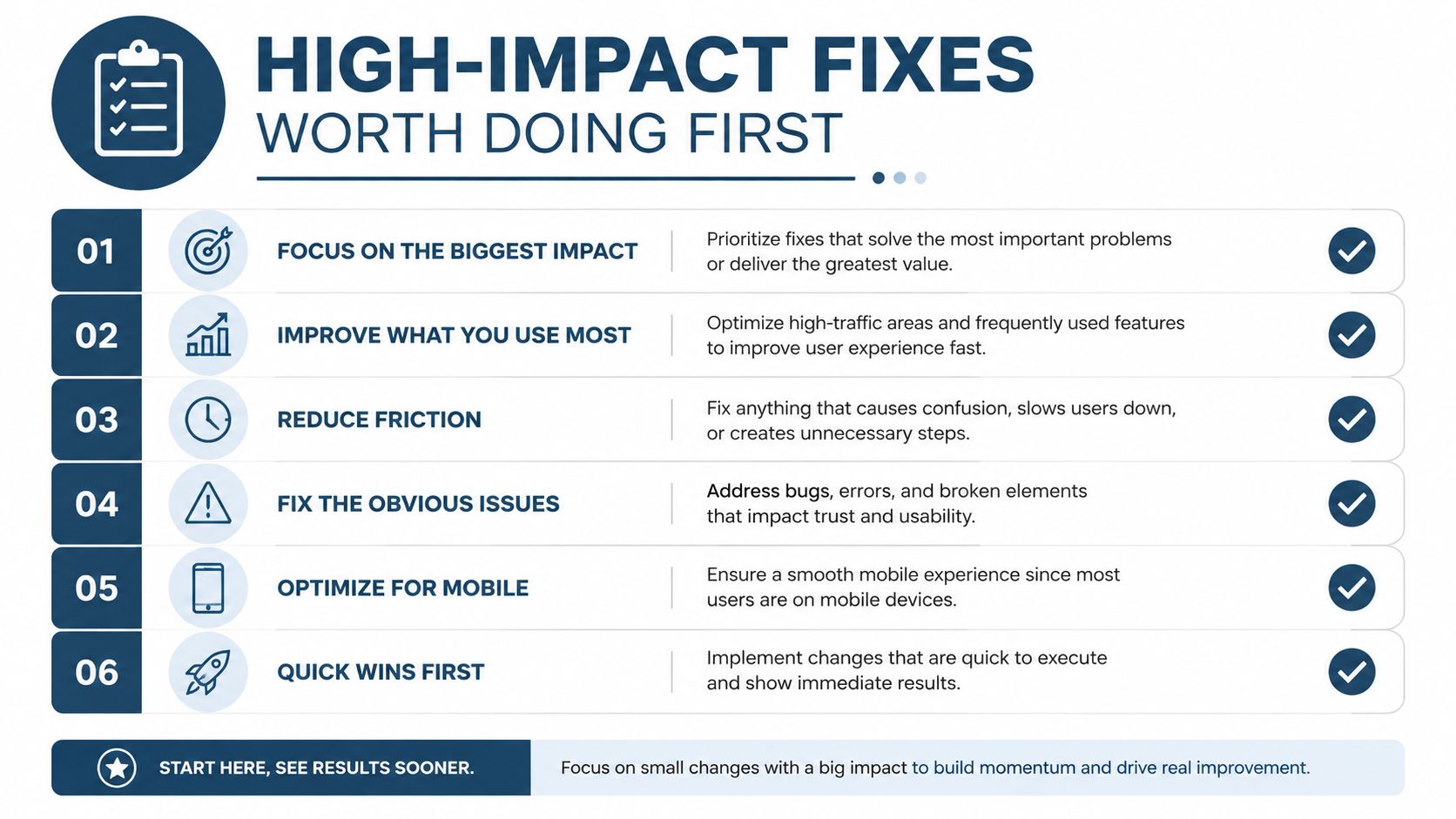
Not every change deserves your time. The best owners and marketers don't try to optimise everything at once, because that way lies a tragic spreadsheet and a lot of half-finished ideas. They pick the fixes with the highest impact, strongest confidence, and least effort, then ship those first.
The fixes that usually earn their keep
Start with the bits that remove obvious friction. Shortening quote forms is nearly always worth testing. So is making the call-to-action plain English instead of marketing fog. “Get a quote” beats “Submit your details” most days of the week, and especially on mobile.
A Birmingham solicitor provides the sort of example that makes the maths obvious. Cutting an eight-field form down to four produced a 17% lift in completion rate in the example given in the brief, which is exactly the sort of practical, testable change that matters more than a full visual redesign. That kind of lift comes from removing friction, not from sprinkling “synergy” on the page.
Other useful first moves include clearer local trust signals, tighter landing-page copy, and better alignment with the Google Business Profile that sent the visitor in the first place. If someone clicked from “emergency plumber Croydon”, the page should not look like a national brochure site pretending to know where Croydon is.
Pick the next job with ICE thinking
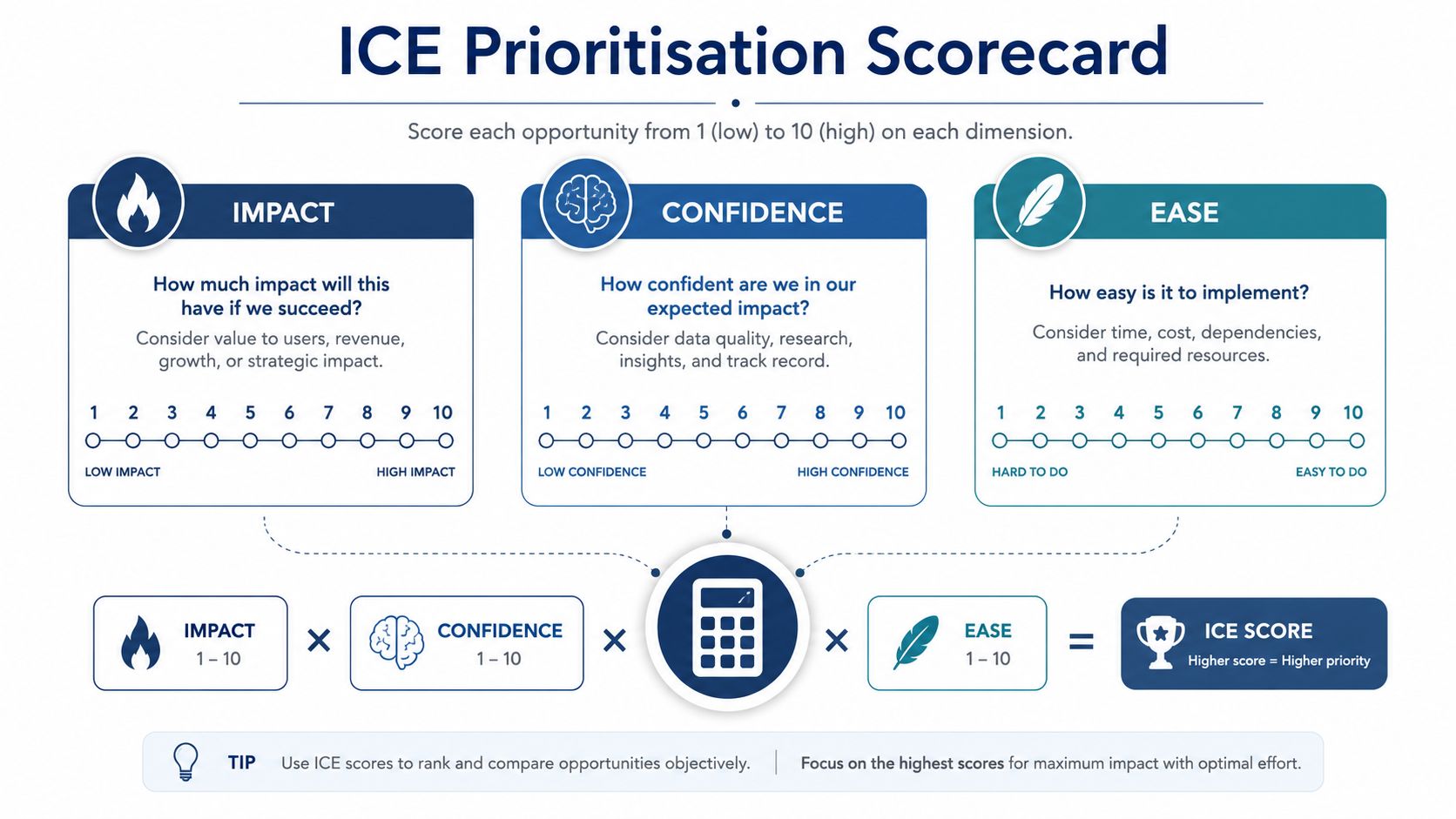
Use a simple ICE lens.
- Impact: will this likely affect qualified enquiries, not just clicks?
- Confidence: do you have enough evidence from recordings, forms, or heatmaps?
- Ease: can it be changed quickly without breaking the rest of the site?
That scoring keeps you honest. A glamorous redesign that affects everything and proves nothing is usually worse than a boring form trim that saves actual enquiries. If you want a wider set of practical ideas, this increase conversion rates resource is useful as a general reference, but the primary win comes from prioritising changes against your own funnel data.
Good optimisation feels a bit unsexy. The work that wins is usually the work that makes the next click feel obvious.
The rule of thumb is simple, fix the path, then sharpen the promise, then tidy the proof. Once those three are strong, you've earned the right to test fancier ideas.
Forming Hypotheses and Running Real A/B Tests
Opinions are cheap. Tests are expensive enough to make people honest. If you want reliable uplift, every change needs a clear prediction tied to a single metric, otherwise you're just redecorating in public.
A decent hypothesis has three parts, change, because, metric. “If we move the service area into the headline, because visitors need local relevance fast, we will increase quote requests from the target postcode.” That's a proper starting point. Vague nonsense like “Let's make the page feel more modern” isn't a hypothesis, it's a nervous shrug in a suit.
Keep the test clean
Change one thing at a time. If you alter the headline, form length, and CTA colour in one go, you won't know what caused the result. That's how teams end up celebrating a win they can't explain, then copying the wrong bit everywhere else.
For a small service firm, the sensible test design is usually lightweight. Pick one primary metric, often qualified enquiries, not raw submissions. Run the test long enough to reach statistical significance rather than stopping as soon as one version looks prettier. Early spikes lie. They often lie with excellent posture.
A few test ideas worth running
- Local headline clarity: put the service area in the headline rather than burying it in the subcopy.
- Form reduction: remove one or two non-essential fields and watch completion behaviour.
- CTA language: compare action-led wording against generic “submit” style labels.
- Trust placement: move reviews and accreditations closer to the point of decision.
- Phone prominence on mobile: make the tap-to-call option more obvious on smaller screens.
- Channel-message match: align ad copy, GBP promise, and landing-page wording.
Small firms don't need a massive experimentation stack to get value. Session replays and short user tests are often enough to spot the obvious pain points. Five-second tests are especially handy for finding out what a page seems to say before anyone has time to rationalise it. If the visitor can't tell what you do, where you work, and why they should care, the rest of the page is doing decorative work.
The best tests are boringly specific. They don't try to prove the whole strategy, they prove one point at a time.
Where Local Intent Trust and Lead Quality Actually Live
A page can convert beautifully in one town and limp along in the next, and that's not random. Local intent changes the job the page has to do. A visitor from a postcode with strong intent wants speed, reassurance, and proof that you cover their area, not a national template with a map pinned somewhere in the footer like a tired afterthought.
Reviews are a conversion asset, but only if they're honest
The UK Competition and Markets Authority's guidance on online reviews says businesses must not suppress or hide negative reviews, and they must give a balanced picture by publishing reviews as collected unless there's a legitimate reason to remove them (CMA online reviews guidance). That matters because local trust is fragile. One carefully edited wall of praise can look less credible than a steady stream of mixed, real-world feedback.
For a solicitor, plumber, electrician, or roofer, the goal is transparent reassurance. A balanced review profile tells the visitor that real customers have used the service, not that the business has spent the afternoon polishing the glass. It's the same logic for post-conversion value, as mentioned earlier, you want the right enquiries, and you want them to arrive with realistic expectations.
Match the page to the channel
GBP visitors behave differently from paid search visitors, and both behave differently from generic organic traffic. If the visitor clicked because they saw a local listing, the page should reflect that local promise straight away. If they came from a service-specific ad, the landing page needs to continue that exact conversation instead of dumping them on the homepage and hoping they enjoy treasure hunts.
That channel match matters because the page promise, the location signal, and the intent behind the click all have to line up. Generic CRO checklists talk about CTAs and social proof, which are fine, but they often skip the local mechanics that shape real lead quality. That's why a local business can get more submissions and still feel poorer at the end of the month.
Balanced trust beats loud trust. The visitor wants enough evidence to proceed, not a carnival of badges and buzzwords.
If the enquiry value varies by postcode or service line, optimise for the booking you want, not just a bigger pile of form fills. That's the difference between tidy traffic and useful revenue.
White Hat Grey Hat and Black Hat in Plain English
The temptation to cut corners is real, especially when the numbers wobble and someone says, “Just make the button bigger and hide the phone number.” That's where judgement matters. In local service businesses, reputation is sticky, so the tactic has to survive customer complaints, Google scrutiny, and a competitor who's bored enough to look properly.
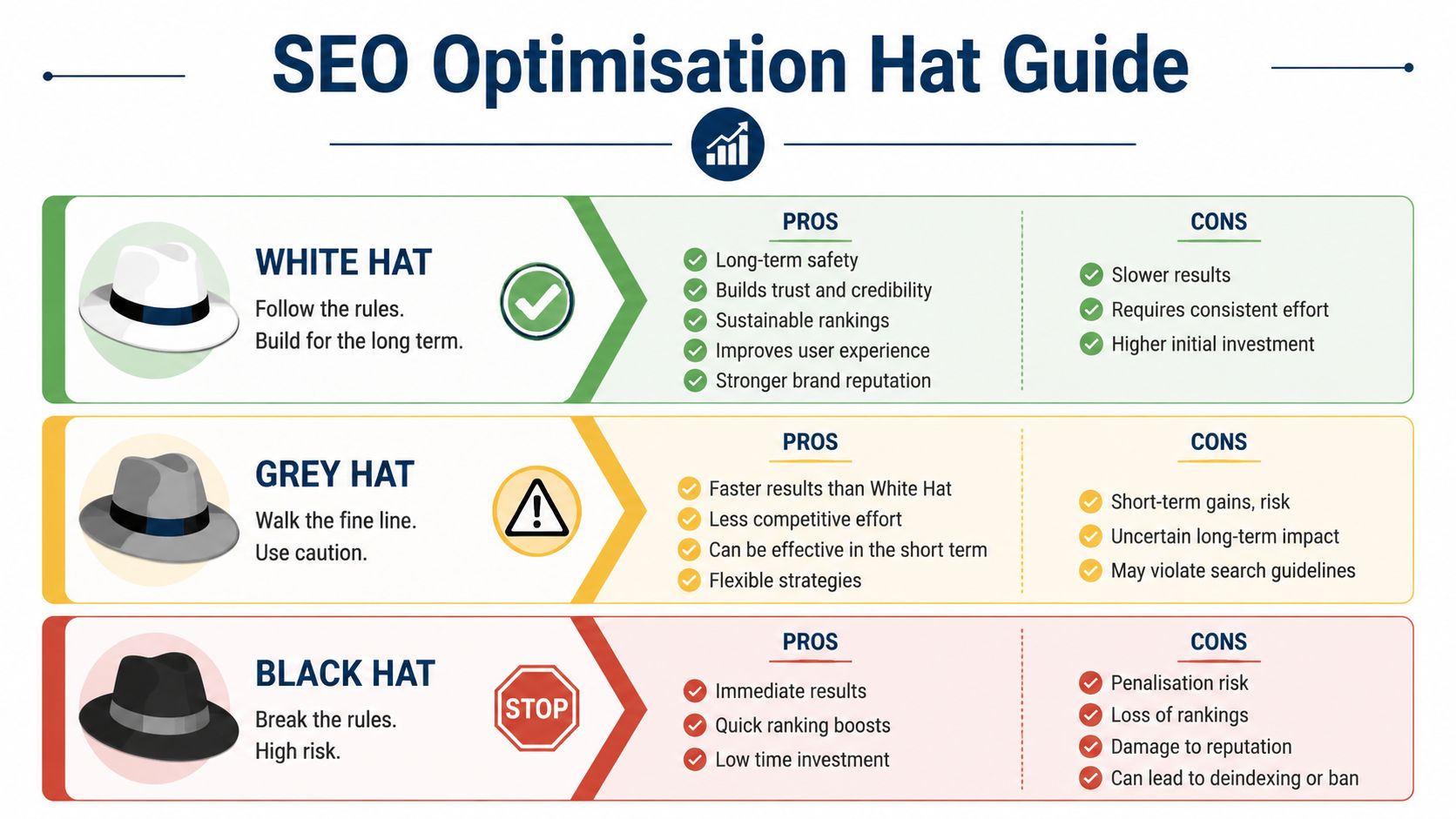
White hat is the honest route, transparent forms, visible contact details, genuine reviews, and tests built on real behaviour. It's slower than a shortcut, but it stands up. Grey hat lives in the awkward middle, things like dark-pattern form design, aggressive review gating, or nudges that feel clever until a customer notices. Black hat is the stuff that can torch trust, cloaked landing pages, fake testimonials, or bought leads dressed up as your own performance.
Why shortcuts backfire for local firms
A national e-commerce brand can sometimes absorb a messy experiment and move on. A local solicitor or trades firm can't. One dodgy review scheme or a misleading call-to-action can ripple through word-of-mouth, and word-of-mouth in local markets travels faster than a nervous apprentice on a tea run.
The practical problem is that grey and black tactics often distort the very data you're trying to improve. If the lead flow is padded with low-intent enquiries or the page design tricks people into the wrong action, your numbers look healthier while the business quality gets worse. That's not conversion optimisation, that's self-deception with better margins.
For UK service firms, the white-hat route is the only sustainable one. It's measurable, it's defensible, and it doesn't rely on the customer missing the trick.
Your 30 60 and 90 Day Conversion Improvement Plan
The cleanest way to improve conversion rates is to treat it like a working rhythm, not a one-off project. In the first 30 days, audit the funnel, confirm tracking, and remove obvious blockers. In the next 60 days, form one testable hypothesis at a time and run controlled experiments on the highest-friction pages. By day 90, you should be scaling the winners, documenting the losers, and using those learnings to choose the next round of tests.
A simple operating checklist helps keep this sane.
- 30 days: check analytics, call tracking, form analytics, and review visibility.
- 60 days: test one change at a time, with a single primary metric and no fiddling mid-test.
- 90 days: roll out winners, monitor the post-launch impact, and re-audit the weakest step.
That rhythm pairs neatly with the discipline outlined in this conversion rate optimisation consultant page, because the actual job is not just spotting issues, it's turning them into structured improvements. The numbers matter, but the quality of the enquiry matters more.
What to watch every month
- Analytics accuracy: are the key events still firing correctly?
- Call quality: are the leads real, local, and worth quoting?
- Form patterns: are people abandoning at a specific field?
- Review health: are you showing a balanced picture, not a cherry-picked one?
- Channel fit: does the landing page still match the source that brought the visitor in?
If you keep those five things under review, you'll stop guessing and start improving. The whole point is to build a reliable machine for more of the right enquiries, not a louder machine for any enquiry that can type its own name.
If you want a sharper, more accountable way to improve your site's conversion rate, DigiVisi Ltd helps UK service businesses turn local traffic into qualified calls and enquiries through data-led SEO, GBP optimisation, and conversion-focused website improvements. Visit DigiVisi Ltd if you want a practical review of what's leaking in your funnel and a plan to fix it without the usual marketing theatre.