Skip to content
A plumber in Birmingham searches his own business name and finds an old directory listing, a half-completed Google Business Profile and three competitors appearing in the local map results. A solicitor in Bristol asks why ChatGPT recommends firms that never seem to rank for the obvious Google query. Neither problem is solved by sprinkling “AI” over a monthly report and hoping the robot fairy delivers enquiries.
AI SEO services now cover two separate commercial jobs. The first is earning visibility and citations inside AI-assisted answers. The second is winning traditional organic and map-pack clicks from people ready to call, book or visit. The tactics overlap, but the objectives, measurement and budget decisions are different. Treating them as one shiny optimisation layer is how businesses end up paying for theatre.
Table of Contents
- What AI SEO Services Actually Mean for a Local Business
- How AI Slots Into the Core Components of SEO
- Why AI Overviews and Local Pack Need Different Tactics
- Two UK Local Business Stories Put the Framework to Work
- The Evaluation Checklist That Separates Real Specialists from Snake Oil
- Realistic UK Pricing, Packages, and Success Metrics
- How DigiVisi's Methodology Fits the Picture
What AI SEO Services Actually Mean for a Local Business
Take a Leeds electrician competing for emergency callouts. A sensible AI SEO service might audit the website, identify technical barriers, improve service pages, organise internal links, clean up the Google Business Profile, build relevant citations and monitor search visibility. It might also use AI to find patterns in competitor pages, cluster related queries and produce a first draft.
That is the useful definition. AI SEO services are traditional SEO delivered with machine-assisted research, analysis and production, plus deliberate work to make important information easy for search engines and AI systems to retrieve. They aren't a licence to publish hundreds of bland pages or promise a place in every answer engine by Friday afternoon.
What the tools can accelerate
AI is excellent at repetitive inspection. It can flag broken links, group similar keywords, compare page structures, identify missing entities, summarise review themes and surface unusual changes in Search Console data. It can also help a strategist monitor SERP layouts across a large set of local and service queries.
A machine can draft an FAQ about boiler repairs. It can't verify whether the business offers same-day visits, whether a legal statement is compliant or whether the tone sounds like a competent local firm rather than a content mill wearing a tie.
Where expertise still matters
A trained SEO professional decides which pages deserve investment and which queries indicate genuine buying intent. They check facts, remove invented claims, choose suitable schema, judge link quality and rewrite AI output so it reflects real experience. That human pass matters particularly for solicitors, electricians, dentists and other firms where inaccurate advice can damage trust.
For a broader view of the practical work involved, see these local SEO services. The point isn't to replace SEO fundamentals. It's to make the analysis more efficient while keeping accountability with a human being.
| SEO Component | Traditional Task | AI-Enhanced Version |
|---|---|---|
| Technical SEO | Crawl and diagnose issues | Prioritise patterns across crawl data and logs |
| On-page SEO | Map keywords and improve pages | Cluster intent and suggest content relationships |
| Content | Research and write useful copy | Produce briefs and drafts for expert editing |
| Links | Find relevant prospects and outreach opportunities | Research prospects and personalise initial angles |
| Local SEO | Manage GBP, citations and reviews | Detect inconsistencies and analyse review sentiment |
| Reporting | Track rankings, traffic and leads | Separate organic, map-pack and AI citation signals |
The right question isn't “Which AI tool do you use?” Ask which decisions the tool improves, who checks the output and how the work connects to calls and enquiries. If the answer is a dashboard full of mysterious scores, keep your wallet safely in your pocket.
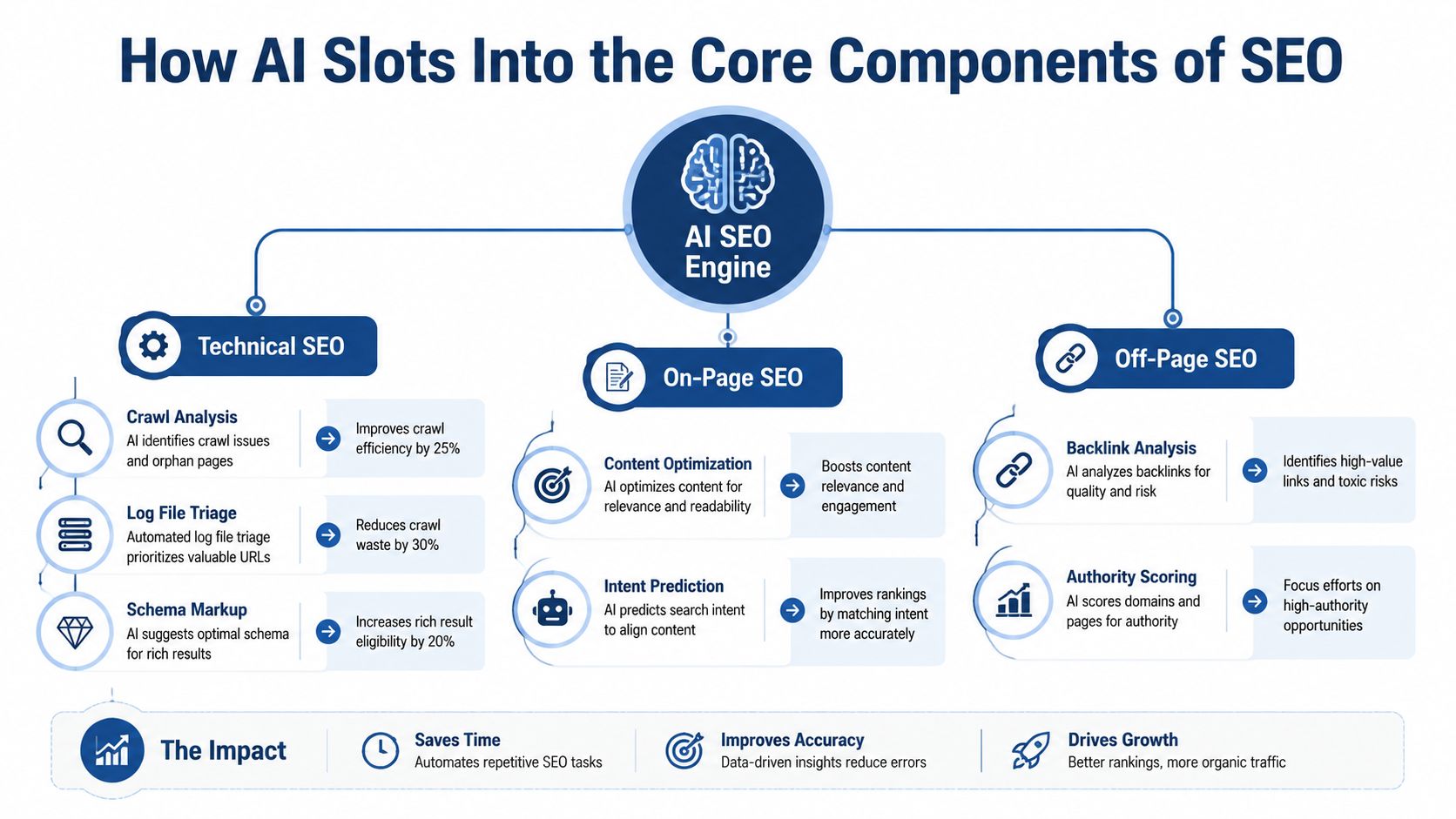
How AI Slots Into the Core Components of SEO
AI works best as a junior analyst. It reads, sorts and highlights. A senior SEO supplies judgement, context and a mildly suspicious eyebrow.
Technical and on-page work
For a roofer targeting “roof repairs Manchester”, an AI-assisted crawl can group duplicate title tags, identify thin location pages and prioritise broken internal links. Log analysis can help a specialist spot crawl activity that deserves investigation, while a human decides whether a technical fix affects real visibility or merely makes a spreadsheet look tidier.
Schema generation is similar. AI can prepare a draft for LocalBusiness, Service or FAQ markup, but the published code must describe information visible on the page. Incorrect structured data isn't clever. It's a filing cabinet labelled “important” containing the wrong paperwork.
On-page analysis benefits from pattern recognition. A system can cluster “leaking roof”, “emergency roofer” and “roof repair quote” by intent, then suggest links between the relevant service page, area page and advice article. The strategist still decides whether those pages should be combined, expanded or removed.
Content and authority
A dentist targeting “Invisalign Bristol” needs more than a page repeating the phrase. AI can help create a brief covering treatment suitability, consultation steps, costs explained without unsupported figures, aftercare and local relevance. The dentist or qualified editor must then add accurate experience, remove overblown promises and ensure the page answers a patient's actual concern.
For off-page SEO, AI can sort potential partners, monitor brand mentions and create outreach notes. It shouldn't manufacture relationships or fire generic emails at every website with a pulse. The same principle applies if you're looking to find SEO for local brands, assess the method behind the service rather than being dazzled by automation vocabulary.
Local search operations
A system can identify missing Google Business Profile services, compare categories with competitors, group review themes and flag inconsistent business details across directories. It can draft a proposed update, but the owner should confirm opening hours, service areas and claims before anything goes live.
Use AI to widen the analyst's field of view, not to remove responsibility. That approach produces cleaner research, more relevant pages and fewer embarrassing errors. It also keeps the work firmly in the white-hat camp.
Why AI Overviews and Local Pack Need Different Tactics
The popular advice that one “AI SEO” campaign covers everything is wrong. AI Overviews and the Local Pack are different search surfaces, so a business needs separate objectives for each.
AI Overviews favour pages that provide clear, extractable answers in a trustworthy context. A family-law practice might need well-structured explanations of divorce, child arrangements and financial orders, supported by a coherent set of service and author pages. The aim is to become a credible source that an AI system can cite when assembling an answer.
The Local Pack is a local lead-generation contest. Proximity, category relevance, Google Business Profile completeness, reviews, local references and traditional organic signals all matter. A London plumber trying to win “emergency plumber near me” needs accurate service areas, a properly managed profile, compelling reviews and a page that supports the local intent. A beautifully written explainer won't fix a missing phone number or a profile that says the firm is open when nobody answers.
The British search environment is already split
YouGov's 9 July 2026 report says consumer use of AI assistants is now part of the search journey in Great Britain, with trust, usefulness and the place of AI alongside traditional search central to the discussion (YouGov's 2026 UK web search and AI report). A separate Which? study found that 51% of UK adults use AI search tools in their personal life to search for products, services and advice (Which? consumer research on AI search tools).
Local demand still needs its own treatment. UK-focused reporting identifies 4.5 million monthly near-me searches, says only 24.5% of UK local businesses have optimised Google Business Profiles, and reports an average local-search click-through rate of 68% (UK local SEO performance data). Another UK guide reports that 76% of UK consumers searching for something nearby visit a business within 24 hours, while 46% of Google searches carry local intent (UK local search guide).
| Factor | AI Overviews | Local Pack |
|---|---|---|
| Main job | Earn citations in an answer | Win map visibility and clicks |
| Strong content | Clear, entity-rich explanations | Relevant service and location information |
| Local assets | Supporting evidence and reputation | GBP, reviews, categories and proximity |
| Core measurement | Citation presence and linked mentions | Calls, directions, profile actions and rankings |
Split the budget by commercial purpose. Fund authoritative answer content and citation monitoring for AI visibility. Fund GBP maintenance, review processes, citation accuracy and local landing pages for map-pack performance. A single blended “visibility score” conceals more than it reveals, which is convenient for a poor report and useless for a business owner.
Two UK Local Business Stories Put the Framework to Work
Consider a Leeds electrician whose profile contains duplicate categories, stale reviews and incomplete service information. The website has a generic “electrical services” page, but nothing that answers urgent questions such as power cuts, tripped circuits or emergency callouts.
The first job is not to generate a grand library of AI content. It is to tidy the foundations. The electrician's team would confirm the primary category, remove irrelevant duplicates, complete services and attributes, check contact details across citations and build a clear cluster around emergency electrical work. Technical work would connect the service pages properly and use accurate local business markup. Review requests would focus on genuine completed jobs, without scripts that ask customers to recite suspiciously polished prose.
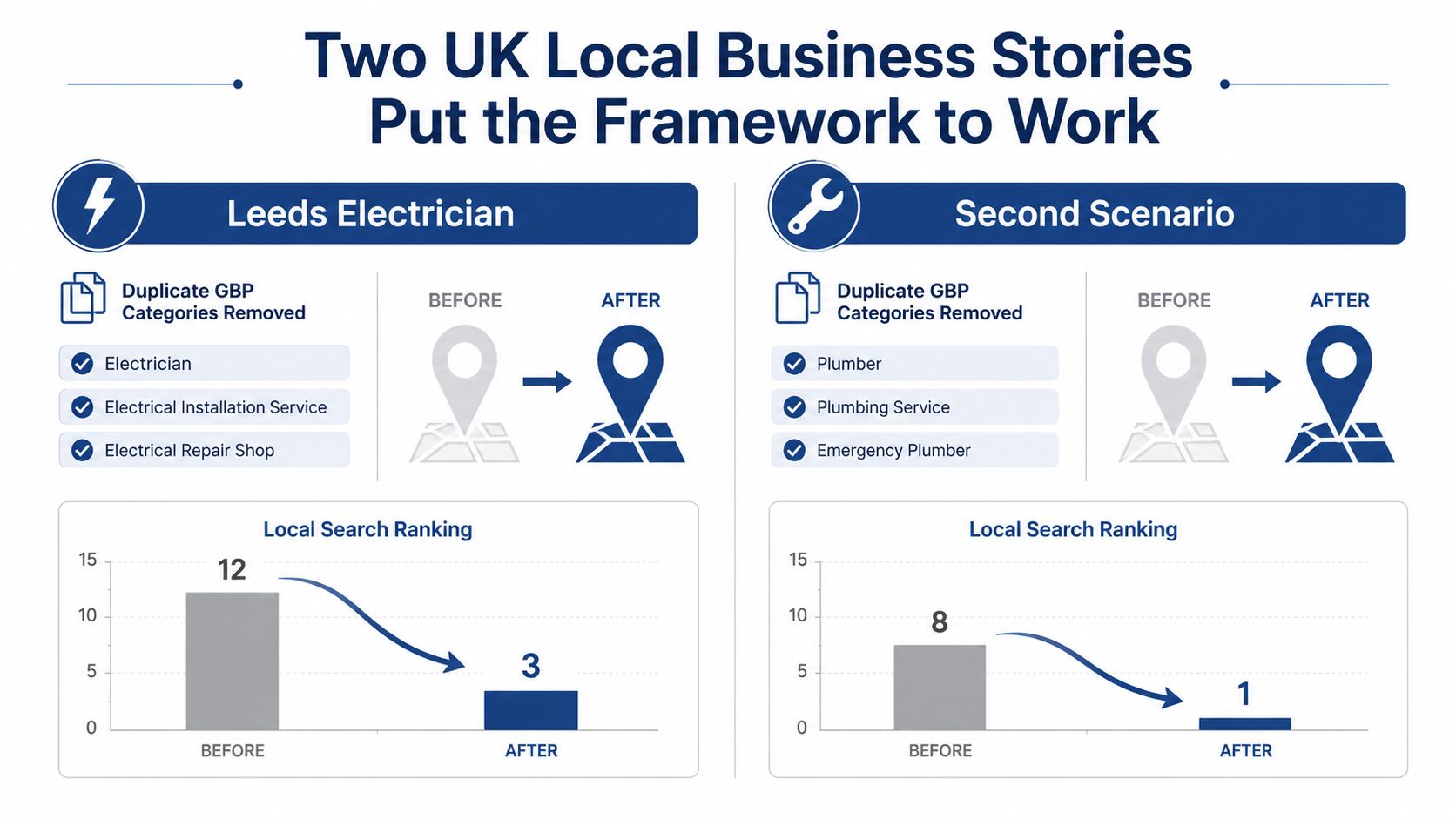
The target measurement is map visibility and qualified calls, not an impressive pile of impressions. A business owner should know which profile actions and queries produce enquiries, then compare that with organic performance. The work is practical, local and rather less glamorous than asking a chatbot to write “The Ultimate Guide to Electricity”, but it has a better chance of paying the bills.
Bristol solicitor scenario
Now take a Bristol family-law practice that rarely appears in AI answers. Its site may contain good legal knowledge, but the information is buried in long pages, the firm's people and specialisms aren't clearly connected, and the FAQs don't answer questions in a self-contained way.
The remedy is an entity and evidence programme. The firm can create clear solicitor biographies, focused service pages and structured FAQs, then pursue legitimate mentions in authoritative legal directories and relevant local or professional publications. Every statement needs careful review. Legal content should explain options and next steps without pretending that a general page replaces advice for a specific case.
The solicitor's key measures differ from the electrician's. Track whether the practice is cited for relevant questions, which pages receive those references and whether those visitors contact the firm. Don't judge the campaign solely by map-pack position, because the firm may be competing for informational trust before a prospect chooses a provider.
The two scenarios need different emphases. The electrician has an urgent local conversion problem. The solicitor has an authority and answer-retrieval problem. Same country, same broad service category, entirely different work. A generic package that treats them identically is a recipe for beautifully formatted irrelevance.
The Evaluation Checklist That Separates Real Specialists from Snake Oil
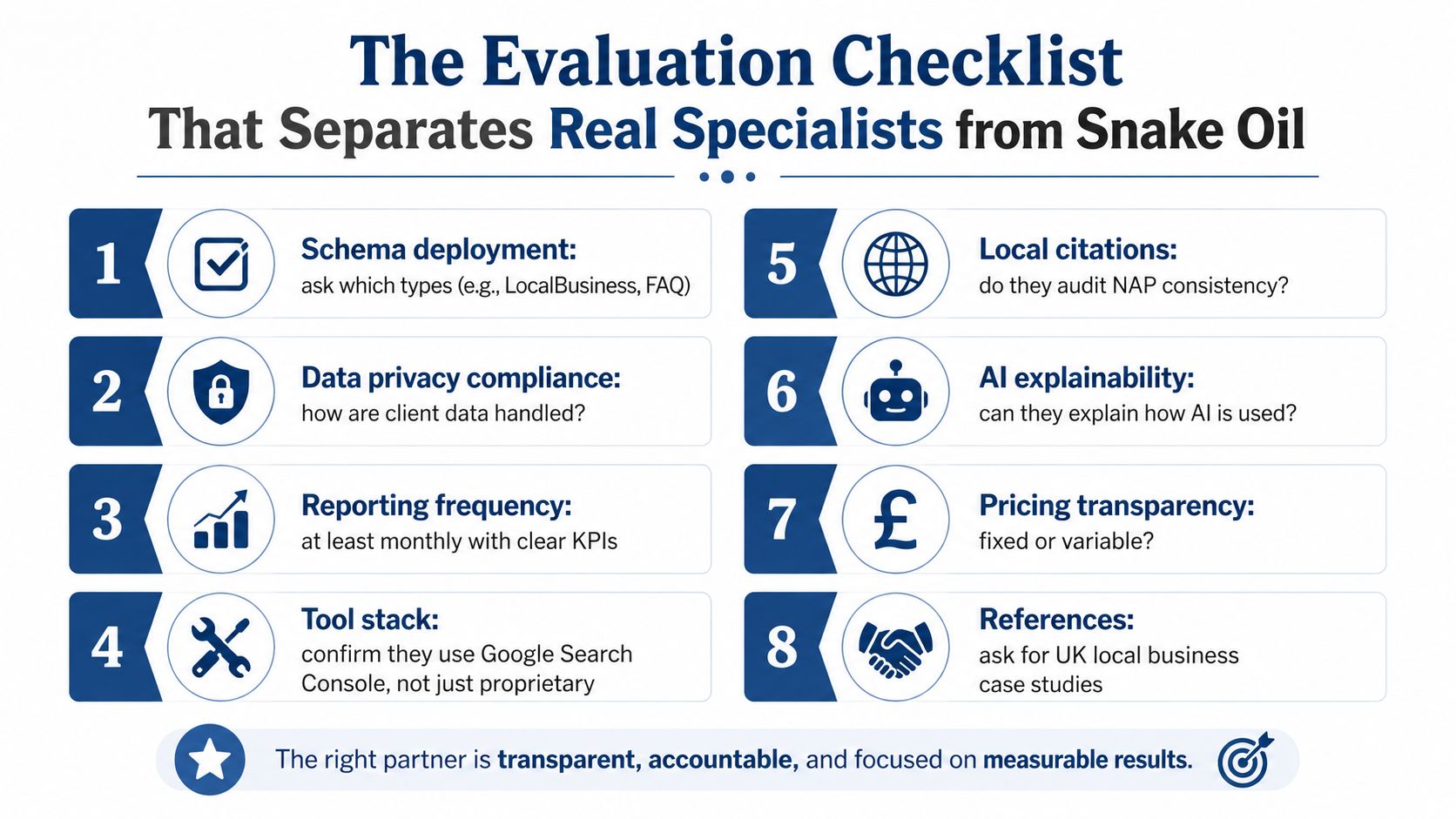
A reputable SEO specialist should explain the work without hiding behind proprietary fog. Start with the website and local market, not a contract. Anyone asking for a commitment before understanding the business, service areas, competitors and conversion path is selling confidence, not diagnosis.
Questions to ask before signing
- Schema deployment: Which types will be used, such as LocalBusiness, Service or FAQ, and how will you validate that the markup matches visible content?
- AI measurement: How will you test and report AI Overview or assistant citations instead of inventing a “generative visibility” score?
- Link transparency: Can you see the sites targeted, the reason each is relevant and the final links acquired?
- Local methodology: How will the team improve GBP categories, services, reviews, citations and local landing pages?
- Reporting evidence: Will you receive a sample report showing actions, outcomes, calls and qualified enquiries?
- Human review: Who checks AI-generated content, legal claims, trade advice and local accuracy before publication?
- Data handling: What information enters third-party AI tools, and how is client data protected?
- Exit terms: Can you leave without losing ownership of content, profiles, tracking data or accounts?
A sound supplier won't guarantee rankings. Search results depend on the query, location, competition and platform changes. They can guarantee a process, transparent reporting and decisions tied to commercial outcomes.
Red flags worth rejecting
Private blog networks, undisclosed paid links, mass-produced location pages and “secret” AI systems deserve a firm no. So do dashboards that show keyword movement but never identify calls, bookings or useful profile actions.
One UK small-business report highlights a technical issue often ignored in sales pitches. Retrieval bots, including OAI-SearchBot, PerplexityBot, ChatGPT-User and Claude-SearchBot, should be checked in CDN and robots.txt settings, with public content allowed while sensitive areas remain protected (UK small-business guidance on SEO in the AI era). The same source cites Ahrefs data associating AI Overviews with a 58% lower click-through rate for the top-ranking page, so citation visibility needs to be assessed alongside possible click loss, not celebrated blindly.
Practical rule: If a provider can't explain what changed, why it changed and which business outcome it should influence, don't pay them to discover the answer on your behalf.
Realistic UK Pricing, Packages, and Success Metrics
Pricing depends on scope. A solo tradesperson serving one area needs a different workload from a multi-location firm competing across many towns. The figures below are editorial planning bands, not verified market statistics. Use them to compare the work included, not as a promise of a universal rate.
| Tier | Monthly Investment | Core Deliverables | ROI Metrics That Matter |
|---|---|---|---|
| Solo trade foundation | £400 | Technical checks, GBP maintenance, focused service-page work, basic reporting | Qualified calls, booked jobs, profile actions |
| Growing local firm | £1,200 | Competitor research, content production, citation work, review analysis, technical improvements | Enquiry quality, booked appointments, map visibility |
| Multi-location campaign | £3,000+ | Location architecture, wider content programme, citation outreach, separate reporting by area | Leads by location, cost per enquiry, assisted conversions |
At the lower tier, reject the content factory. A roofer may gain more from resolving service-area confusion, improving a roof-repair page and maintaining the profile than from receiving generic articles each month. At the middle tier, a dentist or solicitor can justify a broader topic cluster, expert review and active authority work.
The £3,000-plus tier suits businesses with enough locations, services or commercial value to support that complexity. If a provider cannot explain the extra work, the higher price is just a bigger hat.
Measure the two surfaces separately
AI visibility and Local Pack performance require separate budgets, tactics and scorecards. For AI answers, record the queries tested, whether the business or its pages are cited, which competitors appear, and whether linked visits or enquiries follow. For the Local Pack, track calls, direction requests, website actions, profile views, query groups and location-specific ranking changes.
A UK SERP analysis of AI Overviews found AI Overviews appearing in about 19.23% of Google searches. 93.78% of those Overviews linked to at least one domain already in the top ten organic results, while 64.94% linked to pages in the top one hundred. Strong organic foundations therefore support citation opportunities, but pages also need clear, extractable answers.
Do not expect every improvement immediately. Technical corrections may show sooner than authority work, while reviews, citations and content require consistent monitoring. Judge progress against the starting point, the target query set and the lead journey, not a supplier's favourite chart. If AI citations rise while calls stay flat, protect the citation work but review the conversion path. If map actions improve while AI visibility does not, keep the local budget focused rather than buying an expensive package that treats both jobs as one.
How DigiVisi's Methodology Fits the Picture
DigiVisi's reverse-engineering approach fits this two-surface model because it starts with the pages and profiles already performing for the target query. Instead of applying a templated checklist and calling it strategy, the team analyses competitor winners, identifies the technical, on-page, off-page and local signals they use, then builds a plan to match or exceed the relevant gaps.
That matters for a local firm because “SEO improvement” isn't one task. A Leeds electrician may need GBP category cleanup, citation consistency and emergency-service architecture. A Bristol solicitor may need clearer entity signals, expert-led content and authoritative legal references. The work should follow the business problem, not force both firms into the same monthly content sausage machine.
The human and machine balance
AI can help DigiVisi research competitors, organise keyword themes, draft content and identify internal-link opportunities. The published work still needs a human rewrite for accuracy, experience and trust signals. That is especially important for regulated or high-stakes services, where confident nonsense remains nonsense, even if it has excellent headings.
The methodology also keeps reporting distinct. AI Overview citations and Map Pack rankings should not be blended into one score, because one reflects answer inclusion and the other reflects local discovery and clicks. Google permits publishers to opt out of AI Overviews, AI Mode and AI Overviews in Discover without that choice acting as a ranking signal for ordinary organic results, as reported in Search Engine Journal's coverage of Google's UK AI search controls. That gives site owners a clear visibility and risk decision rather than a mysterious technical lever.
DigiVisi's published offer includes Foundations, Authority and Market Leader packages, with audits, competitor and keyword research, service-page optimisation, internal linking, schema, citations and monthly content. The sensible way to choose between them is to decide where the business needs investment: answer citations, local map visibility or both, rather than selecting a package because its name sounds grand.
| Package | Primary Surface | Monthly Deliverables | Best Fit For |
|---|---|---|---|
| Foundations | Local foundations | Audit, GBP work, core pages, citations and reporting | Solo trades and small service firms |
| Authority | Balanced visibility | Content clusters, competitor analysis, internal linking and citation development | Growing professional firms and local SMEs |
| Market Leader | Both surfaces at scale | Wider location architecture, ongoing content, authority work and segmented reporting | Multi-location businesses |
Google's UK controls also mean a site owner can make an informed choice about generative surfaces without automatically sacrificing standard organic visibility. That is the sort of useful distinction a proper adviser should explain, rather than waving around an acronym and hoping nobody asks what it does.
DigiVisi Ltd helps UK service businesses separate AI answer visibility from traditional local search performance, using competitor-led SEO, Google Business Profile optimisation, content, citations and transparent reporting. Visit DigiVisi Ltd to discuss which search surface is costing your business enquiries and choose a practical plan built around calls, bookings and qualified leads.