Skip to content

The popular advice is to “know your customer” before you do anything else. Sensible, but incomplete. A small business doesn't need a glossy customer persona or a heroic spreadsheet exercise. It needs evidence that answers a harder question: which customers, services and locations can produce profitable work after labour, acquisition and delivery costs?
That's the useful version of market research for small business. It connects what people search for, what they complain about, which competitors appear in local results and what your business can afford to deliver. Done properly, it tells a Leeds electrician whether emergency call-outs deserve a dedicated service page, helps a Bristol café choose a profitable local offer, and gives a Manchester accounting practice a clearer route to qualified enquiries. No crystal ball required, although a decent cuppa helps.
Table of Contents
- Why Market Research Matters More for Small Firms
- Defining Research Objectives That Drive Revenue
- Affordable Secondary Research Sources in the UK
- Competitor and Local Search Analysis Techniques
- Customer Interviews and Surveys That Actually Work
- Turning Findings into SEO and Service Actions
- Quick-Win Tactics and Templates to Start Today
Why Market Research Matters More for Small Firms
Market research is often treated as a luxury for corporations with research departments, procurement teams and enough meetings to fill a small hotel. That assumption gets the economics backwards. A small firm has less room for a bad location, an unprofitable service line or a campaign aimed at people who were never going to buy.
The UK small-business environment makes this especially important. At the start of 2025, the UK had 5.7 million private sector businesses, including 5.64 million small businesses with 0 to 49 employees, which represented 99.18% of the total business population, according to the Enterprise Research Centre's State of Small Business Britain report. In other words, most local competitors are small too. A modest improvement in understanding demand, pricing or local competition can create a meaningful edge because the playing field contains so many firms operating with limited insight.
Research should protect cash, not decorate a brand plan
A useful research project informs a decision involving investment, finance or profitability. The British Business Bank's Small Business Finance Markets Report 2025 factsheet links access to finance with business investment and describes finance as a live constraint for smaller firms. That changes the question from “What does our audience like?” to “Which signal justifies spending scarce cash, and can the resulting work survive current costs?”
For a local solicitor, research might compare conveyancing with employment advice before creating new pages and campaigns. For a café, it might test whether weekday breakfast demand is strong enough to justify earlier opening. For a plumber, it could reveal that boiler servicing attracts steadier enquiries than a broad “plumbing services” message.
Practical rule: Treat every research finding as a potential allocation decision. If it won't change what you offer, where you promote it or how you price it, it probably isn't worth collecting.
The advantage isn't the size of the research budget. It's the discipline of connecting evidence to action. Free official datasets, competitor reviews, Google Business Profile observations and a handful of well-structured conversations can expose opportunities that expensive branding work politely walks around.
Defining Research Objectives That Drive Revenue
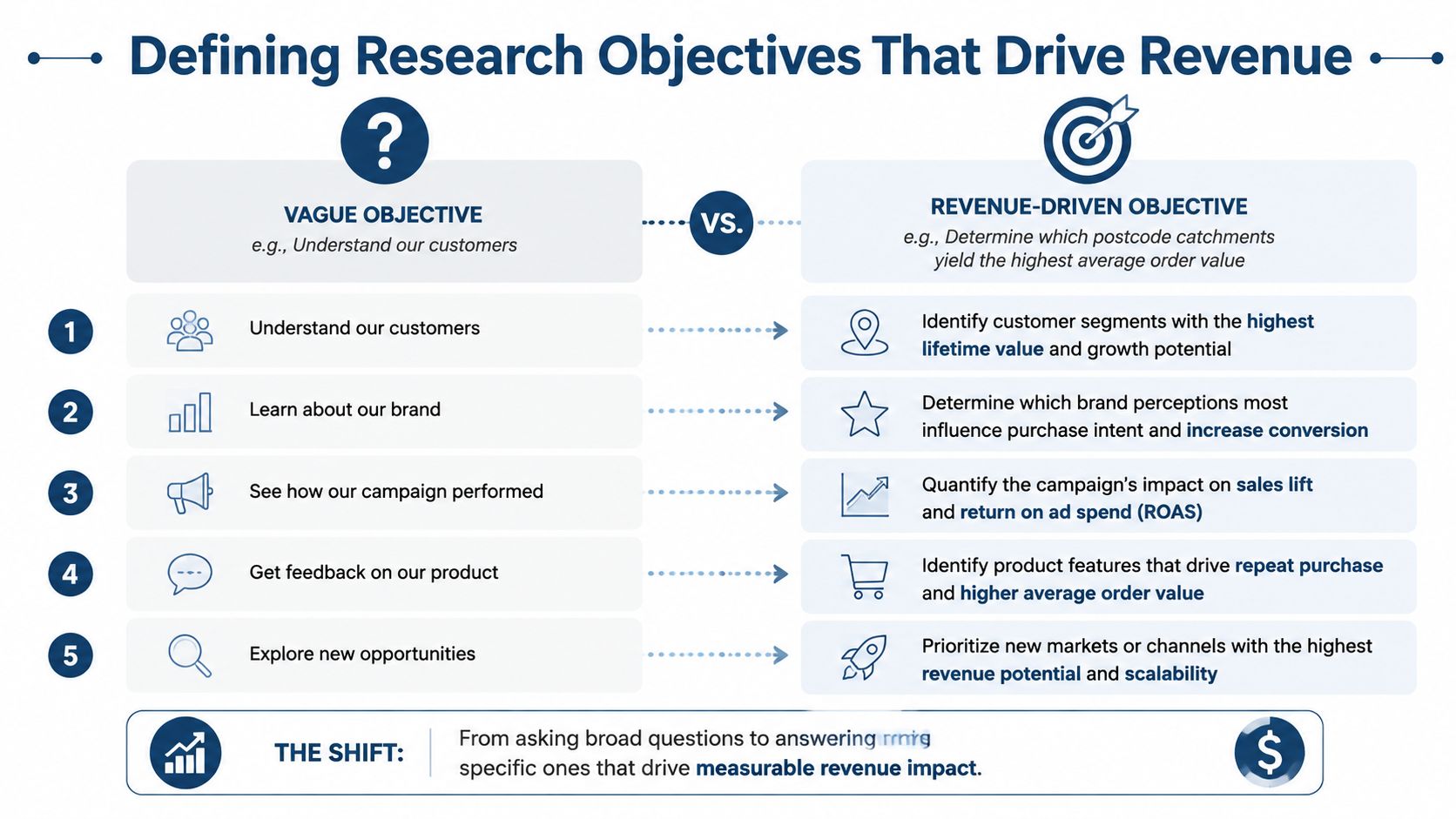
“Understand our customers” sounds responsible, but it gives you no test, threshold or decision. A stronger objective names the choice in front of you, the audience affected and the evidence that could change your mind.
Start with the decision
Write the decision before choosing a survey tool or opening a keyword platform. Use this sequence:
- Name the decision. Are you adding a service, changing pricing, targeting a new postcode or revising your Google Business Profile categories?
- Define the evidence. Which answers, search patterns, reviews or competitor gaps would support the decision?
- Set the consequence. What happens if you invest and demand is weak, or if you delay and a viable opportunity remains untouched?
- Choose the audience. Existing clients may explain satisfaction, while lost prospects may explain why enquiries never became work. Those are different groups with different evidence.
A Leeds electrician might replace “find out what customers want” with “determine which postcode catchments show enough demand for emergency electrical work to justify a dedicated landing page and extended response coverage”. The research then has a job. It can examine search intent, competitor coverage, review language, call records and customer interviews.
A professional firm needs similar precision. “Improve our website” is vague. “Identify the three client concerns that prevent small employers from enquiring about employment advice, then create service-page sections that answer them” is actionable. A Bristol café could ask which local customer occasions support a new weekday offer, rather than asking whether people “like the brand”.
Make the audience specific enough to act on
Audience definition should include the situation that triggers a purchase, not just age or location. A property solicitor might separate first-time buyers, landlords and commercial clients. A roofing firm could distinguish urgent repair customers from homeowners planning refurbishment. For a useful introduction to identifying audiences, EmailScout's audience identification guide offers a helpful framework for narrowing broad descriptions into usable groups.
Write down the decision, the audience, the evidence and the action that follows. If the answer won't affect a page, offer, category, budget or service area, sharpen the objective until it does.
Affordable Secondary Research Sources in the UK
Start with evidence that already exists. Secondary research can show market size, business pressures and the phrases customers use before you spend time recruiting interviewees. It will not describe every prospect, but it helps you choose which services, locations and search questions deserve primary research and budget.
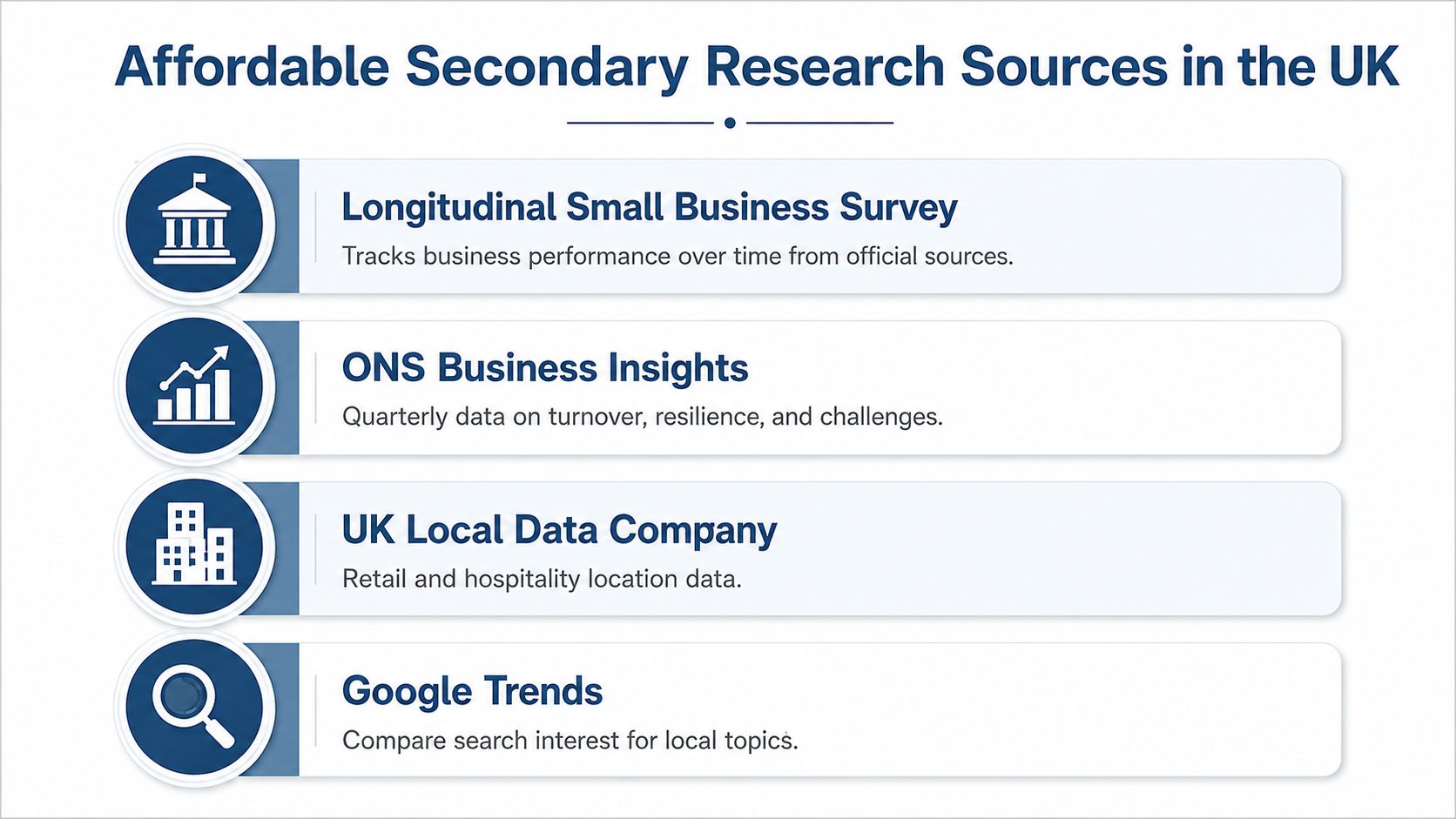
The UK Government's Small Business Survey reports explain the development of the recurring Small Business Survey into the Longitudinal Small Business Survey, which covers registered and unregistered private-sector SMEs across the UK and industries. It examines turnover and employment growth, exporting, innovation and training. The practical takeaway is to record your own customer segments, acquisition channels and competitors repeatedly, rather than treating one survey or one ranking as permanent truth.
A sensible source stack
The Longitudinal Small Business Survey 2024 release describes a structured CATI study of 10,611 UK business owners and managers, conducted between October 2024 and May 2025. Do not copy its scale. Copy the discipline: define the audience, use consistent questions, apply quota controls where appropriate and interpret findings against the customers you want to reach.
For current conditions, compare longer-term survey evidence with the ONS Business Insights and Conditions Survey, a voluntary fortnightly survey tracking short-term business conditions. The difference matters. A self-selected pulse can reflect the respondents most motivated to answer, while a longitudinal source offers more durable context. Local decisions improve when you combine both with sector and location checks.
HMRC's Customer Experience surveys provide another useful model, covering five defined groups, including Small Businesses. A Bristol café owner could apply the same principle to customer research by separating weekday regulars, weekend visitors and takeaway customers, then mapping each group to an offer or Google Business Profile category.
Find useful local detail quickly
Search official sites with the service, geography and commercial decision together. “West Yorkshire electrical businesses”, “Bristol hospitality conditions” and “Manchester professional services employment” should produce more useful evidence than a broad search for “market trends”. Check publication dates, methodology and audience fit before assigning money to a new page, service area or campaign.
Use secondary evidence to form a hypothesis, then test it against search behaviour, reviews and conversations with customers. RewriteBar's primary vs secondary sources guide explains the distinction clearly. The result should be an action, such as prioritising a postcode page, changing a service description or revising your Google Business Profile categories. Otherwise, it is research theatre, and small firms have better uses for the budget.
Competitor and Local Search Analysis Techniques
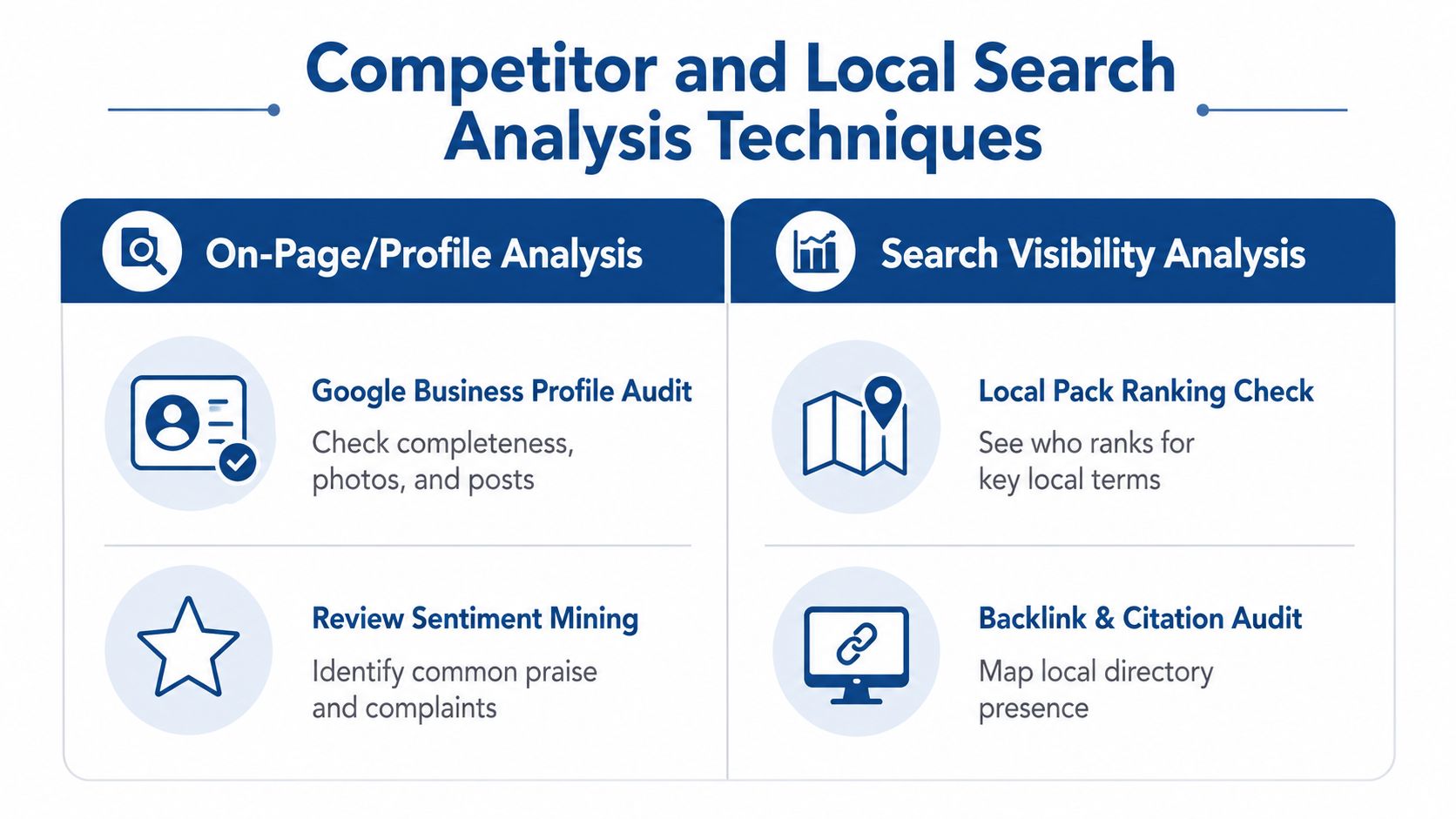
A competitor audit should examine what customers can see, not merely whether another firm has a website. Search the services and locations a buyer would use, record the businesses appearing in the local pack, and inspect the reasons customers might choose them.
For a Manchester accounting practice, compare the visible competitors for terms linked to limited companies, tax advice or payroll support. For a Leeds electrician, inspect emergency electrical searches separately from rewiring or inspection searches. Local demand isn't vanishing. It's becoming more fragmented across neighbourhoods, high streets, service occasions and digital discovery.
Audit the profile customers actually encounter
Review the leading local profiles for completeness, primary and secondary categories, service descriptions, photographs, posts, opening information and Q&A content. Note whether the business answers recurring customer questions clearly. Don't copy wording blindly. Extract the themes customers care about, then produce clearer and more useful information on your own profile and site.
Reviews provide especially rich research material. Sort comments into praise, frustration, hesitation and unmet needs. A solicitor may find repeated concern about communication. An electrician may see customers praising punctuality but complaining about unclear pricing. Those themes can inform service-page copy, FAQs, enquiry forms and follow-up processes.
Customers often describe the service they want in reviews more honestly than they do in a formal survey.
Separate sustainable tactics from shortcuts
White hat SEO follows search-engine guidelines and builds durable visibility through accurate information, useful content, genuine reviews and consistent business details. Grey hat SEO occupies an ambiguous middle ground, using tactics that may not be expressly forbidden but can still create ethical or operational risk. Black hat SEO goes against guidelines, often through manipulation, deceptive content or artificial signals.
A business considering local search should favour the first category. Don't create fake locations, buy artificial reviews, stuff place names into every sentence or build irrelevant citations merely to inflate a spreadsheet. The distinction is explained clearly in this guide to white hat, grey hat and black hat SEO.
Benchmark the top three visible competitors across profile quality, service-page relevance, technical performance, citations, reviews and useful local references. A structured competitor SEO analysis can help organise that comparison without turning it into an afternoon of tab-hoarding.
Customer Interviews and Surveys That Actually Work
Primary research earns its keep when it reveals decisions, objections and search language, not polite compliments. A customer may say they were satisfied, then choose another firm because the response time, location, explanation or booking process felt safer. Ask about the last purchase, while the details are still concrete, rather than an imaginary future one.
Start with a short, neutral interview guide. Let people explain their answer before offering options. Their wording can later inform service pages, Google Business Profile questions and the local searches worth funding.
A practical interview guide
Ask a trades customer:
- What problem were you trying to solve?
- What made it urgent, or allowed you to wait?
- Which searches, recommendations or websites did you use?
- What made you contact this business?
- Which alternatives did you consider?
- What nearly stopped you booking?
- Which part of the service mattered most?
- What would you change about the experience?
- How did you judge whether the price was reasonable?
- What wording would you use when recommending the service?
A professional firm can adapt these questions to explore trust, clarity, response time and perceived expertise. A café might ask about visit occasions, convenience, menu choices and what would encourage a return during quieter periods. Record recurring phrases accurately. One customer's colourful description is anecdotal; repeated language is a candidate for a page heading, service label or profile update.
Surveys need structure, not confetti
A survey should test a small set of hypotheses. Use plain questions, avoid leading language and separate different ideas. “How satisfied were you with price and communication?” is two questions wearing one trench coat. Ask about price and communication separately.
Sampling affects the decision you make from the results. A poll posted in a group may attract enthusiastic supporters, so it describes those volunteers rather than the wider market. Structured, repeated research gives a firmer basis for judging customer needs than a single self-selected snapshot, as shown in the Longitudinal Small Business Survey SME employers release.
Use simple quotas that match the decision. For a plumbing service, separate recent customers, dormant customers and people who requested a quote but did not proceed. For a local café, distinguish regular visitors from occasional visitors, nearby workers and residents. Those groups may need different questions and different Google Business Profile or content actions.
Narrareach's audience identification guide can help define who should receive each questionnaire. Keep the final survey focused. Ten purposeful questions beat fifty vague ones, especially when a busy owner is analysing responses between appointments.
Turning Findings into SEO and Service Actions
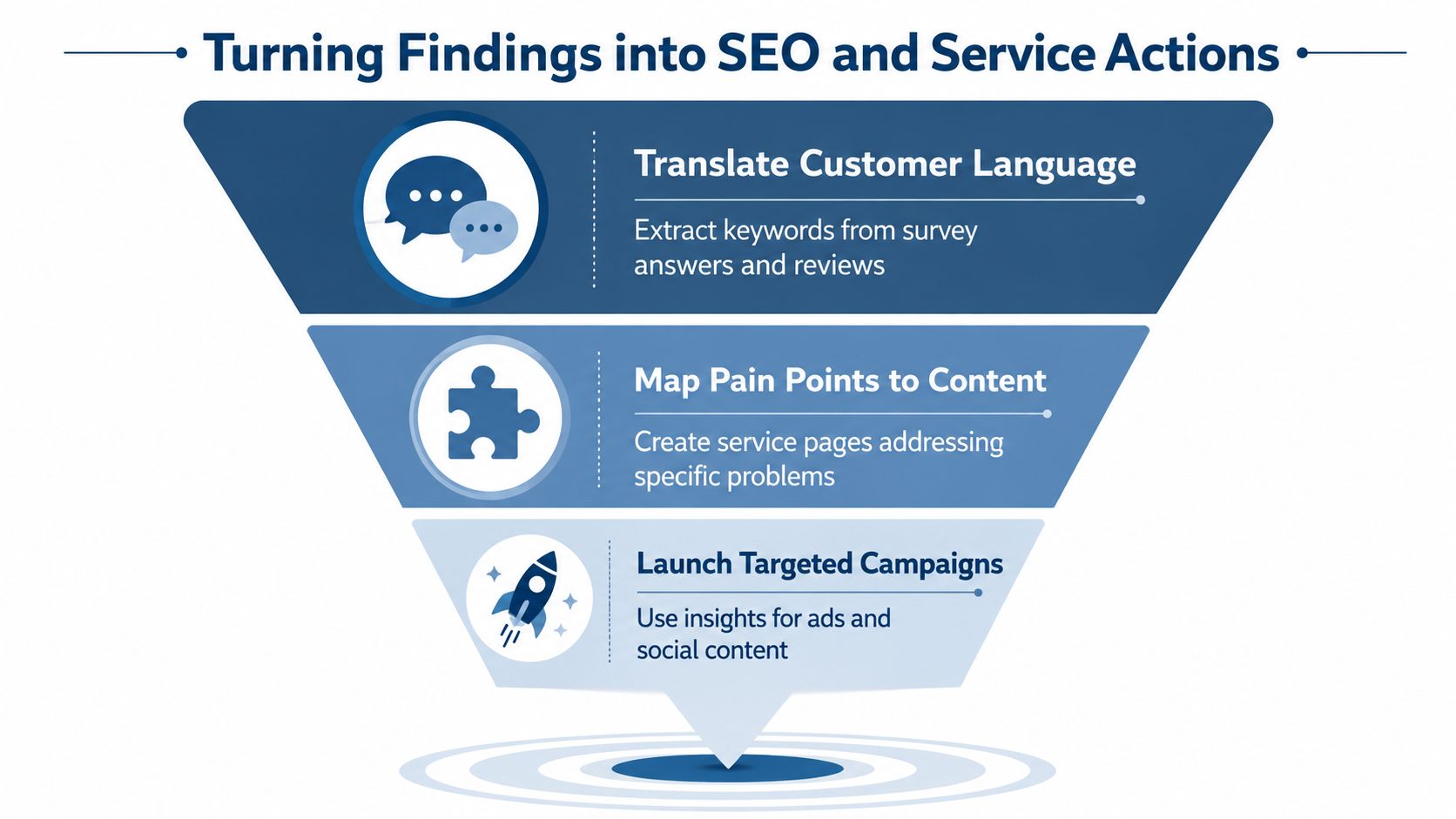
Research only earns its keep when it changes what appears in search and what happens after the click. Start with the exact language customers use in interviews, reviews, emails and Google Business Profile Q&A. Preserve the meaning, then group phrases by intent rather than scattering them across pages like confetti at a wedding.
Convert language into page architecture
If solicitor interviews repeatedly mention uncertainty about the process, the relevant service page should explain stages, documents, costs and communication expectations in straightforward language. If electrician reviews highlight urgent evening faults, create useful emergency-service content that explains availability, likely next steps and what customers should do safely before help arrives.
Map each meaningful pain point to an action:
- Search intent: Turn recurring customer phrases into service, location and question-led keyword groups.
- Page purpose: Give each major service a focused page instead of forcing every offer onto one generic “what we do” page.
- Internal links: Connect problem-led guides to the relevant service page, then make the enquiry route obvious.
- Structured data: Review whether suitable schema markup can clarify services, organisation details, locations and frequently asked questions.
- Local signals: Correct inconsistent name, address, phone and website details across important directories and profiles.
- Profile improvements: Update categories, services, photographs, Q&A and posts to address gaps found in competitor research.
Prioritise by commercial sense
Rank actions by likely value and implementation effort. A profile category correction or unanswered customer question may be quicker to address than a full site rebuild. A new service line deserves stronger evidence than a minor wording adjustment because it affects staffing, finance and delivery.
DigiVisi Ltd provides keyword and competitor research, service-page optimisation, internal linking, schema markup, citation and Google Business Profile work for small service-led businesses. Those activities fit the capital-allocation approach because they connect market evidence with the pages, profiles and search opportunities most likely to attract qualified enquiries.
Quick-Win Tactics and Templates to Start Today
You can begin without commissioning a grand study. Set aside a focused working session and build a short evidence file for one service, one location and one commercial decision. A Leeds electrician might investigate emergency call-outs in a chosen catchment. A Bristol café could examine weekday breakfast demand. A Manchester accountant might compare payroll and tax-advice enquiries.
Use this compact research checklist
- Choose one decision: Write the investment, pricing, service or location choice in one sentence.
- Search the buyer's wording: Record local results, related questions and the services competitors emphasise.
- Inspect three visible competitors: Note profile completeness, categories, review themes, service pages and enquiry routes.
- Mine customer language: Review your own enquiries, lost opportunities, Q&A entries and feedback.
- Test the hypothesis: Speak to relevant customers or run a tightly targeted survey.
- Make a go, pause or stop decision: Record what you'll change, what you'll monitor and when you'll review it.
For a competitor audit, create columns for business name, target service, target location, profile categories, review themes, service-page gaps, calls to action, citations and your response. Don't award points for decorative flourishes. Record evidence that could influence a customer or a search engine.
Three useful checks for this week
First, read the questions and answers on local Google Business Profiles. Repeated questions about parking, response time, documents, payment or availability can become profile updates, FAQs and service-page sections.
Second, analyse competitor reviews for gaps rather than copying praise. If customers repeatedly mention slow replies, explain your response process. If they praise clear quotations, show how your own quotation journey works.
Third, monitor relevant local Facebook groups ethically. Look for recurring problems and language, but don't intrude, pretend to be a customer or harvest personal information. Informal sentiment is a prompt for further research, not proof of market demand.
Market research is a repeatable discipline. Small, regular checks beat one magnificent report that gets filed away and forgotten, probably beside the unused label maker.
DigiVisi Ltd helps UK service businesses turn market research into keyword plans, competitor-led SEO, Google Business Profile improvements and conversion-focused service pages. Visit DigiVisi Ltd to discuss the local search opportunities your evidence can support.