Skip to content
You're a Cambridge business owner, and the phone has gone oddly quiet. Your website still works, your services are sound, and you may even be publishing useful articles, yet a newer competitor keeps appearing in the map pack for the searches that matter. A plumber in Cherry Hinton, a solicitor on Hills Road and a café near the market square can all end up asking the same question: why are customers finding them instead of me?
The answer usually isn't a shortage of blog posts. SEO in Cambridge is an operational discipline, built from accurate business information, a credible Google Business Profile, technically clean pages, local trust signals and steady measurement. This guide sets out how to build those signals properly, while avoiding the grey-hat shortcuts that look clever until Google takes a dim view of them.
Table of Contents
- Why Cambridge Local SEO Is an Operational Game
- Running a Cambridge-First Technical and NAP Audit
- Reverse-Engineering the Cambridge SERP Winners
- Optimising Your Google Business Profile for Cambridge
- Building Cambridge Service Pages That Earn Their Keep
- Citations, Reviews and Local Link Building Done Properly
- Tracking, Reporting and a Realistic Cambridge SEO Timeline
Why Cambridge Local SEO Is an Operational Game
A quiet phone creates a particular kind of panic. The plumber checks missed calls, the solicitor refreshes their enquiry inbox and the café owner notices that the competitor across town has more direction requests than usual. Nobody has necessarily done anything dramatic. A rival may have corrected its business details, added useful service information, collected genuine reviews and made its location relevance clearer.
Cambridge is a demanding market because its business population is substantial and active. One Cambridge directory cites approximately 5,000 local businesses across the city, while a wider Cambridge database built from Companies House and FAME data mapped over 56,000 companies within a 20-mile radius. The business environment changes as firms incorporate, relocate and close, so the local search results are never entirely static. Cambridge business data and directory coverage helps illustrate why service firms compete in a compact but crowded geographic market.
The city's science, technology and knowledge-intensive economy adds another layer. A Cambridge cluster summary describes more than 5,000 companies, more than 67,000 people employed and around 3,000 information technology and telecoms companies, with life sciences employment having grown two-and-a-half times since 2010. Those figures come from the Cambridge database methodology report, and they matter because professional firms often need to demonstrate specialist authority as well as local relevance.

Practical rule: Don't try to out-publish a competitor whose business information, reviews and service structure are already stronger. Match the signals first, then add genuine usefulness.
A sensible six-month programme starts with technical and location-signal repairs, moves into competitor analysis and service-page improvements, and continues through review generation, local relationships and monthly iteration. The work compounds because each improvement supports the next one. Content still matters, but content volume alone won't rescue a business with conflicting addresses, a weak profile or pages that Google can't properly crawl.
For a broader view of how businesses can apply local search systems across different operating models, these local SEO use cases provide useful context. The principle is straightforward: make the business easier for Google to understand and easier for customers to trust.
Running a Cambridge-First Technical and NAP Audit
Start with the website, not the blog calendar. In a dense local market, broken technical signals can suppress otherwise excellent content, so the first task is to establish whether Google can crawl, index and interpret the pages you already have.
Fix the problems that block everything else
Use Google Search Console alongside a crawler such as Screaming Frog, Sitebulb or a comparable technical tool. Check that important service and location pages are indexable, that canonical signals make sense, and that no accidental noindex directives are hiding commercial pages. Review page speed and mobile rendering, then inspect broken internal links, redirect chains, orphaned pages and thin content.
A Cambridge heating and ventilation firm might have separate pages for boiler repairs, heat pumps and emergency call-outs. If those pages all use nearly identical copy, link poorly to one another or sit behind broken navigation paths, adding another article about boiler maintenance won't solve the underlying problem. Consolidate duplicates, strengthen useful pages and remove or redirect obsolete versions where appropriate.
The audit should produce a short priority list rather than a heroic spreadsheet nobody opens again:
- Fix immediately: indexing errors, blocked service pages, broken key links, incorrect contact details and serious mobile usability problems.
- Fix next: duplicated location copy, weak title tags, missing internal links, unclear page hierarchy and incomplete service descriptions.
- Log for review: lower-impact metadata refinements, older blog updates and layout improvements that don't affect access or conversion.
Treat NAPW as a business process
NAPW means Name, Address, Phone and Website. Check those details on the website, Google Business Profile and the major UK directories. A small difference can create needless ambiguity, such as “Cambridge Heating Ltd” in one place, “Cambridge Heating” in another, or an old workshop address still appearing in a directory listing.
The UK-focused Cambridge SEO workflow recommends resolving crawl issues, page speed problems, broken internal links, thin pages and duplicate location signals before expanding content. It also reports that achieving citation consistency above 90% across key UK directories for NAPW can lift Google Business Profile engagement by 28-35%. Treat those figures as a benchmark from that guide, not a promise for every firm.
For the HVAC example, record every listing in one sheet, including the live URL, login owner, current details and action required. Correct the website and Google profile first, then update trusted directories. After the next crawl, check whether old versions remain indexed and whether contact details are consistent on service pages, the footer, contact page and structured data.
This can be a focused Saturday for a competent owner. The hard part isn't clicking “edit”. It's resisting the urge to create more pages before the signals you already control are coherent.
Reverse-Engineering the Cambridge SERP Winners
Search your priority phrases from the areas you serve, not just from the office computer. A solicitor might inspect “solicitor in Cambridge”, an emergency plumber might search “emergency plumber Cambridge”, and an accountancy practice could check “accountant CB2”. Record the top three map-pack listings and the strongest organic results, then compare the signals behind them.
Read the map pack as evidence
Open each Google Business Profile and note the primary category, secondary categories, services, opening hours, attributes, photos, description, questions and answers, review themes and response behaviour. Don't reduce the exercise to review totals. A business with fewer reviews but better service relevance, fresher imagery and clearer information may be giving Google a cleaner match for the query.
UK local-search benchmarks report that complete profiles generate 5x more views than incomplete ones, with 70% of profile views coming from Google Maps rather than classic Search and 84% of discovery searches being category, product or service-led rather than branded. Those figures are reported in the UK local SEO benchmark for 2026. They support a practical conclusion: optimise for what a customer wants to hire, not merely for the business name.
Inspect the website behind the listing
Review the competitor's service pages, titles, headings, internal links, LocalBusiness and Service schema, trust content, qualifications and evidence of relevant work. Then examine the link sources. A genuine local relationship, trade association or useful community resource is materially different from a pile of unrelated guest posts.
Turn your notes into a gap list with three labels:
- High impact, lower effort: correct categories, add missing services, repair title tags and complete contact details.
- High impact, higher effort: build a proper service page, improve internal linking, create useful local evidence and earn relevant links.
- Low priority: cosmetic changes that don't improve relevance, trust or usability.
Repeat the exercise quarterly. Copying a competitor's link profile through automated submissions is the grey-hat temptation. Understanding which signals matter, then earning or improving them legitimately, is slower but far more durable.
Optimising Your Google Business Profile for Cambridge
Your Google Business Profile is often the first piece of digital real estate a prospective customer sees. It deserves the same care as your reception area, although Google probably won't judge the quality of the biscuits.
Start with the primary category. A Cambridge café should choose the category that best describes its core operation, then add realistic secondary categories. A trades firm should avoid selecting every remotely related category. Category stuffing creates a muddled profile and can make the business less relevant for its strongest service.
Complete the services section in plain customer language. Add products where they apply, write a complete description, set accurate opening hours and review seasonal changes, bank holidays and emergency availability. A plumber should explain whether emergency call-outs are available and where. A café should make menus, seating, accessibility and opening variations easy to understand.
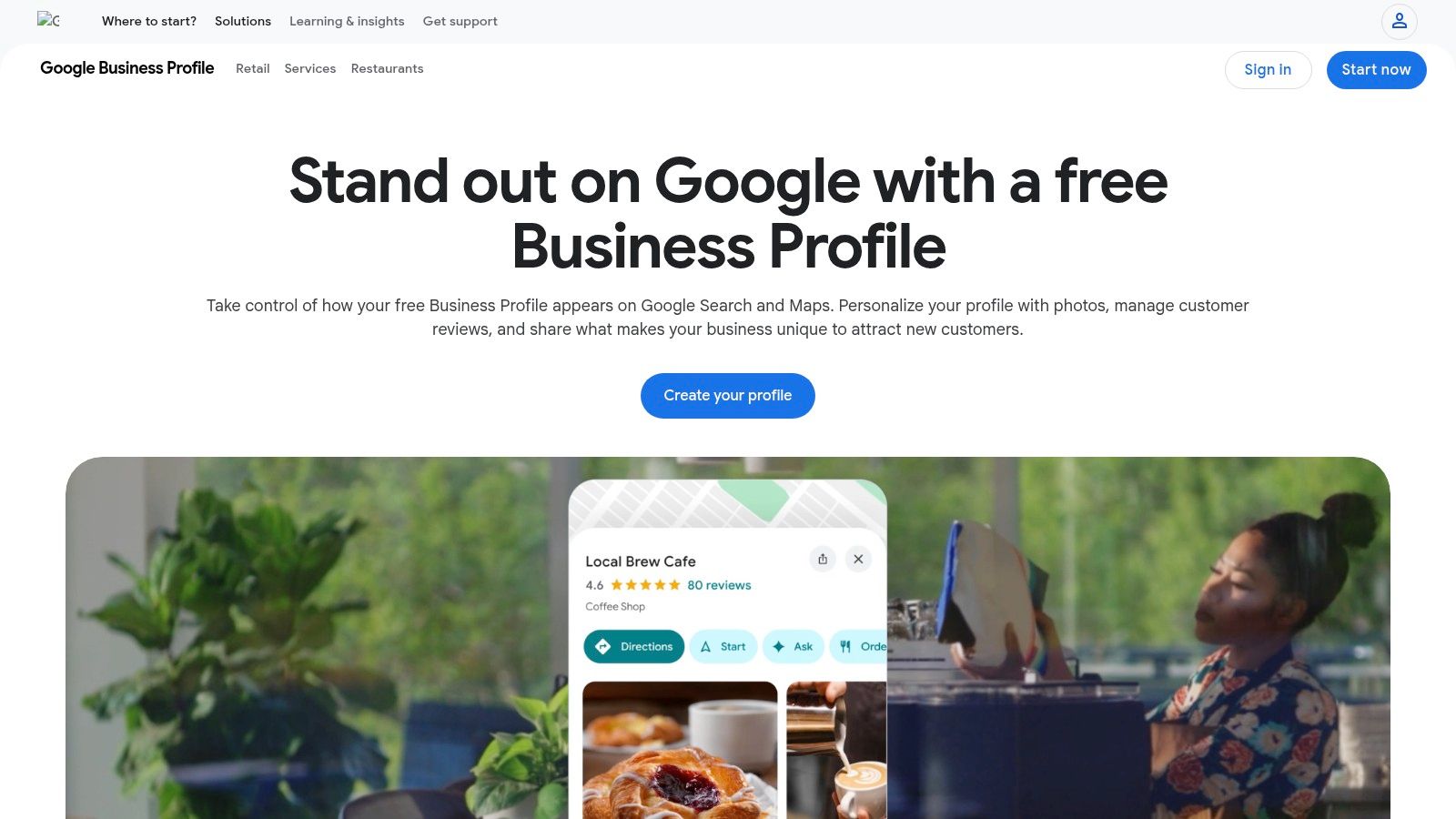
Photos carry practical weight. Add the exterior, interior, team, vehicles, completed work and genuine before-and-after examples where appropriate. The 2026 UK benchmark cited above reports 7x more clicks for businesses with photos, while another UK source reports that profiles with 30+ photos receive 2.7 times more clicks than profiles with fewer than 10 photos. These are separate benchmark claims, so use them as directional evidence rather than guaranteed outcomes. UK local SEO ranking-factor coverage provides the latter comparison.
Keep the profile active without turning it into a daily performance. Publish useful Google Posts when you have a real update, answer customer questions, enable messaging if someone can respond promptly and add FAQs that address genuine objections. A Cambridge café can explain reservations and dietary options. A trades firm can clarify service areas and what customers should do during an emergency.
Reviews need a process, not a desperate Friday afternoon text blast. Ask satisfied customers shortly after completing work, make the request easy and respond to every review professionally. This guide to improving local SEO with Google reviews is useful for building a compliant review routine.
Avoid the shortcuts that put the entire profile at risk:
- Fake addresses: Don't use a virtual office or residential address that doesn't meet Google's requirements.
- Keyword-stuffed names: Use the trading name, not a string of services and locations.
- Paid review pods: Don't buy reviews or exchange them in organised groups.
- Unmanaged messaging: Don't enable a channel nobody monitors.
Google's local results are principally shaped by relevance, distance and prominence, as summarised in this UK local SEO guide. Profile completeness supports all three, but it can't turn an ineligible or misleading listing into a trustworthy local business.
For a practical website-side companion to profile work, see this small-business local SEO resource. It connects profile optimisation with the pages and local signals that support it.
Building Cambridge Service Pages That Earn Their Keep
A homepage titled “SEO in Cambridge” or “Plumbing Services Cambridge” is rarely enough on its own. Customers search for a specific need, and Google needs a page that clearly satisfies that intent. A Cambridge conveyancing solicitor should have a useful conveyancing page, not one thin area page attempting to rank for every legal service in every nearby town.
Build pages around real combinations of service and location, but don't manufacture doorway pages. A conveyancing practice might create distinct pages for Cambridge, Ely, St Ives and Huntingdon if it serves those areas and can provide useful local context. Each page should explain availability, process, relevant expertise, travel or meeting arrangements, testimonials and the questions customers ask.
A Cambridge plumber can structure pages around boiler repairs, emergency plumbing and heat-pump installation. An accountancy practice might separate tax returns, payroll, bookkeeping and limited-company accounts. The architecture changes with the business, but the principle remains consistent: one clear intent, one useful page, one obvious next step.
The anatomy of a useful local page
| Page Element | What It Should Do | Priority for Local SEO |
|---|---|---|
| Title tag | Combine the service, location and a clear value proposition | High |
| H1 heading | Confirm the page's main subject in natural language | High |
| Opening copy | Answer the visitor's immediate need without padding | High |
| Service detail | Explain scope, process, exclusions and likely questions | High |
| Internal links | Connect related services, areas and contact paths | High |
| LocalBusiness schema | Reinforce the organisation's identity and location | Medium |
| Service schema | Clarify the service described on the page | Medium |
| Trust evidence | Show qualifications, reviews, memberships and relevant work | High |
| Call to action | Make calling, booking or enquiring straightforward | High |
Run a five-minute quality check before publishing. Can a customer tell what you do, where you do it and what happens next? Does the page contain original information rather than swapped town names? Are the claims supported by visible evidence? Does it link to related services and the contact page? Does the page work properly on a phone?
Schema can clarify the page, but it won't disguise weak copy. Nor will adding “Cambridge” to every heading. Local relevance comes from the complete page, the business details around it and the authentic-world evidence supporting the service.
Citations, Reviews and Local Link Building Done Properly
Citations are useful when they confirm the same business identity across trusted places. They become clutter when an owner submits the same details to every directory that accepts a form. Prioritise established UK platforms such as Yell, Thomson Local, FreeIndex, Bing Places and Apple Maps, then add credible industry directories relevant to the service.
A solicitor should look for legitimate legal directories and professional memberships. A trades firm should consider respected trade-specific listings. Check whether each citation is indexed, maintained and useful to customers. A directory that exists mainly to sell a link is not a local trust strategy, regardless of how impressive its submission dashboard looks.
Reviews need authenticity and consistency. Ask all suitable customers, don't cherry-pick only the easiest ones, and never offer incentives that distort the feedback. If someone leaves a negative review, acknowledge the issue, avoid discussing private details publicly and invite them to continue the conversation offline. A calm response can demonstrate more credibility than a defensive paragraph written at half past ten at night.
Local links work best when they reflect genuine involvement. Consider a Cambridge Chamber of Commerce membership, a community sports sponsorship, a free workshop for local residents, a supplier relationship, university collaboration or charity activity that produces a real page mentioning the business. The link should be a by-product of useful participation, not the sole reason for the activity.
White-hat work creates evidence. Grey-hat work creates a cleanup bill.
Avoid private blog networks, paid guest-post packages, automated directory networks and irrelevant sponsored links disguised as editorial coverage. They may create movement for a while, but they don't build the reputation a customer can verify. Businesses also need to consider how reputation signals are interpreted beyond traditional search, so this resource on optimising local signals for ChatGPT offers a useful additional perspective.
Tracking, Reporting and a Realistic Cambridge SEO Timeline
Track a small set of commercial indicators. For most service businesses, that means map-pack positions for the priority three to five searches, Google Business Profile calls and direction requests, website calls, form enquiries and changes in branded search demand. Traffic and impressions can help diagnose visibility, but they aren't the same as booked work.
A practical 90-day programme looks like this:
- Weeks one and two: Audit crawling, indexing, mobile performance, internal links, service pages and NAPW.
- Weeks three and four: Reverse-engineer the current winners and repair Google Business Profile categories, services, hours and media.
- Month two: Improve priority service and location pages, add internal links and implement appropriate schema.
- Month three: Strengthen review requests, correct remaining citations, pursue relevant Cambridge relationships and review lead data.
Expect early improvements in clarity and profile activity before expecting stable ranking movement. At month three, you should know which pages and searches are responding. At month six, a disciplined campaign should have a clearer local footprint and stronger evidence about where to invest. At month twelve, the accumulated technical, content, review and relationship work should give you a much firmer platform, although no ethical practitioner can promise a specific position or number of leads.
Google dominates UK search share at about 93.5%, according to UK local SEO coverage, so Google Business Profile hygiene deserves serious attention. The same source reports that fully optimised profiles received 3.2 times more website visits from local searches than profiles without that level of optimisation. Treat the figures as reported benchmarks, not contractual forecasts.
Review the dashboard monthly, log completed work, check calls and forms, inspect new reviews, and adjust the next month's priorities. A solo owner can handle the fundamentals with time and discipline. A retained specialist costs more, but may be sensible when technical work, content production and competitor monitoring compete with serving customers. The right choice depends on capacity, not bravado.
DigiVisi Ltd helps Cambridge service businesses with technical audits, competitor-led local SEO, Google Business Profile optimisation, service-page improvements, schema, internal linking and NAPW fixes, with transparent reporting tied to visibility and enquiries. Visit DigiVisi Ltd to discuss a practical Cambridge SEO plan built around the signals your customers and Google can verify.