Skip to content

You're probably in one of two camps right now. Either your Cambridge business does excellent work but barely appears when someone searches for it, or you do show up occasionally, somewhere beneath the fold, while firms with weaker service somehow pinch the call. That's maddening, especially when you know customers are searching for exactly what you offer.
The good news is that local SEO isn't smoke and mirrors. It's mostly about relevance, trust, technical health, and being very clear about where you serve. In Cambridge, that last point matters more than most guides admit. A business targeting all of “Cambridge” often misses the easier wins sitting right inside CB1, CB2, CB4, or CB5.
Table of Contents
- Why Your Cambridge Business Is Invisible on Google
- Our Data-First Cambridge SEO Methodology
- Smarter Targeting for Cambridge Businesses
- Our Cambridge SEO Packages Unpacked
- Proof It Works Cambridge SEO Case Studies
- Your Questions about SEO in Cambridge Answered
Why Your Cambridge Business Is Invisible on Google
A familiar Cambridge story goes like this. A plumber in Arbury has solid reviews, answers the phone, turns up on time, and gets most work through word of mouth. But when someone nearby searches for help on their mobile, the business is nowhere obvious. Not because the service is poor. Because Google hasn't been given enough clear local signals to trust and rank it properly.
It's the same for a bakery in Romsey, a solicitor near the station, or a dog groomer in CB5. If the website is thin, the Google Business Profile is half-filled, and the business details vary across directories, the business becomes oddly hard to find. You exist in real life, but not convincingly enough online.
That's why SEO matters so much now. The UK SEO market reached £19.2 billion in 2023 and is projected to reach £25 billion by 2028, with 60% of UK businesses actively using SEO. In plain English, your competitors aren't waiting around. They're investing in visibility while many smaller firms still hope a decent website alone will do the trick.
What invisible usually looks like
- You rank for your business name only: Fine for existing customers, useless for new enquiries.
- You appear in the wrong places: Google may understand your service, but not your service area.
- You get traffic without calls: That often means the page targets vague terms rather than buying-intent searches.
Most local SEO problems aren't mysterious. They're usually a pile-up of small misses that tell Google, “I'm not quite sure who this business serves.”
A proper local campaign fixes that pile-up. It ties together your site, your location signals, your content, and your local profile so that someone searching “accountant CB1” or “boiler repair near Mill Road” can find you.
If you want a straightforward primer before diving deeper, this guide to small business local SEO is a useful place to start.
Why Cambridge is trickier than it looks
Cambridge isn't just one neat blob on a map. Search behaviour differs between central areas, nearby villages, and postcode clusters. Someone in Cherry Hinton won't always search the same way as someone near Chesterton Road. If your strategy treats the whole city as one keyword target, you'll miss intent that's right under your nose.
That's the heart of effective SEO in Cambridge UK. Not shouting louder across the whole city, but showing up precisely where intent is strongest.
Our Data-First Cambridge SEO Methodology
Good local SEO starts with fewer opinions and more evidence. Guesswork is expensive. It leads to random blog posts, bloated service pages, and “clever” tricks that look busy but don't move the dial.
The better approach is simple. Find out what already ranks in Cambridge for the searches that matter, inspect why it ranks, and build a stronger version without crossing into risky tactics.
Start with evidence, not hunches
Think of your website like a shop. Before repainting the front window, you'd check whether the roof leaks and whether the sign has the right address on it. SEO works the same way.
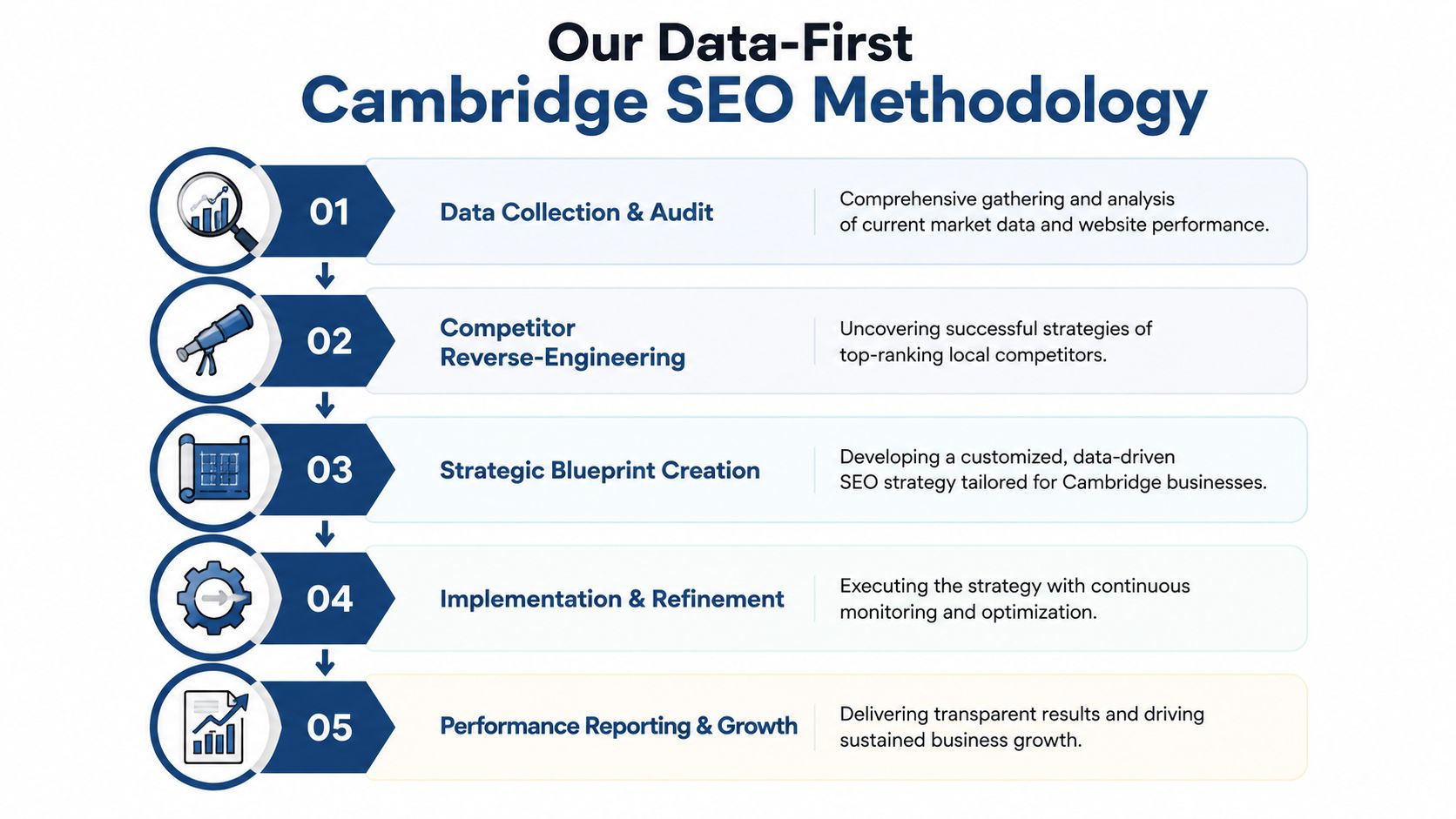
A data-first local process usually looks like this:
- Audit the technical basics: Indexing, crawl issues, page speed, broken internal links, thin pages, and duplicate location signals.
- Reverse-engineer local winners: Check which pages rank in Cambridge, how they structure services, and how they support them with internal links and local relevance.
- Map keywords to intent: Separate research terms from ready-to-buy searches.
- Improve trust signals off-site: Clean directory listings, Google Business Profile details, and local references.
- Refine monthly: Watch what rises, what stalls, and what needs tightening.
The four pillars that actually move rankings
There are dozens of tasks in SEO, but most fit into four practical buckets.
Technical SEO
This is the foundation. If pages are slow, difficult to crawl, or muddled by duplication, rankings wobble no matter how good the copy is. Technical work isn't glamorous, but neither is fixing a burst pipe. You still want it done properly.
Examples include cleaning up redirect chains, improving mobile usability, sharpening internal linking, and making sure service pages can be found and understood by search engines.
On-page SEO
Many Cambridge sites go too broad. They optimise one page for “electrician Cambridge” and stop there. Better on-page SEO builds distinct pages around genuine services and service areas, with sensible title tags, useful headings, and copy that answers what a local customer needs to know.
A page for “commercial electrician CB4” should not read like a recycled generic service page with Cambridge sprinkled on top like parsley.
Off-page SEO
This is about reputation. Not spammy links from odd corners of the web. Not rented backlinks from suspicious blogs that appear to have been written by a toaster. Proper off-page work builds authority through relevant mentions, clean citations, and consistent business information.
For Cambridge businesses, citation accuracy matters more than many owners realise. Achieving a citation consistency score above 90% across key UK directories for Name, Address, Phone, and Website can increase Google Business Profile engagement by 28–35%. If your phone number differs between Yell, Thomson Local, 192, and your own site, Google sees uncertainty where you want trust.
Practical rule: If your NAP-W details aren't identical everywhere that matters, fix that before chasing clever content ideas.
Hyper-local signals
This is the bit most general guides underplay. Cambridge rewards specificity. Clear service area language, postcode references where appropriate, embedded maps, locally relevant service pages, and a tightly managed Google Business Profile all help connect your business to the right searches.
White hat, grey hat, and black hat
A seasoned SEO should know the difference, because the line matters.
- White hat SEO means sustainable work. Strong pages, honest local relevance, clean citations, proper internal links, technical fixes, and earned authority.
- Grey hat SEO sits in the murky middle. It may work for a while, but it often relies on manipulation that doesn't age well.
- Black hat SEO is the danger zone. Keyword stuffing, doorway pages, fake reviews, churned links, and other shortcuts can damage rankings badly.
Cambridge firms don't need cowboy tactics. They need a site and local presence that Google can trust, and customers can use without wanting to throw their phone into the Cam.
Smarter Targeting for Cambridge Businesses
Most local businesses start with the obvious phrase. “Plumber Cambridge.” “Solicitor Cambridge.” “Dentist Cambridge.” That's understandable, but it's also where competition is thickest and intent is blurriest.
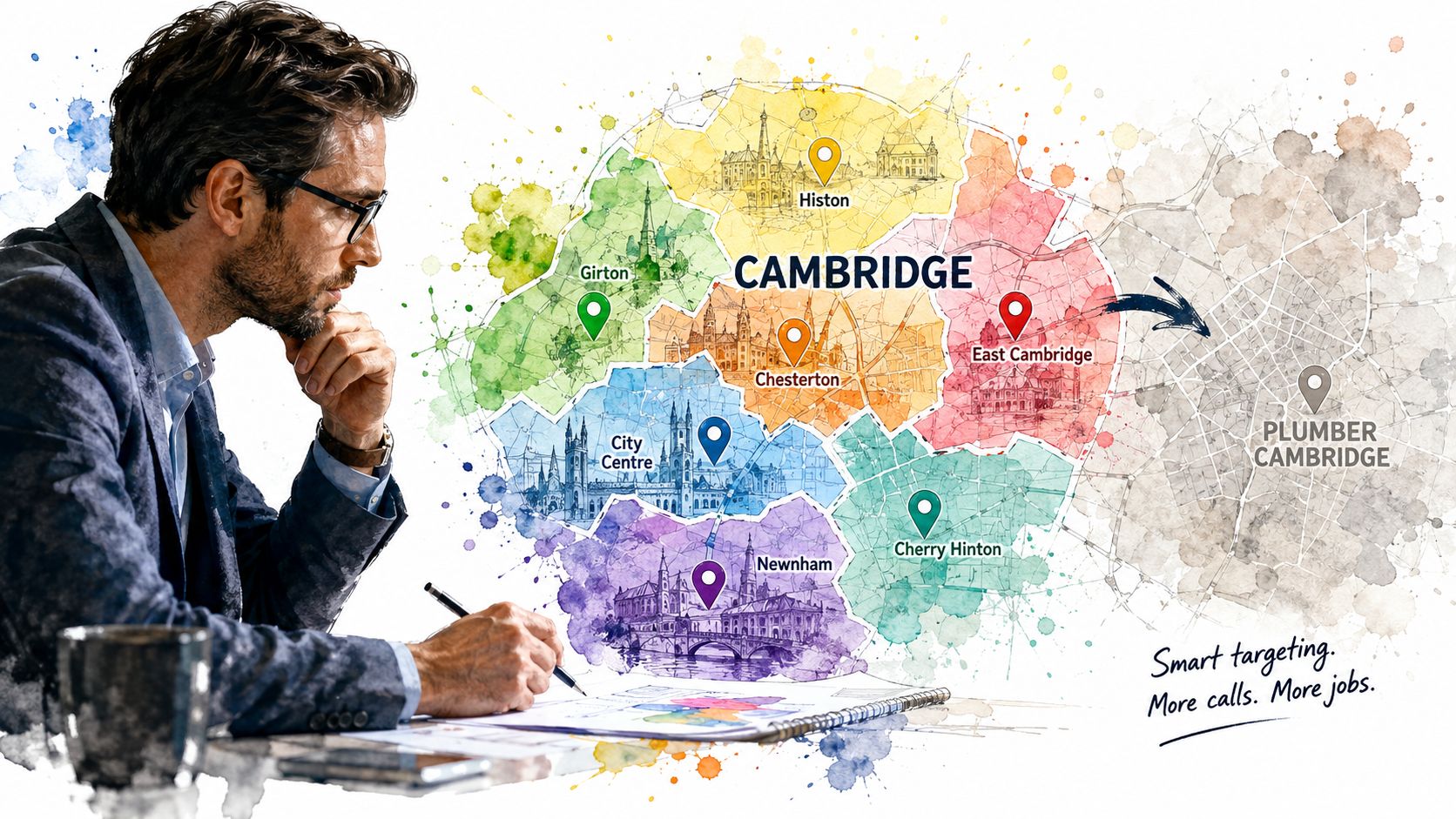
The stronger play in Cambridge is often narrower. Instead of fighting everyone for one broad city term, target the places where buyers reveal intent. That means postcode clusters, neighbourhood language, nearby villages, and service-specific modifiers.
Why postcode targeting beats broad city targeting
A plumber serving CB1 and CB4 doesn't need every searcher in the county. They need the people whose boiler has packed in this morning and who want somebody nearby. That's where hyper-local search terms shine.
For example, hyper-local keywords like “emergency plumber Mill Road Cambridge” outperform generic terms because 70% of local searches include specific location modifiers. That's not a small tweak. It's a different way of thinking about the whole campaign.
A broad term can bring impressions. A postcode-led term often brings calls.
If you serve Cambridge, don't just target Cambridge. Target the bits of Cambridge where your next customer is standing.
This thinking also translates outside the UK. The mechanics of local intent are similar in many cities, which is why Surnex's LA local SEO guide is worth a look. Different city, same lesson. Broad geography is usually a blunt instrument.
What this looks like in the real world
A solicitor in CB1 and a dog groomer in CB5 shouldn't run the same local strategy.
- A solicitor may need pages built around service type plus commercial area intent, such as conveyancing near the station or legal help in central Cambridge.
- A dog groomer may do better with neighbourhood convenience signals, parking details, opening hours, and “near me” relevance around residential pockets.
- A tradesperson often benefits from urgent-intent phrases tied to postcode clusters and service callout areas.
This short video gives a useful overview of local visibility principles before you narrow them down to Cambridge postcodes.
There's also a tactical benefit. Postcode targeting can reduce wasted effort. Instead of one giant page trying to rank for every service, every area, and every variation, you build a more organised set of pages that each answer a clearer search need.
That's often how businesses improve lead quality. Not by chasing more traffic, but by making each page more specific about who it serves and where.
Our Cambridge SEO Packages Unpacked
Most business owners don't want a lecture on metadata over their morning cuppa. They want to know what's included, what stage it suits, and whether the spend is sensible.
That's fair enough. SEO packages should be easy to compare.
The wider UK market gives helpful context. Typical UK SEO services for small businesses often range from £500 to over £1,500 per month, while SEO delivers an average ROI of 825%. That explains why so many firms stick with SEO once it starts compounding. Done properly, it can be one of the most cost-efficient channels available.
Which package suits which business
A sensible package structure follows business maturity.
Foundations
Best for newer firms, smaller service businesses, or companies with a weak local footprint. This should cover the essential groundwork: technical audit, core keyword research, Google Business Profile improvements, on-page fixes, citation cleanup, and a clear reporting baseline.
If your site barely ranks outside your own brand name, that's your starting point.
Authority
This suits businesses that already have some presence but need stronger local trust and broader service visibility. Work here usually expands content depth, internal linking, schema markup, local landing page improvement, and more active off-page support.
This is often the sweet spot for established Cambridge firms that want consistent enquiries rather than sporadic bursts.
Market Leader
This level fits businesses aiming to dominate a local category or expand across multiple service lines and locations. It tends to include a heavier content programme, stronger authority-building, deeper competitor analysis, and constant refinement across technical, on-page, and local signals.
If you're chasing top visibility in a competitive niche, this is the serious option.
DigiVisi SEO Package Comparison
| Feature | Foundations | Authority | Market Leader |
|---|---|---|---|
| Technical audit | Included | Included with deeper refinement | Included with ongoing priority fixes |
| Keyword research | Core service and local terms | Expanded service and intent mapping | Full market and competitor gap analysis |
| Competitor analysis | Basic local review | Detailed reverse-engineering | Deep ongoing competitor tracking |
| Google Business Profile optimisation | Included | Included with stronger local updates | Included as part of full local visibility strategy |
| On-page optimisation | Core pages | Core plus supporting pages | Broad site-wide optimisation |
| Internal linking | Essential improvements | Structured optimisation | Advanced architecture refinement |
| Schema markup | Basic local and service markup | Expanded schema implementation | Advanced markup strategy |
| Citation and NAP-W fixes | Included | Included with monitoring | Included with broader local authority work |
| Content support | Light optimisation | Ongoing content improvements | Monthly content strategy and execution |
| Reporting | Transparent monthly reporting | Transparent monthly reporting | Transparent monthly reporting with broader tracking |
| Best for | Newer or smaller firms | Established local businesses | Firms pursuing dominant local visibility |
One thing matters more than package names. Clarity. You should know what work is being done, why it matters, and how it links to leads rather than vanity charts.
Proof It Works Cambridge SEO Case Studies
Local SEO isn't about admiring a rise in impressions while the phone stays quiet. It's about making it easier for the right Cambridge customer to find you, trust you, and contact you.

Because hard numbers and named client claims aren't something to toss around loosely, it's better to focus on the pattern of what tends to work.
Case study one from hidden to trusted
An independent Cambridge retailer had a common local problem. The shop was known by existing customers, but new customers mostly discovered competitors first. The website had weak local signals, the business details varied slightly across listings, and the Google Business Profile looked neglected.
The fix was not glamorous. Tidy the business information. Improve the profile. Rework core pages so they matched real search intent. Strengthen internal links from informational content to money pages. Make the site clearer about location and what was available in-store.
The result was the kind of change owners care about. Better visibility for nearby searches, more direction requests, and more visits from people who already understood what the shop offered before they walked in.
Case study two better leads, not just more clicks
A Cambridge home service firm had the opposite issue. The website did attract some visitors, but too many were the wrong fit. Broad pages brought broad traffic, and broad traffic often means tyre-kickers, price shoppers, and people outside your service area.
The better move was to narrow the targeting. Service pages were rebuilt around specific needs and service zones. Calls to action became more direct. Supporting content answered practical local questions rather than generic industry fluff.
Better SEO often means fewer irrelevant clicks and more relevant conversations.
That shift usually improves enquiry quality because the website starts pre-qualifying people. Someone landing on a page about the exact service they need in the exact area they're in is far more useful than a casual browser poking about.
What these examples have in common
Both stories follow the same practical logic:
- They fixed trust problems first: Messy local signals were cleaned up.
- They matched pages to intent: Each important page had a clear job.
- They stopped trying to rank one page for everything: Specific pages served specific searches.
- They improved user experience: Clearer information led to better enquiries.
That's the bit many firms miss. Effective SEO in Cambridge UK isn't one silver bullet. It's a disciplined stack of improvements that make Google more confident and customers less hesitant.
Your Questions about SEO in Cambridge Answered
Most cautious business owners ask sensible questions. They should. SEO can be excellent value, but only if the basics are handled properly and expectations stay grounded.
How long does SEO take
Some improvements can help quite quickly, especially local fixes around pages, profiles, and citations. Broader authority growth usually takes longer. The pace depends on your starting point, your competition, and whether the site has technical baggage dragging it down.
If a Cambridge business has serious performance issues, sort those early. Failing Core Web Vitals can cause a 19–24% drop in local organic traffic, and only 54.6% of UK sites currently pass all three metrics. Technical work may not be exciting, but it can produce the fastest ranking lift.
Do I need a new website first
Not always. Plenty of dated websites can be improved without rebuilding from scratch. What matters is whether the site can be crawled properly, loads well on mobile, and supports clear service pages with strong local relevance.
A full rebuild makes sense when the existing site is fighting you at every turn. If the bones are decent, careful optimisation is often the more sensible route.
Do I need a contract
You shouldn't need to be trapped in one to get competent work. Local SEO works best when the service is transparent enough that a business owner can see progress and decide to continue on merit.
That's healthier for everyone. If the work is solid, clients usually stay because they want to, not because they're handcuffed to the radiator.
Will this work for a niche service business
Usually, yes. Niche businesses often benefit more from local SEO because specificity helps them. A specialist surveyor, family solicitor, roofing contractor, or private tutor doesn't need every click in Cambridge. They need the right click from the right part of Cambridge.
That's why postcode-level targeting is so useful. It narrows the field and raises intent.
If your business isn't getting found in the places you serve, it's worth having someone assess the technical setup, local signals, and page targeting properly. A focused audit often reveals what's holding visibility back, and the fixes are usually more practical than people expect.
If you'd like a clear, no-obligation view of where your local visibility stands, DigiVisi Ltd can review your current setup and highlight the gaps affecting rankings, calls, and enquiries. It's a straightforward way to see what needs fixing, what can wait, and where a postcode-led Cambridge SEO strategy can make the biggest difference.