Skip to content

Your phone isn't ringing as often as it should. You know the work's solid, your van's out most days, and customers are happy once you're through the door. But when someone in your area types “emergency plumber near me”, another firm gets the call, and you're left staring at a quiet diary and a lukewarm tea.
That's where local SEO for plumbers stops being marketing waffle and starts being practical business. For a UK plumbing company, this isn't about chasing vanity rankings or stuffing your website with guff. It's about showing up in the places real homeowners check, building trust fast, and making it dead easy for someone with a leaking pipe to ring you before they ring anyone else.
Table of Contents
- Your Digital Shopfront Mastering Google Business Profile
- Build Unshakeable Trust with Reviews and Citations
- Architect Your Website to Turn Clicks into Calls
- Outrank Competitors with Local Links and Advanced SEO
- Your Simple Monthly SEO Workflow for Plumbers
Your Digital Shopfront Mastering Google Business Profile
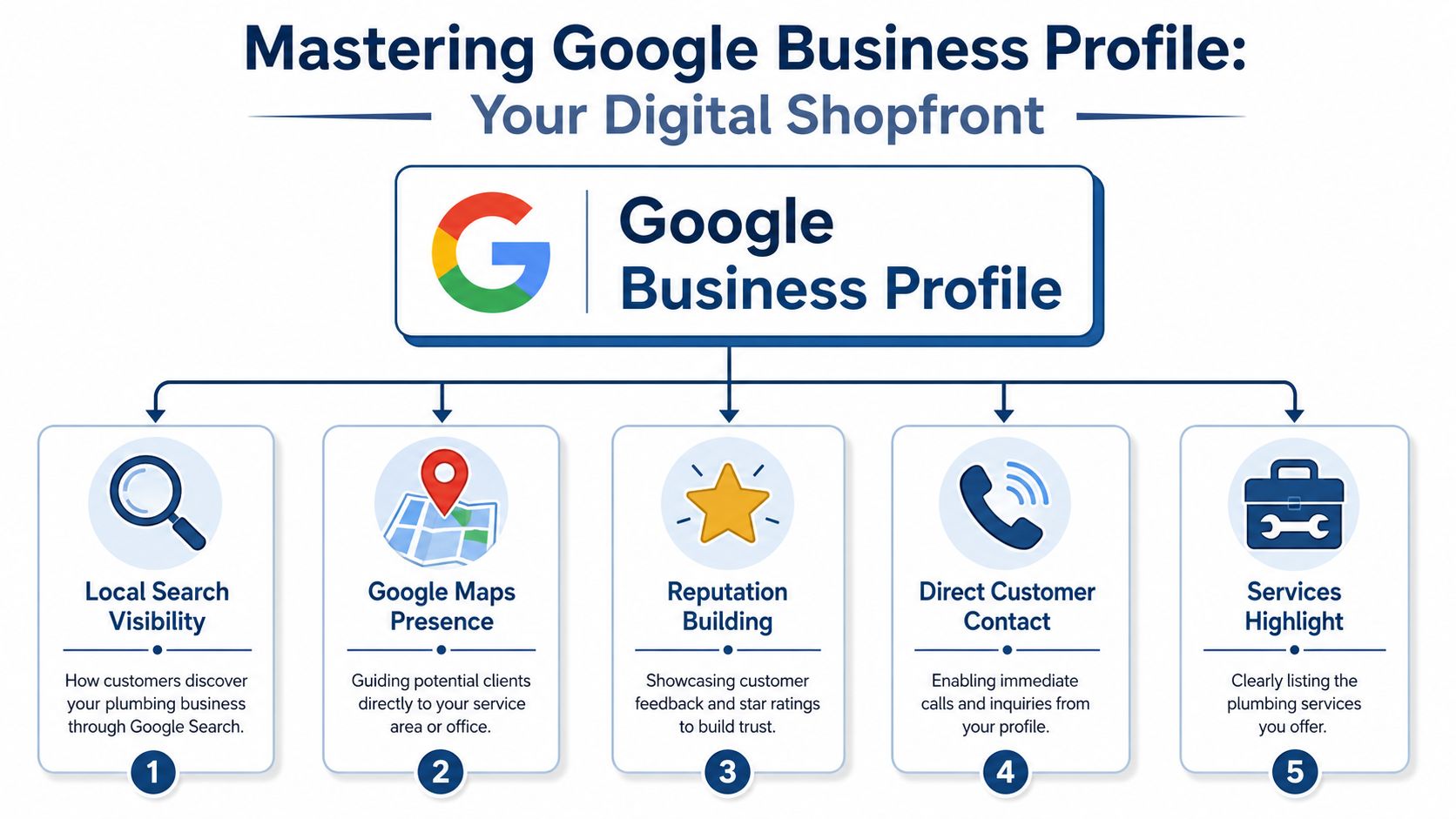
If you fix one thing this month, fix your Google Business Profile. For most plumbing firms, that profile is the modern version of the high street window. It's where people check your hours, scan your reviews, look at your photos, and decide whether to call you or the bloke down the road.
Get the core fields right first
Start with the details that have to be bang on. Your business name, phone number, website, opening hours, and business category need to be accurate and consistent with the rest of your web presence. If your profile says one thing and your website says another, Google starts squinting at you like a customer who's just found an “extra parts charge” on the invoice.
One field gets missed all the time by plumbers: service area. UK plumbers must set their GBP service area to every postcode and town they cover, not just their registered address, to ensure they appear in local results for all served regions, as noted by Klarai's guidance for plumbing SEO. If you cover Reading, Wokingham, Bracknell and nearby postcodes, put them in properly. Don't assume Google will work it out for you.
Practical rule: If you'll happily drive there for a booked job, it should be listed in your service area.
Fill it in like a real business, not a spam listing
A strong profile feels complete. Add your services individually. Upload real photos of your van, your team, your tools, and finished work. A picture of a clean cylinder install in a proper British airing cupboard does more for trust than a stock image of a smiling American tradesman holding a wrench the size of a cricket bat.
Use the business description to explain what you do in plain English. Emergency call-outs, boiler-related plumbing, leaks, blocked drains, bathroom plumbing, landlord work. Keep it specific and honest.
A tidy approach looks like this:
- Primary category: Use the category that best matches your main trade.
- Services list: Add every service you offer.
- Hours: Show real availability, especially if you handle urgent work.
- Photos: Use your own jobs, vehicles, team, and premises if you have them.
- Updates: Post occasional job updates, seasonal tips, or service reminders to show the profile is alive.
If you're a service-area business and don't want customers rocking up to your unit expecting a reception desk and biscuits, set the profile up properly for that model.
What to avoid if you fancy staying out of trouble
Some plumbers get tempted by grey hat or black hat shortcuts. The usual suspect is stuffing keywords into the business name. “Dave's Plumbing Emergency Boiler Leak Specialist Manchester” might look clever for a week. It also looks fake as anything, and it can get edited, suspended, or reported.
White hat local SEO for plumbers is straightforward. Be accurate, complete, active, and consistent.
Grey hat sits in the murky middle. You might get away with pushing category relevance too hard or over-optimising service descriptions, but it's rarely worth the aggro.
Black hat is the daft stuff. Fake listings, fake addresses, fake reviews, keyword-stuffed names. That route often ends the same way: fewer leads, more headaches, and a support thread you wish you'd never had to write.
A proper Google Business Profile should look like a well-run plumbing firm, not a market stall shouting at passers-by.
Build Unshakeable Trust with Reviews and Citations
A polished profile gets you noticed. Reviews and citations get you chosen.
Many plumbers often stumble here. They do decent work, customers are pleased, then nobody asks for a review until six months later when the customer can barely remember who fixed the stopcock. That's like finishing a lovely bathroom refit and forgetting to fit the taps.
Reviews are not a nice extra
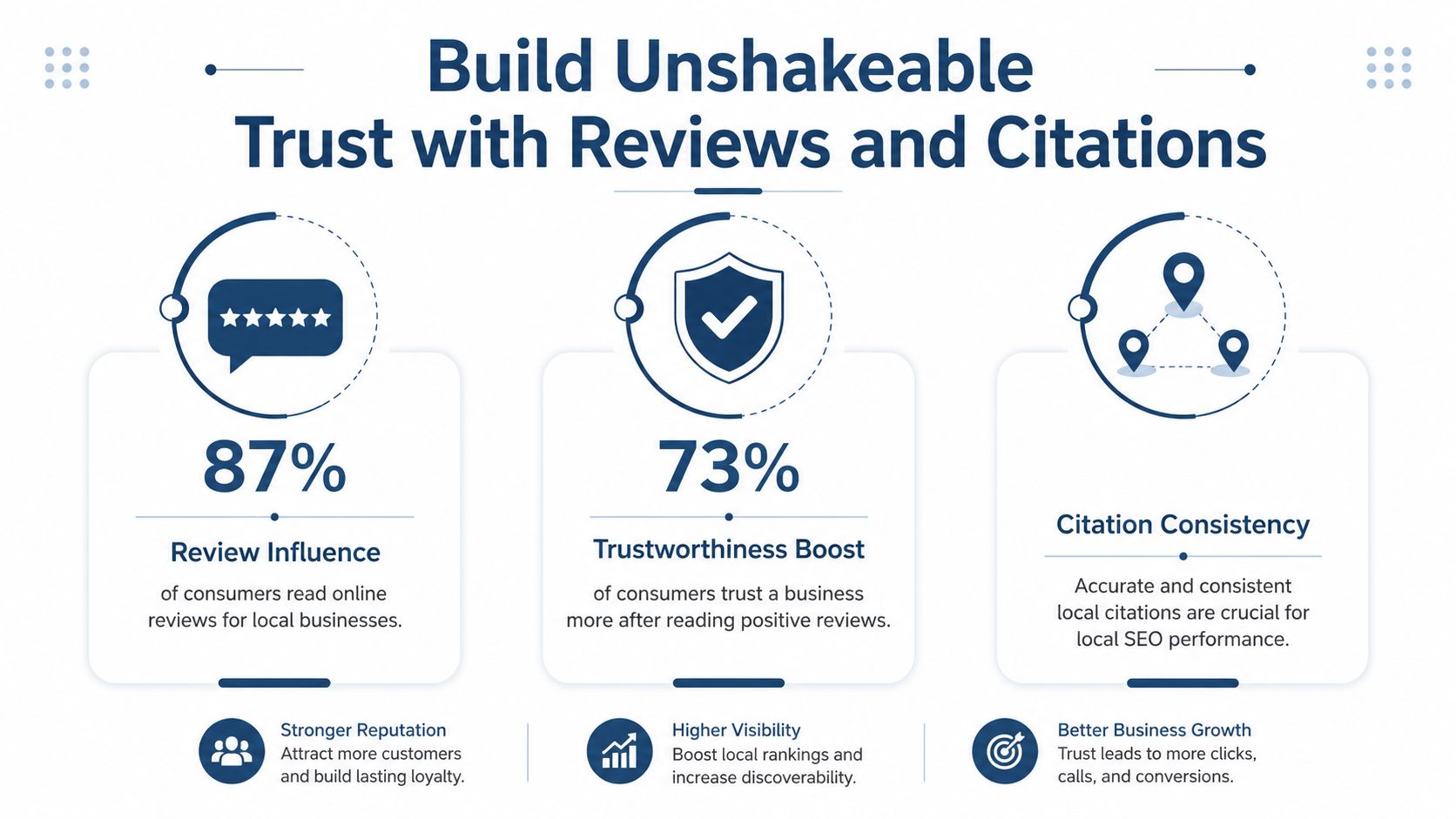
For UK plumbers, review volume is one of the clearest trust signals in local search. In city markets like London or Manchester, top-three placement in the Google Maps Local 3-pack requires a minimum of 100 verified Google reviews, while 20+ reviews is the point where nearly half of potential customers start seeing a business as viable, according to this UK plumbing SEO guide from SEODons.
That gives you a sensible way to think about targets:
- Smaller towns: Get to 20+ reviews first so you're not invisible.
- Larger towns: Push towards 50+ reviews if you want to compete properly.
- Big cities: Expect the serious players to be chasing 100 verified reviews.
This isn't about vanity. A homeowner comparing two plumbers will often pick the one with a stronger review profile before they've even visited the website.
A simple example. If you're a plumber in Swindon with 11 reviews and a rival has 43, you might still do better work. Online, though, the rival looks safer. Searchers don't know your soldering from your shoe size. They go by signals.
Later on, if you want a broader grounding in the fundamentals, this guide to small business local SEO is worth a look.
The easiest review process is a text sent fast
The best review tactic is gloriously unglamorous. Send a direct review link by text within hours of finishing the job. Not next week. Not when you remember on Friday night. While the relief is fresh and the customer still thinks you're a hero for stopping the kitchen from turning into a paddling pool.
Use wording like this:
“Thanks again for having us out today. If you've got a minute, would you mind leaving us a quick Google review? It really helps local customers find us.”
Keep it short. No begging. No essay. No weird incentives.
Google also likes signs of active management. Responding to every review within 48 hours, both positive and negative, is flagged as best practice in this plumbing SEO advice. Reply like a grown-up. Thank happy customers properly. Deal with grumpy ones calmly. Future customers read those replies.
A useful explainer sits below if you want a visual walkthrough.
Citations are your online paper trail
A citation is any listing of your business details on platforms and directories. For UK plumbers, the priority list includes Checkatrade, Rated People, TrustATrader, Yell, Thomson Local, Yelp UK, and the Gas Safe Register if you're certified, based on Klarai's UK-focused citation guidance. The critical bit is that your NAP. Name, address, phone. Must match exactly.
Tiny inconsistencies matter. “Road” on one listing and “Rd” on another. Missing postcode. Old mobile number on a forgotten directory. Those little mismatches can muddy your local visibility.
Here's the practical approach:
- Create a master version: Write down your official business name, address, postcode, and main phone number.
- Fix the main directories first: Start with the UK trade and local directories that matter.
- Match your website footer: Use the exact same details on your site.
- Check old listings: If you moved unit or changed numbers, clean up the mess.
Think of citations as proof you're a real local business with a real footprint. If those records line up neatly, Google trusts you more. If they're all over the shop, you look less established than you really are.
Architect Your Website to Turn Clicks into Calls
Your website has one job. Turn local intent into enquiries.
Too many plumbing sites look fine at a glance but are built like a shed held together with hope. One “Services” page. One “Areas We Cover” page. A bit of generic blurb. Then the owner wonders why a rival with a less flashy website keeps outranking them for “emergency plumber in Basingstoke”.

One service, one town, one page
The cleanest structure for local SEO for plumbers is this: one service, one town, one page.
If you offer emergency plumbing, leak detection, boiler-related plumbing, and blocked drain work across several areas, each main combination deserves its own page. Picture your van: You wouldn't chuck every tool into one giant box and hope for the best. You organise the gear so the right tool is ready for the right job.
A solid setup might include pages such as:
- Emergency plumber in Reading
- Blocked drains in Newbury
- Leak repair in Wokingham
- Bathroom plumber in Bracknell
That structure gives Google a clear answer to specific searches. It also gives the customer a page that feels relevant to what they need right now.
Write pages that sound like the area, not a template
Most sites fall flat. They swap the town name, leave everything else the same, and call it local content. Google's seen that trick more times than a landlord has asked for “just a quick look” at a combi.
Plumbers who address local infrastructure pain points in service area pages with 500 to 800 words of unique, locally relevant content significantly outperform competitors using templated pages, according to The Marketing Juice. That means the page should mention things that are relevant to the area.
Examples work well:
- In older London suburbs, talk about clay pipes and the issues they can cause.
- In the South West, mention hard water and the maintenance headaches it creates.
- In rural areas, mention tree root intrusion where it's a local issue.
If you've had repeat call-outs for scaled-up systems in a hard water zone, say so. If Victorian terraces in one patch often have awkward old pipe runs, say so. That sort of detail makes the page useful, believable, and better aligned to local search.
Local content wins when it sounds like a plumber who knows the area, not a copywriter who's never left the office.
Make the site easy to use on a stressed customer's phone
Plumbing searches often happen in a flap. Someone's under the sink with a towel, not sitting comfortably with a notebook and a fresh latte. Your page needs to get to the point quickly.
A good service page should include:
- A clear headline with the service and location.
- An opening paragraph that says exactly what you do in that area.
- A short list of problems you solve, such as leaks, low pressure, blocked wastes, faulty valves.
- Trust cues, including reviews, certifications, and real photos.
- A clear call to action with tap-to-call prominence on mobile.
Don't bury the phone number. Don't make people hunt for the contact form. Don't lead with a life story about how your grandad once fixed a tap in 1987.
Operationally, your website should also reflect how the business runs. If jobs are dispatched by software, your page experience should match that organised feel. If you're comparing systems or trying to tighten your admin so leads don't slip through the cracks, it helps to understand plumber software features before you redesign your booking and enquiry flow.
A tidy website doesn't just rank better. It wastes fewer leads.
Outrank Competitors with Local Links and Advanced SEO
Once your profile, reviews, citations, and service pages are sorted, the next gains usually come from links and technical authority. This is the stage where average local plumbing sites run out of steam and better-built ones pull ahead.
Links still move the organic results
In the UK local organic ranking model for plumbers, link signals account for approximately 25% of the total ranking weight, making them the largest controllable lever for outranking competitors in service-area organic searches, according to Link Building Journal UK.
That matters most for the non-map results. Google Business Profile drives a lot of map visibility, but your organic rankings lean heavily on the authority of your domain and the pages you want to rank.
If you want “emergency plumber in Maidenhead” or “boiler repair plumbing in Slough” pages to climb, good local links help.
The links worth chasing
Forget nonsense from dodgy link sellers promising hundreds of backlinks for the price of a takeaway. That's black hat territory, and the links are often as useful as a chocolate spanner.
The links that make sense for a UK plumber are usually local, relevant, and earned through real-world activity:
- Community sponsorships: A local football club, charity event, school fundraiser, or village fete website.
- Local press mentions: A proper news piece about community work, seasonal advice, or a notable local job.
- Trade memberships and certifications: Legit listings where your business details and website appear.
- Supplier and partner mentions: If you work regularly with local merchants or adjacent trades, relevant mentions can help.
Grey hat link building often looks like over-engineered guest posting on random sites nobody reads. It can work for a bit, but it's rarely stable. White hat is slower, but it ages well.
Get links from websites a real customer in your patch might actually visit. That's usually the right test.
Schema and technical polish
Then there's the nerdy bit, which does matter. Schema markup helps search engines understand what your business is, where you operate, and which services belong to which pages. Think of it as labelling the shelves in your stock room so nobody has to guess where the fittings are.
At a minimum, your site should clearly signal:
- Business identity: Name, contact details, and core service type.
- Service relationships: Which page covers which plumbing service.
- Local relevance: Towns and service areas tied to the right pages.
- Trust information: Reviews and business details where appropriate.
Technical SEO isn't a magic trick. It's the polish that supports everything else. Faster pages, clean internal links, proper mobile usability, and structured data won't rescue a weak site on their own. But paired with strong local pages and earned authority, they help turn you from “one of several plumbers” into the established choice.
Your Simple Monthly SEO Workflow for Plumbers
Most plumbers don't need a grand marketing strategy pinned to the office wall with coloured arrows and corporate nonsense. They need a repeatable routine that keeps local visibility moving in the right direction.
Treat local SEO for plumbers like an MOT for your online presence. A little attention every week stops bigger problems building up later.
Week by week keeps it manageable
The easiest way to stay consistent is to split the work into short weekly tasks. You're not trying to become a full-time marketer between call-outs. You're keeping the machine well-oiled.
One week might be profile upkeep. Another might be review chasing. Another might be checking website pages or local listings. Do that steadily and you'll stay sharper than firms that only touch SEO when work goes quiet.
Responding to every review within 48 hours is a mandatory best practice for UK plumbers because it helps maintain GBP activity signals, which Google uses to assess business relevance and freshness, as explained in this review management guidance.
A Plumber's Monthly SEO MOT
| Week | Task (Est. 30-45 mins) | Why It Matters |
|---|---|---|
| Week 1 | Check your Google Business Profile. Confirm hours, services, photos, and service areas are still accurate. | Keeps your main local asset current and trustworthy. |
| Week 2 | Ask recent happy customers for reviews by text, then reply to every new review. | Builds trust and keeps customer engagement active. |
| Week 3 | Review one service page and improve local detail, wording, or calls to action. | Stops your site going stale and makes pages more useful. |
| Week 4 | Audit key citations on major UK directories and correct any NAP inconsistencies. | Protects local trust signals and reduces confusion. |
What good consistency looks like
A simple monthly rhythm works best when it's tied to real business habits.
Try this:
- After each completed job: Send the review text while the customer still remembers your name and not just the flood.
- Once a week: Check for new reviews, questions, or profile edits.
- Once a month: Improve one page on the site rather than trying to rewrite the whole thing.
- Every quarter: Look for local link opportunities through real community involvement or local trade connections.
Keep a basic spreadsheet if you need to. Nothing fancy. Date review requests, note which pages were updated, list which directories were checked. Boring, yes. Effective, also yes.
One more thing. Don't chop and change direction every month because some bloke on YouTube said citations are dead, blogs are dead, websites are dead, or Google is dead. Local SEO rewards businesses that stay accurate, useful, and active. The fundamentals still work.
A well-run plumbing business usually wins local SEO the same way it wins repeat work. Good systems, tidy follow-through, and no cowboy behaviour.
If you'd rather have an expert sort the lot properly, DigiVisi Ltd helps UK service businesses improve Google Business Profile visibility, local rankings, service page performance, and lead flow without locking you into contracts. If your plumbing firm needs more calls from the areas you want to serve, they're worth a proper look.