Skip to content

98% of roofing website content generates zero traffic according to Roofing Webmasters' roofing marketing statistics. That number changes the conversation straight away. The problem usually isn't that roofing is too competitive, or that Google has it in for trades. It's that most roofing websites are built like brochures when they need to work like sales tools.
A roofer in Leeds, Newport or Aberdeen can have solid workmanship, tidy vans, decent reviews from happy customers, and still get next to nothing from search. Why? Because the website says vague things like “quality roofing services” instead of targeting what people type when water's coming through the bedroom ceiling. Google can't guess what you mean. Neither can a stressed homeowner.
Good roofing company SEO in the UK isn't about clever slogans or stuffing “best roofer near me” into every paragraph like a teenager hiding crisps under the bed. It's about matching real search demand, proving local relevance, and making it painfully easy for Google and customers to trust you.
Table of Contents
- Why Your Roofing Website Is Not Getting Calls
- The Unbeatable Foundation Google Business Profile and Local Citations
- Your Digital Showroom Perfecting On-Page SEO
- The Technical MOT Making Your Site Fast and Findable
- Become a Local Legend Content Links and Reviews
- Your Monthly SEO Roadmap KPIs and Packages Made Simple
Why Your Roofing Website Is Not Getting Calls
A roofing website can look tidy, load fine, and still bring in next to no enquiries. That catches a lot of firms out. Owners blame the design, the logo, or the agency that built it. More often, the problem is simpler. The site does not line up with how people in your patch search when they need a roofer.
In the UK, that usually means urgent, local, and specific. After heavy rain, high winds, or a named storm on the Met Office forecast, people do not search for “quality roofing solutions”. They search for “emergency roofer Newport”, “flat roof leak Leeds”, or “slipped slate repair near me”. If your website talks in brochure language while the customer wants a fast answer and a phone number, you lose the call before the page has done its job.
The nice website trap
Plenty of roofing websites are built to please the owner rather than win the enquiry. Big banner. Stock photo. A slab of copy about craftsmanship and excellence. Looks respectable enough. Does very little.
The weak spots are usually these:
- Keyword guesswork. The page says “roofing solutions” while searchers type “flat roof repair Nottingham” or “roof leak repair Derby”.
- No service depth. One page tries to cover repairs, new roofs, flat roofs, gutters, fascias, soffits, chimney work, and emergency callouts all in one go.
- No proper local signals. You work across several towns, but the site barely mentions them beyond a postcode in the footer.
- Poor intent match. Someone with storm damage wants reassurance, proof, and a number to ring. They do not want your life story from 1998.
A roofing site does not need to win awards. It needs to answer three things fast. What you do, where you do it, and why you are safe to ring.
What gets calls
A roofer in Cardiff will usually get more leads from a strong page for “Emergency Roof Repair Cardiff” than from three vague blog posts about roofing materials. Same story in Wakefield, Croydon, or Swansea. Service pages and location relevance beat waffle every time.
Local proof matters as well. Real local trust often comes from visual proof. Photos of work in recognisable places, a van outside a job, a mention of a nearby estate, school, or landmark. That sort of detail helps both the customer and Google believe you are active in the area. It is far more convincing than generic copy claiming you cover “all surrounding areas”.
I see the same mistake again and again. Roofers build one homepage and expect it to rank for every service in every town they cover. It rarely happens. A better setup is a clear service page for each money job, then location relevance added where it is honest and useful. If you want the wider picture, this guide to local SEO for small businesses in the UK covers the fundamentals well.
There is also the matter of how the SEO is done. Clean, sensible work lasts. Useful pages, proper structure, honest service areas, real reviews, and consistent business details are the safe route. Murkier tactics can give a short bump, but fake locations, spun pages, and dodgy links tend to end the same way. Fine for a month, then gone when Google sobers up.
A practical reset
If the phone is quiet, run through these four checks:
- Does each main service have its own page with plain English copy and a clear call to action?
- Does the site show where you work with real references to towns, districts, and job areas you serve?
- Does each page match the searcher's immediate need rather than forcing them through generic marketing fluff?
- Does the website prove you are a real local firm with job photos, reviews, contact details, and signs of life beyond a contact form?
If one or two of those are missing, the problem is not mysterious. The website has not been built around how roofing customers in the UK choose who to call. That is fixable, and it is usually a lot less glamorous than a redesign. Which, to be fair, is good news for your wallet.
The Unbeatable Foundation Google Business Profile and Local Citations
Nearly every roofer I speak to wants more calls from Google, but plenty are still treating their Google Business Profile like a box-ticking exercise. That is a mistake. For local roofing searches in the UK, your profile often gets judged before your website even earns a click.
A homeowner with water coming through the ceiling is not settling in for a lovely afternoon of research. They are scanning the Map Pack, checking reviews, looking at photos, and deciding whether your firm looks real, nearby, and capable. If your profile is half-finished, full of old details, or thin on proof, you lose the lead before your homepage gets a look in.
A visual makes this clearer:
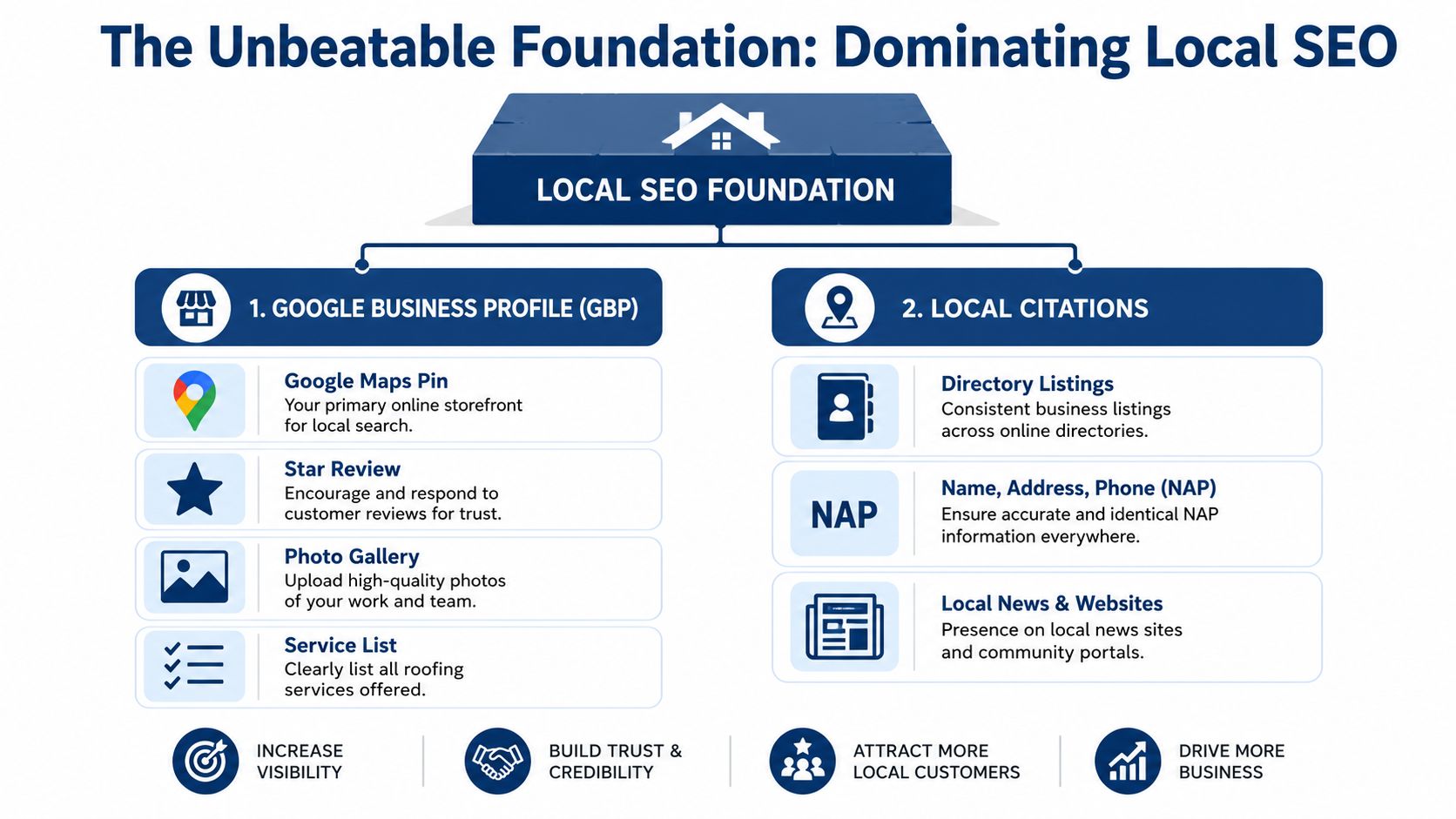
Get the profile right first
Set up your Google Business Profile as if it is your main sales page, because for plenty of local searches, it is.
Use your real trading name. Use a real local phone number that stays consistent across the web. Choose the right primary category, then add relevant secondary services such as roofer, gutter cleaning service, or roofing contractor only if they reflect what you sell. Do not stuff in every trade from plastering to patio laying because Google is not impressed, and neither is a customer trying to work out what you really do.
Photos do more work than many roofers realise. Upload before-and-after shots, close-ups of workmanship, vans with branding, scaffold setups, and team photos on site. UK buyers are sceptical for good reason. They have seen enough stock imagery and borrowed job photos to last a lifetime. Real proof from real jobs wins.
A few details matter more than owners expect:
- Business details. Keep your name, address and phone number identical everywhere they appear.
- Service areas. List the towns and districts you genuinely cover, without pretending you have an office in every postcode.
- Services. Add the jobs that make you money, such as pitched roof repairs, flat roofing, chimney work, lead flashing, fascias and soffits.
- Photos and updates. Show recent activity so the profile does not look abandoned.
- Reviews. Ask after completed jobs and reply properly, like a tradesman who wants the next booking.
For a broader overview of how this fits into a UK local SEO strategy for small businesses, that guide is a solid reference.
Citations still matter, but only the ones people trust
Local citations are mentions of your business details on other sites. They still help, but the job is not to scatter your name across fifty low-grade directories that look as though they were built between episodes of The Bill.
In the UK roofing market, the useful platforms are the ones customers already recognise. Checkatrade matters. TrustATrader can help. Yell is still worth having right. Facebook business details often get checked. If you bid for commercial or public-sector work, even places like Bidwell for web design tenders can sit in the wider digital footprint buyers use to verify a company exists and is active online.
Consistency is the whole point. If your business appears as "J Smith Roofing Ltd" on Google, "John Smith Roofing" on Checkatrade, and "Smith Roofing Emergency Team" on Yell, you are making Google work harder to join the dots. It usually can. It just trusts you a bit less.
One common own goal is call tracking. Use it carefully. A tracking number on landing pages is fine if it is implemented properly, but your core business number should stay steady on your Google Business Profile and major directory listings. Changing that number all over the place creates a mess, and cleaning it up later is dull, expensive work.
Use UK-specific proof, not generic local fluff
Roofing SEO in Britain has a few quirks. Weather is one of them.
When the Met Office issues heavy rain, high wind, or storm warnings, search demand for emergency roof repairs often jumps in the affected areas. Your profile needs to be ready before that happens. Keep opening hours accurate, make sure your phone is answered, and have fresh photos and recent reviews already in place. Scrambling to sort your profile after the first leak calls start coming in is like fixing flashing after the loft is soaked.
Local proof also needs to be specific. Saying you cover Manchester is fine. Saying you recently repaired storm damage near Heaton Park, replaced slipped slates on a terrace in Chorlton, or sorted a flat roof issue off Wilmslow Road is better. Landmarks, districts, and recognisable places help customers trust that you work there. They also help Google connect your business to the areas you want to rank in.
A short video helps if you want the moving-parts version:
Your local citation checklist
| Task | What good looks like |
|---|---|
| Google Business Profile | Fully claimed, verified, complete, and active |
| NAP consistency | Same business details on every listing |
| Review process | Ongoing requests and replies |
| UK trade directories | Present on relevant platforms homeowners trust |
| Local area relevance | Services and coverage clearly shown |
Get this foundation sorted before spending money on blog posts, clever campaigns, or a shiny redesign. Plenty of roofing SEO problems are just profile problems wearing a fake moustache.
Your Digital Showroom Perfecting On-Page SEO
A good service page should feel like a roofer turned up, looked at the problem properly, and explained the fix in plain English. Most pages don't. They feel like they were written by a committee trapped in a stationery cupboard.
Google's E-E-A-T expectations are met more effectively when a roofing company includes a few hundred words of unique quality content per service and dedicated location pages for each town served, as described in Scorpion's guide to SEO for roofing companies. That means separate, useful pages. Not one mega-page trying to do the lot.
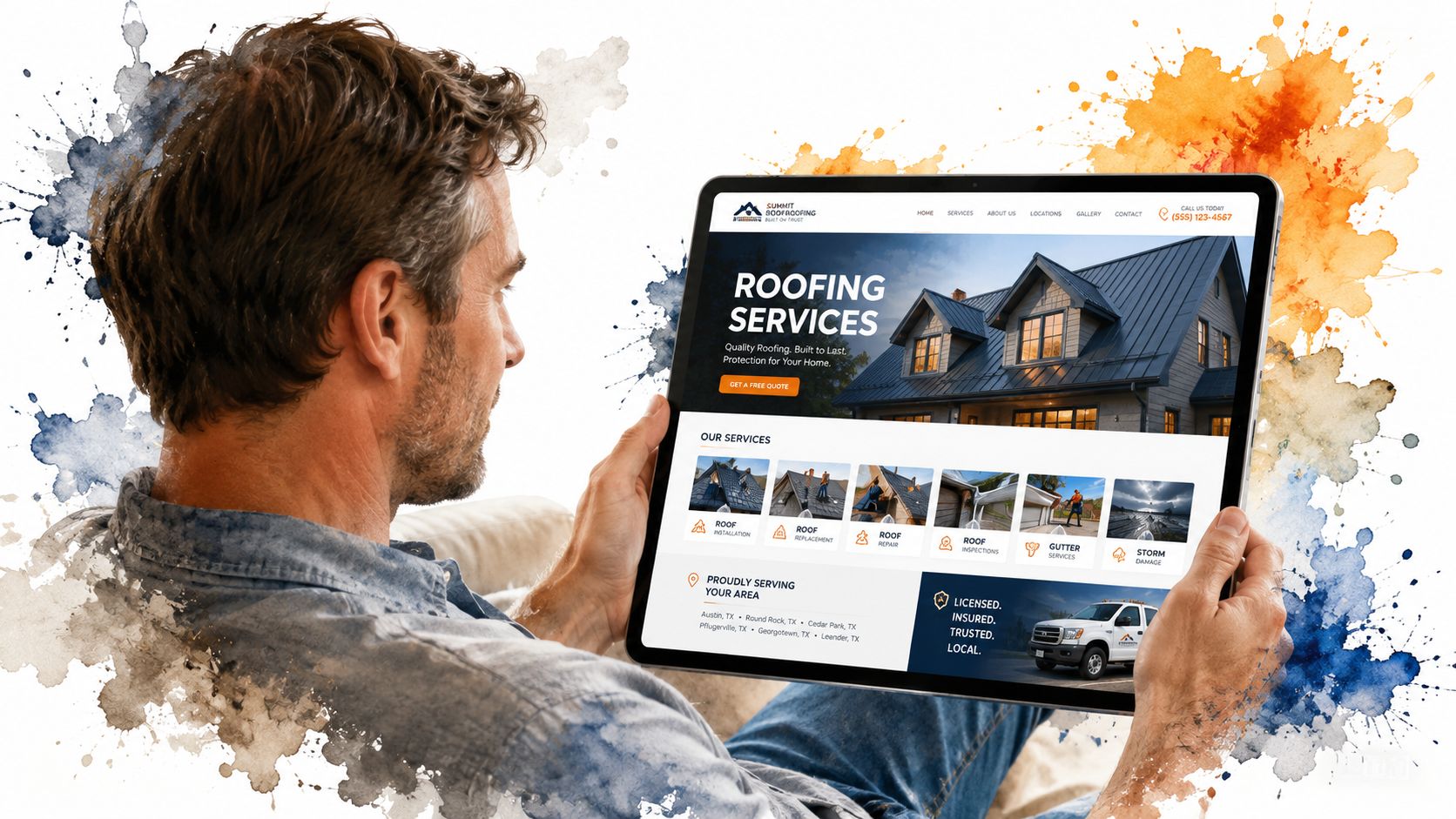
What a strong page looks like
Take an example. You want a page for Emergency Roof Repair Bristol.
The H1 should plainly say that. Not “Protecting What Matters Most”. Save that for the side of the van if you must.
The opening paragraph should say what you do and where you do it. Something like: if your roof is leaking in Bristol, you handle emergency repairs for slipped tiles, storm damage, flat roof leaks and urgent call-outs across the area. Clear. Direct. No poetry.
Then the page should answer the questions a homeowner has in order:
- What counts as an emergency
- What problems you fix
- Which parts of Bristol you cover
- What happens when they call
- How fast they can expect a response
- Why they should trust your team
Show your work properly
UK roofing company SEO presents an interesting dynamic. Generic advice bangs on about content volume. Real local trust often comes from visual proof.
If you repaired a slate roof near Clifton, say so. If you replaced a flat roof on a garage in Bedminster, show before-and-after photos. Mention local landmarks naturally where relevant. “Near Ashton Gate” or “close to Bristol Temple Meads” helps make the job feel real. Because it is real.
Real photos of finished jobs beat stock images every time. Customers can tell. Google can usually tell as well.
Use image alt text that accurately describes the job. Keep captions useful. Don't upload fifteen identical roofline shots and call it strategy.
Good page structure beats clever copy
A useful service page doesn't need to sound fancy. It needs to guide someone from worry to action.
A simple structure works well:
- Direct headline
- Clear opening paragraph
- Service details in short sections
- Local proof and photos
- FAQs
- Obvious call to action
If you're reworking the site itself and need to understand how buyers compare suppliers for web projects, Bidwell for web design tenders is a handy example of how website procurement gets framed from the buyer side. It's useful context when you want pages that aren't just pretty, but commercially sensible.
A roofer in Merthyr Tydfil shouldn't rely on one generic “areas we cover” page and hope for the best. Build the proper town page. Build the proper service page. Join them together with internal links. Then the site starts behaving like a digital showroom instead of a neglected leaflet rack.
The Technical MOT Making Your Site Fast and Findable
Technical SEO sounds scarier than it is. For most roofing firms, it's an MOT. Your site either passes the essentials or it limps along coughing smoke into the rankings.
A practical benchmark from ALM Corp's roofing SEO guide is to get Largest Contentful Paint under 2.5 seconds. The same source says LocalBusiness and Service schema can increase AI Overviews citation rates by 35% for UK home service businesses. Those are useful targets because they connect technical work to actual visibility, not developer vanity.
Speed first
If your homepage takes ages to load because it's packed with giant images, sliders, animations and enough scripts to launch a small moon mission, people will leave.
For a roofer, a pass usually looks like this:
- Fast loading key pages. Your homepage, service pages and contact page open quickly on mobile.
- Compressed images. Roof photos don't need to be the size of a billboard.
- Lean design. Fewer gimmicks, more clarity.
A fail looks like a spinning loader, text jumping about, and buttons that appear after the customer has already gone to a competitor.
Mobile is where the real test happens
A lot of local roofing searches happen on a phone. Usually when someone's standing in the rain, mildly furious, and not in the mood for tiny text or broken forms.
Check three things on your own mobile:
| Check | Pass | Fail |
|---|---|---|
| Phone number | Tap-to-call works | Number is just text |
| Contact form | Easy to fill in | Fields are fiddly or broken |
| Page layout | Clean and readable | Text overlaps or buttons vanish |
If your mobile site is annoying, the customer won't write a thoughtful complaint. They'll tap back and call someone else.
Schema is the quiet helper
Schema is code that helps Google understand your business more clearly. For roofers, the useful bits are usually LocalBusiness, Service, and FAQPage.
That means you can spell out:
- who you are
- where you operate
- which services each page covers
- common questions and concise answers
It's not magic. It won't rescue a poor site. But it does remove confusion, and confusion is poison in SEO.
Keep your FAQ answers short and plain. The goal is clarity, not sounding like a solicitor charging by the paragraph.
If a roofing company in Norwich has a solid emergency roof repair page, clean mobile layout, quick load times, and clear schema, Google has far less guesswork to do. That's the whole point of technical SEO. Make things obvious. Make them fast. Make them easy to crawl.
Become a Local Legend Content Links and Reviews
Roofing company SEO starts to compound when three things work together. Content brings in searches. Links strengthen local authority. Reviews help convert trust into calls. Most firms treat them as separate jobs. They work better as one system.
The content cadence matters. UK roofing SEO demands a minimum of two articles per month targeting informational and commercial keywords, with each article answering a real customer question and linking to service pages, according to UK Roofing Leads' website SEO guide for roofing companies.
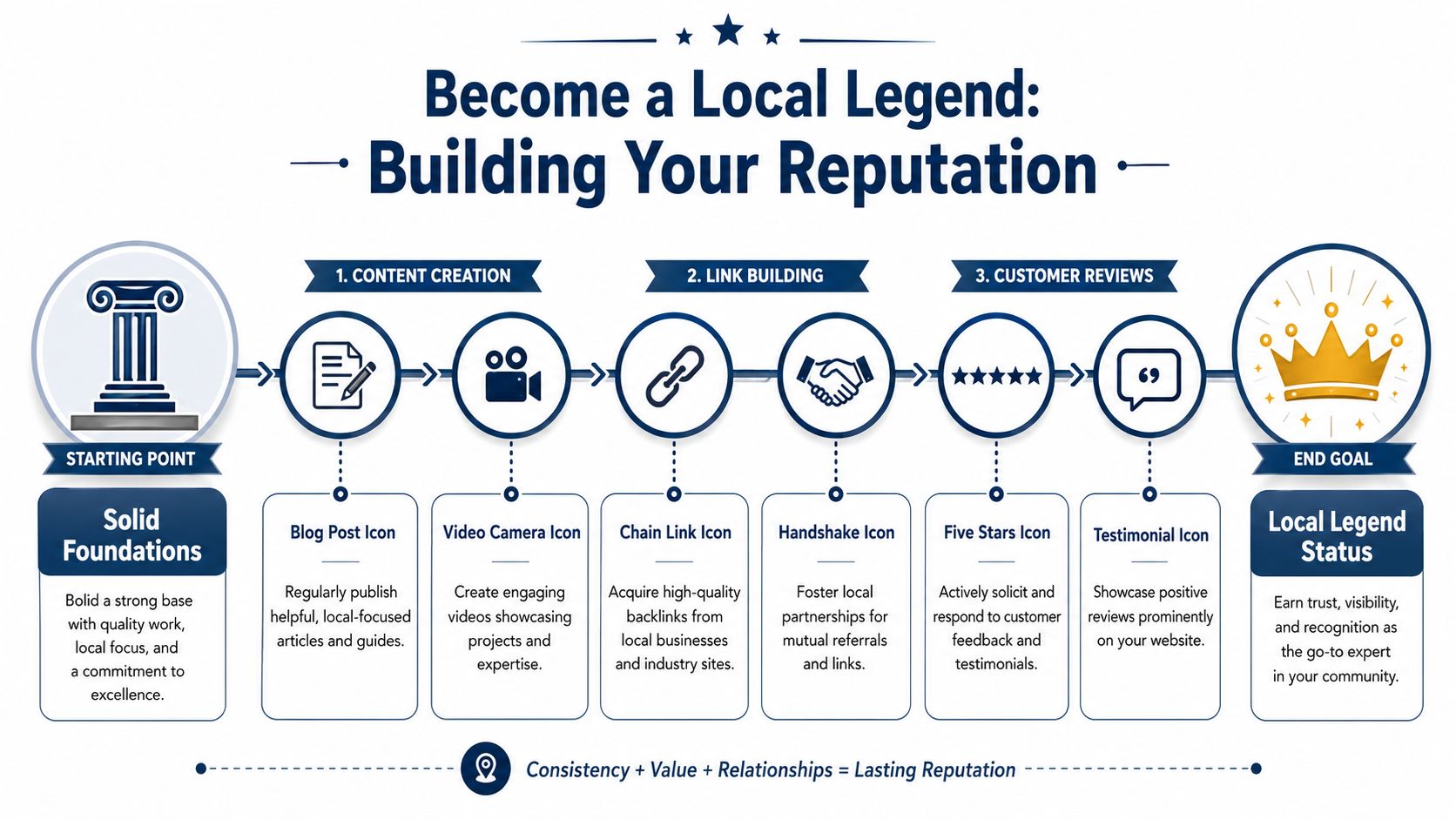
One article can do more than one job
Say you run a roofing firm in York. You publish an article answering a real question: “How much does flat roof replacement cost in York?” That piece can attract search traffic, link internally to your flat roofing service page, and give your sales team something useful to send to wavering prospects.
Then you support it with local signals. A supplier mentions your business on their site. A local property blog references the article. A customer who found you through that page leaves a review saying you explained the process clearly and turned up when promised. Suddenly one useful page has fed content, links and reviews at the same time.
That's much stronger than publishing bland blog posts no one reads.
Content ideas that actually fit roofing searches
The best topics are usually sitting in your office already. They're the questions customers ask before they book.
Good examples include:
- Cost questions. “How much does roof repair cost in Sheffield?”
- Decision questions. “Repair or replace a leaking flat roof?”
- Urgency questions. “What should I do after storm damage to my roof?”
- Time questions. “How long does a roof tile repair take?”
For UK roofers, there's also a neglected angle around weather spikes. When the Met Office issues severe weather warnings, demand for emergency roofer searches often jumps. Firms that update their Google Business Profile, emergency service wording, and relevant landing page copy quickly can catch that intent while others are still having a think and another biscuit.
Local links without the nonsense
You don't need dodgy link packages from mysterious corners of the internet. You need believable local mentions.
A roofer can often earn useful links from:
- Suppliers. If you're a regular trade customer, ask for a listing or project feature.
- Community involvement. Sponsoring a local event or charity can create a natural mention.
- Local property publications. Helpful commentary on roof maintenance can get cited.
- Trade associations and directories. Relevant listings still support authority.
Grey hat link building often looks tempting because it sounds fast. Black hat link buying can look even more tempting when someone waves rankings in your face. Then the bill arrives later in the form of unstable visibility and a mess to clean up.
Reviews are not just for reputation. They strengthen your local visibility and give future customers the reassurance that someone else trusted you first.
Build a review routine
The best review system is boring and repeatable. Finish a job. Confirm the customer is happy. Send the review request while the good impression is fresh. Reply to every review, good or bad, in a calm, professional tone.
A simple example. A roofer in Huddersfield completes a chimney repair, sends a polite follow-up that evening, and the customer mentions the tidy work and quick communication. That review helps the next customer choose, and it gives Google another signal that you're active, local and trusted.
That's how firms become local legends. Not through gimmicks. Through repeated proof.
Your Monthly SEO Roadmap KPIs and Packages Made Simple
Around half of roofing firms I speak to have the same problem. They are paying for "SEO" every month and still cannot say which jobs came from organic search, which towns are improving, or whether the spend is doing anything beyond producing a glossy report. That is not a strategy. That is admin with a logo on it.
SEO for a roofer works best as a monthly operating rhythm. One month of effort can fix obvious issues. It will not turn you into the default choice across Leeds, Cardiff or Kent. In this trade, Google wants repeated proof that your business is active, trusted, and relevant in the places you want to win work.
The timeline matters because expectations go wrong before rankings do. Early movement can happen in the first few months if the basics are a mess and you sort them quickly. Reliable enquiry growth usually takes longer. Proper local dominance, especially in competitive towns or after a bad site migration, is a longer slog. Anyone selling instant results is either inexperienced or having you on.
The KPIs worth tracking
A roofer does not need fifty metrics. You need a short list that shows whether visibility is turning into calls and quote requests.
Track these every month:
- Rankings for service plus town terms that bring paying work. "Flat roof repair Bristol" matters more than broad vanity phrases.
- Google Business Profile actions. Calls, website clicks, direction requests, and messages show whether local visibility is doing its job.
- Organic landing pages. Check which service, town, and advice pages are pulling people in.
- Leads from organic search. Calls, forms, and quote requests. If you cannot track these, fix that first.
- Review pace and quality. Fresh reviews help conversion and local trust.
- Coverage by area. Are you gaining traction only in your home postcode, or are nearby towns starting to show signs of life too?
One blunt point. Ranking first for a phrase nobody types in is useless. I have seen roofers celebrate top positions while the phone stays silent. Google does not pay your scaffold bill. Customers do.
What monthly work looks like
A sensible SEO package is a sequence of jobs done in the right order. Month one should not be stuffed with blog posts if your tracking is broken, your service pages are thin, and your Google Business Profile still has the wrong opening hours from 2022.
A practical roadmap looks like this:
| Month | Focus (Foundations) | Focus (Authority) | Focus (Market Leader) |
|---|---|---|---|
| Month 1 | Audit the site, fix tracking, clean up NAP issues, sort Google Business Profile | Review the local competition and spot trust gaps | Map priority towns, postcodes, and service lines |
| Month 2 | Improve key service pages, tighten internal links, sort mobile usability | Start a review process, tidy local citations | Build the first set of town or district pages |
| Month 3 | Improve calls to action, fix crawl issues, add FAQs based on real customer questions | Publish useful local content tied to actual jobs and demand | Strengthen the money pages with better proof and location signals |
| Month 4 | Keep improving technical health and weak pages | Win local mentions, supplier links, and relevant trade references | Expand into nearby districts with enough demand to justify dedicated pages |
| Month 5 | Rework pages that get traffic but do not convert | Keep reviews, content, and link earning steady | Build out more service-area depth where rankings are close |
| Month 6 and beyond | Maintain site health, conversion tracking, and page quality | Keep authority growing month by month | Protect gains, expand selectively, and avoid spreading too thin |
There is a UK-specific wrinkle here. Demand is not flat across the year. Heavy rain, wind warnings, and storm spells often create search spikes, especially for repairs, leaks, and emergency callouts. If you ignore that and publish content at random, you miss obvious opportunities. A smart monthly plan leaves room to react when the Met Office gives half the county a reason to panic about a missing ridge tile.
Packages only make sense if they match the stage you're in
A one-town roofer with a scruffy website needs different work from a firm trying to rank across ten towns, three service categories, and a couple of nearby cities. That should shape the package.
A simple way to split it:
- Foundations. For firms with weak setup, poor tracking, thin core pages, or inconsistent business details across the web.
- Authority. For firms that have the basics sorted and now need stronger proof, better content, regular reviews, and local mentions from places that matter.
- Market Leader. For businesses pushing into more towns, adding service depth, and competing hard in areas where rivals already have traction.
The trade-off is straightforward. Smaller packages cost less, but progress is slower and choices matter more. Bigger packages can move faster, but only if the work is disciplined. Churning out generic location pages for every village with a church and a roundabout is a waste of money. Picking the towns where you already get enquiries, have vans on the road, or can show proof near recognisable landmarks is far more effective.
A roofer in Swansea might spend the first stretch fixing citation errors, improving the roof repair page, and building a review habit. After that, the sensible move is not "cover all of South Wales" because an agency spreadsheet said so. It is adding pages for places like Morriston, Sketty, and Mumbles where the firm can show real jobs, real response times, and real local proof. A photo captioned "new felt roof completed near Singleton Park" does more than a paragraph of waffle about being "your trusted local experts".
That is how monthly SEO should feel. Ordered, measurable, and slightly boring in a good way.
If you want roofing company SEO to produce calls, judge the work by three questions. Are you improving visibility in the right towns? Are more people contacting you from organic search? Are you building proof that a homeowner in your patch would believe? If the answer is no, the package needs changing, not the colour of the report cover.
If you want that monthly SEO process handled properly, DigiVisi Ltd is built for exactly this kind of UK local search work. The approach is data-first, grounded in competitor analysis rather than guesswork, with monthly options that cover foundations, authority building, and market-leader growth. If you run a roofing business and want clearer reporting, better local visibility, and more consistent enquiries without being tied into a contract, it's a sensible place to start.