Skip to content

You're probably reading this after another month of “marketing activity” that looked busy on paper and did very little in the bank account. A few paid clicks. A few social posts. Maybe a website blog that hasn't been touched since someone in the office had a burst of optimism in February. Meanwhile, the phone is no busier, the enquiries aren't much better, and you're left wondering whether marketing is just an expensive hobby with invoices.
For most UK service businesses, that's the core issue. The problem isn't visibility for its own sake. A plumber in Leeds doesn't need applause. A solicitor in Bristol doesn't need vague “reach”. Both need qualified enquiries from people who are close enough, serious enough, and ready enough to buy. That's where proper B2B content marketing services earn their keep. Done well, they turn your expertise into a working asset that attracts the right people, answers the right questions, and nudges them towards a call, a form fill, or a booked appointment.
Table of Contents
- Is Your Marketing Budget Disappearing into a Black Hole
- The Engine Room of B2B Content Marketing Services
- Spotting the Pros from the SEO Cowboys
- What a Typical Engagement Looks Like Packages and Pricing
- From Clicks to Customers Real UK Case Examples
- Measuring What Matters KPIs That Prove Your ROI
- Your Next Step to Content Marketing Success
Is Your Marketing Budget Disappearing into a Black Hole
A lot of marketing spend disappears because it was never tied to buyer intent in the first place. You pay for attention, but not the right attention. You get visitors who were curious, bored, or accidentally fat-fingered their search. Lovely for web analytics, not much use for payroll.
That's why content matters when it's built around commercial questions. A facilities manager searching for guidance on contractor compliance is far more valuable than somebody casually scrolling past a boosted post. A business owner looking up lease dispute timelines is telling you something important. They have a problem, and they're trying to choose who to trust.

The shift towards content isn't a fad dressed up in a blazer. The UK content marketing market reached $18.65 billion in 2024 and is projected to reach $73.26 billion by 2033, with 28% of the average B2B marketing budget now dedicated to content marketing, according to UK digital marketing statistics from Andava. Businesses don't move that much budget unless something is working.
More visibility is not the goal
The right goal is simple. Get found by people with a real need, give them the confidence that you know your craft, and make contact easy.
A local solicitor can do that with a plain-English article on director disputes, followed by a service page that explains next steps. A commercial plumber can do it with a guide on what landlords should check before replacing communal hot water systems. Neither needs buzzwords. Both need relevance.
Practical rule: If a piece of content can't plausibly help a buyer move closer to an enquiry, it's probably decoration.
How a blog becomes a business asset
A useful blog post doesn't sit there looking pretty. It works as part of a chain:
- Search intent: Someone types a specific problem into Google.
- Best answer: Your article explains the issue clearly, without sounding like a GCSE revision guide written by a robot.
- Trust signal: The reader sees practical detail, local relevance, and signs that you've done this before.
- Next action: The article links to the relevant service page, contact form, phone number, or Google Business Profile.
That's the mechanism. No mysticism required.
If you're also weighing where AI fits into the picture, this 2026 guide to AI ROI is worth a read because it forces the same sensible question content should answer. Not “is it exciting?” but “does it produce commercial value?”
The Engine Room of B2B Content Marketing Services
When people hear “content marketing”, they often picture somebody tapping out blog posts and hoping for the best. That's not a service. That's an activity. Proper B2B content marketing services are a system, and every part has a job.
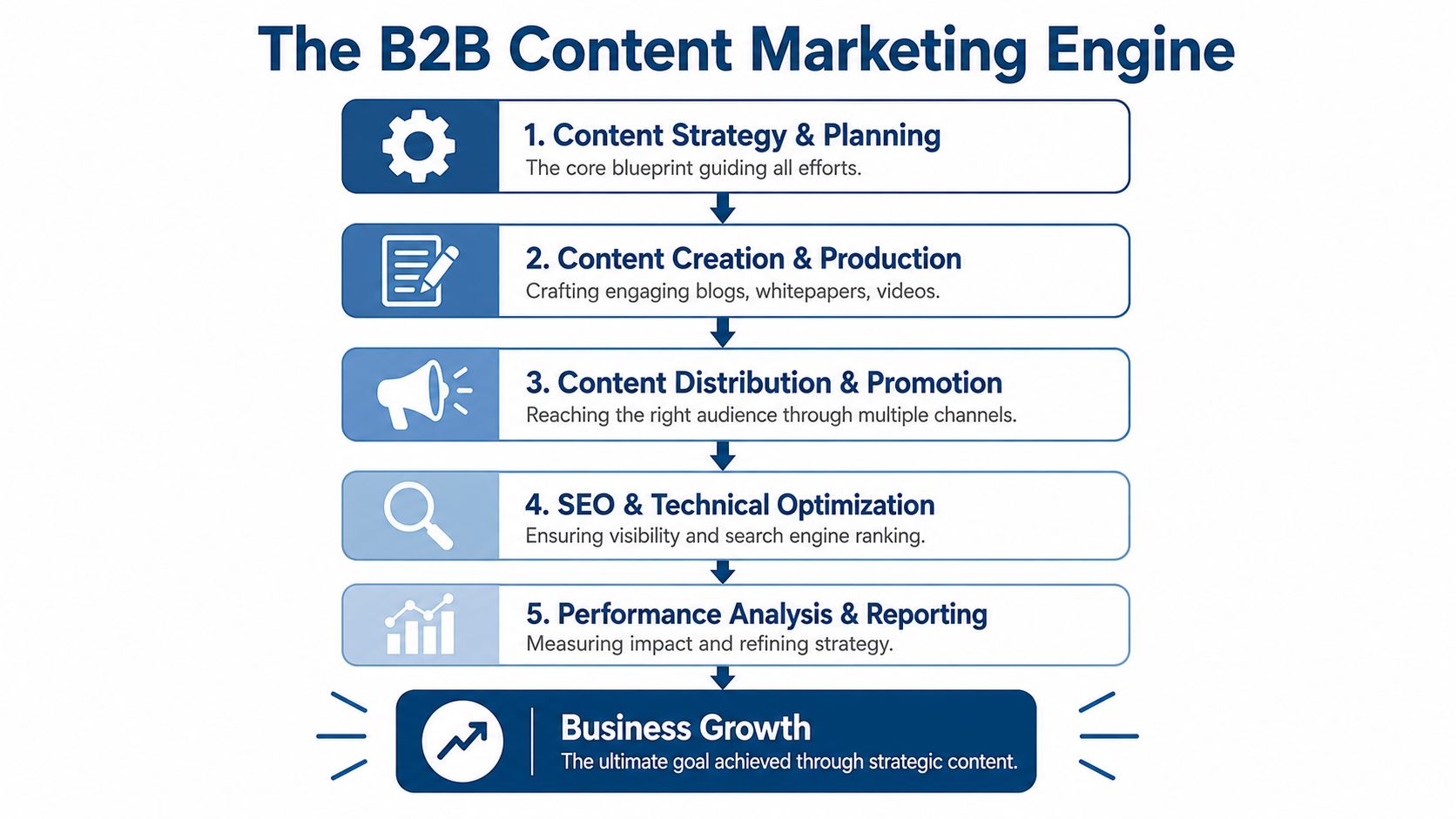
The starting point is structure. UK B2B companies with a documented content marketing strategy, built around topic clusters, audience research, and multi-touch attribution, generate 3× more leads than those without one, according to Whitehat SEO's analysis of content marketing strategies. That result makes sense because random publishing rarely compounds. Structured publishing does.
Strategy before typing
Before anyone writes a word, somebody needs to answer a few stubbornly practical questions.
Who is the buyer? What do they search before they enquire? Which services are worth pushing harder? Where does the site currently lose people? Which pages already attract useful traffic, and which ones are doing the digital equivalent of napping at the till?
For a commercial electrician, the strategy might centre on landlord compliance, office fit-out safety, and emergency callout authority. For a solicitor, it might cluster around employment disputes, debt recovery, and commercial property matters. The point is to build content around commercial intent, not around whatever topic happened to come up in Monday's meeting.
The pages that do the heavy lifting
Think of a pillar page as the main aisle in a library. It covers a broad, commercially important subject and points readers to more specific pieces. The topic cluster articles are the individual books on the shelf, each answering one narrower question in depth.
A sensible setup often includes:
- Pillar pages: Broad service-led guides such as commercial lease disputes, boiler maintenance for landlords, or business waste compliance.
- Cluster articles: Narrower supporting posts like “What counts as fair wear and tear in a commercial lease?” or “How often should a commercial boiler be serviced?”
- Service page optimisation: Clear pages that explain what you do, where you do it, who it's for, and how to get in touch.
- Conversion paths: Phone numbers, forms, quote requests, and internal links placed where a sensible human would expect them.
A plumber serving local businesses doesn't need fifty clever articles about the philosophy of heating systems. One strong pillar page on commercial plumbing maintenance, supported by useful posts on common faults, emergency callouts, and compliance checks, will often do more.
Good content doesn't just attract traffic. It pre-answers sales questions, filters out poor-fit enquiries, and makes the right prospect easier to convert.
Technical work that stops good content going to waste
This is the bit many firms ignore because it isn't glamorous. Neither is drainage, but you miss it when it fails.
Technical foundations matter because even excellent content can underperform if the site is clunky, confusing, or poorly structured. Good B2B content marketing services usually include the unflashy work that supports visibility:
- Internal linking: Connecting related pages so users and search engines can follow the logic of the site.
- Schema markup: Giving search engines clearer signals about services, locations, and page purpose.
- Mobile usability: Making sure a buyer on their phone can read the page and contact you without a wrestling match.
- Page speed: Removing friction. A slow page leaks intent.
For local firms, Google Business Profile also matters. Someone may read a blog post, then check your profile for reviews, opening hours, and service area before calling. That isn't a separate journey. It's the same journey, just with fewer cups of tea between steps.
There's also the question of links from other sites. White-hat linkbuilding is really a credibility exercise. It should support expertise and local authority, not mimic a fruit machine. Relevant citations, industry references, and local business signals are useful. Piles of dubious links from irrelevant sites are not.
Spotting the Pros from the SEO Cowboys
There are still plenty of people selling SEO and content as if it were a magic trick. They'll promise instant rankings, mysterious proprietary secrets, and suspiciously cheap output. Then they'll vanish when the site drops, the leads dry up, or Google decides to stop entertaining nonsense.
The dividing line is simple. White hat work earns trust. Grey hat work borrows time. Black hat work borrows trouble.

What white hat looks like in practice
White-hat content starts with real expertise. It uses interviews with subject matter experts, notes from sales calls, common customer questions, and practical experience from the field. That's why a strong article from a local solicitor feels different from a generic page stuffed with legal phrases. One is written to help a buyer make a decision. The other is written to impress nobody.
UK data also gives a clear clue on format. Publishing long-form white-hat content of over 2,000 words generates 9 times more leads than shorter pieces, according to ProfileTree's B2B marketing statistics. That doesn't mean every page should become a Victorian novel. It means depth, usefulness, and completeness often beat thin content every time.
Signs you're dealing with a proper operator include:
- Transparent process: They can explain why a page is being created, what query it targets, and how it supports a service line.
- Commercial focus: They care about enquiries, not just impressions and applause.
- Technical competence: They talk sensibly about internal linking, page structure, and schema without behaving like they've discovered fire.
- Respect for expertise: They want access to your sales team, project knowledge, and customer questions.
Grey hat and black hat usually sound clever at first
Grey-hat tactics often look tempting because they can produce movement quickly. Thin pages spun into multiple location variants. Over-optimised anchor text. Dubious guest posts on irrelevant sites. AI-generated pages with a quick human polish and fingers crossed. It can all appear efficient right until it stops working.
Black-hat tactics are worse. Hidden text, manipulative link schemes, doorway pages, scraped content. Those aren't shortcuts. They're liabilities wearing sunglasses.
If someone guarantees a number one ranking, they're either guessing or they think you were born yesterday.
A local trades business should be especially wary here. If your reputation depends on trust, you can't build your visibility on rubbish. A plumber doesn't win better commercial contracts by publishing fifty cloned town pages with swapped-out place names. A solicitor doesn't attract better clients with legal gibberish generated at scale. The durable play is slower, but it survives contact with reality.
What a Typical Engagement Looks Like Packages and Pricing
Pricing for B2B content marketing services varies because the scope varies. A business with a slow, outdated site, weak service pages, and no content strategy needs different work from a firm that already has good foundations and only needs steady expansion. That's why sensible packages usually group the work into tiers rather than pretending every business needs the same monthly recipe.
What you are usually paying for
Most engagements combine strategic work, production work, and ongoing refinement. In plain English, that usually means:
- Foundational fixes: Audits, keyword research, service page improvements, internal linking, and technical clean-up.
- Content production: New pages, blog articles, and updates to older content that still has commercial potential.
- Local search support: Google Business Profile improvements, location relevance, and consistency across business details.
- Reporting and review: Rankings, traffic quality, lead tracking, and decisions about what to improve next.
If you want a useful benchmark for the wider search side of the equation, this guide on SEO cost in the UK helps frame what businesses typically pay for proper optimisation work.
Typical B2B Content Marketing Service Tiers
| Tier | Typical Monthly Cost (Incl. VAT) | Best For | Core Inclusions |
|---|---|---|---|
| Foundations | From £360 incl. VAT | Small service firms that need the basics sorted first | Technical audit, keyword research, service page optimisation, internal linking, core local SEO fixes, basic reporting |
| Authority | Higher monthly investment than a foundations plan | Firms that already have a decent site and want consistent lead-focused growth | Strategy refinement, regular blog content, topic clusters, schema work, service page expansion, stronger reporting |
| Market Leader | Premium ongoing investment for aggressive growth | Multi-location firms or specialist businesses aiming to dominate a niche | Broader content programme, deeper competitor analysis, advanced optimisation, local expansion work, frequent iteration and measurement |
The “right” package depends less on your ego and more on your sales model. If you're a local commercial cleaner with a narrow service area and a handful of high-value services, you don't necessarily need the largest plan. You do need the right pages, the right topics, and accurate tracking. If you're a multi-office solicitor targeting several service lines across multiple locations, the scope grows quickly.
A fair proposal should make three things obvious:
- What will be done each month
- Why those tasks matter commercially
- How performance will be reviewed
Cheap retainers often buy motion, not progress.
There's also a trade-off worth being blunt about. If a package promises endless content volume for a suspiciously low fee, something is usually being sacrificed. It may be research depth. It may be editing quality. It may be strategic thinking. Sometimes it's all three, wrapped in a cheerful PDF.
For UK service businesses, a better question than “how many blogs do I get?” is “which revenue questions get answered, which pages get improved, and how will this turn into enquiries?” That's a much less glamorous question. It's also the one that protects your budget.
From Clicks to Customers Real UK Case Examples
Theory is tidy. Real buying journeys are messier. People jump between pages, compare options, ring after reading one paragraph, or disappear for weeks and then come back through a branded search. Even so, the route from content to enquiry is usually easier to understand than people think.
For local businesses, the blog remains the practical starting point. 94% of B2B marketers use content marketing and 84% rely on corporate blogs to distribute it, according to Root Digital's B2B marketing statistics. That tracks with what works on the ground. A blog is flexible, searchable, and easy to connect to service pages.
A commercial cleaner with a better question to answer
Take a commercial cleaning firm in Manchester trying to win larger office and facilities contracts. The weak version of content would be a page saying “We offer high-quality cleaning services with a dedicated team.” Every cleaner in Britain has written some version of that. It says nothing.
The stronger version addresses an actual buyer concern. A guide on choosing a COSHH-compliant cleaning partner gives a facilities manager something concrete. It explains what documents to ask for, what questions to raise about chemicals and staff training, and what warning signs to watch out for.
That article attracts a narrower audience, but a better one. The reader is more likely to be a serious buyer. The internal links then point them towards the company's commercial cleaning service page, industry-specific pages, and a contact route for site surveys. The blog post doesn't “cause” the contract on its own. It starts the trust-building before a sales conversation even begins.
A solicitor using content as pre-sales
A Bristol solicitor handling commercial property work can use content in much the same way. A pillar page on the commercial conveyancing process can answer the questions business owners ask before they call:
- What stages are involved?
- What tends to delay a transaction?
- What information should a buyer prepare early?
- When should a solicitor be instructed?
A good page reduces uncertainty. It also filters out weaker enquiries because people who read it understand the process and the likely next steps. That makes the first call better for both sides.
The best service content doesn't merely attract leads. It improves the quality of the conversation when the lead arrives.
The local trades version is simpler than people think
Now bring it right down to earth. A local plumber serving landlords, offices, and light commercial premises doesn't need a grand “thought leadership strategy” in the dramatic sense. He needs a sensible set of pages that answer practical buying questions.
That might include:
- Emergency guidance: What a business should do before calling about a leaking commercial water line
- Maintenance content: Signs a communal boiler needs attention before it fails
- Compliance-led advice: What landlords should document after plumbing work in shared buildings
- Location relevance: Clear service pages for the towns and areas covered
That combination works because it mirrors how buyers think. They don't search for “superior plumbing excellence”. They search for the nearest useful answer to the problem they've got.
If the article is clear, if the service page reassures them, and if the phone number is obvious, the path from click to customer is not mysterious at all. It's just disciplined.
Measuring What Matters KPIs That Prove Your ROI
Most businesses don't struggle because there are no metrics. They struggle because there are too many, and half of them are vanity wearing a tie. A spike in page views can be nice. It can also be entirely irrelevant if none of those visitors were likely to buy.
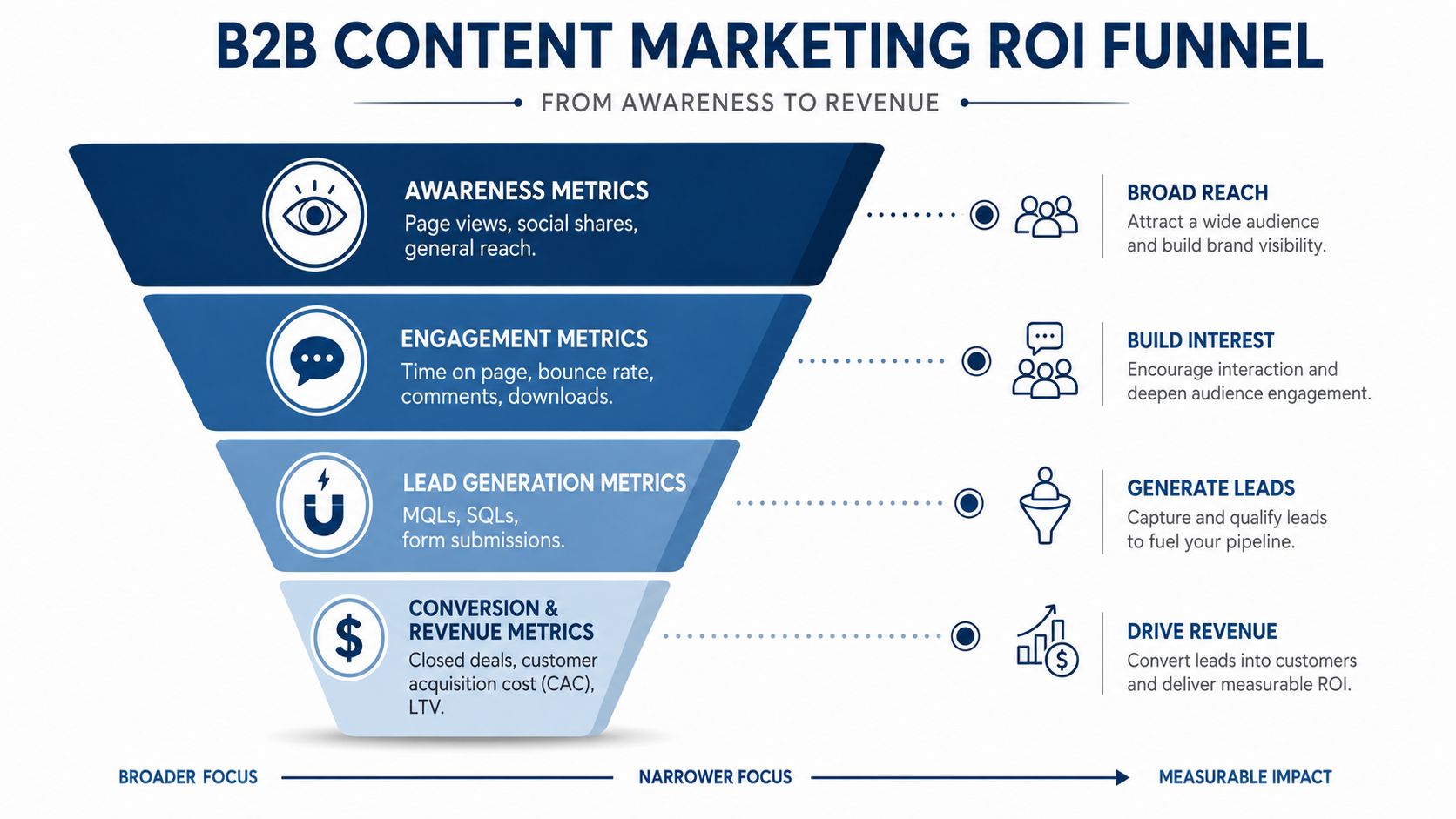
The measurement problem is common. 72% of B2B marketers say measuring content marketing ROI is their primary challenge, according to Stratton Craig's content marketing insight. That's not because ROI is unknowable. It's because many teams track activity without mapping it to revenue.
The metrics that impress nobody
Page views, likes, impressions, and casual social engagement can tell you whether something was seen. They don't tell you whether it mattered.
If a solicitor's article gets traffic from students researching a coursework topic, that's not a commercial win. If a plumber's maintenance post attracts homeowners outside the service area, that's still not a win. You need metrics closer to intent.
This short explainer video is useful if you want the principle visually before you build your own reporting process.
The numbers that actually matter
For a service business, useful KPIs usually sit in a chain.
- Ranking for buyer-led terms: Are you appearing for commercial searches that relate directly to profitable services?
- Organic traffic to service and high-intent content pages: Are the right pages attracting the right kind of visitor?
- Lead actions: Form submissions, phone calls, booked consultations, and Google Business Profile interactions
- Sales outcomes: Which enquiries became opportunities, quotes, or clients
That's the sensible funnel. Start broad enough to diagnose visibility, then narrow quickly to commercial action.
If you want a solid primer on building this kind of reporting, this guide to metrics for content value is a useful companion because it separates attention metrics from business metrics.
A simple attribution view
Attribution doesn't need to become an academic hobby. For most small UK firms, a practical version is enough:
- Identify the landing page someone first found you through.
- Track the next page or pages they viewed before contacting you.
- Record the enquiry source in your CRM, spreadsheet, or booking process.
- Match closed business back to original content themes over time.
A commercial cleaner might find that compliance-related articles produce fewer enquiries overall, but better ones. A solicitor may discover that one conveyancing guide rarely gets the final click before contact, yet repeatedly appears early in the path. That still gives it value.
Key point: The page that starts trust often deserves as much attention as the page that captures the lead.
Your Next Step to Content Marketing Success
Content works when it behaves like part of your sales process, not like a side project. That's the distinction many firms miss. They publish a few articles, wait for fireworks, and then conclude that content “didn't work”. Usually, the issue isn't content itself. It's that nobody built the route from article to service page to enquiry.
The financial case for taking it seriously is strong. In the UK, content marketing generates roughly 3 times more leads at 60% lower cost than outbound tactics, returning close to £3 in revenue for every £1 invested, according to SQ Magazine's content marketing statistics. That doesn't mean every article prints money. It means the channel is worth treating like a proper asset.
Start with one commercial question
Don't begin with a grand editorial calendar worthy of the BBC. Begin with one profitable customer question your business answers all the time.
A solicitor could start with “How long does a commercial lease dispute usually take?” A plumber could start with “What should a landlord do when a shared boiler fails?” A commercial cleaner could start with “What should a facilities manager check before appointing a contractor?”
Then make sure three things happen:
- Write the clearest answer you can
- Link it to the exact service page that solves the problem
- Track whether calls and enquiries follow
If you want a better framework for seeing which touchpoints deserve credit before you cut or increase spend, this guide on how to optimize marketing budget decisions is worth your time. It helps you avoid the classic mistake of giving all the credit to the final click and none to the content that did the persuading earlier.
Action beats admiration. Review your current site. Find the pages that say a lot without answering much. Replace vague claims with useful detail. Tighten the path to contact. Then keep going. The firms that win with B2B content marketing services usually aren't louder. They're clearer, more helpful, and easier to trust.
If you want a straight-talking view of what your website is doing well, what it's wasting, and how to turn visibility into actual enquiries, DigiVisi Ltd is a sensible place to start. They focus on UK service businesses, keep reporting transparent, and build SEO around calls, leads, and sales rather than vanity metrics and interpretive dance.