Skip to content

For most UK small businesses, a proper monthly SEO service will cost between £500 and £1,500. That money should be buying real work like technical fixes, keyword research, on-page optimisation, local SEO, content planning, and reporting, not vague promises and monthly waffle.
You're probably here because you've had one of three experiences. You've had a quote that seemed suspiciously cheap. You've had another that looked like it was priced by someone ordering champagne on your card. Or you've tried comparing providers and realised every package sounds like the same bowl of alphabet soup.
Fair enough. “How much does SEO cost?” is a sensible question. The irritating but honest answer is that search engine optimization cost UK varies because businesses make very different choices. A self-employed locksmith in Leeds, a three-branch dental practice in Manchester, and a solicitor in London are not buying the same thing, even if they all want more calls from Google.
That's why the useful question isn't just “what does SEO cost?” It's “what should I be paying for, what affects the price, and how do I avoid wasting money on cowboy SEO?”
Table of Contents
- How Much for SEO Then? A Perfectly Reasonable Question
- The SEO Menu Decoding UK Pricing Models
- What Actually Drives Your SEO Price Tag
- What Should Be in the Tin A Proper SEO Package Breakdown
- Dodging the Duds SEO Red Flags and Cowboy Tactics
- From Clicks to Calls The Real ROI of Good SEO
- Your SEO Hiring Checklist and Burning Questions
How Much for SEO Then? A Perfectly Reasonable Question
You ask for an SEO price. One agency says £300 a month. Another says £2,000. A third wants to “jump on a discovery call” before naming a number. Annoying? Yes. Suspicious? Sometimes. Normal? Also yes.
SEO prices vary because the work varies. Your costs depend on what you're trying to achieve, how messy your website is, how competitive your area is, and whether you need a light tune-up or a full rebuild. A dog groomer in Dundee chasing local visibility has a much smaller job than a multi-location accountancy firm trying to rank in several towns at once.
That's why cheap quotes fool so many small business owners. They look tidy on the surface, but they often buy very little. Fewer hours. Less skill. Cookie-cutter reports. Or worse, cowboy tactics that give you a short spike and a long headache.
Practical rule: Judge the quote against the job. If the price looks too small for the amount of work involved, the service is too.
A Bristol electrician might need sharper service pages, better Google Business Profile work, stronger reviews, and local location signals. A solicitor in central London needs a far more serious campaign because the competition is brutal and the websites at the top usually have better content, stronger authority, and more consistent optimisation.
This is the bit too many providers avoid saying plainly. SEO is not a flat fee service. It is an investment decision. You are choosing how much firepower to put behind growth, and whether you want progress that lasts or cheap activity that fills a monthly report.
If you want a useful sanity check before signing anything, view our platform pricing and compare how transparent pricing models are presented in other software categories. Clear pricing usually tells you what's included, who it suits, and where the limits are. SEO should be no different.
Spend based on the opportunity, not your hope of finding a miracle bargain. Cheap SEO is often like a £2 pint in London. Technically available somewhere, probably best avoided.
The SEO Menu Decoding UK Pricing Models
Two firms can both buy "SEO" and get completely different things. One gets a proper growth plan. The other gets a few tweaked title tags and a report padded like a dodgy CV. That is why pricing looks all over the place.
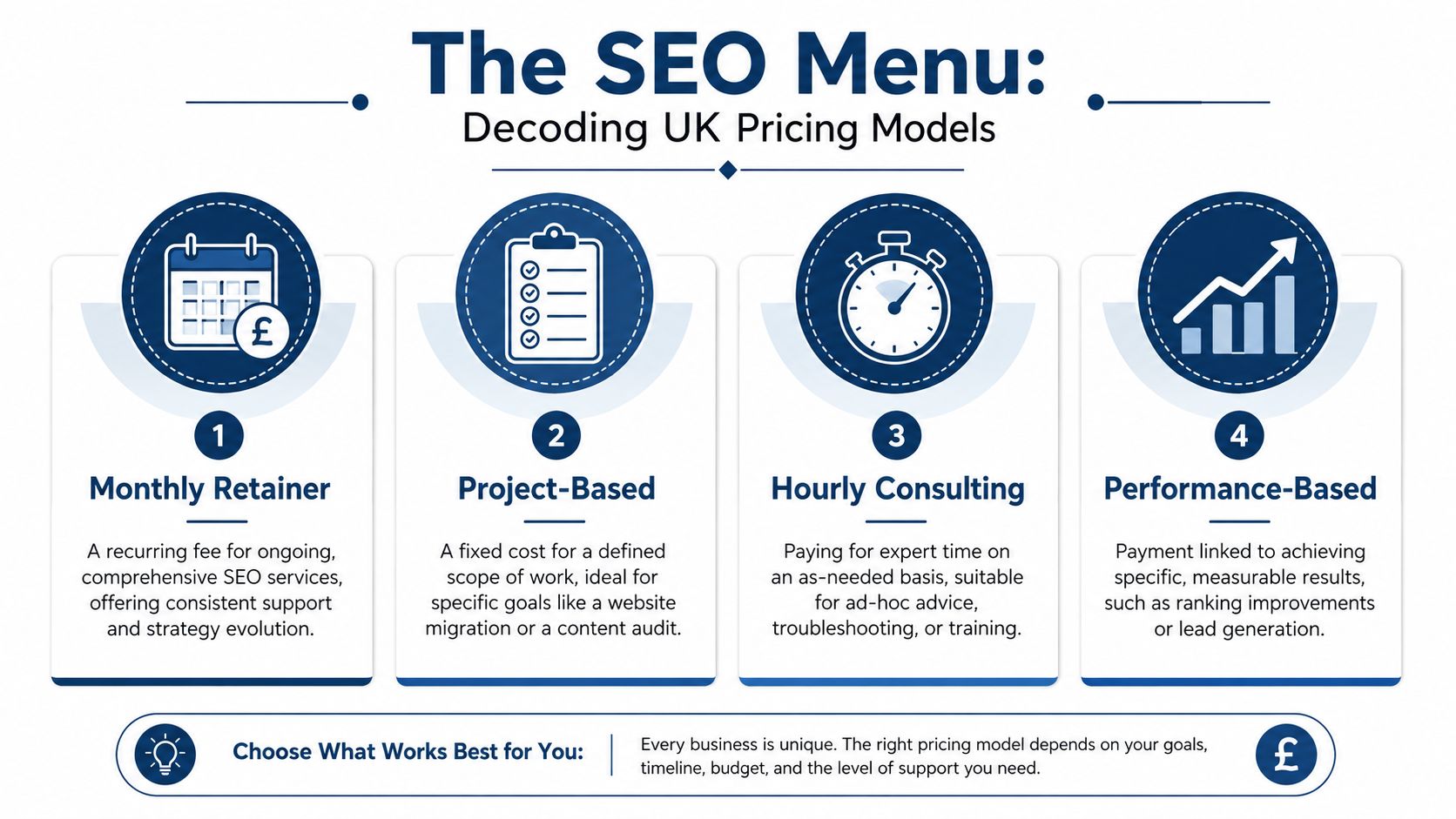
The question is not "what does SEO cost?" It is "what am I buying, and does this pricing model suit the job?" Get that wrong and you can burn through budget fast. Get it right and SEO starts behaving like an investment, not a monthly mystery.
Monthly retainers
This is the standard model for a reason. SEO needs steady work, regular decisions, and someone keeping an eye on the boring but money-making details.
A retainer usually covers ongoing priorities such as:
- Technical fixes: Sorting crawl issues, page speed problems, indexing messes, and broken internal links.
- Content work: Improving service pages, publishing new pages, and tightening up copy so it matches how people search.
- Local SEO tasks: Google Business Profile updates, review support, citation checks, and location relevance.
- Authority building: Digital PR, link acquisition, and trust signals that help you compete.
- Reporting and strategy: Reviewing what is working, cutting what is not, and shifting effort to the pages that can bring leads.
For a small UK service business that wants regular enquiries, a retainer is usually the sensible choice. It works like servicing a van you rely on every day. Skip it for long enough and something expensive starts rattling.
Project work
Project pricing suits a specific problem with a clear finish line.
Good examples include:
- A technical audit
- A site migration
- A content refresh for key service pages
- A local SEO tidy-up after years of neglect
- Keyword and topic research before a rebuild
This model is useful when you need expert work without signing up for ongoing support. It is a smart buy if you know the exact problem. It is a poor buy if your real goal is long-term lead generation and nobody is sticking around to implement the recommendations.
Plenty of agencies love selling audits because audits are tidy. The harder part is fixing the issues and building momentum after the PDF lands in your inbox.
Hourly consulting
Hourly SEO is best for businesses that already have some internal support and need expert direction rather than full delivery.
It makes sense if you need help with:
- Troubleshooting a ranking drop
- Reviewing a migration plan
- Training an in-house marketer or developer
- Sense-checking an agency proposal
- Planning content around search intent and topic gaps
Used properly, hourly consulting can save a fortune. Used badly, it turns into paying premium rates for someone to repeatedly point at problems your team never gets round to fixing. If you need hands-on execution every month, stop pretending consulting alone will do the job.
If your content decisions are part of the issue, tools that leverage Contesimal for better content insights can help you spot whether you're targeting actual search intent or just stuffing pages with keywords and wishful thinking.
Performance-based deals
This is the pricing model that attracts the most raised eyebrows, and for good reason.
"Pay on results" sounds brilliant until you ask one awkward question. Which results? Rankings for easy phrases nobody valuable searches? Traffic from outside your service area? Form fills from tyre-kickers and spambots? A cowboy can hit a target if he sets the target low enough.
Performance deals can work in rare cases, but only with brutal clarity around what counts, how it is tracked, and what happens if lead quality is rubbish. Most small businesses are better off with a clear retainer or a fixed-scope project. They are easier to judge, easier to compare, and much harder for a smooth-talking agency to twist.
Pick the model that matches the work. That is how you avoid paying champagne prices for lemonade SEO.
What Actually Drives Your SEO Price Tag
One firm gets quoted £500. Another gets £1,500. The gap usually comes down to three choices. How hard is your market, how messy is your website, and how much content work needs doing.
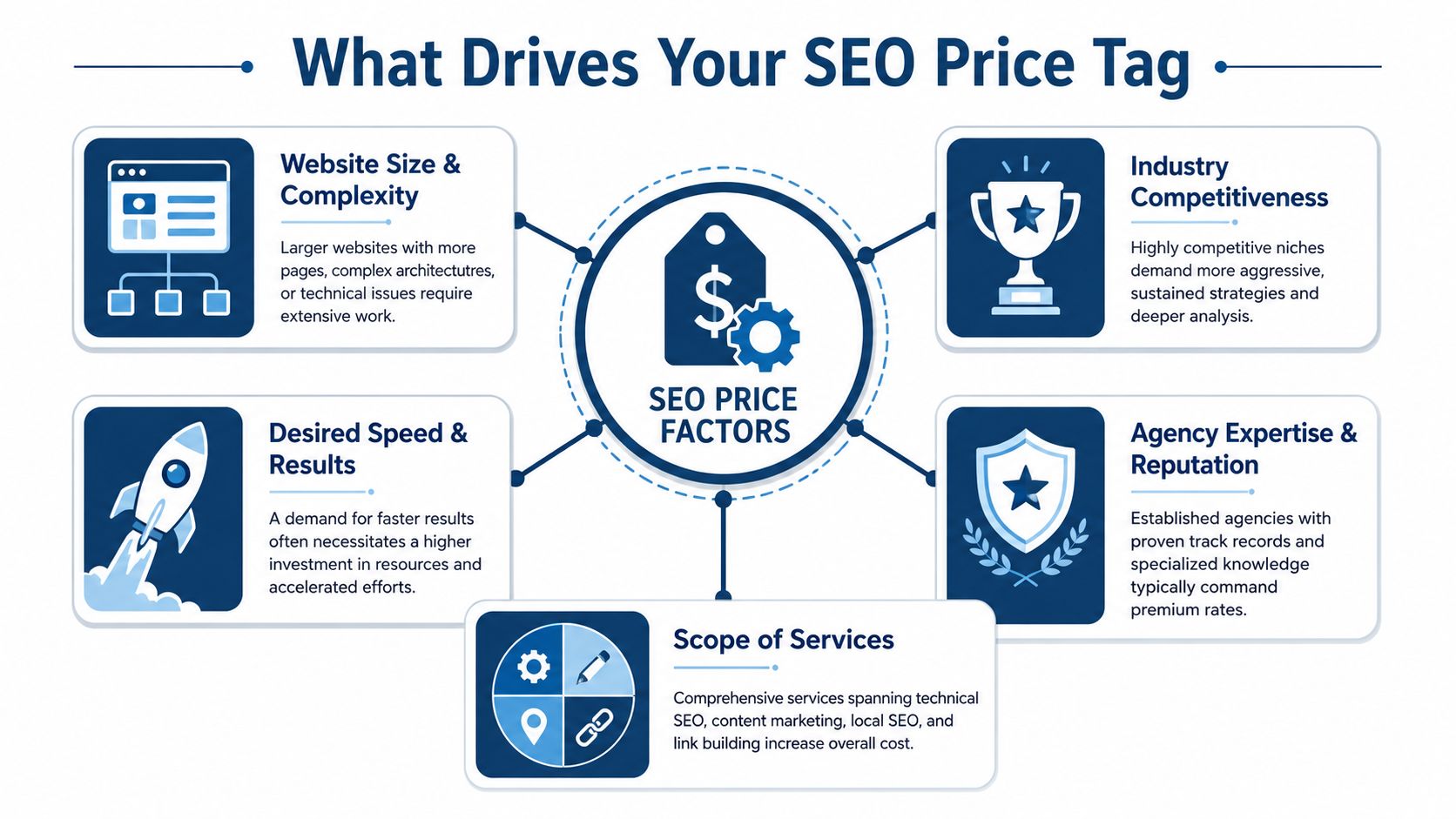
Competition changes everything
SEO pricing works a bit like car insurance. A careful driver in a quiet town pays less than a boy racer in central Manchester. The same logic applies here.
A plumber in Padstow is not fighting the same battle as a solicitor in London. The solicitor is competing with firms that have stronger websites, deeper backlink profiles, more pages, more reviews, and bigger budgets. That means more research, more content, more link building, and tighter local targeting. The fee goes up because the job gets harder.
Crowded sectors usually cost more full stop. Legal, dental, finance, property, and home services can all get expensive fast because everyone wants the same high-value searches. If you need local SEO services for UK businesses, judge the quote against the level of competition, not against your mate's cousin who ranks a dog groomer in a sleepy village.
Your website can make SEO cheap or painfully expensive
A decent site saves money. A clapped-out one burns it.
If your website is fast, logically structured, mobile-friendly, and built around real service pages, an SEO provider can spend more time improving visibility. If it is full of duplicate pages, thin copy, broken links, odd redirects, and template sludge from 2017, the first chunk of budget disappears into repairs.
Here is the blunt version:
- Healthy websites are cheaper to grow: more time goes into rankings and leads.
- Messy websites are dearer to fix: technical debt swallows hours.
- Large websites cost more to manage: more pages means more auditing, optimisation, and QA.
This is why two businesses in the same town can get very different quotes. One needs tuning. The other needs a full engine rebuild.
Content ambition affects the bill
SEO is not just fiddling with title tags and hoping for the best. Google needs clear signals about what you do, where you do it, and why your pages deserve to rank. That takes content.
If you already have strong service pages, local landing pages, FAQs, reviews, and sensible internal linking, costs stay lower because the groundwork exists. If your site has five thin pages and one reads like it was written during a power cut, expect a bigger bill.
Content work can include service page rewrites, location pages, supporting articles, schema, FAQs, and internal links that connect the whole site properly. If you want a smarter view of how search engines interpret page meaning, leverage Contesimal for better content insights. The point is simple. Repeating the same keyword fifty times is old nonsense. Useful, well-structured content wins.
A physiotherapy clinic in York might need better treatment pages, clearer local relevance, and answers to common patient questions. A multi-location estate agency needs that across every branch, service, and area page. Same channel, very different workload.
That is what drives SEO cost in the UK. Not smoke and mirrors. Choices, competition, and complexity.
What Should Be in the Tin A Proper SEO Package Breakdown
If someone offers “full SEO” without telling you what's inside, treat it like a mystery meat pie at a petrol station. Walk away.
For UK service-led businesses, a foundational SEO investment of £500 to £1,500 per month is typical. Basic packages at the lower end should cover technical audits, keyword research, and on-page work, while budgets over £1,000 should include authority building and content strategy to compete properly, according to this guide to UK SEO costs for service businesses.
What a starter package should include
At the lower end, you're paying for the essentials. Not bells, whistles, and interpretive dance.
A proper starter package for a local business should usually include:
- Technical audit: Crawl issues, indexing problems, speed concerns, page bloat, and obvious errors.
- Keyword research: The terms your customers use, not random phrases chosen by guesswork.
- On-page optimisation: Titles, headings, copy improvements, service relevance, and internal linking.
- Local SEO basics: Google Business Profile support, NAP consistency, and citation clean-up where needed.
- Reporting: Clear updates on work completed and what's improving.
That's enough for many smaller businesses in less competitive areas. A carpet cleaner in Chester or a mobile dog groomer in Norwich doesn't always need a monster campaign on day one.
What a growth package should include
Once the budget moves upward, the package should broaden. Often, proposals grow vague during this expansion.
A growth package should build on the foundations and add:
- Authority building: Earning stronger trust signals off-site.
- Content strategy: New service-supporting pages, FAQs, articles, and topic coverage.
- Conversion-minded improvements: Better calls to action, cleaner layouts, and smarter page structure.
- Stronger local targeting: Town or area pages built with purpose, not duplicated guff.
- More detailed reporting and prioritisation: What happened, why it matters, and what happens next.
Below is a simple benchmark you can use when comparing quotes.
Example SEO Package Inclusions
| Feature | Starter Package (Approx. £500-£800/mo) | Growth Package (Approx. £1000-£2000+/mo) |
|---|---|---|
| Technical audit | Core issues identified and prioritised | Deeper technical review with ongoing fixes |
| Keyword research | Primary service and local terms | Expanded topic clusters and intent mapping |
| On-page optimisation | Key service pages optimised | Ongoing optimisation across service and support content |
| Google Business Profile work | Basic optimisation and maintenance | Ongoing local enhancement and competitor-led improvements |
| Citation and NAP work | Core clean-up | Broader local consistency management |
| Content strategy | Light recommendations | Active planning and rollout |
| Authority building | Usually limited | Expected as part of the package |
| Reporting | Basic monthly reporting | Deeper reporting with strategic next steps |
If you're assessing local packages, review these local SEO services as one example of how service scope can be laid out clearly. Clarity matters more than glossy wording.
One practical note. DigiVisi Ltd offers packages built around audits, keyword and competitor research, content optimisation, internal linking, schema, citations, and monthly reporting. That sort of specificity is what you want from any provider. You should be able to point to the list and say, “right, I know what I'm paying for.”
Dodging the Duds SEO Red Flags and Cowboy Tactics
Some SEO is proper, strategic work. Some is a bloke in a metaphorical cowboy hat selling smoke for monthly direct debit.

A worrying 67% of small UK businesses reported zero ROI from their SEO retainers after 3 months, often because they lacked clear contract terms to stop paying for a failing arrangement, according to this warning on SEO retainer risk.
That stat should make you sit up. Not because SEO should magically transform a business in three months. Often it won't. The problem is paying for murky work with no clear rights, no transparency, and no way out.
White hat grey hat black hat
This matters.
White hat SEO is the clean stuff. Technical fixes, useful content, better site structure, sensible internal links, local relevance, strong Google Business Profile work, and earning authority properly. It takes effort, but it builds something durable.
Grey hat SEO sits in the awkward middle. It may work for a while. It may also leave you with a mess later. Think manipulative shortcuts that try to look respectable from a distance.
Black hat SEO is the dangerous nonsense. Spammy links, doorway pages, copied content, hidden text, automated junk, fake location signals. It's cheap for a reason. It's the digital equivalent of taping over the warning light on your dashboard and calling the car fixed.
Cheap SEO often looks busy. Reports get sent. Rankings for useless phrases get highlighted. Meanwhile, the phone stays quiet.
The red flags that should make you walk away
Some signs are obvious once you know them.
- Guaranteed rankings: Nobody credible can guarantee a number one position for meaningful searches.
- Suspiciously low pricing: If the monthly fee barely covers a couple of hours of skilled work, corners are being cut.
- No clear deliverables: “Ongoing SEO” means nothing on its own.
- No reporting worth reading: You need actions taken, findings, and business relevance.
- Long lock-in contracts with weak exit terms: That's how poor work gets protected.
- Tactics they won't explain: If they talk like a magician protecting trade secrets, bin it.
A decent SEO partner should be able to explain their work in plain English. If they can't explain it to a heating engineer, mortgage broker, or beauty clinic owner, they probably don't understand it well enough themselves.
From Clicks to Calls The Real ROI of Good SEO
Cost matters. Profit matters more.
A small business owner in the UK often asks the wrong first question. “Can I get SEO for £300 a month?” is tidy, but it misses the point. The better question is “What would one extra decent job, booking, or client each month be worth to me?”
That is how sensible SEO buying works. You are not buying reports, jargon, or a monthly bundle of mystery tasks. You are buying more chances for the right person to find you, trust you, and pick up the phone.
Say you run a local electrical firm and spend £800 a month on SEO. If that work brings in a few good enquiries and two or three turn into profitable jobs, the fee can pay for itself quickly. If one consumer unit upgrade or rewiring job covers a big chunk of the spend, the maths gets very simple, very fast.
This is why cheap SEO can be such a false economy. Saving a few hundred quid each month means nothing if the work attracts useless traffic, targets the wrong towns, or sends visitors to weak pages that never convert. It is like buying the cheapest van you can find, then acting surprised when it spends more time on your drive than on the road.
A few grounded examples make the point:
- A boiler engineer may only need a handful of strong repair or installation leads each month.
- A private dentist can justify SEO with a small rise in enquiries for higher-value treatments.
- A solicitor does not need floods of visitors. They need relevant enquiries from the areas and case types that matter.
SEO also behaves differently from paid ads. Ads are more like renting a tap. Turn the budget off and the flow stops. Good SEO is closer to fitting better plumbing. It takes work upfront, but once the system is sorted, your pages, local visibility, and authority can keep producing leads without paying for every single click.
Good SEO should make your website pull its weight like a solid member of staff. It should answer questions, bring in the right visitors, and turn some of them into calls while you get on with running the business.
Budgeting works better when you tie spend to likely business gain, not to arbitrary packages. If a sensible campaign could bring in enough extra work to cover its fee several times over, you have a strong business case. If the provider cannot explain that path from rankings to revenue in plain English, walk away.
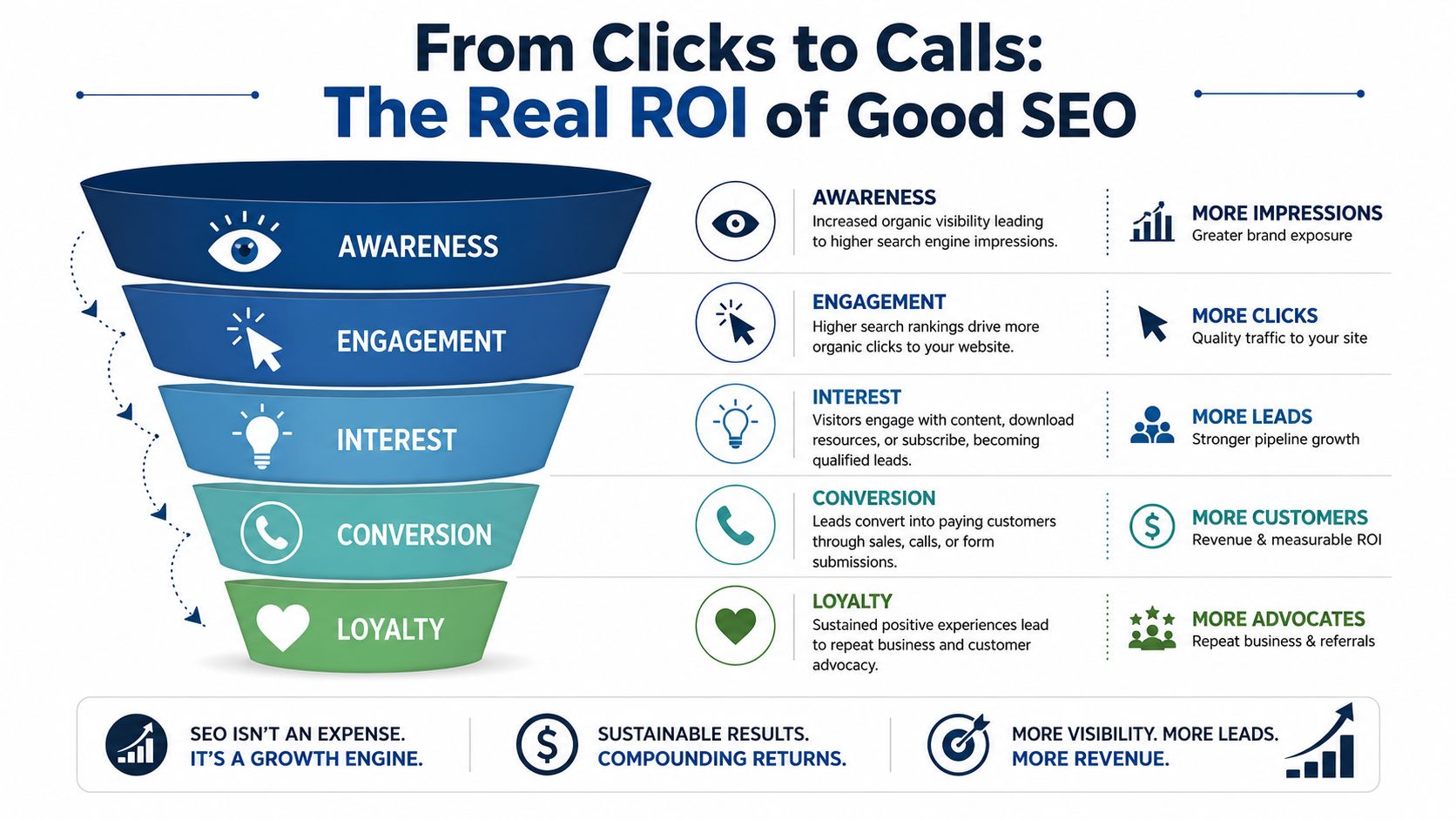
Here's a visual way to think about the journey from visibility to revenue.
What good SEO should create
A healthy campaign improves the numbers that matter to a small business:
- Better visibility: You show up for searches tied to your services and locations.
- Stronger clicks: More searchers choose your listing because it matches what they want.
- Higher intent enquiries: Visitors land on pages built for specific services, not vague waffle.
- More conversions: Calls, forms, bookings, and direction requests become more consistent.
- Less dependence on one channel: You are not stuck praying that ads, referrals, or social keep carrying the whole load.
That is the payoff. A steadier pipeline of enquiries from people already looking for what you sell.
Your SEO Hiring Checklist and Burning Questions
It is at this point that a lot of business owners either save themselves a fortune or set it on fire.
Your hiring checklist
Use this before signing anything.
- Ask what work happens every month: If they can't list tasks, priorities, and outputs, there's a problem.
- Ask how they handle technical SEO, content, local SEO, and authority: You want a complete picture, not one trick dressed as a strategy.
- Ask what happens if results are poor: Exit terms should be clear.
- Ask what access and ownership you keep: Your site, content, listings, and data should not be held hostage.
- Ask how reporting works: It should connect activity to enquiries, visibility, and useful business outcomes.
- Ask how they choose keywords: Good answers mention intent, services, geography, and competition.
- Ask what they won't do: A strong answer often reveals more than the sales pitch.
A local example. If you own a roofing company in Sheffield, and someone spends the whole sales call talking about “national authority metrics” without discussing your service areas, Google Business Profile, location pages, or lead quality, they're probably selling a template.
Burning questions
How long does SEO really take?
Usually longer than people hope, but faster than people think if the basics are awful and get fixed well. Technical clean-up, page improvements, and local optimisation can create movement before a broader strategy matures. The key is whether useful work is happening, not whether someone mutters “SEO takes time” to dodge accountability.
Is it cheaper to do SEO yourself?
It can be. It can also be expensive in a sneaky way because your time has value and mistakes slow everything down. If you're a self-employed decorator with the appetite to learn, you can absolutely improve basics yourself. If you run a growing firm with staff, vans, branches, and constant enquiries to manage, DIY SEO often turns into a half-finished shed project.
Why are some quotes miles cheaper than others?
Because some quotes include less work, less skill, or lower-quality tactics. Sometimes the cheap option is a tiny scope. Sometimes it's automation and outsourced filler. Sometimes it's grey hat or black hat dressed up in a blazer.
Should I choose a freelancer or an agency?
Choose the person or team with a clear plan, good communication, and transparent scope. The label matters less than whether they can do the work properly and explain it without fogging the room up.
What should I spend if I'm a small UK service business?
If you're serious about growth, treat £500 to £1,500 a month as the realistic range for proper foundational SEO in many service-led situations, especially as noted earlier. If you're in a tougher market or a larger city, expect the effort and the cost to rise with the competition.
You don't need the fanciest package on earth. You need the right level of work, done consistently, by people who aren't playing cowboys with your website.
If you want a straight-talking view of what your budget should buy, DigiVisi Ltd works with UK service-led businesses on SEO, local SEO, Google Business Profile optimisation, and conversion-focused websites. If you're weighing quotes and want clarity on what's sensible, what's fluff, and what's likely to move the needle, that's a good place to start.