Skip to content

You're probably in one of two camps right now. Either your clinic is good, good, but Google seems oddly unaware of that fact. Or your site does get traffic, yet the phone stays suspiciously quiet and the appointment diary has more gaps than you'd like.
That's where healthcare SEO stops being a marketing buzzword and starts being practical. A patient in Leeds with neck pain, a parent in Bristol searching for a same-week physio appointment, or someone in Manchester trying to work out whether a symptom is minor or worth getting checked. They go to Google first, not because they love search engines, but because it's there and their problem feels urgent.
Table of Contents
- What Is Healthcare SEO and Why Bother
- The Golden Rules of Healthcare SEO
- Your Technical SEO Health Check
- Winning Patients with Symptom-Led Content
- Dominating Your Local High Street Online
- Measuring What Actually Matters to Your Clinic
- Your Practical Healthcare SEO Checklist for 2026
What Is Healthcare SEO and Why Bother
A common scene. A private GP in Birmingham has a smart clinic, experienced staff, and a decent reputation with existing patients. Yet when someone nearby searches for help, the site sits beneath directories, NHS pages, and a handful of competitors who are not necessarily better, just easier to find.
That's healthcare SEO in plain English. It's the work that helps your practice appear for symptoms, services, clinicians, reviews, and local care options. Done properly, it connects medical expertise with the exact moment a patient needs reassurance or wants to book.
The scale is hard to ignore. In 2022, Google was used approximately 50 million times by people in the UK searching for information related to health issues, and 82.8% of patients used search engines specifically to locate a provider, according to Mayfly's hospital SEO research summary. That's not a niche behaviour. That's ordinary patient behaviour.
A simple example from a local clinic
Take a physiotherapy clinic in Sheffield. If its website only says “sports massage”, “physiotherapy”, and “rehabilitation”, it's speaking the clinic's language. Patients often search differently. They type things like “knee pain going downstairs”, “stiff neck after sleeping”, or “back pain at desk job”.
If your site doesn't meet those searches, Google has very little reason to show you.
Patients don't search like clinicians. They search like worried humans.
Healthcare SEO matters more in this sector than in many others because the consequences are more critical. A badly optimised page for a café is annoying. A badly written health page can damage trust in seconds. That's why the best-performing clinic sites combine accuracy, clarity, local relevance, and technical competence.
A small practice can absolutely compete. It just won't do it by publishing ten flimsy blog posts and hoping for the best. That approach belongs in the marketing recycling bin.
The Golden Rules of Healthcare SEO
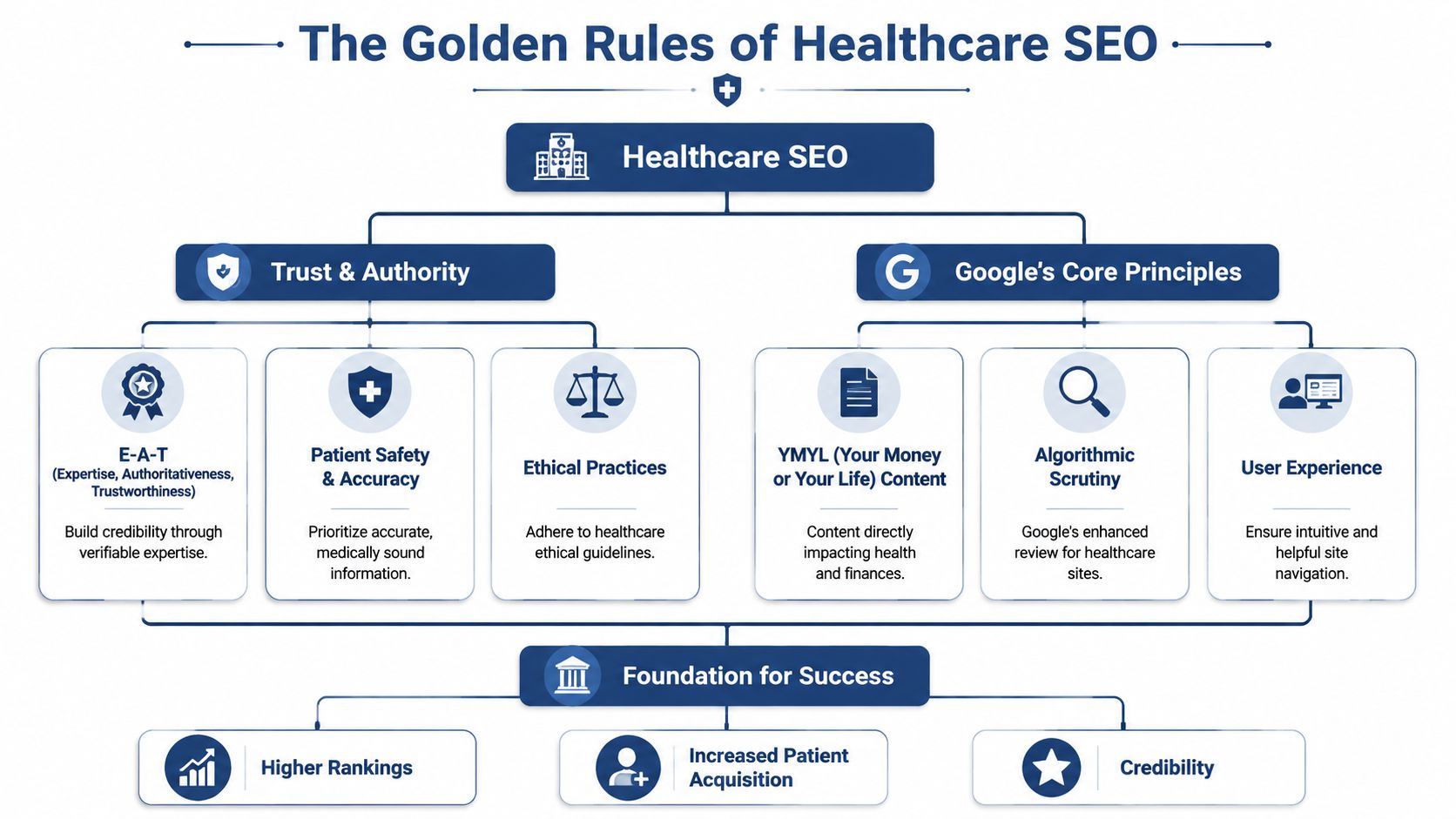
Healthcare SEO has stricter rules than standard local SEO. Google treats health content as YMYL, short for “Your Money or Your Life”. In other words, if your content could affect someone's health decisions, Google expects a much higher standard.
That's where E-E-A-T comes in. Experience, Expertise, Authoritativeness, and Trustworthiness. Not glamorous wording, I know, but it's useful. Imagine your digital waiting room. If the place looks careless, the advice feels vague, and no one can tell who the clinicians are, confidence drops immediately.
Trust comes before traffic
SEO can produce commercial results. UK pharmaceutical companies that prioritise SEO generate 50% more leads compared to those that do not, and 77% of patients use search engines before booking appointments, as noted in Varn Health's review of healthcare SEO statistics. For clinics, the lesson is simple. Visibility matters, but trust is what turns visibility into enquiries.
A trustworthy healthcare page usually includes:
- Named expertise with clinician bios, qualifications, registrations, and clear service responsibility
- Plain English explanations that answer patient questions without sounding like a medical textbook
- Clear safety language that explains when to seek urgent or emergency care
- Strong page intent so a symptom guide educates and a service page helps someone book
What white hat looks like in a clinic setting
White hat healthcare SEO is patient-safe and durable. It means medically reviewed content, accurate service pages, honest review handling, sensible internal linking, and proper local optimisation.
Grey hat sits in the murky middle. That includes things like over-optimised location pages with barely changed copy, or content that's technically original but written to manipulate rankings more than help patients. It can work for a while. It can also unravel at the worst possible time.
Black hat is the proper dodgy stuff:
- Fake reviews on clinic profiles
- Keyword stuffing into titles, footers, or service pages
- Invented medical claims or exaggerated outcomes
- AI-spun pages published without clinical review
Practical rule: If a tactic would make you uncomfortable explaining it to a regulator, don't put it on your website.
A clinic owner in Reading doesn't need tricks. They need a site that proves competence, answers the right questions, and gives Google enough evidence to trust it. That's the boring answer. It's also the one that works.
Your Technical SEO Health Check
Technical SEO isn't the flashy bit, but it's the bit that stops good content from disappearing into the loft. For healthcare sites in the UK, the foundations need to be sturdy because patients are often searching on a phone, in a hurry, and with very little patience for clunky design.
The three checks that matter most
First, make sure the site works properly on mobile. If a patient in Liverpool lands on your page with a sore shoulder and the booking button is hiding beneath a giant banner, they won't persevere out of politeness.
Second, treat accessibility as a minimum requirement, not a nice extra. Implementing WCAG 2.1 AA accessibility compliance is a minimum standard for healthcare SEO in the UK, and that should shape design, content contrast, keyboard navigation, labels, and forms, as outlined in Wheelhouse DMG's healthcare SEO guide.
Third, use schema properly. The same source notes that precise JSON-LD schema such as Physician and MedicalClinic is mandatory to trigger rich results that significantly increase appointment bookings. In practical terms, that means your clinician pages should clearly identify the person, their credentials, affiliation, and service context. Your location pages should clearly identify the clinic itself.
A compact health check looks like this:
| Check | What good looks like | Local example |
|---|---|---|
| Mobile usability | Buttons easy to tap, forms easy to complete, pages readable on a phone | A Croydon podiatry clinic lets users call or book without pinching and zooming |
| Accessibility | WCAG 2.1 AA principles applied across templates and forms | An older patient can navigate a hearing clinic site with keyboard controls |
| Structured data | Valid JSON-LD for clinicians and clinic locations | A Bristol dental implant page clearly identifies the practitioner and the practice |
Privacy and patient data need grown-up handling
Healthcare sites also need careful thinking around forms, messaging tools, and follow-up systems. If your website invites patients to share sensitive information, you need systems that handle that responsibly.
For clinics reviewing software options for secure communications and data handling, this overview of HIPAA compliant software is a useful reference point. The regulatory context differs in the UK, of course, but the practical lesson still applies. Don't bolt random tools onto a healthcare website and hope they behave themselves.
What doesn't work technically?
- Bloated themes with too many scripts
- Template pages that all look the same to Google
- Missing schema on clinician and location pages
- Accessibility ignored until complaint stage
You don't need a massive rebuild every year. You need regular maintenance. A clinic website should behave like a well-run practice. Calm, clear, accessible, and not held together with digital chewing gum.
Winning Patients with Symptom-Led Content
Most clinics build content around services first. “Private GP in York.” “Physiotherapy clinic in Leicester.” “Osteopath services in Manchester.” Those pages matter, but they're only half the picture.
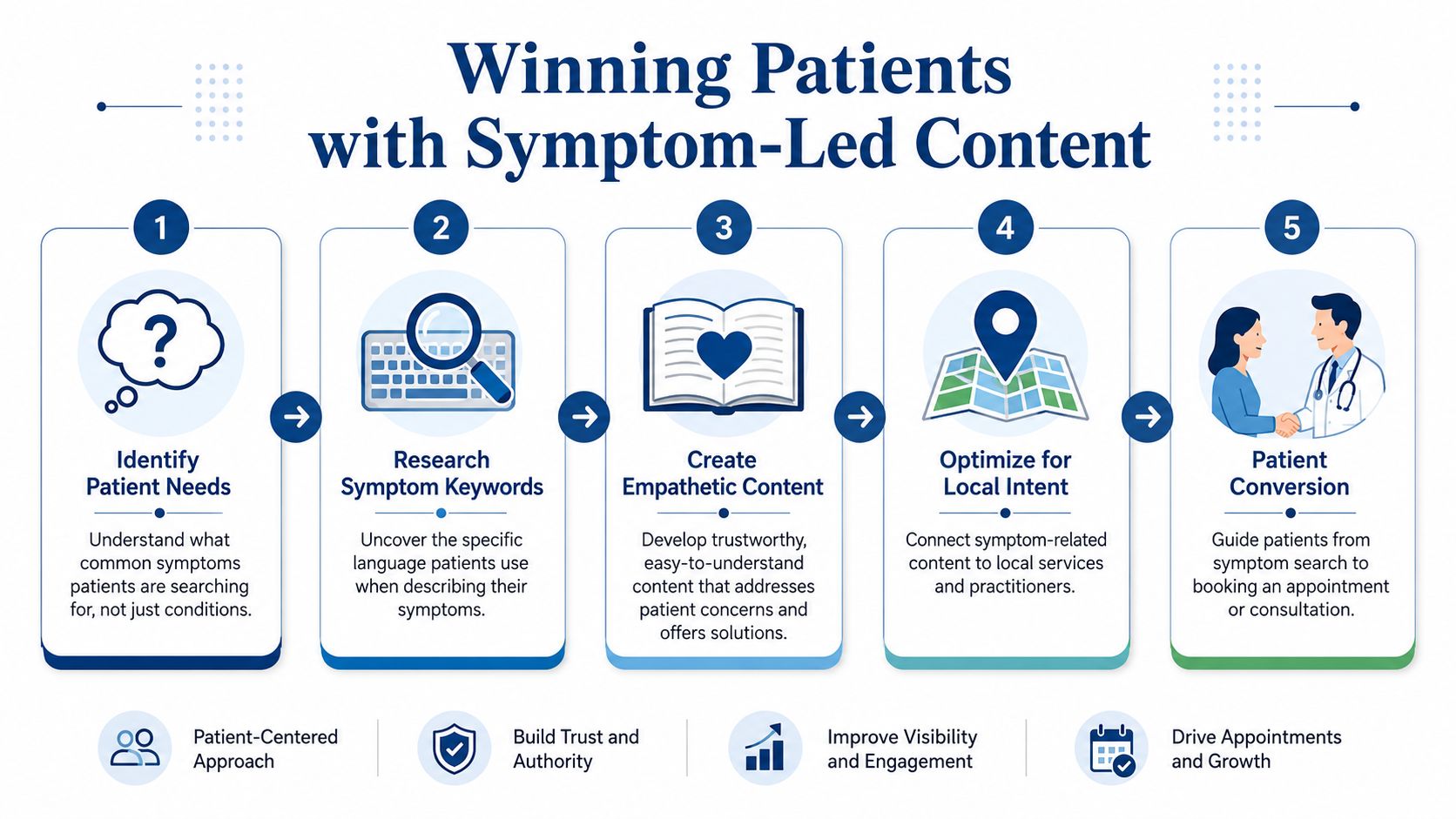
The more interesting opportunity sits higher up the search journey. Data from UK search trends shows 60-70% of initial patient queries are symptom-driven, not service-driven. Yet most clinics fail to create dedicated, medically-reviewed symptom pages, missing a massive opportunity for high-intent local conversions.
Why service pages alone leave money on the table
A patient doesn't always know what service they need. They know what they feel.
Someone in Manchester may not search for “osteopath”. They may search for “lower back pain after sitting all day” or “back pain office worker help”. A parent in Nottingham may not search for “paediatric ENT consultation”. They may search for “child snores every night and mouth breathing”.
That's why the standard service-first strategy falls short. It assumes patients already speak your language. Many don't, especially at the beginning.
A symptom page is often the bridge between worry and booking.
A good symptom-led approach helps both the user and your rankings because it mirrors real search behaviour. It also supports E-E-A-T better than generic blog fluff. If a clinician reviews a page on “persistent knee ache after running”, explains likely causes in plain English, outlines warning signs, and links to the appropriate service page, that's useful. It feels specific because it is.
Here's a simple contrast:
| Approach | Typical page | Problem | Better alternative |
|---|---|---|---|
| Service-first only | “Physiotherapy Services” | Too broad for many early searches | Add pages for symptom themes such as desk-related back pain |
| Generic blogging | “5 Reasons You Might Feel Pain” | Vague and forgettable | Build a local symptom guide with clear next steps |
| Symptom-first | “Lower back pain in office workers” | Matches real patient language | Links naturally to booking and treatment pages |
Later in the section, this walkthrough is worth watching if you want another angle on patient-focused search behaviour:
How to build a symptom page that actually works
A useful symptom page isn't a panic-inducing essay and it isn't a veiled sales page. It needs balance.
For a small clinic, this is the basic blueprint:
Start with the symptom in plain language
Use the words a patient would type. “Sharp pain behind right eye” works better than trying to sound lofty.Acknowledge the concern clearly
Explain what the symptom may relate to in general terms. Keep it medically careful.Include safety guidance
Tell readers when they should seek urgent help rather than wait for a routine appointment.Connect symptom to service
If your clinic treats likely underlying issues, link naturally to the relevant service page and clinician page.Anchor it locally
A Manchester osteopath can write for office workers in the city centre. A Norwich clinic can reference runners training around local parks. Real context helps.
What usually fails is predictable:
- Thin AI copy with no clinician oversight
- Symptom pages that diagnose too aggressively
- No route to action, so readers get information but no next step
- No local relevance, which weakens conversion for smaller clinics
A symptom-first model doesn't replace service pages. It feeds them. That's the nuance most healthcare SEO advice misses, and it's why smaller practices often have a genuine opening against bigger brands.
Dominating Your Local High Street Online
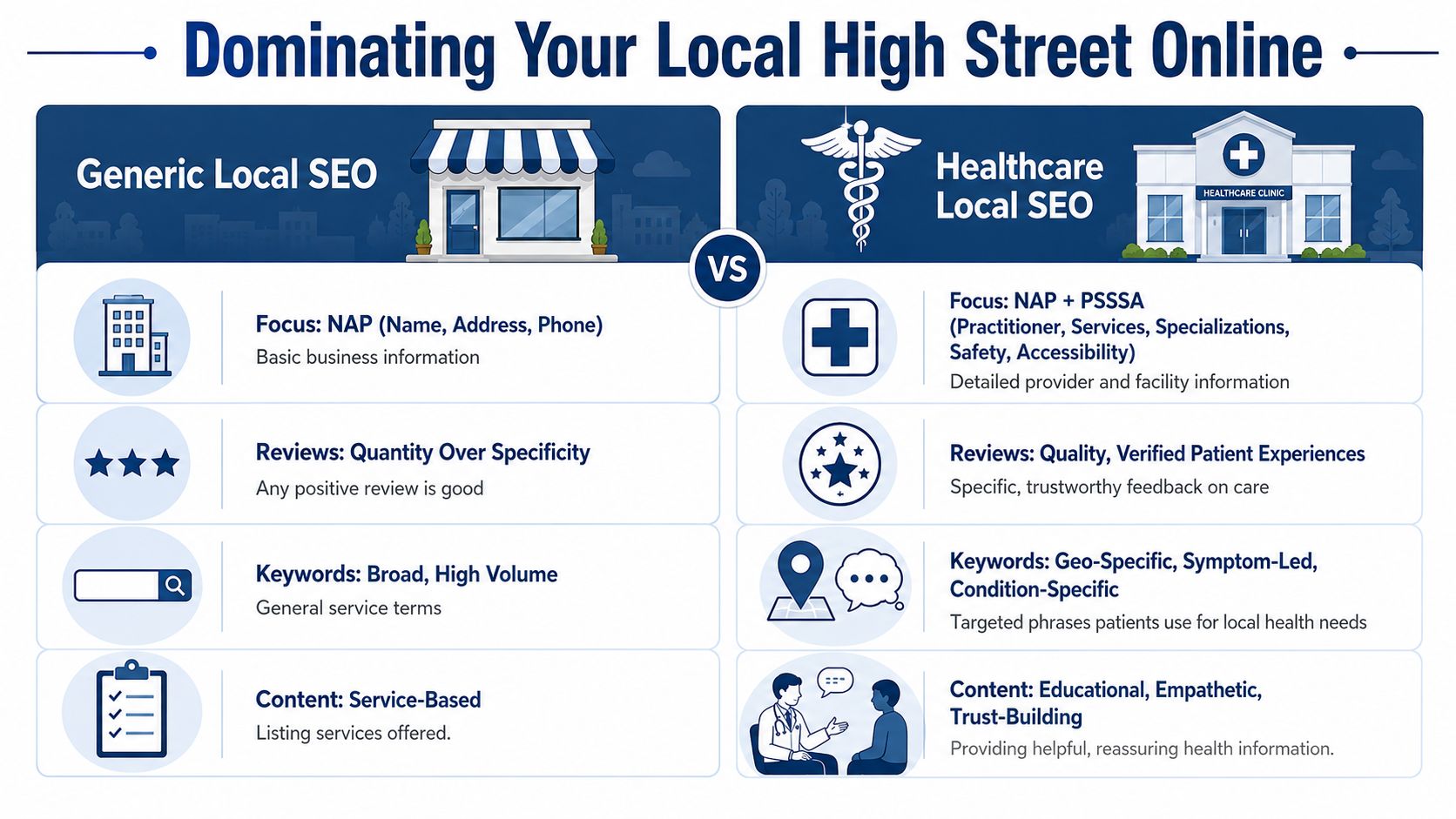
Local healthcare SEO is less about “being everywhere” and more about being unmistakably credible in the area you serve. If you run a clinic in Solihull, your goal isn't vague national visibility. It's to become the obvious local option when someone nearby searches, compares reviews, and decides where to book.
Your clinic profile should be the star
A common mistake is letting visibility scatter across practitioner profiles instead of building authority around the clinic's main Google Business Profile. That can dilute trust and split review signals.
In the UK, 85% of patients trust a clinic's overall Google Business Profile review count over individual doctor ratings, and a clinic-centric review approach can boost local pack visibility and click-through rates by up to 30%. That doesn't mean you manipulate reviews or play games. It means you design your process so satisfied patients are encouraged to review the main clinic profile where appropriate and ethically.
That has practical benefits:
- Stronger clinic identity for branded and non-branded local searches
- Cleaner reputation signals instead of scattered practitioner profiles
- Better user experience because patients compare one primary profile, not five half-built ones
If you've got one location, build one unmistakable local reputation first.
For clinics that want to assess where local weaknesses sit, a proper local SEO audit can show whether the issue is profile setup, citations, location pages, review handling, or all four having a mild argument with each other.
Local pages need local truth
Your Google Business Profile matters, but your website still has to support it. Local pages shouldn't read like copy-paste town swaps. The principle used in strong local SEO is simple. Each page needs unique local detail. In other sectors, one cited benchmark is 500 to 800 words of unique local content on dedicated area pages, including real local references, as described in Red Eagle's local SEO example. The exact page format for healthcare will differ, but the lesson holds.
For a clinic, that means:
- Real service coverage such as “patients from Didsbury, Chorlton, and Sale”
- Local context like commuter back pain, student sports injuries, or family-focused GP demand
- Consistent NAPW details across your site and listings
- A clear booking path from local page to contact or appointment action
What doesn't help is building twenty town pages with the same wording and changing only the place name. Google has seen that trick so many times it could probably recite it from memory.
The clinics that win locally usually do the basics very well. Accurate profile data. Strong main clinic reviews. Sensible local pages. Good service information. No theatrics.
Measuring What Actually Matters to Your Clinic
A lot of clinic owners get monthly SEO reports that say plenty and reveal very little. Impressions up. Average position moving. Graphs in three shades of blue. Lovely. But did more suitable patients call, enquire, or book? That's the bit that pays wages.
The numbers worth watching
For a small practice, the best measures are usually the simplest:
- Phone calls from organic search so you know SEO is driving real conversations
- Appointment form submissions from service and symptom pages
- Clicks to call from mobile
- Google Business Profile interactions such as calls, direction requests, and website visits
- Page-level conversion patterns so you can spot which content attracts action
A podiatry clinic in Newcastle doesn't need a report obsessed with broad rankings across random phrases. It needs to know whether the foot pain page leads to bookings and whether local searches are turning into calls.
Reporting without the usual fog
Good reporting joins SEO data to business outcomes. It doesn't drown you in vanity metrics. If you're reviewing how agencies structure dashboards and explain performance, Oviond's insights on agency reporting are useful because they focus on turning platform data into something decision-makers can read.
A practical monthly review should answer four questions:
| Question | Why it matters |
|---|---|
| Which pages brought enquiries? | Shows what content deserves expansion |
| Which pages attracted visits but no action? | Flags weak calls to action or mismatched intent |
| Which local areas produced leads? | Helps refine location targeting |
| Where did patients drop off? | Shows usability or trust problems |
Rankings are a clue. Bookings are the verdict.
Paid search can support this process nicely. If a service is high value and highly competitive, Google Ads can test demand while SEO matures. Conversion rate optimisation also matters. There's no point dragging in more traffic if your booking form feels like a tax return.
Your Practical Healthcare SEO Checklist for 2026
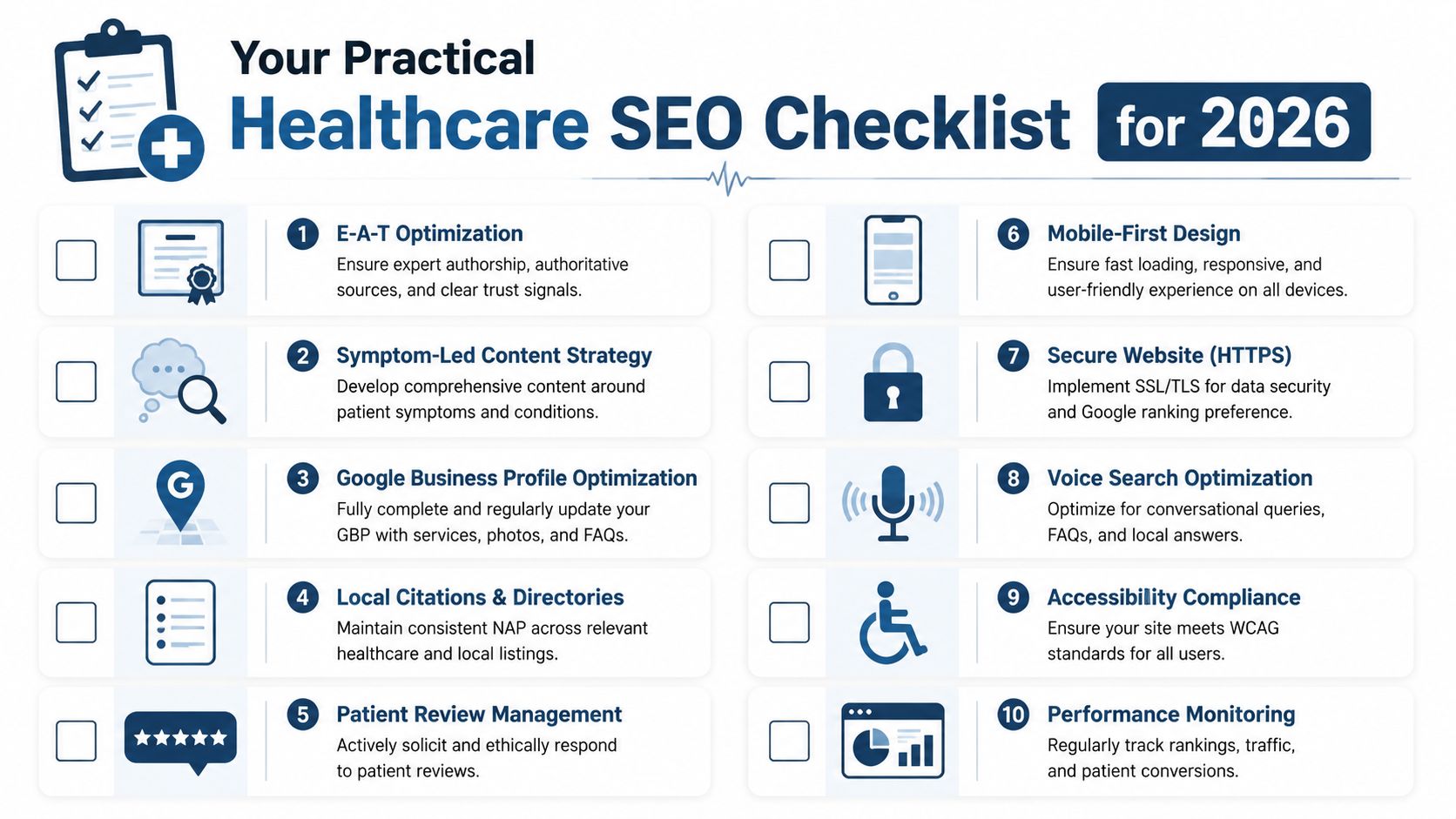
You don't need to tackle everything at once. You do need a sequence that stops the usual chaos of random blog posts, half-finished technical fixes, and local profiles that haven't been touched since the Jubilee.
Technical foundations
Start here, because weak foundations make every later task harder.
- Check mobile usability on real phones, not just in a desktop preview
- Review accessibility against WCAG 2.1 AA as an ongoing practice
- Validate schema markup on clinician and clinic pages
- Tighten contact paths so every important page has an obvious next step
- Secure form handling and review what patient information you collect
Content and trust signals
Many clinics either do excellent work in this area or publish bland filler that no one remembers.
- Rewrite thin service pages so each one explains who it helps, what happens next, and who provides the care
- Create symptom-led pages for common patient concerns in your specialty
- Add clinician bios with qualifications, areas of focus, and review involvement where relevant
- Use medically careful wording with clear urgent-care guidance where necessary
- Keep content current so old pages don't become inaccurate
Local visibility and review handling
This is the practical local layer that turns a decent site into a patient acquisition tool.
Choose one primary clinic profile strategy
Don't split your reputation unless there's a clear operational reason.Complete every field in your Google Business Profile
Services, opening hours, images, and appointment details all matter.Align your NAPW everywhere
Your website, directories, maps listings, and profile details should match.Build local pages
Mention real areas, local patient needs, and the services available from that location.Ask for reviews ethically and consistently
Train reception or follow-up staff to make it part of the process.
Measurement and improvement
This final part keeps the strategy honest.
- Track calls and forms by page type
- Review symptom pages separately from service pages, because they play different roles
- Watch user behaviour on mobile booking journeys
- Improve weak pages monthly instead of endlessly publishing new ones
- Compare lead quality, not just lead volume
A strong healthcare SEO plan for a small UK clinic is usually quite unglamorous. Clear information. Sound technical setup. Local trust. Sensible measurement. That may not sound thrilling enough for a LinkedIn motivational post, but it's the work that fills diaries.
If you want help turning all of this into a practical growth plan, DigiVisi Ltd works with UK service-led businesses on technical SEO, local visibility, content strategy, Google Business Profile optimisation, and conversion-focused lead generation. If your clinic needs more than vague reports and wants a clearer route to calls and enquiries, they're well worth a look.