Skip to content
You're probably in one of two camps right now.
Either your business is good, your customers are happy, and referrals keep you ticking along, but Google feels like a locked front door. Or you've had a few chats about SEO already and come away none the wiser, clutching a proposal full of jargon, vague promises, and enough buzzwords to make your kettle give up.
That's where most small business owners get stuck. A plumber in Preston, a solicitor in Stockport, a roofer in Rochdale, a beauty clinic in Basingstoke. Same problem. Brilliant at the actual job, patchy visibility when local customers search, and no clear idea what “local SEO services for small business” should include, cost, or achieve.
The good news is this doesn't need to be complicated. Local SEO is practical. It's about making sure the right people find you, trust you, and contact you before they ring someone else.
Table of Contents
- Are You Your Town's Best Kept Secret?
- What Exactly Am I Paying For?
- Spotting the Good The Bad and The Downright Dodgy
- Choosing Your Growth Plan SEO Packages Explained
- Your Checklist for Choosing the Right SEO Partner
- From Kick-Off to First Call A Realistic Timeline
- Your Local SEO Questions Answered
Are You Your Town's Best Kept Secret?
A customer in Halifax needs a locksmith at 8:30pm. They search on their phone, scan the map, check the reviews, and ring one of the first few names they trust. If your business does not show up there, being better at the job does not help. You are invisible at the exact moment someone is ready to buy.

That gap costs small firms more than they think. Google explains in its local search advertising guidance that local queries often lead to quick action, especially on mobile, because queries are typically made with a specific place and need in mind, not for casual browsing. In smaller UK towns, that matters even more. Search volume is lower, so every missed local click is a bigger slice of the market gone.
A lot of owners assume local SEO is about chasing huge rankings across the country. Wrong target. A roofer in Rugby or a dental practice in Dumfries does not need national attention. They need to be the obvious local option in Google Maps, local organic results, and now AI-generated answers that summarise nearby businesses before people even click.
That last bit gets ignored far too often.
Google's AI Overviews are starting to shape how people discover local businesses. If your site and business profile do not clearly state what you do, where you work, and why customers trust you, AI systems have very little to work with. The firms that win are usually the ones with clean service pages, consistent business details, strong reviews, and clear local proof. That is one reason optimizing your local search presence now needs to cover more than the old map pack basics.
The silent phone problem
A decorator in Warrington can have a tidy website, a Facebook page that gets the odd update, and six reviews from three years ago. That still will not produce calls if the business sends weak local signals.
If your Google Business Profile is incomplete, your service areas are muddled, your contact details differ from one platform to another, and your website barely mentions the towns you serve, Google has no clear reason to put you in front of local searchers. Neither do AI-generated search summaries.
Practical rule: If a new customer cannot tell in ten seconds what you do, where you work, and why they should trust you, your local visibility is weaker than it should be.
This is also where small business owners get misled by cheap SEO packages. A £99-a-month offer that promises “more traffic” means very little if it ignores the basics that drive local enquiries in the UK. In a smaller town, one well-optimised profile and a site that properly covers your key services and locations will beat a lot of generic SEO busywork.
Local SEO is not mysterious. It is clear positioning, accurate business information, and trust signals that match what local customers are already looking for.
You do not need to become famous across the UK. You need to stop being your town's best kept secret.
What Exactly Am I Paying For?
You should be able to look at an SEO quote and tell, in plain English, what work is being done each month.
If you cannot, do not buy it.
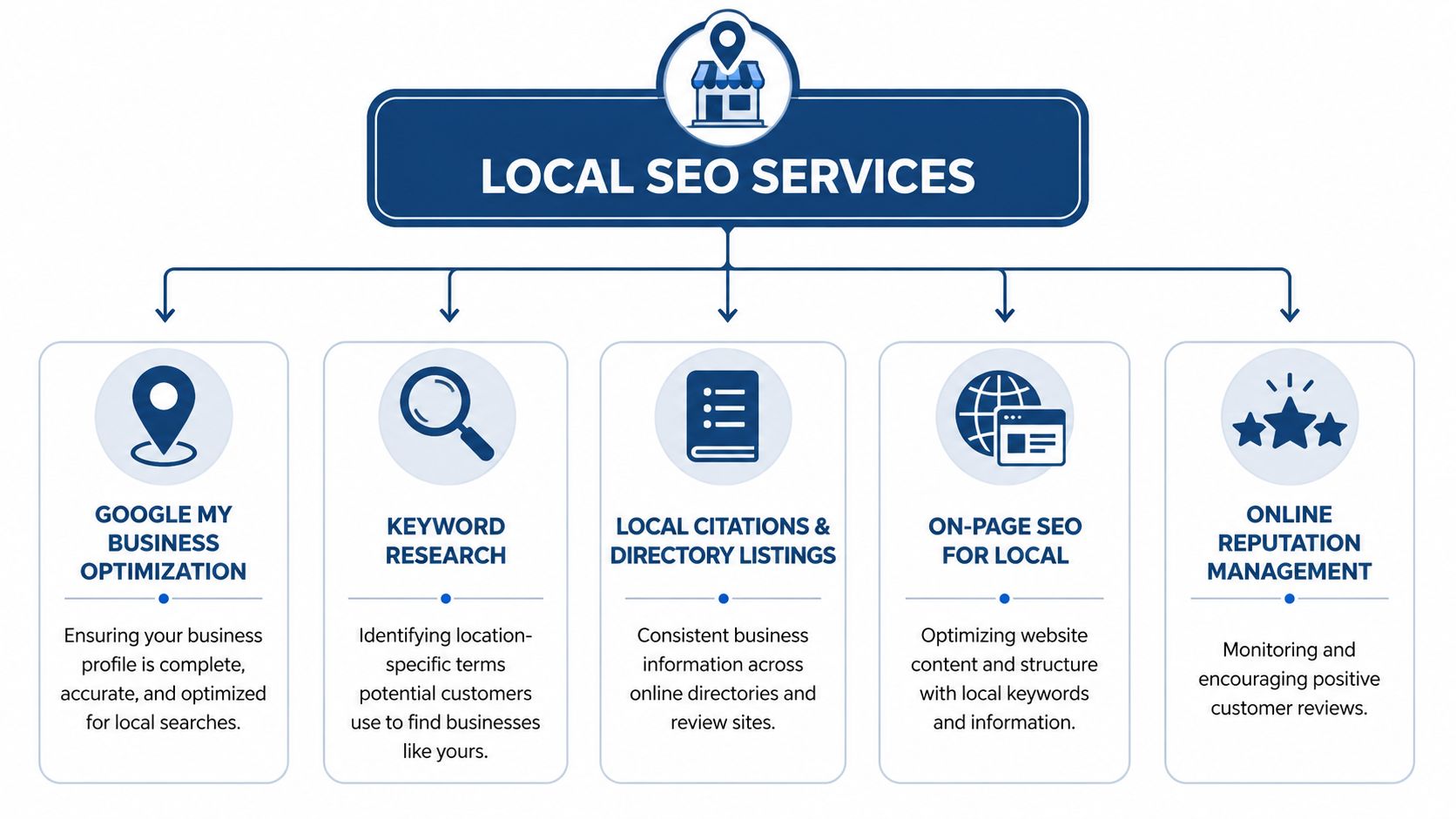
A proper local SEO service for a small business is not a bag of vague promises. It is a shortlist of jobs that help people in your area find you, trust you, and contact you. That matters even more in smaller UK towns, where one strong Google Business Profile, a decent website, and a steady flow of reviews can beat bigger firms with sloppier basics. It also matters for AI Overviews, because these systems pull from the same trust signals, business details, and page clarity that support local rankings.
Your Google Business Profile is the first thing to fix
For a lot of local firms, this profile does more sales work than the homepage.
If you are a plumber in Preston, your profile needs the right primary category, sensible secondary categories, accurate services, working contact details, opening hours, proper photos, and a business description that says what you do. Your service areas need to reflect where you really work, not a wish list of every town within fifty miles.
Good monthly SEO should cover:
- Profile optimisation: Improving categories, services, descriptions, photos, and service areas so Google can match you to the right searches.
- Ongoing updates: Adding fresh photos, checking for unwanted edits, refining services, and keeping business details accurate.
- Review responses: Replying properly, because a silent profile looks unattended.
Your website should support rankings and enquiries
A local website has one job. Make it obvious what you do, where you do it, and why someone should call you.
That means your pages need clear titles, headings, service copy, internal structure, schema markup, and location context. It also means building pages around real services and real towns, instead of stuffing the same paragraph with swapped-out place names. If you are a roofer in Reading, you need a solid page for roof repairs, another for new roofs, and copy that reflects the places you serve.
This also helps with AI-generated answers. If your site is vague, thin, or inconsistent, you are less likely to be cited or echoed in AI Overviews for local searches.
Good local SEO copy should make sense to a customer scanning fast on their phone and to a search engine trying to confirm relevance.
Citations, links, and reviews are part of the bill
This is where cheap packages often fall apart on value.
You will see low-cost offers that mention rankings, then spend almost no time on the trust signals that help local businesses win leads. A decent service should include citation checks, directory cleanup, local link work, and a review plan that gets more genuine feedback from customers.
That usually includes:
- Citation consistency: Your business name, address, phone number, and website match across key directories.
- Local link building: Mentions from local organisations, trade bodies, news sites, sponsorships, and community pages.
- Review strategy: Asking for reviews at the right moment and replying in a way that reassures the next person reading them.
BrightLocal reports that consumers expect businesses to respond to reviews, and Google Business Profiles with stronger engagement earn more attention in local search. The point is simple. If your profile gets seen but looks neglected, you are paying for visibility without giving people a reason to choose you.
A good provider should be able to break the fee down by activity. Setup work. Monthly improvements. Reporting. Review support. Content updates. Profile management. If all you get is a ranking chart, a branded PDF, and a friendly invoice, you are not buying much SEO. You are buying theatre.
Spotting the Good The Bad and The Downright Dodgy
SEO has three camps. White hat, grey hat, and black hat.
White hat is the grown-up option. It builds visibility by improving your website, your local profile, your content, your reputation, and your relevance. It takes work, but it lasts.
Grey hat cuts corners. Black hat brings a shovel and starts digging your website's grave.

What white hat SEO looks like
If you hire someone decent, they'll talk about your customers, your service areas, your competitors in the map pack, your conversion pages, and your reviews. They'll ask sensible questions.
A white hat approach for a locksmith in Leeds might include fixing thin service pages, improving internal links, tidying citations, adding proper local schema, and building location relevance through content and profile work. Boring? Maybe. Effective? Absolutely.
You'll also get realistic language. No sane SEO consultant promises instant domination. Search visibility is earned.
The warning signs you should not ignore
A dodgy SEO pitch usually gives itself away quickly. Watch for these:
- Guaranteed rankings: Nobody controls Google. Anybody promising “number one” is either naive or trying it on.
- Suspiciously cheap monthly fees: If it costs less than a takeaway for four, you're probably buying automation, spam, or neglect.
- Secret methods: If they can't explain the work in plain English, assume the plain English version sounds terrible.
- Bulk link schemes: Hundreds of random backlinks from irrelevant sites are not authority. They're clutter.
- Keyword stuffing: If your homepage reads like “plumber Bristol emergency plumber Bristol cheap plumber Bristol”, run.
A black hat operator is the digital version of a cowboy builder. Fresh paint on the front, chaos behind the walls.
If an SEO service sounds like a loophole, it usually becomes a liability.
Here's a decent video primer on SEO scams and warning signs if you want to sharpen your nonsense detector:
Why the middle ground still bites
Grey hat tactics tempt owners because they often look harmless. Maybe it's spun location pages with barely changed wording. Maybe it's fake local listings. Maybe it's buying links from rubbish sites that happen to have a UK flag slapped on the footer.
The trouble is simple. You're not building a durable local presence. You're propping up rankings with tactics that can wobble the moment Google tightens up or a competitor does the basics better.
For small businesses, that's a rotten trade. You don't need tricks. You need visibility that survives the next update and keeps the phone ringing next season too.
Choosing Your Growth Plan SEO Packages Explained
A roofer in Ripon and a solicitor in central Manchester should not be sold the same SEO package.
That sounds obvious, but plenty of agencies still do it. They put three shiny price tiers on a page, swap the business name in the proposal, and call it strategy. For small businesses in UK towns, that approach wastes money fast. The right package depends on how competitive your patch is, how strong your Google Business Profile already is, and whether you need more visibility in Maps, organic search, or AI-generated answers.
The three package levels that actually make sense
Most local SEO packages fall into three practical groups.
Foundations fits newer businesses, firms with patchy local visibility, or owners who have never had proper local SEO work done. You want the basics fixed properly. That usually means an audit, Google Business Profile setup or cleanup, citation consistency, service page improvements, local keyword targeting, and simple monthly reporting. In smaller towns, this can be enough to get traction because the competition is often weaker and the gaps are more obvious.
Authority suits businesses that already show up occasionally but are not getting steady enquiries. At this level, the provider should be improving pages regularly, building out locally relevant content, tracking competitors more closely, strengthening internal links, and giving proper attention to reviews and trust signals. This is often the sweet spot for established trades, clinics, accountants, and legal firms in decent-sized towns.
Market Leader is for businesses in tougher markets or firms covering multiple areas. You are paying for wider keyword coverage, location-focused landing pages, heavier content production, stronger authority work, and tighter coordination between your website, Google Business Profile, and conversion tracking. If your competitors are active and competent, a lightweight package will not shift much.
What you are usually paying for
The price difference should come from workload and difficulty. Nothing else.
In practical terms, lower-cost packages tend to cover setup, cleanup, and a limited amount of monthly work. Mid-range packages should include ongoing optimisation that keeps building visibility month after month. Higher-cost packages should involve more content, more page-level work, more competitor research, and more attention across several service areas or locations.
For UK pricing, the broad pattern is familiar. Smaller local campaigns often sit in the low hundreds per month, while more competitive or multi-location work climbs well beyond that. One-off setup projects also vary depending on how much fixing is needed. If you want a real-world example of how agencies structure this, DigiVisi's UK SEO package structure shows the difference between foundational work and broader growth campaigns clearly.
The main point is simple. A business in a smaller town does not always need a big-city budget. It does need a package built around the actual opportunity in its area.
Small-town SEO pricing gets misunderstood
Many owners often get talked into the wrong retainer.
If you serve a town where the map pack is full of neglected profiles, weak websites, and inconsistent business details, paying for a heavyweight campaign from day one is often overkill. You will usually get better value from fixing the basics thoroughly, then adding more content and authority work once rankings and enquiries start moving.
The reverse is also true. If you are in a crowded market and several competitors already have strong reviews, well-built location pages, and active profiles, a bargain package will probably keep you treading water.
Packages now need to cover AI visibility too
Local SEO is no longer just about ten blue links and the map pack. Your business also needs a chance of being cited or summarised in AI Overviews and other AI-generated local answers.
That means good packages should include clear service pages, accurate business information, strong topical coverage, useful FAQs, and content that answers the actual questions people ask before they call. If an agency still talks as if local SEO stops at rankings, they are behind. This guide to generative engine optimization is a useful primer because it explains the overlap between classic SEO and visibility in AI-driven results.
Local SEO Package Comparison
| Feature | Foundations (Getting Started) | Authority (Growing Strong) | Market Leader (Dominating Locally) |
|---|---|---|---|
| Best for | Newer firms or weak local visibility | Established local firms wanting stronger lead flow | Competitive sectors or multi-location SMEs |
| Google Business Profile | Setup, cleanup, core optimisation | Ongoing optimisation and refinement | Advanced competitor-led optimisation |
| Website work | Core service pages and local signals | Deeper service page improvements | Broad site architecture and location expansion |
| Citations | Cleanup and consistency fixes | Maintenance and selective additions | Wider authority building |
| Content | Essential pages | Regular local content support | Aggressive local topic coverage |
| Reporting | Basic tracking and visibility updates | Broader lead and ranking reporting | Full strategic reporting with deeper review |
Buy the package that matches your town, your competition, and your growth target. Not the one with the fanciest label.
Your Checklist for Choosing the Right SEO Partner
This bit matters more than owners think. A weak SEO provider can drain budget for months while producing lovely reports and very little else.
The fix is simple. Ask sharper questions.
The checklist
Use this when you speak to anyone offering local SEO services for small business:
- Ask how they assess your town: A proper strategy for a business in Stourbridge should differ from one in Birmingham. If they don't talk about local competition, they're guessing.
- Check what happens to your Google Business Profile: You want active optimisation, not a one-off setup followed by silence.
- Look for competitor analysis: They should be able to explain how they review the businesses already showing in your map results and organic rankings.
- Check whether they work on conversions: Ranking is useful. Calls and enquiries are better.
- Ask how they report progress: You want visibility on rankings, traffic trends, profile activity, and leads where possible. Not just screenshots and good vibes.
- Test whether they can explain the work clearly: If they hide behind jargon, they probably hide weak execution too.
Questions worth asking on the first call
Don't ask soft questions like “How long have you been doing SEO?” That gets you polished sales patter.
Ask these instead:
What would you fix first on my site and profile?
Good answers are specific. Weak answers sound recycled.How do you decide what my competitors are doing better than me?
You want a process, not hand-waving.How do you measure success beyond rankings?
Any provider worth listening to should care about leads, calls, enquiries, and booked work.What's your plan for AI Overviews and generative search?
Plenty of providers go oddly quiet on this front. A 2026 BrightLocal study found only 12% of UK local SEO providers explicitly include AI exposure strategies like llms.txt or structured data for generative engines in their packages. That leaves a wide opening for businesses that get ahead of it.How do you use reviews in the strategy?
If their answer is just “get more”, that's half-baked.
If your business uses short explainers, walk-throughs, or before-and-after clips as part of trust-building, tools and insights for video automation can also help you keep local content moving without turning your week into a film shoot.
The right SEO partner should make you feel better informed after ten minutes, not more confused.
From Kick-Off to First Call A Realistic Timeline
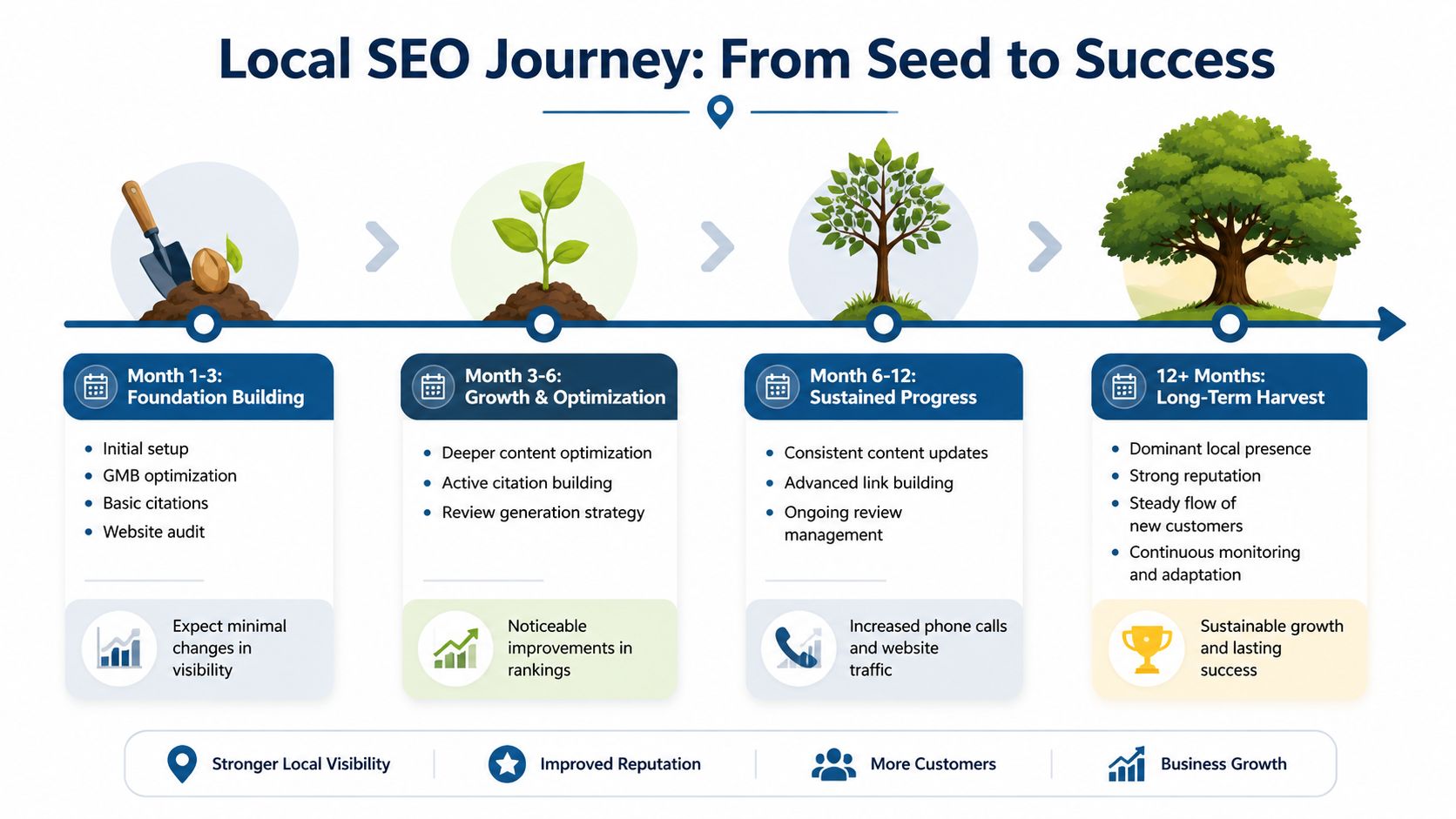
Local SEO is not instant. It's more like sorting out a neglected garden than flicking on a light switch. You clear the mess, improve the structure, plant the right things, and then the results start showing.
That's why unrealistic promises are such a bad sign. A sensible campaign has momentum, not miracles.
Months 1 to 2
This is the groundwork phase. A heating engineer in Huddersfield might start with a technical site audit, Google Business Profile cleanup, citation consistency checks, page rewrites, and local keyword mapping.
You might not feel fireworks yet. That's normal. The point here is to remove the obvious friction that stops Google trusting your business properly.
Typical early wins include:
- Profile improvements: Better categories, services, images, and business information.
- Website fixes: Stronger service pages, improved titles, clearer local relevance.
- Tracking setup: So you can see what changes over time.
Months 3 to 4
Movement usually starts to become visible. Rankings can begin to improve for service-plus-location searches. Your profile may show up more often for nearby queries. More people may click through and compare you properly.
A solicitor in a medium-sized town might notice more impressions in local search and a few stronger enquiries landing through the website. Not a tidal wave. Just enough to show the machine is working.
Early local SEO success often looks modest from the outside. Better visibility, more profile actions, sharper enquiries. Those are the signs to watch.
Months 5 to 6
By now, the campaign should be building on a cleaner foundation. Reviews are helping, content is supporting more searches, your service pages are better aligned, and your profile looks active and trustworthy.
This is often when owners stop asking “is this doing anything?” and start noticing that better-fit leads are coming through. The exact pace varies, but local SEO usually starts showing measurable improvements within three to six months, as noted earlier in the pricing discussion.
The businesses that do well over time are the ones that keep going. They don't treat local SEO like a one-off spring clean. They treat it like ongoing maintenance for a sales channel that compounds.
Your Local SEO Questions Answered
Can I do local SEO myself?
Yes, if you stick to the jobs that are simple, repeatable, and close to the business. You can keep your Google Business Profile accurate, ask happy customers for reviews, tighten up service descriptions, and fix inconsistent name, address, and phone details across directories.
The trouble starts when local SEO turns into a monthly discipline instead of a weekend tidy-up. Small business owners in places like Shrewsbury, Ayr, or Taunton usually have the same problem. Client work comes first, marketing slips, and the profile goes quiet. That is often the point where paying for help starts to make sense.
What matters more, my website or my Google Business Profile?
Treat them as a pair. Your Google Business Profile gets you into the shortlist. Your website convinces people to call.
That balance matters even more now because local search is changing. Google still shows the map pack, but AI Overviews are starting to summarise local options and pull details from multiple sources. If your profile is active but your site says very little, you look thin. If your site is good but your profile is neglected, you lose visibility before anyone reaches it.
How long does local SEO really take?
Expect progress over months, not days. As noted earlier, a fair timeline for measurable local improvement is usually three to six months.
That does not mean silence until month six. You might see earlier signs like more profile views, more direction requests, better rankings for service-and-town searches, or stronger enquiry quality. The exact pace depends on your town, your competition, and how much fixing is needed at the start. Anyone selling instant rankings is selling nonsense.
Is cheap local SEO worth it?
Usually no.
Cheap local SEO often means one of three things. Bare-minimum work. Templated reports with no real action behind them. Or risky tactics that look busy for a month and leave you with a mess later. A smaller monthly budget can still work well, especially in a lower-competition town, but the work needs to be specific and useful. Fewer tasks done properly beats a long list of filler every time.
Do smaller towns need smaller packages?
Often, yes, leading to plenty of UK businesses getting overcharged. A locksmith in a smaller town does not need the same local SEO package as a firm fighting across Manchester or Birmingham.
You should be paying for the level of competition, the number of locations, the state of your website, and the amount of content and profile work needed. You should also ask whether the package includes work that helps you show up in AI-generated search summaries, not just old-school rank tracking. That part is still missing from a lot of local SEO packages, and it should not be.
If you want a straightforward second opinion on your current visibility, pricing options, or what a sensible local SEO plan should look like for your town, DigiVisi Ltd works with UK service businesses on local SEO, Google Business Profile optimisation, and AI-aware search visibility without locking you into long contracts.