Skip to content
Your phone rings with a probate enquiry from Plymouth. You're in Preston. Ten minutes later, an email lands asking about immigration advice, which you don't offer. Meanwhile, the person three streets away searching for a conveyancing solicitor never sees your firm at all.
That's the maddening part. Many solicitors aren't short of visibility. They're visible in all the wrong places.
Local SEO for solicitors fixes that. Done properly, it helps your firm appear when somebody nearby searches for the service you provide. Not vanity traffic. Not random national clicks. Proper local intent from people who may instruct you.
Table of Contents
- Why Your Firm Is Invisible to Local Clients
- Your Digital Front Door Mastering Google Business Profile
- Building Trust Signals Citations and SRA Compliant Reviews
- Optimising Your Website for Local Searches
- Becoming the Local Authority with Links and PR
- Measuring Success and Spying on Your Rivals
- Frequently Asked Questions on Local SEO for Solicitors
Why Your Firm Is Invisible to Local Clients
The old model was simple enough. Good office on the high street, tidy brass plaque, decent reputation, and referrals would do a fair bit of the heavy lifting. That still matters, but it no longer carries the whole load.
Today, 57% of law clients find their solicitors via search engines, which means search has overtaken traditional advertising and word of mouth as the dominant route to client acquisition in the UK, according to Reputation.com's analysis of how UK law firms attract new clients online. If your firm doesn't show up locally, somebody else gets the call.
Why relevance beats reputation alone
A respected family solicitor in York can still lose local business if Google can't work out where the office is, what services the firm offers, or which nearby searches it should match. Search engines aren't sentimental. They don't care that your partner has been practising for decades or that everyone at the golf club knows your name.
They care about signals. Clear location data. Relevant service pages. A complete Google Business Profile. Consistent references across the web. Real reviews. Fresh activity.
Practical rule: If Google can't confidently connect your firm to a place and a service, your reputation won't rescue your rankings.
A common example. A criminal defence firm in Nottingham has one generic “Legal Services” page and a half-finished Google profile. A rival down the road has a proper page for police station representation in Nottingham, office details repeated consistently, and active reviews. Guess who appears for “criminal solicitor near me”.
What local SEO actually does
Local SEO isn't trickery. White hat local SEO is making your firm easy for search engines and clients to understand.
That means:
- Clarifying your location: Your name, address, phone, and website need to match everywhere.
- Clarifying your services: “Solicitor” is too broad on its own. “Employment solicitor in Reading” is better.
- Clarifying your trustworthiness: Reviews, local mentions, and a credible website all help.
- Clarifying your local authority: Hyper-relevant content and local references separate firms that merely exist from firms that deserve to rank.
If you want a practical look at how search strategy ties into legal lead generation, CasePulse legal SEO strategies offer a useful external reference point, especially for firms trying to connect rankings to actual enquiries rather than applause from the marketing department.
Local SEO is now the front line. Ignore it, and your nearest competitor won't send flowers.
Your Digital Front Door Mastering Google Business Profile
Your Google Business Profile is the local equivalent of your reception desk. If it looks neglected, incomplete, or faintly suspicious, people move on.
For most solicitors, this is the first thing to fix. Before redesigning the site. Before buying ads. Before commissioning yet another brochure nobody asked for.
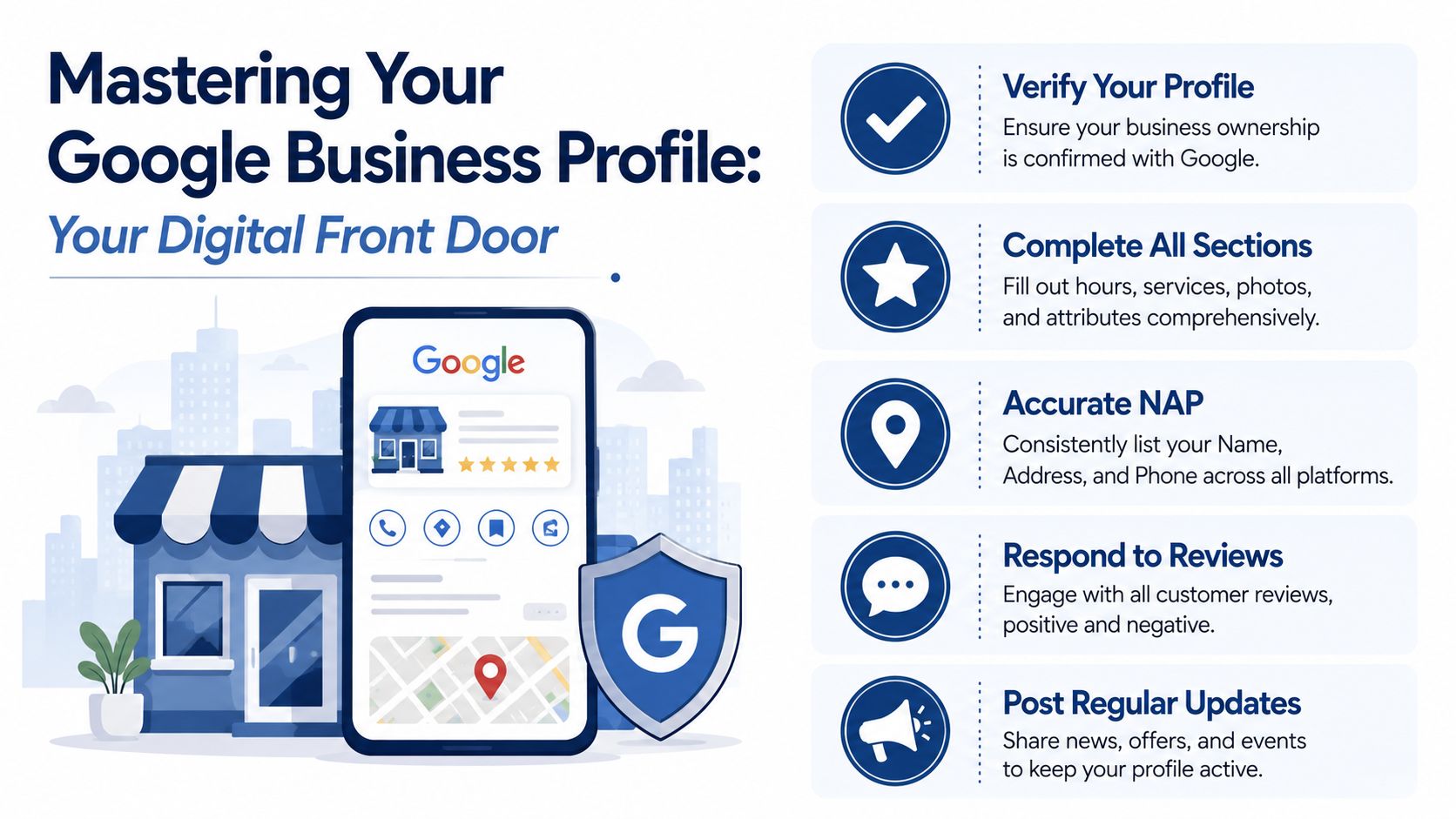
Get the foundations right
The basics are dull, but dull pays.
Start with these jobs:
Verify the profile properly
Until Google trusts that you control the listing, your options are limited.Complete every field that matters
Office hours, phone number, website, services, business description, opening dates, and photos all need attention. Half-filled profiles look abandoned.Use the most accurate categories you can
Specific legal categories matter. A family law practice shouldn't hide behind a vague primary label if the actual target is divorce and child arrangements work.Upload proper photos
Use real office photos, team photos, reception shots, meeting rooms, and exterior signage. Not blurry logos. Not stock images of people shaking hands over a suspiciously clean desk.
A helpful outside reference for firms that want a plain-English overview is Baslon Digital's GMB guide. It covers the practical setup side without vanishing into jargon.
Categories, services and reviews are where movement happens
Many firms leave money on the table when they select broad categories, add a sentence or two, then wonder why better-prepared firms appear ahead of them.
Optimising a Google Business Profile with specific legal service categories and at least 15 verified client reviews can lead to a 3.5x increase in qualified lead generation compared to firms with generic, incomplete profiles, according to Walker Advertising's local SEO checklist for lawyers.
That's not a cue to stuff the profile with every service under the sun. It's a cue to be precise.
A simple local example
Take a conveyancing solicitor in Bristol. Don't just list “property law”. Add service entries that reflect actual buying intent, such as:
- Leasehold extension work
- New build purchase support
- Residential conveyancing
- Transfer of equity
- Remortgaging
Those details help Google understand the profile, and they help a human searcher decide whether your firm fits.
A Google profile should answer three questions quickly: where are you, what do you do, and why should I trust you?
Keep the profile alive
An inactive profile often looks unloved. That doesn't inspire confidence in legal services, where clients are already anxious.
Use Google Posts for:
- Office updates: Holiday hours, new office access notes, or staffing announcements.
- Service education: Short updates on common issues like probate timelines or landlord disputes.
- Local relevance: A brief note on a local property issue, court process, or community event.
The Q&A section is often ignored, which is a gift to competitors. Add sensible questions and answer them clearly. A wills solicitor in Exeter might include “Do I need an appointment to update my will?” or “Can you witness documents at the office?”
None of this is glamorous. Neither is billing. Both matter.
Building Trust Signals Citations and SRA Compliant Reviews
Once your Google Business Profile is in good order, your next job is to prove your firm is credible everywhere else online. To achieve this, citations, NAPW consistency, and SRA-compliant reviews are essential.
Think of citations as repeated confirmations that your firm exists where it says it exists. Boring? Very. Important? Absolutely.
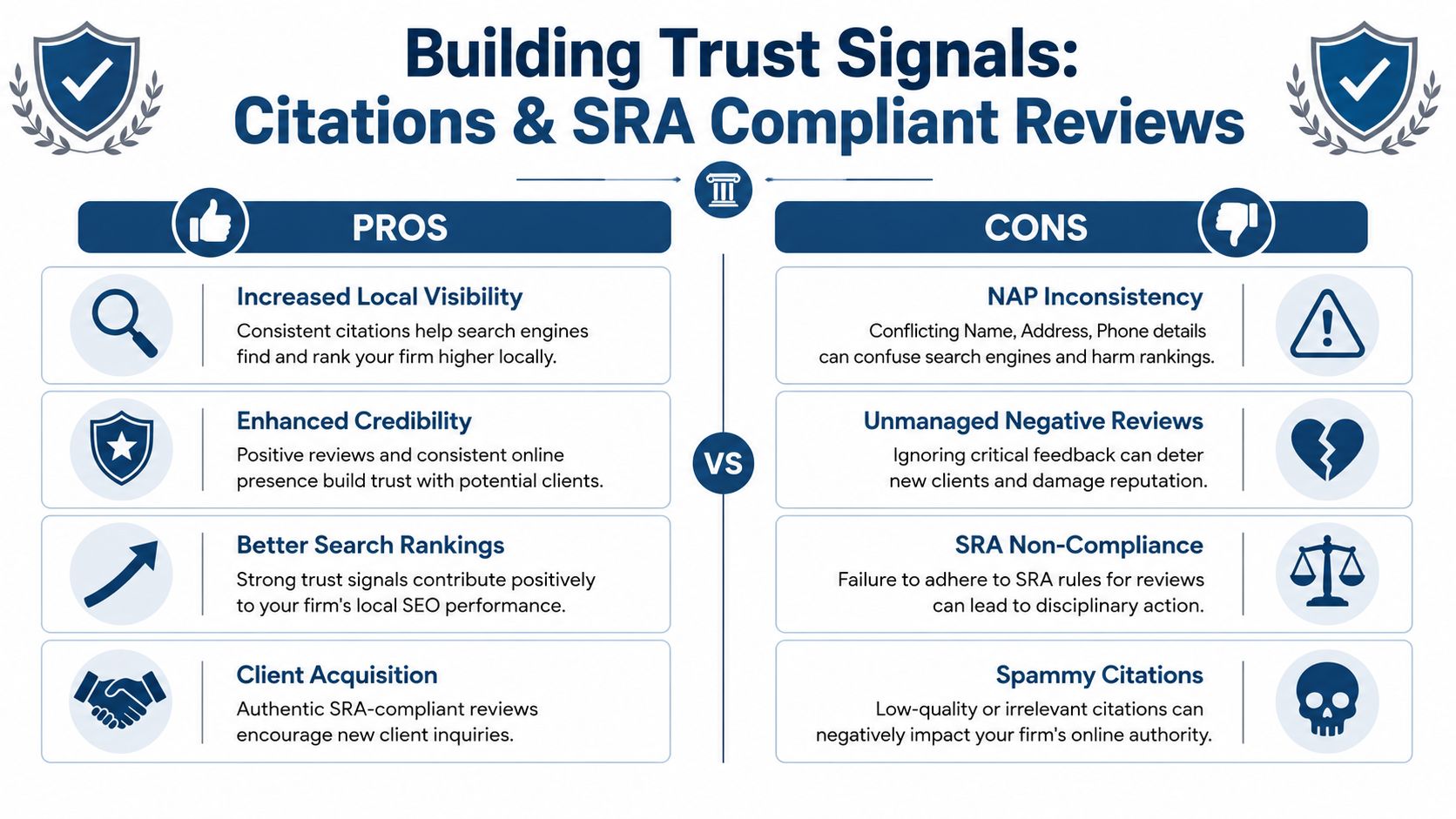
NAPW consistency is tedious and non-negotiable
NAPW means Name, Address, Phone, Website. Those details must match across your own site, legal directories, local listings, and profile pages.
If one listing says “High Street Solicitors Ltd”, another says “High Street Solicitors”, and a third uses an old phone number, you create doubt. Search engines don't enjoy doubt. They respond by trusting you less.
A small example. A solicitor in Leeds moves from Suite 4 to Suite 6 in the same building but updates only the website and Google profile. Old directory listings still show the former suite number. That sort of mismatch can muddy local signals and weaken performance.
Use a checklist:
- Audit existing citations: Search for old office details, old tracking numbers, and old URLs.
- Standardise formatting: Pick one official version of your business name and address, then stick to it.
- Fix the important listings first: Your site, Google profile, legal directories, and prominent local directories come before obscure corners of the internet nobody's visited since 2014.
Reviews need a process, not wishful thinking
Many solicitors are oddly passive about reviews. They hope happy clients will leave one unprompted. They usually won't.
A proper review process helps:
- Ask at the right moment: After a matter concludes smoothly, not in the middle of a stressful dispute.
- Use simple language: Don't draft a speech. Just ask whether the client would be comfortable sharing their experience.
- Send the review link promptly: If you wait a fortnight, life gets in the way.
- Reply to every review: Thank people professionally. Keep responses brief and confidential.
If you need a practical method for gathering them, this guide on how to get more Google reviews is a useful operational reference.
Don't let a receptionist improvise your review policy. In legal marketing, one careless sentence can create a compliance headache you didn't need.
Talking about outcomes without crossing the line
Often, solicitors become overly timid. Fair enough, given the SRA. But fear shouldn't turn your location pages into flavourless porridge.
63% of UK solicitors avoid mentioning local case results due to SRA fears, yet firms that find compliant ways to include them in their location-specific content gain 2.3x more local pack visibility, according to Attorney at Law Magazine's piece on ethics and local SEO.
That doesn't mean publishing confidential case gossip with a map pin attached. It means handling local proof carefully.
Examples of safer, more compliant approaches include:
- Anonymised matter types: “Advised a local landlord on possession procedure” is safer than naming names.
- Jurisdiction clarity: State the courts, regions, or legal jurisdictions you practise in where appropriate.
- Team profiles with local context: Mention experience with local property transactions, family court processes, or regional employer issues without revealing client details.
Grey hat local SEO often pushes firms towards overclaiming, exaggeration, or manufactured reviews. Black hat goes further with fake offices, invented testimonials, and spam listings. None of that is worth the risk. White hat may be slower, but it doesn't end with an SRA problem and a wrecked profile.
Optimising Your Website for Local Searches
A polished Google profile can win the click. Your website has to finish the job.
If your site sends visitors to a generic homepage with vague wording and no local relevance, you've wasted the opportunity. A local searcher wants to know, quickly, whether you handle their issue in their area.
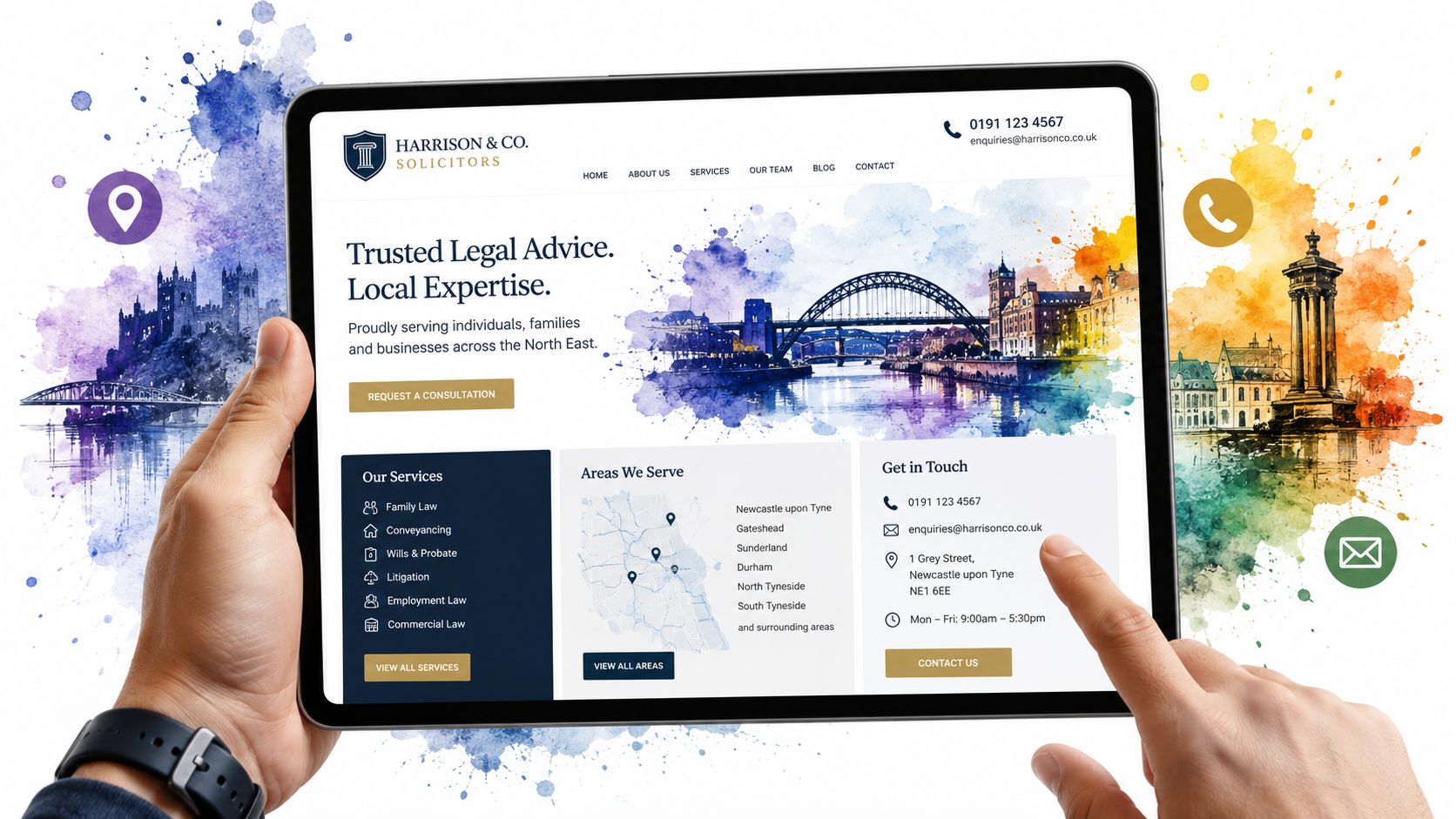
Build pages for real search intent
Local service pages work best when each page covers one service in one location. Not every possible town under the sun. Real target areas you can serve.
A few examples:
- Commercial property solicitor in Leeds
- Divorce solicitor in Manchester
- Probate solicitor in Chester
- Employment solicitor in Sheffield
For a solicitor in Manchester targeting “divorce solicitor Manchester”, a dedicated page with 3,000 to 5,000 words, city-practice combinations, clear FAQs, and internal linking is noted as critical in this practical LinkedIn breakdown on law firm local pages. Thin pages undercut relevance.
That doesn't mean padding pages with waffle. It means answering the questions a local client has. What work do you handle? Which office serves them? What's the process? Why choose your firm locally?
On-page details that still matter
Keep the basics tight:
- Title tags: Include service and place naturally.
- Headings: Make the page easy to scan.
- Internal links: Connect related service and location pages logically.
- Contact details: Show the relevant office details clearly on the page.
A family law page for Reading should not send users hunting through a national contact page maze like they're trapped in a badly designed escape room.
Schema is where many firms quietly lose ground
Schema markup tells search engines what your business data means. For solicitors, the important types are LegalService and, where relevant, Lawyer.
Implementing and correctly testing LegalService schema markup with precise geographic coordinates is critical; failure to do so can result in a 40% reduction in local 3-pack visibility for professional firms, according to Contra's guide to local SEO for law firms.
That matters because local SEO often fails on technical clarity, not effort. A firm may have decent content but sloppy structured data, mismatched coordinates, or incomplete business details.
Key elements to include:
- Official firm name
- Office address
- Phone number
- Website URL
- Opening hours
- Practice area information
- Correct geographic coordinates
And then test it. Always test it. Untested schema is like an unsigned witness statement. It exists, but it won't help much.
A useful explainer sits below if you want a quick visual walk-through of the principles.
Becoming the Local Authority with Links and PR
At this point, your foundations should be sound. Now you need authority. Not fake authority. Real local signals that show your firm is part of the community and worth citing.
In this context, local links and digital PR earn their keep.

What good local links look like
A decent local link usually has context. It comes from something your firm has done, supported, commented on, or contributed to.
Examples that work well:
- Community sponsorships: A youth football club, school fundraiser, local charity page, or chamber event.
- Local commentary: A quote in the local press on property law changes, probate issues, or employment disputes.
- Practical partnerships: A webinar with a mortgage broker, accountant, or mediator on a topic that overlaps properly with your services.
- Useful local resources: A guide for landlords in a specific town, or a relocation legal checklist for buyers moving into the area.
A solicitor in Norwich, for example, could publish a clear guide to leasehold issues affecting local buyers, then support it with commentary to local media and a talk for a community property event. That's a stronger signal than buying a handful of rubbish links from websites that also seem oddly keen on crypto and Bulgarian garden furniture.
For firms that want sharper ideas on the PR side, Carlos Alba Media's PR playbook is a sensible resource for professional services trying to earn press coverage without sounding like they've swallowed a press release generator.
White hat, grey hat and the office question
Let's deal with the awkward one. Some firms want to rank in nearby cities where they don't yet have a strong presence. The temptation is obvious.
A legitimate local office can work. A fake office is asking for trouble.
When a UK law firm opens a legitimate, inexpensive office in a target city costing £400 to £800 per month, it must display compliant signage and register a new Google Business Profile linked strictly to a dedicated location page to be recognised as a valid local entity by Google, as outlined in Elmfield's guidance on local SEO strategy and GBP.
Here's the distinction:
| Approach | What it looks like | Risk level |
|---|---|---|
| White hat | Real staffed or legitimate office presence, proper signage, dedicated location page, honest business details | Lower |
| Grey hat | Barely used serviced space with minimal operational reality, thin city page, just enough to pass a glance test | Higher |
| Black hat | Virtual address, fake listing, no real presence, manipulated reviews or citations | Severe |
If you wouldn't be comfortable showing the setup to a regulator or to Google's quality team, don't build your local strategy on it.
The firms that win long term usually choose the slower route. Real office signals. Real local PR. Real links. Less adrenaline, fewer disasters.
Measuring Success and Spying on Your Rivals
A local SEO campaign should produce evidence, not folklore. If the only report you get is “visibility is improving”, somebody is having you on.
What to track each month
For solicitors, the useful measures are the ones tied to enquiries and local intent:
- Calls from Google Business Profile
- Direction requests
- Website contact form submissions from local service pages
- Organic visits to location and service pages
- Search terms triggering local enquiries
- Quality of leads, not just volume
A conveyancing firm in Leicester might receive fewer form fills than before, but if more of them involve local residential purchases the campaign is improving. Better leads beat busier inboxes.
A simple competitor review
Once a month, look at the firms ranking above you and note:
- Which service-location pages they've built
- How their page titles and headings are written
- What their Google profile includes
- Whether they publish local updates or FAQs
- Which local sites mention or link to them
Turn that into a working document. If three top-ranking firms all have dedicated pages for “commercial lease solicitor Birmingham” and you don't, there's your gap. If they all show stronger local trust signals, there's another.
The best competitor analysis isn't snooping for sport. It's a disciplined way to spot missing signals and close the distance.
Don't obsess over every fluctuation. Track patterns. Compare month to month. Ask whether rankings improved for the right searches and whether better local enquiries followed. That's the bit that pays wages.
Frequently Asked Questions on Local SEO for Solicitors
A few questions come up repeatedly, especially once firms realise local SEO is more than tweaking a homepage and hoping for the best.
Common solicitor questions answered plainly
| Question | Answer |
|---|---|
| Can I rank a new city with a virtual office? | If there's no genuine local presence, it's risky. A virtual address used purely to manipulate rankings drifts into black hat territory very quickly. |
| Are serviced offices acceptable? | They can be, if the office is legitimate, branded appropriately where required, and tied to a real local landing page and operational presence. |
| How long does local SEO take? | It depends on your starting point, your competition, and whether your website and Google profile are already in decent shape. Firms with a weak setup usually need patience and steady execution. |
| What's the difference between national SEO and local SEO? | National SEO chases broader visibility across a wider geography. Local SEO focuses on service-plus-location intent, map visibility, and signals tied to a specific office or service area. |
| Do reviews really matter for solicitors? | Yes, both for trust and visibility. They also affect whether a prospective client feels safe contacting you in the first place. |
| Can I mention local work on location pages? | Yes, but do it carefully. Keep it compliant, anonymised where needed, and consistent with SRA obligations. |
Most firms don't need a fancier strategy. They need a cleaner one. Strong Google profile. Consistent details. Better pages. Proper reviews. Real local authority signals. The rest is usually noise dressed up in PowerPoint.
If your firm wants a clear, data-led local SEO plan without the usual smoke and mirrors, DigiVisi Ltd helps UK service businesses improve rankings, calls, and enquiries through competitor analysis, Google Business Profile optimisation, local landing pages, schema, citations, and transparent reporting. It's a sensible fit for solicitors who want qualified local leads, not vague marketing theatre.