Skip to content

You've probably done this already. You Google your own firm, click the website, and within ten seconds you spot three problems: the page loads like it's on dial-up, the contact button is hiding in a corner, and the copy sounds as if it was written for a law textbook rather than a worried person in Leeds, Bristol, or Croydon who just wants help.
That's the reality of website marketing for lawyers. Most firms aren't losing online because they lack legal expertise. They're losing because their website is slow, vague, badly structured, or trying one of those clever little SEO shortcuts that look smart until Google or the SRA takes a dim view. No one wants their marketing strategy to have the lifespan of a cheap umbrella in a British storm.
A good legal website should do three jobs. It should get found, earn trust, and turn visits into enquiries. If it can't do all three, it's decorative. And decorative websites don't bring in files.
Table of Contents
- The Foundational MOT Your Law Firm Website Needs
- Winning the Local Battle with Smart Content
- Turning Clicks into Clients with PPC and CRO
- Marketing Ethically and Staying SRA Compliant
- Measuring Success and Planning Your Budget
- Your Actionable Website Marketing Checklist
The Foundational MOT Your Law Firm Website Needs
A law firm website needs the same thing a car does before a long journey. An MOT. If the brakes are shot and the tyres are bald, there's no point polishing the bonnet. Website marketing for lawyers works the same way. Before you chase rankings, reviews, or paid traffic, check whether the site is technically fit for purpose.
Start with the roadworthiness check
The first job is speed, stability, and usability. For UK law firms, achieving “Good” across all Core Web Vitals is essential: LCP under 2.5 seconds, INP under 200 milliseconds, and CLS below 0.1, and success also demands LegalService, Person, and LocalBusiness schema to satisfy AI and search engine trust signals, as outlined in Magnify Lab's technical SEO guidance for law firms.
That sounds technical, but the practical meaning is simple:
- LCP under 2.5 seconds means the main content appears quickly.
- INP under 200 milliseconds means buttons and forms respond promptly.
- CLS below 0.1 means the page doesn't jump about like a startled pigeon.
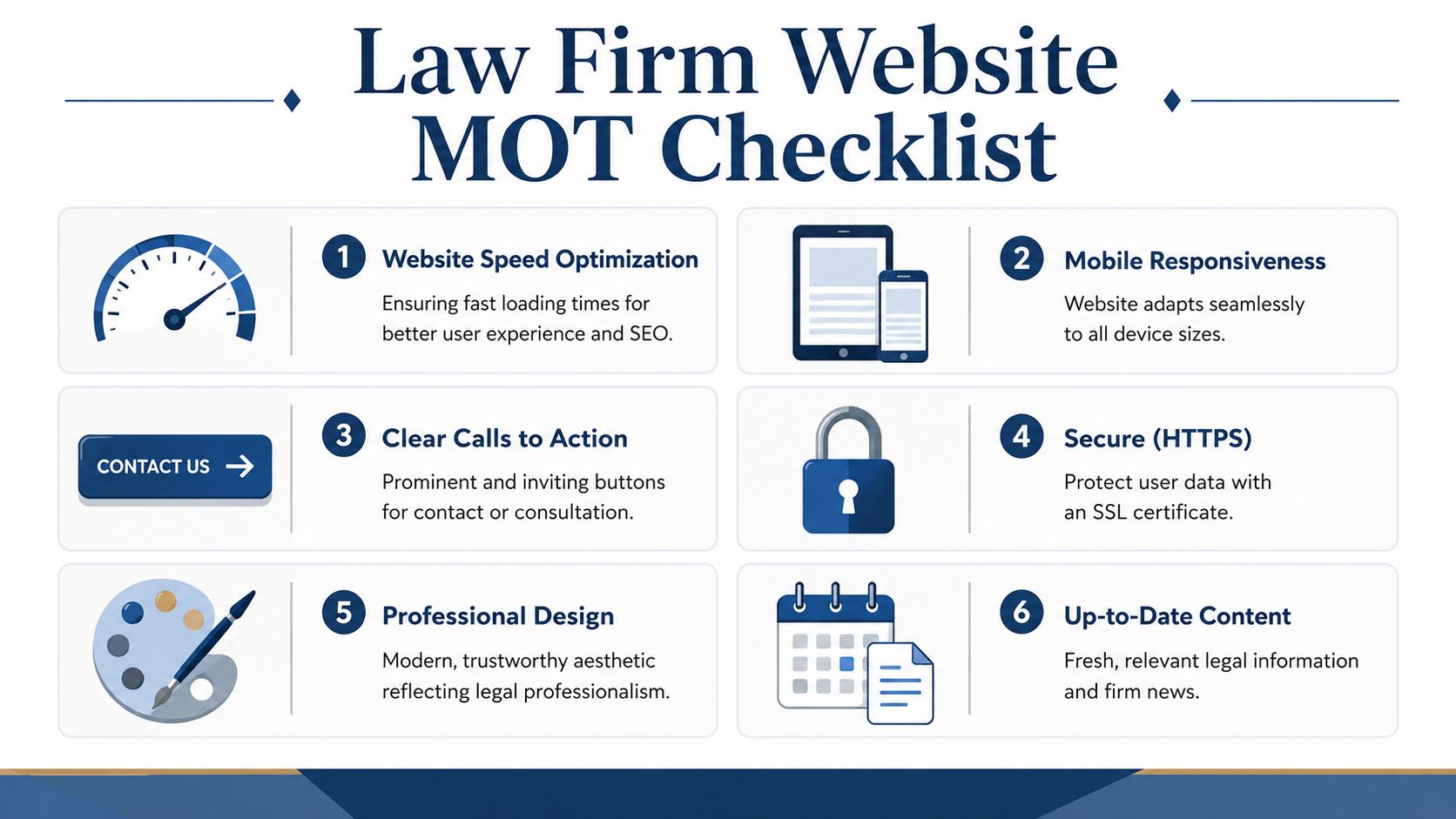
Use PageSpeed Insights and Search Console to spot the obvious offenders. Usually it's huge hero images, clunky sliders, bloated themes, and third-party widgets nobody needed in the first place. A family solicitor in Sheffield doesn't need an animated homepage masterpiece. They need a site that loads fast, works on a mobile, and lets people enquire without a faff.
Practical rule: If a visitor can't understand what you do, where you work, and how to contact you within a few seconds, the page needs rewriting.
Schema matters for legal firms because it helps search engines understand who you are. LegalService schema clarifies your practice areas, Person schema connects solicitor profiles to credentials, and LocalBusiness schema supports local trust signals. Add visible SRA registration details in the footer too. That's not window dressing. It helps humans and machines verify that your firm is real.
Check the pages people actually land on
The second part of the MOT is on-page content. Don't start with the homepage. Start with the pages that should win business: service pages, location pages, solicitor profile pages, and contact pages.
A decent page answers basic client questions quickly. What problem do you solve? Who is the service for? What happens next? How do they contact you? If your criminal defence page opens with three paragraphs about your “bespoke legal excellence journey”, it's trying too hard.
Use this quick review table:
| Page type | What must be obvious | Common mistake |
|---|---|---|
| Service page | Area of law, location, next step | Generic copy stuffed with keywords |
| Solicitor profile | Credentials, role, real expertise | Thin bios with no trust signals |
| Contact page | Phone, form, office details | Hiding the phone number |
| Homepage | Firm focus and key services | Trying to say everything |
For firms in other regulated professions, the same principles apply. That's why Cloudvara's marketing insights are useful reading. Different sector, same lesson: trust, clarity, and local relevance beat clever fluff.
Look at your reputation off-site
The final part is backlinks and mentions. Not all links are equal. A mention from a respected local chamber, legal association, or community organisation can help. A batch of suspicious directory links from places you've never heard of can do the opposite.
White-hat link building is slow and a bit boring. That's precisely why it works. Grey-hat shortcuts like paid link bundles, spun guest posts, and private blog networks look tempting when rankings are flat. They're also how firms end up with messy backlink profiles and awkward clean-up jobs later.
Winning the Local Battle with Smart Content
Local legal marketing isn't about shouting louder than every firm in Britain. It's about being the best answer for a person in your area who needs help now, or thinks they might soon. That distinction matters more than most firms realise.
Write for two very different visitors
Data shows 70% of UK legal search queries are informational, yet 90% of law firm websites lack dedicated content for this audience. Addressing this gap is critical, as informational content can drive 40% more qualified leads than direct service pages, according to Staxton Digital's legal marketing analysis.
That tells you something important. Most firms write as if every visitor is ready to instruct a solicitor today. They're not. Many are still working out what the problem means.
A Bristol family law practice, for example, should split content like this:
- Information-gathering content like “What are the first steps in a divorce?” or “Who stays in the house during separation?”
- Ready-to-hire content like “Divorce solicitor in Bristol” or “Child arrangements legal advice Bristol”
Those pages shouldn't say the same thing in different outfits. Informational pages build trust. Service pages convert urgent intent. You need both.
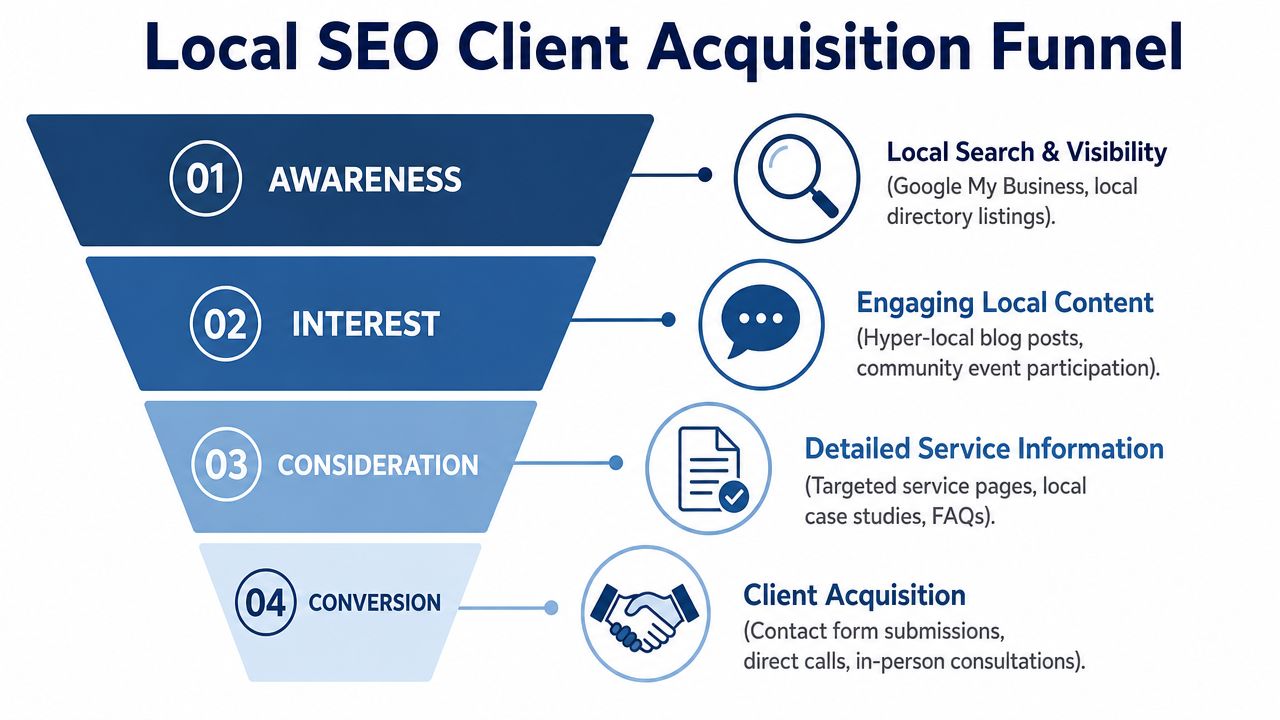
Firms often publish only the “hire us” pages and ignore the questions clients ask before they're ready. That's like opening the shop but bricking up the front path.
Build local pages that sound local
A local page shouldn't be a duplicate with the town name swapped out. Google can smell that sort of thing from miles away, and so can clients.
A proper local service page needs detail that proves you serve the area. Mention the office location if relevant, nearby courts or business districts where appropriate, practical travel information, and the kinds of matters commonly handled there. If you're writing a wills page for York, don't pad it with vague filler. Explain what clients can expect, who they'll speak to, and how to get started.
For professional firms wanting a broader framework, this guide to SEO for professional services is worth a look because the same local-intent principles apply across solicitors, accountants, and consultants.
Treat your Google Business Profile like a second homepage
A lot of lawyers obsess over the website and neglect the Google Business Profile. That's a mistake, especially in competitive local markets where map results can nick attention before a user ever reaches your site.
Focus on three things:
- Primary category choice that matches your main practice focus as closely as possible.
- Consistent firm details across the website and local listings.
- Review generation that happens steadily, not in random bursts after someone remembers.
Keep the photos professional, the business description plain English, and the service list aligned with your website. If your site says one thing and your profile says another, trust takes a hit. A small employment law firm in Manchester can beat a bigger rival in local visibility by having tighter alignment between service pages, location signals, and review quality.
Turning Clicks into Clients with PPC and CRO
Traffic is lovely for the ego. It's less lovely when the phone doesn't ring. Website marketing for lawyers falls apart when firms chase impressions and ignore conversion.

Use PPC to learn fast
SEO is a long game. PPC gives you quicker feedback. That makes it useful, not just for leads, but for research. A tightly controlled Google Ads campaign can tell you which search terms bring serious enquiries and which ones bring tyre-kickers, job seekers, or people after free advice for half an hour.
Start with narrow intent. A conveyancing solicitor in Nottingham might test phrases around local conveyancing help, sale and purchase representation, and remortgage legal support. Don't fling money at broad terms and hope for the best. Hope is not a bidding strategy.
Build landing pages that match the ad exactly. If the ad mentions employment settlement agreements, the page should be about that topic, not a generic employment law page with six unrelated services crammed underneath. PPC works best when the message, keyword, and landing page all line up neatly.
Fix the page before buying more traffic
Once the traffic arrives, the page has to do its job. Over 65% of clients view company ratings and reviews as a significant factor in their decision to hire a lawyer, and 53% of individuals have chosen not to hire a law firm due to a poor online presence, based on the figures discussed in this legal marketing roundup.
That means CRO for law firms isn't about gimmicks. It's about removing hesitation.
Use this checklist on your key landing pages:
- Clear headline that states the service and location plainly.
- Visible trust markers such as reviews, professional memberships, solicitor credentials, and office details.
- Short forms that ask only for what's needed to start the conversation.
- Proper mobile layout so buttons and forms work on smaller screens.
- Relevant testimonials placed near the enquiry point, not buried at the bottom.
The best-converting legal pages rarely feel “salesy”. They feel calm, clear, and competent.
A lot of firms sabotage conversion with one silly habit. They make the visitor work too hard. The phone number is tiny, the form is lengthy, and the CTA says something vague like “Submit”. Change it to something human. “Speak to a solicitor” is clearer. “Request a callback” is clearer. “Start your enquiry” is clearer.
Make calling embarrassingly easy
Some legal matters don't wait. People want to tap and call. If your mobile site makes that awkward, you're leaking leads for no good reason. A practical guide to click to call is handy if you're tightening up mobile conversion paths.
This video is useful if you're reviewing how consultation journeys affect conversion:
The grey-hat temptation here is fake urgency, chat widgets that pretend a human is typing when they're not, or review badges that can't be verified. Don't do it. Legal clients are often anxious already. If the page feels slippery, they'll leave.
Marketing Ethically and Staying SRA Compliant
Plenty of firms treat compliance like a nuisance. Tick the box, add the disclaimer, move on. That's the wrong lens. In legal SEO, compliance can be a trust advantage.
White hat wins longer
White-hat website marketing for lawyers is straightforward. You publish useful content, structure the site properly, earn genuine reviews, improve user experience, and build legitimate local authority. It's not glamorous, but neither is repairing the damage from a penalty or a complaint.
Grey-hat tactics sit in the murky middle. Buying links that are dressed up as “placements”. Churning out doorway pages for every town in the county. Stuffing “best solicitor” into title tags and headers as if saying it often enough makes it true. Black-hat is more blatant still, and it has no place in legal marketing.
Here's the practical distinction:
| Approach | Example | Risk |
|---|---|---|
| White hat | Useful local service pages with real reviews | Low |
| Grey hat | Paid links and cloned location pages | High |
| Black hat | Hidden text, hacked links, fake reviews | Extreme |
Compliance is an SEO signal
Recent data reveals that 58% of UK law firms lose SEO rankings due to non-compliant content, yet only 12% proactively audit their sites for compliance as part of their SEO workflow, according to Digital Agency Network's legal sector data.
That should sharpen a few minds. If non-compliant content is dragging rankings down, compliance isn't just about avoiding trouble. It affects visibility.
Check for problems like these:
- Missing disclaimers on service claims that could mislead.
- Unverifiable superlatives such as “the UK's leading” or “the best”.
- Thin solicitor profiles with no clear credentials.
- Old awards or outdated accreditations still sitting on pages.
- Ambiguous claims about outcomes that suggest guarantees.
Transparency converts well because it lowers perceived risk. A careful, honest page often beats a flashy one that overpromises.
What ethical legal copy looks like
Good legal copy doesn't puff itself up. It explains the service, states experience carefully, and sets expectations properly. A Manchester criminal defence page can say the firm handles police station representation, magistrates' court work, and related advice. It should not imply a guaranteed outcome.
If you want a rule of thumb, write as if both a worried client and a regulator might read the page. Because they might. The nice side effect is that this kind of copy also tends to be cleaner, clearer, and more persuasive.
Measuring Success and Planning Your Budget
Marketing only feels vague when firms measure the wrong things. If you know what to track, website marketing for lawyers becomes far more practical.
Track the numbers that matter
The strongest KPI set is usually boring. That's a compliment.
You need to know:
- How much traffic comes from organic search
- Which pages produce calls and form submissions
- Which enquiries are qualified
- Which channel leads to actual matters opened
For law firms, broad benchmarks do help. Organic traffic should account for at least 50 to 70% of total website traffic, blog posts and informative pages should hold an average time on page of 2 to 3 minutes, bounce rate should stay below 50%, firms should publish at least two high-quality blog posts per month, and contact form conversion rates below 2 to 5% can indicate weak on-page performance, according to One400's law firm benchmark review.
That doesn't mean every page must hit every benchmark at once. It means you've got a practical standard to compare against. If your service pages get visits but no enquiries, the issue is often trust, CTA clarity, or page intent. If your blog gets traffic but no movement to service pages, internal linking is probably weak.
What a sensible timeline looks like
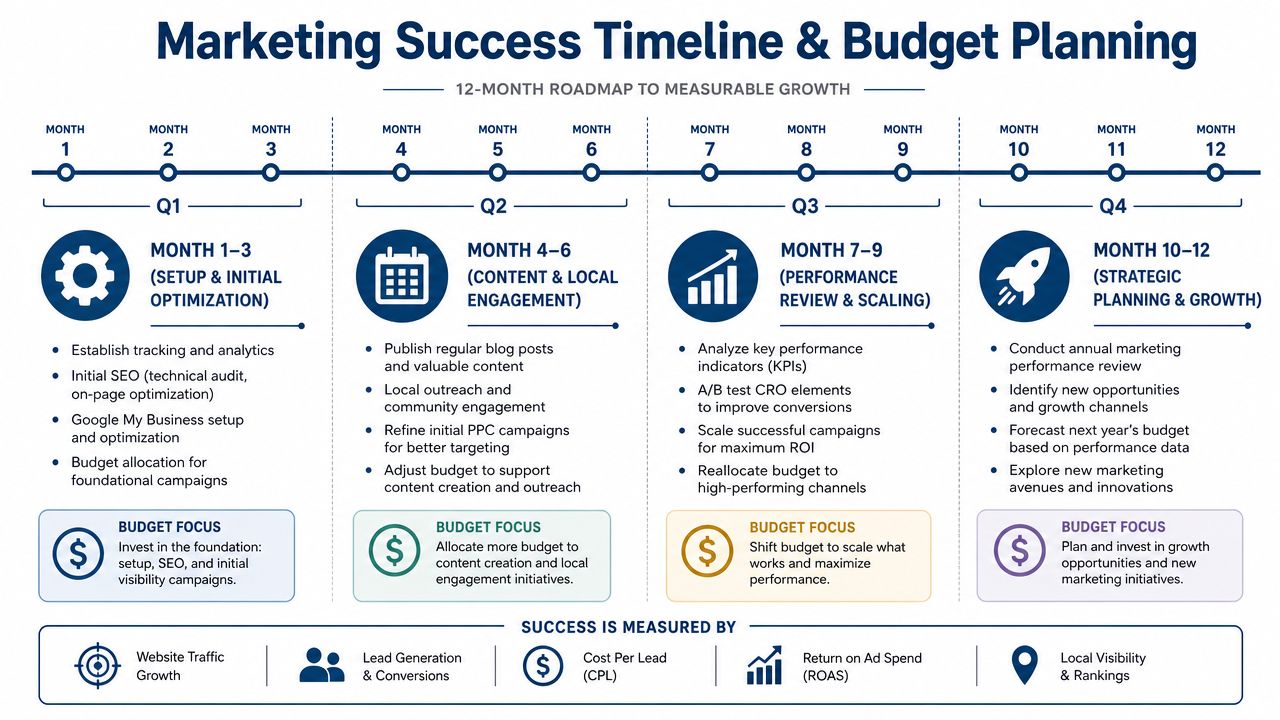
Results don't arrive on command. They arrive when the inputs are good and consistent.
A realistic roadmap looks something like this:
| Period | Main focus | What you're looking for |
|---|---|---|
| First few months | Fix technical issues and core pages | Cleaner indexing and stronger engagement |
| Middle stretch | Publish local and informational content | More relevant search visibility |
| Later phase | Improve conversion and refine winners | Better lead quality and steadier enquiries |
A small probate firm in Kent, for example, might spend the first phase repairing technical issues and rewriting service pages, the next phase building local guides around wills and probate questions, and the later phase tightening forms, reviews, and PPC landing pages. Not exciting. Very effective.
Budgeting without guesswork
The budget question gets oddly emotional. It shouldn't. It's a business decision.
UK law firms investing 1.5–2.8% of annual revenue into digital marketing achieve a 3–5× return on investment over an 18–24 month period, with SEO driving 41–58% of website traffic at a client acquisition cost of £60–£200 per lead, based on White Hat SEO's legal marketing figures.
That matters because it reframes the conversation. The issue isn't “How little can we spend?” It's “What level of consistent investment supports profitable growth?” Sporadic bursts rarely work. One expensive redesign followed by months of inactivity is the digital equivalent of joining a gym, going twice, and wondering why the six-pack hasn't arrived.
Your Actionable Website Marketing Checklist
Most law firms don't need more theory. They need a list they can use on Monday morning. According to a 2024 survey, 78.2% of lawyers confirm their firm uses a website for marketing, and 64.7% identify it as the channel with the highest ROI, as reported in this legal marketing statistics roundup. If the website already carries that much weight, it deserves a proper operating checklist.
Technical foundations
Print this, save it, hand it to whoever manages the site.
- Check Core Web Vitals and fix the worst loading or layout issues first.
- Review mobile usability on actual phones, not just a desktop preview.
- Confirm HTTPS security with no warnings on forms or key pages.
- Audit schema markup so legal services, people, and local business details are properly structured.
- Test key forms and phone links every month. You'd be amazed how often firms forget.
Local SEO and content
Many firms either overcomplicate things or get lazy.
- Create one strong page per core service and location pairing rather than dozens of thin clones.
- Publish informational content for early-stage searches using plain English and real client questions.
- Keep the Google Business Profile aligned with your website details and services.
- Ask for reviews consistently after matters conclude, with a process the team implements.
- Link informational pages to relevant service pages so research traffic has a next step.
A useful legal article should reduce confusion. If it only repeats jargon, it won't build trust.
Conversion and trust
Traffic without action is just a vanity report.
- Put the main phone number where people can see it immediately. Header, contact page, mobile tap-to-call.
- Use clear calls to action. “Speak to a solicitor” beats “Learn more”.
- Show evidence. Reviews, qualifications, office details, and named solicitors all help.
- Trim the friction. If the form looks like a mortgage application, shorten it.
- Match message to page intent. A conveyancing ad should not land on a generic homepage.
Measurement and discipline
The firms that win tend to be the ones that stick to the basics longer than everyone else.
- Track enquiries by source so you know what produces work.
- Review top landing pages monthly for traffic, engagement, and conversion.
- Keep publishing even when you're busy, especially if local competitors have gone quiet.
- Audit compliance alongside SEO work rather than treating it as a separate afterthought.
- Avoid grey-hat nonsense even if a shortcut looks tempting in a slow month.
Website marketing for lawyers isn't mysterious. It's disciplined. Fix the site. Write for real local intent. Make contacting you easy. Stay squeaky clean. Measure properly. Repeat.
If your firm wants a calmer, more structured way to turn website traffic into qualified enquiries, DigiVisi Ltd helps UK service-led businesses improve local visibility, strengthen technical SEO, and build websites that are made to convert, not just sit there looking important.