Skip to content
You're probably in one of two spots right now.
Either you set up your Google Business Profile ages ago, ticked the obvious boxes, and assumed the phone would start ringing. Or you did everything in a rush between jobs, hearings, quotes, invoices, and trying to remember whether you replied to that review from last month.
Then nothing much happened.
That's the bit nobody tells local business owners. A Google Business Profile isn't a framed certificate you hang on the wall and admire. It's closer to a shopfront on the busiest street in town. If the sign is faded, the window is grubby, and the opening hours are wrong, people walk past. Online, they do it even faster.
For UK service businesses, it gets more annoying. Trades, mobile services, and firms with no proper public-facing premises often get lumbered with verification headaches, dodgy edits, and half-baked advice written for American coffee shops with neat little storefronts. If you're a plumber in Bristol, an electrician in Leeds, or a solicitor covering Birmingham, that generic advice can be about as useful as a chocolate spirit level.
Table of Contents
- Your Digital Shopfront Is Gathering Dust
- So What Is GBP Management Anyway
- Your Essential Monthly GBP Workout
- Optimisation Tips That Actually Work for UK Services
- Going It Alone vs Calling in the Pros
- Tackling Multi-Location and Verification Nightmares
- How to Know Your GBP Efforts Are Paying Off
Your Digital Shopfront Is Gathering Dust
A Bristol plumber finishes a long day, checks his phone, and sees the same old story. A couple of website visits, no fresh calls worth having, and a profile that hasn't changed since the day he claimed it. The photos are ancient, one review is unanswered, and Google still shows an outdated service detail.
That business owner usually thinks the problem is visibility alone. Often it isn't. The profile exists, but it's stale. Customers land on it, get a whiff of neglect, and wander off to the next listing.

A Sheffield solicitor can run into the same trouble. The firm may rank for its name, but the profile doesn't help a stranger decide. No fresh posts. Thin description. Slow review responses. A neglected profile sends the same message as a neglected reception desk.
For UK businesses, this is critical: businesses with a verified and optimized Google Business Profile are 2.7 times more likely to be trusted by customers, and 76% of UK consumers searching for local services will visit a related business profile according to these Google Business Profile statistics.
Why passive profiles underperform
Google Business Profile management is what turns a listing from a static entry into a lead generator. Not magic. Not secret sauce. Just regular, deliberate upkeep.
Consider this:
- An unmaintained profile looks abandoned, even if your actual business is excellent.
- An active profile shows signs of life. Recent photos, proper replies, accurate services, current hours.
- A managed profile gives people enough confidence to call, click, or ask for directions.
Practical rule: If your profile hasn't changed in a month, it's probably losing work quietly.
There's also a wider local marketing point here. Your profile doesn't operate in a vacuum. If you're running ads as well, it helps to understand how Google Business Profile activity and maps visibility support optimizing PPC with local search. Paid clicks and local intent often overlap, and a weak profile can blunt the effect of otherwise decent campaigns.
What this looks like in real life
A dog groomer in Dundee doesn't need a complicated strategy deck. They need a profile that looks cared for. New photos of the salon. Review replies that sound like a real person. Services listed properly. A few posts showing seasonal offers or busy appointments.
That's the difference between “we're on Google” and “Google brings us business”.
So What Is GBP Management Anyway
Google Business Profile management is the day-to-day and month-to-month work of keeping your listing accurate, active, and trustworthy.
That's it.
If you had a shop on the high street, you wouldn't open the door once, dust your hands, and vanish forever. You'd tidy the window, replace the faded poster, fix the wonky sign, and speak to customers when they walk in. Your profile needs the same treatment.
The simple version
For a local service business, management usually means:
- Keeping core details correct. Name, phone, website, hours, and service information need to match reality.
- Adding fresh proof. Photos, updates, and review replies show the business is active.
- Watching for problems. Duplicate listings, odd edits, and verification issues need sorting before they turn into a headache.
A Manchester heating engineer doesn't need jargon. He needs to know whether Google shows the right phone number and whether the profile looks alive when someone searches on a Tuesday evening.
White hat, grey hat, black hat
A lot of owners frequently get tripped up. Not all tactics are equal.
| Approach | What it looks like | What happens |
|---|---|---|
| White hat | Accurate categories, honest service areas, real photos, proper review replies | Builds long-term visibility and keeps the profile safe |
| Grey hat | Pushing things a bit too far, like stretching categories or overloading service areas | Might work briefly, but often creates instability |
| Black hat | Keyword stuffing the business name, fake reviews, fake locations, stock images passed off as real | Risks suspension, reinstatement delays, and a proper mess |
A common black-hat example is stuffing extra keywords into your business name. If your actual business is “Smith & Co Solicitors”, jamming in service phrases and locations to game rankings is asking for trouble. It can work for a while. So can driving with the warning light on.
The fastest route to a suspended profile is pretending Google's guidelines are just polite suggestions.
What good management feels like
Good Google Business Profile management is boring in the best possible way. The details are right. Reviews get answered. Photos are current. Service areas make sense. Nothing looks spammy.
That's why it works.
Bad management usually feels clever right up until the profile gets flagged, ranking drops, or some stranger changes your opening hours before a bank holiday. Then it's all very exciting for the wrong reasons.
Your Essential Monthly GBP Workout
Most local businesses don't need a grand strategy. They need a routine they'll stick to.
Call it a monthly workout. Not glamorous, but it keeps the profile healthy. Miss it for long enough and the whole thing goes a bit soft round the middle.
The core tasks worth doing every month
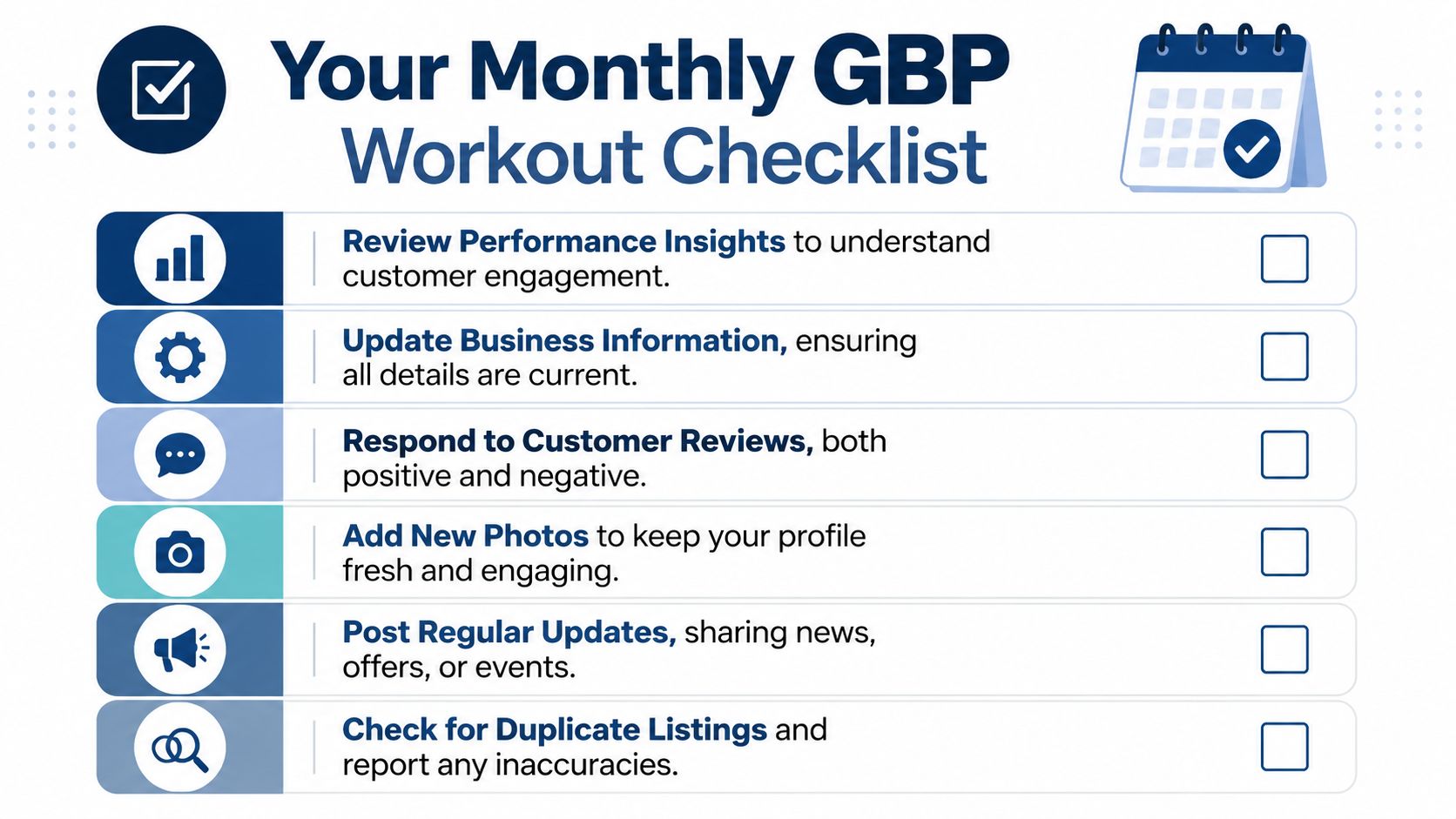
Here's the routine I'd put in front of most UK service businesses.
Check the basics first
Look at your name, phone number, website link, opening hours, and service details. If anything has changed in real life, update it promptly. Don't leave old bank holiday hours sitting there like last year's Christmas decorations.Review your performance insights
Don't stare at the dashboard for sport. Look for useful signals. Are people calling? Clicking through to the site? Asking for directions? If one action drops sharply, inspect the profile before blaming the whole market.Reply to every review
Good review, bad review, awkward review from someone who seems to have mistaken you for another business. Reply anyway. A Bristol café should treat review responses like front-of-house manners. Prompt, polite, and specific.Upload fresh photos
Real work, real team, real premises, real vans, real results. Keep it current. Customers can smell stock photos a mile off.Post updates regularly
Short updates about services, seasonal demand, new availability, or business changes can help the profile feel current. Keep them practical.Scan for duplicates and odd edits
This one catches people out. A duplicate or rogue change can undermine the profile while you're busy doing actual work.
The threat most owners miss
A lot of businesses obsess over reviews and ignore the quieter danger. A frequently ignored threat is the “Suggested Edit” vulnerability. UK third-party directories often auto-sync incorrect NAP (Name, Address, Phone) data to Google, causing profile “drift” that damages local rankings. Constant vigilance is the only defence as explained in this guide on frequently asked questions about Google Business Profiles.
That means a wrong suite number, old phone line, or stale postcode reference elsewhere online can creep back into your profile. It's maddening.
A sensible monthly checklist
- At the start of the month check core business details and service coverage.
- Each week add at least one new visual or update.
- Every few days look for new reviews and public questions.
- Before and after holiday periods check your hours.
- Any time leads feel slow inspect the profile for edits, duplicates, and missing fields before assuming rankings have collapsed.
A lot of “Google has dropped me” complaints turn out to be “my profile's wrong and I hadn't noticed”.
Consistency wins here. Not heroics. A tidy little routine beats a panic-fuelled profile overhaul every six months.
Optimisation Tips That Actually Work for UK Services
A roofer in Sheffield gets the profile live, adds a few photos, picks some categories, then waits for the phone to ring. A month later, leads are patchy, Google has swapped in an odd edit, and the service area now looks like the business covers half of Yorkshire. That is normal for UK service-area businesses. The job is not stuffing in more keywords. The job is tightening the profile so Google stops getting the wrong idea.
Choose categories like a grown-up
For a plumber, heating engineer, locksmith, or pest control firm, the primary category carries real weight. It tells Google what job you want to be found for. Pick the closest match to the core service that brings in the bulk of your work.
Google's category guidance is straightforward. Choose categories that describe the business as accurately as possible, as set out in Google's guidance on business categories. In practice, that means a Manchester firm should use “Plumber” if plumbing is the main job, not a vaguer umbrella term because it feels broader.
Keep it sensible:
- Use one clear primary category tied to the main commercial service
- Add secondary categories only where they reflect real, regular work
- Skip the kitchen-sink approach unless you fancy confusing both Google and customers
I've seen service businesses hurt themselves by trying to look bigger than they are. If you fit boilers and handle emergency leaks, fine. If you also add builder, bathroom fitter, kitchen remodeler, drainage service, property maintenance and half a dozen more, the profile starts looking like a spam experiment.
Write a description for customers first
The description is not a ranking cheat code. It is sales copy with guardrails.
Google lets you write up to 750 characters, and Google's business description guidelines explain what belongs there and what does not. For a Birmingham solicitor or a mobile dog groomer in Solihull, the best version is plain English. Say what you do, where you work, and why someone should trust you. Leave the hard sell and repeated keyword strings out of it.
A decent description usually covers:
- Main services
- Core towns or boroughs served
- A useful trust signal, such as years trading, specialism, or accreditation
Bad: “Best electrician Leeds emergency electrician cheap electrician Leeds call now”.
Better: “NICEIC-approved electrician serving Leeds and nearby areas for fault finding, rewires, consumer unit upgrades and emergency call-outs.”
That sounds like a real business, which is the point.
Set service areas based on where vans actually go
UK service-area businesses often come unstuck. The temptation is to add every nearby town, every postcode district, and every place your cousin once had a job. It feels proactive. It usually creates a mess.
Google says service-area businesses should list the areas they serve rather than claim a broad radius for the sake of it, as covered in Google's service-area business help documentation. If you are a cleaner in Leeds who rarely works beyond Harrogate, Horsforth, Roundhay and Wakefield, set the area to match that reality.
A tighter service area does three useful things. It keeps the profile believable. It reduces the odds of attracting rubbish leads from miles away. It also gives you a better chance of showing for the places you serve.
Use photos as proof of work
Photos do more than make the profile look alive. They reduce doubt.
For trades and local services, the best images are not glossy stock shots. They are proof. A branded van outside a real job, a tidy boiler install, a before-and-after patio clean, a therapist's treatment room, a solicitor's office frontage. Google's own photo advice for business profiles supports adding real, accurate imagery that helps customers recognise the business and understand what to expect, as explained in Google's photo guidelines for Business Profiles.
Good uploads for UK service firms include:
- Team members in uniform or workwear
- Vehicles with branding
- Completed jobs
- Premises or office signage
- Tools, equipment, or setup that customers will see
One practical note. Keep a separate folder on your phone for “GBP-ready” photos. Otherwise the profile gets ignored until December, when someone uploads three blurry van snaps and calls it marketing.
Use updates sparingly, but use them well
Posts and updates are rarely the magic bullet owners hope for. Still, they can help if you treat them like a nudge, not a campaign.
A locksmith might post about 24-hour call-outs in winter. An outdoor design professional can show a completed paving job with the area named naturally. A solicitor can share a short note about a specific service, such as conveyancing or wills. The value is relevance and recency, not volume.
This also pairs nicely with off-profile local visibility. If you are already doing digital PR or local publicity, mention the strongest proof points on the profile and support the wider effort with tactics like leveraging press releases for search rankings. Just do not turn the GBP into a noticeboard full of fluff.
Guard against the two UK headaches generic guides miss
First, rogue edits. UK directory data is messy, and old phone numbers or odd abbreviations have a habit of creeping back in. A service-area business with no shopfront is more exposed because Google has less visible location context to work from.
Second, the verification loop. If Google asks for video verification again after a change, stop fiddling with details and get your evidence in order before you touch anything else. Branded vehicle, tools of the trade, paperwork, access to the stated address if relevant. Random edits made in frustration often make the whole thing worse.
Good optimisation is rarely flashy. It is accurate categories, believable service areas, proper photos, and wording that sounds like a competent local business, not a bloke shouting every keyword he can think of into the void.
Going It Alone vs Calling in the Pros
A lot of UK service businesses start with good intentions here. The owner claims the profile, adds a few photos, replies to a couple of reviews, then gets dragged back into real work. Three months later, Google has accepted a random edit, the service areas look odd, and the profile that should be pulling in calls is causing headaches.
That is the fundamental choice. Not intelligence. Not ambition. Time, consistency, and how much hassle you can stomach before the whole thing gets left to gather dust.
The DIY route
DIY works well for a straightforward business with one profile, stable contact details, and someone who will check it each month.
It usually suits you if:
- You run one location or one clear service-area profile and the basics do not change often.
- You are willing to learn Google's rules rather than copying spammy competitors with keywords rammed into the business name.
- You can spare time every month to review edits, add fresh photos, answer reviews, and fix small issues before they turn into bigger ones.
The upside is obvious. The profile itself is free, and if you stay organised, you keep full control.
The downside is less obvious until it bites. A plumber, locksmith, or cleaning company can lose a daft amount of time fiddling with categories, service areas, reopening verification requests, or trying to work out why a perfectly normal change triggered another round of Google scrutiny. For service-area businesses in the UK, that admin burden is often the deciding factor.
When professional help earns its keep
Outside help starts to make sense when a wrong move has real consequences. Solicitors, trades covering several towns, home services with hidden addresses, and any firm that has already had verification trouble fall into that camp.
A good specialist is not there to sprinkle magic dust on the listing. They are there to stop expensive mistakes, keep the profile within Google's rules, and sort problems faster. That matters if your main lead source depends on the profile staying live.
The biggest trade-off is cost versus owner time. DIY is cheaper on paper. Professional management is often cheaper in practice if the owner keeps burning half a day on support threads, rejected edits, and repeated video verification attempts.
If you are already trying to build local visibility beyond the profile, broader brand signals matter too. This piece on leveraging press releases for search rankings is a useful bit of background if you want the GBP to support a wider local SEO effort rather than doing all the heavy lifting on its own.
DIY vs Agency Google Business Profile Management
| Aspect | DIY (Do It Yourself) | Agency Management |
|---|---|---|
| Cost | Lower direct spend, but uses owner or staff time | Ongoing monthly fee, but less time lost internally |
| Speed | Slower while you learn and troubleshoot | Quicker if the provider knows the common problems |
| Risk of errors | Higher if nobody knows Google's edge cases | Lower if the work is handled by someone competent |
| Review handling | Fine if somebody owns the task | More consistent when things get busy |
| Verification issues | Often painful, especially for service-area businesses | Usually handled with a clearer process and better evidence |
| Best for | Simple setups with stable details | Busy firms, service-area businesses, regulated sectors, and multi-location operations |
Monthly pricing in the UK varies widely. Some freelancers charge modest retainers for basic upkeep. Agencies charge more when the job includes review management, posting, issue resolution, duplicate cleanup, and support with suspensions or verification problems.
If the profile needs light maintenance, doing it yourself is perfectly sensible. If one rogue edit or failed verification could choke off your leads for a week, paying for experienced help is often the cheaper option.
Tackling Multi-Location and Verification Nightmares
The easy advice stops being useful the moment a business has more than one location or no public-facing premises.
A tidy little bakery with one address has one set of problems. A cleaning company covering several towns or a firm with multiple branches has another lot entirely. That's where Google Business Profile management gets less like gardening and more like untangling Christmas lights in the loft.

When multi-location gets messy
The first mistake is treating every location as a free-for-all. One branch updates hours. Another changes categories. Somebody else edits the phone number from an old spreadsheet. Before long, the business looks inconsistent.
For multi-location SMEs, the fix is operational discipline:
- Keep one source of truth for name, address, phone, website, and hours.
- Standardise categories and service descriptions unless a location genuinely differs.
- Assign ownership clearly so not everyone can fiddle with key fields.
- Check each profile regularly for duplicates and unauthorised changes.
A firm with offices in Manchester, Leeds, and Sheffield shouldn't let each branch improvise the profile setup like it's a school art project.
Escaping the video verification loop
The nastiest issue for UK service-area businesses is verification. UK service-area businesses often get stuck in a video verification loop because Google's algorithm flags non-storefronts as high risk. Generic guides fail to explain that specific evidence, like utility bills with service-area mapping, is needed to overturn these denials according to this guide for Google Business Profile beginners.
That's why so many trades businesses feel singled out. They aren't imagining it.
If you're a mobile locksmith, cleaner, or electrician with no shopfront, prepare evidence properly before recording anything. Generic “show your tools and smile at the camera” advice often isn't enough.
Useful proof can include:
- Utility bills connected to the business base
- Service-area mapping that matches where you work
- Signed client contracts or job paperwork tied to visited addresses
- Business equipment and branded assets that show legitimate operation
A quick explainer can help if you're stuck at this stage:
Don't try to “look bigger” in verification. Try to look provable.
The trade-off is simple. A modest but well-documented service-area profile is safer than an inflated one that tries to appear like a storefront business when it plainly isn't.
How to Know Your GBP Efforts Are Paying Off
You don't manage a profile for the thrill of updating opening hours. You manage it because you want more enquiries, better leads, and a profile that earns its keep.
The good news is that the useful signals are straightforward. In your profile insights, pay attention to actions that tie to business outcomes. Phone calls, website clicks, and direction requests matter far more than vanity.
What to watch
- Calls tell you whether the profile is persuading people to make contact.
- Website clicks show whether searchers want a bit more confidence before enquiring.
- Direction requests matter most for customer-facing premises and local footfall.
- Review activity tells you whether the profile looks alive and trusted.
A drop in one metric doesn't always mean disaster. It might mean an old photo set is dragging the profile down, your hours are wrong, or a rogue edit has crept in. That's why regular checking matters.
How to judge progress properly
Look for patterns over time, not one dramatic Tuesday. If calls improve after you refresh visuals, tighten categories, and reply to reviews more promptly, that's not luck. That's management doing its job.
If you want a sharper view of what's helping or hindering local visibility, a proper local SEO audit can reveal where the profile, website, and citations are helping each other and where they're working at cross purposes.
Google Business Profile management is not admin for admin's sake. Done properly, it becomes one of the clearest, most measurable marketing assets a local business has. For plenty of UK service firms, it's the difference between being found and being forgotten.
If your Google Business Profile feels neglected, suspended, inconsistent, or underpowered, DigiVisi Ltd can help you sort it properly. The team focuses on UK service-led businesses, fixes the messy local SEO details that block calls and enquiries, and approaches GBP work with the kind of white-hat discipline that keeps profiles visible instead of landing them in hot water.