Skip to content
You can feel when local SEO is stuck. The phone still rings, the work still gets done, but the same three firms keep sitting above you in the map pack, and every new citation or guest post feels like paying for a fancier coat of paint on a dodgy wall. That's usually the point where link building for local SEO stops looking like a tidy checklist and starts looking like a proper detective job.
The good news is that local rankings are rarely won by noise alone. Relevance, trust, and local prominence matter far more than a pile of random links, and local search has long rewarded businesses that look connected to their area. BrightLocal's local ranking-factor research has repeatedly shown that local search isn't driven by backlinks alone, with citations estimated at about 11% of local pack signals in its 2024 summary, and reviews rising from 16% in 2023 to 20% in 2024 according to the historical benchmark cited here. That shift matters because the trick isn't to collect links like fridge magnets, it's to build the right local authority profile.
Table of Contents
- Why Most Local Link Building Falls Flat
- Building a Prospect List That Actually Converts
- Outreach Scripts That Earn Replies
- Linkable Assets That Local Press Actually Want
- Google Business Profile and Citations as Link Adjacents
- White, Grey and Black Hat Tactics You Must Recognise
- Measuring Results and Managing Risk
Why Most Local Link Building Falls Flat
A Bristol electrician, a Manchester solicitor, and a Kent plumber can all make the same mistake. They buy a few directory listings, chase a guest post on some beige blog nobody in the service area has ever heard of, then wonder why the local pack hasn't budged. The problem isn't effort, it's fit.
The local pack rewards context, not clutter
Local queries tend to show a stronger link-to-ranking relationship than broader searches, and an Ahrefs-based 2026 statistic reported a correlation of about 0.33 for local queries in this industry compilation. That doesn't mean any old backlink will do. It means a link from a local chamber, council page, neighbourhood group, supplier, or local paper can carry more weight for a service business than a generic authority link with no geographic tie.
That's why “more links” is the wrong target. In local SEO, the job is closer to geographic legitimacy than raw volume. A national publisher might bring brand shine, but if it doesn't reinforce your service area, your trade, or your local reputation, it often under-delivers where it matters.
Practical rule: if a link would still look normal after you removed the town name from your business, it's probably too generic for local SEO.
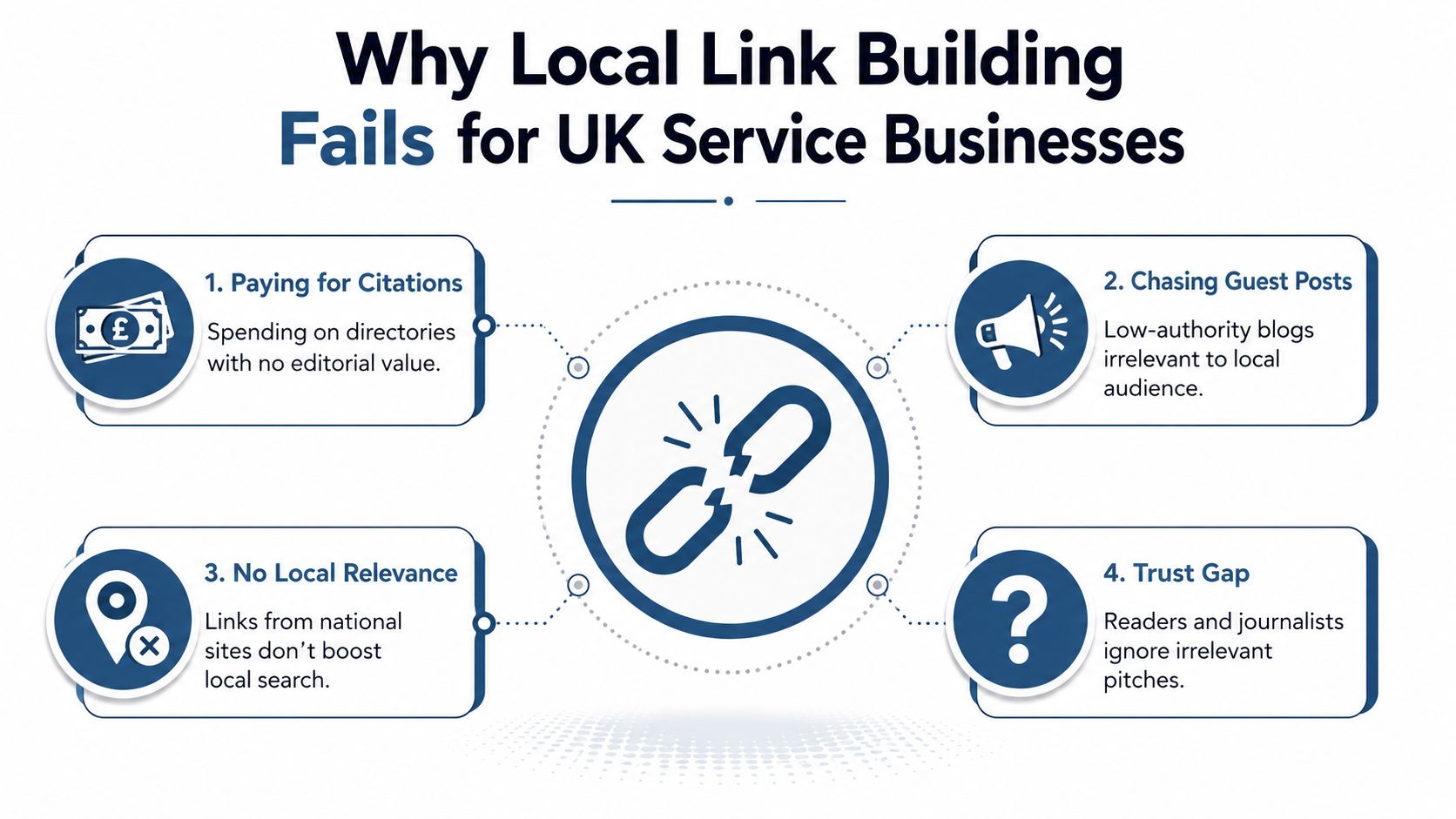
The other thing that trips people up is treating this like a one-and-done campaign. A repeatable local link process is more useful than a burst of frantic outreach. Respona's local link building process frames it as a monthly system, and that matches reality on the ground, because local links usually come in slowly and need patience.
Reverse-engineer the top three, then stop guessing
The quickest way to get unstuck is to look at the three businesses that keep appearing for your target term, then pull their backlink profiles. You're not hunting for magic. You're looking for patterns, the sort of patterns that show where your own profile is weak.
Start with the local pack results for your main query, such as “plumber Bristol” or “solicitor Leeds”. Note the three names that appear most consistently, then check their referring domains in your preferred backlink tool. You're looking for local sources, not just totals.
Here's what usually matters most:
- Local institutions: chambers of commerce, councils, neighbourhood bodies, trade associations.
- Local media: newspapers, community blogs, regional magazines, radio sites.
- Supplier and partner links: stockists, manufacturers, trade partners, referral pages.
- Directory consistency: a small number of credible UK directories used properly, not thirty clones with the same tired description.
A lot of local competitors don't win because they have more links overall. They win because they've built a sensible local trust trail. That trail often tells you exactly where your next ten opportunities live.
What a Bristol electrician might find
A simple audit for a Bristol electrician might show that the top three competitors all have links from the local chamber, a city guide, one or two neighbourhood websites, and several supplier or partner pages. The electrician with the weakest profile may still have a decent homepage, but no real local footprint beyond a handful of directory entries.
That gap analysis gives you a proper plan. Instead of spraying outreach across the internet, you can prioritise the local newspapers, trade bodies, and community sites that competitors already use. If you want a broader example of how this kind of competitor-led thinking maps to a scalable pipeline, the scalable SEO leads guide is a useful companion piece because it keeps the focus on repeatable prospecting rather than random acts of outreach.
Building a Prospect List That Actually Converts
A good local prospect list isn't big, it's useful. For most UK service businesses, 20 to 30 domains is a sensible starting pool for the next 60 days, because you want enough volume to create movement without drowning in dead ends. That figure makes sense only if each prospect is chosen for local fit first and authority second.
Where to look first
Think in layers. Local newspapers, trade associations, councils, chambers of commerce, niche UK directories, supplier pages, and hyper-local blogs all sit in the mix, but they don't deserve equal effort. A chamber link from a modest town site can outperform a shiny directory page that nobody in your service area has ever used, because the chamber reinforces local legitimacy.
A quick way to separate the good from the rubbish is to ask three questions. Does the site have genuine local readership? Does it publish real editorial content? Does it link out in a way that feels human, not automated? If the answer to two of those is no, move on before you waste an afternoon polishing a pitch no one will read.
| UK Local Link Prospect Sources | Typical effort | Realistic conversion |
|---|---|---|
| Chambers of commerce | Moderate | Medium |
| Local newspapers | High | Low to medium |
| Councils and community organisations | High | Low |
| Supplier pages | Low to moderate | Medium |
| Niche UK directories | Low | Medium |
| Hyper-local blogs | Moderate | Medium |
How to vet a prospect properly
Traffic matters, but so does relevance. A tiny neighbourhood blog with a real audience can be more useful than a broad directory with no local readership. The point is to find places where an actual customer, journalist, or organiser might reasonably expect to see your business mentioned.
A practical filter looks like this:
- Check the audience: if the site is clearly local, its links are more likely to help.
- Check the editorial mix: real articles beat endless listicles and spun descriptions.
- Check the outbound links: if every page is packed with obvious SEO placements, tread carefully.
- Check the fit: a supplier page, council resource, or community event page usually makes more sense than a generic “submit your site” form.
A local prospect list should read like a map of your town's actual trust network, not a collection of random web addresses.
Outreach Scripts That Earn Replies
Personalised outreach is where most campaigns either start sounding like a human being or die in the spam folder. The fix is simple enough, though not glamorous. Send short emails, make the local relevance obvious, and only ask for one thing at a time.
Four emails you can adapt today
For a regional journalist, keep the pitch factual and useful.
“Hi [Name], I run [Business Name] in [Town]. We've put together a local [guide, data page, or comment] on [topic] that may be useful for readers looking at [local issue]. If you're covering this area, I'd be glad to send the details across.”
For a community sponsorship mention, anchor it to the group's own priorities.
“Hello [Name], we'd like to support [Group/Event] and would be happy to confirm a sponsorship. If you're listing sponsors on your site, please could you link to [page] and use [brand name] as shown here.”
For a supplier or partner link, make the exchange easy.
“Hi [Name], we work alongside you on [service/product]. Could you add us to your partner or recommended suppliers page? I can send a short description and logo if that helps.”
For an unlinked mention, keep it polite and specific.
“Hi [Name], thanks for mentioning [Business Name] in your recent piece on [topic]. If you're updating the article, would you mind linking the brand name to [URL]? It'd help readers find the right information quickly.”
Follow-up without becoming a nuisance
A seven-day follow-up window with two outreach touches is a sensible limit for a measurable local workflow. After that, move on. Short emails and tightly tracked outcomes are better than hovering in someone's inbox like a damp umbrella.
For a small UK business, that discipline matters. A plumber in Leeds doesn't need 100 speculative emails. They need 20 to 30 solid prospects, a clear reason to contact each one, and a way to see which pitches get replies. If the same message gets ignored twice, it usually means the prospect list needs tightening, not the subject line.
Linkable Assets That Local Press Actually Want
A decent pitch still needs something worth linking to. Local editors, organisers, and community sites are far more likely to bite when the asset is tied to a place they recognise. That usually means content with genuine local utility, not another bland “ultimate guide” written for no one in particular.

Assets that earn attention
A town-specific cost guide works well because it answers a real buying question. A Manchester plumbing firm, for example, could publish a clear guide on boiler service costs in Manchester for 2026, written in plain English and backed by practical detail. A local paper or neighbourhood blog is much more likely to reference that than a generic service page.
Neighbourhood roundups also pull their weight. So do locally relevant data pages, sponsor-driven event pages, and customer story case studies that show real work in a named area. These are useful because they support both link building and trust, which is handy when a prospect is trying to work out whether you're a real business or just a very shiny contact form.
A decent starting mix might look like this:
- Town guide: useful for local news and community blogs.
- Neighbourhood roundup: useful for hyper-local publications and area pages.
- Event or sponsorship page: useful for group sites and organiser listings.
- Customer story: useful for partner pages and local press.
Press releases and the fine print
Press releases can still have a role when they're attached to real news, not wishful thinking. If you want a practical discussion of how releases can support backlink acquisition, high-value backlinks from press releases is a useful read, especially if you're deciding whether your announcement is newsworthy or just office stationery in disguise.
The key is not to rely on press releases as a shortcut. They work best as part of a broader local visibility play, where the release points to a useful asset and the surrounding outreach targets local editors, organisers, and community pages. If the release has no local angle, it'll probably sink without a trace.
Google Business Profile and Citations as Link Adjacents
A lot of local campaigns go wrong because the site, the Google Business Profile, the citations and the links are treated as separate jobs. In practice, they all shape the same local trust picture. Reviews matter more than they used to, and citations still carry weight, so the aim is to keep every signal pointing in the same direction, as noted in a recent historical ranking-factor benchmark.

Structured and unstructured citations
A citation is a mention of your name, address and phone number, usually shortened to NAP. Structured citations live in directories such as Yell, Yelp, FreeIndex, Apple Business Connect, Bing Places and Yellow Pages. Unstructured citations turn up in local press, community blogs, chamber pages, and similar editorial mentions UK citation guidance.
| Structured vs Unstructured UK Citations | Where it appears | What it signals |
|---|---|---|
| Structured citation | Directory, profile or business listing | Consistent business details |
| Unstructured citation | Local press, community site or chamber page | Local legitimacy and editorial mention |
The point is not to collect as many listings as possible. It is to keep the NAP format identical wherever it appears. If a Bristol electrician is shown one way on a directory and slightly differently in a newspaper mention, that inconsistency does nobody any favours, least of all the search engine.
GBP, reviews and links working together
Google Business Profile needs proper attention because it often acts as the front door. Fill every field, post updates, and keep the profile aligned with your citations. That work is not glamorous, and neither is redoing a bathroom after a bad quote, but both are cheaper when they are done properly first time.
For a simple audit, check the following:
- Business name: exactly the same across GBP and citations.
- Address format: consistent everywhere, including suite numbers and abbreviations.
- Phone number: one main number, used consistently.
- Website URL: the same destination for all core listings.
- Reviews: monitored and answered promptly.
GBP and citations also help the rest of the profile make sense. A solicitor with tidy listings, a steady review pattern and a few relevant local links looks like an actual firm operating in town, not a random lead-gen page with a postcode. That is why local SEO work should be joined up from the start, as covered in this small business local SEO guide.
White, Grey and Black Hat Tactics You Must Recognise
A practitioner can't pretend every link is equally clean. There's a clear difference between earned local authority and the sort of shortcuts that look clever right up until rankings wobble. Knowing that line helps you protect the profile you've built.
The categories in plain English
White hat work includes digital PR, sponsorships, genuine partnerships, local content, and proper outreach. These links make sense to users and to the organisations placing them. They're slower, but they're durable.
Grey hat tactics include aggressive directory submissions, paid placements without disclosure, and niche edits on weakly related sites. Sometimes they work for a while, which is exactly why people keep trying them. They're also the sort of thing that can make a cleanup job far more expensive later.
Black hat includes PBNs, link farms, hacked links, and cloaked redirects. If a previous agency used any of those, you've got more than an SEO problem, you've got a trust problem.
What to do if the old profile looks messy
Start by looking for patterns, not panic. Lots of low-quality exact-match links, strange foreign domains, or irrelevant placements on sites that clearly exist only to sell links are obvious warning signs. If the profile looks grubby, clean it methodically and rebuild with local relevance rather than trying to outrun the mess.
If the link wouldn't make sense to a real customer in your town, it probably doesn't belong in your strategy.
That principle also applies to citations. Structured and unstructured mentions should reinforce the same story about who you are, where you are, and what you do. The more consistent that story is, the less tempting the grey-hat noise becomes.
Measuring Results and Managing Risk
If you don't measure local link work, you end up arguing about vibes. That's no good to anyone, especially when the accountant wants to know why the plumber in town suddenly seems more expensive than the one with fewer links and better rankings. The right dashboard is simple enough to build without a data analyst and honest enough to show what's moving.
The metrics that matter
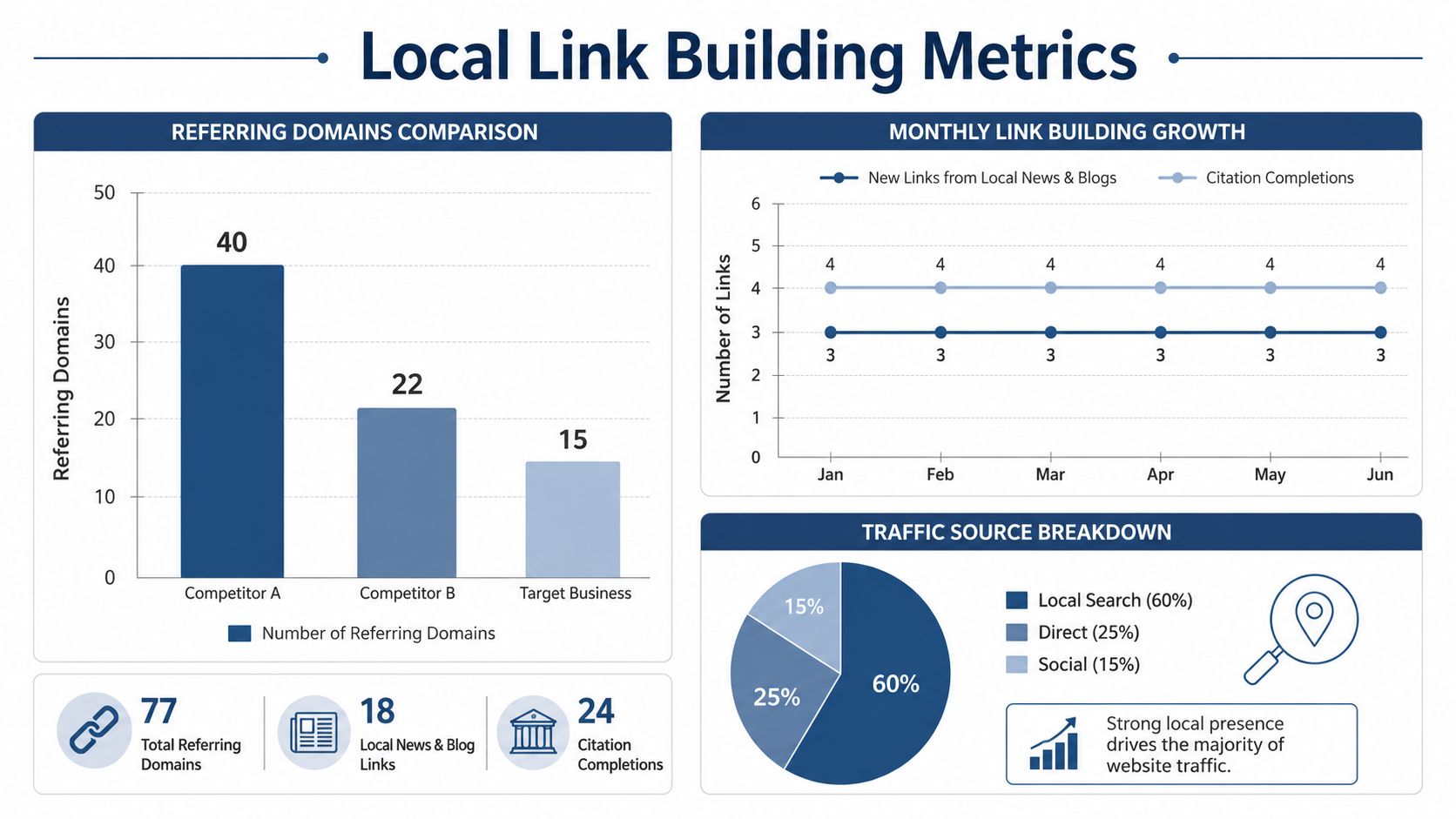
Track referring domain growth, branded search lift, Google Business Profile calls and direction requests, and rank movement for your main local terms. You can also watch your top local competitors, because if they're steadily earning more local domains while your profile stalls, the gap will usually show up in visibility sooner or later.
For a cold profile, the first signs of progress are usually practical rather than dramatic. You'll see more consistent citation completion, a few local links coming in from the kinds of sites you targeted, and better engagement from your GBP. That's enough to keep going, provided the quality stays local and the outreach stays specific.
The line between helpful and harmful matters here. Disavow is rarely the answer, and it's usually a last resort rather than a routine maintenance task. If you inherit obviously toxic links or take a manual action hit, clean the worst offenders, fix the underlying source of the problem, and document what changed before you touch the disavow file.
A simple monthly dashboard
- Competitor referring domains: note the top three local rivals and whether they're still outpacing you.
- Brand searches: look for signs that more of your business name is being searched directly.
- GBP actions: calls, clicks, and direction requests should be visible in the profile insights.
- Local rankings: monitor the hero terms that matter most, not a vanity spreadsheet full of noise.
- Link quality: record the source type, not just the number.
A useful 90-day rhythm is straightforward. Spend the first few weeks prospecting and cleaning up your list, the middle block on outreach and asset creation, then the final fortnight on measurement and refinement. Keep the process white hat, keep the prospects local, and keep the follow-up civil. That's the boring answer, and boring is often what works.
If you want a UK local SEO plan that starts with competitor reverse-engineering rather than guesswork, DigiVisi Ltd builds campaigns around real local signals, from citations and GBP work to content and link opportunities that make sense in your town. Visit DigiVisi Ltd if you want a team that treats local link building as a proper lead-generation system, not a directory-submission hobby.