Skip to content
A partner in a small Bristol practice knows this feeling all too well. The firm has a steady referral stream, a tidy website, and a perfectly sensible set of services, yet the phone rings and the caller says they found a competitor in the Map Pack before they ever saw the firm's homepage. That's local search in accounting now, bluntly effective and slightly rude about it.
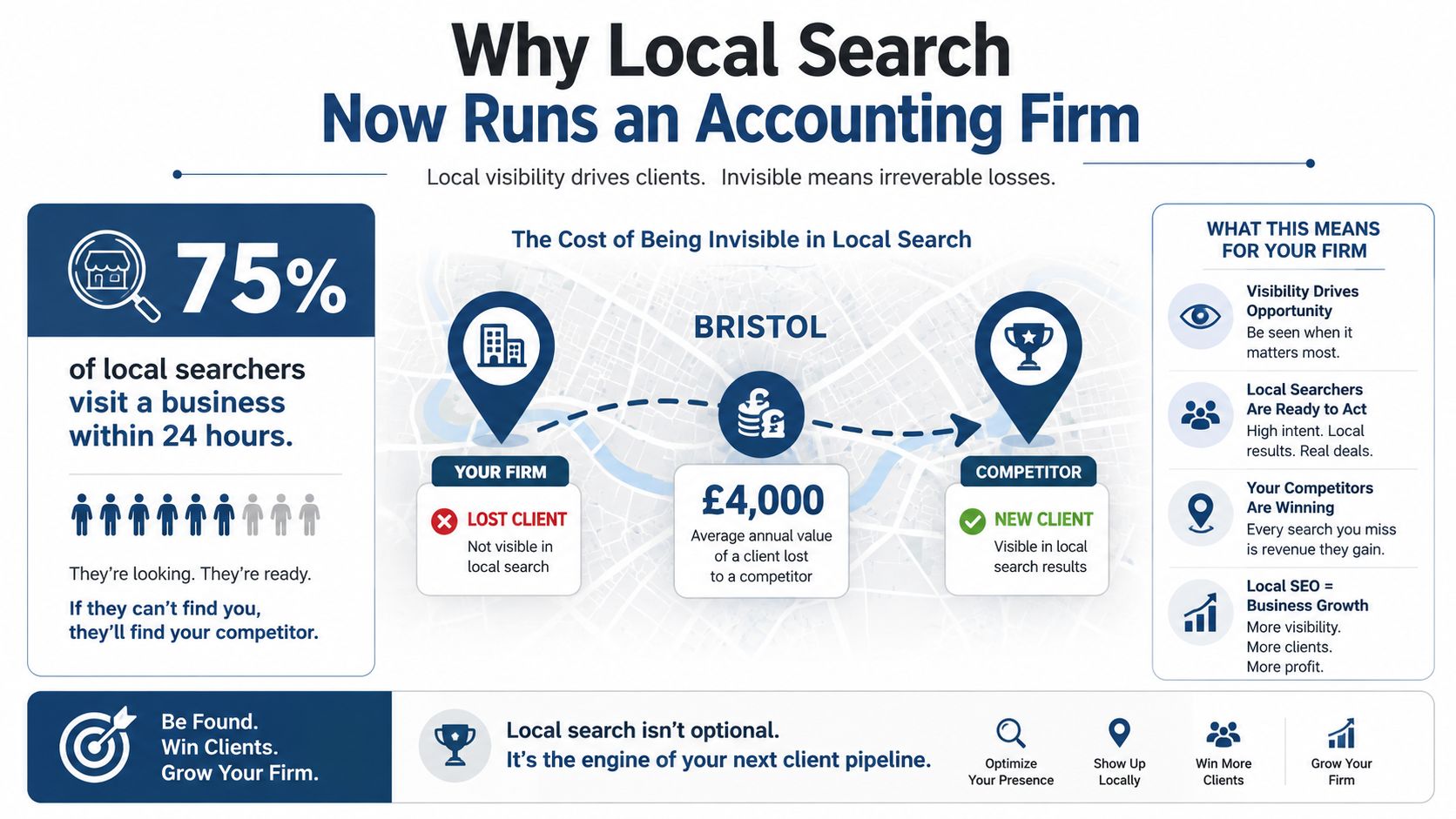
For UK accountants, local SEO isn't a side project anymore. A UK-focused accounting guide states that 75% of prospective clients search online before choosing an accountant, and that makes Google Business Profile, local landing pages, and citation consistency foundational rather than optional. The practical reality is simple, if your practice doesn't show up where nearby buyers are already looking, someone else gets the enquiry, the meeting, and the fee.
Table of Contents
- Why Local Search Now Runs an Accounting Firm
- Getting the Google Business Profile Fighting Fit
- Choosing Categories, Services and Posts That Pre-Qualify Enquiries
- Location Pages for Multi-Office and Regional Firms
- NAPW Consistency and Citations That Earn Their Place
- Reviews as a Conversion Threshold, Not a Branding Metric
- Measurement, Testing and a 90-Day Rollout Plan
Why Local Search Now Runs an Accounting Firm
A Bristol partner once lost a long-term client worth about £4,000 a year because a rival appeared in the Map Pack at the right moment. The client hadn't gone hunting for the “best” accountant in some abstract sense, they'd searched for someone nearby, seen the listings, and clicked the one that looked active, reviewed, and easy to contact. That's the modern front door of an accounting practice, and it's not built from brochures or wishful thinking.
The local search environment rewards whoever looks closest, most trusted, and most current. Independent local SEO statistics for accounting firms report that 89% of “CPA near me” searches trigger the Map Pack, and the top 3 map positions capture 42% of clicks. The same benchmark set says Google Business Profile signals account for 32% of the local ranking algorithm, complete profiles receive 7x more clicks than incomplete ones, and views on Google Maps are up 61% year over year WebTonic's accounting local SEO statistics. That's why the argument isn't “should accountants care about local search”, it's “why would they ignore the place where intent-rich clicks are already landing?”
What white, grey and black hat mean in practice
White-hat local SEO means accurate business data, real reviews, relevant local pages, and a profile that reflects the actual firm. Grey-hat usually means stretching the rules, maybe over-optimising a business name, pushing thin location pages, or buying citations in bulk because someone promised “easy rankings” from a basement full of spreadsheets. Black-hat is the nonsense that gets practices into trouble, fake locations, fake reviews, and invented service areas dressed up as strategy.
Practical rule: if it would look embarrassing in front of a partner meeting, it probably belongs in the bin.
The historical shift matters too. Discovery has moved from directory-led habits to search-led habits, with Google Business Profile and location relevance now central to how accountants are found in the UK market. For firms that depend on trust, proximity, and steady inbound enquiries, local visibility isn't a support act. It's the first pitch, the first impression, and often the first invoice.
Use this internal resource if you want the broader local services context for financial firms, local SEO for financial services.
Getting the Google Business Profile Fighting Fit
Google Business Profile is the one asset I'd fix before anything else. I've audited enough accountancy practices to know the usual pattern, a decent website, a half-complete profile, and categories chosen as if the firm had been told to “just pick something and crack on”. That's not a strategy, it's the digital equivalent of filing your receipts in a shoebox and hoping the spreadsheet will sort itself out.
Verify, align and stop improvising
Start with verification, then make the profile match the website exactly. Thomson Reuters specifically recommends using the exact same business name, address, and phone number everywhere, and that matters because Google likes consistency more than creative interpretation Thomson Reuters guide to SEO for accountants. If the Bath office is called “Bath Accountancy Ltd” on the site, it should not appear as “Bath Accountants and Tax Specialists” on the listing because someone fancied the extra keywords.
For a fictional Bath practice, the opening fields should be boring in the best possible way. Correct address, local phone number, accurate hours, website URL, and a description that explains who the firm serves and what it does. No keyword confetti. No heroic claims. Just the kind of clarity that helps a prospect decide whether they're in the right place.
Choose categories with intent, not vanity
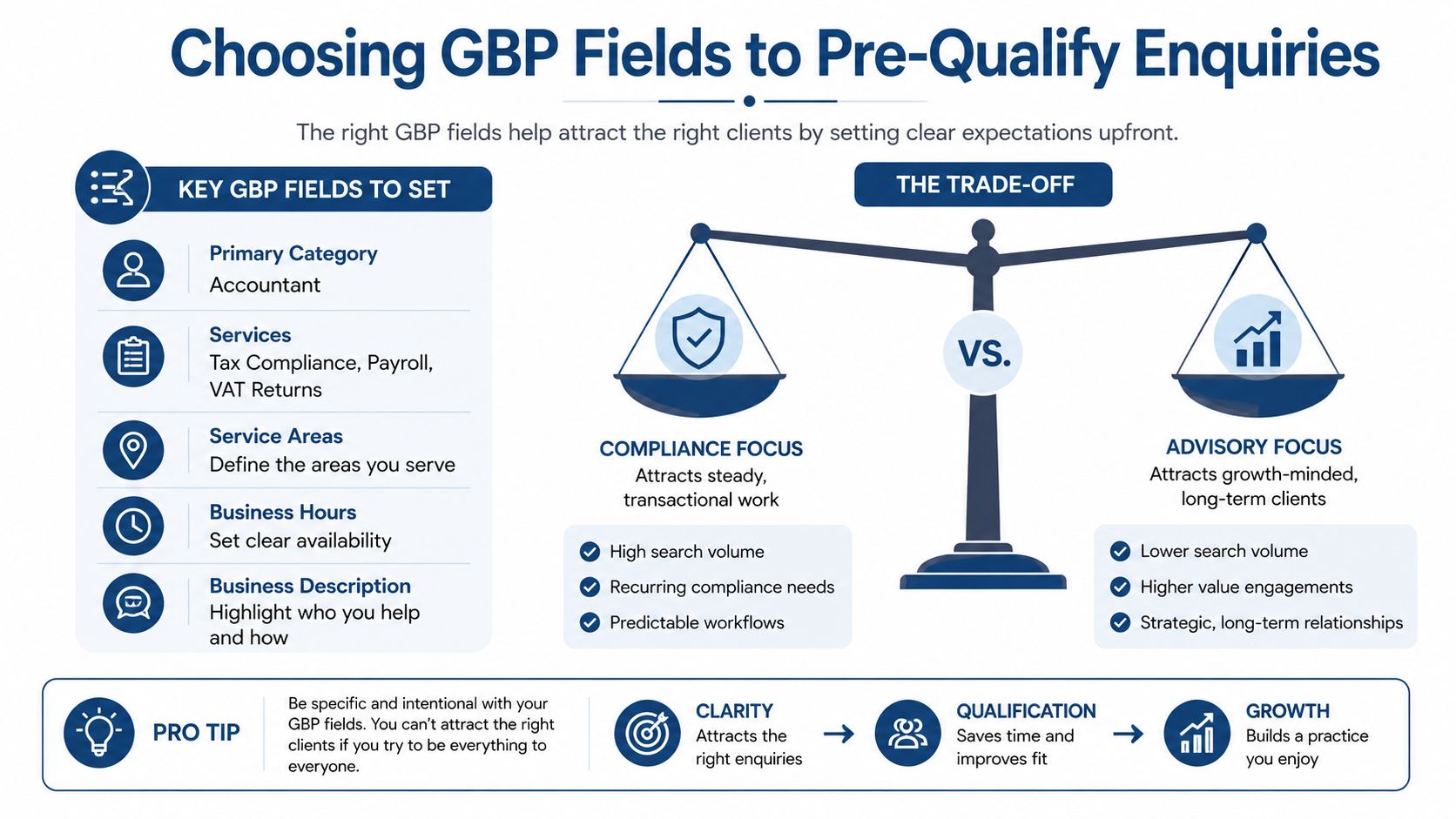
The primary category should usually be Accountant. After that, add only the secondary categories that match real revenue streams, such as Bookkeeping Service, Tax Preparation Service, or Payroll Service. If a firm barely touches payroll, don't slap it on the profile because it sounds complete. Google can smell nonsense, and so can business owners who read the listing.
Opening hours deserve more care than many firms give them. If the office handles Saturday appointments during tax season, set them properly. If it doesn't, resist the temptation to pretend. A profile that matches real availability beats one that looks fuller but sends callers into a voicemail cul-de-sac.
A GBP should read like a live front desk, not a decorative plaque.
Keep the profile alive
Weekly posts, monthly photos, and quarterly attribute audits are enough to stop the listing going stale. That rhythm also gives Google and the user a reason to believe the business is active, responsive, and still trading in the physical world rather than in last year's optimism. Avoid fake service areas and business-name stuffing, because those are the kinds of black-hat shortcuts that can lead to suspension, and suspension is a dreadful way to learn humility.
A good profile lets a partner answer the question a prospect is really asking, “Are you close, credible, and open for business?” If the answer is obvious in five seconds, the profile is doing its job.
Choosing Categories, Services and Posts That Pre-Qualify Enquiries
Google Business Profile isn't just there to win visibility, it's there to shape the kind of enquiry that lands in the inbox. That's where many accounting firms get it wrong. They fill every field, then wonder why the phone keeps ringing with the wrong sort of caller, the one who wants “a quick tax thing” and expects it to be sorted before lunch.
Build for the work you want more of
If the firm wants steady compliance work, the services field should be explicit about tax compliance, VAT returns, and payroll. If the partner wants more advisory enquiries, the profile should still be accurate, but the descriptions, posts, and photos can lean toward planning, forecasting, and business support. The trade-off is straightforward, compliance-focused wording attracts routine work, while advisory-focused wording helps filter for clients who are thinking beyond annual filing.
That doesn't mean turning the profile into a sales page. It means using the few available fields to tell Google and the searcher what sort of firm this is. A practice that mainly handles owner-managed businesses in Bristol doesn't need to pose as a grand theory of enterprise, it needs to say what it does in plain English.
Use posts as a steering wheel
Google Posts are especially useful when demand changes across the year. A January post can talk about self-assessment, year-end checks, and filing pressure. A July post can shift toward bookkeeping, management accounts, and planning for the next quarter. Same firm, different emphasis, fewer unhelpful calls.
A simple monthly content pattern works well:
- January: Tax filing reminders and last-minute document checklists.
- April: Year-end housekeeping and questions about next steps.
- July: Bookkeeping, payroll, and advisory support for established businesses.
- October: Planning for the next tax cycle and service slot availability.
Don't overcomplicate the review response process either. Keep it professional, factual, and safe. Avoid improvising legal or tax advice in public responses, because one clumsy reply can wander into professional indemnity territory faster than anyone enjoys.
The same logic applies to photos. Office shots, team headshots, and local landmarks help more than stock imagery that looks like it was borrowed from a generic “small business success” brochure. People can spot stock photos instantly, and they usually distrust them for the same reason they distrust a suspiciously tidy set of records.
A profile tuned this way does more than collect traffic. It pre-qualifies the enquiry before the first call.
Location Pages for Multi-Office and Regional Firms
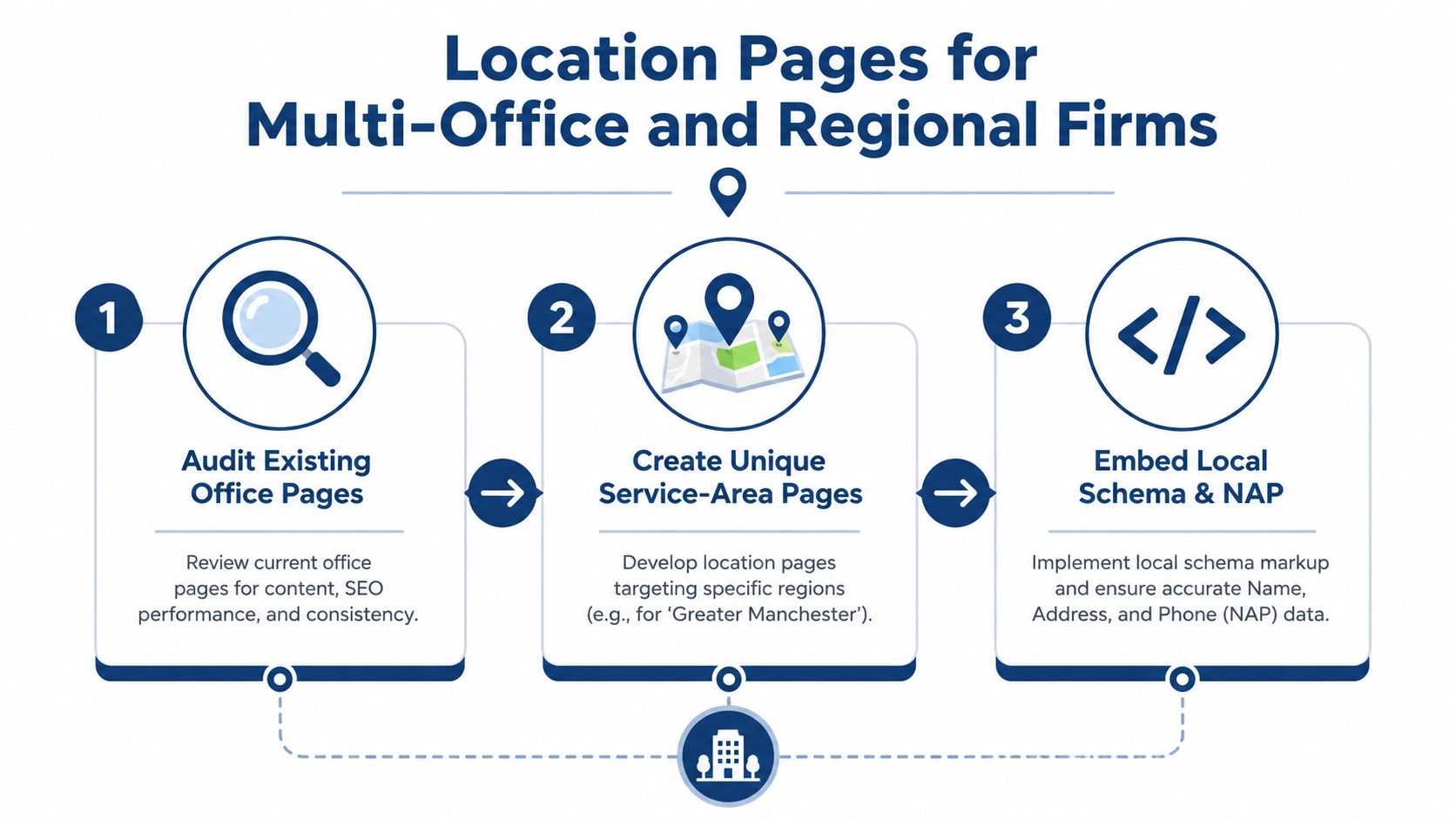
Multi-office firms often try to solve geography with one umbrella page and a hopeful shrug. That rarely works. Google wants a clear signal for each physical office, and the user wants a page that proves the office is real, local, and relevant to the area they searched.
Separate offices need separate signals
Each physical office should have its own separately verified Google Business Profile listing, with a location-specific phone number rather than a central switchboard. That matters for a Manchester and Salford practice because the offices may serve overlapping markets, but they are not the same entity in local search. A single “Our offices” page is too vague to help either one rank properly. Creative Tweed on accounting firm local SEO
Each location page should contain enough original content to stand on its own, plus LocalBusiness schema with address, opening hours, geographic coordinates, and service area. Google's own guidance on local business pages makes the same general point, a page needs clear location details and useful local context, not a recycled template with the postcode changed and everyone pretending not to notice. Google Search Central local business page guidance
What a real page should include
A strong Manchester page might mention nearby transport links, the types of businesses the office serves, and the local partner who handles enquiries. The Salford page should do the same for its own area, using local landmarks and practical cues that show it is not a copy-paste job with the city name swapped.
If the only difference between two pages is the address, Google will not be impressed, and neither will the prospect.
A useful structure for each page is simple:
- Local introduction: Explain who the office serves and what sort of clients use it.
- Local proof: Mention transport, landmarks, and local business context.
- Service detail: Show which services are strongest from that office.
- Trust signals: Add partner bios, reviews, and any local memberships.
- Technical markup: Include LocalBusiness schema, coordinates, and opening hours.
Internal linking matters too. The main service pages should point to each location page, and each location page should link back to the firm's core service pages. That gives Google a clear site structure and gives the user a route from local intent to an actual enquiry.
For regional firms, the same logic applies beyond two offices. One page per office, one set of accurate signals per office, and no pretending that a single generic page can do all the work. It cannot. That shortcut usually looks clever for about a week, then falls apart in a way usually reserved for cheap umbrellas and rushed month-end close.
NAPW Consistency and Citations That Earn Their Place
I'm wary of citation spam, because most of it is dressed-up busywork. Google Business Profile still carries the most weight in the local pack, so that is the asset to keep in shape first. A tidy citation footprint helps, but blasting the same details across every directory with a pulse is not the same thing as building authority.
Start with the right platforms
A sensible UK accountant should prioritise Google Business Profile, Apple Maps, and Bing Places first, then add Yelp, Facebook Business, ICAEW and regional society directories, and the local Chamber of Commerce where they fit the firm's profile. One practical framework suggests around 20 to 30 high-quality directory citations, while another argues that a smaller batch of authoritative, accurate, well-indexed citations is usually better than volume for volume's sake ProGeekTech's local SEO guide for accountants.
| Tier | Platform | Why it matters |
|---|---|---|
| Core | Google Business Profile | The central local ranking and conversion asset |
| Core | Apple Maps | Important for mobile discovery and device-native navigation |
| Core | Bing Places | Useful coverage across another major search ecosystem |
| High trust | Yelp | Adds another consistent local reference point |
| High trust | Facebook Business | Supports brand and location verification |
| Professional | ICAEW and regional society directories | Reinforces sector legitimacy |
| Local | Chamber of Commerce | Adds local authority and community context |
Audit before you correct
Before fixing anything, check where the firm already appears and whether the details match. I prefer a clean audit of at least 10 directories first, because one old listing created by a previous staff member can cause more friction than a dozen well-managed profiles. NAPW means Name, Address, Phone number, and Website, and every field needs to match across the firm's site and its citations.
A Sheffield practice does not need 200 stale listings with oddball numbers and abandoned profiles. It needs a small, accurate set of citations that get indexed and maintained, with the Google Business Profile acting as the central reference point that the rest of the web should echo. The grey-hat version of this work is the cheap submission service that blasts the firm into irrelevant foreign directories just to inflate a spreadsheet. That is decorative rubbish, not local SEO.
If I were handing this to a junior, I'd use one page with four columns, the directory name, login details, current NAPW, and last check date. That keeps the work organised without turning the office into a museum of half-finished claims.
Reviews as a Conversion Threshold, Not a Branding Metric
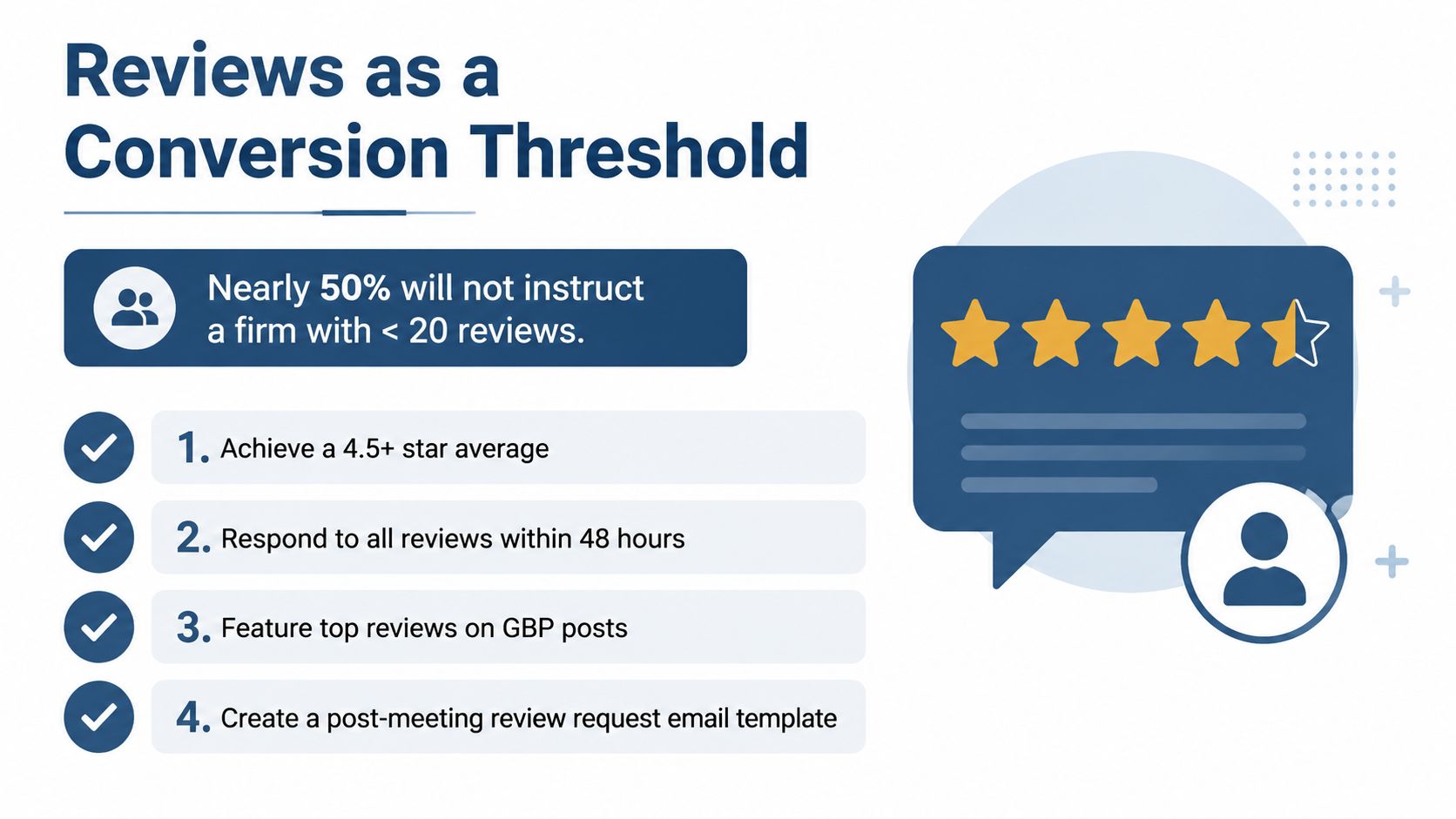
Reviews do more than flatter the firm. They decide whether a prospect feels safe enough to call. That matters because a review profile sits inside the Google Business Profile decision process, where people weigh trust before they click, ring, or book. A firm with a thin review trail can still look credible on paper, but in practice it often loses the enquiry before the first conversation starts.
An infographic titled Reviews as a Conversion Threshold, highlighting four key strategies for business review management. captures the point neatly. Review activity is not just about reputation, it feeds local prominence, supports click-through from the profile, and gives hesitant buyers one more reason to choose the firm over a rival with the same postcode and a shinier logo.
Make the request part of the job
The cleanest process is straightforward. Ask after a successful engagement, not in the middle of a messy one. For accountants, that often means after a self-assessment is filed, a VAT issue is resolved, or a year-end pack goes out without drama. The wording should be neutral, not needy, and definitely not incentivised.
A sensible email might say, “Thanks for working with us on your return. If you'd be willing to share a short review on Google, it helps other local businesses choose with confidence.” That is clear, professional, and unlikely to make the compliance team reach for the sherry. A follow-up SMS can be even shorter, provided the client has consented to messaging.
Respond quickly and keep it civil
Every review deserves a reply within five working days, and negative ones should be answered with the same calm tone you'd use in a partner meeting. Don't argue, don't diagnose, and don't mention confidential details. If a one-star complaint comes from a late-paying client, a simple response works better than an emotional essay, “Thanks for the feedback. We're sorry the experience fell short, and we'd welcome the chance to discuss it directly.”
The review average matters, but review velocity matters too. Fresh reviews tell Google and the prospect that the firm is active now, not just historically reputable in the way old stationery is reputable. A steady trickle is more believable than one glorious burst followed by six months of silence.
The same review set can also be repurposed in Google Posts, provided the content stays factual and doesn't breach conduct rules. A good review process does double duty, it helps rankings, and it lowers the hesitation a cautious buyer feels before picking up the phone.
Measurement, Testing and a 90-Day Rollout Plan
Local SEO gets messy when no one agrees what success looks like. For accountants, the cleanest monthly dashboard has four numbers, GBP queries, profile views, customer actions such as calls, direction requests, and website clicks, and enquiries traced back to local search. You don't need expensive CRM wizardry to track the last one, just a consistent intake form, a call tag, and the discipline to ask how the client found you.
A simple 90-day rollout
The first month should be about structure, not fireworks. Fix the Google Business Profile, clean up NAPW inconsistencies, and verify that the main contact details match everywhere. That settles the foundation before anyone starts poking around in content.
Weeks five to eight should focus on location pages and schema. Build or repair the office pages, make them local, and add the LocalBusiness markup that tells search engines what each page represents. If there's only one office, the same logic applies to the main location page, just without the complexity of branch separation.
Weeks nine to twelve are for reviews, content, and the first batch of partnership links. Ask for reviews through a repeatable process, publish useful local content, and secure a few sensible links from relevant local or professional sources. The point isn't volume. It's signal quality and consistency, which is less glamorous but far more useful.
Troubleshoot the usual three problems
A sudden Map Pack drop usually points to a profile issue, a competitor gaining stronger review and proximity signals, or a mismatch in the local data set. A suspended GBP is often self-inflicted, usually by a name, category, or address problem. Duplicate listings need to be merged or removed before they muddy the waters any further.
Consistency beats heroics in local SEO, which is annoying if you enjoy dramatic interventions and very useful if you enjoy being paid.
If you want a practical way to structure the work, DigiVisi Ltd offers local SEO audits for small UK service businesses, including Google Business Profile review, NAPW checks, and local landing page analysis. That kind of audit is useful when a firm wants a blunt view of what's helping and what's just taking up admin time.
The firms that win here don't chase every shiny tactic. They keep the profile accurate, the pages local, the reviews moving, and the reporting honest. That's less thrilling than a pitch deck full of buzzwords, but it does have the advantage of producing calls.
If you want a more disciplined approach to local SEO for your practice, DigiVisi Ltd can audit your Google Business Profile, location pages, and NAPW consistency, then turn the findings into a clear plan your team can run. Visit DigiVisi Ltd if you'd like the local signals sorted properly, without the usual circus of guesswork and half-baked directory submissions.