Skip to content

You can feel it early. The website is live, the business cards are printed, and a founder has just paid for an SEO retainer that sounded sensible in the pitch deck, yet the first report lands with graphs, impressions and a lot of cheerful fog. The phone still isn't ringing, the map pack is somewhere else, and the blog has somehow become the main event, which is a bit rich for a business that needs enquiries, not a literature degree.
For most UK startups, especially service-led businesses, the right SEO services for startups aren't about churning out posts and hoping for magic. They're about getting the site technically sound, making each service page earn its keep, fixing local visibility, and building trust in a way that suits how people search in Britain, usually on a phone, usually with intent, and usually when they need someone nearby before lunch.
Table of Contents
- Why Most UK Startups Get SEO Wrong on the First Try
- What SEO Services for Startups Include
- Technical SEO Foundations Every Startup Site Needs
- On-Page and Content SEO for High-Intent Searches
- Local SEO and Google Business Profile for Service Startups
- White Hat, Grey Hat and Black Hat SEO Explained Honestly
- SEO Pricing Benchmarks and Timelines for UK Startups
- Your 90-Day Startup SEO Onboarding Plan and FAQ
Why Most UK Startups Get SEO Wrong on the First Try
A founder signs off a retainer, waits for the first monthly report, and gets told the site gained more impressions. Lovely. The trouble is, impressions do not pay wages, and if the work has not touched the pages that bring enquiries, the report is mostly decorative, like a firm biscuit tin with no biscuits.
That mismatch happens because many startups buy SEO as a bundle of activities instead of a set of outcomes. The five working parts are technical SEO, on-page SEO, content SEO, off-page SEO and local SEO, and a sensible plan decides which of those matters most for the business model. For a Leeds plumber or a Bristol solicitor, local visibility and conversion-ready service pages usually matter far more than a heroic blog calendar.
Practical rule: if the proposal starts with “monthly content” before it has checked crawlability, indexation and local intent, you are probably paying for activity, not progress.
The market reality also matters. The UK SEO agency market was estimated to have grown in 2024, reaching £2.1 billion according to the industry statistics cited here, which tells you two useful things. Competition is serious. Agencies also know small businesses will often buy the easiest-looking package, not the one that fits the business.
For startups, that means expectations need to be boringly realistic. SEO is commonly treated as a medium-term channel, not a quick fix, and industry reporting suggests agencies typically deliver measurable results in about 4.6 months, with 60% reporting positive ROI within 6 months. That timeline is entirely sensible for a UK business trying to win organic visibility without acting like a full-time publisher.
What SEO Services for Startups Include
A proper startup SEO proposal should read like a working plan, not a supermarket receipt. If the document does not separate technical work from content work and local work, it has usually been written to impress people who do not enjoy checking what they have bought.
The five pillars in plain English
Technical SEO makes sure search engines can crawl, render and index the site properly. A typical deliverable is a technical audit with fixes for crawl errors, slow pages and messy internal structure, which is exactly what a Manchester electrician needs when a bloated theme is hiding key service pages. For a site that loads like it has been carried uphill in wet boots, the first job is often to fix the basics, and that may include how to fix slow page speed.
On-page SEO aligns each page with a search intent. That usually means title tags, headings, internal links and clearer service copy, which helps a Bristol solicitor's conveyancing page match what searchers are looking for.
Content SEO builds pages and supporting content around useful search themes. A better example is a London startup with a service page plus a concise FAQ, rather than six fluffy articles about “industry insights”, which nobody searching for a quote asked for.
Off-page SEO earns authority from outside the site. In practice, that is editorial links, mentions and credible citations, which can help a Leeds clinic or trades firm build trust without resorting to nonsense links from the internet's back alley.
Local SEO improves visibility in map results and location-based queries. For a multi-location cleaning company in Birmingham, that means location pages, profile optimisation and consistent business details across the web. For UK service-led startups, this is often where the quickest gains live, because Google Business Profile and location pages can move the needle faster than another batch of blog posts nobody will ever read.
| Pillar | Typical Deliverable | Example Outcome |
|---|---|---|
| Technical SEO | Audit, fixes, crawl and speed improvements | Search engines can access the right pages |
| On-page SEO | Titles, headings, internal links, page rewrite | A service page matches search intent better |
| Content SEO | FAQ pages, service content, supporting guides | More relevant pages for specific queries |
| Off-page SEO | Link earning, citations, mentions | Stronger trust signals |
| Local SEO | Google Business Profile, location pages, reviews | Better map-pack visibility for local leads |
A decent proposal should show what gets fixed, what gets written, and what gets measured. If it does not, assume the lovely deck did the heavy lifting.
Technical SEO Foundations Every Startup Site Needs
A startup site can look tidy and still be technically a mess. That happens a lot when a founder buys a decent theme, adds a pile of plugins, and then wonders why Google is acting unimpressed. Good design does not cancel out crawl problems, which is irritating, because it would save a great deal of time.
What to fix first
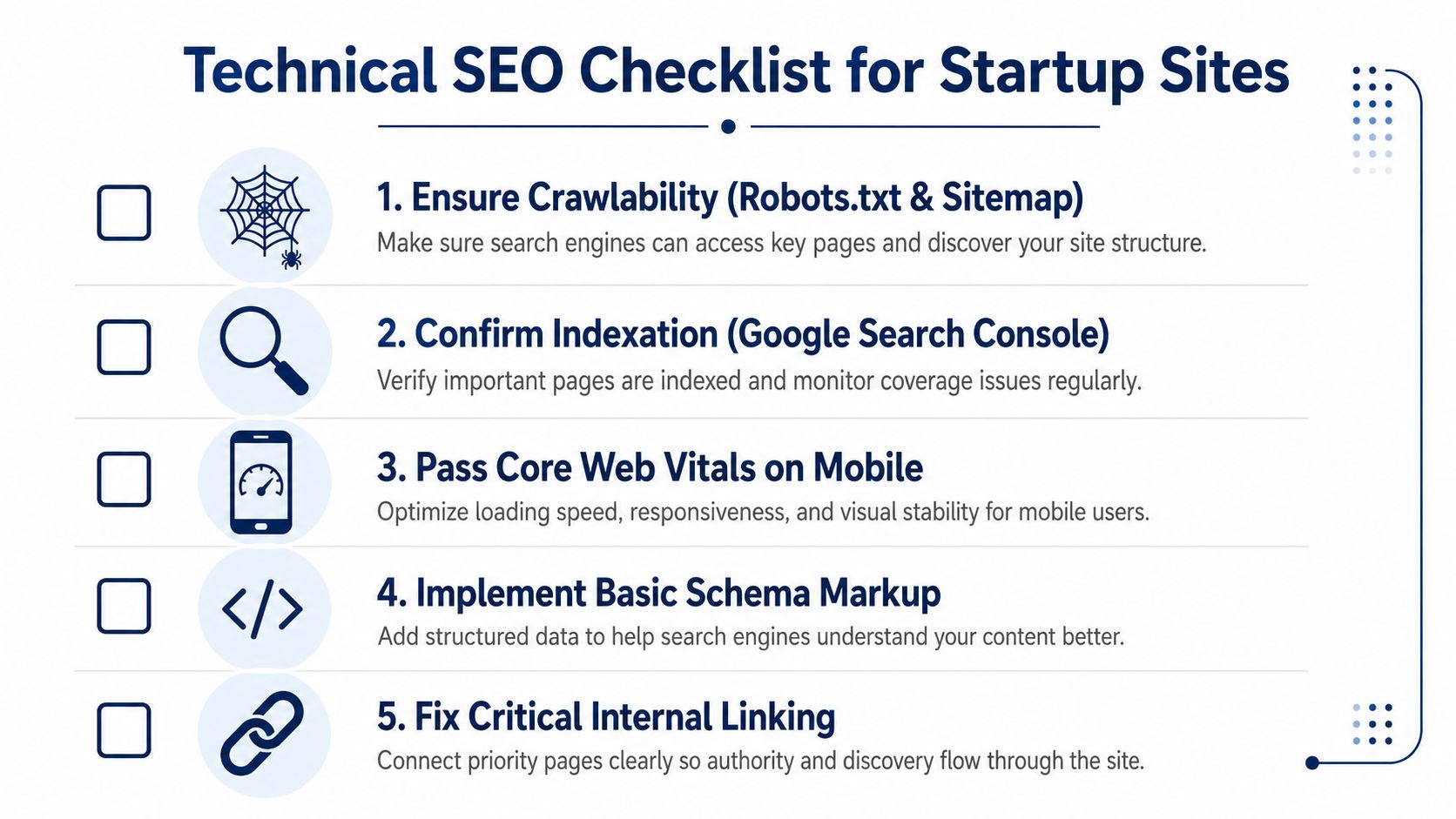
Start with crawlability. If robots directives and sitemaps are messy, search engines waste time, and a startup with only a small site cannot afford that. A Manchester plumber with duplicate URLs and a muddled crawl path is effectively sending enquiries elsewhere.
Next is indexation. Google Search Console should show which pages are in the index and which ones are excluded or ignored. A Bristol solicitor with thin service pages often needs pruning, consolidation and clearer intent, not more pages just to look busy.
Then sort mobile speed and Core Web Vitals. Startup sites lose ground quickly when pages are slow on phones, and that is especially unhelpful for service businesses where people are checking a site between calls or on the bus. Analysing mobile performance data, a checklist infographic outlining five essential technical SEO steps for optimizing a startup website for search engines. and as noted in the startup SEO data, the message is plain enough, slow loading pages make everything harder. A useful guide on how to fix slow page speed is worth keeping close if the site is chewing through render-blocking scripts like a bored intern on a Friday.
For a local firm, this matters even more than many agencies admit. A site can rank well on paper and still lose calls because the mobile version is clumsy, the contact details are buried, or the service page takes too long to appear. That is the sort of practical failure that pushes prospects back to the next listing in the map pack.
What a real audit should hand over
A proper technical audit should produce a prioritised list, not a 50-page tour of shame. It should flag crawl issues, thin or duplicated pages, schema opportunities, broken internal links and anything dragging mobile usability down. The output should end with a short action list, because nobody fixed rankings by admiring a spreadsheet.
On-Page and Content SEO for High-Intent Searches
A good service page doesn't try to be clever. It answers a specific search with enough clarity that the visitor thinks, “Yes, that's me,” and then clicks, calls or fills in the form before the kettle boils. That's the whole game for many UK startups, and it's why generic homepage copy so often falls flat.
Match the page to the search intent
A page targeting emergency electrician Leeds should look like a response to an urgent local need, not a brochure for the entire company. The title, headings, copy and internal links should reflect service, location and urgency, while the page gives obvious proof points, clear call paths and enough specificity to feel real. A homepage that says “We deliver solutions” is doing precisely nothing, except taking up server space.
The next layer is structure. One page should focus on one intent, with the main heading, subheadings, service details and supporting FAQs all aligned. That gives search engines and humans the same message, which is refreshingly efficient compared with the usual startup habit of trying to make the homepage do the work of six pages and a small committee.
What to prioritise first
- Service pages first: A plumber in Leeds needs “boiler repair Leeds” or “emergency plumbing Leeds” pages before a thought-leadership blog about water pressure.
- Location pages next: A solicitor in Bristol serving multiple areas needs distinct location signals, not one vague “we cover the South West” paragraph.
- FAQs last but useful: Add practical questions where they remove friction, especially around pricing, availability and service scope.
- Internal links throughout: Link from the homepage to core services, and from service pages to related services or local pages.
For startups trying to build trust signals cleanly, startup backlinks via listing credits can be useful when handled sensibly, because the point is relevance and credibility, not spraying links around like confetti after a minor corporate morale event.
Good content rule: if a page wouldn't help a customer choose you over the firm down the road, it probably isn't doing enough.
Local SEO and Google Business Profile for Service Startups
For most UK service startups, local SEO is the bit that moves the needle first. That is not glamorous, but it is practical, and practical work pays invoices. If someone in Leeds wants a plumber today, they are not usually reading a white paper before calling someone with a working van.
Build the local footprint properly
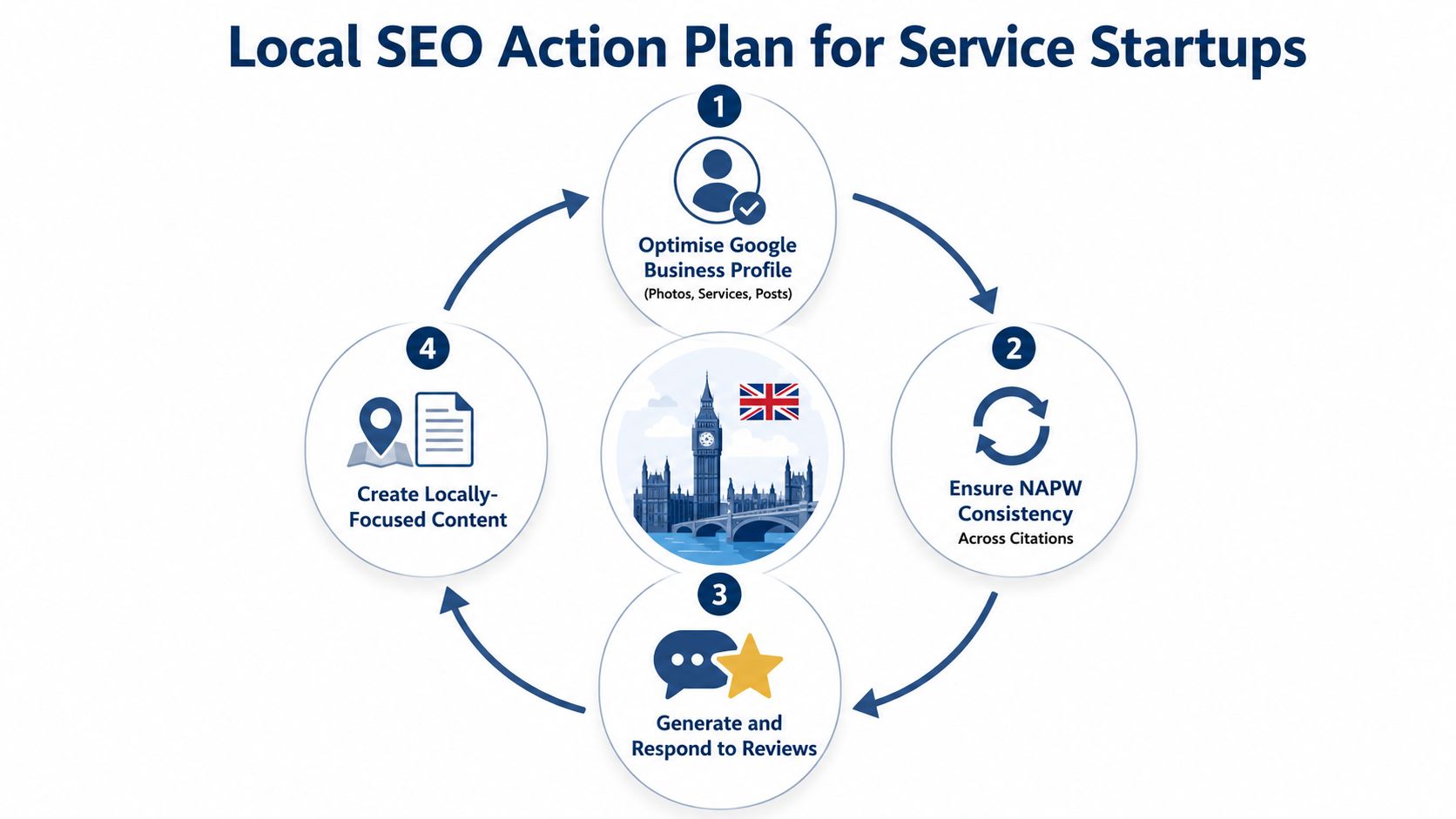
The first job is a fully optimised Google Business Profile. Add accurate services, the right categories, decent photos, posts where they make sense, and opening information that matches reality. If the profile is half-finished, the business looks half-open, which is not a strong commercial message. Google gives people very little patience for guesswork, and neither do customers.
Then get NAPW consistency, meaning name, address, phone and website details matching across the places that matter. Google reads the business identity more cleanly when those details stay stable, and customer trust improves too, because people do notice when the phone number on one listing is different from the one on the contact page. A multi-location home-services firm needs this even more, since each location should look deliberate, not as if it was duplicated by a weary spreadsheet at 4.55pm on a Friday.
Reviews and location pages matter more than directory busywork
BrightLocal's UK research found that 98% of people used the internet to find a local business in 2023, and 87% read online reviews for local businesses as reported in the UK consumer research summary. That makes review generation and response quality a real operational task, not a vanity exercise. A Bristol solicitor with strong reviews and sensible responses will usually look more credible than one with a prettier logo and no social proof.
Google search behaviour points in the same direction. A large share of searches have local intent, and people searching for something nearby often visit a business soon after. The practical lesson is simple, map-pack visibility matters far more than directory churn for trades, professional services and multi-site SMEs.
A common mistake is selling “local SEO” as directory submission. That is just admin with a hat on. Real local SEO means profile optimisation, review management, location content and page-level relevance, not a glorified copy-and-paste routine. For service startups, the fastest wins usually come from the Google Business Profile, local landing pages and fixing basic technical issues before anyone starts talking up “authority content” like it is the answer to every problem.
White Hat, Grey Hat and Black Hat SEO Explained Honestly
There's a lot of nonsense spoken about SEO ethics, usually by people trying to sell shortcuts with a straight face. For startup founders, the distinction matters because a service business depends on trust long before it depends on traffic. You can recover from a weak keyword strategy. It's harder to recover from a penalty and a damaged reputation.
Where the lines actually sit
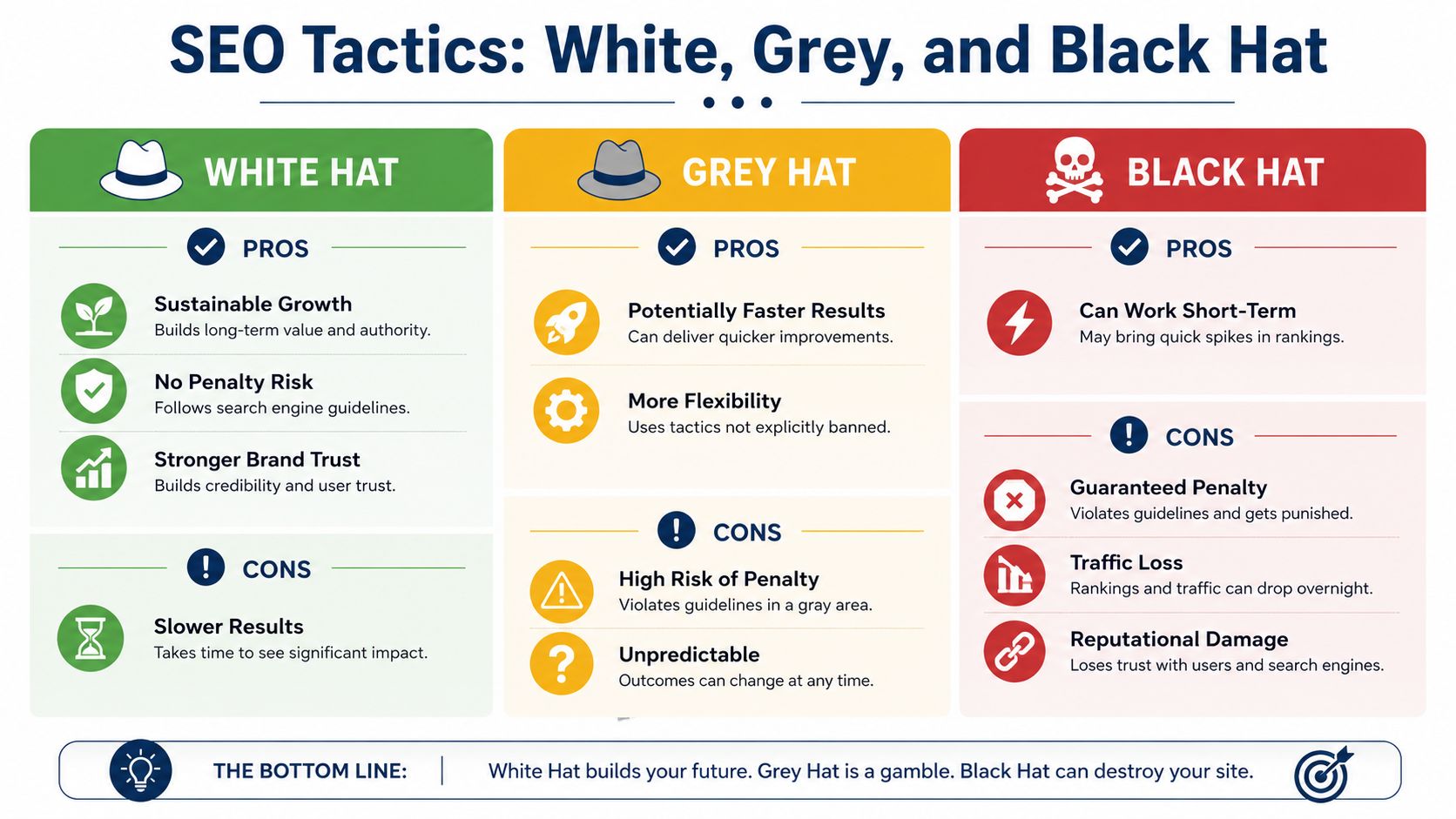
White hat SEO uses genuine outreach, useful content, technical fixes and earned mentions. It's slower, but it's stable, which is exactly what a local law firm or trades startup needs if it wants search visibility without taking silly risks.
Grey hat SEO lives in the murky middle. That's where you see tactics like private blog networks, aggressive anchor text patterns and AI content churned out at scale with very little editing. It can look efficient for a while, which is why people get tempted, but the downside is obvious once rankings wobble or trust drops.
Black hat SEO is the stuff that deserves the frown it receives. Hacked links, cloaking and parasite-style abuse can create short-term movement, then cause real damage when search engines catch up. A startup dependent on local reputation can't sensibly play that game, unless the business model includes sudden regret.
If an agency suggests anything that sounds like “we'll get you loads of links quickly” without explaining relevance, quality and risk, take that as your exit cue.
A simple red-flag checklist
- Guaranteed rankings: Nobody serious guarantees positions, because that's not how search works.
- Secret methods: Usually means risky methods.
- Content at industrial scale: If it's written to impress algorithms and confuses customers, it's not strategy.
- Link packages with no explanation: Good luck explaining those to your accountant, or Google.
- Cloaking or fake local signals: Fine if you enjoy trouble. Less fine if you like being found.
SEO Pricing Benchmarks and Timelines for UK Startups
A startup's SEO budget should follow the work that needs doing, not a tidy number from procurement. Cheap packages often buy a report, a few templated tweaks and a comforting sense of motion. Proper work costs more because it involves judgment, implementation and, now and then, telling the founder that the homepage cannot do every job in the business.
How to read the price bands
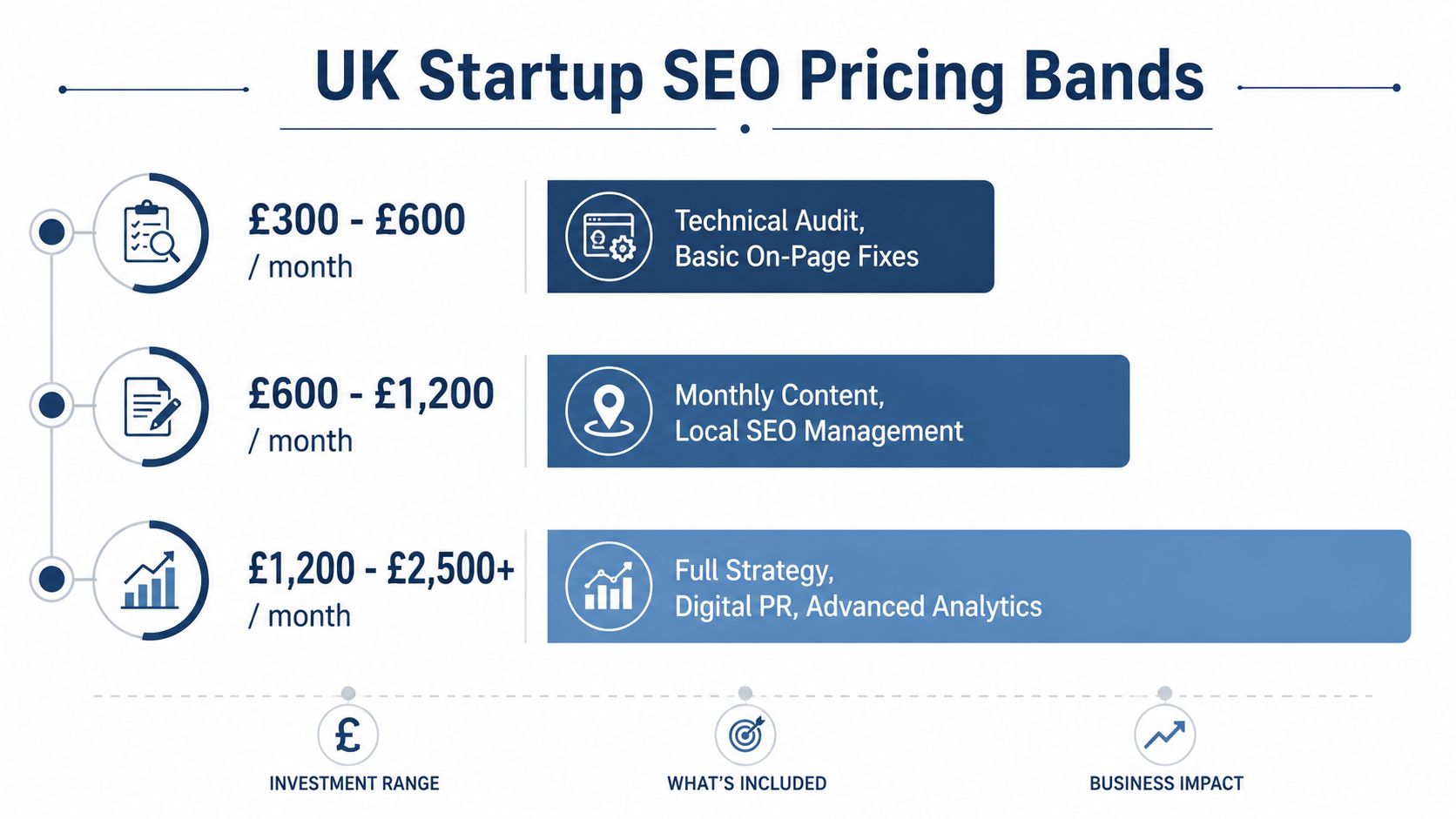
The lower band, £300 – £600 / month, usually covers a technical audit and basic on-page fixes. It can suit a very small site with limited ambition, but it rarely leaves enough room for ongoing content, local work or meaningful link earning. In practice, that means you get the first round of housekeeping, then the account starts looking a bit thin.
The middle band, £600 – £1,200 / month, typically adds monthly content and local SEO management. For many UK service startups, that is the point where the work starts to make commercial sense, because the plan can support service pages, Google Business Profile upkeep and steady improvements without turning into a one-off fire drill. It suits businesses that need enquiries, not just polite traffic graphs.
The upper band, £1,200 – £2,500+ / month, is where strategy, digital PR and more advanced analytics start to appear. That level tends to fit startups with competitive markets, multi-location needs or a genuine growth plan, not just a hope and a login. If the pitch sounds grand but the delivery is vague, you are probably buying presentation, not momentum.
For a useful cost comparison in the UK market, the search engine optimisation cost guide helps frame how scopes differ before anyone starts haggling over a retainer like it is a second-hand sofa. It is a good reality check before you decide whether the ask is local, national or somewhere awkwardly in between.
What to expect over time
The pricing and timing pattern usually follows the shape described earlier in this article and in broader industry commentary. SEO does not behave like paid ads, where spend can create instant visibility if the budget is there. It tends to begin with technical fixes and clearer service-page relevance, then build through local visibility, stronger internal linking and content that answers real search intent.
For most startup sites, that means early progress shows up in crawl health, better indexing, cleaner local signals and more qualified clicks. Rankings can move before revenue does, which is why the sensible question is whether the work is changing search visibility and enquiry quality, not whether a dashboard has become more decorative.
If you want a cost lens for local work specifically, AI Tools for Local SEO pricing insights is worth a look before deciding whether a local-only scope or a broader campaign makes sense. It is especially useful for startups that rely on nearby customers and want to compare what local SEO usually covers against broader retainers.
Your 90-Day Startup SEO Onboarding Plan and FAQ
The first 90 days should feel structured, not mystical. A startup doesn't need a heroic strategy document that reads like a software philosophy essay, it needs a sequence of sensible jobs that create visibility, improve conversion paths and make future work easier.
A practical 90-day plan
Weeks 1 to 2. Audit the site, check tracking, confirm Google Search Console and analytics access, and map the pages that should exist but don't. This is also the point to identify whether the site has a local search problem, a technical problem, or both. A startup with a broken baseline can't afford to guess.
Weeks 3 to 6. Fix crawl issues, prune weak pages, improve headings and rewrite priority service pages. At the same time, optimise the Google Business Profile, clean up business details and make sure the contact paths work properly on mobile. If the site is slow, awkward or vague, this marks the point where the wobble starts to stop.
Weeks 7 to 12. Build or improve location pages, publish a small amount of focused content where it supports a commercial search need, and start review generation in a way that fits the business. Add citations where they support consistency, not because someone has promised “more exposure” in exchange for directory drudgery.
KPIs worth watching
Track impressions, clicks, map-pack visibility, calls and enquiries. If those don't move in the right direction over time, the work is probably misallocated or poorly executed. Vanity graphs are fine for morale, but enquiries pay for the tea.
Questions to ask any agency
- What will you fix first, and why?
- Which pages matter most for leads?
- How do you handle local SEO for service businesses?
- What will you report on each month?
- What do you expect to achieve in 90 days, and what won't happen yet?
Quick FAQ
How long does SEO take?
For many startups, meaningful movement starts to show over a few months, and the industry benchmark above points to measurable results around the middle of that window.
Should a new UK startup invest in local SEO or national SEO first?
If the business sells locally or regionally, local SEO usually deserves the first push. If the offer is national and the market supports it, broader keyword work can follow once the site is technically sound.
How do you know if the agency is doing a good job?
They can explain what changed, why it changed, and which business outcomes it affected. If the monthly update reads like a horoscope, it's time to ask better questions.
DigiVisi Ltd works with UK service-led startups on SEO audits, Google Business Profile optimisation, local landing pages, technical fixes and conversion-focused content, so the work is tied to enquiries rather than just traffic. If you want a practical approach that suits a startup budget and a real-world local market, visit DigiVisi Ltd and see how it fits your business.