Skip to content

In 2026, only 4.3% of the 237,407 trading UK construction companies have a detectable SEO system in place, even though 96% of homeowners start their search for construction services online according to Firmbase's UK construction SEO adoption analysis. That's the sort of gap that should make any builder, roofer, electrician, or general contractor sit up a bit straighter.
Most firms still lean on referrals, repeat work, and the old “we've always done alright without the website” line. Fair enough, until the work slows, margins tighten, or the competitor down the road starts appearing every time someone searches for loft conversions, house extensions, or roofing repairs in your area. At that point, your website either earns its keep or it sits there like a hard hat on a coat stand.
SEO for construction companies isn't magic, and it certainly isn't about stuffing a few keywords onto a page and hoping Google gets sentimental. Done properly, it's a practical system for getting your business in front of people who are already looking for what you do, in the places you serve.
Table of Contents
- The Untapped Goldmine of Construction SEO
- Laying Your Digital Foundations
- Building High-Ranking Service Pages
- Dominating Your Local Patch with Google
- Earning Trust with Authority and Backlinks
- Fuelling Your SEO Engine with Content
- Measuring Success and Planning Your Investment
The Untapped Goldmine of Construction SEO
Construction is full of good businesses that are nearly invisible online. That's the opportunity.
If most of your competitors still rely on referrals and a contact page from 2018, you don't need gimmicks to beat them. You need a site that loads properly, service pages that match what people search for, a tidy Google Business Profile, and enough trust signals that Google feels comfortable putting you in front of buyers.
A simple example. A family-run builder in Worcester may do excellent house extensions, but if their site has one vague “Services” page and no clear area pages, Google has very little to work with. Meanwhile, a less experienced rival with a better structure can show up first for “house extension builder Worcester” and take the enquiry.
Practical rule: Being good on site doesn't automatically make you visible online. Google can only rank what it can understand.
That's why the data above matters so much. The market is not saturated with strong SEO. Far from it. It's underbuilt, which is a rare thing in construction.
The primary commercial advantage sits in the gap between customer behaviour and contractor visibility. People search first. They compare. They look at reviews, photos, location relevance, and whether the firm feels trustworthy. If your business appears at that moment, you're in the running. If it doesn't, your reputation offline won't save that lost lead.
Why this gap is worth chasing
- Local intent is high: Someone searching “flat roof repair Leeds” usually isn't browsing for entertainment.
- Trust can be demonstrated online: Project galleries, testimonials, accreditations, and a clear service area all help.
- The field is still open: In many towns, the websites ranking well are hardly masterpieces. They're just better organised.
There's also a lovely little truth many firms miss. SEO compounds. A strong page about garage conversions in Solihull can bring enquiries month after month, while paid ads stop the second you stop funding them.
Done right, SEO for construction companies turns your website into a working asset, not a digital brochure that gathers more dust than a bag of plaster in the van.
Laying Your Digital Foundations
Before touching titles, content, or backlinks, survey the site properly. The same way you wouldn't pour footings without checking the ground, you shouldn't launch into SEO without understanding what's already there.
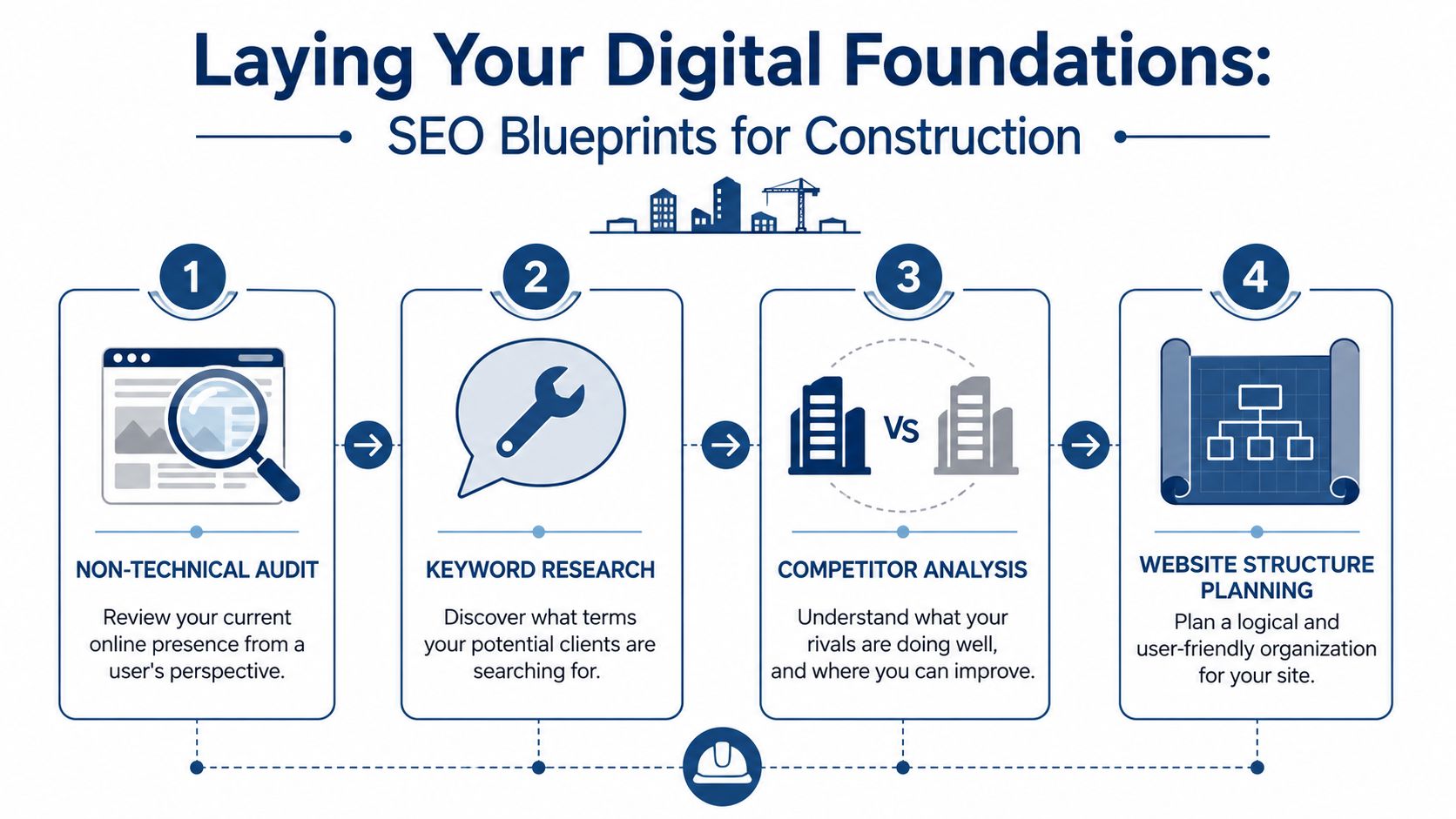
Start with a site survey
Look at your website as a customer would.
Can someone on a phone land on the homepage and quickly work out:
- Who you are: Builder, roofer, electrician, extension specialist, kitchen fitter
- What you do: Specific services, not woolly marketing waffle
- Where you work: Towns, boroughs, counties, or postcodes
- What to do next: Call, request a quote, upload plans, or book a survey
Technical performance matters here too. Appleby Creative notes that technical SEO for construction companies requires a mobile-first site architecture with sub-2-second load times, because 72% of UK service searches occur on smartphones. The same source says firms that get this right see a 35% higher organic conversion rate, while 58% of failed construction SEO campaigns stem from poor site speed and mobile optimisation.
That lines up with what shows up again and again in the trade. A slow site loses trust before your copy even gets a chance.
If your quote form is fiddly on mobile, your image galleries crawl, and your phone number is buried in the footer, the problem isn't traffic. It's friction.
For many builders, the first fixes are gloriously unglamorous. Compress the project photos. Make the contact button obvious. Reduce the clutter in the menu. Put your key services in plain English. You're not building an art installation.
If your team also prices work from plans and wants a cleaner pre-sales process, tools such as Exayard construction estimating software can help keep estimating and enquiry handling more organised, which supports the bigger goal of turning website visits into properly qualified jobs.
Find the phrases real customers use
Keyword research for construction firms should be dead practical. Forget vanity terms. Go after the searches that map to the work you want.
A local electrician in Reading might target:
- Emergency electrician Reading
- Consumer unit replacement Reading
- EICR for landlords Reading
A building firm in Kent might need:
- Loft conversion company Maidstone
- Kitchen extension builder Canterbury
- Garage conversion contractor Ashford
Then look at who already ranks. Not to copy them blindly, but to spot the gaps.
A quick competitor review usually reveals one of four things:
| What you find | What it usually means |
|---|---|
| Strong rankings, weak design | SEO structure is doing the heavy lifting |
| Lots of pages, thin content | Opportunity to beat them with better detail |
| Decent content, poor local targeting | Easy opening for tighter town-specific pages |
| Great reviews, poor website | Their Google presence is carrying them |
Plan the structure before you write
Construction websites often go wrong because everything gets dumped into one services page. Google wants clearer relevance than that.
A sensible structure looks like this:
- Core service pages for each main revenue line, such as loft conversions, roofing, rewires, or groundworks.
- Location pages where there's genuine demand and you serve the area.
- Project pages showing completed work with photos, scope, and outcome.
- Trust pages covering accreditations, guarantees, process, and contact details.
That gives you a clean blueprint. And unlike some building projects, it doesn't require three rounds of “just one more tweak”.
Building High-Ranking Service Pages
The firms that win with SEO for construction companies usually don't have the flashiest websites. They have the clearest pages.
Take a fictional example, Smith & Sons Loft Conversions in Kent. Their old service page said they offered loft conversions across the South East, had two stock photos, and a paragraph that could have described anyone. It existed, but it didn't pull its weight.
A better version is specific. The page title mentions loft conversions in Kent. The opening states exactly who the service is for. The copy explains the types of loft conversions they handle, the planning considerations, the build process, and what homeowners can expect. Then it backs that up with real project photos from local jobs, a testimonial, and a clear enquiry form.

What a strong local service page looks like
A useful service page answers the questions a customer already has in their head.
For Smith & Sons, that page might include:
- Service scope: Dormer loft conversions, Velux loft conversions, hip-to-gable options
- Area relevance: Clear mention of Kent towns they serve
- Proof of work: Before-and-after photos from recent loft projects
- Client reassurance: Insurance, experience, process, timelines in broad terms
- Next step: A quote form with enough detail to qualify the enquiry
Many firms wobble in this regard. They write for Google and forget the client, or they write for the client and give Google nothing structured to understand. You need both.
A roofer in Leeds doesn't need pages filled with fluffy lines about excellence and passion. They need a page that says what roofing work they do, where they do it, what past jobs look like, and how fast someone can get in touch.
A service page should sound like a capable site manager, not a sixth-form brochure.
Schema markup is the bit most firms skip
This is one of the easiest missed wins in the sector. Priority Pixels reports that 87% of UK construction firms ignore LocalBusiness schema markup, and that firms using proper schema markup see 32% higher visibility in Google's local results.
That matters because schema helps search engines interpret what your business is, where it operates, and how your pages relate to local intent. It won't rescue a bad page, but it does strengthen a good one.
For a construction site, useful schema often includes:
- Business details: Name, address, phone, website
- Service relevance: What the page is about
- Location context: The area or service region the page targets
- Supporting content: FAQs when they're useful
A common mistake is creating several near-identical pages for nearby towns and pointing them all at the same service without enough differentiation. That's how you end up with pages competing against each other rather than helping one another.
If Smith & Sons serves Maidstone, Canterbury, and Ashford, each page should reflect actual local relevance. Different jobs, different examples, slightly different questions. Not a lazy find-and-replace job that smells of copied content from a mile off.
Dominating Your Local Patch with Google
For a local builder, ranking in the map pack is often more valuable than chasing broad national traffic. If someone searches for a builder near them, Google Business Profile is usually where the fight starts.
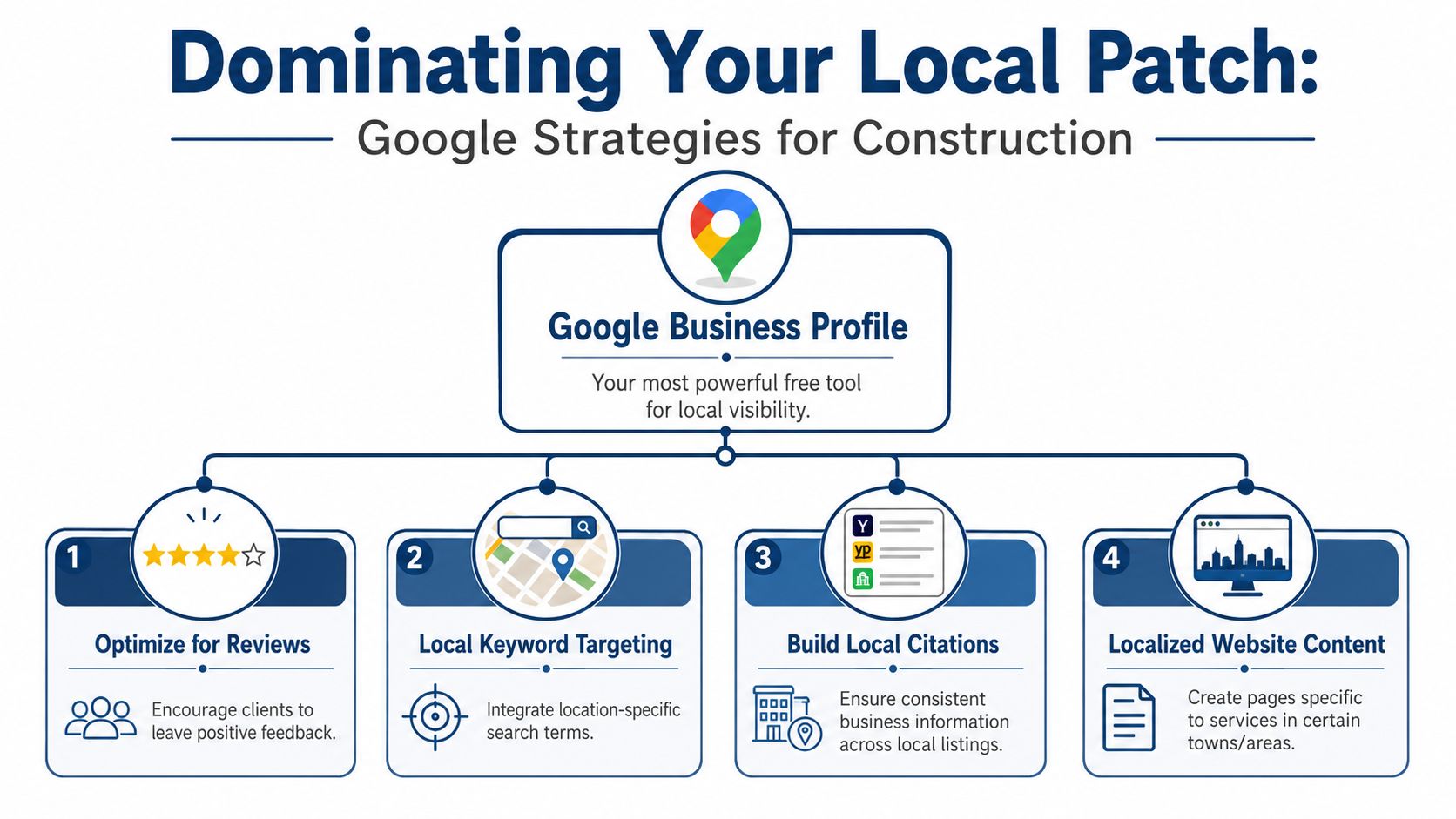
Treat your Google Business Profile like a live sales asset
A neglected profile is a wasted opportunity. A good one can generate calls, direction requests, and quote enquiries with no one needing to click through ten pages first.
The basics need to be right:
- Business name: Use your real trading name, not a list of keywords stuffed in like a skip
- Primary category: Pick the closest match to the core service
- Service areas: Keep them accurate
- Photos: Show real projects, vans, team members, and completed work
- Business description: Explain what you do and where you work in plain English
Then keep it moving. Add recent photos. Answer questions. Check details regularly. A profile that looks active tends to inspire more confidence than one frozen in time.
Later in the process, it helps to review your broader local performance with a proper local SEO audit for service-area businesses, especially when rankings vary wildly from one town to the next.
Here's a useful video if you want a visual walk-through of local visibility basics:
Citations and NAP consistency still matter
Local SEO still runs on trust signals. One of the biggest is NAP consistency, meaning your business name, address, and phone number appear the same way across the web.
Lasso Up explains that a local SEO method starting with strict NAP consistency and then building geo-specific service pages can yield a 40–60% increase in local visibility within 6–9 months for UK construction companies.
For builders and trades, that means cleaning up listings on places such as:
- Google Business Profile
- Yell
- Checkatrade
- Trusted local directories
- Relevant trade and association listings
This isn't glamorous work, but neither is clearing rubble and it still has to be done.
A common mess looks like this:
- One listing says “J Turner Building Ltd”
- Another says “J Turner Builders”
- One has an old mobile number
- Another has the unit address missing
- The website footer shows something different again
Google sees inconsistency and gets cautious. Caution is not what you want when someone nearby is searching for “builder in Stafford”.
Field note: If your citations disagree with one another, Google has no reason to trust which version is correct.
Local pages win when they're genuinely local
A page called “Roofing in Manchester” only works if it contains something useful about your roofing work in Manchester. That might be project examples, area-specific service notes, references to common roof types in the region, or practical details about response coverage.
Good local pages usually include:
- A specific service plus place pairing
- Photos from work in or near that area
- A testimonial tied to the local patch
- A clear call to action
Bad local pages are obvious. Thin copy, no proof, no local detail, and twenty cloned versions for towns you barely serve. That sort of page might have worked years ago. Today it's more likely to waste crawl budget and annoy visitors.
For a sparky in Bristol, one strong page for “EV charger installation in Bristol” beats a stack of limp pages targeting every postcode with the same copy and a different heading.
Earning Trust with Authority and Backlinks
Some construction firms hear “backlinks” and immediately picture nonsense emails, shady directories, and someone promising the moon by Friday. Fair enough. A lot of link-building advice is absolute rubble.
The trick is knowing the difference between white hat, grey hat, and black hat.
White hat means earning links through genuine relevance and real-world credibility. Grey hat sits in the murky middle, where tactics may work for a while but carry risk or low long-term value. Black hat is the cowboy stuff: spammy links, manipulative schemes, and shortcuts that can leave your site flat on its face.

White hat beats cowboy tactics
A builder in Nottingham does not need hundreds of random links from irrelevant websites. They need a handful of sensible, trusted signals that support who they are and where they work.
Useful links often come from genuine business relationships:
- Suppliers: Timber merchants, roofing suppliers, kitchen manufacturers
- Trade bodies: Membership profiles and accreditation pages
- Local organisations: Chambers, sponsorship pages, community partnerships
- Press mentions: Charity projects, awards, notable local work
These links work because they make sense in actual scenarios. Google is getting better at spotting what looks natural and what looks stitched together after too many pints.
Where construction firms can earn proper links
Think about the places your business already appears, or should appear, outside your own site.
A few reliable opportunities:
- Trade associations: If you belong to a recognised body, make sure your profile links back correctly.
- Manufacturer and supplier pages: Some suppliers feature approved installers or project spotlights.
- Local news coverage: Community jobs, restoration work, or school projects often deserve a mention.
- Project partners: Architects, surveyors, engineers, and developers may showcase completed work.
The strongest links often come from pages that also reinforce trust. A local paper mentioning your community renovation. A supplier highlighting a kitchen installation. A trade body confirming membership. That's the sort of footprint a real business builds.
Grey hat tactics sit a bit closer to the edge. Think low-quality paid placements or irrelevant guest posts churned out for links rather than value. They may shift rankings short term, but they rarely age well.
Black hat tactics are worse. Link schemes, spam networks, and mass-produced junk can create a spike followed by a drop, which is a miserable trade if your phone relies on visibility. In construction terms, it's the online version of painting over damp and hoping the surveyor's forgotten his glasses.
Fuelling Your SEO Engine with Content
Service pages win the core searches. Content expands the territory.
Often, many firms either overcomplicate things or give up before they start. You don't need to publish endless fluff. You need material that proves you know your trade and helps customers make decisions.
Case studies do the heavy lifting
A proper project case study is one of the best assets a construction company can publish.
Take a garage conversion in York. Instead of uploading three unlabeled photos and calling it a day, build a page around the job:
- The client's goal
- The constraints of the property
- The work completed
- Materials or methods used
- The finished result
- Photos taken during and after the work
That sort of page does three jobs at once. It supports SEO, it builds trust, and it gives future customers something concrete to judge you by.
It also feeds E-E-A-T, because it shows lived experience rather than generic claims. Real jobs, real process, real outcomes.
The best content for a builder is often proof, not opinion.
Simple question-led content builds trust
The second content type is straightforward educational material. Not essays. Just useful answers to the things clients already ask.
Examples:
- How long does a loft conversion take?
- Do I need planning permission for a rear extension?
- What's included in a full rewire?
- How do I choose between a flat roof repair and replacement?
This content helps in two ways. It captures early-stage searches, and it improves the quality of the enquiry. People arrive better informed, with better expectations.
A tidy content mix for a local construction firm usually includes:
| Content type | Purpose |
|---|---|
| Project case studies | Show proof and local experience |
| FAQs | Answer objections and pre-qualify leads |
| Service explainers | Clarify what's included and who it suits |
| Area-specific articles | Support local relevance where genuinely useful |
The key is consistency of topic, not volume for volume's sake. A website packed with vague blog posts about “home improvement trends” won't help much if your money services are extensions, roofing, and conversions in a defined local patch.
Measuring Success and Planning Your Investment
If SEO isn't producing better enquiries, it's just a hobby with a spreadsheet.
Construction firms often track the wrong things. They fixate on traffic totals or chase broad rankings that look nice in a report but don't bring in useful work. The better approach is simpler. Track whether visibility is turning into calls, quote requests, and the right type of jobs.
Track the metrics that lead to jobs
For a local builder, the important signals are usually:
- Phone calls from the website
- Quote form submissions
- Google Business Profile actions
- Visibility for core service and location searches
- Which pages generate actual enquiries
Vanity metrics still have their place, but they're supporting indicators. Ranking for a broad informational phrase is far less valuable than appearing for “builder in Harrogate” if Harrogate is where you want the work.
This is also where patience matters. Some changes improve lead quality before they improve volume. A clearer service page may reduce tyre-kickers and increase serious project enquiries. That's a win, even if the graph looks less dramatic than some LinkedIn warrior would like.
Typical UK SEO investment tiers for construction
Peak Digital's UK guide gives a useful benchmark. Construction companies investing between £300 and £600 per month tend to focus on foundational growth, while those spending over £700 monthly can target aggressive multi-location expansion. The same source notes that this investment level correlates with the effort needed to outrank competitors.
That tracks with reality. A sole trader targeting one town has a very different job to a contractor trying to rank across several areas with multiple services.
Here's a practical view.
| Tier | Typical Monthly Investment (excl. VAT) | Focus | Best For |
|---|---|---|---|
| Foundations | £300 to £600 | Core service pages, local SEO basics, Google Business Profile work, citation cleanup, early content | Sole traders and small firms targeting one main town or service area |
| Growth | Over £700 | Broader service expansion, stronger authority building, more content depth, wider location targeting | Established firms competing across several towns |
| Market Leader | Over £700 | Multi-location strategy, deeper technical work, stronger off-page authority, ongoing content production | SMEs pushing hard across a region or multiple branches |
Budget shouldn't be picked out of thin air. It should follow the market you want to win.
A roofer trying to dominate one borough may get strong traction from a focused foundational campaign. A commercial contractor with several offices and varied service lines needs more content, more local signals, tighter technical work, and stronger authority. Same channel, very different scope.
SEO for construction companies works best when expectations are sensible. It's not overnight. It's not passive. But when the foundations are sound and the work is steady, it becomes one of the few marketing channels that keeps paying rent long after the page is published.
If you want a straight-talking plan rather than vague promises, DigiVisi Ltd helps UK service businesses build search visibility that turns into real calls and enquiries. From technical fixes and service page optimisation to Google Business Profile work, schema, citations, and content aligned with how people search, the focus stays where it should be. On bringing in better leads, not dressing up reports.