Skip to content

You've probably had this moment already. You finish a proper day's work, glance at your website, then realise the phone's been quieter than it should be. Meanwhile, some competitor with a worse van, worse reviews, and a homepage that looks like it was built during the reign of dial-up keeps showing up in Google and hoovering up enquiries.
That usually isn't because they're better at the job. It's because their site answers more of the questions your customers are asking.
That's what content gap analysis is for. It's the practical job of finding the useful topics, service angles, and customer questions your competitors cover and you don't. For a local service business, it's less about “content marketing” in the fluffy sense and more about making sure your website pulls its weight and gets the phone ringing.
Most guides make this sound like you need a stack of pricey software and three free afternoons. You don't. If you're time-poor, budget-conscious, and allergic to pointless jargon, there's a scrappy way to do this with Google, your competitors' websites, and a decent spreadsheet.
Table of Contents
- Why Your Competitors Are Getting Calls You Are Not
- Setting Your Sights on Goals and Competitor Spying
- The Treasure Hunt Unearthing Your Content Gaps
- From List to Goldmine Prioritising Your Opportunities
- Building the Bridge with Content Briefs and Internal Links
- Proving It Worked and Measuring Your Success
Why Your Competitors Are Getting Calls You Are Not
A local business can be excellent offline and nearly invisible online. That's the nasty little disconnect. You might be the best electrician in Exeter or the most reliable solicitor in Stockport, but if your site doesn't answer what users are looking for, Google has no reason to put you in front of them.
Your competitors aren't always winning because they have bigger budgets. Often, they've just covered the obvious questions better. They've got the page about emergency call-outs, the guide on costs, the FAQ that handles objections, and the service-area wording that matches how real people search. You've got one broad service page and a contact form doing all the heavy lifting. Poor thing hasn't got a chance.
A good content gap analysis fixes that. It shows where your site is silent, thin, vague, or aimed at the wrong intent. Then it gives you a shortlist of pages and topics that are much more likely to bring in useful traffic instead of random tyre-kickers.
Practical rule: If a customer can ask the question in Google and your competitor answers it clearly while you don't, that's a content gap.
There's also a hard business reason to take this seriously. A 2024 study by XCONS Solutions found that UK SMEs that carried out a forensic content gap audit saw a 42% increase in organic traffic within six months, with the strongest gains coming from People Also Ask and Featured Snippet visibility, according to XCONS Solutions' content gap analysis research.
That doesn't mean every article you publish turns into a flood of leads by teatime. It means the method works when it's tied to real search behaviour and real customer questions. White hat work wins here. Clear service pages, useful FAQs, and well-structured supporting content build momentum. Grey hat shortcuts might produce a temporary blip. Black hat nonsense usually ends with wasted time, a compromised site, or both.
Setting Your Sights on Goals and Competitor Spying
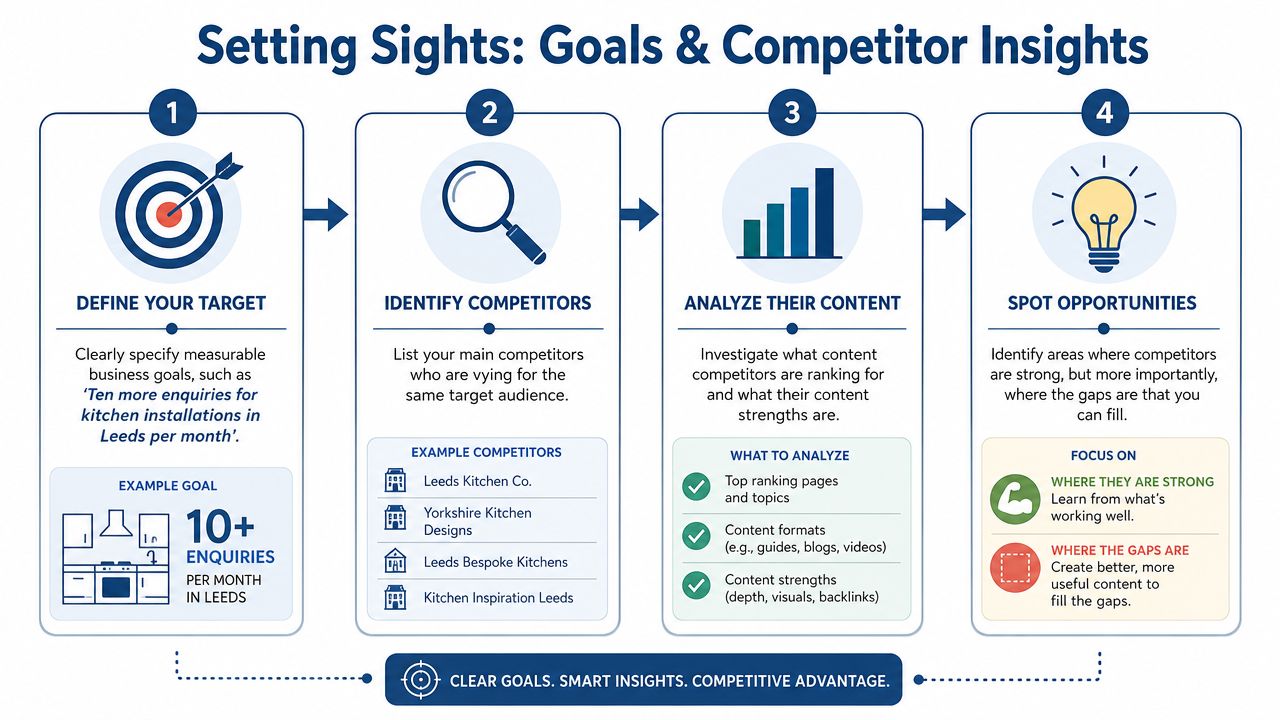
“More traffic” sounds nice, but it's a lousy target. Traffic can rise while enquiries stay flat. If you run a kitchen fitting business in Leeds, a proper goal is closer to “more enquiries for kitchen installations from people in Leeds who are ready to compare quotes”. That's useful because it shapes the pages you'll build and the gaps worth chasing.
Pick a business target that means something
Start with one service and one location. Keep it tight.
Examples that make sense for local businesses:
- Trades: More boiler repair enquiries in Sheffield.
- Professional services: More personal injury consultation requests in Nottingham.
- Home improvement: More bathroom renovation leads in Bristol.
- Multi-location firms: More service pages and supporting content for one branch before rolling the format elsewhere.
This isn't just tidy planning. It stops you writing content that attracts the wrong audience. A local roofing company doesn't need broad “what is roofing” fluff. It needs pages that answer the questions people ask when they're close to hiring, comparing, or panicking because water is coming through the ceiling.
Know who your real competitors are online
Plenty of businesses make a mistake at this point. The firms you compete with offline are not always the same sites beating you in search.
That split matters. In UK content gap analysis, competitors are commonly separated into business rivals and digital rivals, with benchmarking focused on the sites ranking better for the terms you want, as noted in Brafton's guide to content gap analysis. In plain English, the company whose van you keep seeing on local roads might not be the one nicking your clicks.
Use this scrappy process:
- Search your core service in an incognito browser.
- Search the service plus town, city, or area.
- Note the websites that repeatedly appear in organic results.
- Ignore directories for now and focus on actual businesses.
- Pick the top 3 to 5 websites that keep showing up.
Make a simple sheet with these columns:
| Competitor | Service searched | Ranking page | Type of page | What they cover that you don't |
|---|---|---|---|---|
| Example local plumber | emergency plumber york | Emergency call-out page | Service page | response times, common faults, pricing FAQs |
| Example solicitor | no win no fee solicitor sheffield | Blog guide | Informational page | process explained, claims timeline, objection handling |
If you want a more structured way to compare what rivals rank for versus what your site misses, a focused competitor SEO analysis is useful because it forces you to look at intent and page type, not just vanity rankings.
One extra point. If you publish on social platforms to support your visibility, the same discipline applies there too. A practical LinkedIn posting strategy can help professional firms turn service insights into posts that reinforce expertise, especially if you're in legal, finance, or consultancy rather than a pure trade.
Don't copy competitors. Nick the opportunity, not the wording.
The Treasure Hunt Unearthing Your Content Gaps
This is the fun bit. It's also where expensive software gets far too much credit. If you've got Google, a browser, and half an hour of proper concentration, you can uncover a lot.

Raid competitor pages properly
Open each digital rival's site and go through it like a customer, not like a bored owner skimming your own homepage for the hundredth time.
Look at:
- Service pages: Do they have separate pages for emergency work, pricing, service types, or locations?
- FAQs: Are they answering basic objections you've ignored?
- Blog or advice pages: Are they picking up searches from people still researching?
- Navigation labels: These often reveal what they think customers care about most.
- Trust content: Testimonials, case examples, accreditations, process explanations, and guarantees.
A Sheffield solicitor might have a page explaining “No win, no fee” in plain English. A Bristol plumber might have separate pages for boiler servicing, boiler repair, and emergency heating issues. A Kent glazing company might have a post on patio door repair costs and what affects the quote. Those are not random content pieces. They're often the exact pages catching searches from people close to making contact.
Write every missing topic down. Don't judge it yet.
Use Google like a free research assistant
Google tells you a tremendous amount if you know where to look.
Start with your core searches and mine these areas:
- People Also Ask: Questions people are actively asking around the service.
- Related searches: Good for variants and adjacent concerns.
- Autocomplete suggestions: Handy for seeing how phrases expand.
- Local pack wording: Useful for understanding how Google frames nearby intent.
- Competitor title tags and headings: They show the angle Google is rewarding.
There's strong evidence that local, longer phrases matter here. A 2023 benchmark analysis of 500 UK service businesses found that 89% of top-ranking competitors had content covering long-tail local keywords, such as postcode-level searches, and filling those gaps led to an average 3.4x improvement in Google Business Profile visibility, according to Screaming Frog's content gap analysis benchmark.
That lines up with what local firms see in practice. A page targeting “boiler repair” is broad. A page that also addresses “boiler repair in Harrogate”, “same-day boiler engineer Harrogate”, and the questions people ask before calling is much closer to how local customers search.
If Google keeps showing the same question in People Also Ask, treat it like a neon sign. Customers care about it.
A quick example for a Manchester roofer:
| Google clue | What it tells you | Content idea |
|---|---|---|
| “How much does roof repair cost?” in PAA | Price anxiety is blocking calls | Roof repair cost guide for Manchester homeowners |
| “Can a roofer fix a leak in heavy rain?” | Urgency and expectations matter | Emergency leak response FAQ |
| Related search for “flat roof repair near me” | Specific service demand | Dedicated flat roof repair service page |
| Competitor page on storm damage insurance claims | Comparison-stage need | Guide to roof damage and insurance evidence |
Here's a useful walkthrough if you want to see a version of the process in motion:
Turn the mess into a usable list
After a proper search session, you'll have scribbles everywhere. Good. Now organise them.
Split your list into three buckets:
Missing pages
You have no page at all for the topic. Example: no dedicated “emergency electrician” page.Weak pages
You have something live, but it's thin, outdated, or vague. Example: one generic services page with no detail on rewires, fault finding, or landlord certificates.Intent mismatches
You wrote an article when Google is rewarding service pages, or you built a service page when users clearly want an explainer first.
A free process works especially well for scrappy SMEs because many guides assume paid tools. That's not much use if your monthly SEO budget is closer to “careful” than “corporate”. Google itself, your competitors' sites, People Also Ask, your own customer calls, and Google Business Profile insights can get you surprisingly far.
The trick is discipline. Don't collect ideas like a magpie and then do nothing with them. Build a list that maps each gap to one service, one location, one likely customer need.
From List to Goldmine Prioritising Your Opportunities
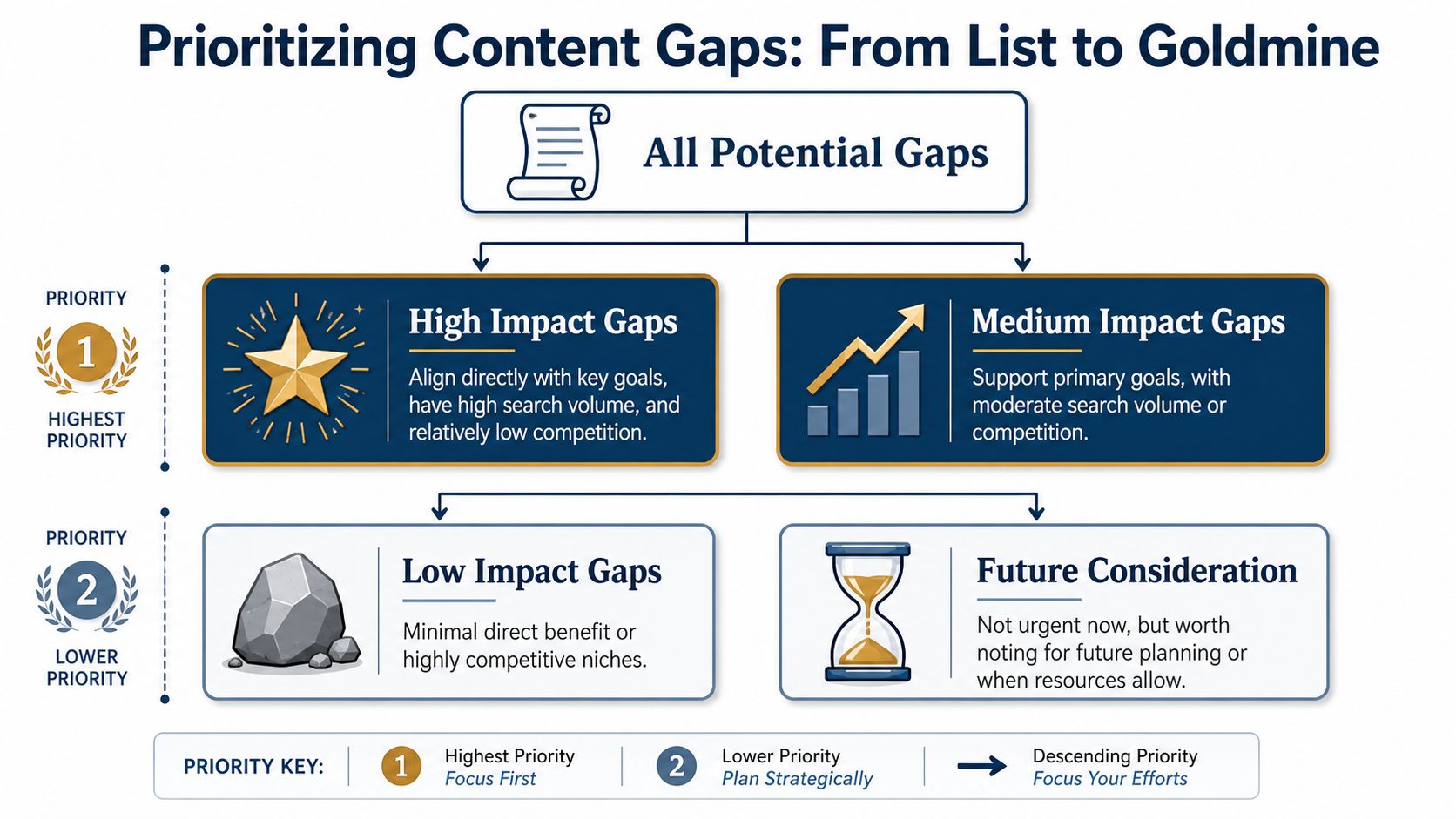
A long list of gaps feels productive, but it's not. If you try to tackle everything, you'll either stall or publish a pile of middling pages that don't move the needle. The smart move is to sort the list by business value.
Think in three lenses: commercial intent, competitive weakness, and effort.
Score each idea before you write a word
A simple scoring table works nicely:
| Opportunity | Commercial intent | Competitive weakness | Effort | Priority |
|---|---|---|---|---|
| emergency boiler repair york | High | Medium | Low | High |
| what causes low boiler pressure | Medium | High | Medium | High |
| history of domestic heating systems | Low | Irrelevant | High | Bin it politely |
Commercial intent comes first because not every search is worth your time. A person searching “how much does a blocked drain repair cost in Reading” is far closer to hiring than someone browsing broad educational queries with no local or service signal.
Competitive weakness is where opportunities often hide. A rigorous content gap analysis process should filter for weak rankings where competitors are relying on outdated articles or forum threads, because those gaps can often be won with a better structured, more current page, as explained in Yotpo's modern content gap analysis methodology.
What a strong opportunity actually looks like
A strong target usually has most of these traits:
- The searcher sounds ready: Terms with cost, near me, repair, quote, emergency, service area, or comparison intent tend to be commercially useful.
- Current results look lazy: Thin pages, old blog posts, vague service copy, or forum chatter are a welcome sight.
- You can say something helpful: If you've got genuine expertise, examples, or a clearer process than the ranking pages, you've got a shot.
- It connects to revenue: The page can naturally lead to an enquiry, booking, or call.
A poor target looks different:
- The topic is broad and woolly
- The ranking pages are excellent and firmly entrenched
- The query doesn't relate to a profitable service
- You'd need ages to produce something decent
Reality check: The best gap isn't always the biggest keyword. It's the page that a busy buyer reads and then decides to ring you.
For a local locksmith, “uPVC door lock repair cost in Norwich” could beat a broader topic every day of the week. Smaller audience, stronger intent, less nonsense.
This is also where white, grey, and black hat thinking part company. White hat prioritisation asks, “Can we create the best answer and tie it to a service?” Grey hat asks, “Can we inflate this with search bait and city swaps?” Black hat asks, “Can we clone a dozen pages and hope Google doesn't notice?” The first one lasts. The other two eventually produce grief.
Building the Bridge with Content Briefs and Internal Links
Once you know what to create, don't just hand a topic to a writer, or to yourself on a rushed Friday afternoon, and hope for the best. That's how you end up with a page that sort of mentions the keyword, waffles for 900 words, and never asks for the call.
A one-page brief beats winging it
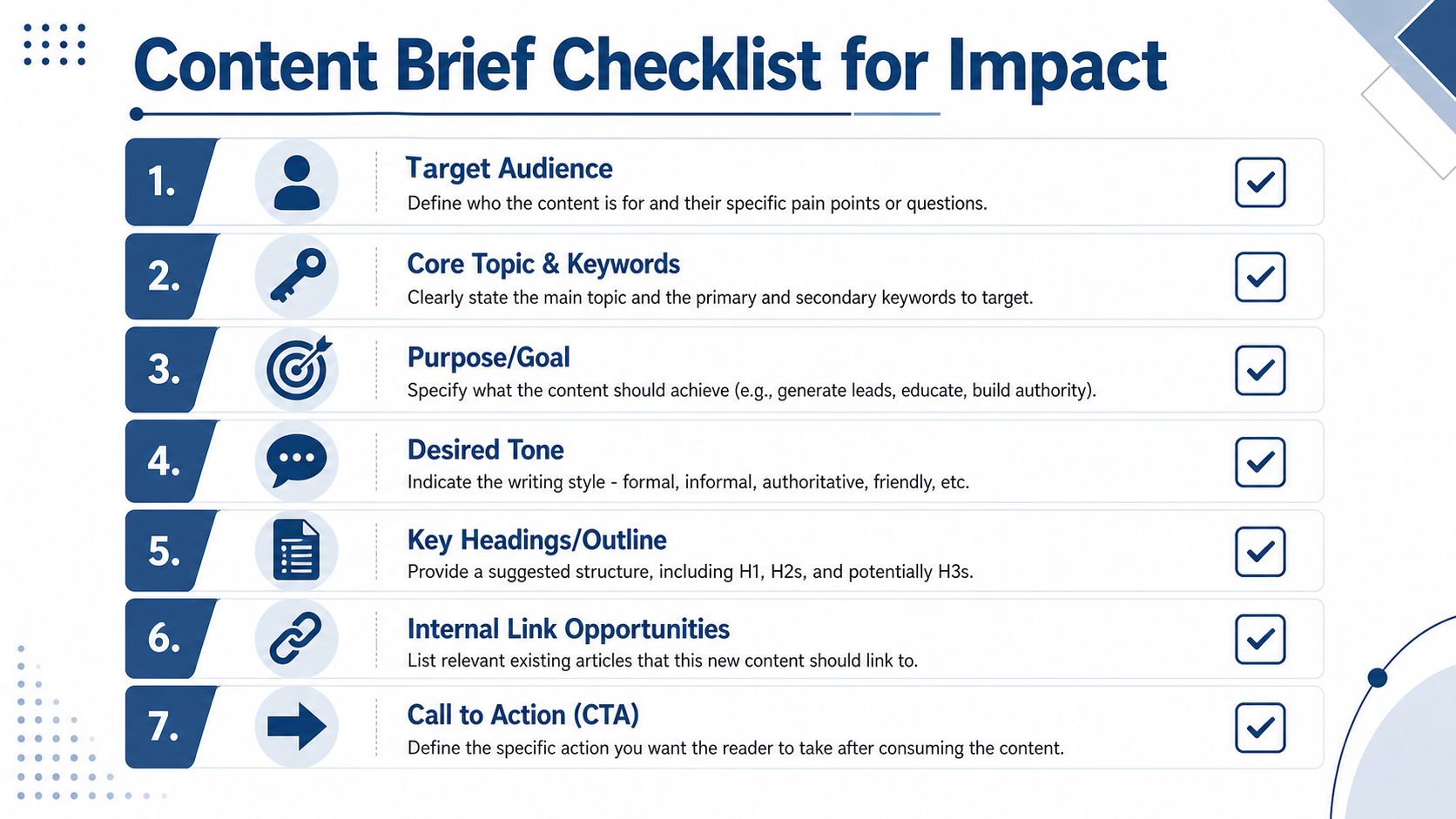
A content brief for local SEO doesn't need to look like a legal contract. One page is enough if it's sharp.
Your brief should include:
- Target page type: Service page, FAQ, location page, guide, comparison page.
- Primary topic: The main phrase and the core service problem.
- User questions: Pulled from People Also Ask, related searches, and real customer conversations.
- Essential subheadings: The points a buyer expects before they trust you.
- Proof elements: Experience, qualifications, process, examples, service area detail.
- CTA: Call now, request a quote, book an inspection, ask for a callback.
- Internal links: Which existing pages should point to this page, and which related pages it should link back to.
The strongest briefs also check whether competitors have missed something in recency, readability, expertise, experience, or thoroughness. Those five E-E-A-T dimensions are critical when mapping content gaps to the buyer's journey, as outlined in Semrush's content gap analysis guidance.
That matters more than many owners realise. A decent page doesn't just “cover the topic”. It answers the right questions at the right stage.
For example, if you're writing for a Cambridge accountant:
- A research-stage page might explain how CIS tax refunds work.
- A comparison-stage page might explain what to look for in a local accountant for contractors.
- A decision-stage page should make it dead easy to understand your process, fees approach, and next step.
Better structure often beats more words. A clear answer near the top is worth more than three vague paragraphs of throat-clearing.
If you repurpose service expertise into video content as well, tools that help you find viral YouTube topics can be useful for spotting angles people already engage with. For local firms, that can turn one strong FAQ or explainer into both a page and a short video script.
Internal links turn articles into enquiries
This bit is not optional. Publishing a new page and leaving it orphaned is like printing leaflets and storing them in the loft.
Internal links do two jobs. First, they help search engines understand the relationship between your pages. Second, they move humans from information to action.
A practical example for a heating engineer:
| New content page | Link from | Link to |
|---|---|---|
| Boiler servicing checklist | Boiler servicing service page | Annual boiler service booking page |
| Boiler pressure explained | Boiler repair service page | Emergency boiler repair contact page |
| Landlord gas safety FAQs | Gas safety certificates page | Quote request page |
Use sensible anchor text. “Learn more about boiler servicing” is fine. “Click here” is a wasted chance. So is stuffing exact-match anchors into every sentence like you've had too much coffee and not enough restraint.
Keep the linking pattern natural:
- Link from core service pages to supporting articles.
- Link from supporting articles back to the main service page.
- Link between related supporting pages where the reader would benefit.
- Add links into older pages when you publish something new.
That creates a bridge. The article handles the question. The service page handles the sale. Together, they do a lot more than either page on its own.
Proving It Worked and Measuring Your Success
This is the easy bit, thankfully. You don't need a bloated reporting deck with thirty charts and a paragraph of waffle under each one. For local service businesses, three signals tell you whether the content gap analysis paid off.
First, check rankings. Search the target phrases manually in an incognito browser, or use a simple tracker if you already have one. You're looking for movement on the phrases you targeted, especially the local and service-led terms tied to the new or improved pages.
Second, check traffic in Google Search Console. Not all traffic matters equally, but if impressions and clicks are rising on the right pages, that's a healthy sign. It means Google has started to see your page as a relevant answer.
Third, and most important, check leads. Did the page drive more phone calls, quote requests, form submissions, or direct emails? If a new article on emergency drain unblocking brings visitors but none of them turn into enquiries, it may be attracting the wrong intent or failing to bridge to the service page.
A tidy way to review progress each month:
- Rankings: Are your target searches moving up?
- Traffic: Are the right pages getting seen and clicked?
- Leads: Are real enquiries tied to those topics increasing?
That's the whole game. Not vanity impressions. Not “brand awareness” hand-waving. Better visibility for the right searches, more visits from people with a problem, and more chances for your business to solve it.
If you'd rather skip the trial and error, DigiVisi Ltd helps UK service businesses find the content gaps their competitors are profiting from, then turn those gaps into rankings, calls, and enquiries. If your site isn't pulling its weight, it's worth having a proper look.