Skip to content
You're staring at a quote for an SEO audit and thinking, “That's either a bargain, or someone's forgotten a few pages.” For UK service businesses, that reaction's completely normal. A decent audit can feel a bit like paying a mechanic to tell you your car has four tyres, one suspicious noise, and a boot full of old takeaway wrappers, useful, but only if the diagnosis is solid.
For a local plumber in Birmingham, a solicitor in Leeds, or a multi-location HVAC firm trying to win more calls, an SEO audit is the website version of a proper health check. It spots where Google can't quite make sense of your pages, where local visibility is being lost, and where quick wins are hiding in plain sight. If you want a simple example of how profile-style diagnostics work in practice, Xholic AI's profile audit insights give a useful parallel for the kind of structured review that makes problems visible before they become expensive.
Table of Contents
- Introduction to SEO Audits and Their Value
- Understanding the Key Concepts
- Typical SEO Audit Cost Ranges in the UK
- Factors That Affect Audit Cost
- Sample Packages and Pricing Scenarios
- DIY Audits vs Agency Audits Trade-offs
- Evaluating Proposals and Measuring ROI
- Next Steps and Calls to Action
Introduction to SEO Audits and Their Value
A plumber in Birmingham doesn't need a lecture on leaks. If the phone's quiet, the website's probably not doing enough heavy lifting. An SEO audit works in the same spirit, it checks whether your site is helping people find you, or whether it's sitting there looking tidy while Google walks straight past.
For service-led businesses, the value is practical rather than glamorous. Audits help identify technical issues, confusing page structure, thin content, weak local signals, and the kind of problems that stop enquiries before they start. In plain English, that means fewer wasted visits and more chances for a visitor to turn into a call, form fill, or booking.
Practical rule: if your website gets traffic but the phone stays strangely quiet, the problem is usually not the colour of the homepage button.
A good audit also helps you decide what to fix first. That matters because the cheapest issue to spot isn't always the cheapest issue to solve, especially once dev time, content changes, and local SEO work are involved. For UK businesses, understanding the audit before buying it is the difference between paying for insight and paying for a very expensive to-do list.
Understanding the Key Concepts
Think of an audit like a house inspection. You don't start by admiring the curtains, you check the foundations, the wiring, the damp, and whether the front door closes. Search engines do something similar, only with less tea and fewer clipboards.
The technical foundations
This is the bit that tells search engines whether your site is easy to crawl and index. It covers things like page speed, mobile friendliness, site architecture, schema, and broken paths that send users and bots on a pointless tour of the internet. If a trades website has service pages buried three clicks deep, or a law firm has duplicate location pages that all look suspiciously alike, the audit should catch it.
The content and authority layer
Here you're checking whether the pages answer search intent. A boiler repair page that reads like a generic brochure won't do much for rankings or leads. The same goes for weak metadata, unclear headings, or backlinks that look about as trustworthy as a garage forecourt payday loan sign.
The local visibility layer
For service businesses, local SEO is often the difference between being found and being forgotten. That includes your Google Business Profile, citations, and NAPW consistency, which is making sure your name, address, phone, and website details match across the web. If your details drift around, search engines and customers both get nervous.

An audit is strongest when it links all of these pieces together. A beautiful website with poor crawlability is still a poor business asset. A technically sound site with weak service pages is just a neatly organised ghost town.
Typical SEO Audit Cost Ranges in the UK
UK pricing usually follows the size and complexity of the website, not the industry label stuck on the homepage. Published 2026 pricing guides show that a one-off SEO audit is commonly priced from £300 to £3,000 for small-to-medium websites, while larger or more complex sites can reach £3,000 to £8,000+ as shown in this UK pricing guide.
| Site Type | Pages | Cost Range |
|---|---|---|
| Small service site | 5–20 | £300–£1,000 |
| SME website | 20–80 | £1,000–£3,000 |
| E-commerce or enterprise site | Larger, more complex | £6,000–£8,000+ |
A local electrician with a tidy 12-page site will usually sit in the lower band, because there's less to crawl, compare, and prioritise. A multi-location dental practice, by contrast, has more pages, more local pages, more overlap risk, and more chance of finding technical clutter hiding behind a respectable-looking homepage. That's why the bill climbs.
The price also reflects what sits behind the number. Deeper crawling, indexing checks, duplication analysis, and template review take more time and more expertise, so the cost follows the work rather than a magic calculator. If you want to compare audit pricing with broader UK SEO pricing structures, the same logic shows up in this UK SEO cost overview, where scope and complexity drive the numbers.
For service businesses, the key question isn't “What's the cheapest audit?” It's “What will the audit examine, and how much mess will it uncover?” Cheap audits can be perfectly fine for a small site, but they won't suit a business with several service areas, multiple locations, or pages that compete with each other like siblings in a minicab queue.
Factors That Affect Audit Cost
The biggest price driver is scope. More pages mean more analysis, and more analysis means someone has to inspect, interpret, and prioritise the findings rather than just spray a spreadsheet at you and vanish into the fog.
Scope and technical complexity
A simple brochure site is one thing. A site built on a fiddly CMS, packed with filters, location pages, schema, and plugin sprawl is another. If a site uses lots of moving parts, the audit has to check how those parts affect crawlability, internal linking, and conversion paths. That's where the work starts to feel less like tidying a desk and more like dismantling a wardrobe without the instructions.
Local SEO and competitive pressure
A single-location business can often get away with a focused review. A multi-location SME usually can't. Citation consistency, Google Business Profile quality, location page structure, and service area overlap all take time to evaluate properly. Add strong local competitors and the audit gets more strategic, because it's no longer just about fixing errors, it's about closing visible gaps.
A good audit cost reflects interpretation, not just data collection. The expensive bit is deciding what matters first, and what can wait until the next cup of tea.
Deliverables and depth of reporting
Some audits stop at identifying issues. Better ones rank priorities, explain fixes in plain English, and show what should be tackled first by a developer, writer, or local SEO specialist. That reporting depth pushes the price up, but it also makes the audit usable.

In short, the more your site behaves like a living system rather than a static brochure, the more the audit needs to behave like a proper diagnostic.
Sample Packages and Pricing Scenarios
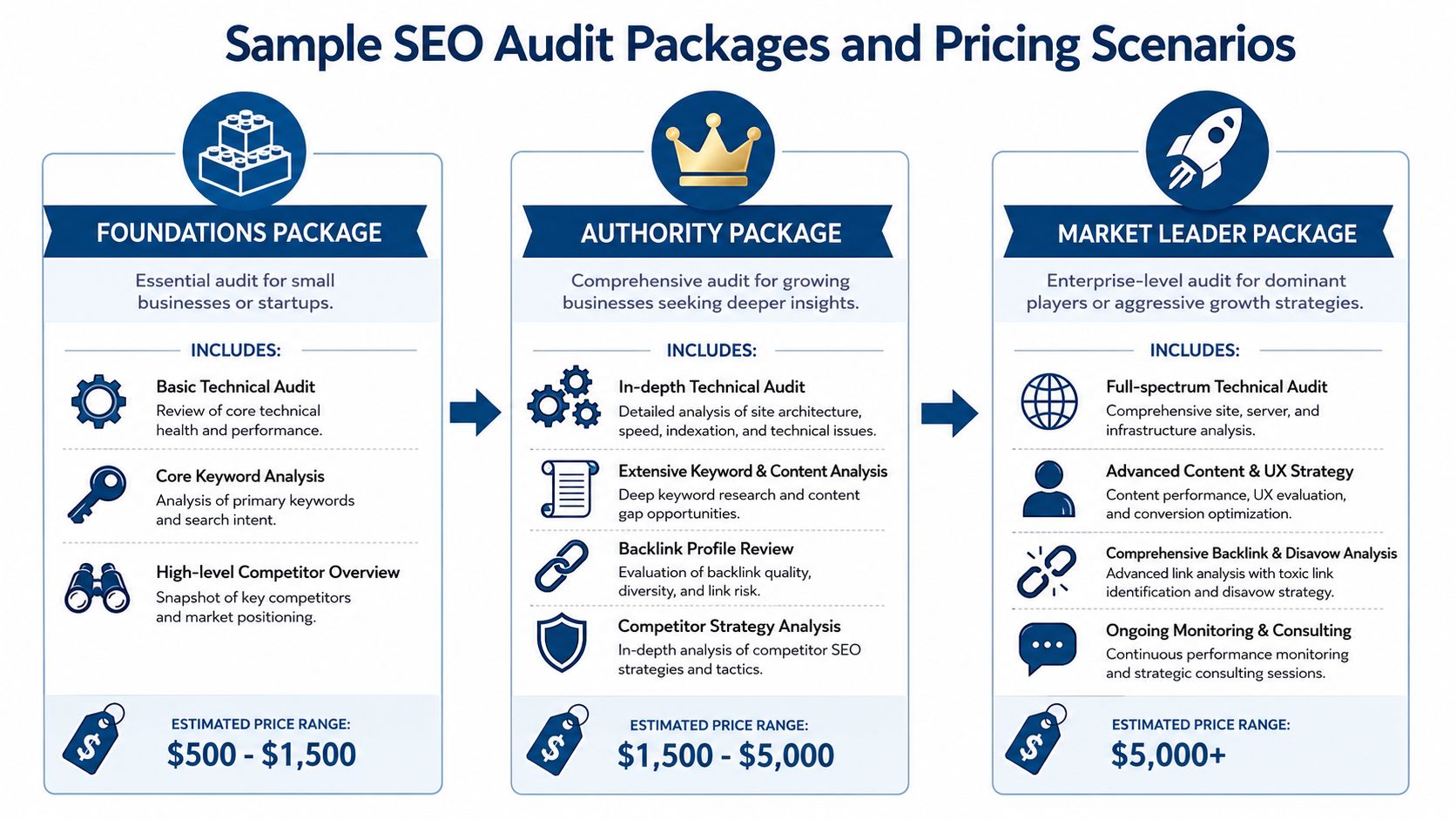
Audit packages usually make more sense than one flat fee because different businesses need different levels of work. A startup plumbing brand with one service area is not buying the same thing as a multi-location accountancy firm with layered content and crowded local markets. One is paying for a tidy health check, the other is paying for a proper examination of how the whole search setup fits together.
Foundations package
This is the sensible starting point for smaller service businesses. It usually focuses on the basics, technical checks, keyword review, and a light competitor scan, so you can tell whether the site is sound or wobbling at the edges. A focused technical audit is priced at about £595 in this pricing guide, which fits neatly with this entry-level approach for firms that mainly want to spot obvious issues before they turn into expensive headaches.
A package like this often suits a local plumber, solicitor, cleaner, or therapist who wants clear priorities without paying for every bell and whistle. You get the practical readout, the sort that tells you whether titles, indexing, and basic crawl issues are behaving themselves. If the site is small and the service area is straightforward, this can be enough to steer the next round of fixes.
Authority package
This tier is for businesses that need more than a quick health check. It usually includes deeper technical review, content analysis, backlink profile review, and a closer look at competitors, so the findings are grounded in what the market is doing. A full multi-area audit is quoted at £1,200–£4,550 in the same UK guidance, which makes sense once a site has more pages, more service lines, and more chances for small problems to hide in plain sight.
For service-led SMEs, this tier often suits the point where SEO starts to affect lead quality as much as lead volume. A regional law firm, multi-branch trades business, or established clinic may need the audit to separate quick fixes from items that need a writer, a developer, or a local SEO specialist. The cost rises because the work is not just spotting faults, it is sorting them into a sensible order.
Market leader package
At a more advanced level, strategic search-visibility audits become substantial. They can include AI-platform assessment and competitive modelling, and they are quoted at £2,400–£6,600 in recent UK guidance. That level of audit suits businesses where search visibility affects larger revenue opportunities, or where the local market is crowded enough that a standard “fix these issues” report would be about as helpful as a paper umbrella in a thunderstorm.
This is the sort of package that appeals to firms trying to hold a stronger position in a busy market, especially where multiple service pages, brand search demand, and local competition all need to be assessed together. It is less about finding a few broken bits and more about understanding where the site can realistically gain ground. That means the report is often built around strategy as much as diagnosis.
Package names vary, of course, but the logic does not. You pay for the breadth of analysis, the depth of thinking, and the quality of the next-step plan. That is why two quotes can look wildly different while still both being fair.
DIY Audits vs Agency Audits Trade-offs
A DIY audit is often the right place to start if you just want to spot obvious problems. Using Screaming Frog, Google Search Console, and PageSpeed Insights, a free-tools audit can be done in 2–4 hours according to this UK guidance. That's handy for checking broken links, missing titles, page speed issues, and a few clear red flags.
An agency-style audit takes longer because it's doing more than listing faults. The same guidance says a SME in-depth audit usually takes 2–3 weeks and costs £1,500–£4,000 when it combines technical, content, backlink, and competitor analysis. That extra time buys you prioritisation, sequencing, and recommendations that fit a real business rather than a generic checklist.
Where DIY works
- Small sites with simple structures: A local handyman, decorator, or one-location therapist can often use a DIY pass to catch the basics.
- Early-stage checks before a bigger project: If you suspect problems but don't yet want a full diagnostic, DIY helps you gather evidence.
- Budget-sensitive housekeeping: Free tools are useful when the site is small and the issues are obvious.
Where expert audits win
- Mixed technical and local problems: If rankings, leads, and local visibility are all behaving oddly, you need interpretation, not just findings.
- Multi-location or competitive markets: More moving parts means more chance of hidden conflicts and misleading signals.
- White hat, grey hat, black hat awareness: A proper audit can spot risky tactics too, such as manipulative links, spammy location pages, or content that looks engineered to game the system rather than serve users.
DIY is fine for a quick check. Professional audits are better when the website matters to revenue, because a report that no one can action is just expensive wallpaper.
Evaluating Proposals and Measuring ROI
A proposal is easier to judge once you know what sits behind the headline price. UK pricing guides usually frame audits as one-off deliverables at around £300–£3,000 for small-to-medium sites, while larger or more complex sites can reach £6,000–£8,000+, which still leaves buyers unsure about the cost of fixing the problems after the audit as noted here. The report may look affordable on paper. The fixing is where the budget often wakes up and starts asking questions.
What to compare in proposals
- Scope clarity: Check whether the audit covers technical, content, backlink, local, and competitor work, or only one part of the site.
- Deliverable quality: Ask for sample outputs, priority matrices, or examples of how findings are presented.
- Implementation support: Find out whether the work stops at diagnosis or continues into practical fixes.
- Business fit: A quote for an e-commerce platform is not a fair benchmark for a local trades site.
If a proposal reads like a checklist but not a plan, you are probably paying for symptoms rather than solutions.
A useful proposal should also make the next step obvious. For a service business, that means spotting which pages drive enquiries, which local signals need tidying, and which technical issues are creating hidden obstacles. If the document only names problems, it is like a mechanic handing you a list of engine noises without lifting the bonnet.
How to think about ROI
ROI makes more sense when you connect the audit to business outcomes. For a local service business, that usually means more qualified enquiries, stronger visibility in the areas you want to serve, and less effort spent on pages that do not earn their keep. For multi-location SMEs, the return often shows up through cleaner site structure, better local consistency, and fewer ranking clashes across service pages.
A sensible way to judge value is to ask what the audit helps you stop doing, as well as what it helps you improve. If it prevents wasted content work, exposes weak internal linking, or shows why one location page is competing with another, the benefit is real even before rankings move. A good audit does not promise results like a vending machine. It gives you a practical roadmap, which matters when the alternative is guessing while competitors keep taking the calls.
Next Steps and Calls to Action
If your site is small and tidy, a focused audit can be enough to expose the obvious leaks. If it's bigger, messier, or built to support real lead generation across several locations, you'll want a more strategic review that looks at technical issues, local visibility, and the competitive picture together. Recent UK guidance also points to the value of advanced audits for AI-era search visibility, with premium strategic audits cited at £2,400–£6,600 when AI platform assessment, revenue exposure modelling, and competitive deep-dives are included in this guide.
The sensible next move is simple. Decide whether you need a foundational check, a fuller diagnostic, or a market-leader level review. Then ask any provider what's included, what happens after the report lands, and how the fixes will be prioritised for your business rather than for a generic spreadsheet.
If you're a UK service business owner, start with the audit that matches your site's actual complexity, not the one that sounds most impressive in a sales deck. A clear scope beats a shiny promise every time, and your future self will thank you for not buying a report that needs a second report to explain it.
A CTA for DigiVisi Ltd.