Skip to content

You're probably in one of two camps right now. Either your website exists, technically, but it's about as useful as a van with no engine. Or you've had a few pages written already, but they read like they were assembled by a bored robot and a bag of keywords.
That's normal. Most local firms start there. The electrician in Sheffield, the plumber in Manchester, the solicitor in Bristol. Brilliant at the actual job. Strangely invisible when someone nearby searches for it on Google.
The fix usually isn't “more blogs”. It's better search-led content written by someone who understands how local customers search, how Google reads a page, and how trust is built online. That's where SEO content writers earn their keep. A good one doesn't just fill a page. They help turn your expertise into enquiries.
Table of Contents
- Your Best Employee Might Just Be an SEO Content Writer
- What SEO Content Writers Actually Do
- Why Your Local Business Needs One Yesterday
- How to Spot a Pro from a Pretender
- Realistic Costs and What You Get for Your Money
- Writing the Perfect Brief for Local Success
- Onboarding Your Writer and Measuring Success
Your Best Employee Might Just Be an SEO Content Writer
A local business owner rings me and says, “We do solid work, customers like us, but the phone's gone quiet unless we pay for ads.” I hear that a lot.
Usually the website tells the story. One generic services page. A homepage that says “quality solutions”. A contact page. Maybe a blog post from 2022 called “Top Tips”. Nothing on actual service areas. Nothing answering the questions real customers type into Google at half seven when the boiler's packed in.
That's where SEO content writers come in. Not fluffy “brand storytellers”. Not keyword stuffers. Proper commercial writers who can turn a vague service into pages that rank, reassure, and convert.
Most hiring advice gets this wrong. You don't need someone who can merely write nicely. You need someone who can work out how people in your patch search, and why your competitors keep showing up.
For UK local firms, that gap matters. ProfileTree's guidance on SEO writing points out that most guides miss the key bit for local businesses: proving a writer can analyse local competitors and capture regional search intent, rather than just following a brief. That's the difference between “electrician page written” and “electrician page that pulls in leads from Walkley, Ecclesall, and Crookes”.
The real job they do
A decent SEO content writer acts like a translator between three groups:
- Your customers, who search in plain English when they need help now
- Google, which needs clear signals about relevance, trust, and location
- You, who already know the trade but don't have time to write ten sensible service pages before tea
If you're a conveyancing solicitor in Cardiff, the writer should understand the difference between someone searching for general information and someone searching because they need a quote this week. If you're a roofer in Leeds, they should know a page for “roof repair Leeds” won't do all the work on its own.
That's why a strong SEO content writer can end up being more useful than another generic marketing task on your list. They don't just add words. They help make your website pull its weight.
What SEO Content Writers Actually Do
A proper SEO writer is part researcher, part editor, part on-page strategist, and part common-sense merchant. They don't just “write articles”. They shape pages so they answer the right question in the right place for the right person.
To make that easier to picture, here's the role in one glance.

They match the page to the job
If someone searches “emergency electrician Sheffield”, they don't want a history of electricity. They want to know whether you cover their area, how quickly you respond, what sort of faults you fix, and how to contact you.
That means the writer has to nail search intent. In practice, that usually includes:
- Service pages that solve a clear need. A page for consumer unit upgrades is different from a page for emergency callouts.
- Local landing pages with genuine local detail. If you cover several places, one city page won't cut it.
- Answer-first structure. Say the useful bit early, not after a load of waffle about your “commitment to excellence”.
If you run a multi-area trade business, local pages need proper substance. Red Eagle's local SEO guidance says a service business covering multiple areas, such as a plumber in Manchester, needs at least 500 to 800 words of unique content per page, featuring local landmarks and testimonials from that location to avoid duplicate or thin content issues. In plain English, your Salford page can't be your Stockport page with the postcode changed. Google isn't daft.
They build trust signals into the page
The strongest pages don't just say “we're experts”. They prove it with specifics.
For a local solicitor, that might mean explaining the process clearly, naming the sort of matters handled, showing who wrote the page, and using examples rooted in real work. For a locksmith, it might mean listing actual callout situations and naming the neighbourhoods served.
A good writer also keeps pages readable. Short paragraphs. Clear subheadings. Simple language. Human flow. If your page reads like a council memo, people will leave.
Practical rule: if a visitor can't tell within a few seconds that you serve their area and understand their problem, the page needs rewriting.
You can also borrow a few quick win SEO strategies to sharpen what's already on your site, especially around page structure, intent, and internal linking. Handy if you want to sanity-check what your writer proposes.
Later in the workflow, the technical side matters too. Headlines, title tags, image alt text, internal links, schema hints, and calls to action all support the writing. That's why the writer's role overlaps with strategy. The words are only half the job.
A short explainer helps if this still sounds a bit abstract.
Why Your Local Business Needs One Yesterday
If your site isn't bringing in enquiries, it isn't a brochure. It's dead weight.
The commercial case for hiring a strong SEO content writer is simple. Search traffic arrives from people already looking for what you do. They're warmer than random browsers and far more useful than someone who liked a social post while waiting for the bus.
Artios reports that SEO delivers the highest ROI of any digital channel, with a 14.6% lead close rate. The same source says the UK SEO and Internet Marketing Consultants industry was worth £19.2 billion in 2023, and that 100% of experts prioritise search intent while 60% focus on E-E-A-T signals in content. That tells you exactly where things have gone. This isn't old-school copywriting with a few keywords wedged in. It's strategic content built to win trust and enquiries.
Good content sells before you answer the phone
Think about how a local customer behaves. They search “boiler repair South Bristol”, scan a few pages, click one, and make a quick judgement.
Your content needs to answer questions before they ask them out loud:
- Do you cover my area?
- Do you handle my exact problem?
- Do you sound competent?
- Can I trust you in my house or with my case?
- Is contacting you going to be a faff?
That's why well-written local pages matter so much. They warm up serious buyers and naturally repel tyre-kickers. A page that explains emergency response, common faults, pricing approach, areas covered, and next steps does half the sales job for you.
Local search is now a trust game
Google has got fussier, and frankly that's good news if you're a real business. Thin pages, vague claims, spun location content, and AI porridge won't hold up.
A proper SEO writer helps you build pages that show lived experience and local relevance. For example:
- A plumber in Leeds should mention common callouts, the towns actually covered, and what happens after a customer rings.
- A family solicitor in Nottingham should answer practical concerns in plain English, not hide behind legal fog.
- A garage door installer in Kent should include local service areas, real use cases, and a clear booking route.
Your website should sound like a capable local firm, not a laminate brochure from 2009.
That's why I'm bullish on this. For a local business, good SEO content isn't a nice extra. It's part of how you compete.
How to Spot a Pro from a Pretender
Plenty of firms get mugged off when someone says they “do SEO content”, sends a few tidy-looking samples, talks about rankings, then delivers pages stuffed with awkward keywords and all the charm of a parking ticket.
You need a vetting process. Nothing fancy. Just enough to filter out the chancers, the grey-hat gamblers, and the black-hat cowboys who still think stuffing town names into footers is genius.
Questions that separate grown-ups from cowboys
Ask these in the first conversation.
How do you research a local service page before writing it?
You want to hear about SERP review, competitor comparison, service intent, local modifiers, and question research. If they jump straight to word count, that's a wobble.How would you approach pages for different towns we serve?
A strong answer mentions unique copy, local landmarks, specific service differences, and avoiding duplicate content.What do you need from us to write something trustworthy?
Good writers ask for photos, job examples, testimonials, accreditations, named experts, FAQs, and service details. Pretenders ask for the logo and crack on.How do you think about white hat, grey hat, and black hat SEO?
You want someone who understands the difference. White hat is sustainable and customer-focused. Grey hat tends to flirt with manipulation. Black hat is outright risky.How do you measure whether a page is working?
The right answer includes rankings for target terms, leads, page engagement, organic landings, and local visibility. Not “vibes”.
If a writer guarantees number one rankings, put the kettle on and end the call politely. They're selling fantasy.
Hiring an SEO Writer Green Flags vs Red Flags
| Green Flag (What you want to see) | Red Flag (What to avoid) |
|---|---|
| Talks about customer intent before keywords | Talks about keyword density like it's still 2006 |
| Reviews local competitors before drafting | Writes from your brief alone without checking the search results |
| Wants real business details, proof, FAQs, and named expertise | Says they can write everything with no input from you |
| Recommends unique pages for each service area | Suggests swapping town names on one template |
| Explains white-hat methods clearly | Hints at shortcuts, bulk pages, spun content, or “guaranteed rankings” |
| Writes plainly for humans first | Produces stiff, robotic copy meant only to impress an algorithm |
| Thinks about internal links, metadata, and calls to action | Treats SEO as words on a page and nothing else |
| Can explain decisions in plain English | Hides behind jargon and hopes you won't ask again |
White hat versus the mucky stuff
Here's the clean version.
- White hat means useful pages, local relevance, honest structure, real expertise, proper optimisation, and no tricks. Slower than nonsense promises, but it lasts.
- Grey hat often includes mass-produced location pages, over-optimised anchors, or content built more for loopholes than users. It may work for a bit. It may also turn sour.
- Black hat is the swamp. Hidden text, spam links, doorway pages, scraped content, fake signals. Avoid it unless you enjoy self-inflicted admin.
A pro won't need to boast about being ethical. You'll hear it in the process. They'll talk about users, intent, page usefulness, and long-term gains. That's your person.
Realistic Costs and What You Get for Your Money
Let's deal with the awkward question. What should a decent SEO content writer cost in the UK?
There isn't one magic rate, because some jobs are simple and some involve research, interviews, local SERP analysis, on-page structure, revisions, and strategy. But there is a useful benchmark for judging whether you're shopping in the right bit of the market.
What the salary gap tells you
Reboot Online's SEO statistics analysis puts the UK median annual salary for an SEO professional at £39,719, with a mean average of £43,426. By contrast, a general content writer with SEO skills sits at £23,964 per year, with entry-level pay starting around £19,000 and early-career earnings averaging £22,645. In London, the average base salary for a content writer with SEO skills is £25,353, with reported pay ranging from £20,000 to £39,000.
That gap tells you something important. SEO content writing is a specialist skill, not basic word production. If someone is charging bargain-basement rates for “SEO pages that rank”, be sceptical. Skilled work costs more because the brief is harder and the potential impact is greater.
Common pricing models
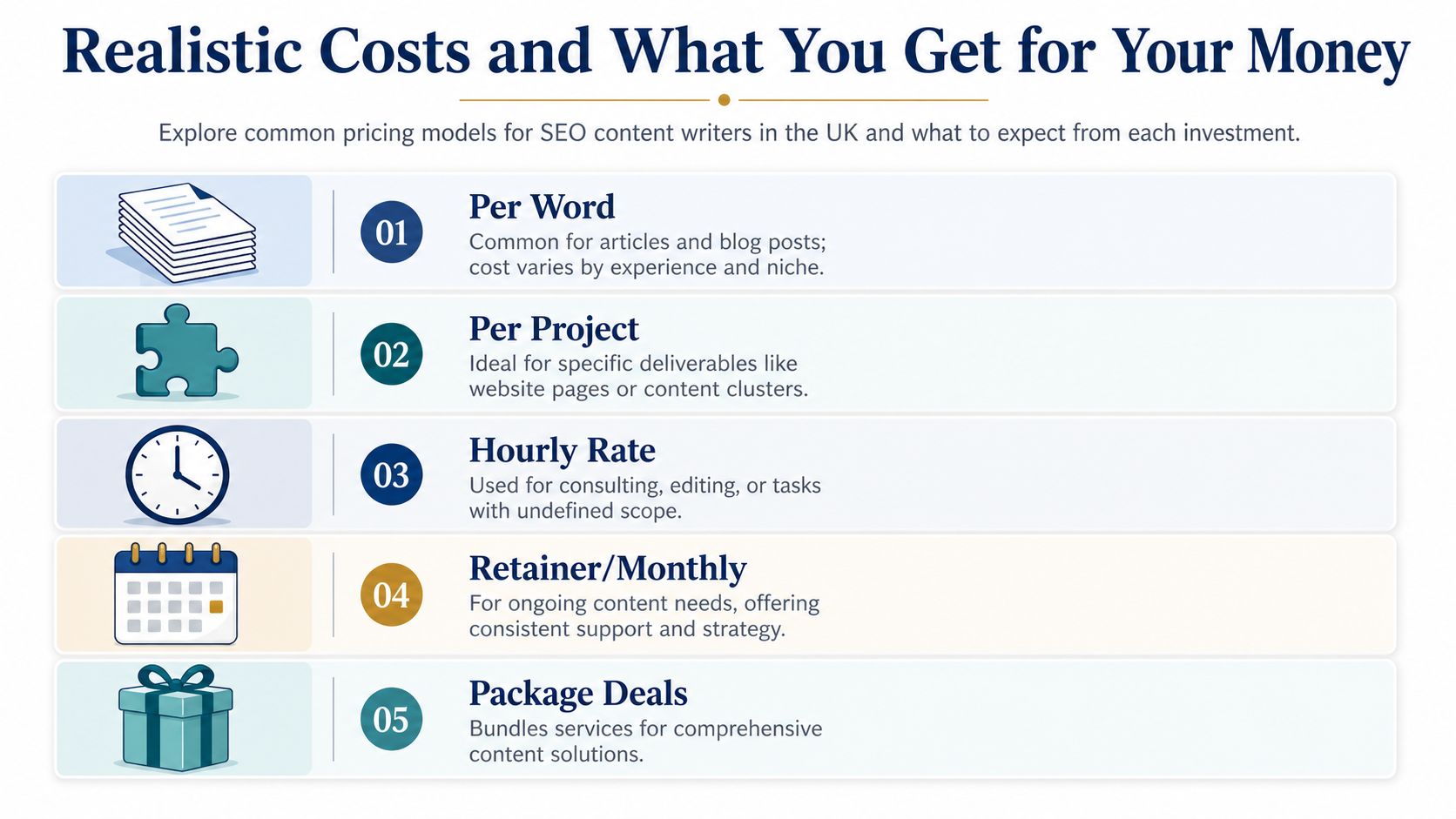
You'll usually see a few different models in the UK market:
- Per word. Simple on paper, often daft in practice. It can encourage padding. Fine for straightforward articles, less useful for conversion-led service pages.
- Per project. Better for local businesses. You agree the outcome, such as a service page, a town page, or a cluster of FAQs.
- Hourly rate. Reasonable for audits, rewrites, or consulting. Murkier if the scope isn't clear.
- Monthly retainer. Useful when you need ongoing content, optimisation, and updates rather than one-off pieces.
- Package deal. Works if it clearly states what's included and what isn't.
What should you expect for your money? At minimum, ask whether the price includes:
- Research including keyword intent, local angle, and competitor review
- Writing that sounds like your business, not generic filler
- On-page basics such as heading structure, title ideas, internal link suggestions, and calls to action
- Revisions so the draft can be improved with your input
If you want support beyond the writing itself, some firms also bundle content strategy with optimisation work. For example, DigiVisi's SEO copywriting service includes keyword and content strategy, pages built around search intent, and on-page structure support. That's useful if your issue isn't just “we need copy” but “we need the right pages in the right order”.
Cheap content usually creates a second bill. First for the draft, then for the rescue job. That's not thrift. That's paying twice.
Writing the Perfect Brief for Local Success
Most weak content starts with a weak brief. “We need a page for electrical services” is not a brief. It's a shrug.
A solid brief saves time, cuts revisions, and gives your writer the raw material needed to produce something that sounds like your business. This is comparable to handing a builder plans instead of pointing at a patch of land and saying, “Do your thing.”

What to put in the brief
Keep it practical. Your writer needs facts, not corporate poetry.
- The service. Be precise. “Emergency electrician for domestic callouts” is better than “electrical solutions”.
- The location. Name the actual area. Towns, postcodes, boroughs, neighbourhoods.
- The customer. Homeowners, landlords, commercial clients, first-time buyers, families, whoever pays the bill.
- The goal. Phone calls, quote requests, form fills, booked consultations.
- The proof. Testimonials, accreditations, case examples, years in business, named team members.
- The objections. Price worries, urgency, trust issues, availability, legal confusion.
- The call to action. What should they do next?
Give the writer your real-world details. The page gets stronger when it reflects actual jobs, actual customers, and actual places.
Sample brief for a Sheffield electrician
Here's a straightforward example you could nick and adapt.
Business: Smith & Sons Electrical
Page type: Local service page
Service: Emergency electrician
Primary area: Sheffield
Secondary local references: Crookes, Hillsborough, Walkley, Ecclesall
Ideal customer: Homeowners and landlords needing urgent help with faults, tripping electrics, or power loss
Goal: Phone call enquiry
What the page must cover
- Fast response for urgent domestic faults
- Common emergency issues handled
- Areas covered across Sheffield
- What happens when someone calls
- Reassurance on safety and qualifications
- Clear call to action
Business details to include
- NICEIC approved
- Same-day appointments where available
- Emergency fault finding
- Consumer unit issues
- Lighting and socket faults
- Recent customer feedback from Hillsborough and Crookes
Questions to answer
- Do you cover my part of Sheffield?
- Can you help today?
- What counts as an electrical emergency?
- Do you work in homes and rental properties?
- How do I contact you?
Tone
Plain English. Competent. Calm. No waffle. No cheesy sales talk.
If you want a more structured done-for-you route, hand the same sort of details into a proper SEO copywriting service. The important part isn't the format. It's whether the brief gives enough truth for the page to sound real.
Onboarding Your Writer and Measuring Success
Once you've hired someone decent, don't toss them a login and vanish. Good onboarding makes the first pages better, faster.
A clean onboarding checklist
Give your writer these early:
- Access to the current site so they can review service pages, blog content, and internal linking
- A list of priority services in order of commercial importance
- Service areas with real locations, including specific boroughs or postcodes where relevant
- Brand voice guidance with examples of how you speak to customers
- Proof assets such as reviews, certifications, photos, staff bios, and common customer questions
For local SEO, precision matters. Digital Marketing First's local SEO guidance notes that content and metadata should target specific postcodes and borough names, such as SW1 or Camden, and that LocalBusiness schema markup with business details helps Google understand your actual service area. That's the kind of detail your writer should be briefed on from the outset.
What to track without losing your mind
You do not need to become an analytics monk.
Watch a short list of business-led signals:
- Are key service pages improving in search visibility for the places you care about?
- Are more people landing on those pages from organic search?
- Are phone calls and contact form enquiries improving from those pages?
- Are leads better qualified because the page answers basics before they get in touch?
One more thing. Give content time, but don't give it a free pass forever. A good writer should review what's working, what isn't, and where pages need tightening. Local SEO is iterative. That's an annoying word, but in this case it just means you refine what's already there instead of chucking spaghetti at the wall.
If your local business needs content that's built around competitor research, search intent, and proper local SEO rather than generic filler, DigiVisi Ltd can help. The focus is simple. Build pages that match how people search, strengthen trust signals, and turn better visibility into real enquiries.