Skip to content
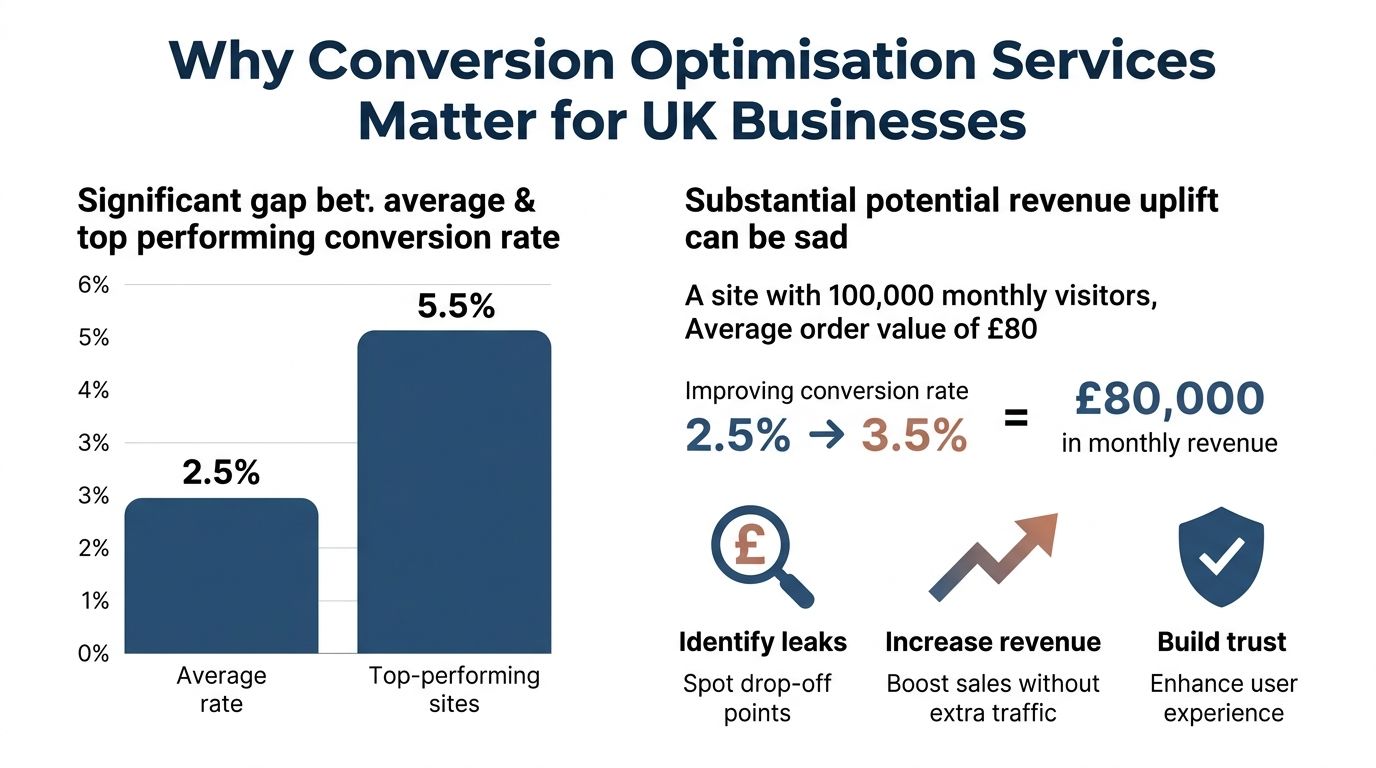
Average website conversion rate is 2.35%, while top-performing sites reach 11.45% or higher. That gap is why conversion optimisation services matter so much for UK businesses, because the money is already in the traffic you've paid for, earned, or dragged in through search and local listings. A site pulling 10,000 visits a month could move from roughly 235 conversions at the average rate to about 1,145 conversions at top-decile performance, before any extra traffic lands on the door. Matomo's CRO benchmark research also notes businesses spend about $92 on acquisition for every $1 spent on CRO, which is a rather blunt way of saying many firms keep buying more visitors when the bottleneck is the page itself.
For UK service businesses, that's not a cosmetic issue. It's the difference between a solicitor's website that leaks leads and one that turns a steady stream of search demand into calls, enquiries, and booked consultations. In the professional-services world, the numbers are even kinder when the page experience is done properly, because benchmark research puts professional services at 4.6%, legal services at 3.4%, and finance at 3.1%, all above the 2.35% baseline, with the top 25% of websites converting at 5.31% or higher. Those benchmarks are a useful reminder that visibility alone doesn't pay the bills, the page has to earn the click.
Table of Contents
- Why Conversion Optimisation Services Matter for UK Businesses
- The Typical Conversion Optimisation Process Explained
- The Measurement Gap That Undermines Most CRO Projects
- Pricing Models and What to Expect From CRO Packages
- How to Choose the Right Conversion Optimisation Provider
- Mobile-First CRO for Local Service Businesses
- Your Conversion Optimisation Action Checklist
Why Conversion Optimisation Services Matter for UK Businesses
For a UK trades firm, law practice, accountancy firm, or private clinic, conversion optimisation services matter because they protect the value of the traffic you already pay for. A website that brings in decent search intent but loses the enquiry at the last step is doing the digital equivalent of fitting a new boiler and leaving the valves open.
The core issue is commercial, not cosmetic. If your site already attracts visitors from Google Search or Google Business Profile, weak calls to action, muddled page structure, or thin trust signals mean you are spending to earn the visit and then spending again to recover the lead elsewhere. Matomo's benchmark data shows how wide the gap can be between average performance and the sites that turn visits into enquiries, and that gap is large enough to alter lead volume in a way owners feel in the pipeline.
Why the numbers matter in practice
A local roofing firm does not need a glossy redesign pitch. It needs more quote requests from people already searching for roof repairs in the right area. A specialist solicitor does not need extra vanity traffic either. It needs more qualified enquiries from users who trust the firm enough to take the next step.
Practical rule: if the site already gets attention, CRO is about turning that attention into action, not admiring it.
For service businesses, the useful lesson is not the headline benchmark itself, it is what sits behind it. The Frank Agency's benchmark round-up points to a clear performance split between firms that make the next step obvious and firms that leave visitors to work it out for themselves. In practice, that usually comes down to page structure, trust signals, form friction, and whether the site makes the enquiry path feel straightforward or like a paperwork exercise nobody asked for.
For UK businesses, that makes CRO a revenue lever and a trust exercise at the same time. Local search users often compare more than one provider before they pick up the phone, so a small improvement in enquiry flow can matter more than another burst of traffic. If you need a simple way to justify the budget, use this: improving conversion behaviour usually beats sending more traffic into a leaky funnel.
The Typical Conversion Optimisation Process Explained
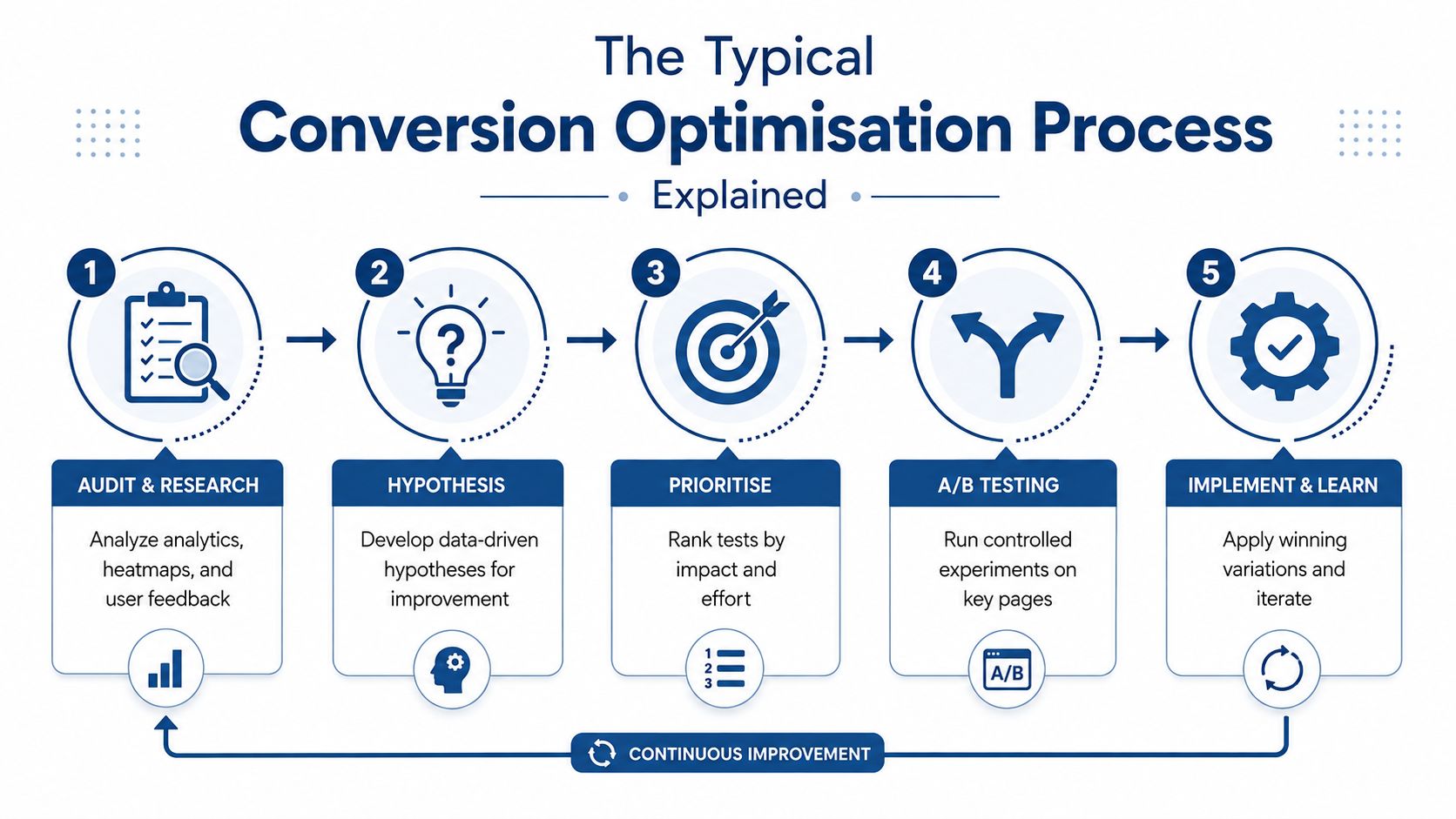
A decent CRO engagement starts with evidence, not guesswork. For a plumbing firm in Leeds, that usually means looking at which service pages get visits, where users drop off, how the quote form behaves on mobile, and which calls or enquiries are worth counting. The point isn't to produce a fancy deck. It's to find the pages and interactions that are costing the business work.
Audit, hypothesis, prioritisation
The first stage is the audit. That means analytics review, page inspection, heatmaps if they're available, and real user feedback where possible. A local solicitor's practice might discover that people are visiting the family law page, but the contact button is buried, or the form asks for too much too early.
From there, the provider should form hypotheses. Not “let's make it prettier”, but “shortening this form should reduce drop-off for mobile visitors”, or “moving the call button higher should improve contact actions from local search traffic”. After that comes prioritisation, because not every fix deserves the same effort.
Testing and implementation
The testing phase is where a lot of firms get overly excited. A/B testing has its place, but it's only useful when the traffic is enough to support a sensible experiment and the tracking is clean enough to trust. Otherwise you're just producing statistical theatre, which is like buying a gym membership and calling it health.
The final stage is implementation and learning. Winning changes get rolled out, weaker ideas get parked, and the next round of tests should be based on what the earlier data showed. For service businesses, quick wins often hide in the obvious places, clearer calls to action, shorter forms, less clutter, and stronger trust cues.
A straightforward engagement for a local firm should usually leave you with:
- A clear audit summary showing the biggest friction points.
- A ranked test backlog so you know what gets done first.
- Simple reporting that connects actions to leads, not just clicks.
A good CRO process feels almost boring in the right way. It removes ambiguity, trims waste, and makes the next decision easier than the last.
If you want a simple example of how benchmark thinking is used in practice, see how Orbit AI compares and look at the way conversion rates are framed against page intent rather than just raw traffic.
The Measurement Gap That Undermines Most CRO Projects
The biggest problem with many CRO projects is that they celebrate the wrong number. A form fill looks tidy on a dashboard, but if half of those enquiries are junk, out of area, or never answered, the “win” is about as useful as a chocolate teapot. Measurement has to start with what the business cares about: qualified calls, booked appointments, and revenue downstream, not just on-page events.
Why conversion rate is often incomplete
For UK service firms, cookie consent, GA4 migration, and offline lead quality muddy the water. Users decline tracking, switch devices, call from a search result, or complete the journey away from the browser entirely. The on-site conversion might be real, but the commercial result lives somewhere else.
That's why many page-level tests are commercially meaningless on their own. A new headline can improve form submissions while lowering lead quality. A shorter form can increase volume while attracting more tyre-kickers, and no one wants to pay for a bigger pile of bad leads. You can be technically right and still wrong for the business, which is a splendidly unhelpful place to be.
What to ask before you sign anything
A sensible CRO provider should be able to explain how it will connect on-site behaviour to downstream outcomes. That includes call tracking where appropriate, lead qualification rules, and a reporting view that doesn't pretend every enquiry is equal. If the conversation stays trapped inside “conversion rate” without mentioning qualified outcomes, ask sharper questions.
If you want a provider that understands the measurement side of service-led CRO, the internal conversion page at DigiVisi Ltd is a reasonable example of how service businesses should think about lead generation, though the important point is the framework, not the badge. For wider context on choosing sensible measurement and design partners, design service web partner tips is worth a look because it keeps the focus on fit, process, and communication rather than glittery promises.
Useful question: “How will you prove that a test produced better leads, not just more tracked events?”
Pricing Models and What to Expect From CRO Packages
Pricing for conversion optimisation services is usually more about incentives than arithmetic. A retainer suits ongoing improvement, project-based fees fit a specific rebuild or audit, and performance-based models can sound appealing until you notice how many assumptions sit underneath them. If a provider is paid only when a metric moves, they may push for the easiest metric to move, not the one that matters most.
Retainer, project, or performance
A retainer is the most natural fit for a local service business that wants steady experimentation, ongoing reporting, and a rolling list of fixes. It makes sense when the site has enough traffic and enough conversion paths to test over time. The downside is obvious, if the scope is vague, the hours can get blurry faster than a window in a Brighton flat.
A project-based package works better when there's a clear job to do, such as a landing page overhaul, booking-flow review, or audit before a major campaign launch. It's tidy, finite, and easier to budget for. The risk is that the work stops at delivery, just when the most valuable learning begins.
A performance-based model is less common and can be useful in narrow circumstances, but it can also encourage gaming. If the provider is only chasing tracked form fills, you may get more of the wrong leads, not better business outcomes.
What a sensible package should include
A serious package should include discovery, a priority list, implementation support, and reporting that a normal human can read. It should also make room for hybrid approaches, because small firms often need a bit of strategy, a bit of build work, and a bit of iteration without signing away half the year.
A few things are worth checking before you compare proposals:
- Scope clarity: Are the pages, actions, and outcomes named properly?
- Reporting method: Does it show leads, not just traffic movement?
- Change ownership: Who implements the fixes?
- Review cadence: How often are priorities reassessed?
The smartest buyers don't ask “what's the cheapest CRO package?”. They ask “which model matches the shape of my business and the way my leads are generated?”. That's a much better question, and it saves a lot of faff later.
How to Choose the Right Conversion Optimisation Provider
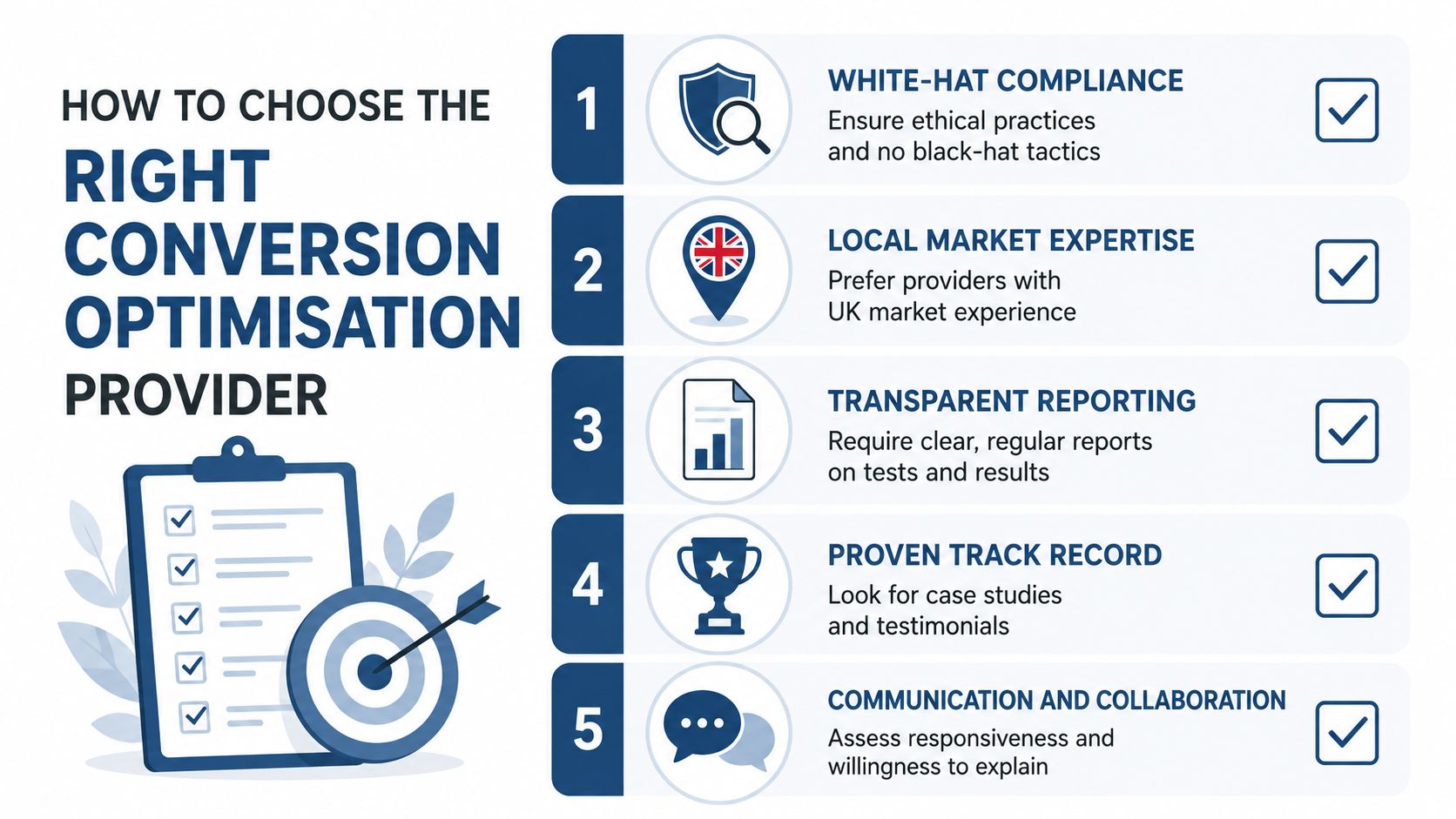
The right CRO provider should feel slightly unglamorous in the best possible way. They should talk clearly about measurement, compliance, user behaviour, and implementation, and they should be honest about what can be proved. If someone treats every site like an ecommerce checkout with a different coat of paint, keep your wallet in your pocket.
Non-negotiables for UK service businesses
Start with compliance. UK consumer law doesn't give anyone a free pass for fake urgency, hidden fees, or misleading statements, and the CMA's enforcement powers are now stronger under the Digital Markets, Competition and Consumers Act 2024 from 6 April 2025, with misleading actions or omissions able to breach the Consumer Protection from Unfair Trading Regulations 2008. For a local plumber in Manchester, that means you can test messages, but you can't invent scarcity or play games with pricing. That is not growth, it is a headache in a shiny jacket. The legal and practical line is summarised well here.
Accessibility matters just as much. The British Standards Institution's accessible web content guidance maps closely to WCAG 2.2, including areas such as accessible authentication, focus appearance, and target size, all of which affect whether users can complete the action you want. If your booking form is awkward for keyboard users or hard to read on mobile, it is a conversion problem as well as a usability one. BSI-aligned guidance is useful to keep in mind because friction is friction, whatever label you stick on it.
Questions worth asking in a sales call
A good provider should be able to explain how they work with local intent, mobile traffic, and service-led enquiry paths. If they cannot tell the difference between a map click, a call, and a form submission, they probably do not understand your lead flow properly.
Ask about reporting, too. You want transparent readouts, a practical test plan, and a clear explanation of what has been learned, not a pile of charts that only look clever when viewed from 10 feet away. The same standards apply when you are choosing partners for design and delivery, so the design service web partner tips are a useful reminder to look for someone who can collaborate, explain, and adapt rather than hide behind jargon.
For UK service businesses, the best providers also ask awkward questions about measurement before they talk about tests. If enquiry quality is fuzzy, call tracking is partial, or offline conversions never make it back into the CRM, the whole CRO exercise can end up polishing vanity metrics while the phone stays stubbornly quiet. A decent consultant will want to fix the tracking first, because a prettier dashboard does not pay the bills. If you need that kind of help, a specialist conversion rate optimisation consultant should be able to show how they link tests to commercial outcomes.
A final filter is whether the provider understands service-led business models. They should talk about lead quality, location pages, and enquiry types rather than obsessing over basket size. If they do not, they will probably hand you a template built for an online shop and call it strategy, which is a bit like using a satnav to find a sandwich.
Mobile-First CRO for Local Service Businesses
A solicitor's potential client in Birmingham isn't sitting at a desk with a calming cup of tea. They're on a phone, juggling a search result, a poor signal, and the vague suspicion that every other firm looks the same. In that moment, mobile CRO is about reducing hesitation fast, because the user wants to know three things, are you local, are you credible, and can I contact you without a faff?
What actually converts on a phone
For local services, the best conversion is often not a form submission at all. It might be a phone call, a map click, or a direction request, especially when the user is trying to act quickly. Most public CRO advice talks as if every journey ends in a checkout, but a local electrician, dentist, or family solicitor doesn't live in that world.
The fixes that usually matter most are simple. Microcopy can clarify what happens after a click, live chat prompts can catch hesitant visitors, shorter forms reduce fatigue, and speed improvements stop people bailing before the page settles. Clear call-to-action buttons still matter, but they need to support the actual local action, not a generic “submit” that sounds like it belongs on a tax form.
If a user on mobile can't see the phone number, trust the page, and act within a few seconds, the page has lost the argument.
How to prioritise across locations
Multi-location firms need a slightly different lens. One branch may need calls, another may need booked assessments, and a third may rely on direction requests because the user is still deciding which site to visit. The page should reflect that difference instead of making all locations march in identical formation like a particularly joyless school assembly.
A practical order of attack for mobile-first CRO is straightforward:
- Make the primary action obvious: Put the call button or booking action where thumbs can reach it.
- Reduce form friction: Ask only for what you need at first contact.
- Tighten the trust layer: Show location, service area, and proof without clutter.
The best mobile improvement is often the one that removes a doubt before it becomes a bounce. That's not glamorous, but it is very effective, and the user won't complain because they got what they wanted without a minor administrative ordeal.
Your Conversion Optimisation Action Checklist
If you run a small service business in the UK, start with the stuff that changes behaviour, not the stuff that looks impressive in a meeting. A better headline won't rescue a broken form, and a prettier layout won't help if users don't trust you enough to click. The cleanest wins usually come from removing friction, clarifying the next step, and measuring the right outcome from day one.
What to fix first
Before you hire anyone, check the basics:
- Calls to action: Are they visible on mobile and desktop, and do they make sense for the service?
- Form length: Are you asking for more than you need at the first step?
- Trust signals: Do the pages show real service details, location cues, and proof that a human business exists behind the logo?
- Tracking setup: Can you see calls, enquiries, and other meaningful actions, or just page visits dressed up in a nice dashboard?
If you're handling forms in-house, form UX best practices for 2026 is a sensible reference point because it keeps the focus on clarity, field design, and reducing avoidable friction. That matters, because a form is often the point where enthusiasm goes to die.
What to ask a provider
Ask any CRO provider how they will separate useful leads from noisy ones. Ask how they handle privacy, consent, and accessibility. Ask whether they'll report on call outcomes and booked appointments, not just on-site clicks, because a local service business can't pay the rent with tidy dashboards alone.
If a proposal talks a lot about testing and very little about lead quality, it's probably half a plan. If it talks about lead quality but can't explain the measurement, it's probably half a plan too. You want both sides joined up, or the whole exercise becomes a rather expensive hobby.
What to track from the start
Track the actions that map to revenue in your business. For some firms that's call volume, for others it's appointment requests, and for others it's qualified enquiries by location. Keep the dashboard boring, readable, and honest, because if you can't explain it to a colleague in one minute, it's too clever.
DigiVisi Ltd works with small UK service businesses on SEO, local visibility, and conversion-ready web improvements that help turn search demand into enquiries. If you want practical help with the measurement, page structure, and local lead flow behind conversion optimisation services, visit DigiVisi Ltd and take a proper look at how the pieces fit together.