Skip to content

Dave, a Bristol plumber, has three job boards open on a wet Tuesday morning. His phone is charged, the van is ready, and the kettle is doing its best, but enquiries have gone quiet. Meanwhile, three competitors appear in Google's Local Pack for “emergency plumber near me”, complete with prominent call buttons, recent reviews and directions. Dave's business sits lower down the results, technically present but practically invisible.
That's the uncomfortable reality of Google Maps SEO for UK service businesses. Your Google Business Profile is often the digital shopfront, particularly when a customer wants a plumber, solicitor, dentist or heating engineer immediately. In the UK, Google Maps reached 73% of online adults in 2024, up from 69% in May 2023, while the Google Maps app reached 71% of UK online adults, according to UK local search data on Google Maps usage. Google also held about 93.5% of UK search share in July 2025, so map visibility affects access to the market's dominant search channel, not a forgotten corner of the internet.
The commercial intent is just as important. A UK-focused local SEO benchmark reports that the local pack appears on 95.6% of trades queries, and on above 90% of genuine hire-intent searches across most sectors studied. Another UK source reports that 46% of Google searches have local intent, as detailed in UK local SEO statistics for 2026. A customer searching for “solicitor near me” or “boiler repair BS8” isn't browsing for intellectual enrichment. They're trying to solve a problem.
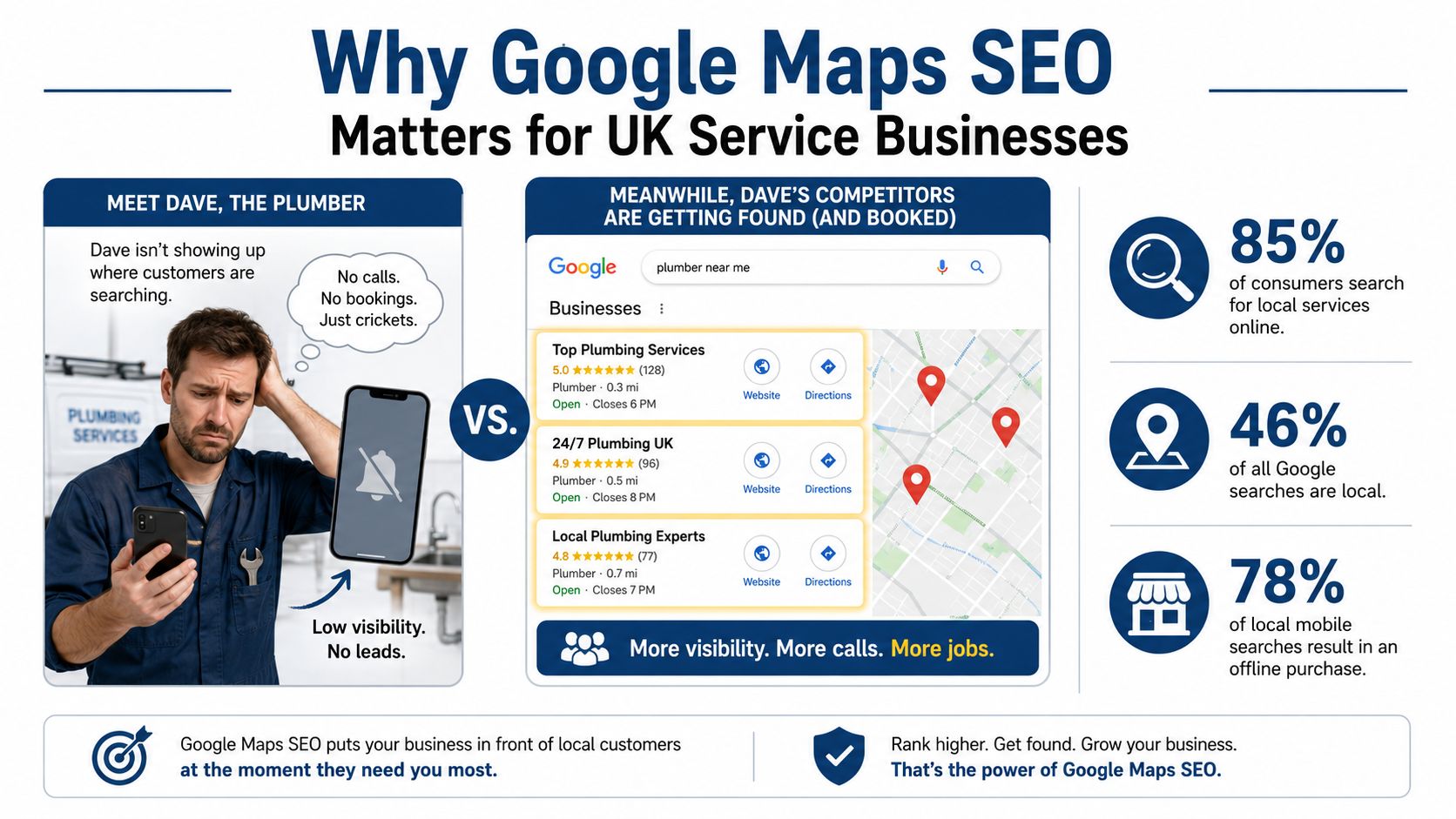
The useful comparison is not “website versus Maps”. It's front door versus side entrance. Your website can explain your services, but the Local Pack places your phone number, reviews, opening status and directions directly in the search journey. Even businesses that cover a wide radius need to understand that visibility changes by postcode. A Bristol plumber can look dominant in BS1 and disappear in BS16, while a smaller rival may win because the searcher is closer to its verified location.
A similar principle applies to local decisions outside the trades. Someone comparing Nursery Advice 2026 choices is likely to care about proximity, trust and practical information before reading a long corporate page. Local search rewards businesses that make those decisions easier.
Table of Contents
- Why Google Maps SEO Matters for UK Service Businesses
- Optimising Your Google Business Profile the Right Way
- Understanding the Local Pack Ranking Signals
- White Hat, Grey Hat and Black Hat Tactics Explained
- Reverse-Engineering Local Competitors by Postcode
- Reviews, Citations, Schema and Measurement in One Loop
Why Google Maps SEO Matters for UK Service Businesses
A service business can deliver excellent work and still lose the first conversation. Google Maps SEO determines whether a customer sees your firm before they see a directory, a national chain or the organic blue links beneath the map. That makes local visibility a commercial issue, not a cosmetic exercise.
The map is the first conversation
A customer with a leaking pipe rarely wants to compare twenty websites. They search, scan the map, check the rating, inspect the opening status and tap to call. A family looking for a Leeds solicitor may follow a similar pattern, although hopefully with fewer towels on the floor.
Google's own guidance says local results are mainly based on relevance, distance and prominence, as explained in its guidance on how local results are ranked. Those three ideas explain why a business can rank brilliantly for one postcode and poorly for another. Relevance comes from matching the service and intent. Distance reflects the searcher's location or specified area. Prominence reflects the business's wider evidence of trust and recognition.
The UK data makes the opportunity difficult to ignore. Trades searches trigger the Local Pack with exceptional frequency, and local intent appears across a substantial share of Google searches, according to the UK local SEO benchmark. If your business doesn't appear in the map results, the customer may never reach your website.
Visibility must be measured locally
A single rank check from your office is a poor diagnostic. It tells you what Google shows one searcher in one place, at one moment. It doesn't tell you whether a plumber is visible across BS1, BS8, BS16 or the surrounding towns.
Track performance by postcode cluster, not just by city name. For each priority service, record:
- Search location: Use consistent points inside each target postcode.
- Map-pack presence: Note whether your profile appears and where.
- Competitor mix: Record which businesses occupy the leading positions.
- Action signals: Monitor calls, direction requests and website visits from GBP Insights.
- Operational reality: Compare visibility with the areas your team can serve profitably.
Practical rule: A city-wide average can hide the exact neighbourhood where your best customers are searching.
This is why generic optimisation checklists fall short. A complete profile is useful, but it doesn't overcome a weak service match, an inaccurate service area or a competitor with stronger local prominence in the searcher's postcode.
Optimising Your Google Business Profile the Right Way
Treat your Google Business Profile as an operational asset. Every field should help Google understand what the business does, where it operates and whether the listing represents a real, eligible organisation. Google's Business Profile guidelines advise businesses to use the fewest categories needed, keep the name consistent with real-world branding and provide an accurate address or service area.
Start with ownership and verification. A Bristol plumber should claim the genuine profile for the trading business, complete verification properly and make sure the phone number reaches someone who can answer during the stated hours. A Leeds family solicitor should use the firm's real public-facing name, office address and actual reception arrangements. A profile that sends callers to a dead number is not an SEO asset. It's a digital receptionist who has gone out for lunch and may never return.
Make the core decisions first
Choose one accurate primary category. Select the category that best describes the main business, not every service that could generate a call. If emergency plumbing is the highest-margin service but the business is primarily a general plumbing firm, choose the category that accurately represents the actual operation. Don't wedge in unrelated categories because they sound commercially attractive.
Write for relevance, not stuffing. The business description should explain services, customers and genuine coverage in natural language. “Bristol plumber” can appear where it makes sense, but the profile shouldn't read like a bag of keywords shaken over a keyboard.
Set service areas. A service-area business should list locations it can serve reliably. If a plumber covers central Bristol and nearby districts, those areas should reflect actual response capability. Adding every town in the South West may create a larger-looking footprint, but it won't create genuine proximity or relevance.
Match hours to reality. Opening hours, holiday hours and emergency availability must align with the phone and staffing. A solicitor who accepts calls only during office hours shouldn't present an always-open profile unless an actual response process exists.
Use evidence rather than decoration
Upload photographs that prove the business exists and does the work. Useful images include the van, branded equipment, office exterior, reception, team members and genuine work in progress. Avoid stock images and staged scenes that could belong to any firm in Britain.
The grey-hat temptation appears when owners try to manipulate the profile instead of improving the evidence. Keyword-stuffed names, virtual offices and inaccurate addresses may look clever until Google questions the listing. Google's Business Profile policies cover eligibility, ownership and representation, so a legitimate profile should resemble the shopfront, not a Christmas tree.
Add services that match the website, answer genuine questions in the Q&A area and publish useful updates when there is something worth saying. None of these replaces relevance, distance or prominence, but together they make the profile clearer for both searchers and Google.
The dashboard is where you turn these decisions into a maintained asset. This short walkthrough provides a useful visual reference before you begin making changes.
Understanding the Local Pack Ranking Signals
Google Maps SEO becomes much easier to prioritise when you separate relevance, distance and prominence rather than treating every task as equally valuable. Google's guidance identifies those three broad local-ranking factors, while a UK-focused expert survey summary reported approximate weighting of 32% for Google Business Profile signals, 20% for review signals and 15% for on-page signals, as outlined in this summary of Google Business Profile statistics.
Those figures shouldn't be treated as a universal calculator. Google doesn't publish a simple public formula, and local results vary by query, location and business type. They are useful as a prioritisation model, particularly because they show why profile work and reviews deserve more attention than endless directory submissions.
A practical prioritisation model
| Signal | Approximate Weight | Key Sub-Signals |
|---|---|---|
| Google Business Profile | 32% | Primary category, completeness, service alignment, accurate location and profile activity |
| Review signals | 20% | Relevance, recency, quality of responses and authentic customer feedback |
| On-page signals | 15% | Service-location relevance, NAP consistency, LocalBusiness schema and useful landing pages |
Relevance comes first. A Manchester solicitor may outrank a national chain for a Chorlton query because the profile, service information and website better match the search intent. A larger brand doesn't automatically have the best local answer.
Distance changes the battlefield. A Camden plumber may dominate searches close to the business and become far less visible a short distance away. That isn't a technical error. It's the natural effect of proximity, which is why postcode-level tracking matters.
Prominence needs credible support. Reviews, links, citations and on-page signals help establish trust, but they don't rescue an irrelevant or inaccurately located profile. The UK local ranking-factor analysis also emphasises profile completeness, aligned service areas, fresh photos and review activity as practical priorities.
The order is straightforward: fix category and service relevance, strengthen review activity, improve local pages and links, then tidy citations. Citation chasing before correcting the profile is like polishing the number plate on a van with no engine. It may sparkle, but it won't get to the job.
White Hat, Grey Hat and Black Hat Tactics Explained
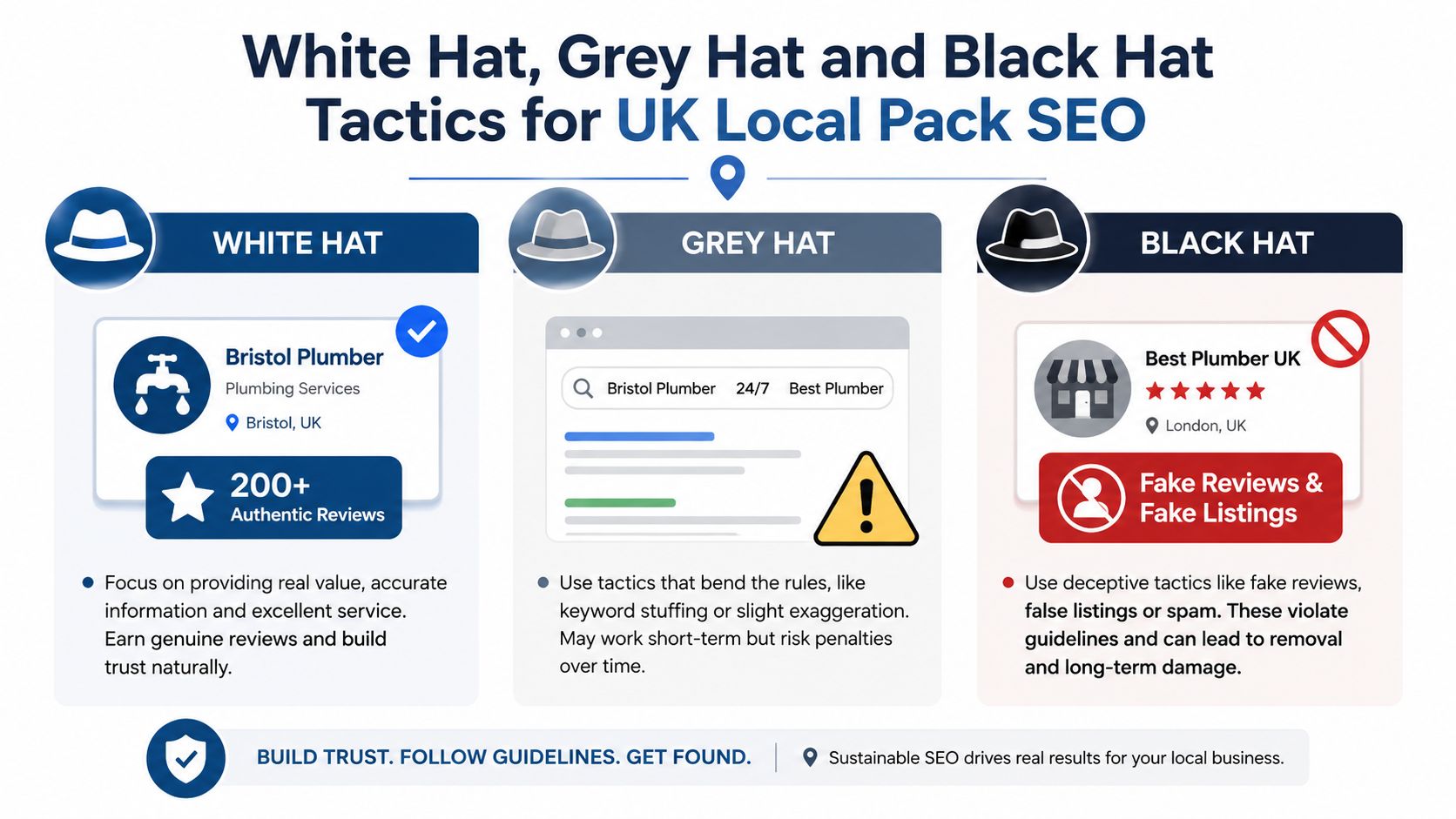
Local SEO tactics sit on a spectrum, but the boundary matters. White-hat Google Maps SEO improves the accuracy and usefulness of a genuine listing. Grey-hat tactics try to exploit weaknesses without always creating an obviously fake business. Black-hat tactics rely on deception, manipulation or fabricated signals.
The Bristol plumber test
A white-hat plumber verifies the business, uses its trading name, selects accurate categories, serves the stated areas and asks completed-job customers for honest reviews. Genuine citations on relevant UK platforms such as Yell, Checkatrade and Trade Rated can support the business when those details match the actual operation. That foundation also gives postcode-cluster testing something reliable to measure, rather than a profile padded with invented locations.
A grey-hat competitor might buy reviews through Telegram, use a virtual office in central Bristol despite operating elsewhere, or add a list of keyword-stuffed service cities. These tactics attempt to manufacture proximity or trust. They can create ownership, eligibility and suspension problems under Google's Business Profile policy framework.
A black-hat operator goes further by building a private network of fake trade directories, cloaking landing pages or paying for fake clicks. The aim is to imitate local relevance without improving the business behind the profile. It may look active in a short-term postcode check, then leave an obvious trail when the listing, website and review patterns are examined together.
What to audit before hiring help
Ask an SEO agency how it generates reviews, which directories it uses and who owns the Google Business Profile. Be wary of proposals promising a fixed ranking everywhere, requesting extra locations in the business name, or refusing to show the citations and links being built.
The practical signs of risk include:
- Review irregularity: Sudden bursts, repeated wording or reviews from people who never used the service.
- Location fiction: A virtual office, borrowed address or profile placed outside the actual operating footprint.
- Name manipulation: Search terms appended to the business name.
- Opaque reporting: Screenshots without search locations, tracked queries or a record of profile changes.
- Disposable assets: New domains, fake directories or profiles created without proper ownership.
Grey-hat gains are fragile because the underlying business evidence remains unchanged. A tactic may work briefly, yet leave the owner with a profile that is difficult to verify, defend or recover. Honest reviews, accurate information and genuine local relevance take longer to build, which is why they hold up better across postcode clusters and competitor checks.
Reverse-Engineering Local Competitors by Postcode
The most useful competitor analysis asks a narrow question: why does this business appear for this service in this postcode? A city-wide search won't answer it. Build a postcode grid, search from consistent locations and compare the same signals for the leading three profiles.
Four steps for a postcode cluster audit
Start with the map. For a Bristol plumber, test a priority service from search points across BS1 to BS16, then inspect the clusters where visibility changes. For a Leeds solicitor, compare the relevant LS areas and note whether the leading profiles are nearby, service-area businesses or firms with offices in the search location.
Record the top three, their displayed addresses or service areas, category choices, review freshness, photos and profile activity. Don't treat the result as a league table for the whole city. It is a local snapshot.
Compare profile activity next. Review count alone doesn't explain the result. Look at review velocity, owner-posted updates, Q&A activity and photo upload cadence. A smaller profile may beat a larger rival in one cluster because its recent activity and service relevance are stronger there.
Audit the supporting pages. Crawl competitor websites with Screaming Frog and inspect LocalBusiness and Service schema, NAPW formatting and service-plus-location pages. For a plumber, that might mean pages addressing boiler repairs in specific Bristol areas. For a solicitor, it could mean carefully written service pages for relevant Leeds neighbourhoods, not thin pages with the postcode swapped in twelve times.
Map authority and relevance. Ahrefs or Semrush can reveal referring domains, but rank them by topical relevance and local usefulness rather than collecting them like football stickers. UK trade directories, local organisations and relevant professional sources are more meaningful than a pile of unrelated listings. For broader methodology, learn competitor analysis in SEO before building your comparison sheet.
A working audit table
| Postcode cluster | Top rival | Reviews | Photos | Owner posts, 90 days | Distance from centroid |
|---|---|---|---|---|---|
| BS1 | Record live result | Record live result | Record live result | Record live result | Record live result |
| BS8 | Record live result | Record live result | Record live result | Record live result | Record live result |
| BS16 | Record live result | Record live result | Record live result | Record live result | Record live result |
The table deliberately uses live audit fields rather than invented figures. Populate it on the same day, from consistent search points, because Google results change with location and personalisation.
Turn gaps into actions
If a rival wins BS8 because its office is closer, don't create a fake BS8 address. Build genuine relevance through accurate service coverage, useful local content and evidence of completed work in the area. If a competitor has stronger review activity, improve the customer follow-up process rather than purchasing praise from strangers on Telegram.
The aim isn't to copy every rival. It's to identify the signal that explains the result in each cluster, then improve the weakest credible part of your own profile.
Reviews, Citations, Schema and Measurement in One Loop
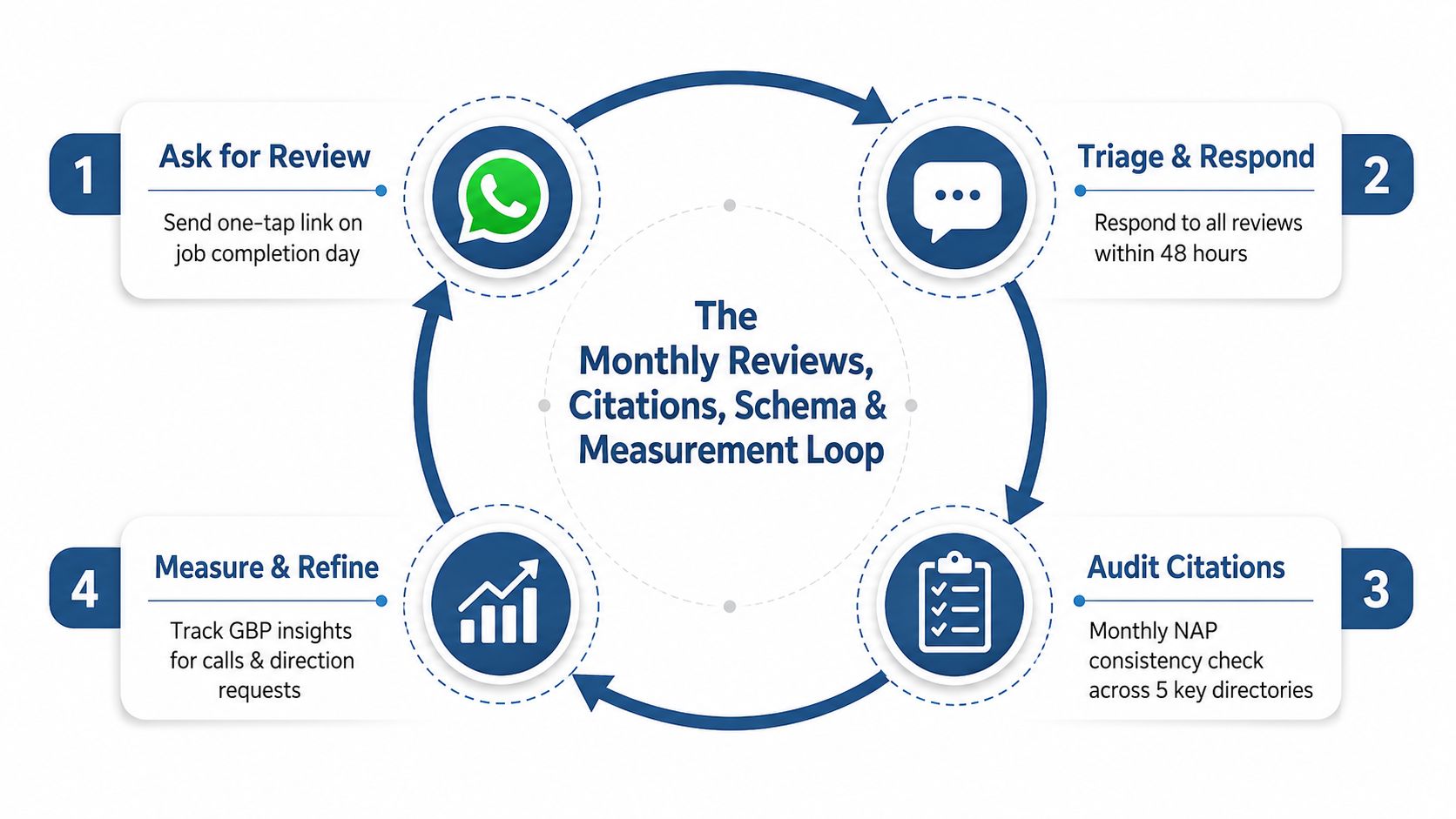
Maps SEO works best as an operating rhythm, not a one-off tidy-up. Reviews create fresh customer evidence, citations reinforce business identity, schema clarifies the website and measurement shows which postcode clusters deserve attention.
Run the customer feedback process properly
Ask for a review on the day the job is completed, ideally through WhatsApp with a one-tap link. The request should be neutral and honest. Don't demand particular wording, a five-star rating or a location keyword.
Respond to every review promptly and professionally. Acknowledge the actual service, avoid exposing private details and move sensitive complaints into a direct conversation. If a review appears to violate Google's policies, document the issue and flag it through the proper process rather than trying to bury it with more manufactured feedback. The guide to getting more Google reviews covers the customer-side process in greater detail.
Keep citations and schema useful
Maintain a master NAPW sheet with the business name, address, phone, website and audit date. Check relevant UK directories such as Yell, Checkatrade, FreeIndex, Bark, Cylex and Thomson Local, but don't assume that more listings automatically mean more prominence. Correct, relevant records are the objective.
On the website, use appropriate LocalBusiness and Service schema, include accurate AreaServed information and connect each service page to the business details it represents. A Bristol plumber can clarify boiler repair and emergency plumbing coverage. A Leeds solicitor can distinguish family law from conveyancing instead of forcing every service into one vague page.
Measure actions, not vanity
Use Local Falcon or BrightLocal to track Local Pack share of voice across BS, LS or M postcode clusters. Record calls with unique GBP phone numbers where appropriate, and log GBP Insights screenshots in a dashboard so changes have a date and context.
A monthly review should cover:
- Profile accuracy: Categories, hours, service areas, contact details and ownership.
- Customer evidence: New reviews, response quality, policy concerns and recurring complaints.
- Content freshness: Photos, updates, Q&A answers and service-page improvements.
- Local authority: Citation corrections, relevant links and competitor changes.
- Commercial outcomes: Calls, direction requests, website visits and qualified enquiries.
DigiVisi Ltd offers Google Business Profile optimisation, competitor analysis, citations and schema work for UK service businesses, with position tracking and transparent reporting. If your profile is visible in one postcode but absent in the next, visit DigiVisi Ltd to discuss a data-led Google Maps SEO audit and a practical plan for converting local visibility into more calls and enquiries.