Skip to content
You've probably done it yourself. You search for a local plumber, solicitor, dentist, or accountant, glance at the star rating, then start reading the reviews to see whether the business feels reliable or like a bit of a gamble. Your customers do exactly the same thing.
That's why knowing how to respond to Google reviews matters so much. It isn't admin. It isn't just being polite. It's public proof that somebody in the business is awake, paying attention, and capable of handling praise, complaints, and the occasional utterly baffling comment with a straight face.
For UK service businesses, there's another wrinkle. A garage in Leeds, a law firm in Brighton, and a physio clinic in Bristol can't all use the same canned reply. Some can be chatty. Some need to be careful with confidentiality. All of them need to sound human. And now there's a newer layer to think about as well. AI-driven search surfaces are starting to shape how people discover local businesses, so the words in your replies may do more work than most owners realise.
Table of Contents
- Why Bother Responding to Google Reviews Anyway
- Your Review Response Mission Control
- The Good The Bad and The Baffling
- Dealing with Dodgy Reviews and Trolls
- The Advanced Playbook for UK Professionals
- Making Review Management a Winning Habit
Why Bother Responding to Google Reviews Anyway
A new review lands. If it's a five-star rave, it's tempting to smile and move on. If it's a one-star grumble about lateness, you might want to put the kettle on first and reply later. Both instincts are understandable. Neither is the best move.
The reason is simple. Customers read your replies as carefully as they read the review itself. A 2023 UK-focused survey found that 76% of UK online searchers check Google reviews for local businesses, 61% expect a business to respond within a week, and 44% would be less likely to choose a business that never replies to any reviews according to the UK review response survey summary.
That changes the job of review responses completely. You're not just talking to the person who left the review. You're talking to the next potential customer who's deciding between you and the business down the road.
Your replies are part customer service and part marketing
Take a local locksmith in Nottingham. A review says, “Turned up quickly, sorted the lock, fair price.” If the owner replies with a warm thank-you that mentions the emergency call-out, a future customer sees attentiveness and professionalism. If there's silence, the profile feels neglected.
The same applies when things go wrong. A measured reply to a complaint can reassure people far more than a spotless profile with no owner responses at all. Businesses are run by humans. Customers know that. What they want to see is whether you handle hiccups like a grown-up or like somebody arguing in a pub car park.
Practical rule: Every review response is a tiny advert for how your business behaves when someone is happy, disappointed, or difficult.
There's also a local search angle. Active profiles tend to look more trustworthy because they show signs of recent engagement. Not fake engagement. Not keyword stuffing. Just sensible, timely, helpful replies.
White hat review management is straightforward. You respond promptly, personalise the message, and stay honest. Grey hat behaviour starts when businesses over-optimise, use clumsy AI copy without checking it, or try to manipulate the thread. Black hat territory is fake reviews, fake accounts, and made-up conversations. That stuff isn't clever. It's just risky and usually obvious.
Your Review Response Mission Control
The mechanics are refreshingly plain once you know where to look. In your Google Business Profile, go to the reviews area, open the Read reviews tab, choose the review, click Reply, type your response, and publish it.

Google also puts a hard limit on what you can write. Replies must be 1,000 characters or fewer according to Google Business Profile Help on replying to reviews. That's a blessing. It forces you to be concise instead of writing a courtroom statement because someone said the waiting room magazines were a bit naff.
Find the reply box quickly
If you only check reviews now and then, you'll always feel behind. Set the profile up so reviews come to you.
A sensible setup looks like this:
- Turn on notifications in Google Business Profile so new reviews don't sit unnoticed.
- Check reviews daily if you're a busy service business with regular bookings or call-outs.
- Keep draft templates ready for positive, negative, and unclear reviews, then customise each one.
- Log awkward cases in your CRM or job notes so the person replying knows the background.
A fast process matters because delay weakens the impact. UK businesses that respond to Google Reviews within 24 to 48 hours see, on average, a 12 to 18% higher click-through rate from local search results and a 22% improvement in local pack appearance frequency over six months according to this UK local business response analysis.
Build a fast response routine
Here's the practical version I'd use for a local electrician in Manchester or a cleaning company in Reading:
- Morning check: Open the profile with your emails.
- Triage first: Decide whether the review is positive, a genuine complaint, or suspicious.
- Reply the same day where possible: Especially if the review raises a problem.
- Move detail offline: Publicly acknowledge, then invite a call or email for specifics.
That's the rhythm. Nothing glamorous. Very effective.
A short walkthrough helps if you prefer seeing the interface in action:
The key trade-off is speed versus quality. Don't wait a week trying to write the perfect reply. But don't fire off something robotic either. The sweet spot is a response that's quick, calm, and obviously written for that specific review.
The Good The Bad and The Baffling
Most advice on how to respond to Google reviews collapses into “be polite and professional”. True, but not enough use when you're staring at an actual review from an actual person with actual opinions.

When the review is glowing
A plumber in Peckham gets this:
“Great service from Dan. Fixed a leaking pipe same day and left everything tidy.”
A poor reply:
“Thanks for your review.”
A strong reply:
“Thanks, Sarah. Glad Dan could sort the leaking pipe quickly and leave things tidy. We know plumbing issues are stressful, so we really appreciate you taking the time to leave a review.”
The difference is specificity. If the reviewer's name is visible, use it. Guidance commonly recommends that because it makes the reply feel real rather than copied. This review response guidance on personalising replies also supports using the reviewer's visible name and echoing specific details from the review.
When the review is rough
A Bristol café gets a one-star review saying the coffee was cold and the staff were rude. In such situations, owners either do their best work or make a complete hash of it.
The mistake is replying defensively:
“You must have come on a busy day and our staff are never rude.”
A better approach is empathy plus a route offline. That matters even more in sensitive sectors. Guidance on negative review handling recommends apologising for the customer's frustration or negative experience, not for the underlying issue, which helps you show empathy without admitting liability, especially in legal or healthcare settings, as explained in this guide to review response wording.
A safer reply:
“Hi James, we're sorry to hear you left feeling disappointed. That's not the experience we want for anyone visiting the café. Please contact us directly so we can understand what happened and look at how to put it right.”
That wording works because it:
- Acknowledges emotion: You recognise the customer's disappointment.
- Avoids legal self-sabotage: You haven't publicly admitted fault.
- Invites resolution: You move the conversation somewhere private.
For a solicitor, accountant, or clinic, this distinction is even more important. You can be warm without saying something you'll regret later.
When the review is confusing
Then there are the oddballs. The three-star review that says, “Fine.” Helpful. Cheers for that.
A marketing consultant in Leeds might reply:
“Thanks for your feedback, Priya. We appreciate the rating and your time. If there's anything we could have done to improve the experience, we'd be glad to hear it.”
That keeps the door open without sounding needy.
Sometimes the baffling review is so vague you can't identify the customer at all. A bakery in Bristol might get: “Terrible service. Avoid.” No date, no order, no clue. In that case, stay factual and civil:
“Hello, we're sorry to read this. We take feedback seriously but can't identify the situation from the review. If you'd like to contact us directly, we'll do our best to look into it.”
| Review Type | Core Elements | Example Snippet (for a Local Cafe) |
|---|---|---|
| Positive | Thank them, use name, mention a detail, reinforce the experience | “Thanks, Hannah. We're so pleased you enjoyed the flat white and lemon drizzle.” |
| Negative | Acknowledge disappointment, stay calm, offer offline resolution | “Sorry to hear the visit left you frustrated. Please contact us so we can look into it properly.” |
| Neutral | Appreciate feedback, invite clarification, keep tone light | “Thanks for the review, Tom. If there's one thing we could improve, we'd love to hear it.” |
A review reply should sound like a competent person at the front desk, not a robot wearing a lanyard.
Dealing with Dodgy Reviews and Trolls
Not every bad review is genuine. Some are spammy, some are mistaken identity, and some look suspicious enough to raise an eyebrow from here to Huddersfield. The trick is not to treat every negative review as fake just because you don't like it.
How to spot a suspect review
A review deserves closer inspection when it has no identifiable detail, no sign the person used the business, or language that sounds copied and pasted. A genuine complaint usually mentions something concrete, even briefly. A fake one often stays oddly vague.
Use this checklist:
- Check your records: Can you match the name, date, service, or situation?
- Look for specifics: Real customers usually mention a product, visit, staff member, or problem.
- Review the account profile: A string of extreme reviews across unrelated places can be a warning sign.
- Stay unemotional: Being annoyed doesn't make the review fake.
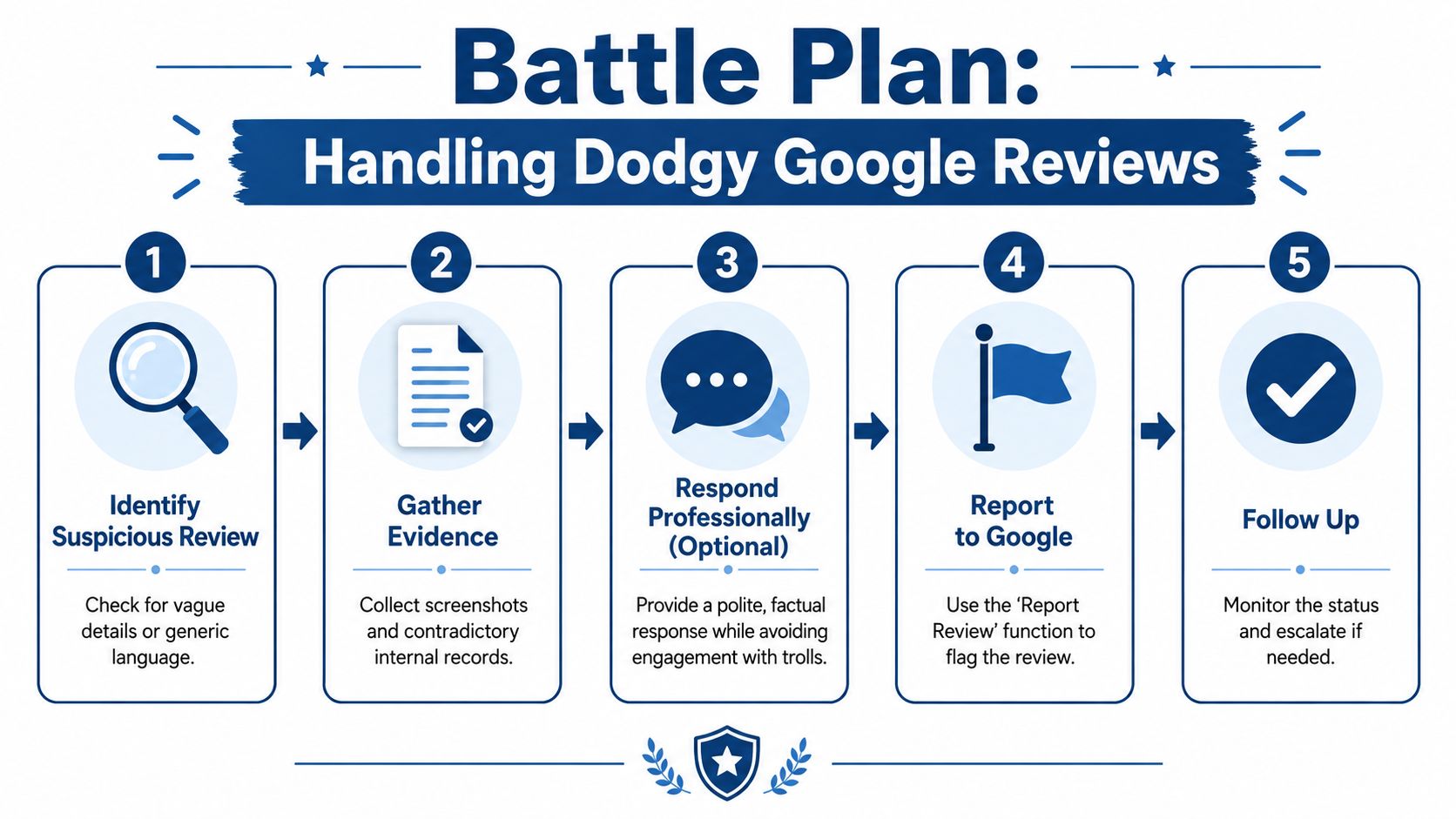
If you believe the review breaches policy, gather evidence first. Save screenshots. Note why it appears false. Keep internal records handy in case you need them later.
How to report it without making a mess
Google lets you flag reviews for removal through the review management area in your Business Profile. Keep your reasoning factual. Don't write a mini rant. Don't accuse the reviewer publicly of being a competitor unless you can prove it.
A sensible sequence is:
- Flag the review in Google Business Profile.
- Document the issue internally with screenshots and notes.
- Post a restrained public reply if needed so readers can see you're attentive.
- Monitor the status and follow up through available support routes if appropriate.
A public holding reply can be useful while you wait:
“Hello, we take feedback seriously but we can't identify any customer record matching this review. We'd welcome direct contact so we can investigate properly.”
That works because it's calm and transparent. No public slanging match. No feeding the troll.
For owners who want a broader framework for reputation risk, this online reputation guide for founders is worth a look because it helps you think beyond a single review and towards process, evidence, and escalation.
The Advanced Playbook for UK Professionals
Generic templates can cause real problems in UK professional services. A roofer, a dental practice, and a solicitor do not have the same risk profile when replying in public.

Why regulated firms need different wording
For solicitors and other regulated professionals, public replies need extra care. UK professionals like solicitors must modify review responses to comply with sector-specific regulations such as GDPR and SRA guidance, and many standard templates risk breaching data protection norms by encouraging businesses to mirror specific details from a client's experience in a public reply, as discussed in this guide on handling negative Google reviews in regulated contexts.
That means a high street shop might safely say:
“Thanks for choosing us for your kitchen tap replacement on Tuesday.”
A solicitor probably should not say:
“Thanks for trusting us with your employment dispute hearing.”
The safer route is to keep public wording broad:
“Thank you for your feedback. We appreciate you taking the time to share it and would be happy to discuss any concerns directly.”
That still sounds responsive. It just doesn't reveal personal data or case details to the whole internet.
If you work in a regulated service, your review process should sit alongside your wider visibility strategy. This is one reason many firms treat review handling as part of SEO for professional services, not just customer service. The public language on your profile affects both trust and discoverability.
Compliance rule: Use only information already visible in the review, and even then, think twice before repeating anything sensitive.
Writing replies that also help AI surfaces
Another angle most guides miss is how review responses may influence AI-led discovery. Research notes that UK-focused guidance rarely explains how replies interact with AI Overviews and other generative search features, despite the growing role of AI-assisted search in local discovery, as outlined in this discussion of AI and Google review responses.
The practical takeaway is not to stuff replies with keywords like it's 2009. That's grey hat at best and clumsy at worst. Instead, write naturally in ways that surface useful signals:
- State the service clearly: “Glad we could help with your boiler repair.”
- Reinforce reassurance: “We appreciate your trust in our team.”
- Use location naturally when relevant: “Thanks for choosing our Brighton clinic.”
- Show next-step clarity: “Please contact the practice directly so we can assist.”
Those small choices can help both humans and machine-generated summaries understand what your business does and how it treats people. Clean, precise wording ages far better than puffed-up sales language.
Making Review Management a Winning Habit
Review management works best when it stops being a panic response and becomes part of routine operations. The businesses that do this well don't wait until someone leaves a stinker. They keep the profile active, organised, and monitored.
There's a payoff for that consistency. UK service businesses that respond to negative reviews within 24 hours see the average rating of subsequent reviews rise by 0.4 stars over 90 days, and profiles with an 80% or higher response rate get 27% more new reviews per month according to this analysis of response rates and follow-on reviews.
A monthly rhythm that actually sticks
You don't need a grand system. You need a boring one that gets done.
A practical monthly checklist for a local business owner looks like this:
- Review response coverage: Check whether every recent review has a reply.
- Template refresh: Tighten your standard wording so it still sounds human.
- Escalation log: Review any unresolved complaints or suspicious reviews.
- Pattern spotting: Notice repeated praise or repeated grumbles. Both are useful.
- Team ownership: Make sure one person is clearly responsible for checking and replying.
For a small roofing firm, that might be the office manager. For a solicitor's practice, it may need sign-off from someone who understands confidentiality. For a dental clinic, reception can draft and management can approve sensitive cases.
Why consistency compounds
High response rates do two useful things at once. They reassure future customers, and they encourage more people to leave reviews because the business looks active and attentive. That creates a healthier feedback loop than the all-too-common British approach of “ignore it and hope it goes away”.
When reviews do become a recurring headache, it helps to understand your options clearly. If you want a broader sense of the available solutions for negative reviews, that resource gives useful context around handling persistent issues without rushing into the wrong move.
Keep the habit simple. Reply promptly. Personalise the message. Avoid canned fluff. Escalate the dodgy ones. Stay within your professional boundaries. That's how to respond to Google reviews in a way that helps the business, rather than just making the notifications disappear.
If you want help turning your Google Business Profile into a proper lead source, DigiVisi Ltd helps UK service businesses improve local visibility, sharpen review strategy, and turn more searches into calls and enquiries.