Skip to content

You're probably in one of two camps right now. Either your website looks decent enough but the phone isn't ringing, or you're getting the odd enquiry and wondering why the firm across town keeps showing up above you for searches you know you should be winning.
That's the reality of SEO for small businesses UK in 2026. The best business doesn't always get the click. The one that's easiest to find usually does. A brilliant plumber in Preston, a careful solicitor in Sheffield, or a cracking gardener in Kent can all stay invisible online if Google can't clearly connect the business to the service and the area.
The good news is that local SEO isn't magic, and it isn't reserved for giant firms with silly budgets. The most reliable approach is far less glamorous. You stop guessing, study the businesses already ranking, and build a stronger version of what Google is already rewarding. That's reverse-engineering in plain English. Less crystal ball, more clipboard.
Table of Contents
- Why Your Local Business Cannot Afford to Ignore Google
- Your Starting Point A DIY SEO Audit Checklist
- Winning On-Page SEO The Foundations of Your Website
- Mastering Local SEO Your Google Business Profile and Citations
- Smart Content Strategy for UK Service Businesses
- How to Reverse-Engineer Your Local Competitors
- Budgets Timelines and When to Call in The Pros
Why Your Local Business Cannot Afford to Ignore Google
A customer in Preston has a leaking boiler at 7:10am. They grab their phone, search “emergency plumber Preston”, and ring one of the first firms that looks credible. If your business is missing, buried, or looks half-finished, you are not in the running. That is not a branding problem. It is lost revenue.
For local service businesses in the UK, Google is usually the first checkpoint before someone calls, fills in a form, or decides you look too risky to bother with. A Facebook page will not rescue you if your Google presence is weak. A nice van wrap will not help if your competitor has stronger reviews, clearer service pages, and a better Google Business Profile.
Google decides who gets inspected first
Owners often assume they compete with the firms they know by name. Search works differently.
If you are a solicitor in Sheffield, your competition in Google may be a smaller practice with tighter service pages, better reviews, and cleaner local signals. If you are a roofer in Bolton, the businesses taking calls from search are the ones Google trusts to answer that query well. Those are your actual search competitors, whether you have heard of them or not.
That is why generic SEO advice wastes so much time. It tells a business owner to “improve visibility” without showing what Google is rewarding in their patch. A better approach is to reverse-engineer the firms already winning your money terms and copy the signals that deserve copying.
Visibility is not a vanity metric
People use Google to check four things fast. Do you offer the service they need. Do you cover their area. Do you look trustworthy. Can they contact you without effort.
If any one of those is unclear, the click goes elsewhere.
I have seen this repeatedly with trades and legal firms. The business itself is sound, the work is good, and the phones should be busier. But the search result shows a weak title tag, no useful reviews in sight, and a website that hides the main service behind vague marketing copy. Google did not kill the lead. Poor presentation did.
Practical rule: If you are not visible for your service plus town searches, or your listing looks weaker than the firms around you, Google is already affecting sales.
The useful question is not “How do I do SEO?”
The useful question is, “What are the top three businesses in my area doing that I am not?”
Start there.
Search your core terms and examine what appears in the map pack and the organic results. Look at the service categories they use, the wording in their page titles, the depth of their service pages, the quality of their photos, the review themes, and how clearly they mention locations. You are not guessing then. You are working from evidence.
For a quick framework, this guide on how to do an SEO audit is a solid reference point. The trick for small businesses is applying that audit locally, against nearby competitors, rather than treating SEO like a generic checklist copied from a national brand.
Small gains stack up fast
You do not need to dominate every search in the county. You need to appear for the services and areas that pay the bills.
That usually means doing the obvious basics better than the average local competitor. Clear service pages. A complete Google Business Profile. Recent reviews. Consistent business details. Location relevance that is specific, not spammy. None of that is glamorous, but it is often the difference between page one and being ignored.
Google is where local buyers compare, shortlist, and decide. If your business is not giving Google enough confidence, a competitor will happily take the call instead.
Your Starting Point A DIY SEO Audit Checklist
Before changing anything, check what a customer sees. Not what you think is there. Not what your web designer said was there. What's showing up.
If you're a plumber in Preston, search the phrases a normal customer would use. Try “emergency plumber Preston”, “boiler repair Preston”, and “plumber near me”. If you're a solicitor in Sheffield, search “conveyancing solicitor Sheffield” or “employment solicitor Sheffield”. Your own business name doesn't count. Branded searches are the easy bit.
Five checks worth doing today

Check your Google Business Profile
Look at your business name, phone number, address, opening hours, website link, services, and photos. Then read your latest reviews. If a customer spots stale information, trust drops fast.Check your website on mobile
Open the site on your phone. Is the text readable? Do buttons work? Can someone call you in one tap? If your site feels fiddly, people won't wrestle with it out of politeness.Check your service pages
Do you have a proper page for each key service, or one vague “What We Do” page trying to cover everything from rewires to EV chargers? Google prefers clarity.Check local relevance
Does the site clearly mention the towns you serve in a useful way? “We cover the whole UK” is usually meaningless for a local firm. “Blocked drains in Chorley and Leyland” is much more useful.Check your competitors side by side
Search your target phrase and open the top three local businesses. Compare their Google profile, reviews, pages, and messaging with yours. Don't overcomplicate it. You're looking for obvious gaps.
A good audit should feel slightly annoying. If it doesn't reveal anything uncomfortable, you probably haven't looked closely enough.
What to record in a simple spreadsheet
You don't need fancy software for the first pass. A plain spreadsheet will do the job nicely.
- Search term used
- Whether you appeared
- Which page showed up
- Top three visible competitors
- Missing basics on your own listing
- Obvious strengths competitors have
For example, an electrician in Leeds might spot that the top-ranking firms each have separate pages for emergency callouts, landlord certificates, rewires, and fuse board upgrades. Meanwhile, their own site has one service page thinner than a crisp packet.
Don't confuse activity with progress
Many owners burn hours tweaking logos, changing button colours, or posting random blog updates no one asked for. That isn't an audit. It's fidgeting.
If you want a structured checklist that goes a bit deeper without disappearing into technical soup, this guide on how to do an SEO audit is a useful reference. Use it to tighten your process, then bring the findings back to one question: what's stopping a local customer from choosing you?
That's your starting point. Not rankings software. Not jargon. Plain evidence.
Winning On-Page SEO The Foundations of Your Website
A customer in Preston searches for “emergency boiler repair near me”, clicks your site, and lands on a page that says “Welcome to our website”. That page has no chance. Google cannot tell what the service is, the customer cannot tell if you cover their area, and a competitor with a clearer page takes the enquiry.
That is on-page SEO in plain English. It is the job of making each important page obvious to both Google and the person who needs help today.

The easiest way to get this right is to reverse-engineer what already ranks in your town. Search your main service plus your location. Open the top few pages. Then ask boring but profitable questions. What words appear in the title tag? How specific is the H1? Do they have a dedicated service page, a location page, FAQs, reviews, pricing hints, or trust signals you do not?
Do not copy them line for line. Match the signals that matter, then build a page that is clearer and more useful.
Write pages that make the job obvious
Take a service page for a Sheffield solicitor. A weak page says, “We offer legal services to clients across the region with an experienced team and bespoke support.” It sounds polished, but it says almost nothing.
A stronger page states the service, the place, the problem, and the action. Conveyancing in Sheffield. Fixed-fee quotes. Help for first-time buyers and sellers. Call today or request a callback.
That level of clarity wins more often than clever writing. It also makes competitor analysis much easier, because you can compare like with like instead of guessing what a vague page is trying to rank for.
What good page structure looks like
The basics still carry a lot of weight if they are aligned with search intent.
| Element | Good example for a local business | What goes wrong |
|---|---|---|
| Title tag | Boiler Repair in Preston | 24 Hour Gas Engineer | Vague titles like Home or Welcome |
| H1 | Emergency Boiler Repair in Preston | H1 missing or unrelated |
| Meta description | Fast boiler repair across Preston. Call for urgent help, diagnostics, and replacement advice. | Auto-generated filler |
| URL | /boiler-repair-preston/ | /service-page-2/ |
| Internal links | Link to heating services, contact page, and nearby area pages | Important pages left isolated |
If three competing plumbers all have dedicated pages for boiler repair, servicing, and landlord gas certificates, while your site bundles everything into one thin services page, there is your answer. The issue is not mysterious. Their site gives Google cleaner relevance signals.
The page elements that usually make the difference
For local businesses, the strongest pages tend to include the same building blocks.
- One clear primary topic per page, such as boiler repair, probate solicitor, or emergency electrician
- A real local angle that fits where you work
- Useful detail like turnaround times, typical jobs, service boundaries, accreditations, or pricing context
- Trust signals such as reviews, case examples, before-and-after images, or named team members
- A visible next step like call now, request a quote, or book a consultation
Many small firms often drift off course. They publish pages that are technically indexed but commercially useless. Plenty of words. No clear intent.
Use competitor pages as a checklist
I prefer this approach over generic SEO advice because it keeps you honest. If the top-ranking firms in Leeds all have 800 to 1,200 words on a service page, a proper FAQ section, and internal links from related services, then your 200-word page with no supporting detail is underbuilt. If the ranking pages are concise and tightly focused, adding another 1,500 words of waffle will not save you either.
On-page SEO is not about stuffing in more content. It is about matching the page type, depth, and signals Google already rewards for that search.
A quick example. Search “family solicitor Sheffield”. If the leading pages all mention specific matters such as divorce, child arrangements, fixed-fee consultations, and office location details, that tells you what Google associates with a useful result. Your page should cover the same decision points, but with stronger proof and clearer calls to action.
Technical basics that support the page
This part is less glamorous, but it helps Google process the page properly.
- Consistent business details on the site, especially your name, address, phone number, and opening hours
- Schema markup where it fits, especially for local business, service, and FAQ content
- Fast load times on mobile
- Logical internal linking so service and area pages are easy to reach
- Clean supporting references such as quality directory listings if your wider web presence is patchy
Do not build location pages for places you do not genuinely serve. That shortcut produces thin, repetitive pages and usually ages badly. A smaller set of strong pages beats fifty near-identical town swaps every time.
If you want one job for this week, choose the page that brings in the most money and compare it against the top three local results. Check the title, H1, headings, local relevance, trust signals, and call to action. Close the obvious gaps first. That is on-page SEO at small business level. Less theory, more wins.
Mastering Local SEO Your Google Business Profile and Citations
A customer searches “emergency plumber Preston” at 7:10am. Before your homepage has any chance to impress them, Google shows three map results, star ratings, opening status, photos, and a call button. If your profile looks sharper than the firms around you, you get the call. If it looks half-finished, you have already lost the click.
That is why local SEO starts with visibility assets Google can read quickly and trust. Your Google Business Profile does a lot of the heavy lifting, and your citations back up the basic facts. The practical way to handle both is to reverse-engineer the businesses already sitting in the map pack. Check their primary category, review pace, photo quality, service areas, and the directories they appear in. Then close the obvious gaps on your own profile first.

Start with the platforms that actually influence local visibility
For UK businesses, the first three to sort are Google Business Profile, Bing Places for Business, and Apple Business Connect. After that, common priorities include Yell, Thomson Local, FreeIndex, and Facebook, plus any industry-specific directories that real customers and referral partners use.
The order matters. A solicitor in Sheffield gains more from a complete Google profile and a correct Apple listing than from spending an afternoon submitting to random directories nobody visits. Get the major platforms right. Then add the niche and trade citations that make sense for your sector.
What a competitive Google Business Profile looks like
The best profiles are rarely clever. They are complete, current, and clearly tied to the service being searched.
Core business details are correct
Business name, address, phone number, website, opening hours, and main category need to match reality and match your other listings.Categories reflect the main service
This is one of the easiest things to compare against competitors. If the top local firms are all using a more precise primary category than you are, fix that before worrying about anything fancy.Service areas are clear
If you travel, say where. If customers visit your premises, make that obvious. Ambiguity costs enquiries.Photos prove the business is active
Real staff, vans, office frontage, completed jobs, treatment rooms, menus, signage. Anything genuine beats generic stock shots.Reviews show steady activity
Review count matters less than review quality, recency, and relevance to the service. A roofer with recent reviews mentioning storm repairs often looks more trustworthy than one with fifty old reviews and no recent activity.
A quick explainer can help if you want to see the basics in action:
Citations work as corroboration
A citation is your business details listed on another platform. Google uses those listings as supporting evidence. If your name, address, phone number, and website keep changing from one site to another, trust drops. If the same details appear consistently across respected platforms, your local footprint looks more credible.
Small businesses often waste time. They chase volume instead of accuracy.
For a typical UK service business, the job is to match or slightly beat the citation profile of the top local competitors, not flood the web with junk listings. Search your target term, note the directories that appear again and again for the firms ranking well, and make sure you are present there with the same details. That is the reverse-engineering bit. It removes guesswork.
What to check on your citations
A useful citation audit is boring, and that is the point.
- Business name written the same way everywhere
- Address formatted consistently
- Phone number identical on every listing
- Website URL correct and live
- Categories aligned with the service
- Duplicate listings claimed or removed
- Old addresses and old numbers cleaned up
A business called “Smith & Co Solicitors Ltd” on one site and “Smith Legal Sheffield” on another creates unnecessary confusion. Google does not know whether that is branding variation or two different businesses. Keep it tight.
Where small firms usually get this wrong
The common mistakes are predictable.
Good use of time
- Claiming and completing the major profiles
- Fixing duplicate or outdated listings
- Adding trade association or sector-specific directories
- Checking competitor citations before building more
- Reviewing listings every few months
Poor use of time
- Buying bulk submissions to low-value directories
- Stuffing business names with keywords
- Choosing categories that do not match the actual service
- Ignoring Apple and Bing because Google feels bigger
If you need a plain-English benchmark for what counts as quality directory listings, use that as a sanity check. Relevant, accurate, and consistent listings help. Messy citation volume just creates cleanup work later.
Smart Content Strategy for UK Service Businesses
A plumber in Preston does not need 40 blog posts about “the future of heating”. He needs a site that answers the questions people ask right before they ring, compare quotes, or leave the page and call the firm above him.
That is the job of content. It should pull its weight.
The easiest way to keep content useful is to reverse-engineer what already ranks, then fill the gaps better than the firms ahead of you. If the top local competitors all have proper service pages, pricing FAQs, and area-specific pages, that is the pattern to study. If they are missing clear explanations, local proof, or decent internal linking, that is your opening.
Build content in two layers
Start with money pages. These are the pages tied to enquiries and revenue. Service pages, location pages, and key combinations of both. Examples include “emergency electrician Sheffield” or “boiler installation Preston”.
Then add support content. These pages answer the practical questions that slow a buying decision. A roofer might cover leaking flat roofs, storm damage, and whether repair makes more sense than replacement. A solicitor might explain probate timescales, tenant disputes, or what fixed-fee conveyancing includes.
This split keeps content focused. It also stops small firms wasting months writing articles that never support a service page.
Write for the visit that turns into an enquiry
Good local content is clear, specific, and tied to a real service. It answers the main question early, uses plain English, and makes the next step obvious.
For most UK service businesses, that means:
- Lead with the direct answer, not a padded introduction
- Cover the exact service terms customers use
- Add short FAQs based on real calls and emails
- Include local detail that a generic page cannot fake
- Link back to the relevant service page naturally
- Show evidence of experience through examples, process, pricing approach, or common case types
A good page should sound like a competent professional explaining the issue across a desk, not a marketing intern trying to impress an algorithm.
If you want a useful benchmark for sector-specific page structure, this guide to SEO for professional services firms shows how service intent, trust signals, and content depth work together on sites where enquiries are worth real money.
Publish in the order that supports rankings
Small businesses usually ask how often they should publish. Wrong question.
The better question is which page will help an important service rank or convert better. In practice, one solid update or new page a month is enough if it fits a sequence.
A simple schedule looks like this:
| Month | Content idea | Best suited to |
|---|---|---|
| Month 1 | Refresh a high-value service page | Core enquiries |
| Month 2 | Add an FAQ article from real customer questions | Lead qualification |
| Month 3 | Publish or improve a local area page with unique detail | Geographic relevance |
| Month 4 | Create a comparison, cost, or process guide | Buyers close to a decision |
That order matters. A cost guide without a strong service page behind it often pulls in curious traffic and very few leads. A clear service page supported by a cost guide tends to do both jobs better.
Use competitor evidence to choose topics
Content planning gets easier once you stop guessing. Search your target terms, open the top-ranking local sites, and note the pages they rely on repeatedly. Which services have dedicated pages? Which questions show up in headings? Which locations get their own page, and which are lumped into one vague area page?
Then improve on what you find.
If three competing solicitors in Sheffield all rank with conveyancing pages plus a fees FAQ, you probably need both. If none of them explains timelines clearly, publish the clearest version and link it properly. That is how content stops being a box-ticking exercise and starts becoming an advantage.
If planning topics is where you get stuck, SleekPost's content tool insights are useful for turning scattered ideas into a repeatable schedule.
The target is simple. Fewer filler posts. More pages that help a customer choose you.
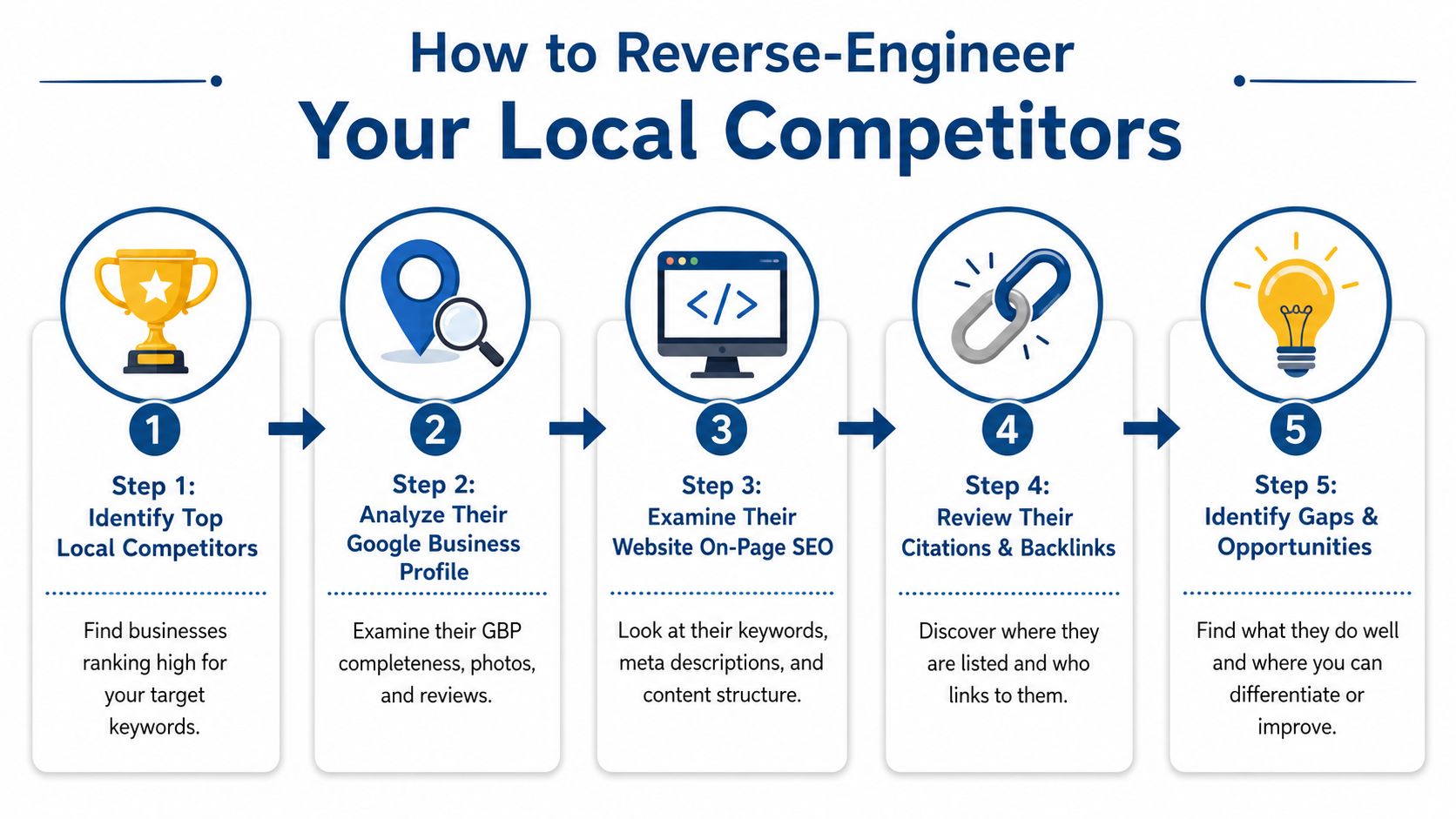
How to Reverse-Engineer Your Local Competitors
SEO gets much less mysterious when you stop treating Google like a riddle and start treating rankings like evidence. Somebody is already winning your target terms. Your task is to work out why.
That doesn't mean copying pages line for line like a lazy sixth-former. It means identifying the signals the top firms have in place, then building a better, cleaner version for your own business.
Start with the real competitors, not the obvious ones
Search your target phrase in Google and note the top three businesses that repeatedly appear in the map pack and organic results. These aren't always the firms you consider your business rivals offline.
A solicitor in Sheffield may think the competition is other long-established firms in the city centre. In search, competitors might be smaller practices with sharper location pages and tidier Google profiles.
Look at three layers
First layer. Google Business Profile
Check categories, services, reviews, photos, Q&As, and how clearly they describe the business. Are they active? Do they look trustworthy at a glance?
Second layer. Website structure
Open their key pages. Which services get dedicated pages? Which towns or districts do they target? Do their title tags and headings match the search term well? Are the pages useful?
Third layer. Off-page footprint
Look for where they're listed and mentioned. Industry directories, local associations, chambers, trade bodies, sponsorship pages, supplier pages. You're looking for patterns, not secrets.
Turn observations into an action list
Use a sheet with three columns: competitor signal, whether you have it, and how you'll improve on it.
For example:
- Competitor has a dedicated “Emergency Plumber Preston” page. Yours doesn't.
- Competitor shows recent job photos on GBP. Yours has the van outside your old office.
- Competitor appears in trusted trade directories. Your citations are patchy.
- Competitor has area pages for Chorley and Leyland with different copy. Your town pages are near clones.
That turns SEO from “we should probably do more content” into a clear work order.
Don't copy the winner's ceiling. Copy their floor, then raise your own standard above it.
If you want to see how this approach applies to firms where trust and local intent matter heavily, this page on SEO for professional services is a relevant example of the methodology in practice. The principle is the same whether you're a solicitor, surveyor, accountant, or tradesperson. Study what ranks, identify the missing pieces, and build the cleaner system.
Budgets Timelines and When to Call in The Pros
A Preston plumber can tidy title tags, add a few service pages, post on Google Business Profile for a month, then wonder why the same rival still sits above them. That usually means the easy wins are gone. The next gains come from choosing the right work, in the right order, with a budget that matches the gap.
SEO timing depends on the strength of the businesses already ranking. A small brochure site in a less competitive town can shift faster than a Sheffield solicitor competing against firms with older domains, better links, deeper content, and a steady flow of reviews. Expect progress over months, not days. The question is not “how much does SEO cost?” It is “what are the top local competitors doing that you still have not matched?”
Typical UK small business SEO budgets
| Service Level | Typical Cost (inc. VAT) | Best For |
|---|---|---|
| Basic local support | £300 to £1,200 per month | Single-location businesses needing core local visibility work |
| Broader ongoing SEO | £500 to £1,500 per month | Established small businesses needing content, audits, and page optimisation |
| Agency-level strategic support | £1,500 to £3,000 per month | SMEs needing deeper technical SEO, research, and link acquisition |
Those ranges are only useful when tied to specific fixes.
A single-location electrician with decent pages, clear services, and one target area may only need steady monthly improvements. A multi-location firm with duplicate town pages, messy citations, weak internal linking, and no enquiry tracking can burn through the same budget fast. Bad prioritisation is what wastes money, not SEO itself.
That is why I prefer a reverse-engineering approach to a generic retainer. Compare your site with the businesses already winning the map pack and local organic results. If they have stronger service pages, better review signals, fresher Google Business Profile activity, and more trusted local mentions, the budget has a job. It is there to close ranking gaps you can see.
When DIY is sensible
DIY works when the business is simple and someone will keep at it.
Usually that means one location, a short service list, and enough time each month to improve pages, request reviews, update Google Business Profile, and keep NAP details consistent in the main directories. Business owners who can write clearly, follow a checklist, and avoid publishing ten near-identical area pages can make solid progress themselves.
When it's time to bring in help
Bring in a specialist when the work gets technical, inconsistent, or expensive to get wrong.
- You have multiple locations and each one needs its own local signals, not copied pages with the place name changed.
- Your competitors are increasing the gap with better site structure, stronger content, or cleaner authority signals.
- Nobody has time to do the work every month. SEO usually stalls because it gets bumped by jobs, quotes, and client delivery.
- You need a plan based on what ranks in your patch rather than a recycled monthly task list.
- Each lead is worth real money. For solicitors, dentists, surveyors, and higher-value trades, one missed enquiry can cost more than a month of competent SEO work.
One option is DigiVisi Ltd at https://digivisi.co.uk, which works with UK service businesses using a reverse-engineering SEO method across audits, content, schema, citations, and Google Business Profile optimisation.
The sensible decision comes down to opportunity cost. If you can do the work properly and keep doing it, carry on. If SEO keeps slipping to the bottom of the list while competitors keep improving, get help before another year disappears.