Skip to content
A Saturday morning starts badly for many local businesses. A plumber checks Google before breakfast, a solicitor notices a rival appearing above them in Maps, or a salon owner sees a fresh one-star review sitting beneath yesterday's opening hours. The phone may still ring, but fewer of those calls now become conversations.
That's the practical reality of online reputation management. Your reputation isn't a decorative layer on top of marketing. It's the combination of reviews, search results, business information, customer comments and visible responses that helps a prospect decide whether to contact you. In the UK, the commercial stakes are substantial. Government research estimated that online reviews could influence about £23 billion in annual consumer spending, while 76% to 80% of consumers who used reviews before buying considered them very likely or fairly likely to be trustworthy. The UK government's research on online reviews shows why reputation has long been more than a branding exercise.
The good news is that reputation damage is usually recoverable when you treat it as a system. You need a clear way to spot problems, earn legitimate trust, improve what searchers see, measure commercial outcomes and stay firmly on the right side of UK consumer law.
Table of Contents
- The Moment a Local Reputation Starts to Cost You Calls
- What Online Reputation Management Means for a UK Service Business
- Why Reputation Now Drives Local Search and Lead Generation
- The Four-Part ORM Playbook for Small UK Service Firms
- White, Grey and Black Hat Reputation Tactics and Where the Law Draws the Line
- Measuring Reputation Like a Growth Channel, Not a Vibes Channel
- Two Local Case Examples That Show the Playbook Working
- Your 90-Day Reputation Recovery Plan and Ready-to-Use Templates
The Moment a Local Reputation Starts to Cost You Calls
A Bristol plumbing firm notices something odd on a Saturday morning. The owner's phone used to buzz steadily after local searches, especially when people needed an emergency repair. Now the call log is strangely quiet.
He opens the company's Google Business Profile and sees a 1.9-star average, followed by a cluster of recent complaints about missed appointments, unclear arrival times and one boiler repair that apparently took three visits. The owner knows the team had a difficult fortnight. He also knows one job went badly. What he hadn't realised was that every searcher could now see the pattern before speaking to anyone.
Above the map pack, competitor adverts are taking prominent space. Impressions appear to be holding steady, but the click-through rate has fallen. People still see the firm, yet fewer choose it. That's a credibility gap, not a bad review.
Practical rule: A review is written by one customer, but read by many future customers.
The owner's first instinct is understandable. He wants the reviews removed, the rating repaired immediately and the old confidence restored by Monday. None of those outcomes can be forced through a shortcut. A public argument with reviewers would make the firm look defensive, while buying positive reviews could create a far more serious problem.
The recovery starts by treating the search result as part of the sales process. Monitoring identifies what happened, thoughtful replies show accountability, genuine review requests rebuild the evidence base, and useful content gives searchers a clearer picture of the business. Measurement then connects those actions to calls and enquiries, while UK-specific controls prevent a repair effort from drifting into prohibited manipulation.
The phone hasn't stopped ringing forever. The business needs to give searchers a reason to trust it again.
What Online Reputation Management Means for a UK Service Business
Online reputation management, or ORM, is the organised process of monitoring and improving how people encounter and judge your business online. For a UK plumber, solicitor, electrician, accountant, café or salon, that includes branded searches, Google Maps, review platforms and local recommendations.
Your reputation works like the visible condition of a plumber's van. Customers notice the signwriting and whether the driver arrives looking professional. Neighbours form an impression when the van repeatedly appears on their street. Google assesses surrounding signals, including the business profile, relevance, prominence and customer feedback. You cannot control every opinion, but you can control much of the evidence surrounding it.

The assets a small firm can influence
A practical ORM programme usually covers:
- Google Business Profile: Categories, services, photographs, posts, opening information, questions and reviews.
- Third-party directories: Yell, Checkatrade, TrustATrader and Tripadvisor where they fit the business.
- Owned content: Service pages, customer stories, FAQs, policies and factual pages explaining who you are.
- Social profiles: Facebook, Instagram, LinkedIn and other profiles where customers may comment or tag the firm.
- Earned mentions: Local news, trade coverage, community pages and credible testimonials.
ORM has a different job from public relations. PR seeks attention and positive coverage, crisis communications handles a serious incident, and brand marketing shapes the business's presentation. ORM concentrates on third-party signals and search visibility that influence discovery and conversion.
It also sits apart from pay-per-click advertising, a logo refresh or a campaign to delete criticism. A truthful complaint may remain online. The appropriate response is often to resolve the underlying issue, reply calmly and demonstrate professional conduct.
For an owner checking the diary on a Monday morning, the useful test is straightforward: does the online evidence help a suitable customer choose, call and book? That makes ORM a measurable local growth system, not a branding nicety. Track the evidence customers see, the actions the firm takes and whether those actions produce enquiries.
Why Reputation Now Drives Local Search and Lead Generation
A local search result has two jobs. It must help Google identify which businesses are relevant and prominent, then help a human decide which listing deserves attention. Google describes local results through factors including relevance, distance and prominence, so a profile that accurately matches the search still needs credible public signals around it.
UK buyer behaviour makes those signals commercially important. A February 2026 Censuswide study of 3,000 nationally representative consumers found that 85% check at least one review source before buying, rising to 91% among people aged 18 to 34. The same Feefo Trust Advantage research found that 63% worry about fake reviews, 80% say fake reviews actively damage brand reputation, and purchasers trust verified reviews about twice as much as open-platform reviews.
That changes the job of a review. It isn't merely feedback for the owner or a star graphic on a website. It's evidence used during consideration. A recent, specific review about a Leeds roofer's communication can reduce uncertainty. A calm response to a complaint can reassure someone who never comments. A profile with stale photographs, unanswered questions and old reviews can make a capable business look absent.
The sensible approach is to connect reputation signals to actual behaviour rather than promise a magical ranking lift.
| Reputation signal | Impact on local ranking | Impact on conversion |
|---|---|---|
| Review relevance and detail | Helps reinforce the relationship between the business and its services. | Gives prospects evidence that the firm handles comparable jobs. |
| Review recency | Keeps the profile looking active and current. | Reduces the fear that the business used to be good but has since declined. |
| Owner responses | Shows ongoing profile activity and customer engagement. | Demonstrates how the firm behaves when a job goes wrong. |
| Verified customer feedback | Creates a more credible trust signal than anonymous praise. | Helps prospects distinguish genuine experience from manufactured enthusiasm. |
| Accurate profile information | Supports relevance for local searches. | Removes friction around calls, visits and service expectations. |
Don't assume a particular star-rating increase or response-time target will double enquiries. That kind of outcome depends on competition, service quality, location, search demand and the strength of the website. Measure the relationship between review-led visibility, profile actions and qualified enquiries instead. Reputation is now a measurable local SEO input, not a soft branding nicety.
The Four-Part ORM Playbook for Small UK Service Firms
Small firms don't need an enormous command centre. They need a repeatable routine that survives a busy day, a broken boiler and an owner who's also answering the phone.
Part one, monitor what customers can see
Start with the business name, trading name, owner name, common misspellings and high-intent phrases such as the brand plus “reviews” or “complaint”. Set up Google Alerts, check Google Business Profile notifications and search relevant directory profiles. A simple spreadsheet can record the platform, date, issue, sentiment, owner and next action.
Social listening doesn't need to become a full-time hobby. Assign one person to check alerts and public comments, then classify each item as positive, neutral, negative, inaccurate or urgent.
Owner checklist
- Find the surfaces: Google Business Profile, Yell, Checkatrade, TrustATrader, Tripadvisor where relevant, social channels and local forums.
- Record the baseline: Current rating, recent themes, unanswered reviews and inaccurate business details.
- Assign responsibility: One named person monitors, with a backup for holidays and weekends.
Part two, respond and request feedback properly
Reply to every review with a calm, human answer. Thank positive customers without turning the reply into an advert. For criticism, acknowledge the experience, avoid private details and offer a direct route to resolution.
A useful structure is: “Thank you for raising this. We're sorry the appointment didn't meet expectations. We'd like to review what happened and put it right. Please contact [name] on [channel] with your booking details.” Don't grovel theatrically, argue point by point or offer a reward for changing a review.
Ask customers for honest feedback after a completed job, not only those you predict will leave five stars. Verified-review systems matter because the Feefo research cited above found that purchasers trust verified reviews about twice as much as open platforms. Your request should make feedback easy without steering the customer towards a particular rating.
Owner checklist
- Use one neutral request: Ask for an honest review through the platform link.
- Keep the timing sensible: Send the request once the service is complete and the customer has had a fair chance to assess it.
- Close the loop: Log repeated complaints and fix the process, not just the wording.
Part three, improve the search results around the brand
Audit the first page for the business name, service areas and common reputation questions. Strengthen accurate owned assets, including service pages, staff profiles, customer stories, accreditations and clear contact information. Update Google Business Profile photographs and posts so the listing reflects the business customers will encounter.
Suppression can be legitimate when it means publishing stronger, more relevant material that gives searchers accurate context. It isn't legitimate to manufacture a network of thin satellite sites and pretend they're independent praise.
For firms collecting video testimonials, practical production guidance such as testimonial interview setup tips can help capture clear, consented customer stories without making the interview feel like a hostage situation.
Owner checklist
- Check branded results: Identify outdated, inaccurate or weak pages.
- Improve owned pages: Add factual service information, proof and internal links.
- Keep profiles consistent: Match the business name, contact details, services and areas served.
Part four, escalate proportionately
Contact the reviewer privately where a genuine resolution is possible, but keep the public reply visible and professional. Report reviews that breach platform rules, preserve screenshots and retain booking or transaction evidence. If a listing contains inaccurate personal data, consider the appropriate data-protection route. Serious defamatory material may justify specialist legal advice, including advice concerning the Defamation Act 2013.
The CMA's review-site compliance advice sets out principles covering representations, vetting, complaints, monitoring, investigations and sanctions, plus collection, moderation and publication. In other words, don't treat escalation as a furious email sent at half eleven at night.
Owner checklist
- Preserve evidence: Save the review, profile details, dates, messages and relevant transaction records.
- Choose the right route: Resolution, platform report, data complaint or legal advice each has a different purpose.
- Keep the tone factual: Escalation works better when the record is organised and unemotional.
White, Grey and Black Hat Reputation Tactics and Where the Law Draws the Line
ORM has its own version of the SEO hat spectrum. White-hat work improves the experience and makes genuine customer feedback easier to find. A Manchester dentist can ask real patients for honest reviews, explain treatments clearly, answer complaints professionally and correct inaccurate information. That's durable work because it improves both the evidence and the business behind it.
Grey-hat tactics often look clever until a platform, customer or journalist asks awkward questions. Review exchange clubs, selective funnels that hide unhappy customers, undisclosed incentives and satellite websites designed to crowd out criticism all create platform and trust risk. They may produce a tidier dashboard while making the underlying reputation less credible.
Black-hat tactics include fake reviews, paid removals, astroturfing, impersonating customers and threatening legal letters to silence truthful criticism. The UK government's fake reviews guidance states that fake reviews are banned under consumer protection law. The Digital Markets, Competition and Consumers Act gives the CMA direct enforcement powers, including fines of up to 10% of global annual turnover.
The law is not theoretical. On 26 March 2026, the CMA announced investigations into businesses suspected of breaking consumer law around online reviews under the Digital Markets, Competition and Consumers Act 2024. The CMA's online consumer reviews case information also reinforces why a business should be able to explain how it collects, checks and publishes feedback.
| ORM tactic | Hat category | Platform risk | UK legal position |
|---|---|---|---|
| Ask genuine customers for honest feedback | White hat | Low, provided the request isn't manipulated. | Permitted when feedback is genuine and the process is transparent. |
| Offer a reward only for positive reviews | Grey to black hat | Removal, account action and loss of trust. | Prohibited where the reward conceals an incentivised review or misleads consumers. |
| Create fake customer profiles | Black hat | Severe risk of removal and account sanctions. | Prohibited fake or misleading review activity. |
| Report a review that breaches platform policy | White hat | Low when evidence supports the report. | A legitimate compliance action, not a guaranteed removal route. |
| Threaten a reviewer over truthful criticism | Black hat conduct | Escalation and public backlash. | Legal advice must distinguish defamation from fair criticism. |
Before spending money, ask who writes the review, whether an incentive is disclosed, whether unhappy customers are being hidden and whether the agency contract records the process. Government guidance also says businesses remain responsible when they use a PR, marketing or SEO agency, so staff training, written procedures and contract controls matter. The CMA's guidance for businesses and agencies is a sensible starting point.
Measuring Reputation Like a Growth Channel, Not a Vibes Channel
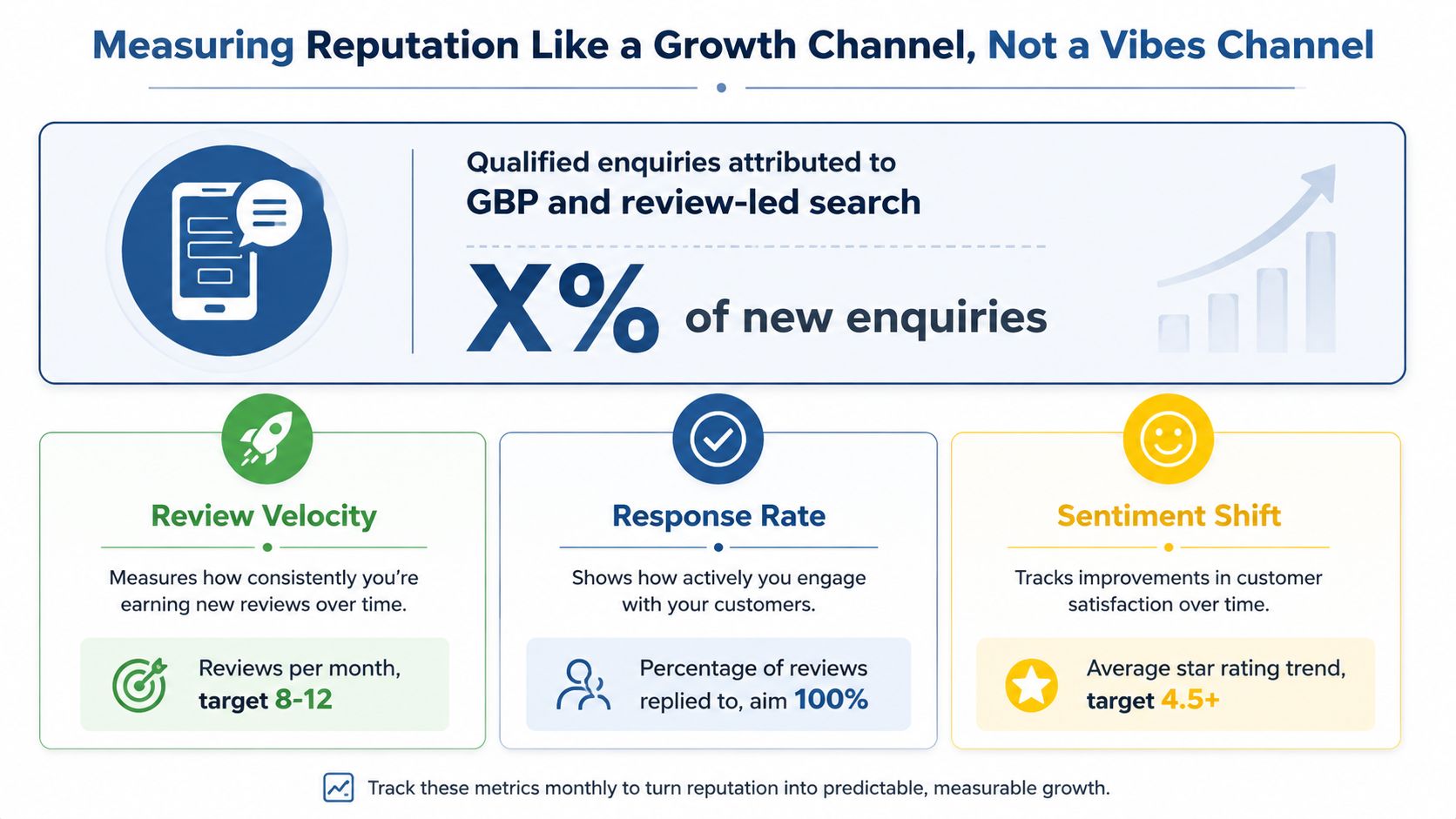
A reputation report that only says “sentiment improved” won't help a self-employed electrician decide what to do next. Start with the commercial headline: qualified enquiries attributed to Google Business Profile and review-led search. Then track the few inputs that explain whether that number is moving.
A monthly one-sheet dashboard can include:
- Weighted star rating: Record the rating by platform and location, with newer evidence considered alongside the full history.
- Review recency mix: Note whether recent feedback is arriving steadily or whether the profile has gone quiet.
- Response rate and median response time: Measure whether the business replies consistently and how long customers wait.
- Sentiment themes: Group comments around punctuality, workmanship, communication, price and aftercare.
- Branded search visibility: Check what appears for the business name, “reviews” and service-area searches.
- GBP actions: Track calls, website visits and direction requests, then compare them with qualified enquiries.
What deserves attention
Review velocity matters because a steady flow of genuine feedback keeps the profile current. Response rate matters because unanswered criticism leaves the reader with the final word. Sentiment shift matters when it reveals a repeated operational fault, such as late arrivals or confusing invoices.
Don't use a universal target as proof of success. A rural solicitor and a busy London salon have different search demand, customer journeys and competitive conditions. Set a baseline, record monthly changes and connect them to calls or forms using the information available in your analytics and booking process.
Raw five-star volume is a vanity metric if the phone still produces poor-quality leads.
The owner should be able to answer three questions at review time. Are suitable prospects finding the profile? Are they taking an action? Are those actions turning into jobs, instructions or appointments? If the answer is no, more stars alone won't solve the commercial problem.
Two Local Case Examples That Show the Playbook Working
A five-person roofing outfit in Greater Manchester received a cluster of one-star reviews after a scheduling slip. The complaints weren't identical, but several mentioned missed arrival windows and poor communication. Monitoring exposed the shared issue quickly, while the owner's instinct had been to treat each review as a separate attack.
The team checked job records, replied without blaming customers and contacted reviewers with a practical route to discuss the work. They introduced clearer appointment messages, updated the Google Business Profile with current project photographs and asked completed customers for honest feedback. The middle period was uncomfortable. After posting a public apology, the business experienced a two-week slump, partly because the response made the disruption visible before enough fresh evidence had appeared.
The recovery came through clearer call quality and steadier lead flow, not a sudden miracle. When a competitor later attempted to review-bomb the firm, the organised records and established reporting process made it easier to identify irregularities and escalate them without filling the profile with angry replies.
A three-partner Bristol family law firm faced a different problem. Its Google Business Profile had been dormant for 18 months, while a competitor appeared more active in local results. The partners felt uneasy about requesting testimonials from clients dealing with bereavement and relationship breakdown, quite reasonably.
They chose a careful approach. Solicitors asked suitable former clients whether they would voluntarily provide feedback, explained that no outcome or rating was expected, and avoided exposing confidential details. The firm refreshed service information, added professional photographs and answered reviews with discretion. Some clients declined, and that was respected.
The result was a steadier flow of relevant enquiries and clearer conversations with people who had already understood the firm's areas of work. The lesson is not that every profile will follow the same path. It's that reputation repair has awkward stages, ethical limits and operational work behind it.
Your 90-Day Reputation Recovery Plan and Ready-to-Use Templates
The first phase is days 1 to 30. Audit branded search results, review platforms, directory listings, profile categories, services, photographs and contact details. Set up monitoring, record the baseline and identify the recurring service issue behind negative feedback.
Days 31 to 60 are for consistent execution. Send neutral review requests after completed work, reply to existing reviews, improve the most important service pages and publish accurate Google Business Profile updates. For practical guidance on handling positive and negative feedback, use this guide to responding to Google reviews.
Days 61 to 90 should focus on refinement. Review enquiry quality, branded search results, response performance and complaint themes. Create a factual customer story or local trade contribution, then take a light legal and compliance pass over your review process.

Templates you can adapt
Post-job review request SMS
Hi [name], thanks for choosing [business]. We'd value your honest feedback about the service. You can share it here: [review link]. Please mention anything you think future customers should know.
One-star complaint response
Thank you for explaining what happened. We're sorry the service didn't meet expectations, particularly around [specific issue]. We'd like to review the booking and put things right where we can. Please contact [name] on [phone or email] with your job details.
Suspected fake review response
We can't match this review to a customer record, and we take the concern seriously. We've reported it through the platform's review process and would welcome the reviewer contacting us directly with the relevant booking details.
Local journalist or trade body email
Subject: Local insight on [relevant customer issue]
Hello [name], I run [business] in [area] and can offer practical insight into [issue]. We can share factual examples, explain what customers should check and provide a concise comment if useful. Kind regards, [name].
Print a checklist with one owner for monitoring, one for responses, one for review requests and one monthly reporting slot. Each task should produce an output, such as a logged mention, a published reply, a genuine review request, a corrected listing or a recorded qualified enquiry.
DigiVisi Ltd helps UK service businesses connect reputation work with local SEO, Google Business Profile visibility and qualified enquiries through audits, competitor analysis, content optimisation and transparent reporting. If your reviews are affecting calls or your profile needs a structured recovery plan, visit DigiVisi Ltd to discuss the next practical step.