Skip to content
Your phone is quiet, your website is live, and someone has promised that a new plugin will sort everything out by Friday. The homepage looks respectable, yet visitors arrive from Google, glance around, and disappear without calling, booking or completing the enquiry form. That isn't a design problem alone. It's a business performance problem.
Website optimisation services should be judged by what they do for qualified visits, usable pages, enquiries and sales. Rankings matter, but a ranking that attracts the wrong people, lands them on a slow page or hides the telephone number is not a commercial victory. The right service fixes the weakest link first, measures the effect properly and only then adds more activity.
The UK SEO and internet marketing consultancy market reached £24.6 billion in 2025-26, following five years of 6.6% compound annual growth, with 35,088 businesses counted in the sector, according to the UK SEO Industry Report 2026. That scale tells you something useful. Optimisation is no longer a niche add-on for technically minded owners. It's a mature commercial discipline, and the competition for attention is rather less polite than a queue at the post office.
Table of Contents
- What Website Optimisation Services Should Deliver
- Comparing the Main Optimisation Service Types
- Packages and Retainers Compared
- How to Evaluate a Website Optimisation Provider
- White Grey and Black Hat Boundaries
- Matching Services to Local Business Needs
- Recommended Service Bundles
- Choosing the Right Optimisation Package
What Website Optimisation Services Should Deliver
A credible optimisation programme turns website visits into calls, enquiries, bookings and sales. It doesn't stop at producing a spreadsheet of keywords or announcing that a page has moved up a ranking.
Take a Cardiff solicitor with a polished website and a quiet enquiry inbox. A useful engagement might discover that the legal service pages load slowly on mobile, the contact form asks unnecessary questions, the strongest trust signals sit below the fold, and the Google Business Profile sends visitors to a generic homepage. Fixing those issues is optimisation because each change improves a route to a commercial action.
Four outputs deserve attention
Qualified visibility comes first. The work should help the right people find the business through organic search, local listings and relevant pages. For a Manchester plumber, that means matching urgent local searches to a clear emergency plumbing page, not publishing an essay aimed at a national audience.
Usability follows. Pages need to render quickly, respond properly and remain accessible. The main field metrics are Largest Contentful Paint at 2.5 seconds or less, Interaction to Next Paint at 200 milliseconds or less, and Cumulative Layout Shift at 0.1 or less, measured at the 75th percentile among real users, as outlined in this Core Web Vitals guidance for the UK market.
Conversion paths should make the next step obvious on a phone. A visitor should see the service, understand why the firm is credible, know where it works and contact it without wrestling with a form designed by an especially gloomy committee.
Measurement must connect changes to enquiries or revenue. A report should show the baseline, the work completed, the pages affected and what happened to calls, form submissions, bookings or sales afterwards.
What should appear in the report
Expect a technical audit, keyword and search-intent mapping, content briefs, internal-link recommendations, performance fixes, accessibility remediation, Google Business Profile work and clear attribution. Accessibility deserves its own scrutiny. 48% of websites analysed in the UK were found to need accessibility improvements, according to Digital Applied's local SEO and accessibility guidance.
Practical rule: If a provider can't explain which page should generate more enquiries, how that page will change and how the change will be measured, you're buying activity rather than optimisation.
Set a baseline before work begins. Record existing rankings, organic visits, phone calls, form completions and important page performance. Without that feedback loop, even a beautifully formatted report can become a monthly museum of completed tasks.
Comparing the Main Optimisation Service Types
The six main service types solve different problems. Buying all of them at once sounds thorough, but it can leave a small firm paying for a buffet when it only needs the soup.
| Service Type | Primary Job | Typical Deliverables | Best Fit | Main Limitation |
|---|---|---|---|---|
| Technical SEO | Make the site crawlable, indexable and logically structured | Crawl audit, indexation fixes, schema, architecture recommendations | Sites losing visibility because of structural issues | Limited without useful content and credible links |
| On-page SEO | Match pages to search intent and improve relevance | Keyword research, titles, headings, internal links, content briefs | Service pages that rank poorly or attract unsuitable visitors | Weak if the site is slow or the offer is unclear |
| Conversion rate optimisation | Turn existing visits into more enquiries or sales | User testing, heatmaps, landing-page changes, form improvements | Sites with traffic but weak enquiry rates | Limited when traffic is the real bottleneck |
| Speed and Core Web Vitals | Reduce friction during loading and interaction | Hosting, caching, image and code optimisation, performance budgets | Mobile-heavy service sites | A fast page with a weak offer still won't sell |
| Accessibility | Make the experience usable for more people | WCAG audit, alt text, contrast, keyboard navigation, captions | Businesses improving inclusive access and reducing compliance risk | Limited commercial lift when treated in isolation |
| Local SEO | Improve visibility for nearby searches and map results | Google Business Profile, citations, reviews, local content | Trades, restaurants and firms with a defined catchment | Weak if the website doesn't support local relevance |
Technical SEO is the plumbing. It deals with crawling, indexing, redirects, duplicate pages, structured data and the way sections connect. It should produce a prioritised fix list, not a ceremonial audit that sits untouched in a folder.
On-page SEO handles the meaning and usefulness of individual pages. A Bristol accountant may need separate pages for self-assessment, small-business accounts and payroll rather than one vague “services” page. The work should map each page to a real query and a clear next step.
Conversion optimisation examines what visitors do after arriving. Heatmaps can show where people stop scrolling, while user testing can reveal that the form asks for a company registration number before anyone has established trust. Good CRO removes hesitation, not merely changes button colours because somebody enjoys buttons.
Speed work covers hosting, caching, image compression, scripts and rendering. The UK-focused benchmark source Cloudswitched's Core Web Vitals report describes average performance around 3.2 seconds LCP and 0.18 CLS, while top-10% sites reach about 1.8 seconds LCP and 0.05 CLS. Treat those as a competitive performance reference, not a magic guarantee.
Accessibility includes readable contrast, descriptive alternative text, keyboard access and properly labelled forms. It helps customers who use assistive technology and often improves the experience for everyone else too.
Local SEO connects the website with the business profile, service area, reviews and local references. Google local visibility is mainly shaped by relevance, distance and prominence, with prominence influenced by links and reviews, as explained in this UK local SEO guide. For businesses preparing content for modern search interfaces, these AI-friendly site architecture tips are useful because clear page relationships help both people and search systems understand the site.
Packages and Retainers Compared
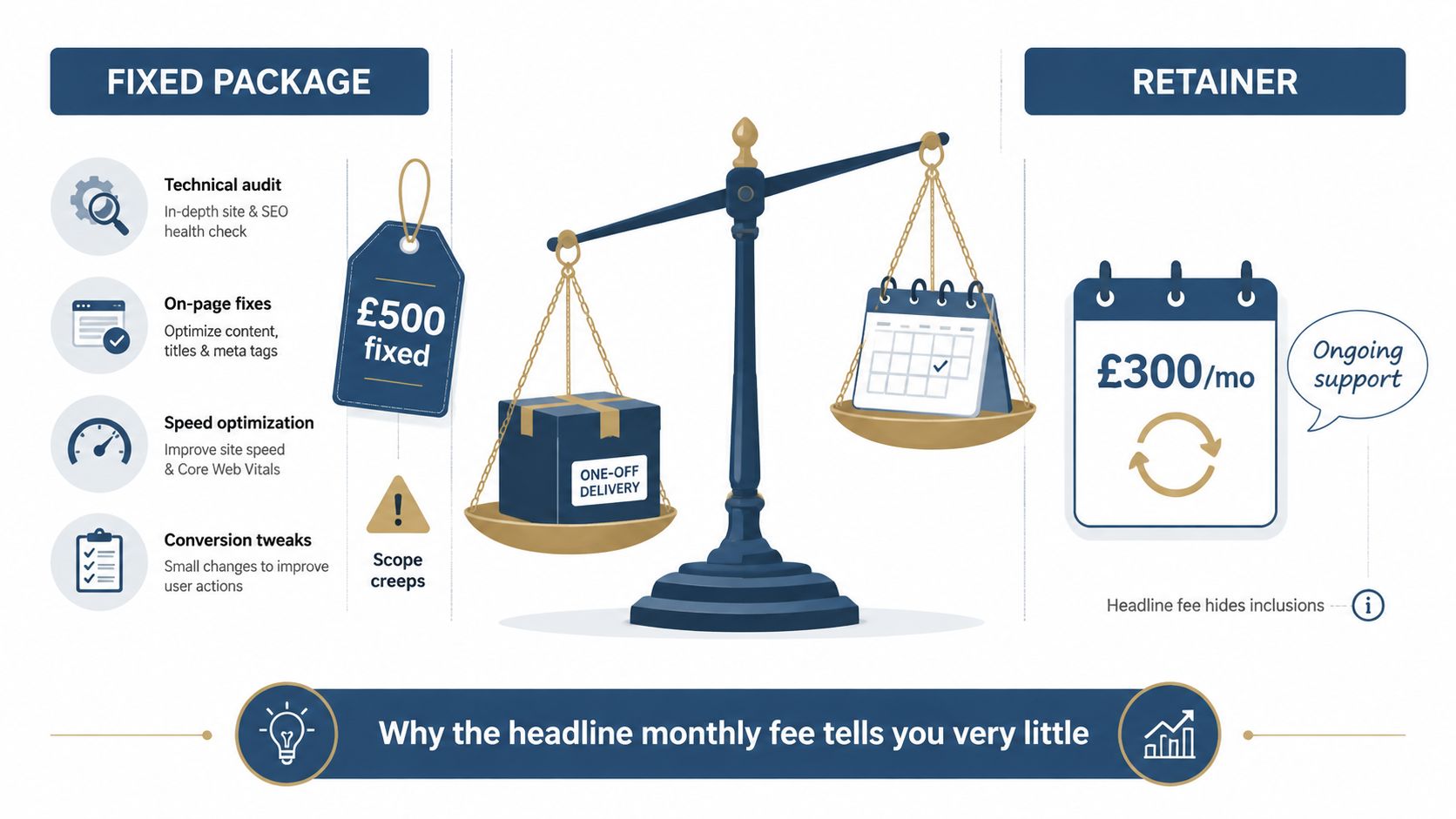
The headline fee tells you very little. A fixed package might include a technical audit, speed fixes and on-page work for one defined project. A local package might cover the Google Business Profile, citations and review processes. You know the boundary, which makes budgeting easier, but the boundary can become a fence around useful follow-up work.
A retainer reserves capacity each month. That capacity might fund content production, technical maintenance, link earning, conversion testing and reporting. It suits a site that needs continuous improvement, but only when the provider explains what the time produces. “Strategy” is not a deliverable, however attractive the presentation deck looks.
Compare the working model
| Question | Fixed package | Monthly retainer |
|---|---|---|
| Scope | Defined tasks and outputs | Ongoing capacity and priorities |
| Cost control | Predictable for the agreed work | Predictable monthly payment, variable activity |
| Best use | Foundation work or a focused repair | Continuous content, CRO and technical improvement |
| Main risk | Scope creep and change requests | Paying for time without meaningful outputs |
| Reporting | Project milestones | Recurring performance and activity reporting |
| Exit terms | Usually ends after delivery | Must be clear before commitment |
Read proposals by dividing the fee by the hours, tasks and named outputs committed. Don't divide it by the number of buzzwords. Ask whether content approvals, development time, tracking, revisions and reporting are included. A package can be excellent value when the problem is clear. A retainer can be wasteful when nobody has established what success looks like.
A hybrid approach often works well. Start with a fixed-scope foundation, then use a lightweight maintenance retainer once the site has a clean technical base and reliable tracking. Businesses planning to address AI visibility can also find useful commercial framing in GetIntel's guidance on packaging AI visibility as an agency service.
For a direct comparison of UK package structures, review this SEO package guide for UK businesses, then ask any supplier to map its inclusions against your actual funnel.
How to Evaluate a Website Optimisation Provider
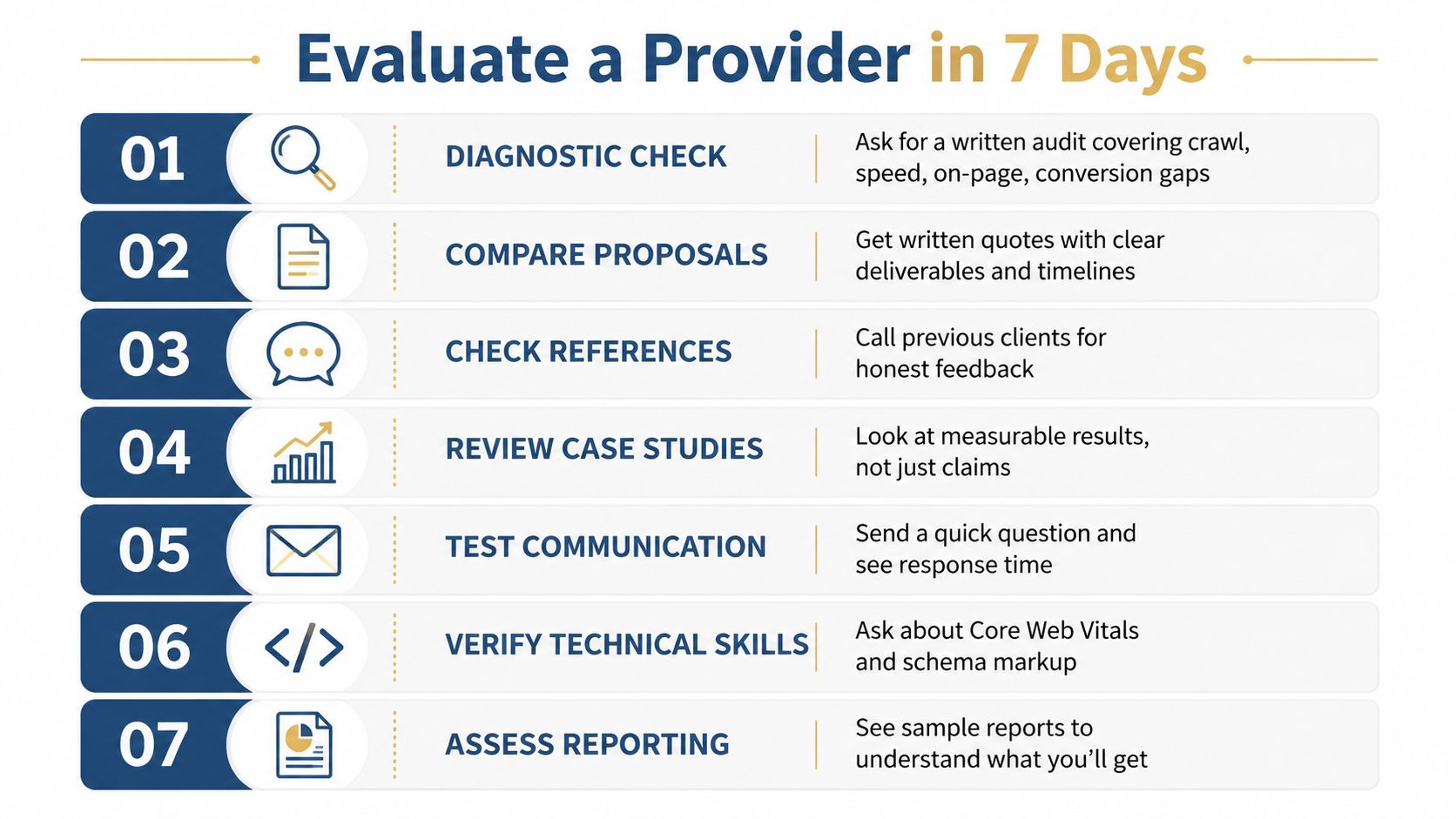
You can complete sensible due diligence in a week. You don't need to become an SEO technician. You need to test whether the provider understands your business, can name the work and will explain what happened afterwards.
Start with diagnosis
Ask for a written audit covering crawlability, indexation, page speed, on-page relevance, accessibility and conversion friction. Compare the findings with the sales conversation. If the salesperson promised local lead growth but the audit contains only generic title-tag comments, the service has already shown you its priorities.
Request a proposal with named deliverables, owners and timing. “Improve content” isn't specific enough. “Rewrite the emergency plumbing page, add internal links from the boiler and leak pages, implement service schema and measure calls from organic landing sessions” is specific enough to discuss.
Test methods and communication
Ask how the team earns links and handles local authority. White-hat work uses useful content, genuine outreach, accurate business information and technically sound implementation. Offshore link farms, automated directory blasts and suspiciously perfect anchor text deserve a firm no.
Send a practical question before signing. Notice whether the answer is clear, prompt and written for a business owner rather than for a robot wearing a lanyard. Ask who will explain the report and whether a senior person reviews priorities.
Score the commercial fit
A good provider will discuss leads, calls, bookings and sales alongside rankings. It should explain which metrics are leading indicators and which represent actual business outcomes. Progress normally needs months rather than days, particularly when new content, local authority and customer behaviour all play a role.
Copy this checklist into a spreadsheet:
- Written audit: Does it cover technical, content, speed and conversion gaps?
- Named outputs: Can you count the pages, fixes, tests and reports?
- Sound methods: Are links earned ethically and technical changes explained?
- Communication: Is there a named contact who can discuss priorities?
- Measurement: Are calls, enquiries or sales included in the reporting?
- Expectations: Does the timeline reflect real search competition?
- Exit terms: Can you leave without losing access to your website and data?
A provider that welcomes these questions is easier to manage. A provider that treats them as an insult may be confusing secrecy with expertise.
White Grey and Black Hat Boundaries
The quickest tactic in a sales call is rarely the safest tactic for a local brand. A plumber, solicitor or independent clinic has more to lose from damaged trust than a disposable affiliate website does.
White-hat optimisation works with search-engine guidelines and customer expectations. Examples include fixing indexation, improving internal links, writing useful local service content, implementing accurate schema and earning editorial mentions through real relationships.
Grey-hat work pushes the rules without always looking outrageous on day one. A provider might suggest buying aged domains for links, manipulating anchor text aggressively or showing different landing pages to search engines and users. Those tactics can produce movement, but they create an asset you don't fully control.
Black-hat SEO uses deliberate deception or manipulation. Paid link networks, hidden text and doorway pages sit firmly in this category. Google defines link spam as links created primarily to manipulate rankings and includes buying or selling links, exchanging goods or services for links, excessive reciprocal linking and automated link creation among its examples in this UK local SEO guidance on link practices.
| Category | Common Tactics | Risk to a Local Business |
|---|---|---|
| White hat | Technical fixes, useful content, accurate schema, genuine outreach | Usually sustainable when implemented well |
| Grey hat | Aged-domain links, aggressive anchor manipulation, cloaking | Unstable visibility and reputational exposure |
| Black hat | Link networks, hidden text, doorway pages | Penalties, lost trust and difficult recovery |
If a tactic needs to be hidden from you, it isn't a sensible foundation for your business.
A manual action or algorithm change can leave a local firm explaining why its pages vanished while competitors receive the calls. Sustainable optimisation may feel less dramatic, but it builds an asset you can keep using.
Matching Services to Local Business Needs
A sole-trader plumber doesn't need the same programme as a multi-location professional firm. The sensible starting point is the weakest part of the customer journey, not the longest list of services available.
A plumber who relies on word of mouth should begin with local SEO, mobile usability and speed. The Google Business Profile needs accurate services, opening information, photographs and a clear route to call. The website needs a focused emergency page, visible phone details and fast loading. A national content campaign can wait. Buying links from unrelated sites can wait indefinitely.
A home services firm with three vans has a wider catchment and more operational capacity. A bundle covering local SEO, conversion improvements and performance work makes sense because the firm can handle more enquiries. Separate service and area pages can support relevance, provided each page offers useful information rather than a town name swapped into the same paragraph.
A professional services firm, such as a Bristol solicitor, normally benefits from strong service pages and conversion optimisation before chasing map-pack visibility. Longer decisions require clear explanations, credible team information, useful FAQs and a reassuring enquiry process. A redesign that makes the site look modern but buries expertise beneath decorative animations is money spent on theatre.
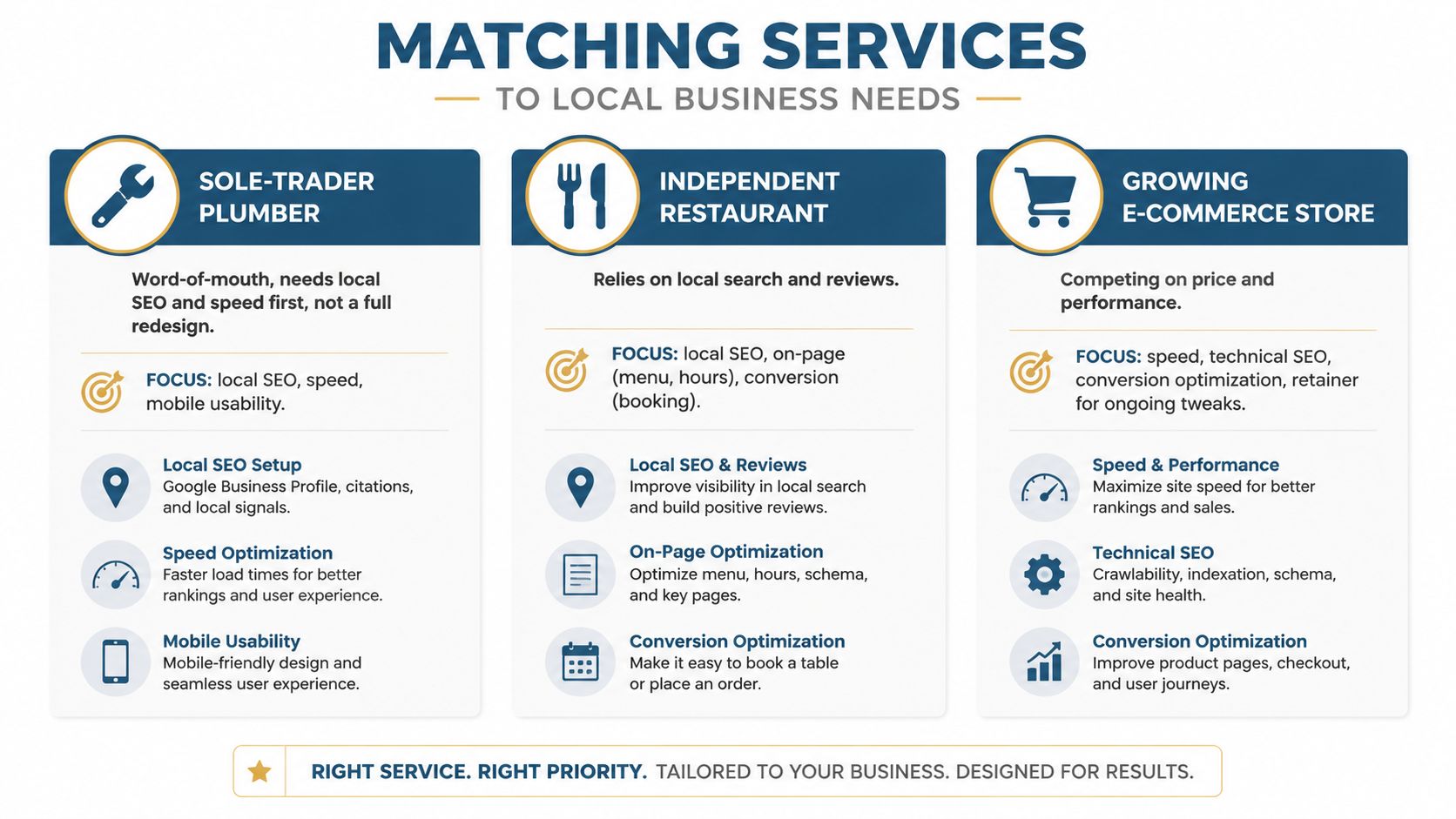
A multi-location SME needs a technical and accessibility foundation first, followed by local work for each branch. That means consistent business details, distinct location information and conversion paths that help a customer contact the correct office. Duplicating thin pages for every town is not a local strategy. It's a content photocopier.
Restaurants need local discovery, accurate menus and opening details, reviews and a frictionless booking route. A growing ecommerce shop usually needs speed, technical SEO and conversion testing because product discovery, category structure and checkout usability all interact. Owners developing repeatable content ideas can browse these prompt collections for local brands, but prompts still need human judgement. No customer has ever praised a restaurant because its content sounded efficiently generated.
Recommended Service Bundles
The most useful bundles are built around business outcomes, not a bag of fashionable nouns. Start with the repair required today, then add growth work when the foundation can support it.
| Bundle | Core Deliverables | Best For | Indicative Monthly Investment |
|---|---|---|---|
| Foundation | Technical audit, prioritised fixes, speed improvements, on-page essentials, baseline tracking | New, neglected or structurally weak sites | Fixed-scope project, followed by optional maintenance |
| Growth | Foundation maintenance, local SEO, CRO, structured content, internal linking and conversion reporting | Businesses receiving visibility but losing enquiries | Monthly retainer sized to agreed outputs |
| Market Leader | Authority building, advanced schema, accessibility audits, ongoing CRO experiments, content and technical development | Established firms defending share across competitive locations | Ongoing strategic retainer |
Foundation
The Foundation bundle should make the site clean, fast, indexable and understandable. Deliverables include a crawl and indexation audit, priority technical fixes, Core Web Vitals work, page-title and heading improvements, internal-link planning and tracking for calls and forms.
Use it for a small firm whose website has accumulated years of edits without a proper plan. The engagement should be a defined project, with a clear list of what will be fixed and what remains outside scope. Measure technical health, relevant visibility and the quality of enquiries rather than celebrating a completed ticket list.
Growth
Growth adds local SEO, conversion rate optimisation and structured content. A Manchester electrician with steady search visibility but inconsistent calls may need stronger service pages, a better Google Business Profile, clearer trust signals and a shorter mobile enquiry path.
The engagement should run as an ongoing retainer because the team needs to learn from search data and customer behaviour. Reports should connect page changes and local activity to calls, forms, bookings and sales wherever tracking permits.
Market Leader
Market Leader is for an established firm with a solid foundation and meaningful competition. It can include authority building, advanced schema, accessibility audits and ongoing CRO experimentation, alongside technical maintenance and content.
For a transparent UK option, DigiVisi Ltd offers Foundations, Authority and Market Leader packages that combine audits, keyword and competitor research, service-page optimisation, internal linking, schema, citations and reporting, with monthly billing from £360 including VAT and no contracts, as described in the publisher information. The commercial logic is straightforward: fixed-scope foundations first, then growth retainers tied to enquiry and revenue metrics where the measurement supports it.
Choosing the Right Optimisation Package
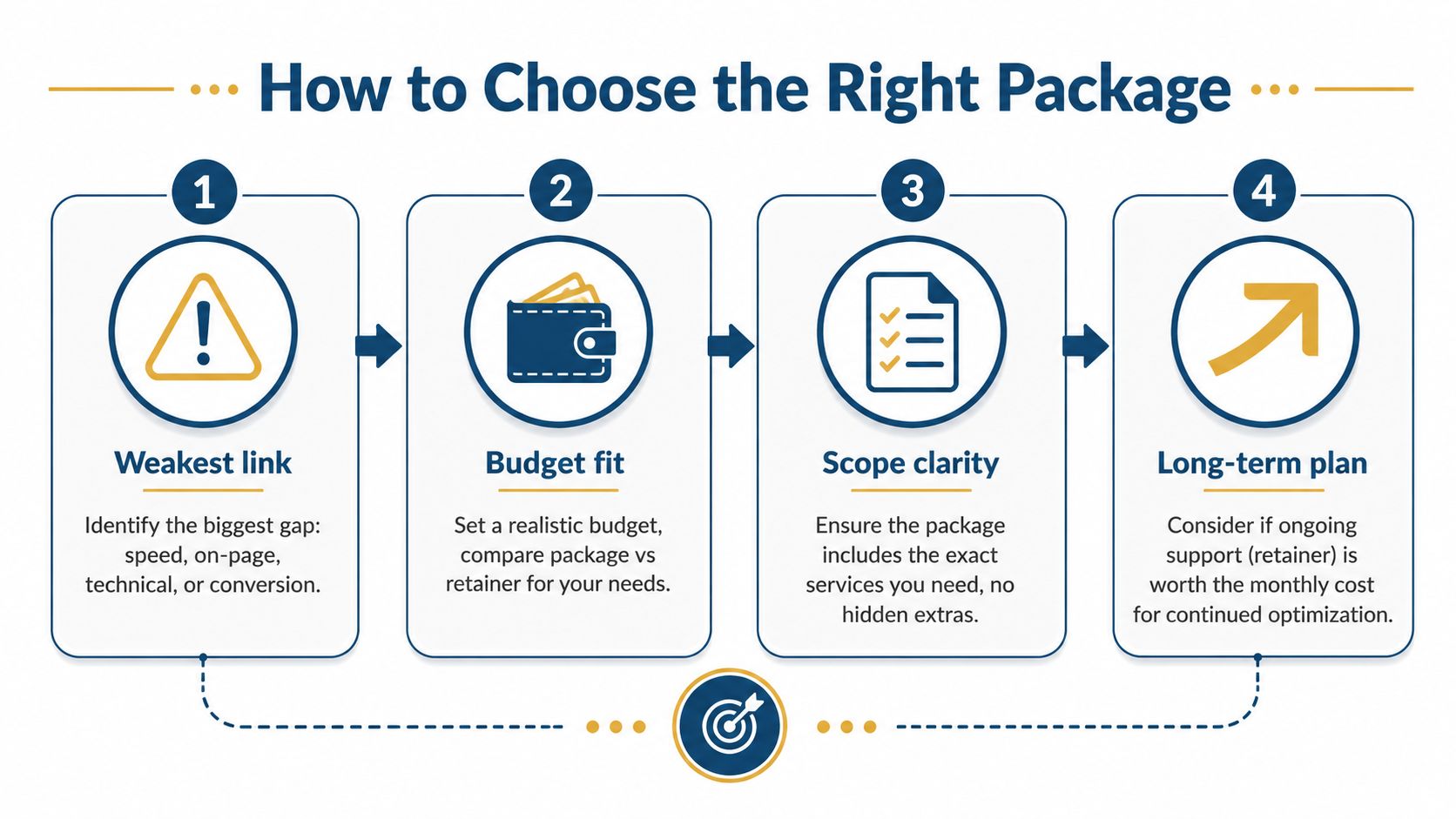
Choose the package by finding the weakest link in your funnel.
First, decide whether the main problem is visibility, speed, unclear service pages, local discovery or conversion friction. Next, select one commercial outcome, such as more qualified calls or completed enquiries, rather than attempting to improve every dashboard at once.
Match that outcome to the service type and tier. A new site with technical problems needs Foundation work. A visible site that loses visitors before contact needs Growth activity. A strong, established firm can justify Market Leader support once tracking and fundamentals are reliable.
Then vet the provider against the audit, deliverables, methods, communication, measurement, expectations and exit criteria already outlined. The cheapest package offering every service is rarely good value. The most expensive retainer only makes sense when the foundations are sound and the team can show what the monthly work is intended to change.
Judge optimisation by incremental calls, enquiries and sales, not by vanity traffic or a colourful rankings chart. Start with the smallest bundle that addresses the weakest link, measure the result properly and scale only when the evidence earns the next investment.
DigiVisi Ltd provides fixed-scope SEO foundations, service-page optimisation, technical audits, local SEO, Google Business Profile work and conversion-focused retainers for UK small businesses. Visit DigiVisi Ltd to discuss the website problem that is costing you enquiries and choose a practical route towards better visibility and more useful customer action.