Skip to content
A Cardiff café owner checks the phone after a quiet morning and discovers the problem isn't the coffee, the menu or the weather. One directory shows the café's address in one format, another uses a different version, and an old listing points customers towards the wrong side of town. Calls go astray, delivery drivers ring competitors, and potential visitors give up. Online directories can be a bit like a village noticeboard after a gale, with half the papers stuck on upside down.
That's where a citation cleanup service earns its keep. It finds conflicting business details, removes or resolves duplicate listings, and creates a dependable version of your business identity across the UK platforms customers and search engines use. The work looks administrative on the surface, but it can protect enquiries, directions and local visibility.
Table of Contents
- Facing Citation Chaos
- Understanding Citation Cleanup Service
- Why Cleanup Matters for Local SEO
- Typical Citation Cleanup Process
- Benefits and Pricing Expectations
- How to Choose a Citation Cleanup Service
- Case Study Showing Real Results
- Making Cleanup Part of Your SEO Strategy
Facing Citation Chaos
The Cardiff café had one real premises, one public phone number and one perfectly decent website. Online, however, its identity had splintered. A directory displayed the street name in full, another abbreviated it, and an old profile retained a previous phone number. None of those errors looked dramatic in isolation. Together, they created uncertainty for people trying to decide whether they'd found the right café.
A customer searching on a mobile might tap the wrong listing, call a disconnected number or follow directions to an outdated location. Another might see conflicting information and choose a café that appears easier to trust. The owner can't solve that problem by adding yet another listing. More entries would give the confusion extra places to breed.
Practical rule: Treat every old listing as business data that needs an owner, not as harmless internet clutter.
A proper cleanup begins by finding the variations customers may encounter. It then establishes the correct business name, address, phone number and website details, before correcting the most influential profiles and working through the rest. For a café, that may mean repairing map information and local directories. For a solicitor, electrician or florist, it may also mean tracking old trading names and former premises.
The Cardiff café's lesson is straightforward. Local visibility depends on dependable information, and dependable information requires more than creating a profile and hoping the internet tidies itself.
Understanding Citation Cleanup Service
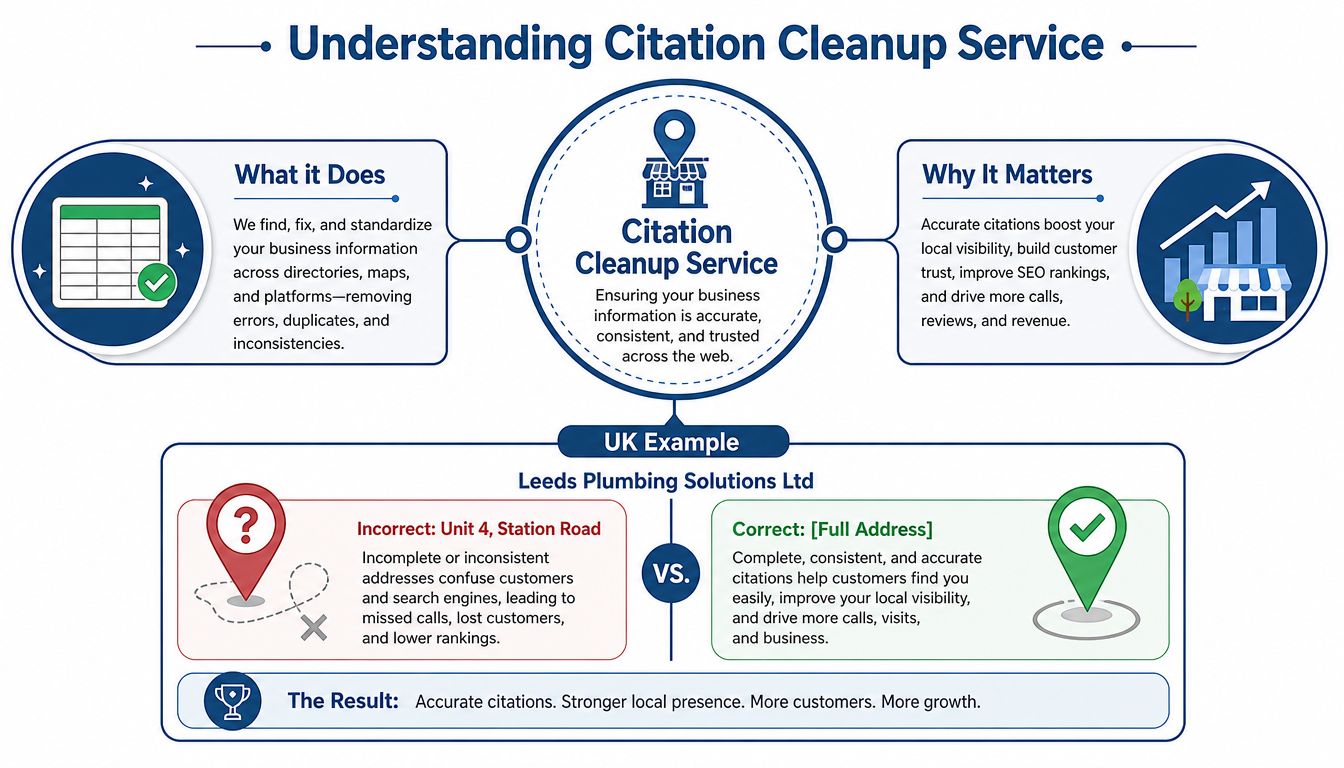
A local citation is an online mention of a business's Name, Address and Phone number, commonly shortened to NAP. UK guidance treats a citation as stronger when those details agree across the business website, Google Business Profile and major directories. One practical recommendation is to choose a canonical NAP format and use it consistently, because small variations can create data drift and weaken trust signals, as explained in this UK local SEO guide to consistent NAP details.
Take a Leeds plumbing firm. Its address appears as “Unit 4, Station Road” on one listing and “4 Station Rd” on another. A cleanup service doesn't merely copy both versions into a spreadsheet and call it a day. It confirms the preferred format, checks which entry reflects the physical premises, then updates the important profiles and records what happened.
What the work includes
A sound process usually covers:
- Discovery: Find existing listings, missing profiles, duplicate records, former names and outdated addresses.
- Standardisation: Agree the canonical business details before making edits.
- Correction: Update priority platforms and legitimate directories.
- Duplicate handling: Request merges, closures or removals where more than one profile represents the same business.
- Record keeping: Note the listing URL, correction made, status and any platform response.
The ethical distinction matters. White-hat cleanup corrects genuine information on legitimate listings, such as a Birmingham solicitor replacing a mismatched phone number. Grey-hat tactics sit in an uncertain area and may involve manipulative formatting or aggressive practices. Black-hat behaviour includes keyword stuffing in a business name or manufacturing fake listings to influence rankings, which can lead to suspension or other search-engine problems, as outlined in this guide to white-hat, grey-hat and black-hat SEO.
A citation cleanup service should make your business easier to identify, not try to disguise it.
Why Cleanup Matters for Local SEO
Consistent citations help search engines connect different online references to the same real-world business. When the name, address or phone number changes from platform to platform, that connection becomes harder to interpret. Customers face the same uncertainty, particularly when they're searching for a nearby electrician, salon or café and need accurate directions quickly.
The strongest argument for cleanup is operational, not mystical. Independent research covering 115,000 business locations across the US, UK, Germany and France found that listings management affected Google Local Pack visibility and customer actions including directions, calls and clicks, according to the Moz listings management study. That makes citation work a measurable local-search lever rather than a directory housekeeping exercise.
Signs your profile may be fragmented
Look for practical clues:
- Google Business Profile displays an address that differs from your website.
- Customers mention calling an old number.
- Map directions lead to a former premises.
- Several listings use different business names.
- A rebrand left the old trading name live online.
- A duplicate profile competes with the profile you actively manage.
These problems can affect conversion even when rankings appear unchanged. A person who reaches a disconnected number won't become a customer just because your listing appeared in a prominent position. For businesses using Google Local Services Ads, it's also sensible to understand the relationship between missed calls and lead performance through this practical resource on how missed calls hurt Google LSA rank.
Citation cleanup won't replace useful service pages, a well-managed Google Business Profile, relevant local links or accurate schema. It removes avoidable friction so those wider efforts have a cleaner foundation.
Typical Citation Cleanup Process
A UK-focused workflow should move from discovery to authority, then from authority to the wider directory ecosystem. Rushing straight into submissions is tempting, especially when a spreadsheet is staring at you like an overdue council form, but it can spread the wrong details further.
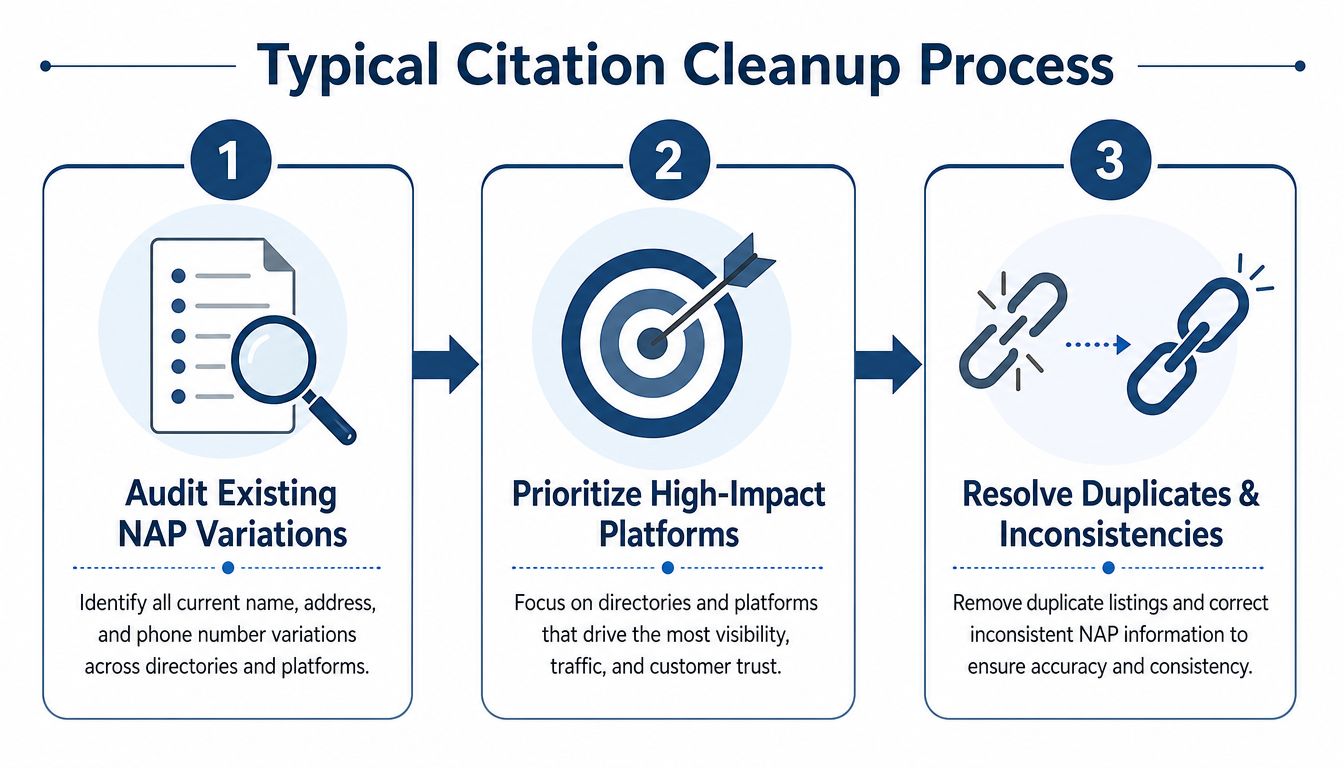
Start with a complete audit
Collect every known variation of the business identity. Include current and former addresses, old phone numbers, trading names, website versions, category choices and duplicate profiles. A multi-location SME should audit each branch separately, because one location may have inherited data from another.
Mark each record as accurate, inconsistent, duplicate, outdated or uncertain. Don't delete an old listing only because it looks untidy. First establish whether it represents the same business, a former premises or an entirely separate company.
Fix the authoritative sources first
Correct the business website NAP and Google Business Profile before spending time on smaller directories. A UK-focused cleanup workflow prioritises duplicate Google Business Profile resolution because conflicting profiles can fragment local trust signals. The same approach then moves through Bing Places and Apple Maps, followed by major UK directories.
For a Bristol electrician or Cardiff hair salon, the practical order includes:
- Website and Google Business Profile: Establish the version customers should trust.
- Bing Places and Apple Maps: Align other prominent map ecosystems.
- Major UK directories: Review Yell, Thomson Local, Yelp UK, 192.com, FreeIndex and Scoot.
- Additional recognised sources: Work through relevant records rather than chasing every obscure directory.
You can use this Google Business Profile audit resource to structure the first review.
Resolve, document and verify
A duplicate may need a merge request, a closure request or evidence that the profile has moved. An old trading name may require a carefully managed update rather than an abrupt replacement. A relocated business may need the former address closed while the new listing is verified.
Keep a change log with the platform, profile URL, issue, action, date and outcome. Recheck the records after updates, because some directories review edits manually and others may restore old information from their own data sources.
This video offers a visual companion to the workflow. It sits after the practical sequence so you can compare the explanation with the process before watching.
Benefits and Pricing Expectations
The value of cleanup usually appears in practical moments. A customer reaches the correct premises, a call arrives at the right number, and a map profile no longer competes with an obsolete duplicate. Those outcomes support local visibility, but they also improve the basic customer journey.
Don't judge a service by how many directories it promises to touch. Modern UK local SEO increasingly treats citation cleanup as one part of a broader visibility stack, alongside Google Business Profile optimisation, local links, schema, reporting and work intended to improve conversion and AI visibility, as reflected in this UK local SEO service overview. Consistency and relevance matter more than collecting directory badges like a digital Brownie leader.
What you're paying for
A useful quote should make the scope clear:
| Service component | What it should cover |
|---|---|
| Audit | Existing listings, NAP variations, duplicates and outdated records |
| Priority corrections | Website, Google Business Profile, Bing Places and Apple Maps |
| UK directory work | Relevant platforms such as Yell, Thomson Local, Yelp UK, 192.com, FreeIndex and Scoot |
| Legacy handling | Former names, moved premises, duplicate suppression and evidence requests |
| Reporting | URLs reviewed, changes made, unresolved issues and next actions |
Pricing varies with the number of locations, the volume of legacy data and the amount of platform follow-up required. A single-location café with one old phone number is a different project from a professional firm with several branches, former premises and multiple trading names.
DIY can work when the business has a clear canonical NAP and only a modest number of listings to review. Professional support becomes more useful when nobody knows which profiles exist, when duplicates keep returning, or when branch-level governance matters. Ask for a defined audit, not a vague promise of “more citations”, and compare the work against the value of accurate calls, directions and enquiries.
How to Choose a Citation Cleanup Service
Choose the process before you choose the polish. A smart-looking report won't help if it ignores a duplicate Google Business Profile or leaves an old address active on a prominent directory.
Questions worth asking
- Which UK platforms do you audit? Look for Google Business Profile, Bing Places, Apple Maps and relevant UK directories, not an unexplained list of low-value submissions.
- How do you confirm the canonical NAP? You should approve the exact business name, address, phone and website format before edits begin.
- How do you handle duplicates? Ask whether the service requests merges, closures or removals, and how it documents unresolved cases.
- What happens after a move or rebrand? The answer should cover former premises, old trading names and legacy profiles, not just spelling corrections.
- What will the report show? Expect listing URLs, error categories, actions taken and items that still need platform intervention.
- Is the method white hat? Legitimate corrections are sensible. Keyword-stuffed business names and fabricated listings are not.
A provider should also explain what it won't change without permission. Categories, business names and addresses can affect profile integrity, so casual edits are a warning sign.
Red flags in a proposal
Be cautious when a supplier focuses on raw citation volume, guarantees a ranking position or refuses to show the platforms included. The same applies to work that creates profiles for businesses that don't operate at the stated location.
A useful test: If the method would look misleading to a customer reading the listing, it's probably poor SEO too.
Ask how the service separates branches, records approvals and protects the live business profile. A reliable operator will talk comfortably about evidence, platform policies and unresolved edge cases. Legacy cleanup is data governance with a local-search outcome, not a quick spellcheck across the web.
Case Study Showing Real Results
The multi-location florist in this example had listings spread across 30 recognised UK sources, including platforms such as Google Business Profile, Bing Places, Apple Maps, Yell, Yelp UK, Thomson Local, Scoot, FreeIndex, Cylex-UK and 192.com, all identified as important citation sources in Whitespark's UK citation list. The challenge wasn't a lack of profiles. It was the lack of one reliable system for managing them.
One branch used a former trading name, another retained an old phone number, and several entries showed inconsistent address formatting. The team first established the canonical details, then reviewed duplicates and worked through the highest-value platforms before addressing the remaining records.

The important lesson isn't a dramatic before-and-after claim. It's the operating model. A florist with several branches needs a living register of approved names, addresses, phone numbers, websites and profile owners. Without that register, the next rebrand, move or staff change can recreate the same mess.
For a growing business, citation governance prevents yesterday's information from becoming tomorrow's customer-service problem.
Making Cleanup Part of Your SEO Strategy
Citation cleanup works best as an ongoing control, not a one-off spring clean. Review listings when you move, rebrand, change phone numbers, open branches or discover a duplicate profile. Keep the canonical NAP in your internal records, align the website and Google Business Profile first, then monitor important UK directories.
Used alongside useful local pages, profile optimisation, technical SEO and conversion tracking, clean citations make it easier for customers to find and contact the right business. Ignore them, and the internet may continue telling several slightly different stories about you.
DigiVisi Ltd can audit and correct inconsistent, incomplete or missing NAPW details across relevant business, industry and market directories as part of its local SEO work. Visit DigiVisi Ltd to discuss a citation cleanup approach that fits your locations, legacy listings and wider search strategy.