Skip to content


Typical UK SEO retainers for small service businesses in 2026 sit roughly between £300 and £1,200 per month for local work and £1,500 to £3,000 per month for growing SMEs, with hourly rates from £75 to £250. The right price for SEO services depends on the labour required to beat your competitors, not on the fanciest package name in a sales deck.
You're probably looking at three quotes that seem to describe the same thing. One promises “complete visibility” for a few hundred pounds, another wants several thousand, and the third includes enough marketing language to make a plumber reach for the kettle. The difference usually comes down to what somebody will do each month, how difficult your market is, and whether the work follows Google's rules.
A Leeds plumber competing with established local firms needs a different campaign from a solicitor with offices across the South East. This guide gives you a practical UK benchmark, shows what each price band tends to deliver, and explains where cheap SEO cuts corners.
Table of Contents
- What UK Small Businesses Actually Pay for SEO in 2026
- Hourly, Monthly Retainer or Project-Based Pricing Explained
- Typical UK SEO Price Bands by Campaign Type
- What You Get at Different Price Points
- White Hat, Grey Hat and Black Hat SEO and Why Price Hides the Difference
- Realistic ROI Examples for Local UK Service Businesses
- How to Compare SEO Providers and What to Budget
What UK Small Businesses Actually Pay for SEO in 2026
A plumber comparing SEO proposals often sees wildly different figures for apparently similar work. One quote may cover Google Business Profile improvements and local citations. Another may include technical fixes, service pages, content and link acquisition. The invoice alone won't tell you which one has understood the ranking problem.
For a single-location local service business, the practical UK benchmark is about £300 to £1,200 per month. Local or startup campaigns commonly sit in this range, while growing SMEs often budget £1,500 to £3,000 per month for broader technical SEO, content and regional targeting. These ranges are reported in UK pricing guidance from White Hat SEO's SEO package pricing guide.
Hourly consulting commonly falls between £75 and £250, with more senior specialists reaching £300 to £600 per hour, according to the UK digital services pricing benchmark. A defined project for a small site, such as an audit, migration or focused technical overhaul, usually lands around £1,000 to £5,000, depending on scope.
| Pricing Model | Typical UK Range | Best For |
|---|---|---|
| Local monthly retainer | £300 to £1,200 per month | Single-location trades and professional firms |
| Growing SME retainer | £1,500 to £3,000 per month | Broader regional growth and content |
| Hourly consulting | £75 to £250 per hour | Audits, advice and one-off fixes |
| Small-site project | £1,000 to £5,000 | Defined audits, migrations or technical work |
These are guideposts, not guarantees. Location count, niche competition and website condition push the price up or down. A local electrician with a sound website may need focused GBP work, citations and service-page optimisation. A solicitor with several offices may need location landing pages, internal-linking work, technical development and a much wider content plan.
Practical rule: Ask what hours, deliverables and decisions sit behind the fee. “SEO package” isn't a scope of work.
The broader market reflects the same segmentation. Independent UK benchmarks place local SEO around £300 to £800 per month, national SEO at £1,000 to £2,000, mid-market campaigns at £2,500 to £5,000, and e-commerce work at £2,000 to £6,000 or more, as outlined in the UK marketing cost index. The price rises because the ranking problem gets harder, not because the provider has discovered a secret button marked “rank higher”.
Hourly, Monthly Retainer or Project-Based Pricing Explained
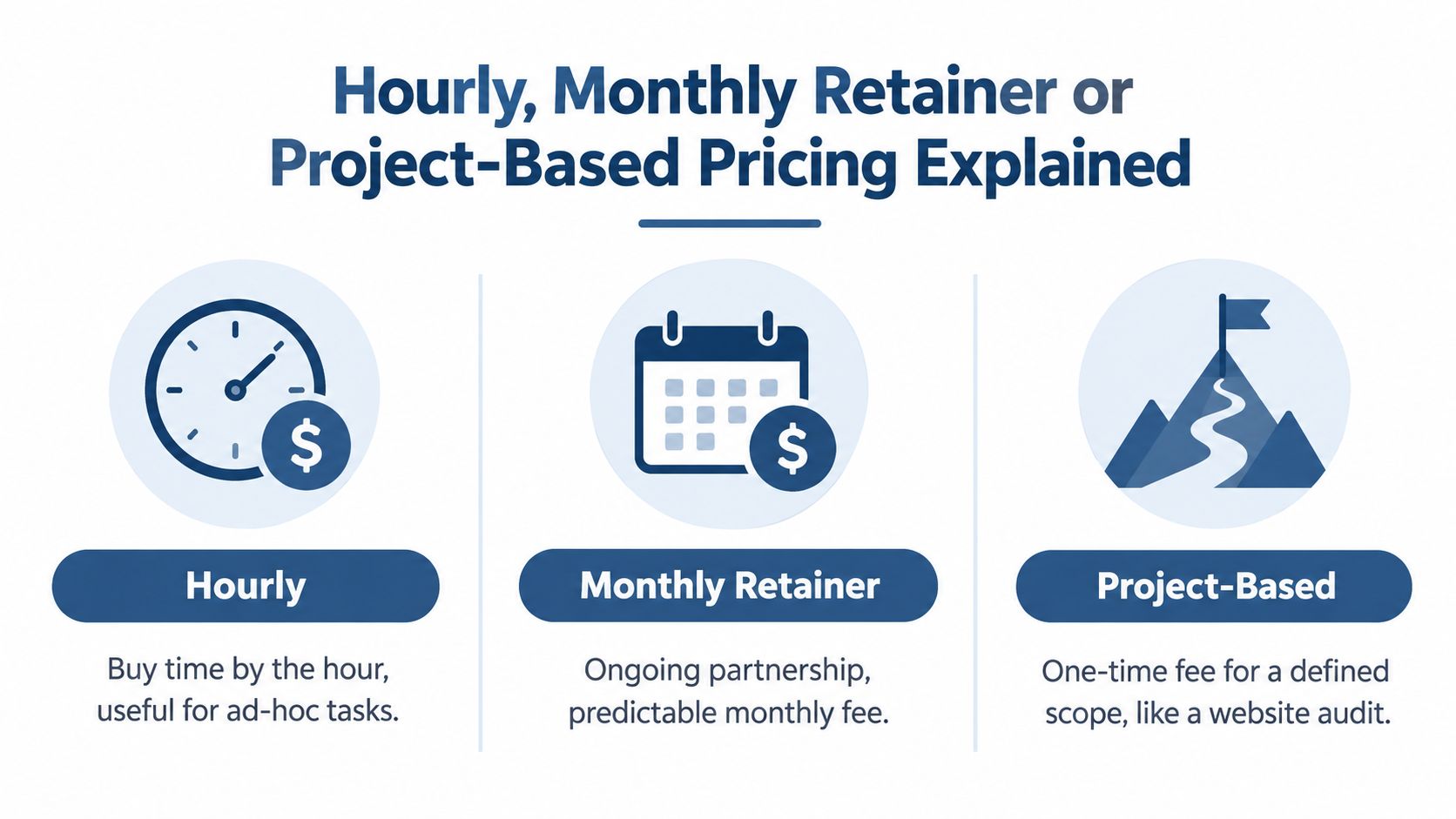
SEO pricing normally follows one of three models. Think of them as buying a mechanic's time, keeping a mechanic available, or commissioning a defined repair. Each model can work, but they solve different business problems.
Hourly work suits contained problems
Hourly SEO is useful when you need expert input without an ongoing campaign. You might pay for a technical review after a website rebuild, training for an in-house marketer, or advice before moving from one content management system to another.
The attraction is control. You pay for the time used, and you can stop once the immediate question is answered. The weakness is that ongoing visibility becomes difficult to manage because every new task needs approval, estimation and another block of hours. Scope can drift quickly, particularly when an audit reveals problems that weren't visible at the start.
Retainers fund consistent progress
A monthly retainer reserves a continuing block of expertise. The work might include technical monitoring, service-page optimisation, content briefs, internal linking, local SEO and reporting. That structure suits a business that wants organic growth rather than a single tidy-up exercise.
The UK SEO pricing research from White Hat SEO describes retainers as the dominant structure for packaged audits, technical fixes, content and link-building work. That makes sense operationally. Rankings, competitors, reviews and search results keep changing, so a campaign needs regular decisions rather than one heroic spreadsheet delivered in spring.
Projects define an endpoint
Project pricing works well when the deliverable has a clear finish. Examples include a technical audit, backlink cleanup, site migration, new service-page rollout or category architecture review.
A project gives you a fixed scope and usually a fixed fee. It doesn't automatically provide the follow-through needed to implement recommendations, publish content or earn authority. If the site needs continuous improvement, a project can be the first stage, not the whole campaign.
| Model | Scope changes | Reporting cadence | Accountability |
|---|---|---|---|
| Hourly | Usually creates more billable time | Often task-based | You manage priorities |
| Monthly retainer | Can be prioritised within agreed capacity | Usually monthly | Shared ongoing responsibility |
| Project-based | Normally triggers a revised quote | Milestones or final report | Clear deliverable ownership |
For a one-off problem, hourly or project pricing is sensible. For a plumber who needs steady local visibility, or a professional firm building authority around several services, the retainer usually fits better. It lets the team respond to what the data shows instead of treating SEO like a leaflet that gets printed once and forgotten in a drawer.
Typical UK SEO Price Bands by Campaign Type
The campaign type gives you a useful starting point, but it isn't a substitute for scope. A single-location business in a competitive city can need more work than a regional company in a quieter niche. The labour drivers below explain why the bands differ.
| Campaign Type | Monthly Retainer | Typical One-Off Project | Main Cost Drivers |
|---|---|---|---|
| Local SEO | £300 to £800 | £1,000 to £5,000 | Citations, Google Business Profile, reviews and local pages |
| National SME SEO | £1,200 to £2,500 | £1,000 to £5,000 | Content production, technical work and digital PR |
| Mid-market SEO | £2,000 to £4,500 | £1,000 to £5,000 | Location pages, internal linking and wider service coverage |
| E-commerce SEO | £1,500 to £5,000 or more | £1,000 to £5,000 | Structured data, templates and faceted navigation |
A local campaign for a tradesperson usually concentrates on Google Business Profile optimisation, citations, review signals and service-area pages. The work is narrower, but local competition can still be fierce. A roofing firm in Manchester isn't only competing on the website. It needs accurate business details, credible reviews, useful photos and a profile that converts searchers into calls.
National SEO changes the job. A business targeting non-geographic terms across the UK needs more content depth, stronger internal architecture and genuine authority-building activity such as digital PR. A page about commercial accountancy must earn trust and relevance beyond a town name.
Mid-market campaigns often combine multiple locations or services. That creates more pages to plan, connect and maintain. Internal linking becomes a labour issue, because every new page needs a sensible place in the wider structure rather than being lobbed into the website like a rogue garden shed.
E-commerce introduces technical complexity. Category templates, product pages, structured data and faceted navigation can create duplication, indexing and crawl problems. The fee reflects the number of templates and decisions, not merely the number of products.
The one-off project range sits alongside these retainers because an audit or migration may be necessary before ongoing work can produce results. A fixed project can diagnose or repair a problem, while the retainer handles the continuing campaign.
What You Get at Different Price Points
A low monthly fee can be perfectly reasonable if you understand its limits. It becomes poor value when a sales page implies a complete growth programme but the delivery amounts to a few automated tasks and a monthly screenshot parade.
The entry band
At £300 to £500 per month, a sole-trader plumber in Leeds might receive optimisation for a handful of core pages, a basic Google Business Profile tidy-up, a small citation exercise and a monthly report. That can create a useful foundation if the website is already healthy and the local competition isn't unusually strong.
The four-office solicitor, however, will quickly outgrow that scope. Four locations, separate service priorities and local relevance require more planning. At this price, the campaign may only touch the main office or a limited set of pages.
The working middle
At £800 to £1,500 per month, the plumber should expect more consistent on-page work, a technical audit, properly defined content briefs, conversion tracking and genuine local link-earning activity. The focus shifts from housekeeping to a managed campaign.
For the solicitor, this band can support priority location pages, service-page improvements, internal linking and a more useful reporting process. It won't cover every possible office and service combination at once, but it can establish a sensible order of attack.
Higher-intensity campaigns
At £2,000 or more per month, the work can expand into multi-location landing pages, advanced schema, broader outreach, conversion-rate optimisation and carefully controlled scalable content. A solicitor with several offices may need that depth because every page must serve both a search purpose and a prospective client.
The difference is labour intensity, not secrecy. More money should buy more analysis, implementation, content quality, technical attention and accountability. It shouldn't buy vague promises or a larger pile of branded charts.
| Price Band | Sole Trader Example, Plumber | Multi-Location Example, Solicitor | Typical Deliverables |
|---|---|---|---|
| £300 to £500 | Core service pages and local profile maintenance | Limited office or service focus | Basic on-page work, citations and reporting |
| £800 to £1,500 | Ongoing local growth programme | Priority locations and services | Technical review, content briefs, tracking and link earning |
| £2,000 or more | Wider service-area coverage and CRO | Multi-location architecture and authority building | Landing pages, schema, outreach, internal linking and CRO |
Ask for a monthly task list. If the answer is only “optimisation” and “backlinks”, you haven't been shown the work. You've been shown a fog machine.
White Hat, Grey Hat and Black Hat SEO and Why Price Hides the Difference
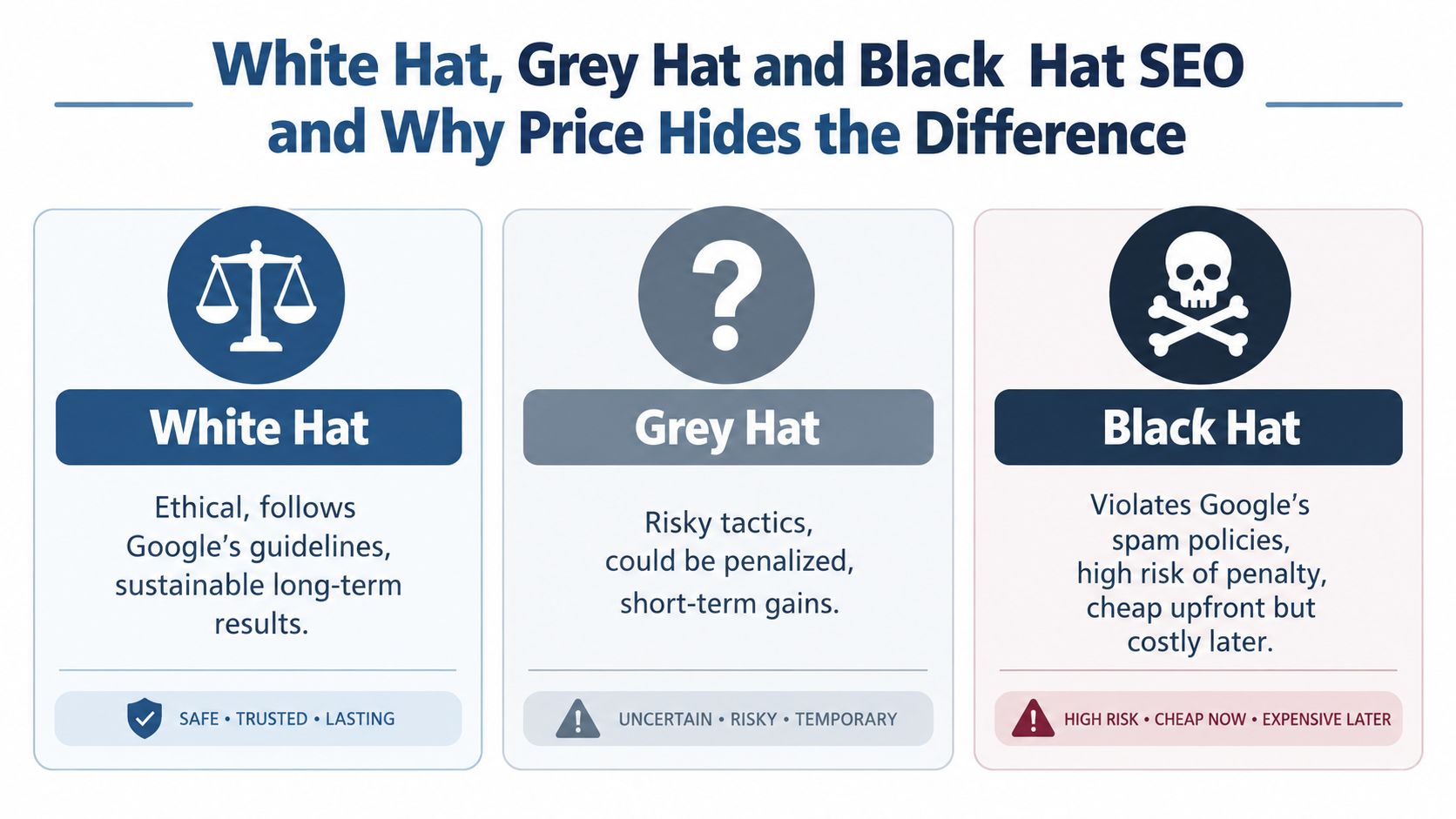
The cheapest quote can become the most expensive once Google catches up. A low fee often reflects fewer skilled hours, automated work or risky tactics that don't appear clearly in the report.
White-hat SEO follows the spirit and substance of Google's guidance. It includes useful original content, clean technical SEO, accurate local information, sensible internal linking and links earned because a business has something worth referencing. The work takes judgement, especially for a solicitor or clinic whose pages need to demonstrate credibility rather than merely repeat keywords.
Grey-hat SEO sits in the uncomfortable middle. Paid link schemes, parasite SEO, AI-spun doorway pages and aggressive exact-match anchor text may be presented as clever shortcuts. Google may not describe every tactic with the same label, but its systems can demote manipulative or low-value results. The risk belongs to the business owner, not the person who added the links.
Black-hat SEO deliberately violates search-engine rules. Hidden text, cloaking, hacked link injections and private blog networks belong here. Google's policies specifically prohibit practices including link spam, cloaking, sneaky redirects and doorway pages, and violations can lead to manual action or ranking suppression, as explained in this UK summary of Google's spam policies and SEO risks.
What to refuse
- Guaranteed rankings: Nobody controls Google's results, so a guaranteed position is a warning sign.
- Secret link sources: You should know whether links come from relevant editorial work or a suspicious network.
- Fixed backlink quotas: A set number encourages volume over relevance and quality.
- Unedited mass content: A tool can assist research, but it can't replace subject knowledge, fact-checking and useful writing.
- No account ownership: Keep control of Analytics, Search Console, your website and Google Business Profile.
A legitimate SEO partner can explain the tactic, the expected purpose and the risk. If the explanation relies on “we have a special network” or “Google won't notice”, put the kettle on and walk away.
Realistic ROI Examples for Local UK Service Businesses
ROI should begin with your commercial numbers, not a ranking screenshot. A plumber cares about booked jobs, an accountant cares about retained clients, and a roofer cares about profitable enquiries. You can model the decision without pretending that every campaign follows a neat script.
The following scenarios are editorial illustrations, not reported client results. They use the stated spend and commercial assumptions to show the arithmetic a business owner should test before signing.
| Business Type | Monthly SEO Spend | Extra Leads / Month | Avg Order Value | Est. Payback |
|---|---|---|---|---|
| Leeds plumber | £450 | 8 calls | £180 | About four months |
| Bristol accountancy firm | £1,200 | 3 leads | £2,500 | About one month |
| Manchester roofing firm | £3,000 | 35 enquiries | £90 acquisition cost | About one month |
A Leeds plumber paying £450 per month would spend £1,800 across four months. If the campaign generated eight additional calls each month and each job averaged £180, the simple gross-value model would produce £1,440 per month, before considering close rate, materials, travel and profit. The plumber shouldn't treat every call as revenue, but the exercise shows what needs measuring.
A Bristol accountancy firm spending £1,200 per month and closing three additional leads at a £2,500 retainer value would create £7,500 in stated client value per month. The firm still needs to account for conversion quality, retention and delivery costs. High-value professional services can justify a more substantial campaign when tracking connects search visibility to signed work.
The Manchester roofing scenario uses £3,000 per month and an acquisition cost of roughly £90 per enquiry. That represents a campaign with substantial activity after a rebuild, but it shouldn't be treated as a promise. The owner must check whether enquiries are genuine, whether the team can quote them and whether the resulting jobs are profitable.
SEO can pay back handsomely, but only when call tracking, enquiry quality and close rates sit beside rankings in the report.
Don't expect instant results. Organic work generally compounds from around month four onwards, and the sensible test is whether technical improvements, relevant visibility and qualified enquiries are moving in the right direction. If a provider can't connect activity to commercial outcomes, the price for SEO services is impossible to judge properly.
How to Compare SEO Providers and What to Budget
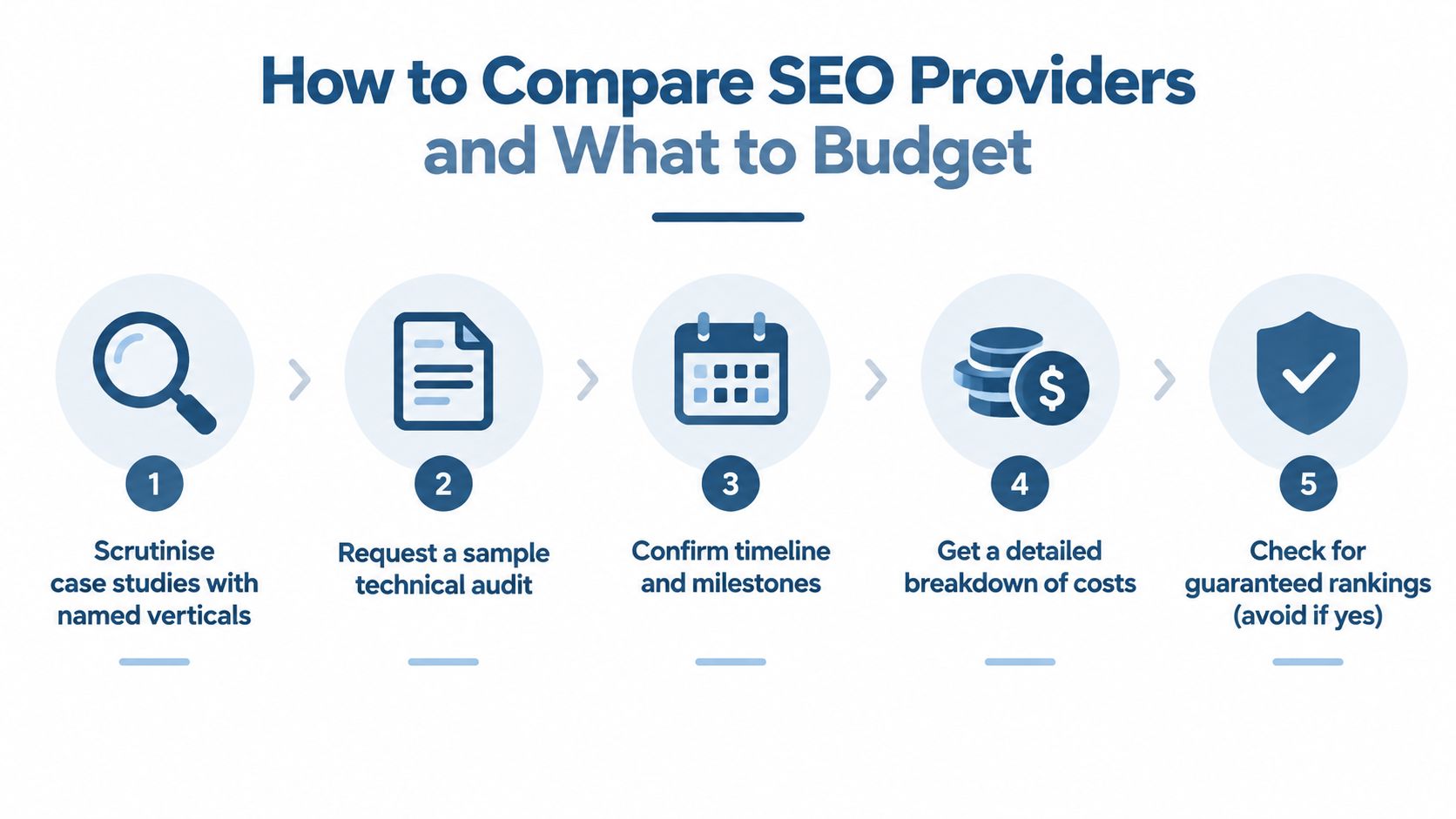
Shortlist providers by inspecting the work, not by circling the lowest figure. Ask for case studies with named verticals, a sample technical audit, a clear explanation of link-building methods, reporting frequency, account ownership, contract length and exit terms.
Questions that expose weak proposals
- Ask for a sample audit: You should see prioritised technical issues, not a generic list copied from a crawl tool.
- Inspect relevant examples: A local trades campaign and a national e-commerce campaign involve different problems.
- Clarify link methods: Confirm that outreach, digital PR and citations follow Google's guidelines.
- Set reporting expectations: Agree whether reports include rankings, organic traffic, calls, enquiries, conversions and completed work.
- Retain ownership: Your website, Google Business Profile, Analytics and Search Console access should remain yours.
- Read the exit terms: Check notice periods, handover arrangements and what happens to content or tracking assets.
For a deeper checklist on vetting an SEO service provider, look for transparency around deliverables, methods and access rather than polished promises. You can also compare the structure of a UK SEO package against your own priorities, especially if you need local optimisation, technical work and reporting in one arrangement.
A sensible 2026 budget
A single-location trades or professional services firm should plan around £400 to £800 per month. A multi-location or highly competitive local firm should consider £900 to £1,500 per month, while an SME targeting national or e-commerce keywords should plan around £1,800 to £3,000 per month. These bands align the budget with the amount of content, technical work and authority-building the campaign needs.
Google Business Profile work deserves proper attention. A 2026 UK analysis found that 67% of Google Business Profiles were incomplete, and profiles with 30 or more photos earned 2.7 times more clicks than profiles with fewer than 10 photos; the same analysis reported an average of 47.4 reviews and a median of 16 reviews per profile in its dataset, as detailed by Media Village's UK small-business SEO pricing analysis. Those figures underline why profile completeness, reviews and photos affect both visibility and conversion.
Budget for at least twelve months of consistent work before judging the whole campaign. Switching early can discard useful learning, interrupt implementation and leave you comparing half-finished strategies. Choose a clear scope, measure qualified leads and hold the work to account.
DigiVisi Ltd offers small UK service businesses structured SEO packages covering technical audits, competitor and keyword research, service-page optimisation, local SEO, schema, citations, content support and transparent reporting, with monthly billing from £360 including VAT. Visit DigiVisi Ltd to discuss a campaign matched to your locations, competition and lead-generation goals.