Skip to content
You can have a website that looks busy, ranks nicely, and still sits there like a half-empty waiting room. A local solicitor gets form fills that go nowhere. A plumber gets late-night calls from bargain hunters who vanish by morning. A salon gets clicks, not bookings. That's exactly where a conversion rate optimisation service earns its keep, because the job isn't to chase more traffic, it's to turn the visitors you already have into proper enquiries, booked appointments, and sales that matter.
For UK service businesses, that shift is more than a tidy marketing improvement. The average website conversion rate across industries is about 2.35%, and moving a site from 2.35% to 3.00% is a relative uplift of about 27.7% in completed enquiries from the same traffic (Matomo benchmark data). That's why a sensible CRO plan can feel less like tinkering and more like turning the taps on properly. If you want a practical starting point, Next Point Digital's CRO expertise is a useful reference for how this work gets structured in practice.
Table of Contents
- Introduction to CRO Service for UK Service Businesses
- Understanding Conversion Rate Optimisation Service
- Typical CRO Process for Local Service Businesses
- Key Deliverables KPIs and ROI Timelines
- Pricing Guidance and Provider Questions
- Integrating CRO with SEO GBP and Google Ads
- Real-world Examples and Case Studies
- Conclusion and Next Steps
Introduction to CRO Service for UK Service Businesses
A lot of owners know the feeling. The marketing report says traffic is up, the website has had plenty of visitors, and yet the phone still isn't ringing like it should. It's a bit like running a busy shop where everyone walks in, has a look around, and leaves without speaking to anyone.
A conversion rate optimisation service tackles that gap by studying what people do on your site and removing the friction that stops them from enquiring. For a solicitor, that might mean fewer abandoned forms and clearer service pages. For a plumber, it might mean a stronger call-to-action and a tap-to-call experience that works without faff on mobile.
The useful part is that CRO doesn't ask you to pour more money into ads just to keep the wheel turning. It asks a different question, which is whether your current traffic is being used properly. That matters because modest improvements can compound fast, especially for service businesses where every qualified enquiry has real commercial value.
The best CRO work starts with the numbers, but it's never just about numbers. It's about the person landing on the page, wondering whether you're local, trustworthy, and worth contacting today rather than “maybe later”. If your website answers those doubts quickly, you've got a much better chance of turning curiosity into a call.
Understanding Conversion Rate Optimisation Service
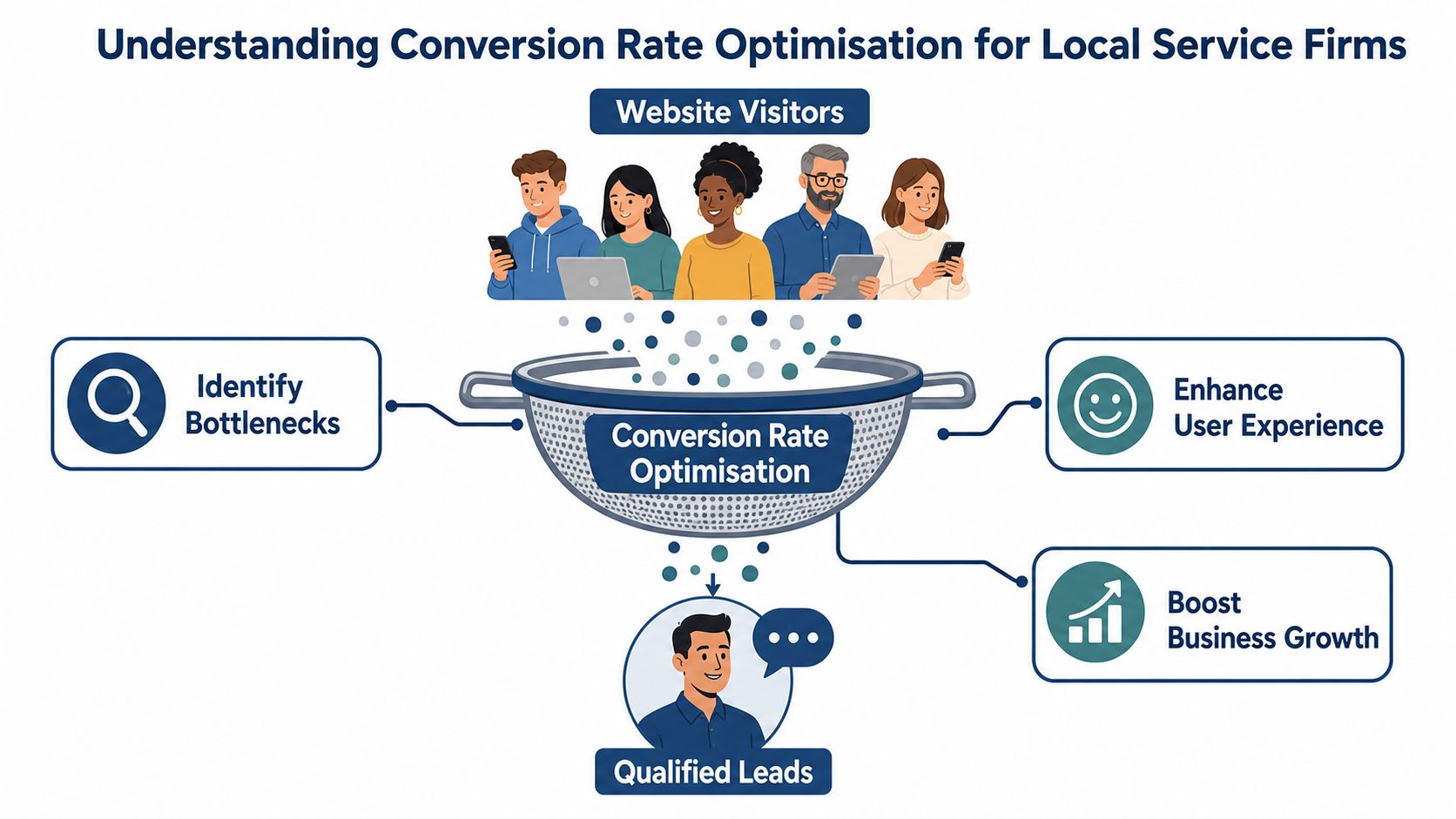
A conversion rate optimisation service is basically a very patient tea strainer. Visitors pour in from search, ads, social, or direct traffic, and the job is to separate casual browsers from people who are ready to enquire. The point isn't to trick anyone. The point is to make it easy for the right people to take the next step.
White, grey, and black hat CRO
White-hat CRO is the clean stuff. You test headlines, forms, page structure, proof points, and calls to action, then keep what helps users and helps the business. That approach fits UK service firms because it builds trust instead of pretending to be something it isn't.
Grey-hat tactics sit in the murky middle. They might squeeze out more form submissions in the short term, but they often do it by pushing urgency too hard or hiding important details. That can create more noise than revenue, which is a terrible trade if your team has to chase low-quality leads all week.
Black-hat CRO is the dodgy end of the pond. It relies on manipulation, confusion, or misdirection, and it's not a sensible path for any serious local business. If your aim is booked consultations, quote requests, or site visits, clean optimisation is the only grown-up option.
Practical rule: if a change would annoy a real customer once they noticed it, it's probably not worth shipping.
What CRO is really doing
The same principle applies whether you run a dental practice, accountancy firm, or home-improvement business. You're not trying to make everyone convert. You're trying to make the right person feel confident enough to act now rather than leave the page for good.
That's why good CRO work focuses on bottlenecks. Maybe the CTA is weak. Maybe the form feels too long. Maybe the page doesn't reassure people that you cover their area or understand their problem. Once you see the blockage, you can fix it without resorting to grey-hat theatre.
Typical CRO Process for Local Service Businesses
A proper CRO process starts with objectives, not design opinions. The NHS guidance on conversion optimisation recommends defining objectives, analysing goal funnels and enquiry drop-offs, mapping user journeys, and using split tests to find what really improves conversion, then keeping the winning changes in place (UK National Health Service guide). That's not glamorous, but it is sensible, and sensible usually wins.
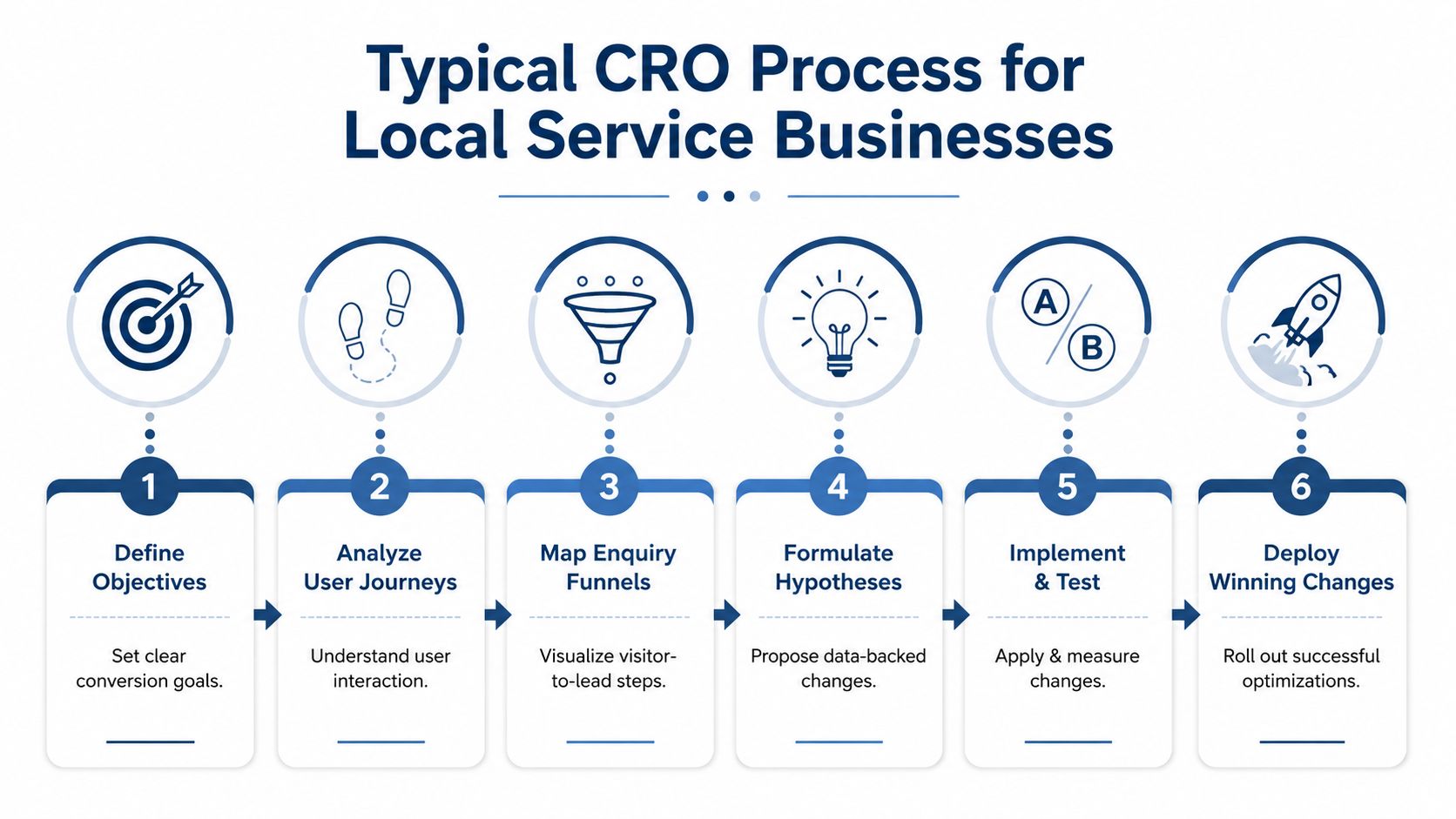
Start with the journey, not the decoration
A local service business needs to know where people drop out. A visitor might click a service page, skim the trust signals, pause at the form, then vanish because the next step feels awkward. That's the sort of thing you only spot by looking at the funnel properly.
The standard conversion-rate formula is simple, conversion rate = (conversions / visitors) x 100, but it becomes much more useful when you track macro-conversions and micro-conversions too (Contentsquare metrics guide). Macro-conversions are the main goal, like booked calls or submitted enquiries. Micro-conversions are the smaller signs of intent, like CTA clicks, form starts, scroll depth, or returning-user actions.
A page that looks fine in a design meeting can still leak leads like a cracked bucket in the real world.
Test changes before you commit
Once you've identified a problem, the next step is a hypothesis. Maybe a shorter form will improve completion. Maybe a clearer headline will reduce hesitation. Maybe a more visible phone button will help mobile visitors who don't want to faff about.
A/B testing, or split testing, is the cleanest way to check whether a change really helps. It compares one version against another rather than relying on instinct. One dataset notes that tests usually take about two to four weeks to reach statistical significance, so this is a methodical process, not a “change it Tuesday, declare victory Wednesday” affair (CRO testing summary).
Keep compliance in view
For UK firms, compliance matters at every stage. Direct marketing must be lawful, fair, and transparent, so lead capture should never drift into aggressive or misleading territory. That's especially relevant if a form change increases submissions but lowers the quality of consent or the quality of the lead itself.
Mobile behaviour deserves separate attention as well. The mobile experience often behaves differently from desktop, and that difference needs its own diagnosis rather than a shrug and a prayer. For local businesses, the practical focus is usually on tap-to-call buttons, short forms, readable copy, and pages that don't wobble apart on a phone screen.
Key Deliverables KPIs and ROI Timelines
A CRO engagement should produce proper deliverables, not vague optimism. That usually means an analytics audit, funnel review, hypothesis list, test plan, test designs or mock-ups, and reporting that shows what changed, what won, and what to do next. If a provider can't explain the process in that kind of concrete way, the proposal probably needs a firmer look.
The right KPIs are not just the final enquiry count. You want to watch form starts, CTA clicks, phone taps, booked calls, and returning-user conversions, because those signals show where friction lives before the final submission point. That makes the work more actionable for a solicitor, trades business, or clinic where one weak step can cost proper revenue.
The strongest commercial lens is whether the enquiries are qualified. Too many guides obsess over volume, while the commercial problem is often quality. Most existing articles focus on generic tactics like shortening forms or adding trust badges, but fail to address how to improve qualified enquiries and booked jobs rather than mere submissions (7milemedia analysis of service-business CRO).
| CRO Benchmark Conversion Rates | Conversion Rate |
|---|---|
| Average website across industries | 2.35% |
| Typical benchmark range for many sites | 2% to 5% |
| Top landing pages | 11.45% |
| Legal services landing pages | 7.4% |
| HVAC landing pages | 3.3% |
| IT staffing and services landing pages | 3.5% |
Those benchmarks matter because they stop you guessing whether a page is healthy or merely getting by. If your site sits near the lower end, the first wins usually come from reducing friction, clarifying the offer, and tightening the route to contact. If it already performs reasonably well, the work shifts to refinement and lead-quality uplift.
Useful mindset: don't ask only, “How many leads came in?” Ask, “How many of those leads were worth the team's time?”
Pricing Guidance and Provider Questions
Pricing for CRO should feel transparent, not like a house extension estimate written by a magician. For smaller UK service businesses, the pricing model usually makes more sense when it reflects the amount of analysis, testing, and iteration involved rather than a generic monthly fee with mysterious “optimisation” tucked inside it.
The bigger question is what the work is designed to improve. If the proposal only talks about clicks, page views, and form fills, you're missing the point. You want a provider who can explain how they evaluate lead quality, how they decide which tests to run, and how they avoid nudging the site towards more rubbish leads.
A good provider conversation should cover the messy bits, too. Ask how they define a qualified enquiry, how they report booked consultations or calls, and how they think about consent and compliance. That's especially important for firms that rely on direct response and lead generation, because the difference between “more” and “better” is where the money lives.
If you're comparing options, DigiVisi Ltd also offers CRO-related work alongside SEO, Google Business Profile optimisation, and conversion-focused Google Ads management, which can be useful when the enquiry problem sits across multiple channels. That still needs scrutiny, of course, because a neat package means nothing if the process isn't tied to business outcomes.
Ask these questions before you sign anything:
- How do you define a qualified lead? If the answer is vague, the rest of the discussion may be too.
- What gets measured beyond submissions? Look for booked calls, contact quality, and downstream conversion signals.
- How do you decide which tests to run first? You want prioritisation based on friction, not gut feel.
- How do you handle compliance and consent? If that sounds uncomfortable, it's the wrong room.
Integrating CRO with SEO GBP and Google Ads
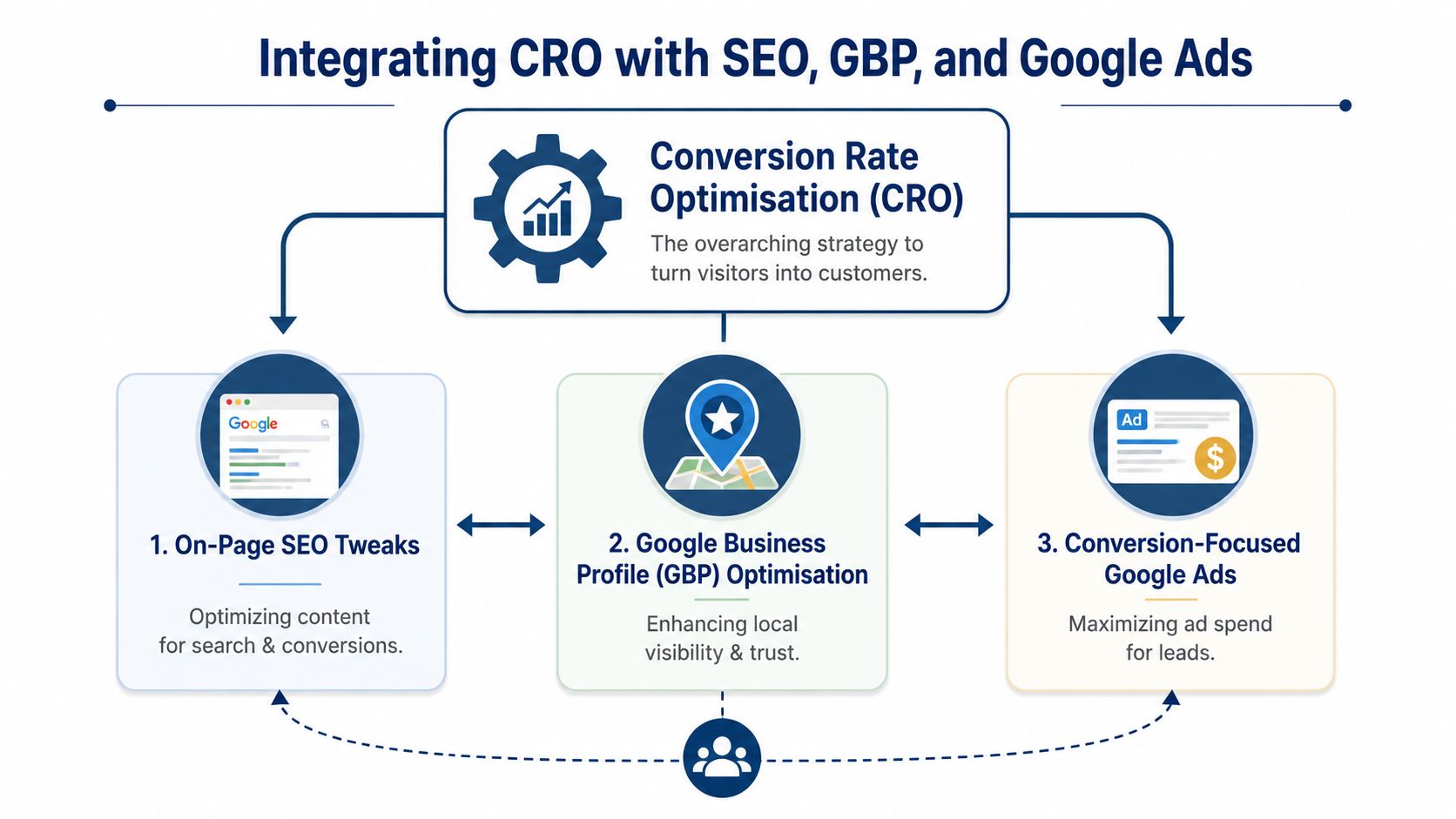
A service website rarely wins enquiries from one channel alone. SEO brings people in through search, Google Business Profile helps local visibility and trust, and Google Ads management can bring in intent-led traffic fast. Conversion rate optimisation service work then makes that traffic do something useful, so the right visitors do not drift away after a good first click.
Why mobile deserves its own treatment
Mobile often causes the biggest drop-off for local firms. One source from Marketingscoop CRO stats reports desktop conversion at 4.14% and mobile at 1.53%, which shows why a phone screen needs its own plan rather than a scaled-down copy of the desktop page.
That matters for trades, salons, and solicitors, where people often search while they are out and about and want a fast answer. If the page is fiddly on a phone, the enquiry is usually gone before the kettle has boiled. A clear headline, a visible call button, and a short form usually do more work than a busy layout full of bells and whistles.
How the channels reinforce each other
SEO shows what searchers already want, because the queries point to intent and the problems behind it. GBP shows which local proof and service cues matter. Google Ads shows which wording and offers get action quickly, which is why many businesses pair it with Google PPC management services when they need clearer intent data.
Good integration means each channel teaches the others something useful, so testing is not happening in a vacuum.
The result is a feedback loop. Better visibility gives you more data. Better data gives you sharper tests. Sharper tests give you cleaner pages, stronger qualified enquiries, and less waste on traffic that was never going to turn into a proper lead in the first place.
Real-world Examples and Case Studies
A Kent plumber had a familiar problem. The website was getting visitors, but the enquiry form felt clunky and the calls-to-action were easy to miss. After tightening the page structure, simplifying the route to contact, and making the mobile experience less fiddly, enquiries rose 35%.
A London solicitor faced a different issue. The page was drawing attention, but too many visitors hovered and left without booking anything. After targeted CTA testing, booked consultations doubled. The work didn't rely on tricks, just cleaner prompts, clearer intent, and a page that gave people a reason to act now rather than “have a think”.
Those two examples show why a CRO service is more than a cosmetic tidy-up. The plumber's win came from reducing friction on a practical service page. The solicitor's win came from improving the action path on a high-trust, high-consideration page. Same discipline, different user psychology.
What mattered in both cases
Both businesses benefitted from changes that made the next step obvious. Neither needed a loud, overcooked sales page. They needed a site that answered the right question quickly, which is, “Why should I contact this business now?”
That's the bit many service websites miss. They speak about themselves for too long and speak to the customer too late. When the page finally gets round to showing proof, geography, service fit, and a clear contact route, the user has often already moved on.
Conclusion and Next Steps
A conversion rate optimisation service is one of the cleanest ways to get more from the traffic you already pay for or earn. For UK service businesses, the big win is not vanity metrics, it's qualified enquiries that turn into booked jobs, consultations, and proper revenue. Start by checking your funnel, then look at the pages where people hesitate, and then run one sensible test at a time.
If you're choosing a provider, ask how they measure lead quality, not just volume. Ask how they handle mobile, compliance, and testing discipline. Most of all, make sure the work is tied to the commercial reality of your business, because a website full of activity is no use if nobody's picking up the phone.
DigiVisi Ltd helps UK service businesses improve the pages, search visibility, and ad journeys that feed enquiries into the funnel. If you want a practical starting point, visit DigiVisi Ltd and see how its SEO, Google Business Profile, Google Ads, and conversion-focused website work can support a stronger lead pipeline.