Skip to content

Monday morning. The kettle's just boiled, the phone hasn't rung yet, and someone in the office has typed “plumber [town name]” into Google from the same Wi-Fi they used to check the football. Your site is sitting at position 9, which feels insulting until you remember position 9 is still the internet's way of saying, “Nice try, mate.” That's the moment a proper website SEO ranking checker stops being a vanity toy and starts being the dashboard for the whole marketing engine.
For UK service businesses, ranking checks are only useful if they tell you what's happening. A decent tool shows whether you're climbing, slipping, or being mugged by a competitor with a better page and a cleaner Google Business Profile. A useless one gives you a shiny number and a headache. White-hat work wants clean, useful signals. Grey-hat work chases shortcuts and hopes nobody notices. Black-hat work usually ends in tears, a penalty, or both.
The trick is to use rank tracking the way a grown-up business does, not the way a nervous owner does after coffee. That means checking real locations, real devices, real competitors, and, real enquiries. Because a plumber doesn't need applause for a keyword. He needs the phone to ring.
Table of Contents
- 1. SEO Packages for Small Businesses – DigiVisi
- 2. Semrush, Position Tracking
- 3. Ahrefs, Rank Tracker
- 4. AccuRanker
- 5. SE Ranking, Rank Tracker
- 6. BrightLocal, Local Rank Tracker
- 7. Nightwatch
- 8. Advanced Web Ranking
- 9. STAT Search Analytics by Moz
- 10. Mangools, SERPWatcher
- Top 10 SEO Ranking Checker Comparison
- From Numbers to New Enquiries: Your 30-Day Ranking Tracker Workflow
1. SEO Packages for Small Businesses – DigiVisi
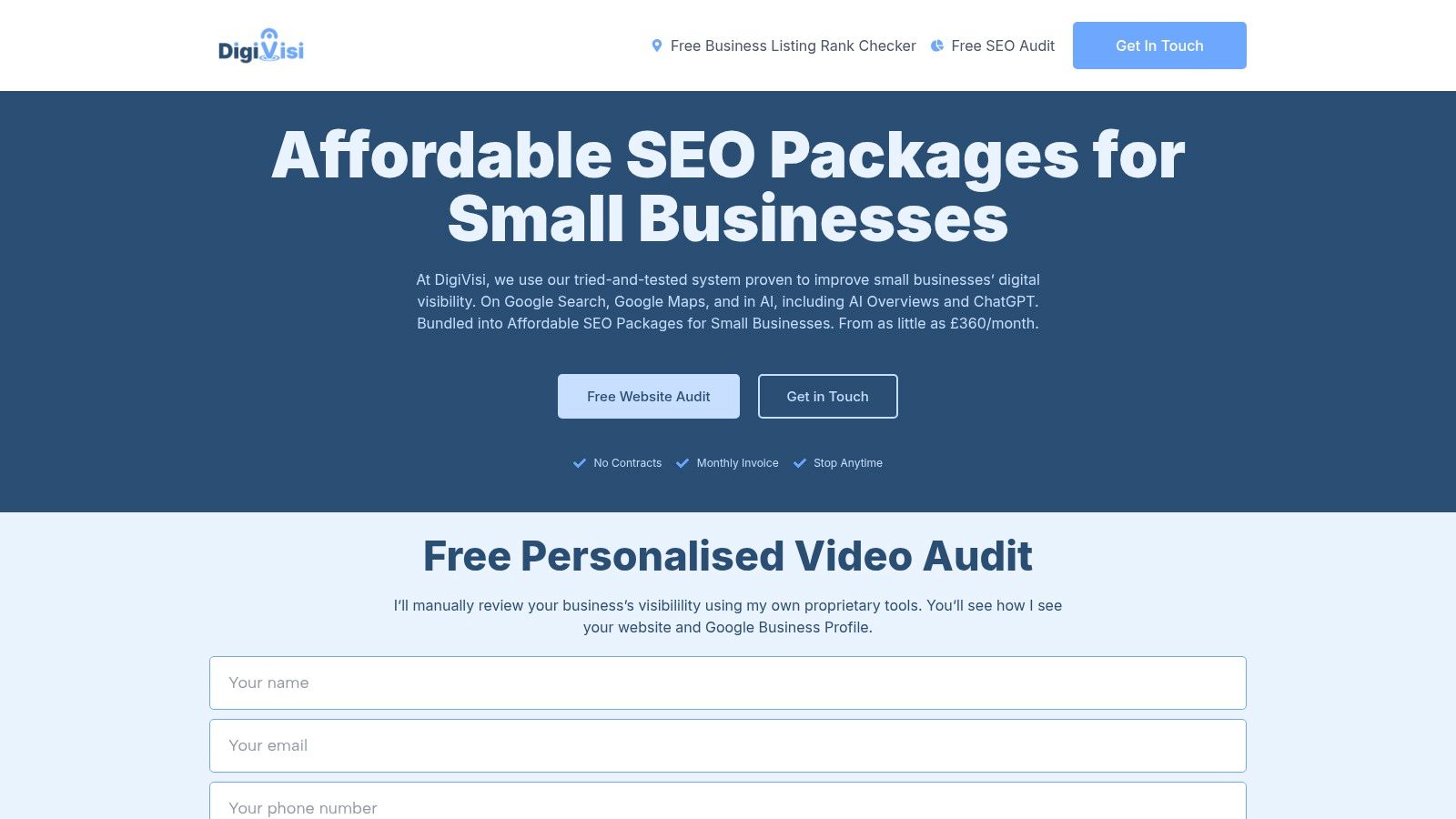
A UK plumbing firm, dental practice, solicitor's office, or accountancy practice needs straight answers, not SEO theatre. DigiVisi is built for that job. Every plan includes built-in keyword position tracking, a complimentary Website Audit, and a personalised video audit, so you can see what is happening without staring at a dashboard like it owes you money. The setup is data-first and built to work backwards from what the better-ranked firms are already doing, which is the right place to start if you want more enquiries, not just prettier graphs.
The tracking is not bolted on as an afterthought. It sits alongside technical fixes, on-page work, local SEO, Google Business Profile improvements, and content shaped around E-E-A-T and AI exposure. That matters because the page has to be discoverable, indexed, and shown properly before it has any chance of ranking, and helpful content still needs to be original, substantial, and written for people first, with clear sourcing and a real byline where appropriate. In plain English, the page itself has to deserve the position, not merely ask nicely for it.
Practical rule: If the ranking goes up but the calls do not, the work is not finished.
DigiVisi also includes optional Google Ads management, conversion-ready web design, and llms.txt support. That matters if you want ranking work to produce actual phone calls and enquiries instead of vanity charts that look busy and do nothing. The site points to transparent reporting, position tracking, and traffic stats, which is the minimum a serious service business should expect. No smoke, no mirrors, no pretending a graph pays the bills.
The white-hat approach is obvious here. Use the tracking to monitor clean, durable gains and fix the pages properly. A grey-hat operator would try to chase movement while leaving weak pages untouched. A black-hat operator would start buying links and then act surprised when the phone stops ringing. If you want the blunt version, that is usually how the story ends.
Pros
- Built-in position tracking keeps progress visible every month.
- Free website audit and personalised video audit give immediate next steps.
- Competitor reverse-engineering helps match or exceed what is already winning.
- Bundled local, technical, content, and GBP work keeps the whole funnel connected.
Cons
- Best suited to UK service-led businesses, not huge international enterprises.
- From £360 per month including VAT is serious money if you only want a vanity checker.
Visit the main site at DigiVisi Ltd and the competitor SEO analysis page if you want to see how the reverse-engineering mindset works in practice.
2. Semrush, Position Tracking
Semrush is the obvious all-in-one choice if you want rank tracking inside a broader SEO suite. Its Position Tracking module is strong on daily desktop and mobile ranks, multi-location tracking, and competitor comparison, which makes it a sensible fit for a UK firm that wants to know whether the Manchester page is behaving differently from the Birmingham one. For a plumber, dentist, solicitor, or accountant, that matters because one location can look healthy while another slips out of view.
For local service work, the appeal is plain. You can watch movement by device and location, then compare your site against the other names crowding the results. That is the sort of data that tells a solicitor whether a practice page is holding its ground in one town and fading in the next, or whether a dentist is winning branded searches but losing the non-branded ones that bring enquiries. Semrush also tracks newer AI search visibility, which is a sensible sign that the category is moving beyond old-school blue-link obsession.
The trade-off is familiar, and slightly annoying if you are a small business with sensible tastes. You get breadth, but some of the sharper reporting features sit on higher tiers. That works if you are running multiple service lines or a bigger local campaign. It is irritating if you only want the useful bits and resent paying for the rest, which is basically the British SEO experience in a sentence.
A rank tracker should tell you where the work is paying off, and where it is merely decorative.
Semrush is a good fit for white-hat teams because it makes clean monitoring easy and repeatable. Grey-hat operators will enjoy the competitive data and start getting ideas they should probably not act on. Black-hat operators will still find a way to misuse it, usually with more dashboards than discipline and not much else.
Pros
- Daily updates give you a clear view of change.
- Device and location splits suit UK-local campaigns.
- Competitor side-by-side views make losses and gains obvious.
- Position tracking tied to broader SEO data helps you connect rankings to real campaign work.
Cons
- Advanced reporting and Share of Voice features sit on higher tiers.
- The wider suite can be more than a small business needs.
Use Semrush's Position Tracking if you want the full platform approach, and pair it with DigiVisi's competitor SEO analysis when you want the local gap explained in plain English.
3. Ahrefs, Rank Tracker
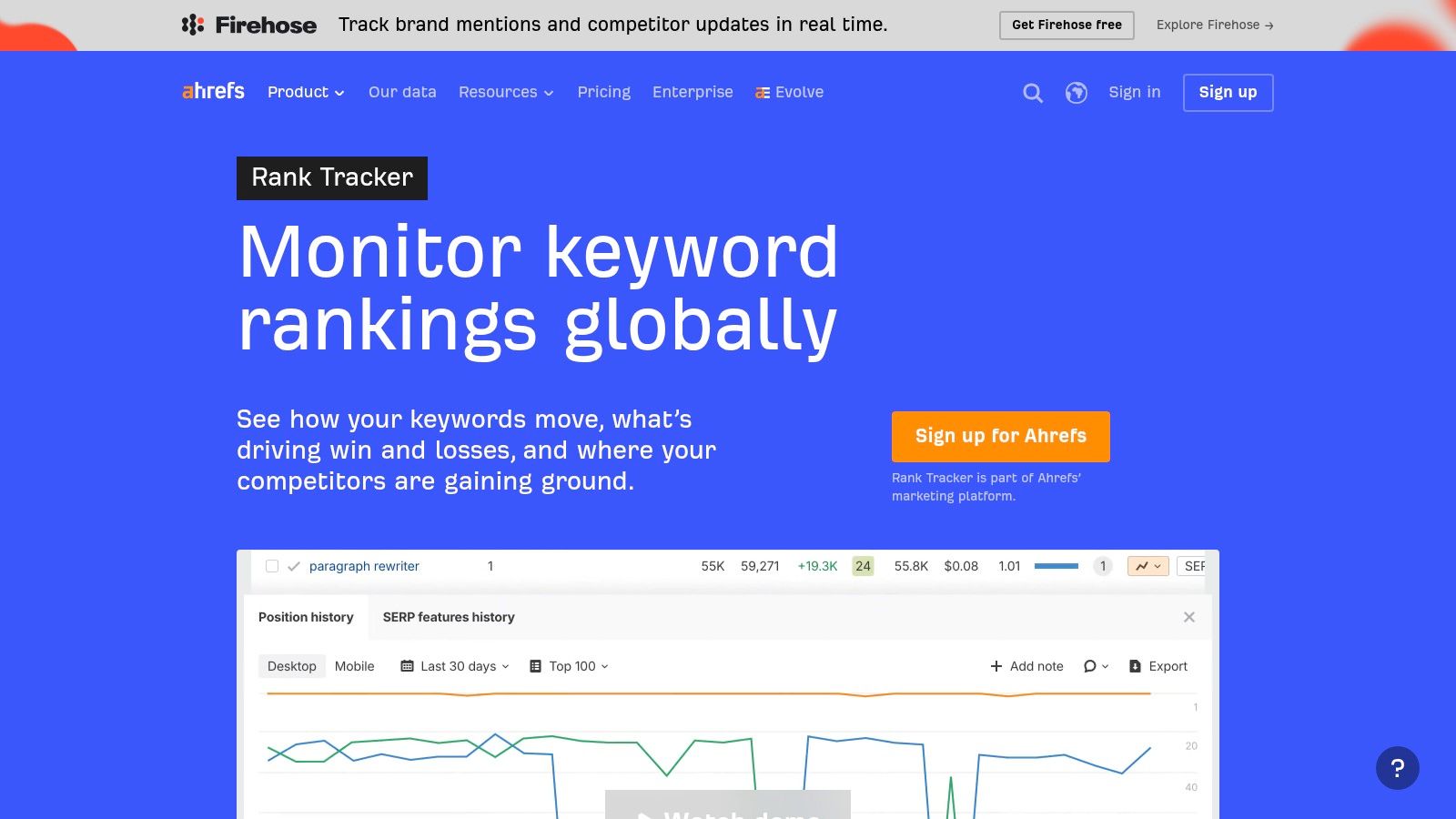
Ahrefs suits the owner who wants serious SEO muscle and doesn't mind a tool that expects you to mean business. Its Rank Tracker covers desktop and mobile tracking across 190+ countries and locations, with SERP-feature tracking including AI Overviews, plus competitor growth charts and SERP history. For a solicitor or dentist competing in a tight local market, that means you can see whether you're holding your ground or being edged out by someone with a better page structure and stronger authority signals.
The big advantage is context. Ahrefs doesn't just show a position, it gives you the surrounding picture, which matters because a ranking number by itself can be misleading. A page might look fine on paper, then lose visibility because the SERP itself has changed, or because a competitor's page is getting stronger at the exact location you care about. That's classic white-hat territory, measure the right thing, improve the right thing, repeat.
The weekly default update rhythm will suit some teams and frustrate others. If you need constant babysitting, this isn't the ideal comfort blanket. If you prefer a more strategic, less twitchy view of movement, it's perfectly respectable.
A rank tracker is only honest when it tells you where you lost visibility, not just where you gained it.
Ahrefs is also a sensible fit for agencies and in-house teams that want reporting and API options without treating rank tracking as a separate hobby. The platform is broad enough that it can support proper SEO work rather than just scoreboard watching, which is usually where grown-up campaigns live.
Pros
- Strong location filtering helps with city and region-level checks.
- Competitor trend charts make movement easy to explain.
- API and reporting options suit larger teams.
Cons
- Weekly updates by default are less immediate than some alternatives.
- Advanced usage tends to push you towards higher tiers.
See Ahrefs' Rank Tracker for the platform, and use it alongside a local plan that ties rankings to enquiries, not just pretty graphs.
4. AccuRanker
AccuRanker is for people who want speed, precision, and less fluff. It's a specialist rank tracker, not a bloated all-rounder pretending it knows your business better than you do. The appeal is obvious for agencies handling UK local accounts, because daily and on-demand refreshes let you check shifts quickly, and the Share of Voice views make it easier to understand overall visibility rather than obsess over one temperamental keyword.
It also handles local pack tracking with Google Business Profile name matching, which is exactly where local businesses often win or lose. A dentist or plumber doesn't only care about the organic result. The map pack can matter more, and a rank tracker that ignores that is basically bringing a bread knife to a roast dinner. AccuRanker also offers a native Looker Studio connector and API access, which gives reporting teams a cleaner way to build client-facing views.
The downside is predictable. Precision costs money, and keyword volume scales the price. That's fine if you're running a serious portfolio of local or regional campaigns. It's less lovely if you just want a modest checker and a cup of tea.
Practical rule: Use AccuRanker when your reporting needs are sharper than your patience for slow updates.
White-hat users will appreciate the clean measurement. Grey-hat users might like the speed a bit too much. Black-hat users will still be black-hat users, only now they'll have a faster dashboard while doing something daft.
Pros
- On-demand refreshes are excellent for active tracking.
- Local pack tracking gives useful GBP context.
- Looker Studio and API support make reporting flexible.
Cons
- Pricing scales with keyword volume.
- It can be overkill for very small, casual campaigns.
Explore AccuRanker if you want a specialist tracker that behaves like one.
5. SE Ranking, Rank Tracker
SE Ranking is the sweet spot for many small businesses and agencies because it gives you useful rank tracking without making you feel like you've joined a tax investigation. The Rank Tracker covers daily checks across locations and devices, Local Pack and Grid Rank tracking, and an AI Results Tracker for AI Overviews and AI modes. That's a tidy mix for UK firms that need both traditional rankings and a clearer view of local visibility.
For a plumber, this is especially handy because ranking in one postcode doesn't mean much if the next area over tells a different story. SE Ranking's local targeting and grid-style views help show whether your pages and local presence are doing the job. It's also friendly enough for in-house teams that don't want to spend half the afternoon learning a new interface just to check whether the homepage has moved two spots.
The platform adds a Looker Studio connector and agency-friendly features such as white-label options and client access. That makes it a practical choice if you're presenting work to owners who want clear evidence rather than jargon. In white-hat terms, it rewards disciplined reporting. In grey-hat terms, it makes it easier to spot dodgy gains that don't last.
Pros
- Good balance of features and usability.
- Local Pack and grid tracking suit UK service businesses.
- AI Results Tracker acknowledges modern search behaviour.
Cons
- Some features live behind add-ons or higher tiers.
- Advanced usage can still add cost as you scale.
If you want a value-focused tracker that understands local search, SE Ranking is one of the cleaner options on the shelf.
6. BrightLocal, Local Rank Tracker
BrightLocal is built for the exact sort of business that lives and dies by local visibility. Being UK-headquartered helps, but the key win is that it treats local SEO as the main event rather than a side dish. Its Local Rank Tracker measures Local Pack and localized organic rankings with precise location input and grid-based views, which is exactly what you want if you're a multi-location practice or a service-area business juggling several towns.
A lot of generic website SEO ranking checker tools fall over here. They'll tell you where a page ranks nationally, which is lovely if you're a newspaper and less useful if you're a dentist in Leeds competing with three other clinics in the same two postcodes. BrightLocal gets the local problem. It also sits alongside other local utilities such as citations and reviews, so the tracking lives inside a broader local workflow instead of floating off by itself like an unhelpful balloon.
The catch is cost structure. More locations mean more spend, and grid reports use credits, which can make people mutter under their breath in a very British way. Still, if you need clear reporting on map visibility and local movement, it earns its keep.
Pros
- Strong UK fit for local businesses.
- Grid and Map Pack tracking give practical visibility.
- Useful companion local tools support the wider workflow.
Cons
- Costs rise with locations.
- Grid reporting credits can add friction.
For local-first work, BrightLocal is the sensible pick. It understands that a ranking in the wrong town is not a win, it's a geography lesson.
7. Nightwatch
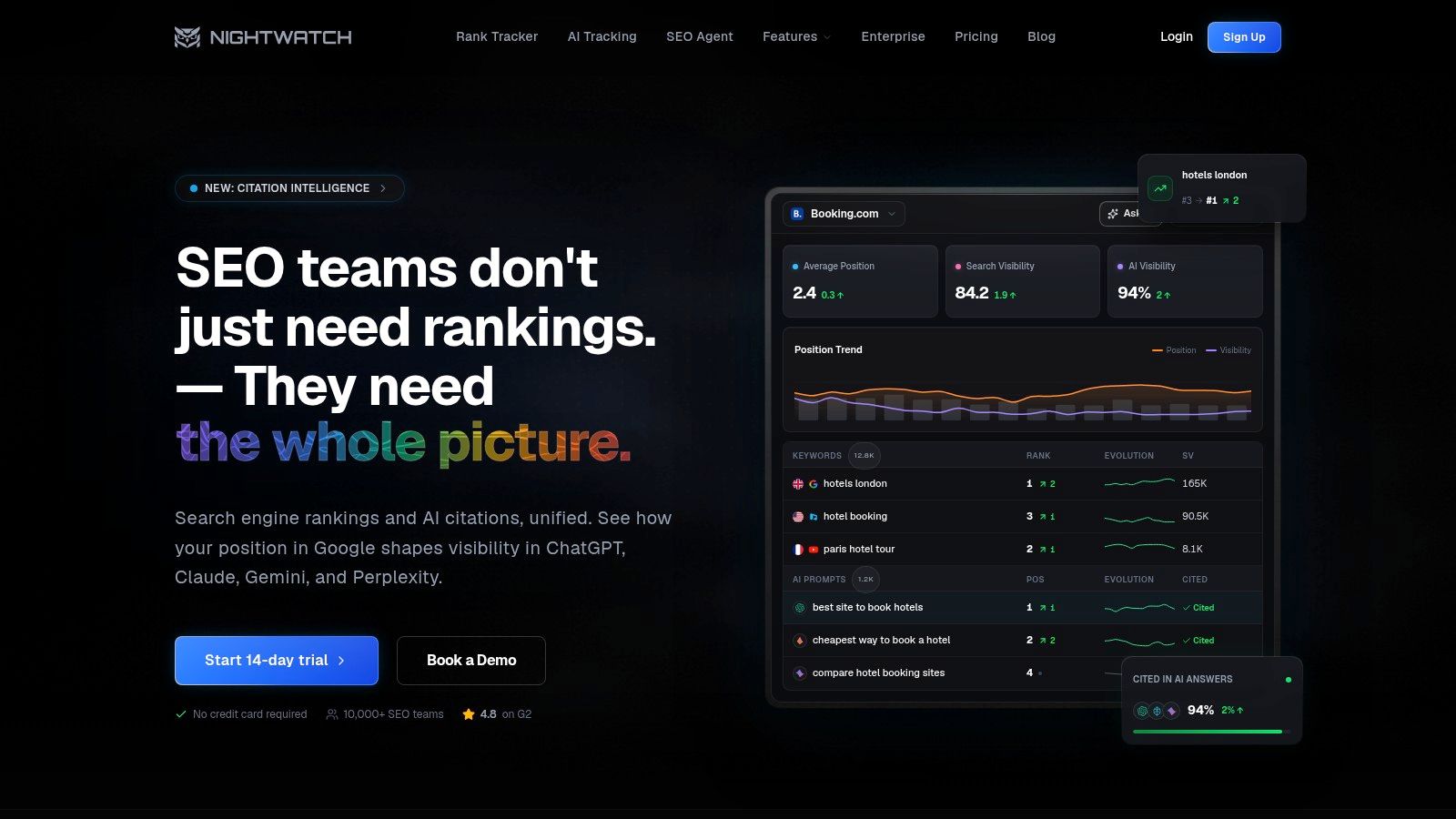
Nightwatch is the tidy, modern option for teams that want strong rank tracking without the usual clunky feel. It gives you location simulation, data-centre validation, and native Looker Studio support, which makes it a good fit for agencies that need clean reporting and reliable geographic precision. For UK service businesses, that means you can look at local movement without feeling like the tool is guessing over a cup of instant coffee.
The nice part is how it plays with broader analytics. GA and GSC integrations help connect rankings to actual site behaviour, which is where the interesting stuff lives. A page can climb and still fail. A page can hold steady and suddenly generate better enquiries because the snippet improved. The tracker should help you see that, not pretend the number is the whole story.
Nightwatch is strong for teams that like structure and clear outputs. It also avoids some of the seat-fee nonsense that makes multi-user reporting feel oddly punitive. That said, if you want the deepest grid-heavy local package on earth, there are more specialist toys out there.
Rankings matter most when they explain a change in calls, not when they provide a comforting green arrow.
White-hat users will appreciate the clean linkage between search data and site analytics. Grey-hat users may use the graphing to rationalise nonsense. Black-hat users will still try to game the result, then act surprised when reality catches up.
Pros
- Flexible reporting with Looker Studio and exports.
- Good geographic precision for UK targeting.
- Useful analytics integrations connect rankings to site behaviour.
Cons
- Local grid tools are less expansive than some niche specialists.
- Some advanced local features feel lighter than dedicated local-first platforms.
Try Nightwatch if you want modern rank tracking that behaves like a proper reporting tool rather than a battered spreadsheet with ambitions.
8. Advanced Web Ranking
Advanced Web Ranking, or AWR if you've been around the block a few times, is the long-running specialist for people who care about tracking and reporting. It's built for large-scale keyword monitoring, white-label dashboards, automated reporting, and Share of Voice style visibility metrics. That makes it especially useful for agencies and multi-market campaigns where rank tracking is a discipline, not a monthly curiosity.
The platform is strong because it knows exactly what it is. It does rank tracking well and gives you enough reporting depth to package the results properly. That's a big deal for consultants handling accountancy firms, solicitors, or multi-site trade groups, because owners want clear summaries, not a lecture on crawl behaviour at 8:45 on a Tuesday.
The flip side is complexity. If you only need a quick view of three keywords in one town, AWR can feel like you've hired a chartered accountant to balance a lemonade stand. For heavier campaigns, though, that depth becomes useful, especially when you need scheduled reporting and broader competitor insight.
Pros
- Purpose-built rank tracking.
- White-label reporting suits client work.
- Scales well for multi-market campaigns.
Cons
- Can feel heavy for smaller users.
- More depth than some teams need.
If your agency life depends on neat reporting and scalable checks, Advanced Web Ranking is a serious contender.
9. STAT Search Analytics by Moz
STAT Search Analytics is the enterprise beast in this list. It's built for high-volume keyword tracking, fresh daily ranks, SERP-feature data, and strong API access. That makes it a good fit for large brands, eCommerce operations, and multi-location businesses that need to track properly at scale rather than fiddle about with a few comforting keywords and call it a day.
The strength here is reliability at volume. If you're managing tens of thousands of keywords, you need the system to hold together without throwing a strop. STAT is designed for that kind of work, and it's the sort of platform an in-house team can use when reporting has to be serious and repeatable. For local service businesses, it's generally more machine than they need, which is not a criticism so much as an honest warning.
It's also worth saying that the tool sits naturally in enterprise workflows. That's good if you have enough complexity to justify it. It's excessive if you just want to know whether the phone number on your site is helping the site rank in Bristol.
Best suited to: teams that need scale, daily data, and dependable SERP insight.
White-hat teams with large footprints will value the measurement discipline. Grey-hat teams may be tempted to use volume as a substitute for judgment. Black-hat teams can't be saved by software, which is important to remember.
Pros
- Highly scalable.
- Daily tracking suits fast-moving environments.
- Strong enterprise workflows and integrations.
Cons
- Overkill for very small accounts.
- Higher entry cost than SMB-focused tools.
See STAT Search Analytics by Moz if your keyword universe is big enough to need proper machinery.
10. Mangools, SERPWatcher
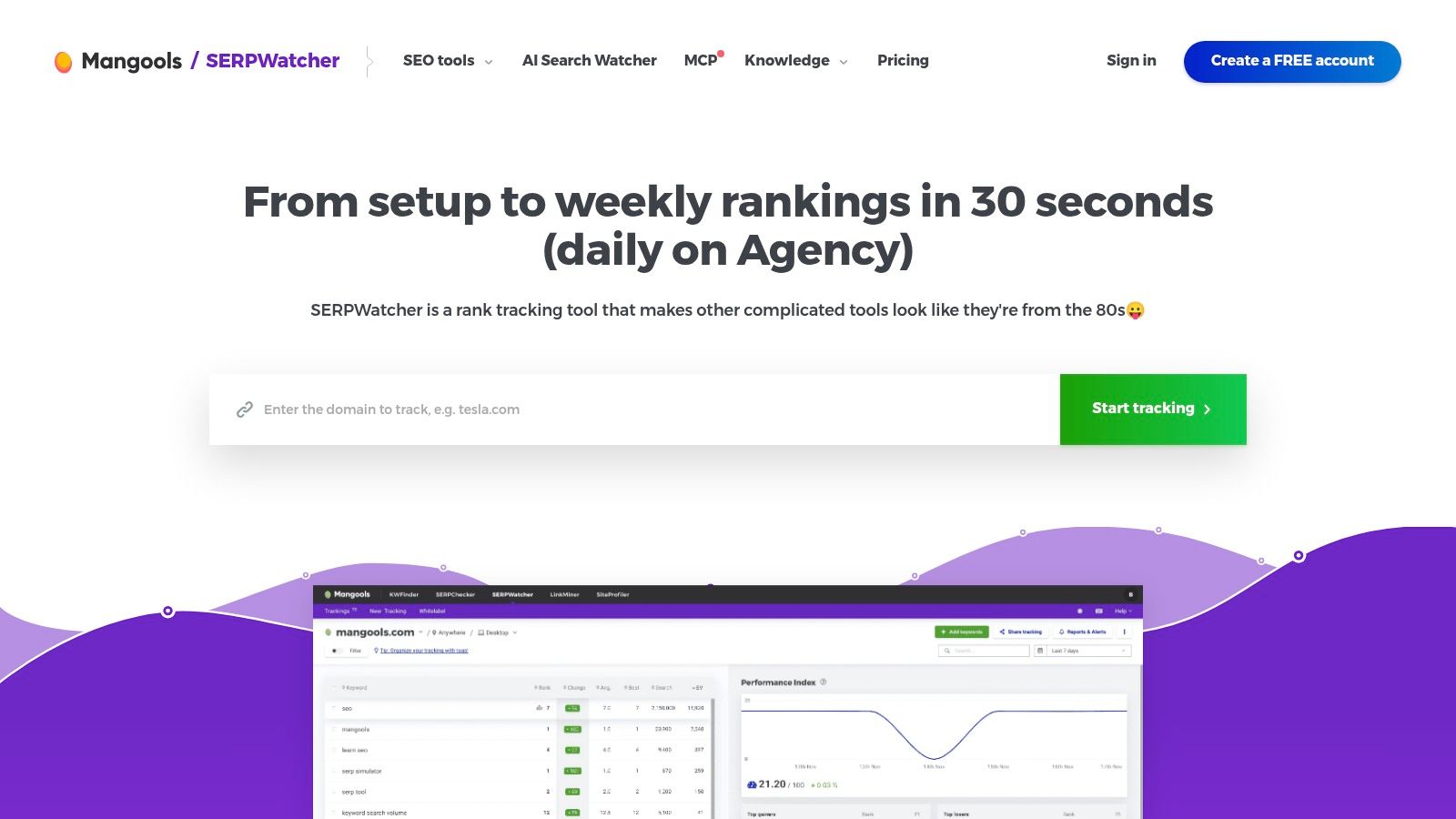
SERPWatcher is the friendly option for small businesses that want to understand rankings without needing a diploma in dashboard archaeology. It gives you weekly updates by default, with daily updates on higher tiers, plus city-level localisation and a visibility or performance-style index that helps summarise progress. For a sole trader or small practice, that's often enough to keep tabs on whether the site is moving in the right direction.
The interface is one of its biggest selling points. It's easy to share, easy to read, and hard to overcomplicate. That matters because a lot of local businesses don't need more data, they need better decisions. If your accountant, practice manager, or office manager can glance at the report and understand it without a ten-minute briefing, the tool has done its job.
It's not built for deep enterprise work, and that's fine. Not every tool needs to act like it's about to run the London Stock Exchange. If you want a simple rank tracker that helps you stay on top of local movement and communicate results clearly, Mangools earns a place.
Pros
- Very easy to use.
- Clear dashboards and shareable reports.
- Good entry point for smaller budgets.
Cons
- Fewer enterprise features than larger platforms.
- Daily updates require a higher plan.
For a light, manageable approach, Mangools SERPWatcher does the job without making a song and dance about it.
Top 10 SEO Ranking Checker Comparison
| Solution | Core features | UX / Quality (★) | Price / Value (💰) | Target audience (👥) | USP (🏆 / ✨) |
|---|---|---|---|---|---|
| DigiVisi, SEO Packages for Small Businesses | Audits, competitor reverse‑engineering, technical/on‑page/off‑page/local, monthly E‑E‑A‑T content, GBP fixes, tracking | ★★★★ Transparent reporting, personalised video audit | From £360/mo incl. VAT 💰 | UK small service‑led businesses 👥 | 🏆 Data‑first reverse‑engineering, ✨ proprietary in‑house tools, no contracts |
| Semrush, Position Tracking | Daily rank tracking, device & multi‑location/postcode splits, SERP‑feature monitoring | ★★★★ Reliable daily updates, clear limits | Tiered plans; advanced features on higher tiers 💰 | SMBs → agencies wanting all‑in‑one SEO 👥 | 🏆 Full SEO suite, ✨ AI search visibility on newer plans |
| Ahrefs, Rank Tracker | Desktop/mobile across 190+ countries, SERP features & AI Overviews, competitor trend charts | ★★★☆ Strong location filtering, weekly default updates | Higher‑tier pricing for full capabilities 💰 | Teams needing backlink + keyword depth 👥 | 🏆 Deep backlink & keyword data, ✨ API & integrated reporting |
| AccuRanker | Daily + on‑demand refreshes, Share of Voice, local pack & GBP matching, Looker Studio connector | ★★★★★ Fast, accurate local data | Scales with keyword volume; can be pricier at scale 💰 | Agencies needing granular UK/local tracking 👥 | 🏆 On‑demand accuracy, ✨ native Looker Studio & API |
| SE Ranking, Rank Tracker | Daily checks, Local Pack & Grid, AI Results Tracker, Looker connector | ★★★★ Value‑focused, easy onboarding | Competitive pricing; add‑ons for higher limits 💰 | SMBs & agencies on budget 👥 | ✨ AI Results Tracker, 🏆 strong price/features balance |
| BrightLocal, Local Rank Tracker | City/postcode Local Pack tracking, grid views, citations & reviews, roll‑up reporting | ★★★★ Purpose‑built local UX | Pricing rises with number of locations 💰 | UK local & multi‑location businesses, agencies 👥 | 🏆 UK‑centric local SEO, ✨ GBP optimisation tools |
| Nightwatch | Multi‑location/local pack, Looker Studio, GA/GSC integrations, scheduled exports | ★★★★ Flexible reporting & segmentation | Tiered, agency‑friendly pricing 💰 | Agencies needing flexible reporting & UK precision 👥 | ✨ Strong Looker Studio & integrations, 🏆 no per‑seat fees on listed tiers |
| Advanced Web Ranking (AWR) | Large‑scale keyword tracking, white‑label dashboards, Share‑of‑Voice, multi‑market support | ★★★☆ Deep reporting; interface can feel heavy | Enterprise/scalable pricing 💰 | Agencies & multi‑market campaigns 👥 | 🏆 White‑label & automation at scale, ✨ multi‑market depth |
| STAT Search Analytics (by Moz) | Daily ranks at scale, SERP features, granular locations, robust API for big data | ★★★★ Enterprise‑grade daily freshness | High entry cost; enterprise value 💰 | eCommerce & large/multi‑location brands 👥 | 🏆 Built for high‑volume SEO, ✨ powerful API & integrations |
| Mangools, SERPWatcher | Weekly (daily on higher tiers) updates, city‑level tracking, visibility index, shareable reports | ★★★ Beginner‑friendly, simple dashboards | Cost‑effective entry point 💰 | Small businesses / early‑stage SEO 👥 | ✨ Easy to use & share, 🏆 wallet‑friendly for starters |
From Numbers to New Enquiries: Your 30-Day Ranking Tracker Workflow
A ranking tracker is useful only if it changes what you do next. For a UK service business, the first 30 days should be about setting a calm routine, not checking every ten minutes like it's a tracking parcel. Start with the pages that win work, your main service pages, your location pages, and the Google Business Profile-linked queries that bring in calls and forms. Then watch the movement on those pages weekly, not every time a competitor posts a new blog about “ultimate tips” and other nonsense.
Each week, look at current position, location split, device split, and the ranking URL. If the right page is rising for the right query, keep going. If the wrong page is ranking, that's a content and internal linking problem. If rankings improve but enquiries don't, the issue is probably the page itself, the call-to-action, or the user's trust level, not the checker.
A good rhythm for most UK plumbers, dentists, solicitors, and accountants is simple. Check the tracker once a week. Review grid or local pack data if the business depends on map visibility. Refresh the audit monthly. Then spend the rest of your time on fixes that matter, such as title tags, on-page content, schema, internal links, mobile usability, and Google Business Profile consistency. That's the white-hat route, and it tends to survive contact with reality.
Use a grid or local-pack tool when local intent is clearly deciding who gets the click. Use a broader platform when you need competitor trends, device splits, or AI visibility signals. Use a spreadsheet and a cup of tea when the data is steady and you just need to stop fiddling. A dashboard is not a lifestyle choice.
If you'd rather not stitch all this together yourself, DigiVisi is the sensible handoff. It combines position tracking with audits, competitor analysis, content work, and local SEO fixes, then ties it back to calls, enquiries, and sales. Rankings are only the middle of the story. The prize is a warmer phone and fewer quiet afternoons.
For a broader view of how to judge whether your site is doing its job, read the measure website success guide. Then check your rankings properly, make the fixes that count, and stop giving position 9 a spiritual crisis.
DigiVisi Ltd helps UK service businesses turn ranking data into actual leads, with SEO packages built around audits, position tracking, competitor analysis, local SEO, and monthly content that supports visibility and enquiries. If you want a website SEO ranking checker workflow that ends with calls, not just charts, visit DigiVisi Ltd and see how the team ties rankings to real commercial growth.