Skip to content
Most advice on travel SEO services gets this badly wrong. It tells operators to write a few destination guides, chase some links, and wait for bookings to roll in, as if a holiday business were a charming little blog with a booking form attached. In practice, travel search is where people compare, question, shortlist, and only then commit, which means SEO has to behave like a sales channel with page-level jobs, not a content hobby with a seasonal tan.
For UK operators, that matters more than most realise. Screaming Frog's 2024 Travel SEO Industry Report found some major travel brands saw over 73% of their traffic coming from search engines, while Booking.com received well over 84.6 million visits per month from search. The same report also noted that 49% of hoteliers believed social media was one of the most important booking channels, yet social media contributed only 1.75% of traffic to the main travel sites on average, which is the sort of gap that should make any sensible operator raise an eyebrow (Screaming Frog Travel SEO Industry Report).

A good travel site doesn't ask every page to do the same job. A Birmingham tour operator needs pages that bring in local enquiries, comparison pages that help hesitant searchers choose, and booking pages that convert once intent is strong. The businesses that treat SEO as a direct line to calls, enquiries, and bookings usually stop losing to the ones still writing evergreen fluff about “Top 10 Things To Do in Somewhere Nice”, which, frankly, Google has seen a few times before.
Table of Contents
- Why Travel SEO Is Not Just Destination Guides
- What Travel SEO Services Cover
- The Technical Layer Most Travel SEO Advice Skips
- Local SEO for UK Travel Operators and Multi-Location Brands
- How Travel SEO Services Are Priced in the UK
- Measuring ROI Beyond Traffic and Rankings
- A Realistic Travel SEO Case Study Walkthrough
- How to Evaluate and Hire a Travel SEO Agency
Why Travel SEO Is Not Just Destination Guides
The old advice says travel businesses should publish more destination guides and gather a few backlinks. That's tidy, easy to repeat, and only partly useful. A travel buyer doesn't move in a straight line from curiosity to checkout, they bounce between inspiration, comparison, reassurance, and the final “right, let's book it then” moment, sometimes over several sessions and several tabs.
Search is the discovery layer
The UK market is not casual about travel research. Screaming Frog's travel report notes that an ABTA survey found 21% of respondents had high confidence in travelling, up from 15% in 2023, which suggests a stronger appetite for planning and comparison (Screaming Frog travel SEO report). More confidence usually means more searching, more comparing, and more opportunities for the right page to show up at the right time.
That's why travel SEO services should be judged by what they do commercially. A guide can support discovery, certainly, but a well-built service page, a local landing page, or a booking-ready itinerary page is often the thing that turns a searcher into a lead. The page role matters as much as the keyword.
Practical rule: if a page can't clearly answer whether it should create awareness, capture comparison traffic, or convert a booking, it probably hasn't been planned properly.
The commercial lens is the useful one
A travel operator in Leeds doesn't need fifteen thin posts about “best family holidays”. They need one page that brings in family holiday searchers, one that handles destination questions, and one that gives the office a chance to earn the call. The same applies to a small coach tour company in Bath or a multi-location airport transfer business in Manchester. Search intent changes, but the commercial target doesn't, it's still calls, enquiries, and bookings.
The strongest travel sites usually map keywords to page roles instead of publishing because the content calendar looks empty. That means service pages for conversion, comparison pages for decision-making, FAQ pages for objections, and local pages for nearby or location-specific searchers. It's less glamorous than “build a content empire”, but it tends to produce more actual business, which is a useful side effect.
What Travel SEO Services Cover
A decent travel site works like a high-street agency. The window pulls people in, the layout helps them compare options, the local sign outside tells nearby searchers where to find you, and recommendations from elsewhere build trust before anyone picks up the phone. Travel SEO services should cover all four, because a channel that only wins clicks but not enquiries is just busywork with a dashboard.
The four pillars in plain English
Technical SEO is the shop window. If the site loads slowly, hides content in scripts, or confuses Googlebot, plenty of searchers will never see the offer properly. On-page SEO is the layout, the words on service pages, destination pages, FAQs, and internal links that help search engines and humans understand what matters. Local SEO is the sign outside, especially for UK travel operators with a physical base or multiple branches. Off-page SEO is the word-of-mouth bit, including links, mentions, and credible listings.
A competent package usually includes technical audits, keyword and competitor research, service-page optimisation, internal linking, schema markup, citations and NAP fixes, reporting, and position tracking. The stronger work also aligns monthly content with E-E-A-T, which matters more in travel than in many sectors because people want signs that the writer knows the difference between a brochure and a real experience.
White hat versus the cheap-and-nasty version
White-hat work builds visibility that lasts. Grey-hat work cuts corners, usually by leaning too hard on scaled content, dodgy links, or template pages with almost nothing to say. Black-hat work is the sort of thing that ends with a nice little ranking collapse and a very awkward call.
The practical test is simple. Ask what the agency does when a booking engine is hard to crawl, when multiple locations need unique pages, or when citations are messy. If the answer sounds like “we'll add more keywords and hope for the best”, that is not strategy, it is optimism in a blazer.
If you want a useful benchmark for how a service page cluster can be structured, the vacation rental playbook at Global's property marketing resource is a decent reminder that search intent, page type, and commercial outcome should match each other instead of just co-existing politely.

A solid brief should also define content ownership, internal linking rules, and what counts as success. If a supplier says they do “everything SEO” but cannot explain how a Birmingham city tour page differs from a national inspiration blog, they are probably selling a bundle rather than solving a business problem. That tends to be fine for their invoicing, less so for yours.
The Technical Layer Most Travel SEO Advice Skips
Travel sites are often beautiful, and beautifully heavy. High-resolution imagery, booking engines, filters, calendars, and review widgets all add friction, and Google doesn't award bonus points for artistic suffering. Independent travel-SEO guidance recommends LCP under 2.5 seconds, INP under 200ms, and CLS under 0.1 as practical Core Web Vitals targets, because image-heavy travel pages and booking widgets are classic offenders (Percepture guidance on travel websites).
Dynamic booking systems are the real battleground
The awkward bit is not just speed. JavaScript-rendered booking engines can hide itinerary details, pricing, or availability from crawlable HTML, which means Google may not see the very information searchers care about most. Faceted navigation can create duplicate or near-duplicate URLs, and canonical mistakes can scatter authority across versions of the same page like a group of tourists trying to find a coach in a rainstorm.
Practical rule: if a booking detail only exists after a user clicks around for a while, assume search engines may struggle with it too.
The technical checks that matter most are straightforward. Audit whether booking calendar pages are indexable, whether schema is present for availability and pricing, whether pagination and canonical tags are clean, and whether redirects are doing anything daft. Also check that mobile pages aren't carrying mixed content warnings on the checkout flow, because trust drops fast when a secure journey looks half-finished.
A quick self-audit before you brief anyone
- Render test the money pages: open itinerary, pricing, and location pages with JavaScript disabled, then see what's left.
- Check duplicate variants: look for the same destination or package appearing under multiple URLs.
- Inspect internal links: make sure important booking pages aren't buried behind filters with no crawl path.
- Review schema output: confirm the markup reflects the page, not just a template dream.
- Test mobile speed: image compression, lazy loading, and widget behaviour matter more than another paragraph about adventure.

A lot of agencies never get this far because it's less charming than writing another blog outline. Yet if the booking system is awkward to crawl, every content improvement lands with a bit of a thud. Fix the plumbing first, then worry about the curtains.
Local SEO for UK Travel Operators and Multi-Location Brands
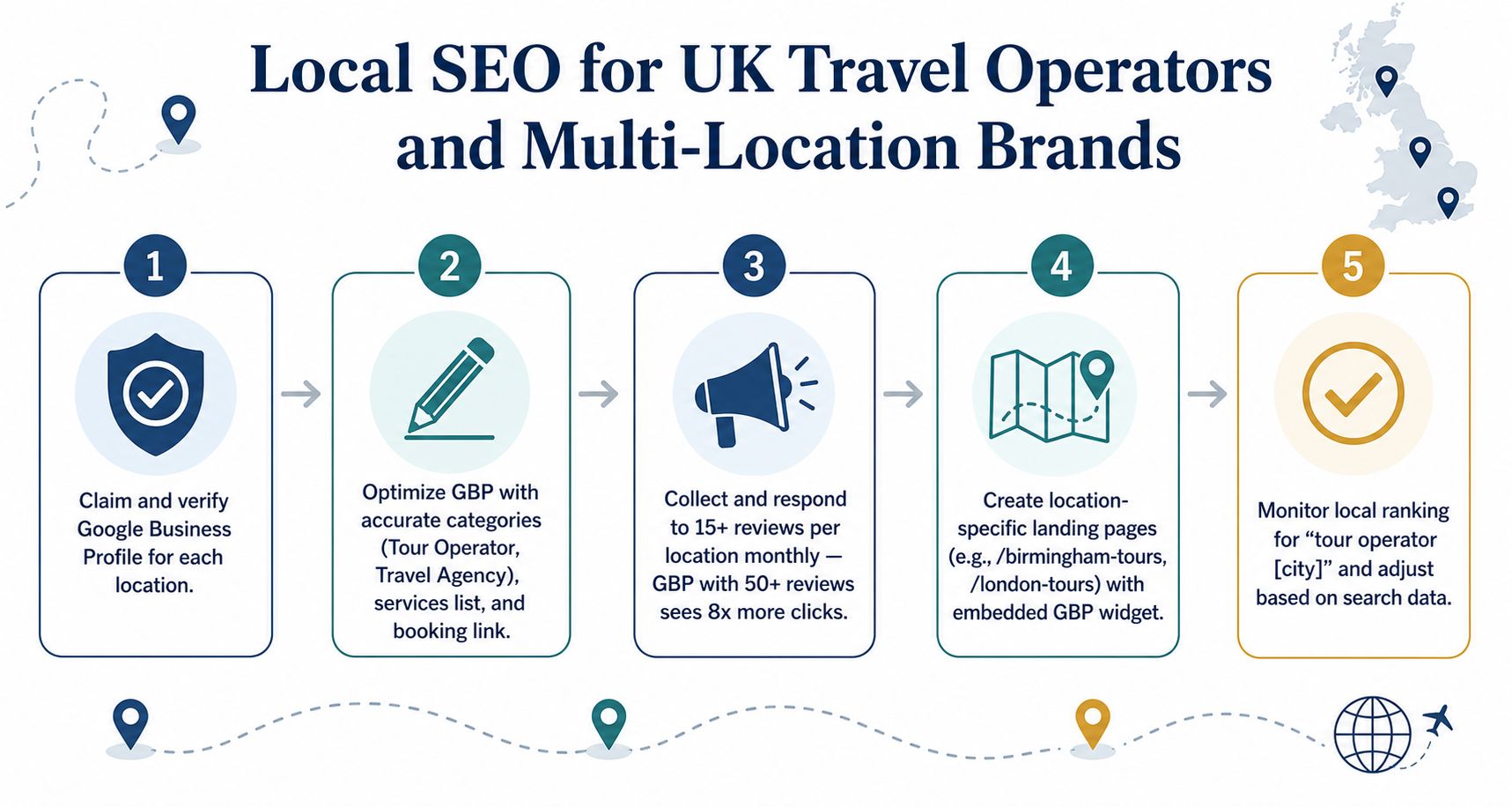
A Birmingham tour operator does not need global visibility to win. It needs to appear when someone nearby searches for a tour, a local holiday service, or a city-based travel agency, and that makes local search the commercial workhorse. For UK travel operators, the highest-impact foundation is usually a Google Business Profile for each location plus strict NAP consistency across every citation and location page (SEOProfy travel SEO guidance).
Build each location as a real local asset
If a business has branches in Birmingham and Coventry, each location page needs its own purpose, not a copied paragraph with the city name swapped in like a ransom note. The page should reflect the catchment area, the services offered there, opening hours, and area-served details, and it should be written in readable HTML rather than hiding key text inside images or widgets. Local schema helps here, but only if the page already makes sense to a human.
A multi-location brand also needs consistent naming, addresses, and phone numbers everywhere they appear. If one profile says “Unit 4, High Street” and another says “High St., Unit Four”, it's not chaos, but it's the sort of inconsistency that makes tidy data less tidy. Google Business Profile entries should use the same core details as the site, and the same logic should apply to citations, directories, and contact pages.
Seasonal planning matters more in travel than in most sectors
Travel demand moves with the calendar, so content calendars need to stop pretending every month is equal. A summer itinerary needs to be live before people start searching for it in anger, and winter or ski-related content should not be published after the first snow has already turned the market's head elsewhere. For a smaller operator, shoulder-season queries are often where the easier wins sit, because larger brands tend to crowd the obvious terms and ignore the slightly awkward ones.
For a Birmingham tour operator, that might mean pushing local day trips in spring, family packages before school-holiday planning kicks in, and giftable experiences in the darker months when people start buying things rather than spreadsheets. The trick is to match content timing to search timing, not to the date in the content meeting. That alone saves a surprising amount of busy work.
For a practical example of location-led search behaviour in travel content, the hostel guide to Edinburgh sights shows how local relevance can be made useful without turning into a keyword dump. That's the standard to aim for, helpful first, searchable second, and not the other way round like so many gloomy directory pages.
How Travel SEO Services Are Priced in the UK
Travel SEO pricing usually falls into three buckets, and each one suits a different stage of business. Retainers are the usual choice for ongoing travel SEO services, project fees suit audits or migrations, and performance-based arrangements sound neat until someone starts arguing about which keyword paid for the booking. In practice, you are paying for different kinds of risk, continuity, and accountability.
Retainer, project, or performance
| Model | Typical UK Monthly Band | Best For | Trade-off |
|---|---|---|---|
| Monthly retainer | Ongoing monthly fee | Businesses that need continuity, content, technical maintenance, and local visibility | Keeps momentum, but ties up budget |
| Project-based fee | One-off scoped fee | Audits, migrations, site rebuilds, or a defined technical clean-up | Good for a snapshot, but nothing stays maintained unless you keep paying |
| Performance-based arrangement | Variable fee linked to agreed outcomes | Operators that want incentives tied to results | Can align goals, but can also reward the wrong metric if the targets are sloppy |
A tightly scoped retainer usually fits an early-stage tour operator better than anything else, especially if the business needs local SEO, service-page work, and a clean reporting rhythm. A multi-location brand tends to need a hybrid approach, because one-off fixes won't hold if the site keeps changing under pressure from branches, seasonal campaigns, and booking updates. That is especially true for dynamic booking systems, where technical debt tends to sit until an indexation problem, duplicate content issue, or broken template starts chewing through revenue.
The pricing conversation changes fast once the site has moving parts. An SEO team may be asked to work around booking engines, filtered search pages, location pages, and availability feeds, all while keeping the commercial pages usable for searchers and staff. That usually means more time spent on technical coordination than on pretty content calendars, which is rarely the bit that gets mentioned in the sales call.
If you want a broader sense of how UK SEO pricing is commonly framed, the overview at Digivisi's UK SEO cost guide is useful as a market reference point. The right question, though, is never just “what does it cost?”, it's “what gets maintained after month one?”
The cheapest quote often excludes the boring parts, which are usually the parts that matter. Technical fixes, content updates, local listings, and reporting are not glamorous, but neither is explaining to the boss why a temporary lift disappeared the moment the project ended. If the agency cannot show how it will measure essential satisfaction metrics alongside leads and bookings, expect a report full of vanity signals and very little commercial value. Funny how that keeps happening.
Measuring ROI Beyond Traffic and Rankings
Traffic is nice. Rankings are pleasant. Neither pays the bills on its own, and travel operators know that better than most because the commercial value sits in calls, enquiries, and bookings. The useful habit is to map keyword clusters to page roles, then decide which page is supposed to do what before anybody starts celebrating impressions.
Match intent to the right page type
Travel search behaviour usually falls into a few buckets. Dreaming queries sit at the top, comparison queries sit in the middle, booking-ready and local service queries sit closest to revenue. A blog post can attract dreamers, a comparison guide can help with decision-making, and a service page or Google Business Profile can turn that attention into contact.
A Birmingham tour operator, for example, shouldn't ask one blog post to handle every stage. A destination article can feed the funnel, a comparison piece can answer objections, and the service page should carry the call-to-action. That structure gives the reporting a far clearer story than “sessions went up a bit”, which is about as useful as a chocolate compass.
Useful test: if a keyword cluster doesn't have a page role assigned to it, you're measuring interest rather than commercial progress.
Track what matters to the business
Calls, enquiry forms, booking clicks, and map interactions should all be tracked where possible. That way, search terms can be judged against actual lead quality rather than vanity traffic. Recent travel SEO advice also leans heavily on separating informational intent from high-converting local intent, which is exactly the right instinct for service-led operators, because not every page that attracts visitors deserves to be praised for it.
For operators who want to watch customer experience alongside SEO, Hen Hideaways' customer satisfaction metrics resource is a sensible reminder that commercial outcomes and client experience should not be kept in separate rooms like quarrelling relatives.
The leading indicators worth watching early are page engagement, click-throughs from local profiles, and whether the right pages are starting to collect the right search terms. The point isn't to worship a dashboard. It's to know whether the work is steering enquiries in a direction the finance side can recognise.
A Realistic Travel SEO Case Study Walkthrough
A regional tour operator with multiple UK locations came in with a familiar mess. The site looked decent, the content was decent enough, and the booking flow was doing its best, which is often how trouble begins. The first technical audit found a JavaScript booking widget blocking 38% of itinerary pages, so search engines were struggling to see a chunk of the money pages properly.
The programme began with a crawl clean-up, a content sprint around destination and FAQ clusters, and a Google Business Profile overhaul for each location. NAP citations were cleaned up so every branch used the same details, and the link work focused on relevant UK travel press rather than a scattergun pile of generic directories, which are usually more decorative than effective.
At the three-month point, the early signal was improved visibility on the pages that mattered most, plus more calls from local profile actions. At six months, the operator had stronger qualified enquiries from location pages and better engagement on destination and FAQ content, which was the useful bit because it showed the site was attracting people with actual travel intent rather than curious browsers who'd wandered in for a look.
What moved the dial wasn't one clever trick. It was the boring sequence done properly, technical fixes first, page roles made clear, local signals tidied, and content aimed at the questions people really ask before they book. Travel SEO has a habit of rewarding the operators who stop chasing novelty and start removing friction.
How to Evaluate and Hire a Travel SEO Agency
A sensible sales meeting should sound less like a pitch and more like an investigation. Ask for sample audits, reporting cadence, link sources, AI exposure strategy, and explicit confirmation of white-hat methods. If the answers are vague, or if the first thing you hear is “we'll get you ranking quickly”, that's your cue to keep the tea warm and the wallet closed.
Questions worth asking
- Audit depth: Can they show how they handle JavaScript booking systems, faceted navigation, and duplicate URLs?
- Measurement: Do they track calls, enquiries, and bookings, or only traffic and rankings?
- Content strategy: Do they map keyword clusters to page roles, or just promise more blogs?
- Local work: Can they explain Google Business Profile optimisation and NAP consistency for multi-location businesses?
- Link approach: Where do links come from, and can they name the types of sites involved?
- AI exposure: Do they build pages that can be cited and understood, rather than chasing gimmicks?
A credible first 90 days should include a proper audit, a clear priority list, fixes to the pages closest to revenue, and reporting that explains business movement in plain English. The first 30 days should feel like analysis and triage. If the plan is mostly “publish four articles and wait”, that's not a strategy, it's a lullaby.
For UK operators wanting a structured service, DigiVisi Ltd offers SEO packages that include technical, on-page, off-page, and local optimisation, plus keyword and competitor research, service page work, schema, citations, NAPW fixes, and monthly content aligned to E-E-A-T and AI exposure. That's the kind of scope that makes sense when the goal is better visibility turning into genuine calls and enquiries, not just prettier charts.
Red flag: if an agency won't talk openly about what they won't do, especially around grey-hat shortcuts or outsourced link schemes, they're asking you to trust the wrong part of the process.
If you want a travel SEO partner that thinks in terms of enquiries, bookings, local visibility, and the technical mess behind booking systems, speak to DigiVisi Ltd. They work with UK service-led businesses that need SEO to behave like a revenue channel, not a decorative report, and they can help you build a search plan that matches how travel customers buy.