Skip to content
Most advice on how to improve domain authority starts in the wrong place. It tells a local business owner to chase a bigger score, collect backlinks by the bucketful and celebrate when a third-party tool awards a few extra points. That's a tidy report, but it isn't a marketing strategy, and it certainly doesn't guarantee more calls for a Bristol plumber or enquiries for a Leeds accountant.
Google dominates UK search, holding 91.56% of UK search traffic in July 2026, while official UK competition findings say it handles more than 90% of general search queries (UK backlink statistics). That makes authority important, but genuine authority comes from being crawlable, relevant, useful and trusted, not from pleasing one software dashboard.
Table of Contents
- Why Domain Authority Might Be the Wrong Goal
- Running a Technical and On-Page Authority Audit
- Building Internal Links That Actually Pass Authority
- Earning Backlinks and Digital PR Placements That Count
- Strengthening Local Authority Through Google Business Profile
- Measuring Progress and Setting Realistic Timelines
Why Domain Authority Might Be the Wrong Goal
Domain Authority, usually shortened to DA, is a third-party Moz metric designed to estimate how likely a website is to rank. Google doesn't use Moz's DA score as a ranking factor. Other platforms calculate their own versions of authority too, which means the same website can receive different scores depending on the tool and its backlink database.
That doesn't make DA useless. It can help you compare your site with direct competitors, sense-check a potential link opportunity and monitor broad backlink growth. The mistake is treating it as the destination. A higher score may correlate with stronger rankings because both can reflect reputable links and useful content, but correlation isn't causation.
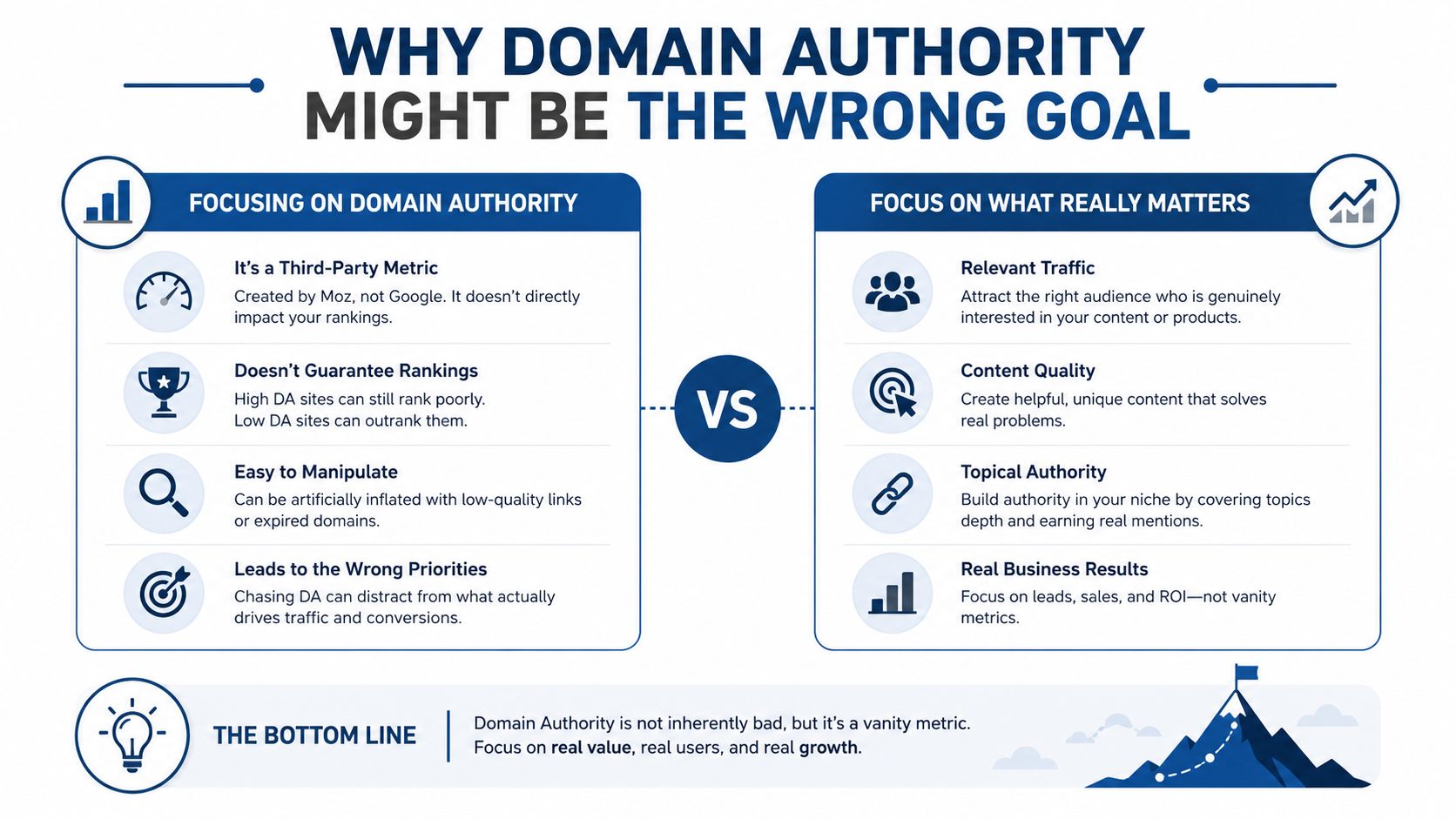
A small service business should ask a sharper question: which searches bring commercially useful visitors, and what prevents the site from winning them? For a Manchester heating engineer, that could mean boiler repair searches, emergency callouts and service-area queries. A modest authority profile with a technically sound website and strong local relevance can outperform a larger-looking score attached to a poorly organised site.
Practical rule: Use DA as a comparative diagnostic, never as your chief business KPI.
The UK SEO and internet marketing consultancy market was estimated at £24.6 billion in 2025–26, following five years of 6.6% compound annual growth (UK backlink statistics). Authority-building has become a serious commercial discipline, but that also means more businesses are sold shortcuts dressed up as strategy. Buying bundles of unrelated links may make a spreadsheet look busy while leaving your service pages, local profile and conversion journey untouched.
Real search authority has several parts:
- Technical trust: Google can discover, crawl, understand and index the important pages.
- Editorial credibility: Other relevant websites choose to reference your expertise.
- Topical usefulness: Your content answers real customer questions and supports service pages.
- Local prominence: Your business presents consistent information and credible evidence across local search platforms.
- Commercial relevance: The pages attracting visibility make it easy to enquire.
That's the standard worth pursuing. The score can follow along behind, like a slightly late train.
Running a Technical and On-Page Authority Audit
Before pursuing backlinks, confirm that your website can receive and use their value. Link equity cannot help a page search engines cannot crawl, a URL that should not be indexed, or a service page buried in a digital cupboard.
Start with crawlability and indexation
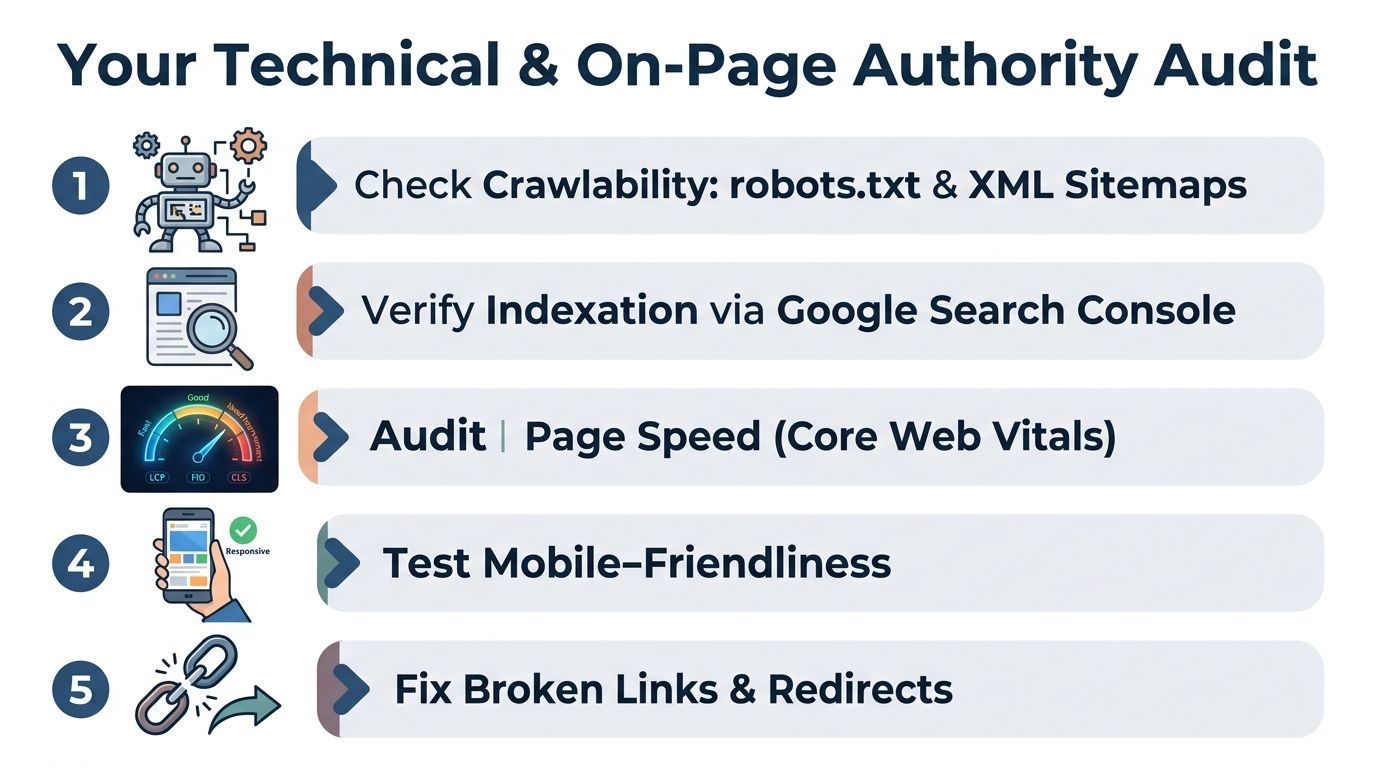
Open robots.txt and check that important service, location and resource pages are not blocked. Review the XML sitemap, remove obsolete URLs, then submit the clean version through Google Search Console.
Inspect priority URLs individually in Search Console. Check for excluded pages, duplicates, redirects, and URLs discovered but not indexed. A local tradesperson may leave dozens of old service variations online after changing their offer. Those pages create clutter, compete with each other and make the site's main topics harder for Google to interpret.
Use Screaming Frog or Sitebulb to crawl the website and export:
- Broken internal links: Replace links leading to missing pages.
- Redirect chains: Point old URLs directly to the final destination.
- Orphan pages: Add relevant internal links or remove pages with no useful purpose.
- Duplicate titles and descriptions: Write unique metadata that reflects each page.
- Thin content: Improve useful pages or consolidate overlapping ones.
- Canonical problems: Confirm the preferred version of each page.
HTTPS, mobile usability and Core Web Vitals belong in the same audit. Someone searching for an emergency electrician will not patiently wrestle with a broken mobile menu or wait for a bloated image to load. Technical polish improves usability while helping search engines understand the site.
For a workflow covering commercial pages, local signals and authority improvements, consult the Transactional LLC local SEO playbook. A focused local SEO audit can also expose problems affecting local visibility.
Make every important page earn its place
A service page needs one clear purpose, a sensible title, useful copy, a straightforward contact route and evidence that the business understands the work. Avoid near-identical pages for every nearby town unless each one offers genuine local value.
A boiler engineer serving Nottingham might consolidate overlapping pages about “boiler repairs Nottingham”, “boiler servicing Nottingham” and old seasonal offers, retaining separate pages only where search intent differs. Fixing indexation bloat gives Google a cleaner group of pages to assess and gives visitors fewer confusing routes to the same answer. The aim is genuine search authority, not a prettier DA score.
Building Internal Links That Actually Pass Authority
Backlinks attract attention, but internal links decide where much of your existing authority travels. They're free, quick to change and entirely under your control, which may explain why they're neglected. Business owners happily spend time hunting for a grand link while the homepage sends no useful signal to the page that earns enquiries.
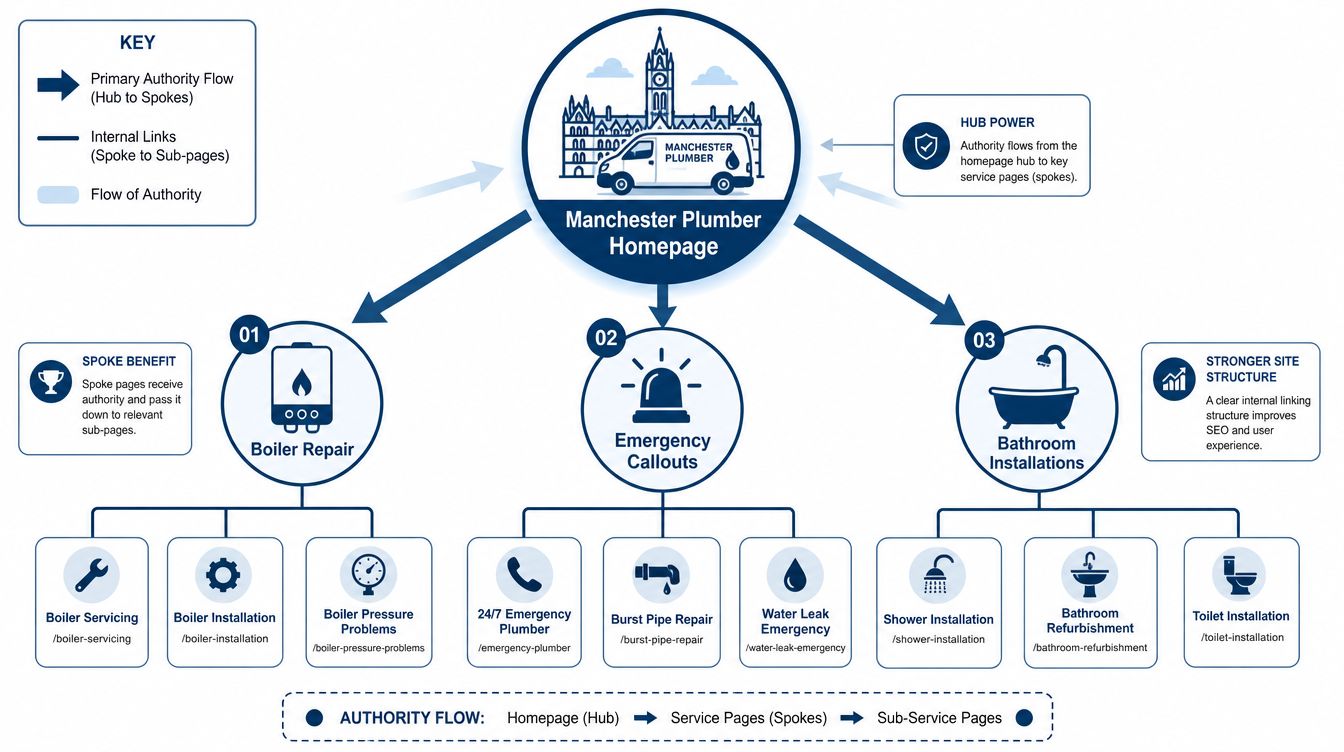
A practical structure is hub and spoke. Choose priority commercial pages as spokes, then connect them to strong hubs such as the homepage, authoritative guides and relevant blog content.
Build the map before adding links
A UK internal-linking guide recommends selecting 10 to 30 priority pages, identifying 5 to 20 relevant linking opportunities for each, and adding 2 to 5 contextual internal links from suitable existing pages before publishing new content (UK internal linking guide).
Take a Manchester plumbing company with three priority pages:
- Boiler repair: Supported by guides about warning signs, repair decisions and seasonal maintenance.
- Emergency callouts: Supported by content about burst pipes, leaks and urgent shut-off steps.
- Bathroom installations: Supported by planning, fittings and renovation guidance.
Before restructuring, the homepage might link only to “Services”, while blog posts link randomly to one another. After restructuring, the homepage links directly to the three priority pages, relevant guides link to the matching service page and each service page links to closely related supporting content.
Use descriptive anchors, but write for people first. “Emergency boiler repair in Manchester” can be useful where it accurately describes the destination. Repeating the same exact phrase in every link looks clumsy and can make the copy read like it was assembled by a particularly nervous robot.
A UK technical SEO analysis reported 4.2× PageRank amplification on pages receiving internal links from 5+ high-authority referring-domain pages, compared with pages receiving none (UK internal linking analysis). Treat that as a reason to audit authority flow, not as permission to cover every paragraph in blue underlined confetti.
Keep relevance in charge
Link only where the destination helps the reader. Fix broken internal links, 3xx chains, orphan pages and URLs with very few internal links in bulk. Otherwise, authority can collect in popular blog content while commercial pages remain starved.
The site structure tips from Keyword Kick provide further guidance on organising hubs, spokes and supporting content. The best internal-linking map is usually simple enough to sketch on paper. If it needs a council planning application, it's probably over-engineered.
Earning Backlinks and Digital PR Placements That Count
A backlink earns its keep when it comes from a relevant, credible publication and gives the reader a reason to visit the destination. Raw link volume is a poor substitute for editorial judgement. Ten unrelated directory links won't necessarily help as much as a small set of relevant references from local news, industry publications, professional bodies or useful niche resources.
A UK-focused digital PR dataset reported that the average campaign earns links from 42 unique referring domains, with 82% followed (UK digital PR link-building statistics). The same dataset reports that UK digital PR demand increased by 330% over two years, which reflects the growing preference for newsworthy assets over bulk submissions.
The operational detail matters. One UK technical SEO guide cited by that dataset reports that 44% of digital PR campaigns target pages with technical issues that prevent full link equity consolidation. Check crawlability, redirects and canonicals before outreach, not after celebrating the placement.
Choose assets people can reference
A local accountant might publish a clear guide explaining common business finance questions, supported by relevant official information. A plumbing firm could offer expert commentary on winter maintenance, create a useful checklist or provide a local journalist with practical insight into a household problem.
Good outreach answers three questions quickly:
- Why is this relevant to the publication's audience?
- What original expertise or useful resource are you offering?
- Which exact page deserves the link?
Relevance beats a shiny authority score. A local article about housing maintenance is a natural fit for a tradesperson. A generic overseas coupon directory is not, even if its sales page promises “powerful authority”.
| Tactic | Effectiveness | Typical Cost | Risk Level |
|---|---|---|---|
| Editorial digital PR | Strong when the idea is genuinely useful or newsworthy | Depends on research, production and outreach effort | Low when earned naturally |
| Local news and community coverage | Useful for local relevance, trust and referral visibility | Usually manageable with a strong local story | Low |
| Relevant industry publication | Valuable when the subject and audience match | Often requires expert input and quality content | Low |
| Trusted UK citation or niche directory | Helpful when accurate and genuinely relevant | Often free or modest | Low to moderate |
| Low-quality directory volume | Weak and difficult to maintain | Cheap, but wasteful | Moderate |
| Private blog networks | Manipulative and unstable | Can become expensive to maintain | High |
| Paid link schemes | Risky when links are bought to manipulate rankings | Variable | High |
Avoid PBNs, undisclosed paid schemes and directory spam. They don't demonstrate expertise, and they can leave a business cleaning up someone else's shortcut. For a practical overview of SEO link building for stores, focus on the principles that transfer to service businesses too, particularly relevance, useful content and sensible outreach.
A healthy link profile includes different types of referring websites, not a pile of links from one network. Track the linking domain, topical relevance, target page, anchor text and whether the link brings referral visitors. If a placement would embarrass you when a customer clicks it, don't pursue it.
Strengthening Local Authority Through Google Business Profile
For a local service business, Google Business Profile authority can matter more than a raw domain authority score. A respectable website can still miss map-pack visibility when the profile is incomplete, the services are unclear or business details conflict across listings.
Google says local ranking is based on relevance, distance and prominence (Google's local ranking guidance). That framework is more useful than chasing a third-party score. A Bristol plumber needs to make the service, location and trust signals obvious, rather than win a medal from an SEO tool.
Complete the profile customers use
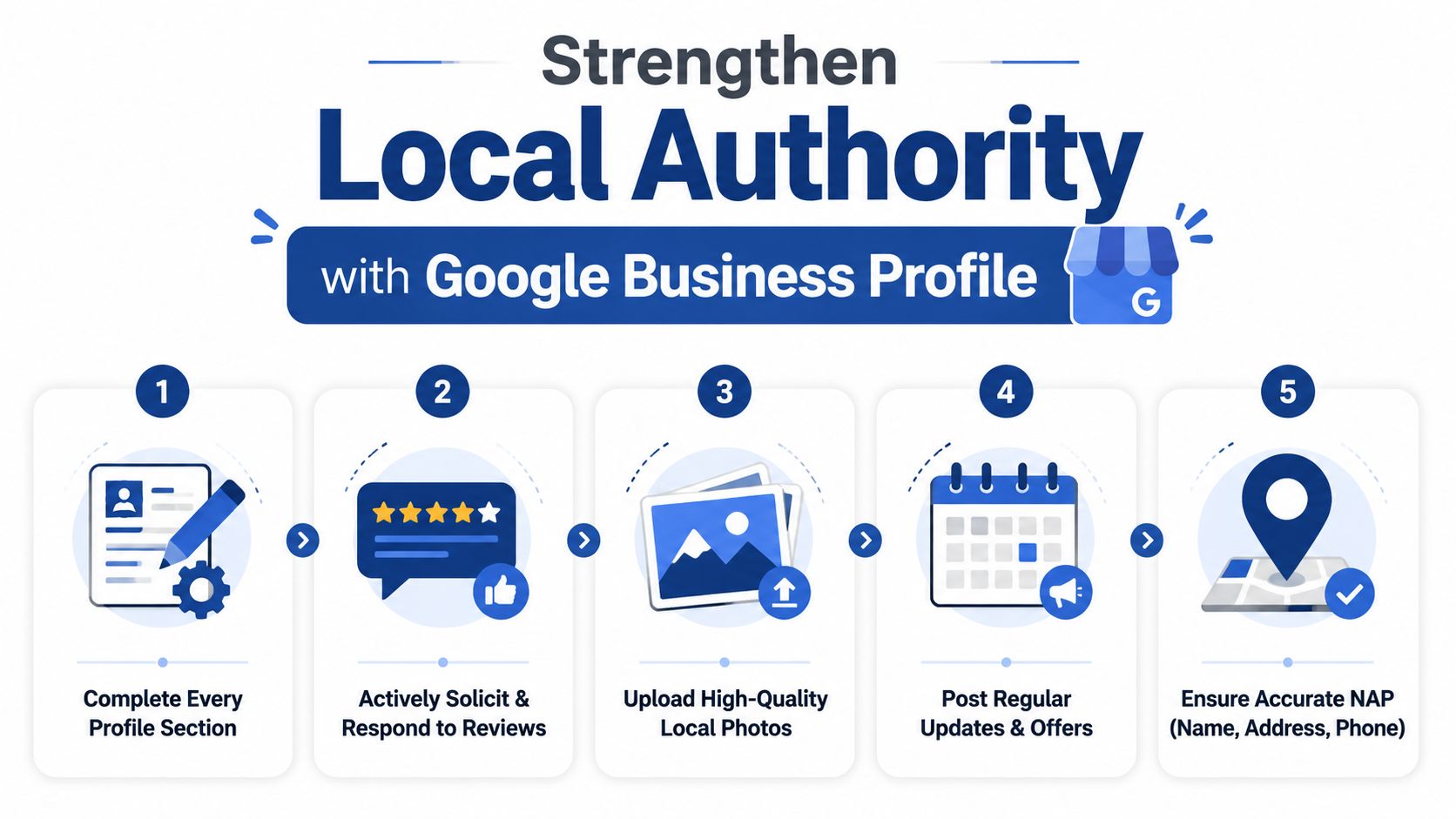
Choose the primary category that best describes the core service, then add accurate secondary categories where they fit. List services in plain language, define service areas carefully and complete every relevant field. Add genuine project photographs, not stock images of suspiciously spotless kitchens that nobody in Britain has ever cooked in.
Reviews need a repeatable process. Ask genuine customers at a suitable point, make the request easy and reply to positive and negative feedback with specific, professional responses. Never buy reviews, publish identical scripts or pressure customers into particular wording. Credibility comes from believable customer experiences, not a chorus of suspiciously similar “excellent service” comments.
Local profile guidance reports that complete profiles can receive 5x more views, that 70% of GBP views come from Maps, and that 84% of discovery searches are category or service-led rather than brand-led (UK local SEO statistics). The practical implication is straightforward: people often search for the service before they know the company name.
Make citations consistent
Citations are mentions of a business name, address and phone number on third-party websites. UK guidance stresses that your NAP must be identical across your website, Google Business Profile and citations (UK local SEO guide). A Leeds accountant should select one canonical format and use it everywhere, including punctuation and address details.
Audit old listings before creating new ones. Correct duplicate profiles, closed premises and outdated phone numbers, then prioritise trusted local and sector sources. .gov.uk and council websites can provide strong trust signals, while commercial directories vary considerably. Bing Places and Apple Business Connect can support local discovery too.
Citations are part of a consistent local identity, not a backlink collection exercise. Accurate details make it easier for customers and search systems to connect the business with the right service area.
Measuring Progress and Setting Realistic Timelines
Authority building is a compounding process, not a vending machine. Put in a backlink, press a button and receive three new enquiries would be lovely, but even the finest vending machine in Britain can't manage that.
Track outcomes in a fixed reporting view:
- Organic traffic: Monitor growth to service and location pages, not only the blog.
- Commercial rankings: Track terms that indicate a need for your service.
- Referring domains: Record relevant new websites and the pages they reference.
- Local visibility: Review profile actions, map visibility and discovery patterns.
- Organic enquiries: Measure calls, forms, booking requests and qualified leads.
Use Search Console for queries, impressions, clicks and indexed-page checks. Use analytics and call tracking to connect organic visits with enquiries. A DA score can sit in the report as a supporting comparison, but it shouldn't outrank revenue-producing evidence.
Work in phases
First, remove blockers. Fix indexation, crawlability, broken links, redirect chains, mobile usability and weak service pages. A healthy foundation makes every later activity more useful.
Next, improve authority flow. Rebuild internal links around priority services, connect supporting content to commercial pages and make important destinations easy for visitors and crawlers to find.
Then, earn credible mentions. Create assets worth referencing, pitch relevant local and industry publications, and maintain a steady relationship-led outreach process. Digital PR works best when the story is useful without the link.
Finally, strengthen local prominence. Complete the Google Business Profile, keep NAP details consistent, gather authentic reviews and maintain real local evidence through updates and project imagery.
A sole trader should prioritise tasks that can be completed consistently without abandoning the business itself. A small team with dedicated marketing resource can run technical monitoring, content production, digital PR and local profile management in parallel. In both cases, review progress over 3, 6 and 12 months, rather than judging the entire strategy after a few optimistic Tuesdays.
The right question isn't “How quickly can I raise DA?” It's “Which authority signal is currently weakest, and which fix can produce a better search experience and more qualified enquiries?” Answer that, then do the work in the right order.
DigiVisi Ltd helps UK service businesses strengthen technical SEO, internal linking, content, citations, backlink acquisition and Google Business Profile visibility through structured SEO packages and transparent reporting. Visit DigiVisi Ltd to discuss the authority and local search improvements most likely to turn better visibility into consistent enquiries.